
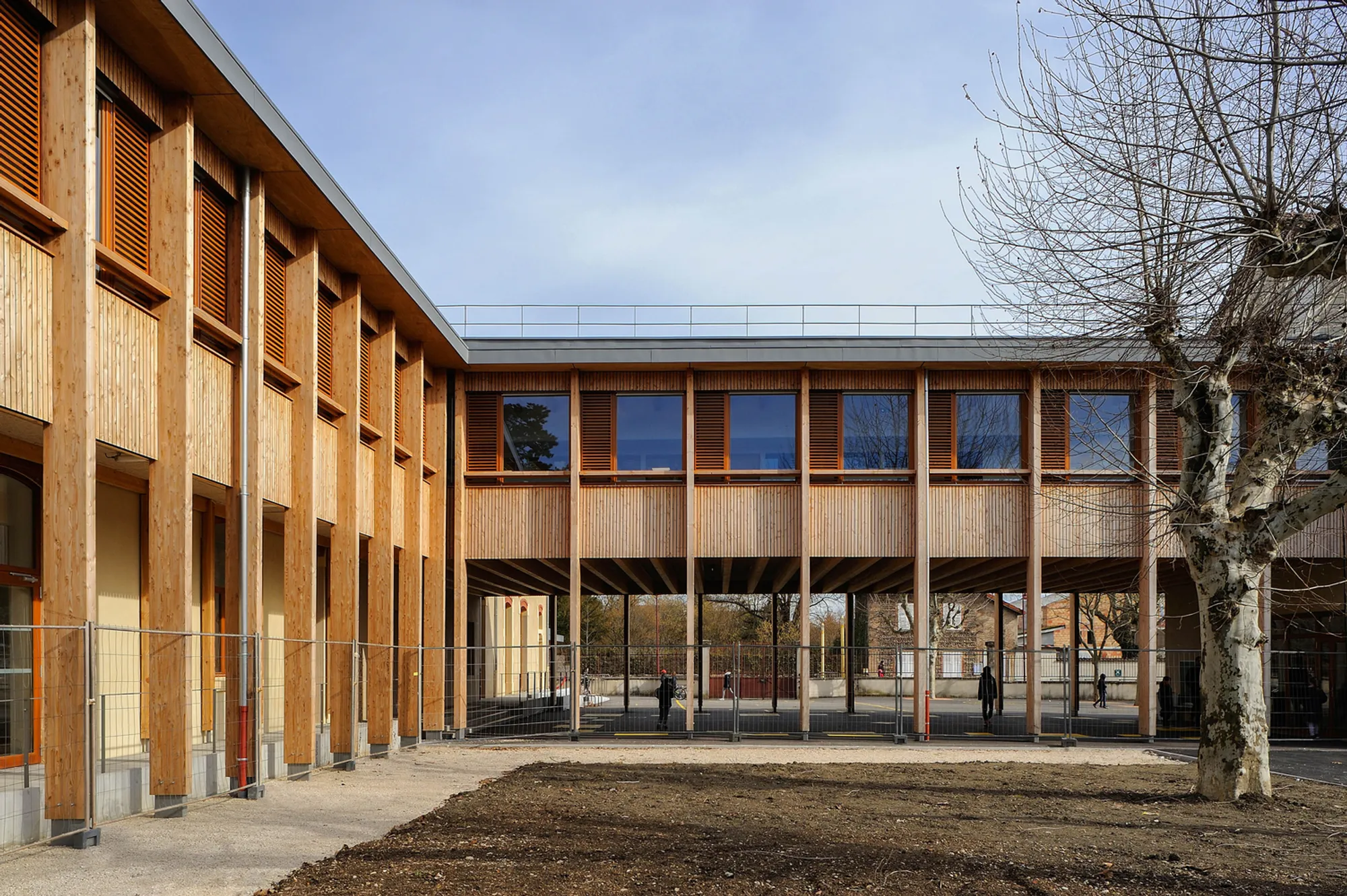
Elementary School at Le Grand Lemps, France by Brenas Doucerain Architectes
The Le Grand-Lemps Elementary School blends heritage preservation, sustainable design, and modern classrooms with wood structures, courtyards, green roofs, and open spaces.


A Sustainable Architectural Dialogue Between Heritage and Modernity
Reconnecting a Village Through Architecture
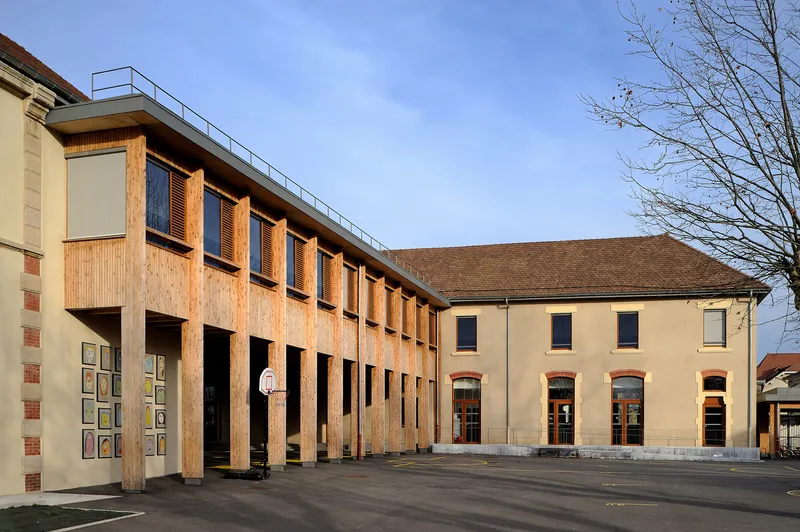
In the heart of Le Grand Lemps, a small French village nestled between heritage adobe buildings, Brenas Doucerain Architectes has created a thoughtful architectural intervention that redefines how educational architecture can harmonize with the past. The Elementary School at Le Grand Lemps (completed in 2020) establishes a bridge between tradition and modernity—literally and metaphorically—through a carefully composed wooden structure that unites two existing school wings around a central courtyard.
The project, led by architect Sonia Doucerain, emerged from a desire to reconnect a fragmented site. Instead of imposing new volumes, the design team worked with what was already there—adapting, optimizing, and preserving. As the architects describe, “like a fashion designer mending fabric,” the project delicately stitches together the historic textures of the village with a new architectural narrative.
Sustainable Design Meets Heritage Restoration
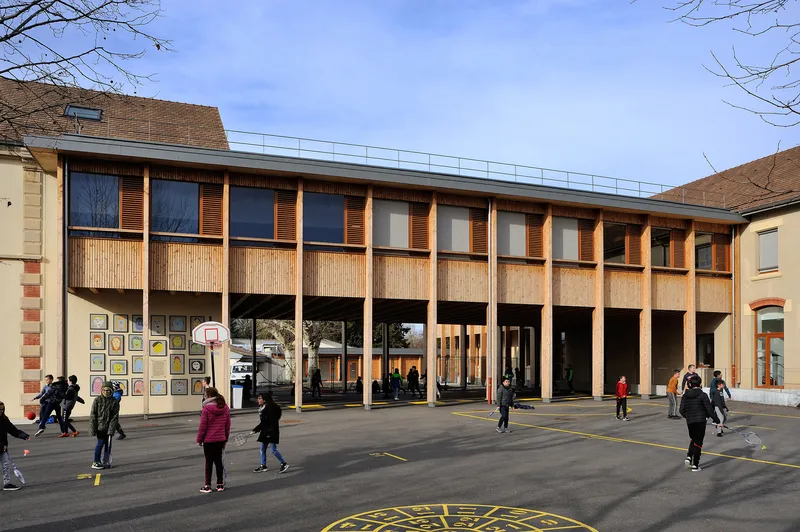
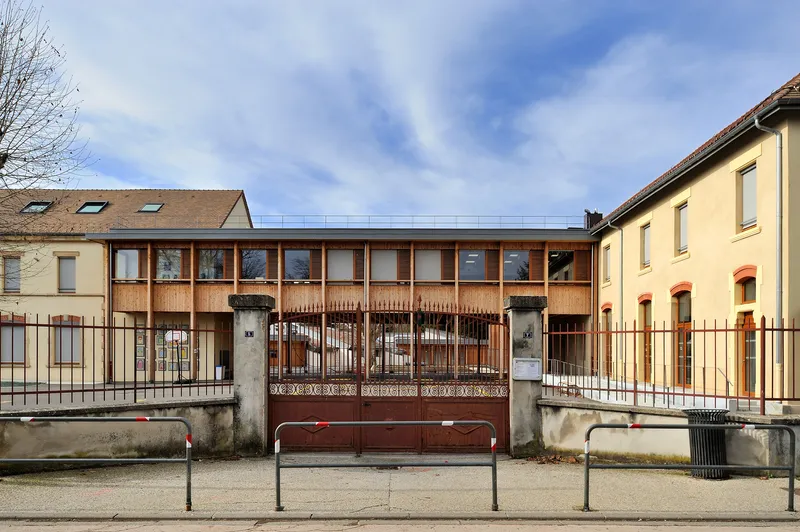
Nestled in the heart of Le Grand-Lemps, the Elementary School by Brenas Doucerain Architectes is a thoughtful blend of heritage preservation, sustainable design, and contemporary architecture. Situated between two historic adobe buildings arranged around a central courtyard, the project introduces a bridge building that seamlessly connects the structures, organizes circulation, and provides protection for students.
Inspired by the precision of a fashion designer threading fabric, the architects carefully “mended” the existing site. Rather than expanding the built footprint, the design prioritizes open ground, preserving plane trees and allowing future extensions without compromising the existing landscape. This minimalist approach enhances the built heritage while maximizing natural light, ventilation, and spatial efficiency.
Optimized Spaces for Learning and Community
The restructured campus accommodates 15 classrooms, a multipurpose room, library, activity room, and administrative offices. Outdoor spaces include vegetable gardens to the west and a public square to the east, fostering interaction with the surrounding neighborhood and ensuring safe student circulation.
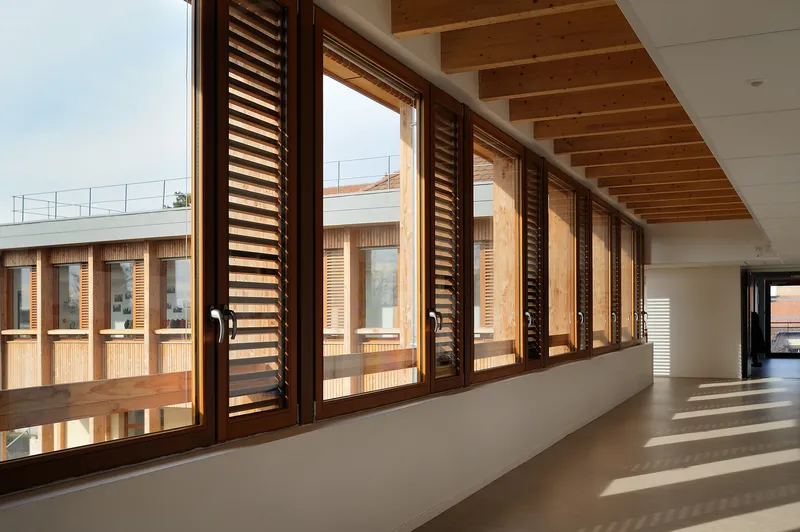
A wooden bridge volume connects the north and south wings, introducing three additional classrooms oriented eastward. This connection enhances interior circulation, covers a courtyard, and maintains spatial harmony. The structure employs glued laminated Douglas wood, spanning 10 meters to create a load-free covered playground, with posts articulating a rhythmic, repetitive joinery pattern. Safety features include ventilating screens and sustainable wood-concrete flooring, while a green roof adds environmental value.
Heritage Enhancement and Energy Efficiency
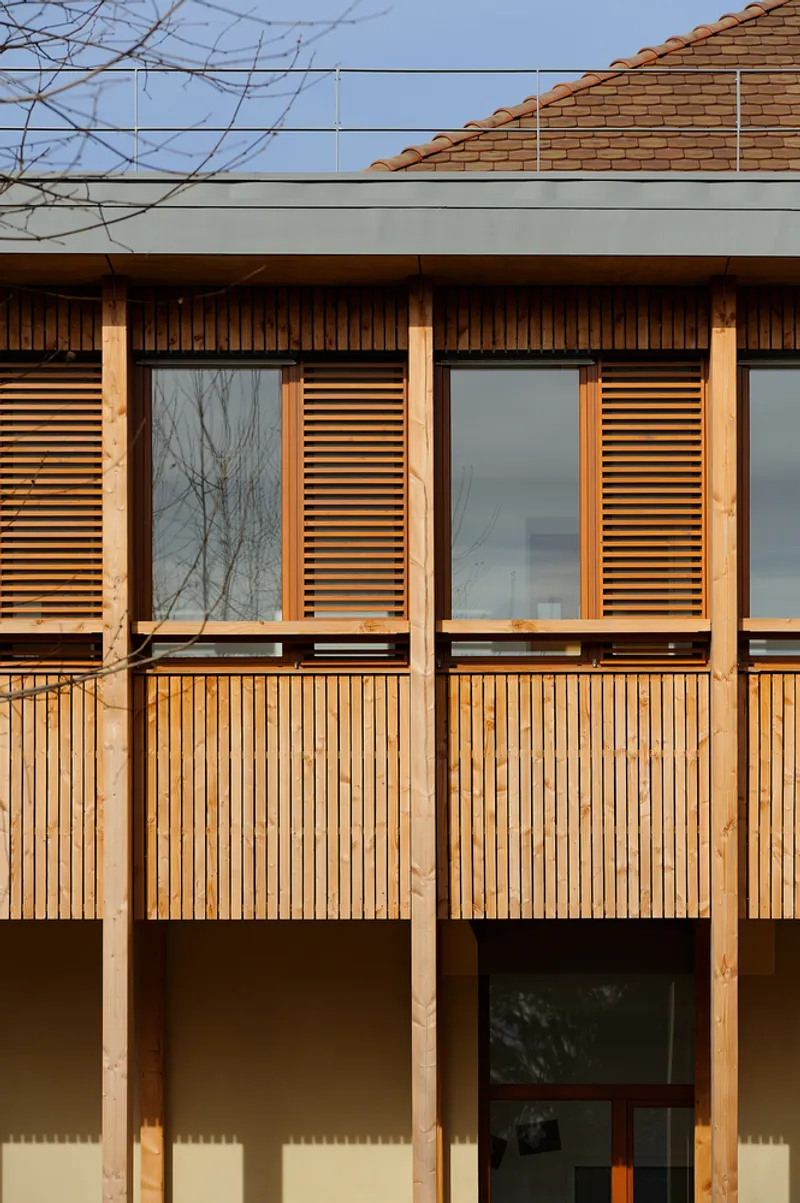
The south wing’s attic was converted into a library, revitalizing the original timber framework, while a wood-concrete joint floor reduces operating costs. The multipurpose room, accessible via a newly created south forecourt, benefits from enhanced terracotta arches, whitewashed adobe walls, and new larch wood frames matching the extension.
Energy efficiency and sustainability were integral, with interior insulation and a modern wood-fired boiler replacing outdated systems. This thermal renovation harmonizes the old and new, reflecting a sensitive approach to historic preservation while meeting contemporary educational needs.
Materials and Finishes
The project showcases a palette of natural, durable materials including wood, concrete, and glass, emphasizing warmth, safety, and longevity. Suppliers include Hoppe, Dormakaba, Atlas Schindler, Forbo Flooring Systems, Bostik, Dörken, Knauf, LEGALLAIS, Nemetschek, Peinture Seigneurie, ROCKWOOL, Remmers, SYLVABAT, Somfy, Swiss Krono AG, and Arte One.
The Elementary School at Le Grand-Lemps exemplifies contextual architecture—a project where heritage meets sustainability. By carefully balancing restoration, expansion, and environmental responsibility, Brenas Doucerain Architectes created a vibrant educational hub that respects the village’s history while supporting modern learning.
All photographs are works of Studio Erick Saillet




Popular Articles
Popular articles from the community


Hill & Cross Opera: Sculptural Opera House Architecture Shaped by Tallinn’s Landscape and Identity
Hill & Cross Opera reimagines opera house architecture in Tallinn through its sculptural hill, civic plaza, glass wave and a luminous cross.

The Musturak Paradise: Senior Living Architecture for a Connected Future in Temara, Morocco
The Musturak Paradise reimagines senior living architecture in Temara via private homes, social spaces, culture, community, and shared care.

Co-life: Sustainable Architecture for Age-Friendly Community Living
Co-life reimagines sustainable architecture for seniors through courtyards, rammed earth, shared gardens, and spaces designed for belonging.

Co-Life: Senior Housing Design That Reconnects Older Adults With the City
Co-Life reimagines senior housing design through healing gardens, shared streets, workshops, and a sustainable community across generations.


Similar Reads
You might also enjoy these articles


Hodi-Mandai Geram
Project Function: Preservation and revitalization of the Intangible heritage and socio-spatial identity of the Hodi by Housing, Cultural Memory Center, Sacred Grove, landscape, local tourism economy


Olio Towers: A Mid-Rise for Performers That Fuses Housing, Rehearsal, and Stage
Located blocks from Houston's Theater District, this modular tower stacks living units around a central performance atrium.

Oasis: Modular Green Housing Carved into Dhaka's Urban Fabric
A shortlisted Plugin Housing entry reclaims unauthorized settlements in Dhaka with stepped concrete volumes, green roofs, and ventilation-driven design.

Black Hole: A Floating Megastructure for the Post-Physical Era
Emiliano Mazzarotto envisions a spherical, self-scaling arena where e-sports, digital hotels, and holographic stadiums replace traditional public space.


Explore Pont-Aven School Competitions
Discover active competitions in this discipline



Challenge to design public laboratory


Challenge to reimagine the Iron Throne


Photograph architecture without architects


Illustrate the lost glory of Angkor Wat - Render Challenge
Comments (0)
Please login or sign up to add comments
No comments yet. Be the first to comment!