
Lucas Takaoka Weaves a Tropical Interior Garden Through Every Room of Embaúba House
A Brazilian home where arched openings, raised planters, and skylights dissolve the boundary between dwelling and garden.


Most houses that claim a relationship with nature settle for a generous window or a courtyard visible from one or two rooms. Embaúba House, designed by Lucas Takaoka, takes the ambition further: planted beds, tropical foliage, and filtered daylight appear in virtually every space, from the kitchen to the bathroom to the corridor between bedrooms. The result is a house where greenery is not decoration but infrastructure, shaping circulation, controlling light, and anchoring the emotional register of each room.
What makes the project worth studying is the consistency of the strategy. Rather than concentrating planting in a single courtyard and letting the rest of the plan be conventional, Takaoka distributes vegetation across raised beds, window alcoves, and skylit voids so that every threshold between rooms involves an encounter with living material. The architectural language is restrained: white curved surfaces, warm timber, cove lighting, arched openings. All of it exists in service of the plants.
Arched Openings as Green Frames

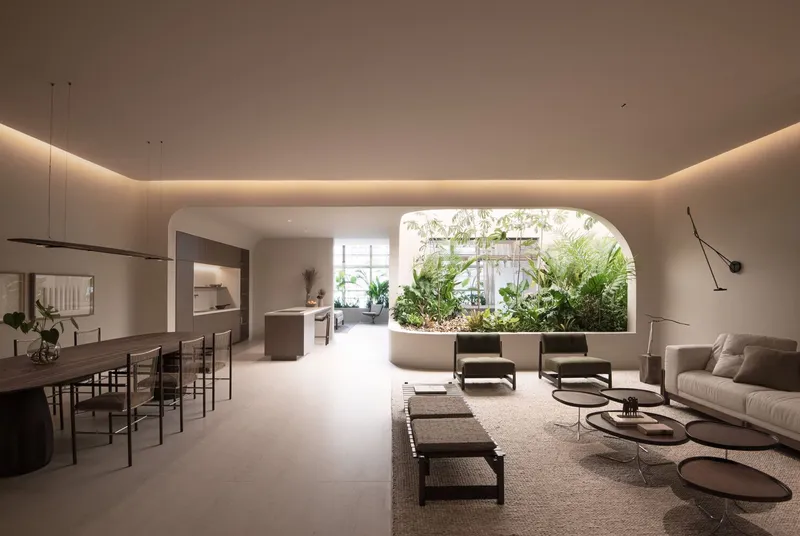
The living and dining areas are organized around a generous arched window that opens directly onto a planted courtyard dense with palms and tropical foliage. The arch is not a period detail; it softens the aperture into something closer to a frame for the garden beyond, turning the courtyard into a living mural visible from multiple angles across the open plan. The planting palette is lush but deliberate, layering tall palms over mid-height ferns and broad-leafed tropicals so that the view has depth even though the courtyard itself is compact.
From the dining table, the arch reads as a threshold you could walk through. From the sofa, it reads as a picture. Takaoka calibrates furniture placement so that each seated position offers a different crop of the same garden, which gives a modestly sized room a sense of spatial generosity.
Planting as a Kitchen Ingredient
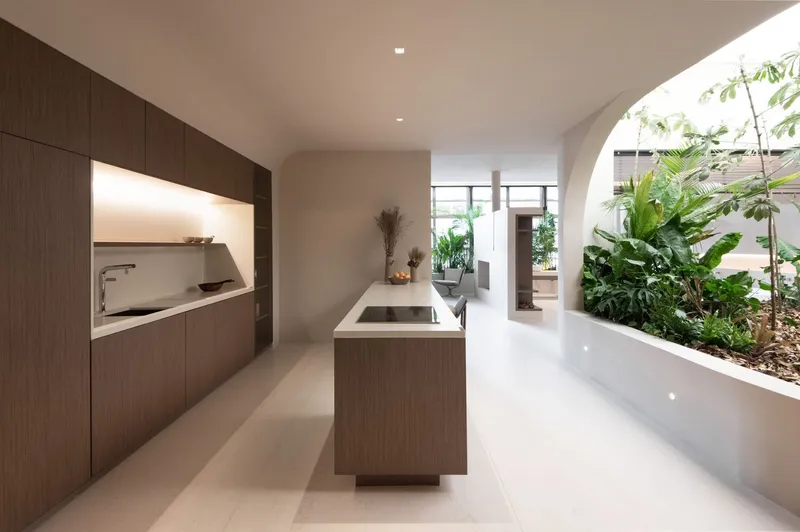

The kitchen is perhaps the most surprising application of the strategy. A raised planted bed sits directly beside the timber island, filled with ferns and palms that rise to eye level. It turns the act of cooking into something that happens alongside, rather than apart from, the garden. The timber cabinetry is warm but unfussy, with flat fronts and a pale counter that recedes so that the greenery beside it becomes the dominant visual event.
Adjacent, the dining area continues the warm material palette with an oval table under a pendant light and perimeter cove lighting that washes the ceiling. The indirect light strategy runs throughout the house, keeping ceilings bright and drawing attention downward to the planted elements and the timber surfaces at hand level.
Bathing Among Banana Plants

The bathroom places a freestanding tub directly in front of a window overlooking a courtyard thick with banana plants. It is a move that risks cliché, the tropical spa aesthetic is well-trodden territory, but the execution here avoids excess. The room is spare: white walls, simple fixtures, no accessories competing with the garden beyond. The window is sized so that the bather's eye level aligns with the mid-canopy of the plants, creating an intimacy that a floor-to-ceiling opening would not achieve.
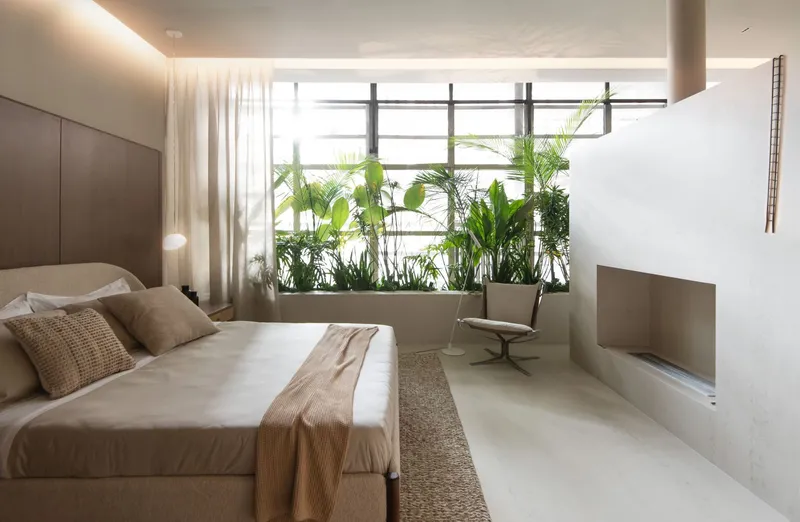
In the bedroom, horizontal metal louvers filter daylight through a planted window alcove, producing soft, striped light that shifts across the wall through the day. The louvers give the occupant control over exposure without a curtain, and they frame the vegetation behind them in a way that turns each leaf into a graphic element. It is a simple detail, but it shows Takaoka thinking about every room as a distinct scene within the same botanical narrative.
Circulation as Garden Walk


The corridors and passages between rooms are not leftover space. A timber wardrobe unit lines one wall of an interior passage while a planted bed filled with palms and greenery lines the other, so that moving from bedroom to living room involves brushing past foliage. The plants are contained in raised white beds that double as a continuous plinth, keeping soil and moisture management clean and legible.
Further along the circulation, a sitting area with built-in shelving and indirect ceiling lighting provides a pause point. The cove lighting here, as elsewhere, washes the ceiling to create a sense of height without relying on exposed structure or double-height volumes. The consistency of this lighting language across every room gives the house a calm continuity that allows the changing plant species to register as the primary variation from space to space.
The Skylit Planter as Interior Landmark

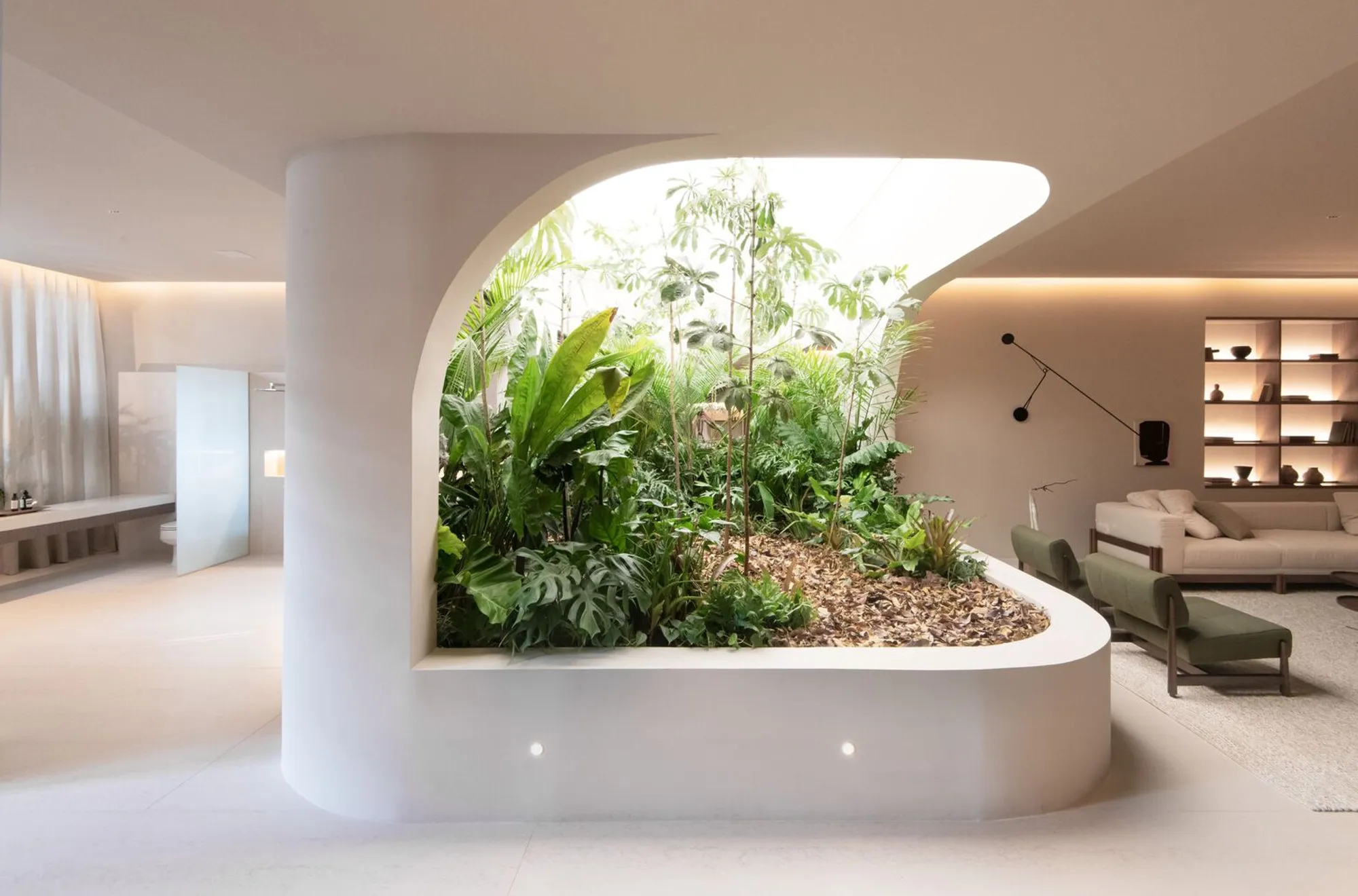
The most striking single element is a curved white planter bed beneath a rounded skylight opening. Tropical plants grow upward toward the light, creating a vertical garden moment at the center of the plan. The curved geometry of the planter and the skylight above echo the arched openings elsewhere in the house, but here the form is fully three-dimensional, wrapping around the viewer and pulling the eye upward. It functions as the heart of the house, a point where the garden strategy intensifies into something almost devotional.
The detail is pure: white rendered surfaces, no edge trim, no junction visible between planter wall and floor. The plants read as though they emerged from the architecture itself rather than being placed inside it. That integration is the whole point of the project.
Why This Project Matters
Embaúba House matters because it treats interior planting not as an accent but as a primary spatial system. Every room, corridor, and threshold is organized around the presence of living material, and the architecture, the arches, the cove lighting, the white surfaces, exists to support that presence rather than compete with it. Lucas Takaoka demonstrates that integrating nature into domestic space does not require enormous budgets or excessive square footage; it requires a plan that puts plants at the center of every decision.
The broader lesson is about commitment. Many architects sprinkle greenery through renders and then build something that reads as a white box with a potted ficus. Takaoka builds the planters into the structure, routes daylight to them through skylights and louvers, and organizes circulation so that inhabitants cannot avoid them. The house does not gesture toward nature. It is full of it.
Embaúba House by Lucas Takaoka.
About the Studio
Share Your Own Work on uni.xyz
If projects like this are the kind of work you want to make, uni.xyz is a place to publish your own, find collaborators, and enter design competitions.




Popular Articles
Popular articles from the community


The Earth Pod: 3D Printed Homes for Resilient Refugee Communities
The Earth Pod reimagines refugee housing through 3D printed homes made from clay, combining resilience, self-sufficiency, and rapid shelter.
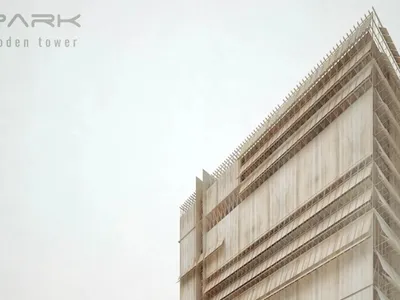
EW PARK: Sustainable Architecture Reimagines the Future of Urban Parking
EW PARK reimagines city parking as a modular wooden tower combining automation, solar energy, electric mobility, and adaptable urban design.

Co-Life: Senior Housing Design That Reconnects Older Adults With the City
Co-Life reimagines senior housing design through healing gardens, shared streets, workshops, and a sustainable community across generations.

Riyadh For All: Intergenerational Urban Design for Active Aging in Rabat
Riyadh For All reimagines urban design in Rabat with intergenerational co-living, adaptive courtyards, and Moroccan cultural exchange today.


Similar Reads
You might also enjoy these articles


Hodi-Mandai Geram
Project Function: Preservation and revitalization of the Intangible heritage and socio-spatial identity of the Hodi by Housing, Cultural Memory Center, Sacred Grove, landscape, local tourism economy


Olio Towers: A Mid-Rise for Performers That Fuses Housing, Rehearsal, and Stage
Located blocks from Houston's Theater District, this modular tower stacks living units around a central performance atrium.

Oasis: Modular Green Housing Carved into Dhaka's Urban Fabric
A shortlisted Plugin Housing entry reclaims unauthorized settlements in Dhaka with stepped concrete volumes, green roofs, and ventilation-driven design.

Black Hole: A Floating Megastructure for the Post-Physical Era
Emiliano Mazzarotto envisions a spherical, self-scaling arena where e-sports, digital hotels, and holographic stadiums replace traditional public space.

Explore Architecture Competitions
Discover active competitions in this discipline



Challenge to reimagine the Iron Throne


Photograph architecture without architects


Illustrate the lost glory of Angkor Wat - Render Challenge


Design challenge to reuse E-waste
Comments (0)
Please login or sign up to add comments
No comments yet. Be the first to comment!