
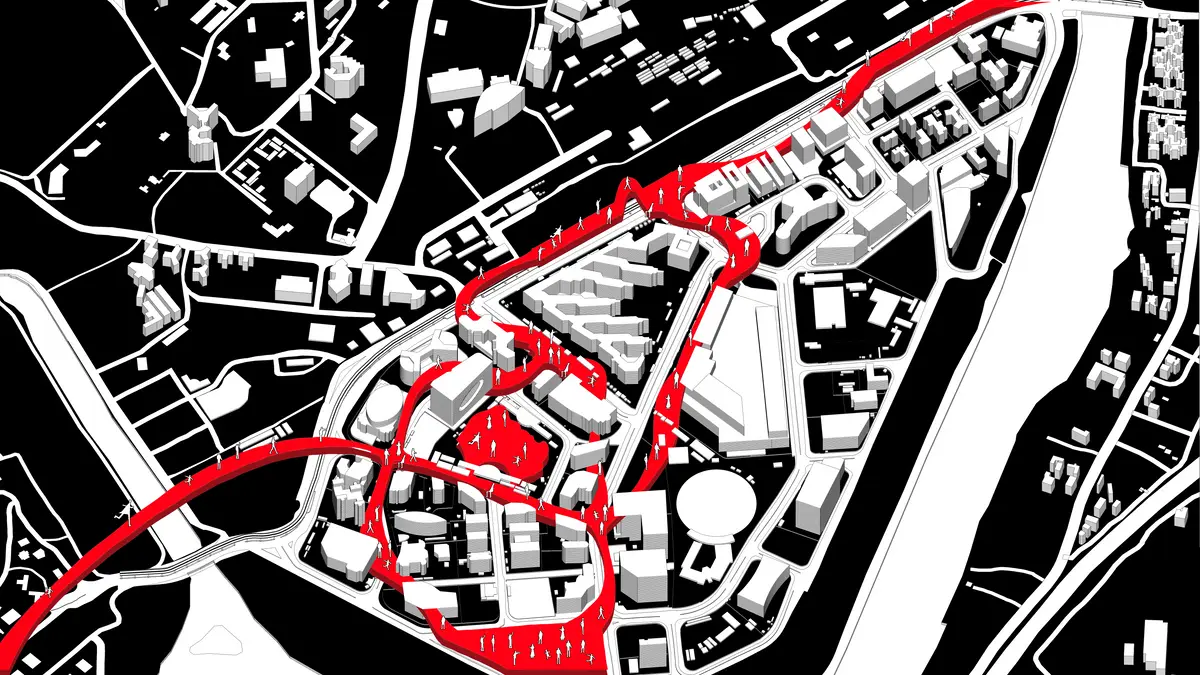
Encounters with the City: Transit Beyond Efficiency
Redefining transit through the public realm in BKC
Bandra Kurla Complex (BKC) is Mumbai’s flagship business district, a purpose-built financial hub developed in the late twentieth century. Unlike the older commercial neighbourhoods in the historic city centre - which evolved organically through centuries of trade, colonial planning, and everyday adaptation - BKC was conceived on vacant land as a modern corporate enclave. Today, it represents the city’s most visible attempt at producing a “world-class” workplace environment. Yet this ambition has come at a cost: the district privileges speed, efficiency, and the movement of cars over inclusivity, human scale, and everyday life.
This thesis argues that BKC, as it currently functions, is an inhuman workplace district. Its design is shaped around the needs of corporations and vehicular circulation, while the lived experience of the ordinary employee is overlooked. Wide pavements remain sterile, surface-level parking lots dominate the ground plane, and the public realm lacks basic amenities. For many, moving through BKC is a purely functional act - a commute from transit node to office - with little room for pause, encounter, or affordable consumption.
The project proposes a reimagining of BKC through a masterplan vision supported by three buildings. Together, these interventions reclaim the ground plane for pedestrians and commuters, transforming underutilised land into inclusive civic spaces. The proposal is not a singular mega-structure but a dispersed network of architectural interventions, each working at the scale of everyday life to soften the corporate rigidity of the district.
The Workplace Context
Different parts of Mumbai reveal distinct relationships between work, movement, and the built environment. In older districts shaped during the colonial period, narrow streets and human-scaled façades foster slower, more reflective encounters. In areas of the city that have undergone industrial-to-commercial redevelopment, fragments of the old fabric still anchor new office towers, creating hybrid environments where traces of history coexist with contemporary workplaces.
BKC, in contrast, offers no such balance. Its towers rise from deep setbacks, separated from the street by walls, lawns, or car parks. Roads are wide and fast, designed for vehicles rather than people. For the workforce - the thousands of clerks, service staff, and junior employees who arrive daily - the experience is one of constant motion without relief. There are few shaded places to sit, few affordable options to eat, and little engagement with the surrounding architecture. BKC embodies a vision of the global city that celebrates glass towers and manicured streets, but it leaves the ordinary worker without infrastructure or belonging.
The Body in Transit
Through site observation, four recurring bodily activities were identified around transit: vending, consuming, waiting, and relaxing. These are not luxuries but fundamental urban functions - the ways in which people inhabit a city while on the move. Elsewhere in Mumbai, the body instinctively finds or creates places to perform these actions: the edge of a street doubles as a vending stall, the steps of a building become a place to wait, a pavement transforms into an informal gathering space.
In BKC, however, these functions are either absent or actively excluded. Pedestrians are funnelled into constant motion; pavements, though wide, are empty; and the body has little agency to adapt its surroundings. This absence of everyday life underpins the thesis’s central argument: that a business district cannot be truly efficient if it neglects the small, informal, and human-scaled activities that sustain its workforce.
The Masterplan and Three Buildings
The masterplan seeks to re-stitch BKC through a web of pedestrian-friendly interventions, challenging the dominance of surface parking and reclaiming the ground plane for public life. Its strategies are tested through three buildings, each forming an interface with a different mode of motion, each occupying a significant site and addressing a different layer of transit in the district.
Extension to the Metro Station
Along the district’s main road, a building extends from a currently under-construction metro station. This intervention formalises a commuter gateway of BKC which does not exist currently, but will soon emerge as an active node in the commuter’s route once the metro becomes functional. This will provide not only circulation but also waiting areas, retail, and public amenities. By layering programmes onto transit, the building transforms the experience of arrival from a purely logistical transfer into a civic moment of encounter and pause.
Building at a Vehicular Node
At a major junction where employees commonly transfer from taxis and three-wheeled rickshaws, a second building redefines the surrounding landscape. Sprawling surface-level car parks - currently dead, underutilised spaces - are relocated underground, releasing valuable land for public plazas and gardens. The building itself operates as a hinge between modes of movement, incorporating commercial programmes and social spaces that support both workers and passers-by. In doing so, a chaotic vehicular interchange becomes a structured civic space that welcomes, rather than disorients, the commuter.
The Pedestrian Street
On one of BKC’s unusually wide pavements, the third proposal experiments with the revival of the building–street interface. Here, modular architectural elements animate the blank edge of corporate towers with food stalls, shaded seating, and flexible kiosks. This transformation converts an otherwise empty pavement into an active public street, encouraging porosity at the ground level and challenging the sealed-off nature of BKC’s office buildings. It is both a critique of and an alternative to the detached relationship between corporate architecture and the city around it.
Towards a Human-Scaled BKC
Together, these three buildings advance the masterplan’s broader vision: the conversion of BKC’s dead ground surfaces into a continuous network of public infrastructure. By relocating parking into basements, plazas and gardens emerge where cars once dominated. By introducing amenities into transit nodes, waiting becomes dignified, vending becomes visible, and consumption becomes affordable. By activating pavements, corporate streets are reimagined as social corridors rather than empty buffers.
The project demonstrates that small shifts in programme and spatial design can accumulate into a transformative vision for the city. BKC, rather than remaining a sterile corporate enclave, can become a layered workplace district - one that balances efficiency with experience, corporate ambition with inclusivity, and speed with the simple possibility of pause. At its heart, the thesis proposes that the ordinary employee deserves as much architectural attention as the boardroom, and that the human scale must be reinstated in the imagination of the global city.

Popular Articles
Popular articles from the community


Juan García Correa, John González and Claudia Rueda Sink a Circular Amphitheater into a Manizales Engineering Building
On the La Nubia campus in Manizales, Colombia, the S1 Building folds labs and offices into a hillside of ramped lawns that double as a campus route.

GROUP A Strips a 1969 Rotterdam Harbor Headquarters to Its Frame and Wraps It in Timber Louvers
In Rotterdam's M4H harbor district, Ferro Offices reuses a 1969 frame, adds one timber storey and reaches BREEAM-NL Outstanding.

Cube Design Draws an Ecological Corridor Between Two Shenzhen Hills with the Nankai Building
Beside Shenzhen's container docks, the Nankai Building pairs stacked balconies with a climbing green screen to connect two hillsides across its height.

LT2A and OPEN Architectes Thread a Brick and Glass High School Through a Wooded Belgian Campus
In Braine-l'Alleud, a 3,000 m² wing for Collège Cardinal Mercier pairs pale brick with a glazed colonnade, deferring to a small chapel and a dense wood.

Similar Reads
You might also enjoy these articles
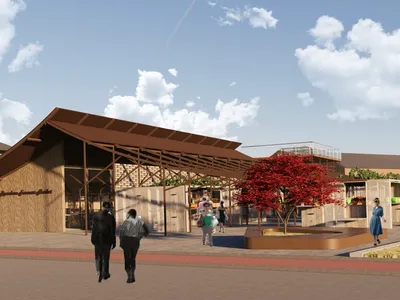
The Rhythm of Seasons
A Farmers' Market Connecting Nature and the City

More Than a Building-Designing a Living System
More Than a Building-Designing a Living System
Base Beyond
DESERT COMPOUND ARID: TOURISM OF ABSENCE AND ABUNDANCE

Explore Urban Design Competitions
Discover active competitions in this discipline


Design challenge to equip cities with modern furniture

Challenge to reimagine the Iron Throne

Photograph architecture without architects

Illustrate the lost glory of Angkor Wat - Render Challenge
Comments (0)
Please login or sign up to add comments
No comments yet. Be the first to comment!