
A Hakone House Where the Engawa Never Ends
HAMS and, Studio renovates a 60-year-old mountain dwelling in Hakone by dissolving its boundaries into a continuous threshold between forest and room.

Renovation in Japan carries a particular weight. The country's residential stock turns over at a pace that makes most Western observers uneasy, with houses routinely demolished after a few decades. So when HAMS and, Studio, led by Yota Hokibara, elects to preserve a 60-year-old dwelling in Hakone's forested hills, the decision itself becomes the first architectural statement. What follows, at 117 square meters, is less a restoration than a spatial argument: that the boundary between inside and outside, the engawa, should not be a line but a gradient that permeates the entire house.
Hakone sits in the caldera of an old volcano, its terrain a tangle of steep slopes, hot springs, and dense canopy. A standard renovation here might replace finishes, improve insulation, and call it done. Hokibara instead reread the existing structure, its timber frame, its roof geometry, its relationship to the sloping site, and used those elements as a framework for a new kind of domestic landscape. The engawa, that covered veranda so central to traditional Japanese residential life, becomes the organizing principle. It stretches, curves, and folds inward until you can no longer tell where the porch stops and the living room begins.
A Red Roof in the Canopy
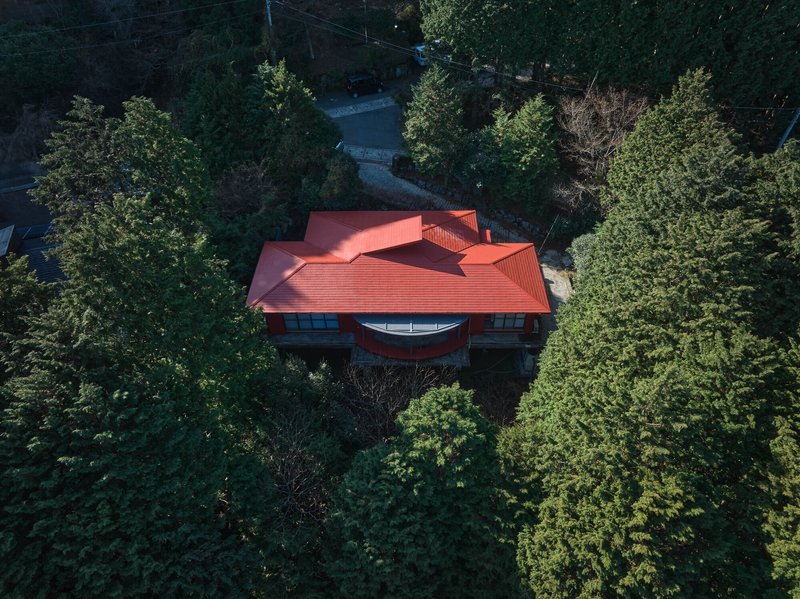
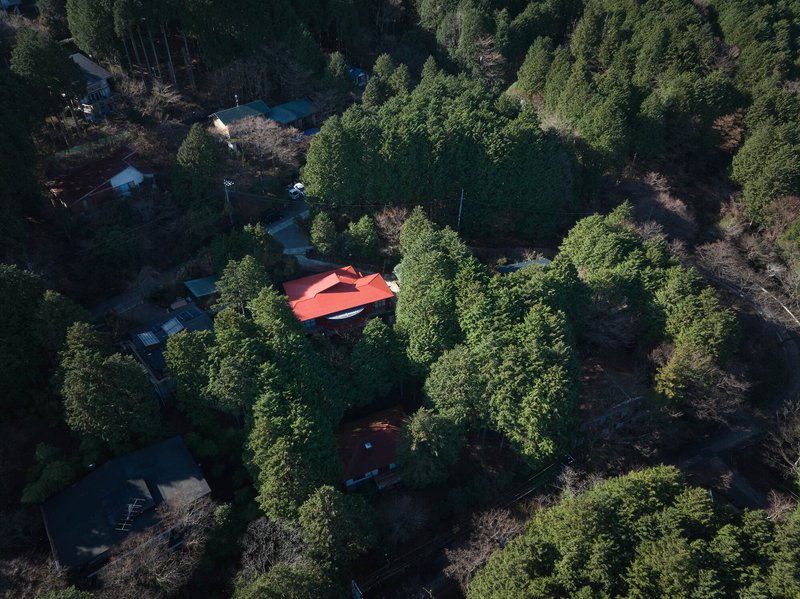
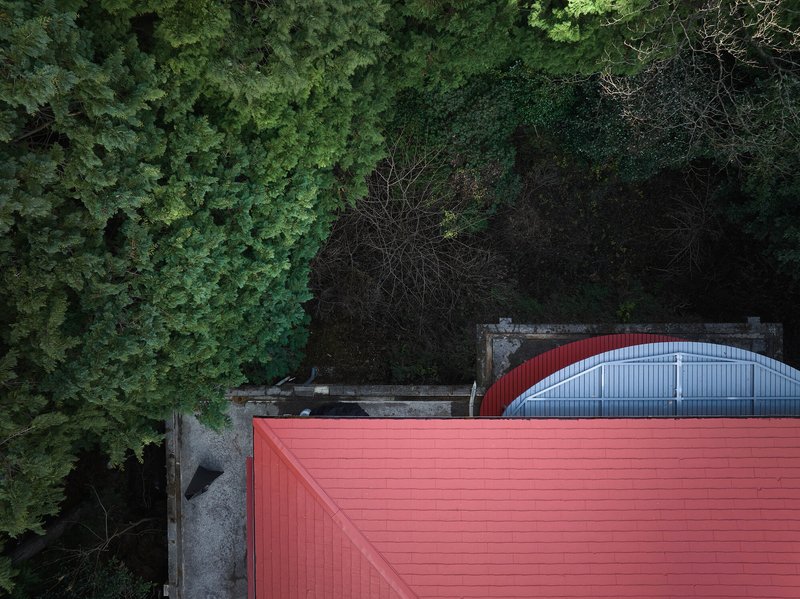
From above, the house reads as a series of red corrugated metal planes sliding beneath the tree line. The drone views reveal something important: this is not a building that announces itself. Its curved center element and low profile suggest an organism that has settled into the hillside rather than been placed on it. The red is bold, almost contradictory against the green, but it gives the house an identity that its modest scale might otherwise deny.
The choice of that vivid roof color also serves a practical legibility. Scattered among neighboring structures in a wooded clearing, the house needs a way to assert its presence without height or mass. The red does that job cleanly. It is a signal, not a shout.
The Threshold Expanded
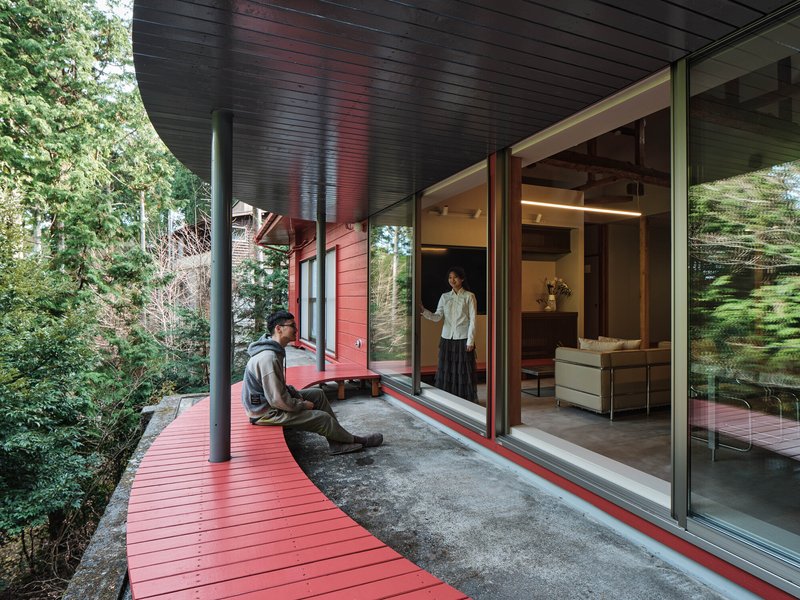
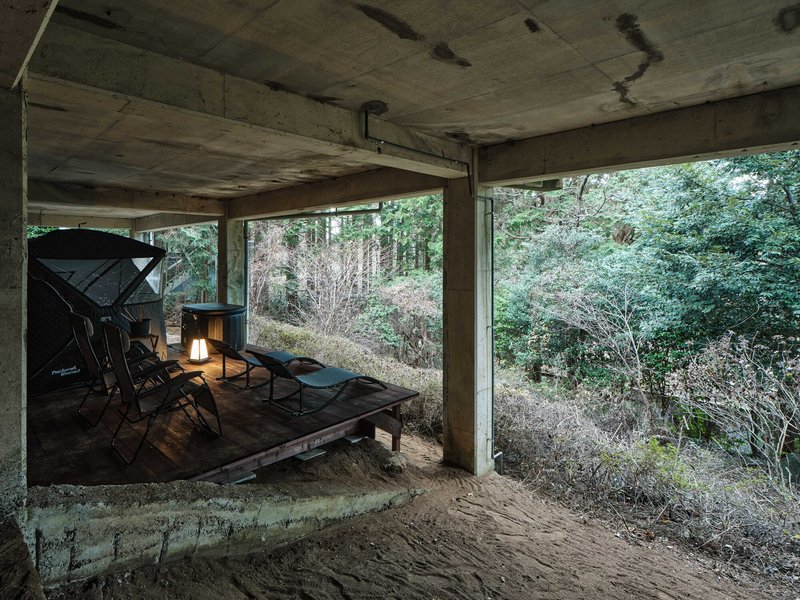
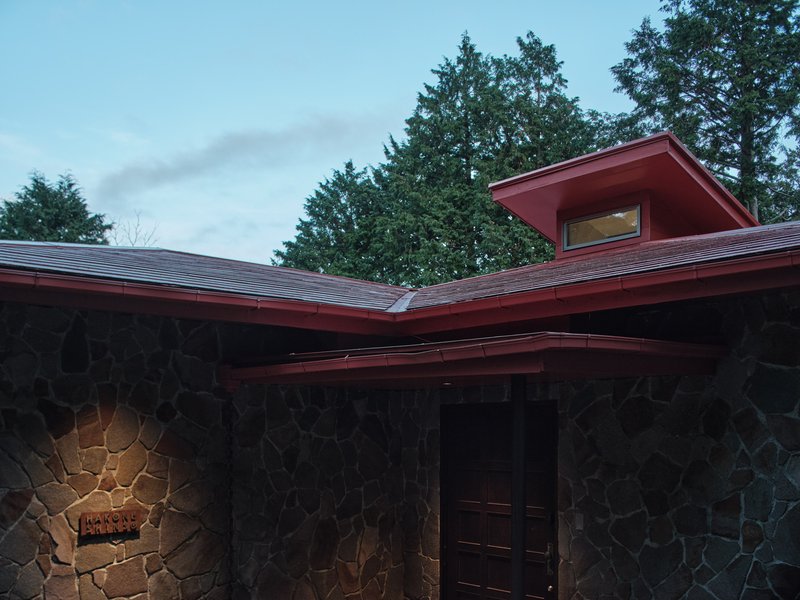
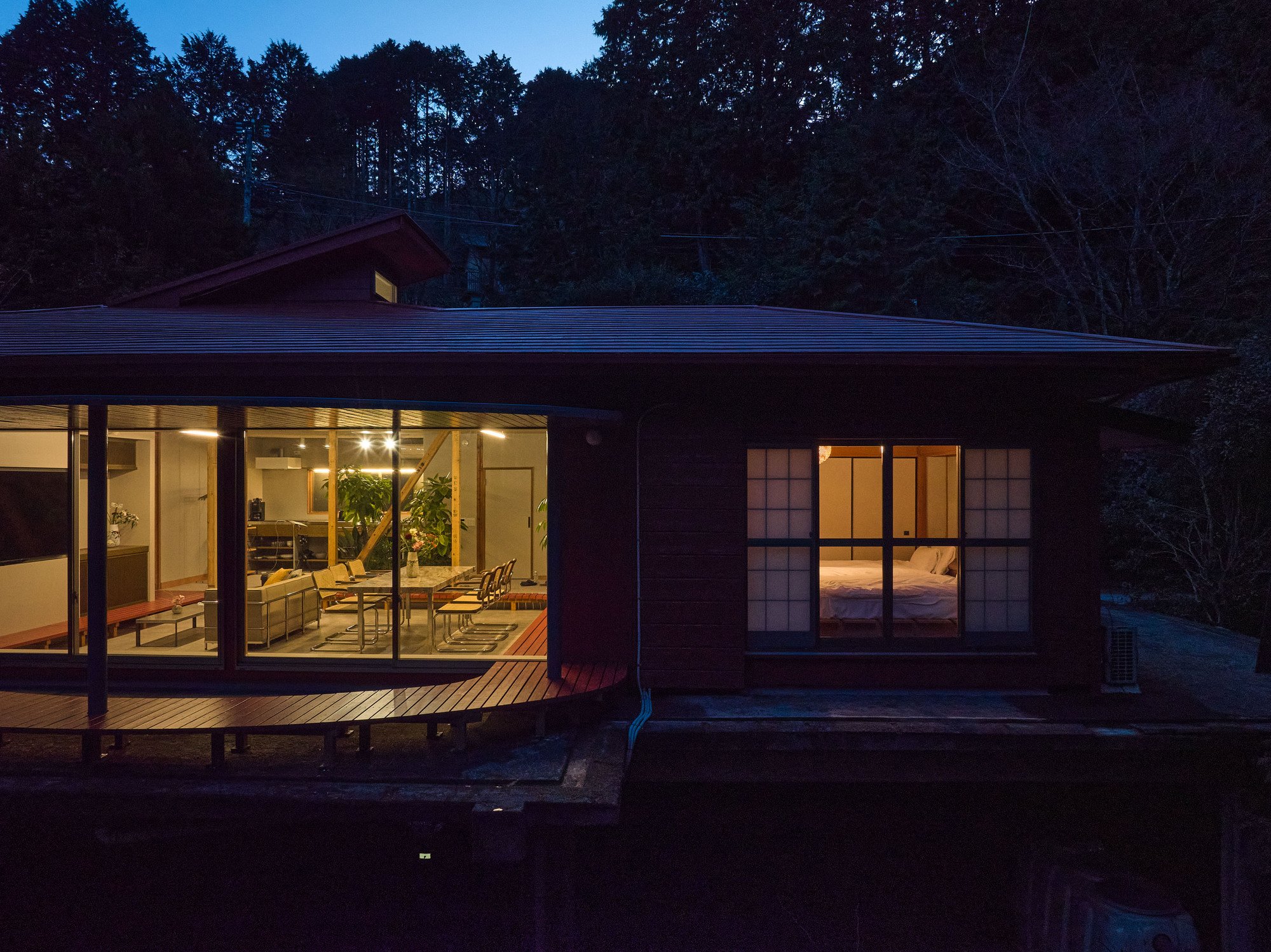
The engawa tradition gives a house its softest edge: a covered platform, neither fully inside nor out, where shoes come off and the garden comes close. Here, that idea is amplified into a full design language. The covered deck with its red planks and dark soffit becomes a gathering zone, not a passageway. Sliding glass doors dissolve the wall behind it, so the deck and living area operate as a single room when weather permits.
The outdoor terrace facing the wooded hillside extends this logic further, offering a concrete-ceilinged perch that feels sheltered without being enclosed. And at dusk, the angled roofline lifts to expose a clerestory window that catches the last light through the evergreens, blurring the temporal boundary as well. Day and night, inside and out, the thresholds keep multiplying.
Timber Frame as Living Memory
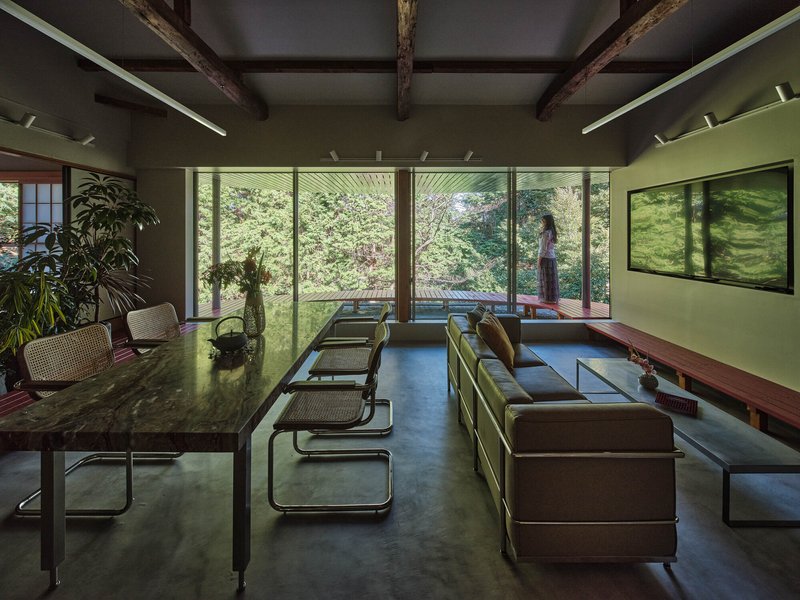
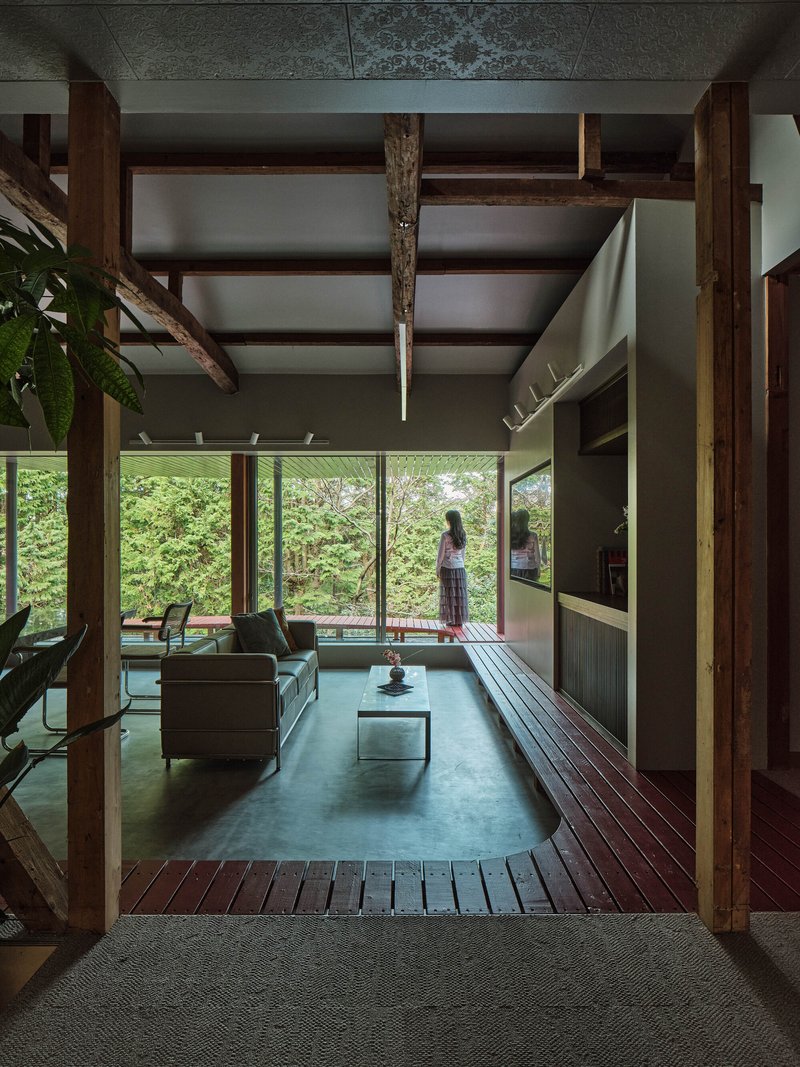
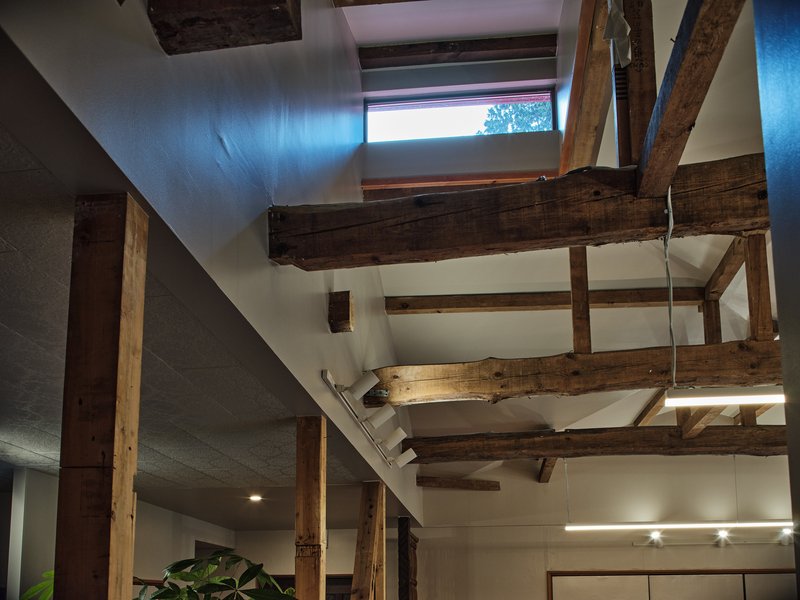
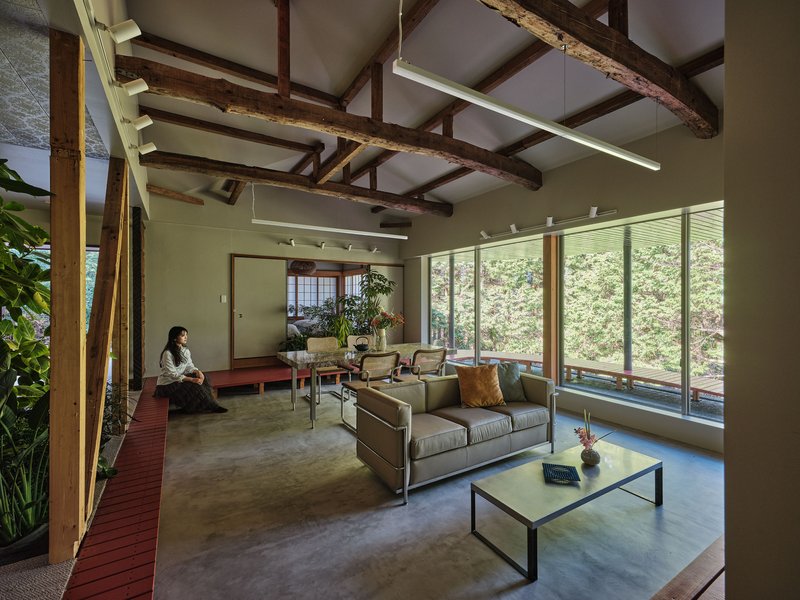
The original timber structure is left fully exposed, and it does a tremendous amount of work. Diagonal bracing, overhead beams, and column rhythms give every room a sense of depth that new construction rarely achieves. The patina of the wood tells you immediately that this frame has been here a long time, carrying snow loads and summer heat for six decades. Rather than concealing that history behind new drywall, Hokibara lets it function as both structure and ornament.
The vaulted ceiling detail with its clerestory window is a standout moment. Here the beams converge upward, framing a sliver of green beyond, and the geometry of the original roof becomes a lantern. It is a move that costs almost nothing in material terms but transforms the spatial experience entirely.
Interior Landscapes
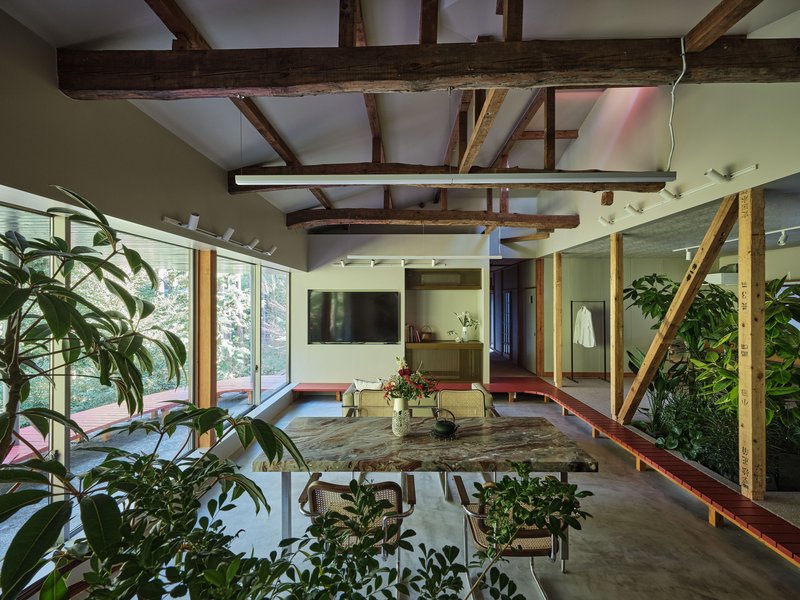
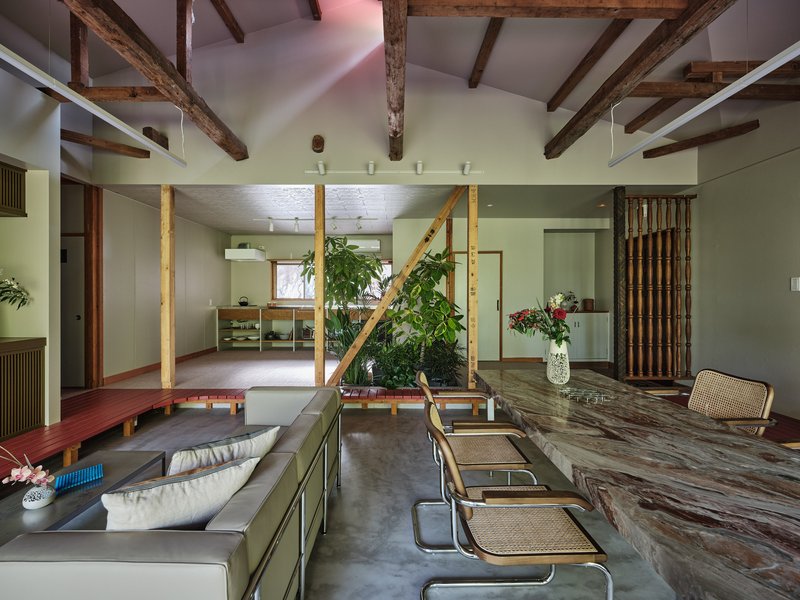
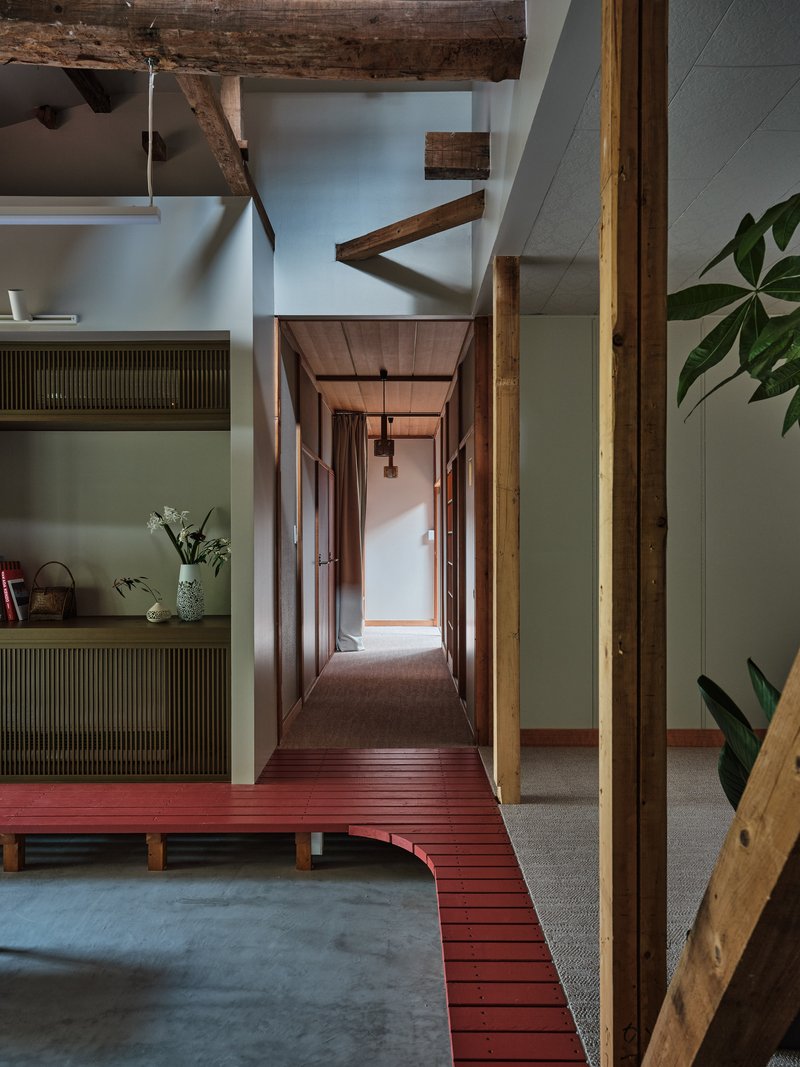
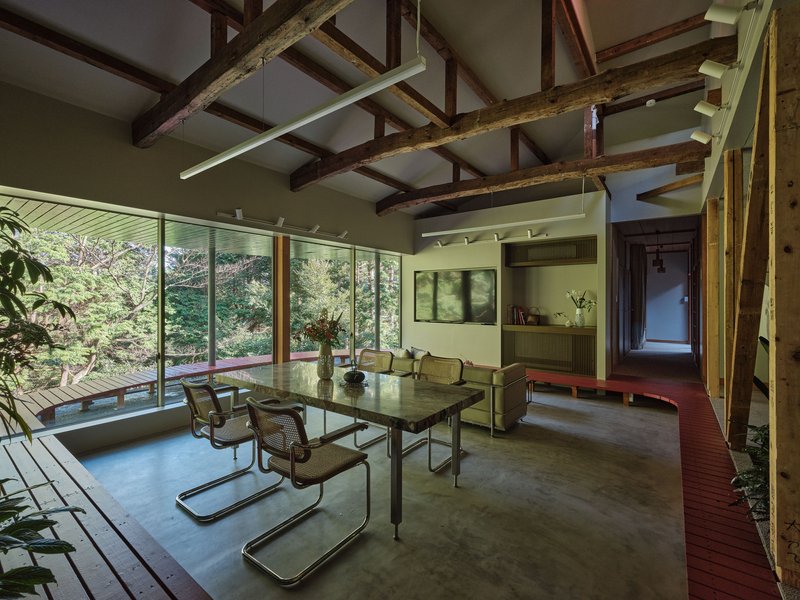
Inside, the open plan is subdivided not by walls but by planted beds and changes in level. The reclaimed wood table anchors the central space, but around it, soil-filled troughs bring greenery directly into the house. These indoor planting beds are more than decoration; they reinforce the core idea that the building's enclosure is porous, that the forest's presence does not end at the glass line.
The raised red timber platform is the interior's most assertive gesture. It connects rooms, defines zones, and carries the color of the exterior deck inward. You step up onto it as you might step onto an engawa, and the gesture triggers the same psychological shift: you are now in a space of pause, of transition, of looking outward.
Circulation as Experience
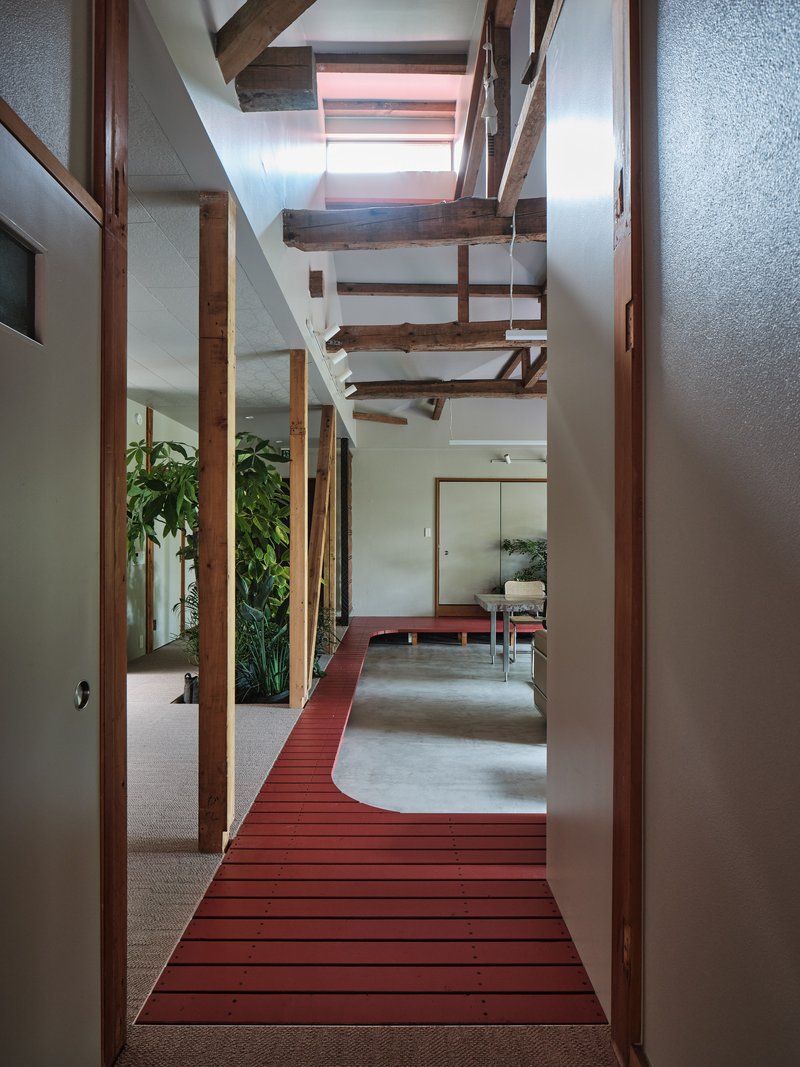
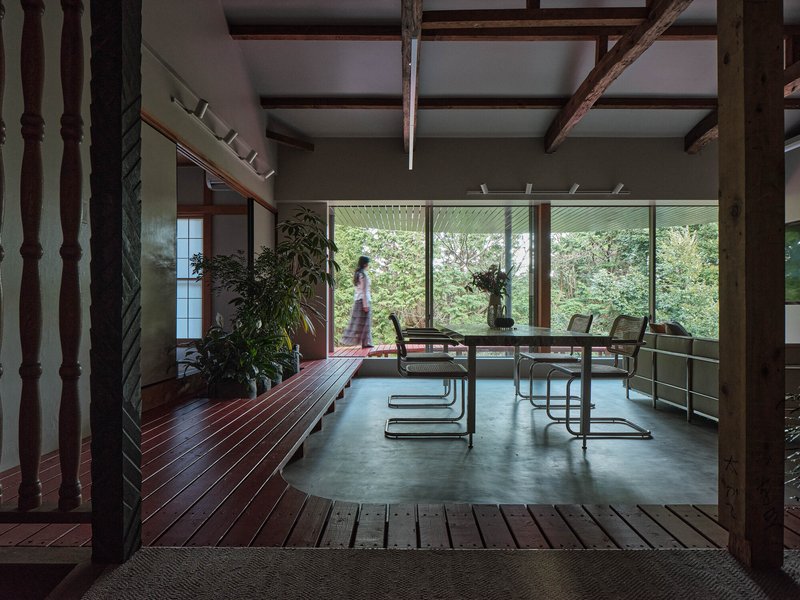
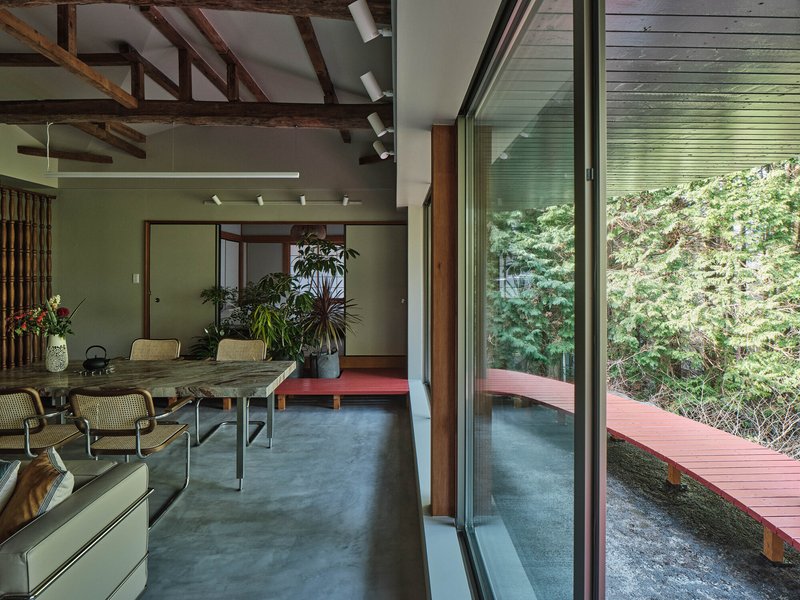
The curving red slatted walkway through the interior corridor is perhaps the project's most photogenic element, and for good reason. It takes what would ordinarily be a utilitarian hallway and turns it into a spatial event. Skylights overhead and the rhythm of the slats underfoot create a dappled, almost forest-floor quality. Circulation here is not something you rush through; it rewards slow movement.
Views through timber columns toward the dining space compound the effect. You are always seeing through layers: column, glass, garden, tree. The house keeps offering new frames within frames, and the dining area's relationship to the exterior deck, visible through sliding doors, reinforces the idea that every room is an engawa of a different kind.
Retreat Rooms
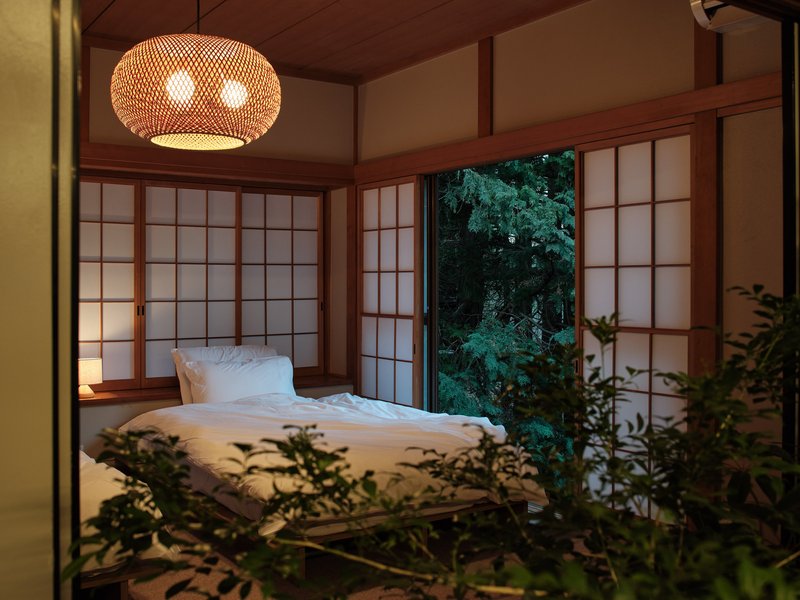
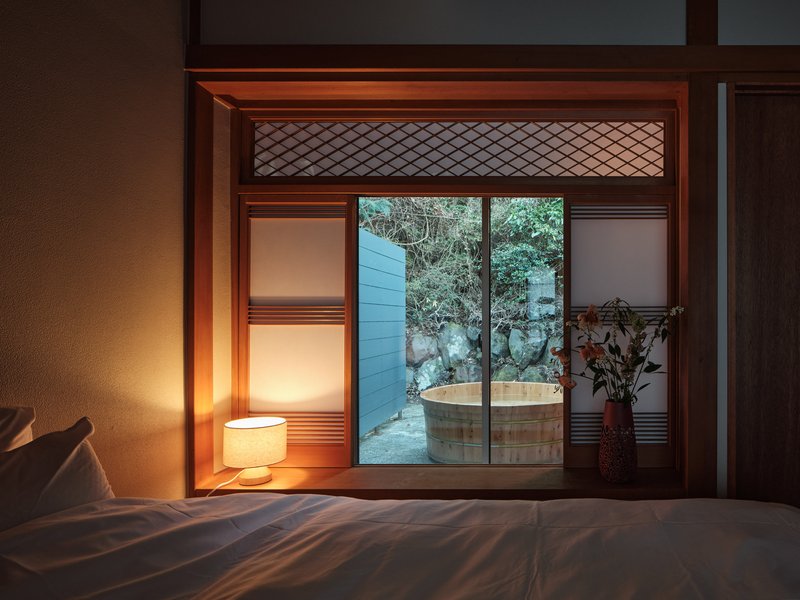
If the public spaces dissolve boundaries, the private rooms calibrate them with care. The bedroom uses translucent shoji screens to filter the evening forest into a soft glow, offering enclosure without isolation. A woven pendant light adds warmth without competing with the view. Adjacent, the outdoor soaking tub framed by wooden lattice turns bathing into a ritual engagement with the landscape.
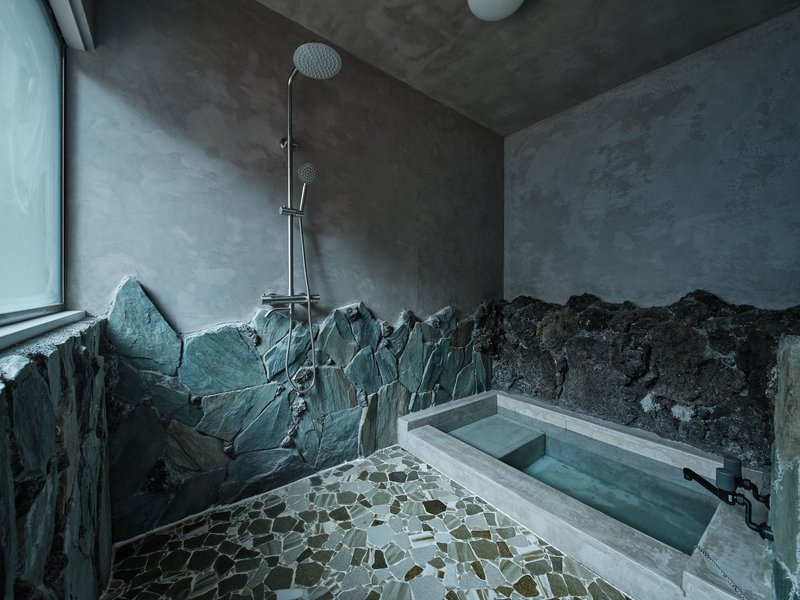
The interior bathroom is a small masterpiece. A slate-clad wall shaped like a mountain silhouette wraps a concrete soaking tub, with a mosaic pebble floor beneath. It is theatrical, yes, but it earns its drama by referencing the volcanic terrain outside. Hakone's hot spring culture gives this room a context that saves it from mere whimsy.
Living at Nightfall
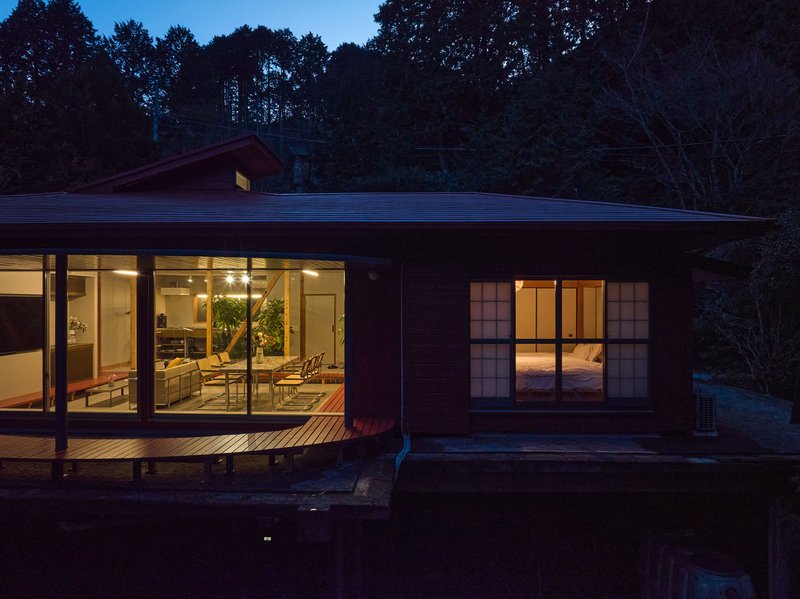
At night, the house becomes a lantern. Floor-to-ceiling glazing turns the living pavilion into a warm volume glowing beside a dark reflecting pond. The image captures the paradox at the project's heart: total openness, total shelter. The polished concrete floor and exposed ceiling beams read clearly from outside, collapsing the distinction between observing the house and inhabiting it.
Inside, the red platform where a figure sits and the dining area with its glass table and cantilever chairs demonstrate that the material palette is deliberately restrained. Concrete, timber, red-stained wood, glass. That economy lets the spatial ideas stay legible. Nothing competes for attention except the relationship between structure and landscape.
Plans and Drawings
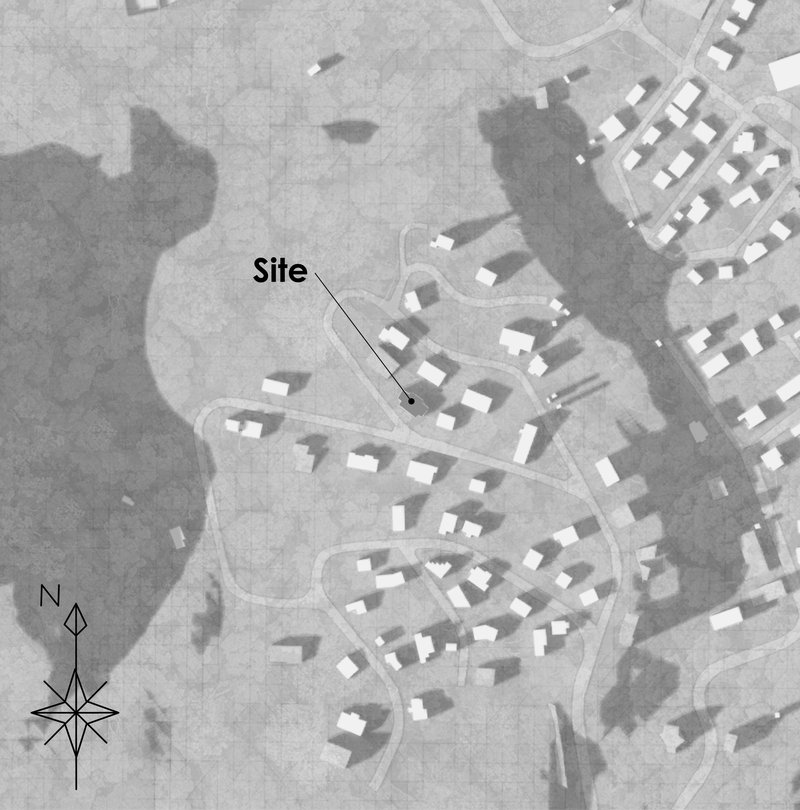
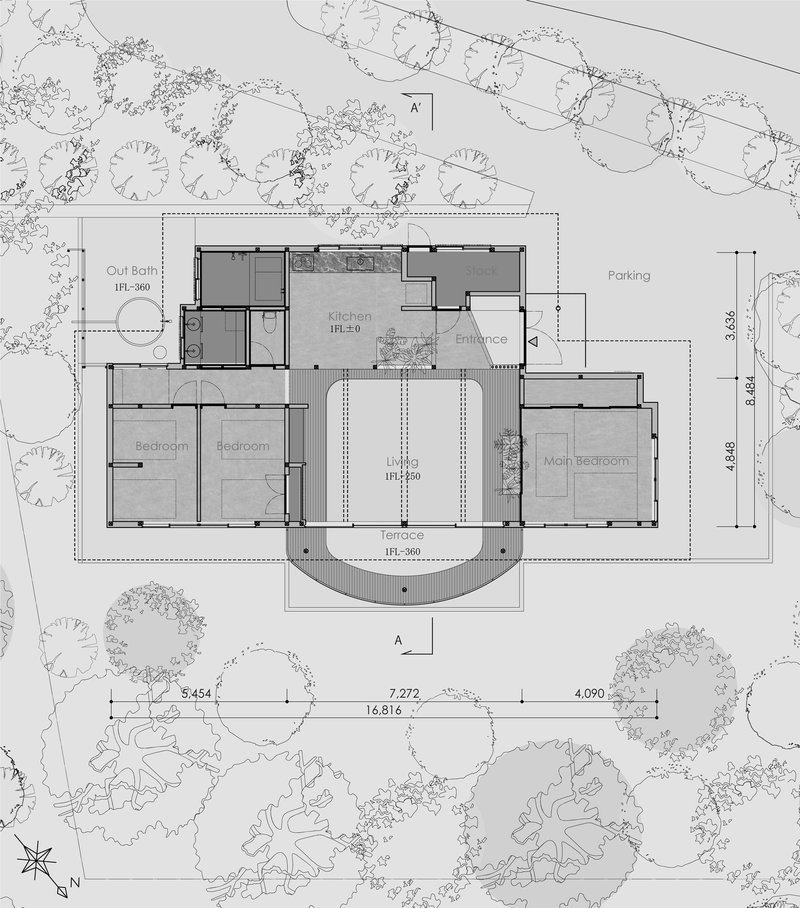
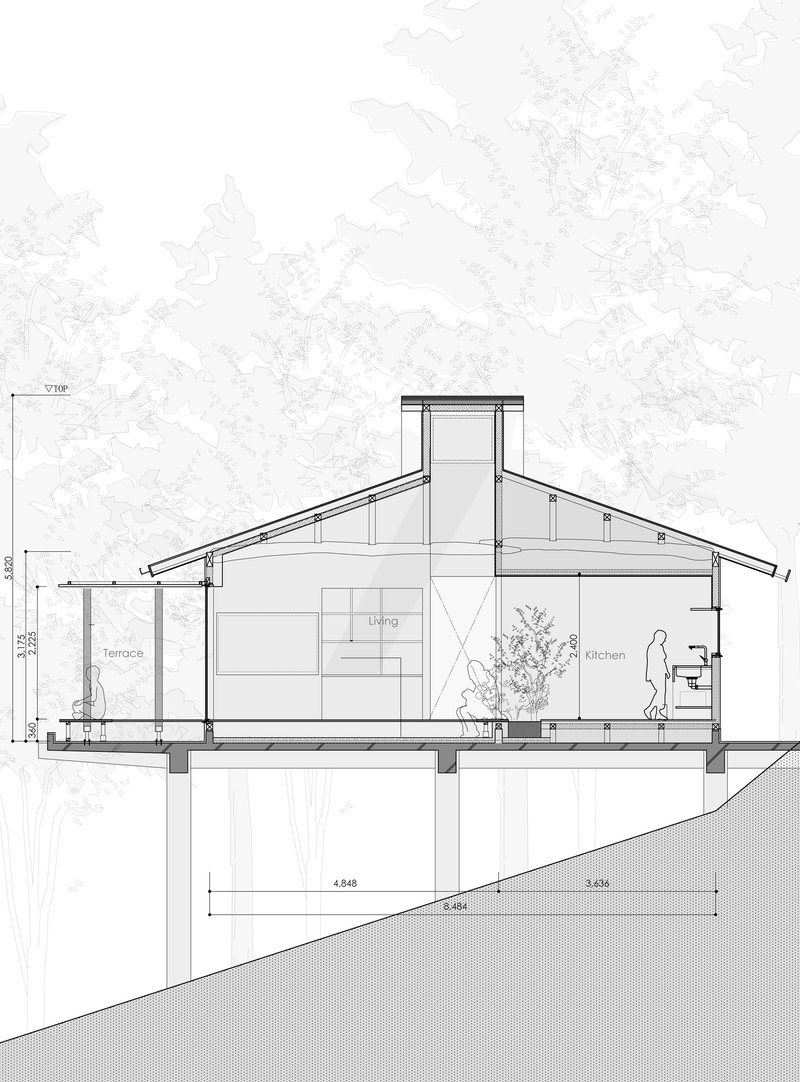
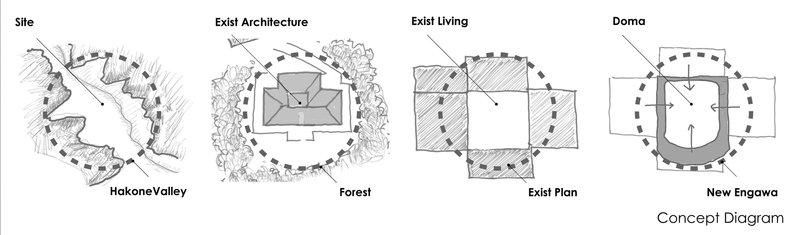
The site plan confirms the house's position along a curving residential street, its lot modestly sized and heavily wooded. The floor plan reveals a central living area flanked by bedroom wings, a symmetry that grounds the more playful formal moves. Surrounding the building envelope, drawn tree canopies demonstrate that the landscape is not afterthought but co-author.
The section drawing is the most instructive. It shows how the sloped roof structure with its central clerestory negotiates the terraced terrain, stepping down the hillside rather than fighting it. The concept diagrams, comparing site context, architecture, living areas, and doma (earth-floored) space, make the intellectual framework explicit. Each layer peels back another degree of enclosure, from the valley scale to the body scale, and the engawa is present at every level.
Why This Project Matters
Japan's default response to an aging house is demolition and replacement. HAMS and, Studio's decision to renovate is, in that context, a quiet act of resistance. But what makes Engawa in Ninotaira genuinely significant is not the preservation itself. It is the conceptual rigor with which the renovation reinterprets a single traditional element, the engawa, and allows it to reorganize the entire house. The threshold becomes the room. The deck becomes the living space. The corridor becomes a garden path. Every spatial decision traces back to one idea, and the house is stronger for that discipline.
At 117 square meters, this is a small project. Its lessons, though, scale well. In an era when architects chase novelty through form, this house suggests that novelty can come from rereading what already exists: an old timber frame, a volcanic hillside, a covered porch. When those elements are taken seriously and allowed to generate architecture rather than merely receive it, the result is a house that feels inevitable, as though it has been waiting sixty years for someone to see what it could become.
Engawa in Ninotaira by HAMS and, Studio (Yota Hokibara), Hakone, Japan. 117 m², completed 2026. Photography by Akira Nakamura.
About the Studio
Share Your Own Work on uni.xyz
If projects like this are the kind of work you want to make, uni.xyz is a place to publish your own, find collaborators, and enter design competitions.




Popular Articles
Popular articles from the community

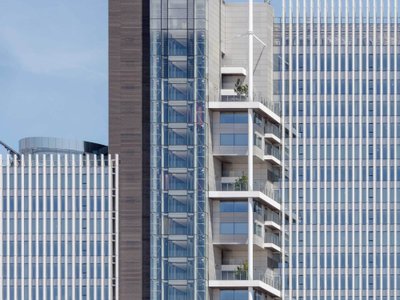
Cro&Co Architecture Builds a 150-Meter Tower on Top of a Seven-Lane Highway in La Défense
Trinity Tower reimagines the office high-rise as a bioclimatic organism threaded with terraces, trees, and public ground in Paris's business district.
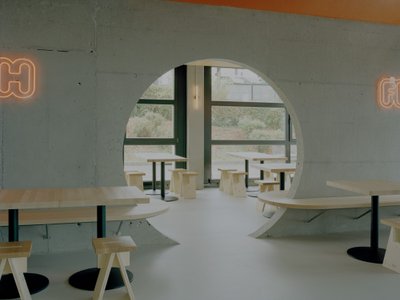
Noue Studio Organizes a Swiss Restaurant Around a Single Concrete Wall
In Granges-Paccot, Switzerland, a 216-square-meter renovation turns raw materials and a central spine into a legible dining experience.
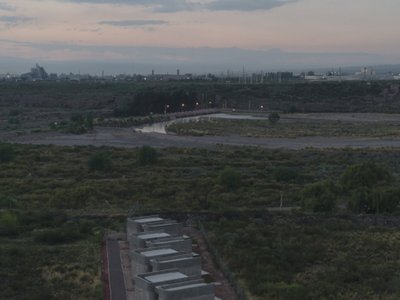
ONA Threads Four Board-Formed Concrete Cabins Along a 260-Meter-Deep Site in Mendoza
At the edge of Argentina's wine country, a set of curved concrete lodges negotiate a razor-thin parcel between city and mountain.
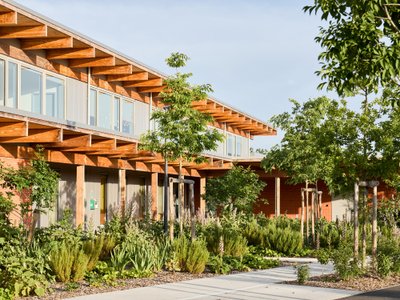
GGR Architectes Anchors a New Neighborhood in Frouzins with a Brick and Timber School Complex
A cruciform plan of terracotta brick and exposed wood frames four courtyards for 140 students outside Toulouse, France.


Similar Reads
You might also enjoy these articles

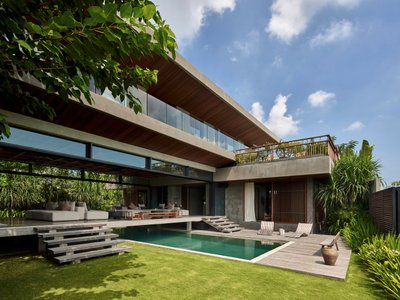
Freebird Residence by Alexis Dornier: A Tropical Modernist Sanctuary in Bali
Floating living pavilion above pool anchors H-shaped tropical villa, blending Japanese minimalism, sustainable strategies, lush landscape, and sculptural interiors.
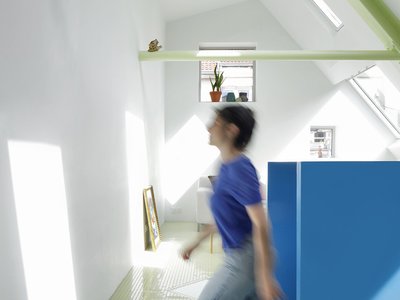
127af Flips a Tiny Bagnolet Rowhouse Upside Down with a Handcrafted Roof Extension
A 55-square-meter terraced house on the edge of Paris gains a luminous upper living floor through lightweight timber and steel.
1.61 Design Workshop Wraps a 600-Square-Meter Café in Vietnam in Sculptural Burgundy Drama
Reden Café & Bistro pairs a helical staircase, mosaic floors, and deep red interiors to rethink Vietnamese hospitality space.

The Unbound Brain: A School Shaped by Cognitive Architecture
Cylindrical learning pods radiate like neurons from a central cortex, turning the floor plan into a spatial model of human thought.
Explore Residential Building Competitions
Discover active competitions in this discipline




The Global Benchmark for Architecture Dissertation Awards


Challenge to design mud housing for contemporary communities


Challenge to design luxury tourism on rails


VR headsets Storefront design competition
Comments (0)
Please login or sign up to add comments
No comments yet. Be the first to comment!