

Imbue Design Tucks a Concrete Block Retreat into the Sandstone Canyons of Escalante
A desert residence in southern Utah uses raw concrete masonry and timber to disappear into its red rock surroundings.


Southern Utah's Grand Staircase-Escalante region is a place that makes architecture feel both necessary and absurd. The sandstone formations are so sculptural, so layered with geological time, that any built intervention risks looking like a tourist booth propped against a cathedral. Imbue Design understood this when they sited their Escalante Retreat at the base of a massive rock outcrop, choosing to work with the landscape rather than compete with it. The result is a low-slung residence that reads almost as a geological feature itself, its concrete block walls echoing the strata of the cliffs behind it.
What makes the project genuinely interesting is its material restraint. Concrete masonry block and timber are the primary players, and neither is asked to perform beyond its nature. The block walls are left exposed inside and out, absorbing and radiating desert heat. The timber soffits provide shade and warmth without pretending to be anything more refined than they are. It is a house that knows exactly what it needs to be, and nothing more.
Reading the Site
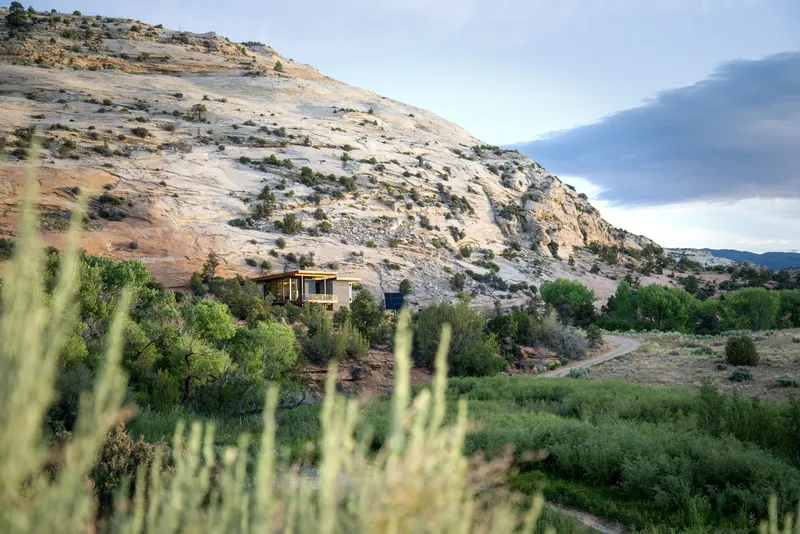
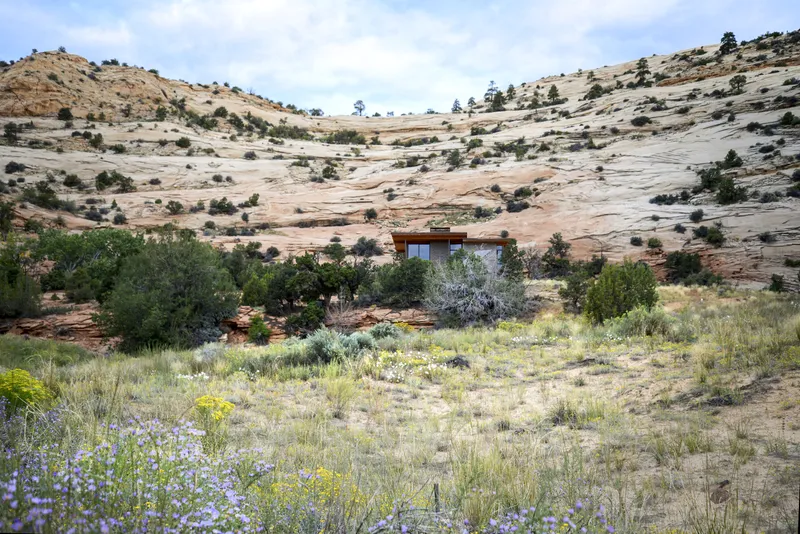
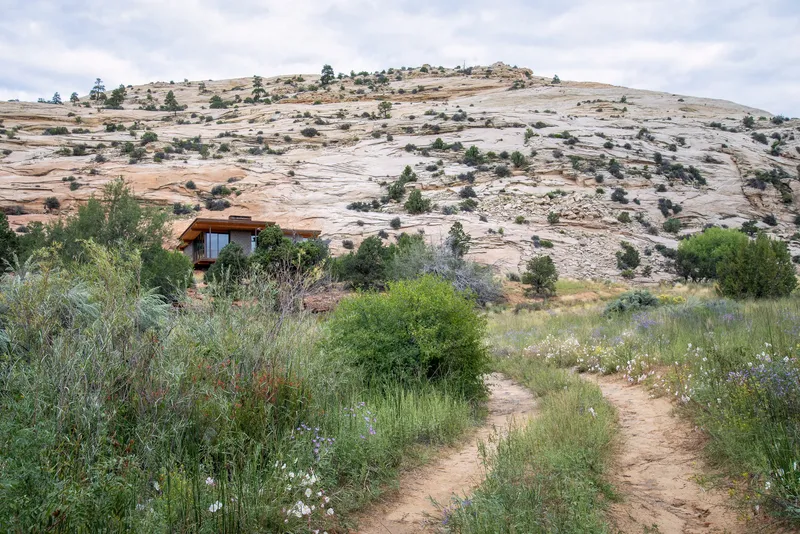
Seen from a distance, the retreat barely registers against the layered sandstone formations that rise behind it. The building sits among native grasses, wildflowers, and scattered trees, its roofline held deliberately below the horizon of the rock face. Imbue Design clearly worked backward from the landscape, determining how large and how tall the structure could be before it started to argue with its surroundings.
The siting also has a practical logic. Nestling into the base of the outcrop provides some natural wind protection and thermal mass from the rock itself, while the elevation offers unobstructed views down the canyon. It is a position that feels discovered rather than imposed.
Concrete Block as Desert Vernacular
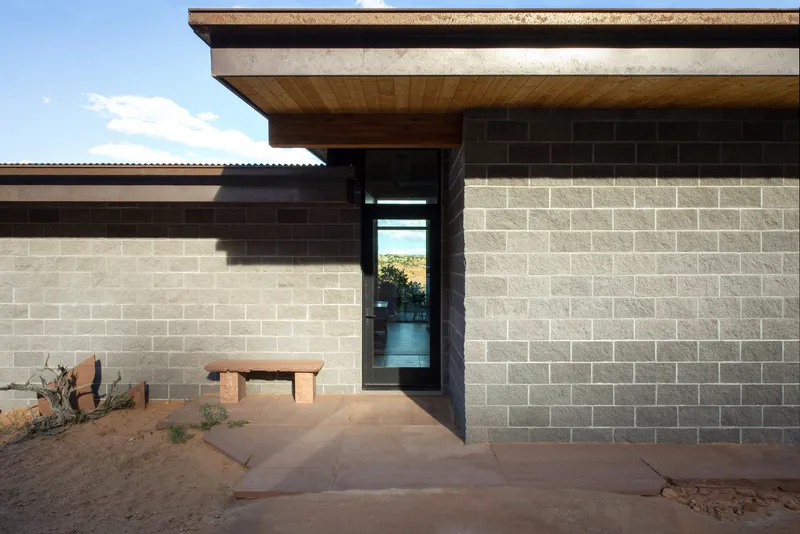
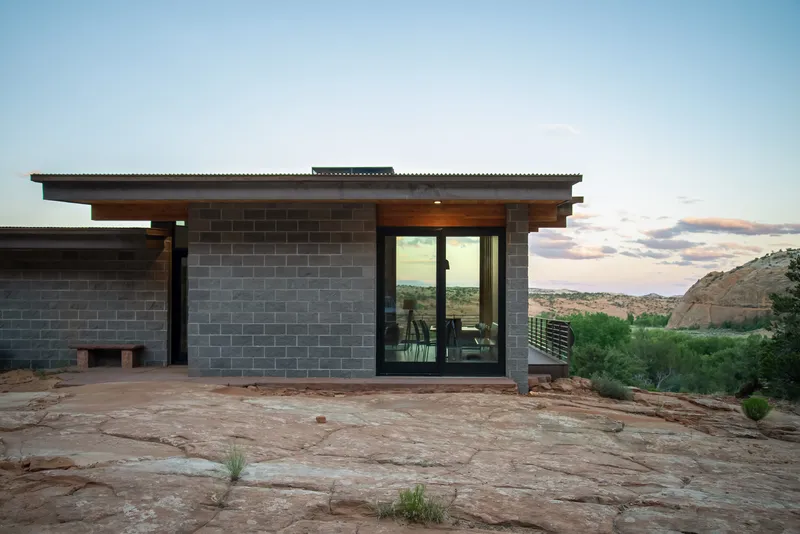
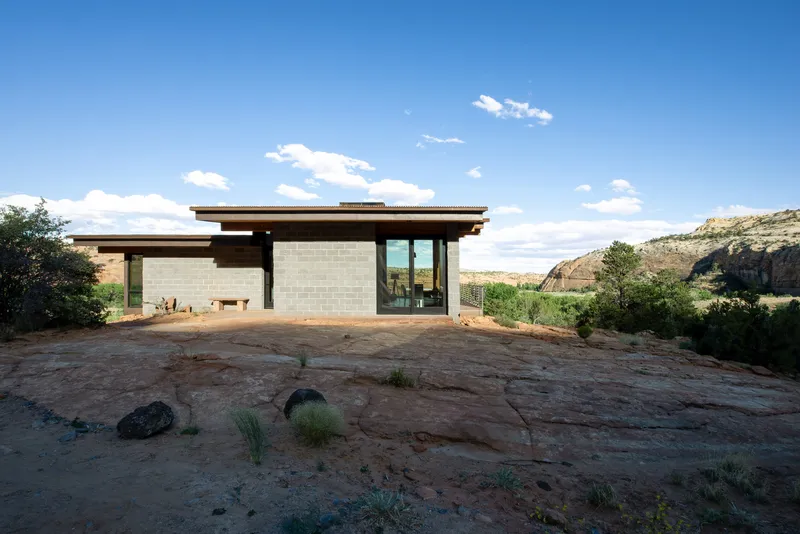
The two-tone concrete block walls deserve close attention. Rather than using a single grey tone, Imbue Design mixed lighter and darker units to create a subtle chromatic variation that mirrors the banding of the sedimentary rock nearby. The effect is understated but deliberate. Up close, the walls have a handmade texture that catches raking desert light; from a distance, they blend into the terrain.
Narrow glazed slot openings punctuate the entry facade, giving the block walls a fortress quality that makes sense in a climate where afternoon sun can be punishing. The deep timber soffit overhangs do double duty, shading the glass and creating a threshold that mediates between the bright exterior and the cooler interior. At dusk, as seen in the approach view, the warm glow from those slots transforms the building into something lantern-like against the darkening canyon.
Living Inside the View
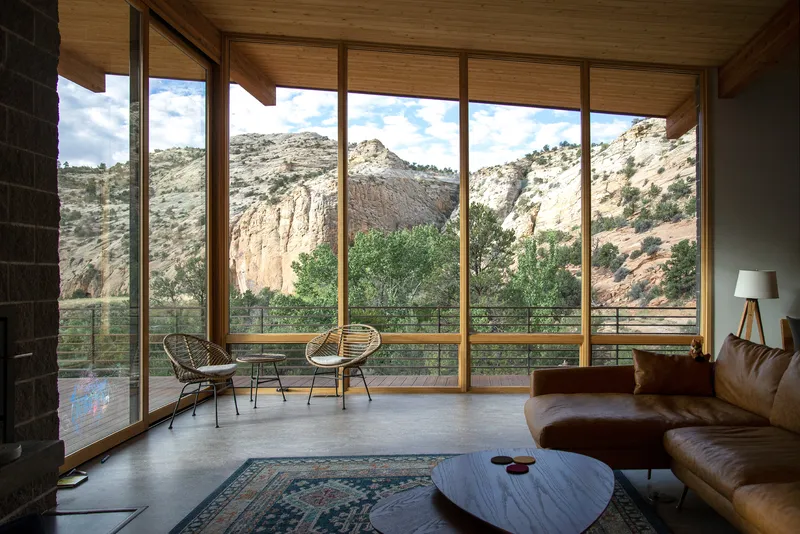
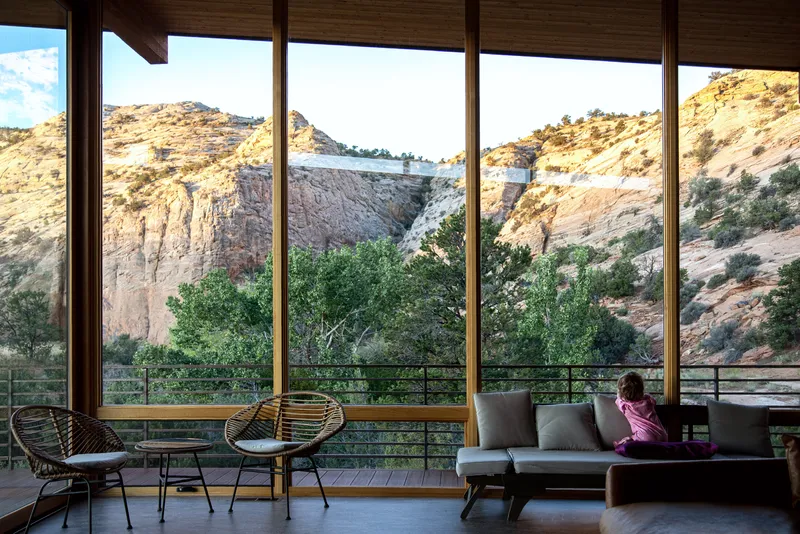
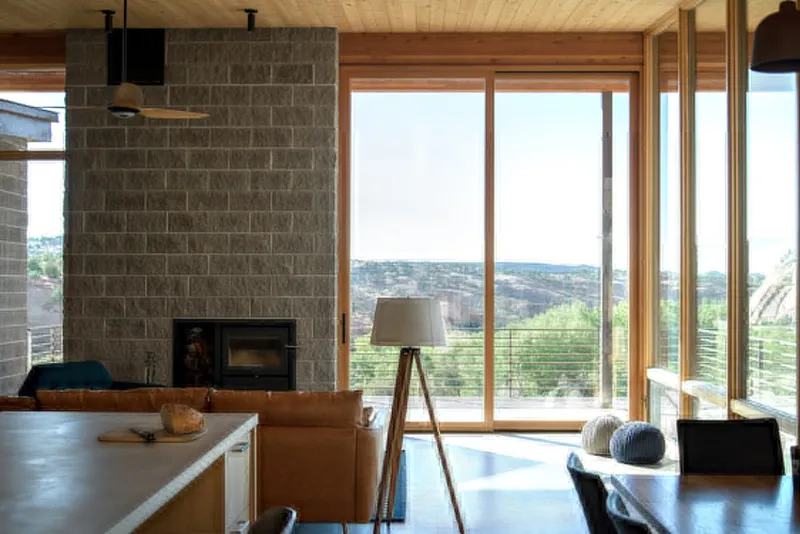
The interior strategy flips the closed, protective facade on its axis. Where the entry side is guarded and opaque, the canyon side is almost entirely glass. Floor-to-ceiling glazing in the living room frames the eroded sandstone cliffs so precisely that the view functions less as scenery and more as a living wall. The concrete block fireplace wall anchors the open kitchen and dining area, pulling the exterior material inside and reinforcing the continuity between house and landscape.
One image captures a person sitting on the terrace just beyond the glass, reading in the shade. It is a small, telling detail. The architecture succeeds because it creates calm zones for exactly this kind of unhurried occupation. Sliding glass doors dissolve the boundary between the dining area and the terrace, so the living space effectively doubles on mild days.
The Deck as Destination
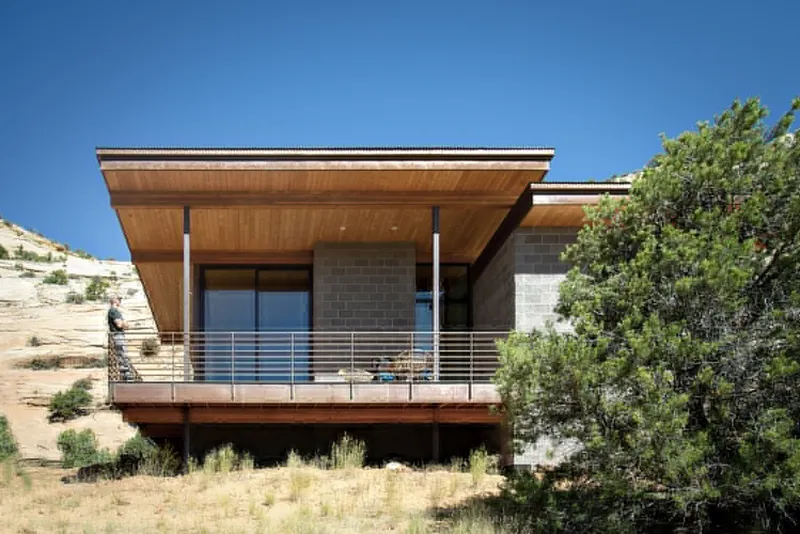
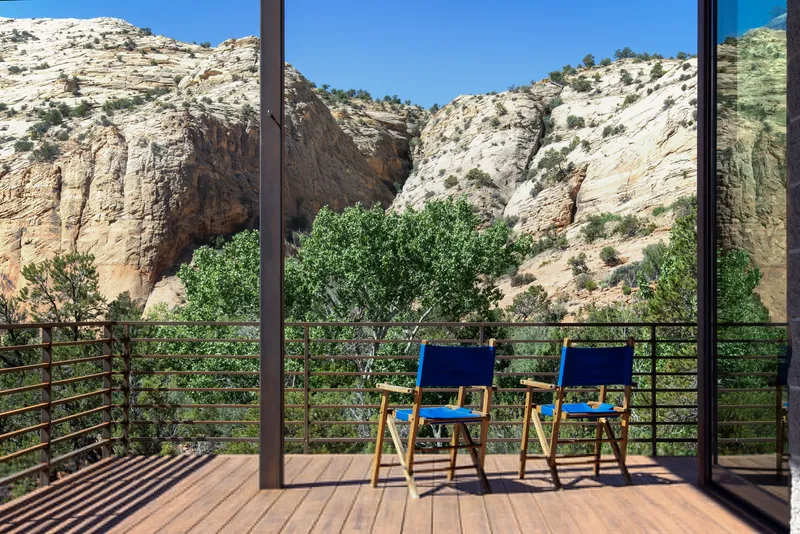
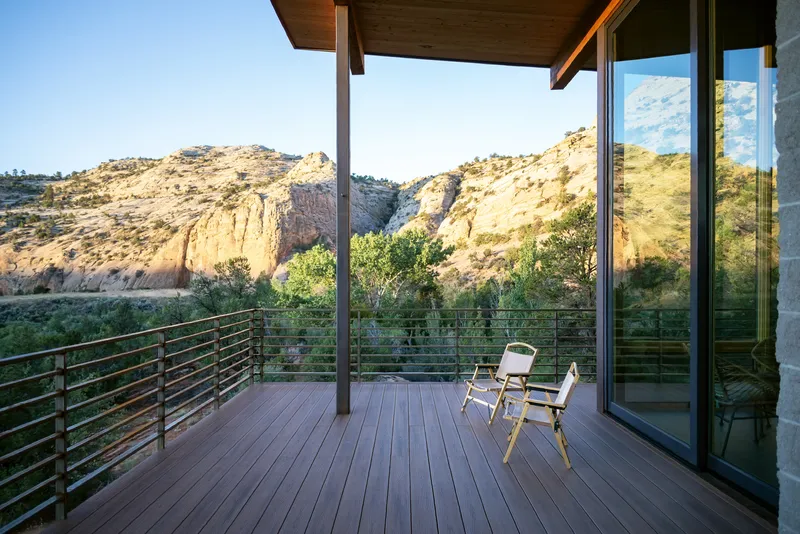
The elevated timber deck is the building's social center of gravity. Cantilevered over the sloping hillside on a concrete and steel structure, it projects the inhabitants out into the canyon without the vertigo of a fully transparent floor. Horizontal steel railings maintain the sight lines while providing a sense of enclosure that a cable railing would not.
Two blue canvas chairs appear across multiple views, always facing the canyon. It is a deliberate staging, but it also reveals the truth of how this space works. The covered portion of the deck, with its deep timber soffit, offers shade during the hottest hours. The open portion captures morning and evening light. Between the two conditions, the deck is usable for most of the day, which in a remote desert setting makes it the most important room in the house.
Material Honesty at the Detail Scale
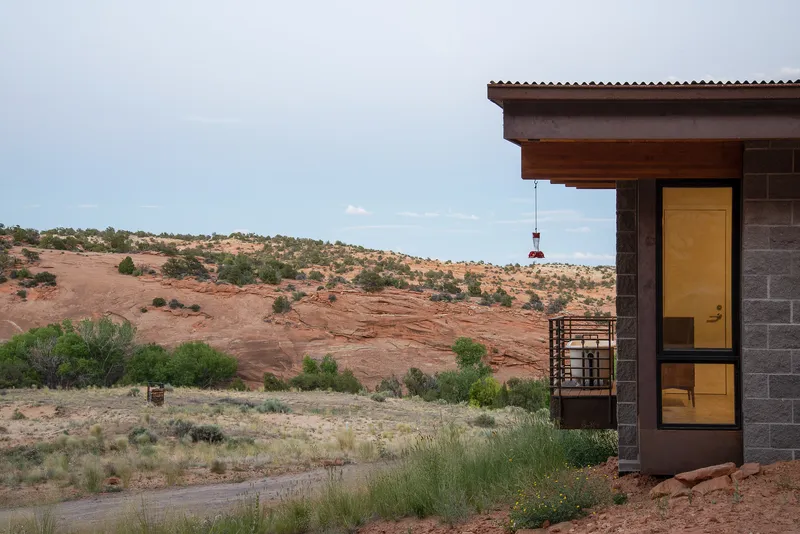
At the corners and transitions, the building reveals its construction logic clearly. Concrete block meets timber soffit with a clean, unadorned joint. Glazed doors sit flush in their steel frames. There is no applied trim, no decorative molding, no moment where a cheaper material is dressed up to look like something else. For a retreat that could easily have leaned into rustic luxury clichés, this honesty is refreshing.
The palette also ages well. Concrete block weathers gracefully in arid climates, and untreated timber develops a silver patina that converges with the grey of the masonry over time. The house will look better in twenty years than it does today, which is about the highest compliment you can pay to a material selection.
Why This Project Matters
Desert architecture in the American West has a tendency to oscillate between two extremes: the glass-box spectacle that prioritizes views at the expense of thermal performance, and the earth-toned bunker that hides from the landscape it claims to celebrate. Imbue Design's Escalante Retreat does neither. It is selectively open and selectively closed, and the logic governing those choices comes directly from sun angles, wind patterns, and the specific topography of the site.
More importantly, the project demonstrates that material restraint is not the same as austerity. The spaces are generous, the views are extraordinary, and the deck is genuinely luxurious in the way it frames canyon light. But none of that required imported stone, exotic hardwoods, or elaborate structural gymnastics. Concrete block, timber, steel, and glass, deployed with precision and discipline, were enough. In a region where development pressure is increasing, this kind of intelligence about what to build and how much is exactly what the landscape demands.
Escalante Retreat by Imbue Design, Escalante, Utah, United States. Photography by Imbue Design.
About the Studio
Share Your Own Work on uni.xyz
If projects like this are the kind of work you want to make, uni.xyz is a place to publish your own, find collaborators, and enter design competitions.


Popular Articles
Popular articles from the community


longwave studio Reorganizes a 112 m² Tainan Apartment Around the Daily Routines of a Family and Two Cats
In Tainan, Taiwan, birch plywood, rust-red furniture and a freestanding plaster wall link arrival, storage, work and family life in one apartment.

David Macias Steps a Doorless Stone and Plaster House Down a Tropical Colombian Hillside
In the humid hills of Colombia, Threshold House replaces the front door with an open void and terraces its 850 m² down the slope instead of fighting it.

David Ortega Stacks a Two-Story Mexico City Penthouse Around a Steel Stair and a Pergola-Shaded Roof Terrace
In Colonia Roma, a 300 m² penthouse uses oak joinery, a planted steel stair and a slatted roof pergola to make a new-build apartment feel like a house.

U.GA Architects Wraps an Oval Rooftop Pool in Curved Board-Formed Concrete on Busan's Jeollidan-gil
In Busan's Jeonpo-dong, a 454 m² mixed-use block stacks a neighborhood facility, guest rooms and an oval rooftop pool inside spiraling concrete walls.

Similar Reads
You might also enjoy these articles


Hodi-Mandai Geram
Project Function: Preservation and revitalization of the Intangible heritage and socio-spatial identity of the Hodi by Housing, Cultural Memory Center, Sacred Grove, landscape, local tourism economy


Olio Towers: A Mid-Rise for Performers That Fuses Housing, Rehearsal, and Stage
Located blocks from Houston's Theater District, this modular tower stacks living units around a central performance atrium.

Oasis: Modular Green Housing Carved into Dhaka's Urban Fabric
A shortlisted Plugin Housing entry reclaims unauthorized settlements in Dhaka with stepped concrete volumes, green roofs, and ventilation-driven design.

Black Hole: A Floating Megastructure for the Post-Physical Era
Emiliano Mazzarotto envisions a spherical, self-scaling arena where e-sports, digital hotels, and holographic stadiums replace traditional public space.

Explore Desert Architecture Competitions
Discover active competitions in this discipline

Challenge to illustrate the ruins of Petra

Challenge to reimagine the Iron Throne

Photograph architecture without architects

Illustrate the lost glory of Angkor Wat - Render Challenge
Comments (0)
Please login or sign up to add comments
No comments yet. Be the first to comment!