
Estúdio Cidade Builds a Landscaped Office Oasis Inside a Brazilian Fuel Depot
A two-story office building on a triangular slope in Ribeirão Preto introduces green space and filtered light to an industrial fuel base.


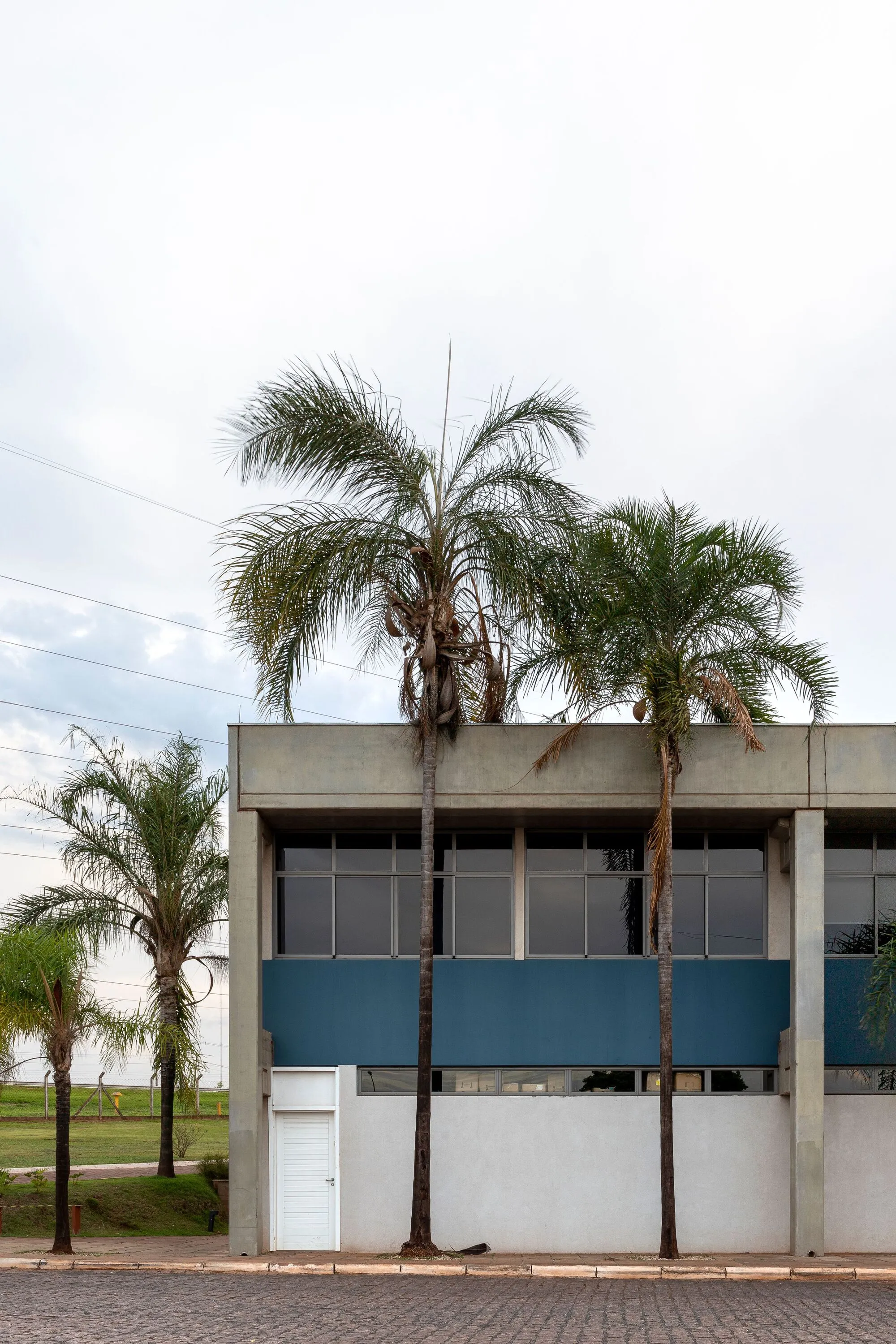
An office building inside a fuel distribution complex is about the least glamorous brief an architect can receive. But Estúdio Cidade treated the Ribeirão Preto Shared Fuel Base Office as proof that even utilitarian infrastructure sites deserve thoughtful architecture. Sited on a triangular, sloping parcel wedged between an existing administrative building and a truck lane leading to the operational area, the 1,060 m² building reorganizes what was a disjointed landscape of randomly placed trees, irregular terrain, and sun-blasted rooms into something genuinely civic: a workplace wrapped around a small public square, anchored by mature palms and shaded terraces.
What makes the project worth studying is the way it stacks pragmatic decisions into a coherent whole. Exposed structural porticoes double as sun control. Relocated trees become landscape design. A slatted metal ceiling in the upper corridor filters zenith light so artificial lighting can be minimized. The result is a building that reads as simple, almost quiet, yet every move is doing real work. For a facility that stores and distributes fuel, the introduction of living areas, planted ground, and flexible common spaces was, by all accounts, unprecedented.
A Facade That Works for a Living
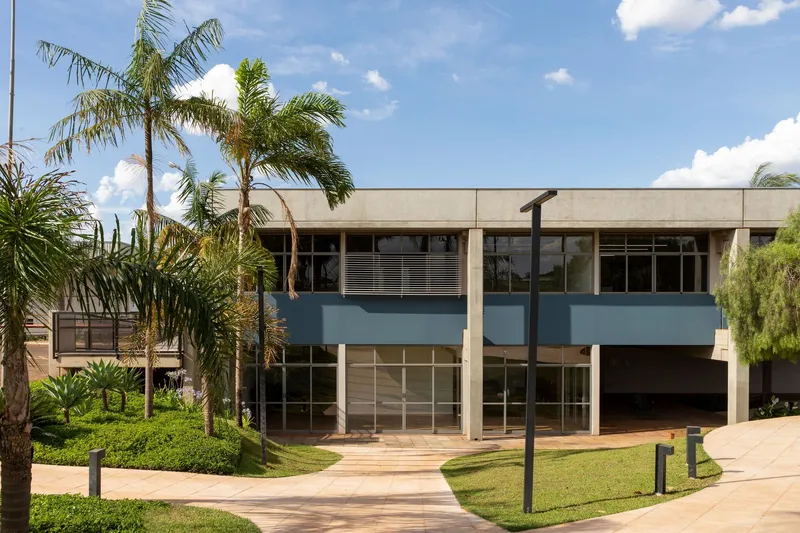


The long, horizontal elevation is defined by a bold blue band of ribbon windows running across both floors, interrupted only by the vertical trunks of palms that predate the building. Structural pillars project forward from the volume, their upper beams forming concrete porticoes that shade the glazing behind them. It is a straightforward industrial language, but the proportions are careful: the porticoes break down the facade's scale and reduce direct solar gain on the office rooms, turning a structural diagram into a passive cooling strategy.
The color palette keeps things tight. White plaster, exposed concrete, and that single saturated blue for the window infill panels. Against the tropical sky and green canopy, the building reads as crisp without trying to be flashy. The tripartite composition, visible from the street approach, gives the facade a civic presence unusual for a fuel depot.
Ground Floor: Terrace, Garden, and Flexibility
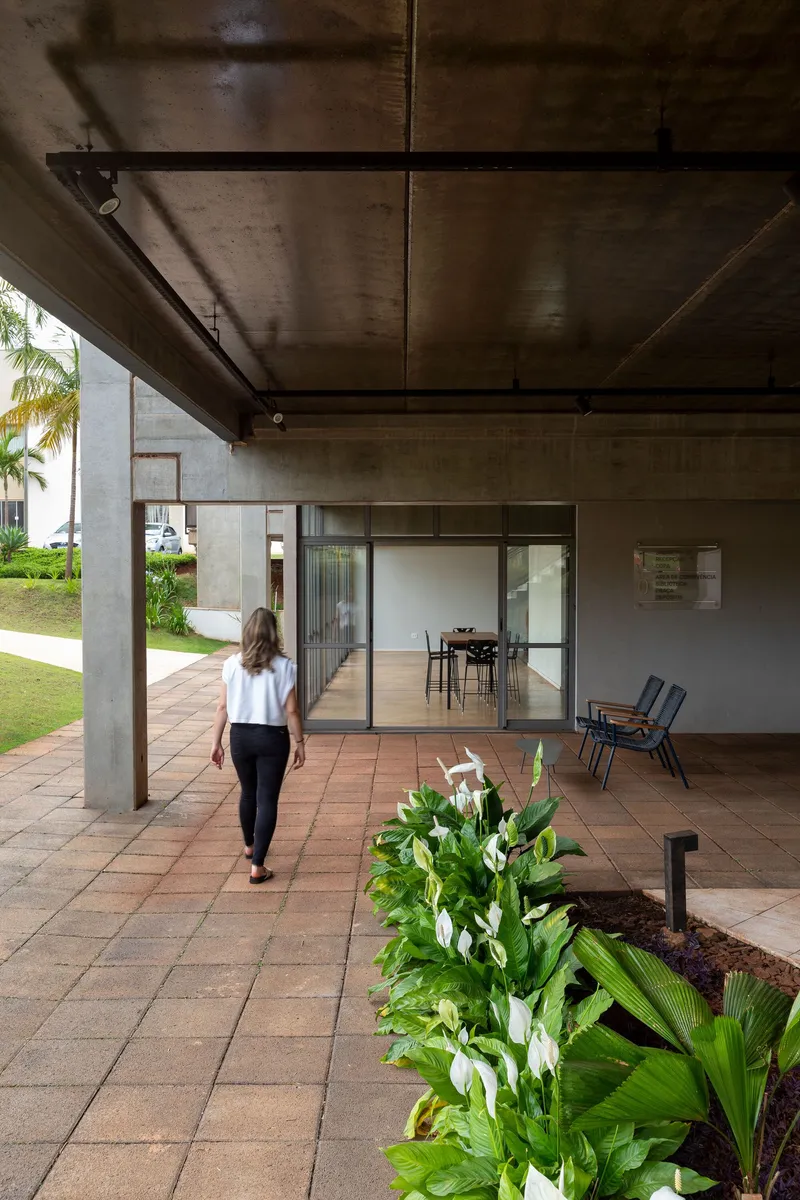

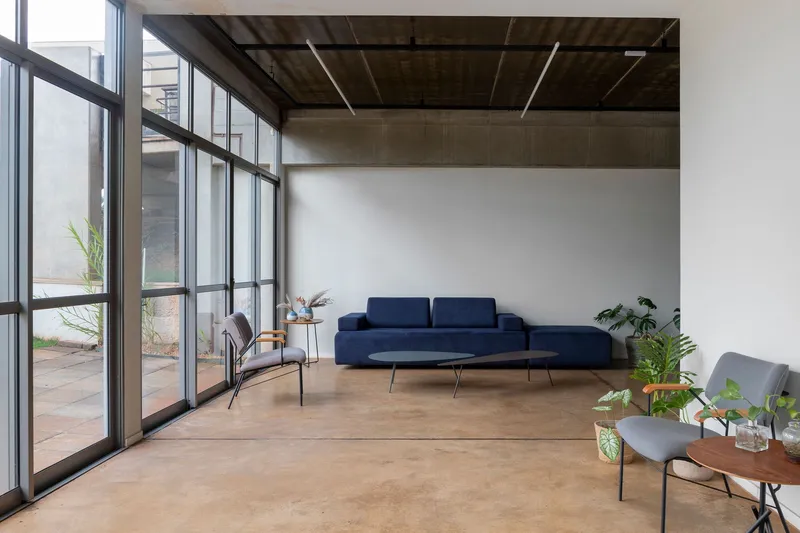
The ground level is deliberately loose. A covered terrace paved in terracotta transitions into a lounge space with floor-to-ceiling glazing on two sides, blurring the line between interior and landscape. The living area, technical zone, and storage occupy defined zones, but common areas are furnished with movable pieces so layouts can shift as needs change. A covered area is reserved for future expansion, meaning the building was designed to grow without demolition.
The relationship to the garden is the key move here. Existing trees were not cleared but relocated to compose a small square, and the floor design follows pre-existing pedestrian paths while adapting to the site's natural topography. For employees who spend their days at a fuel logistics facility, the result is a genuine amenity: a shaded, planted ground plane that frames the office rather than the other way around.
Upper Floor: Repetition, Light, and the Slatted Ceiling

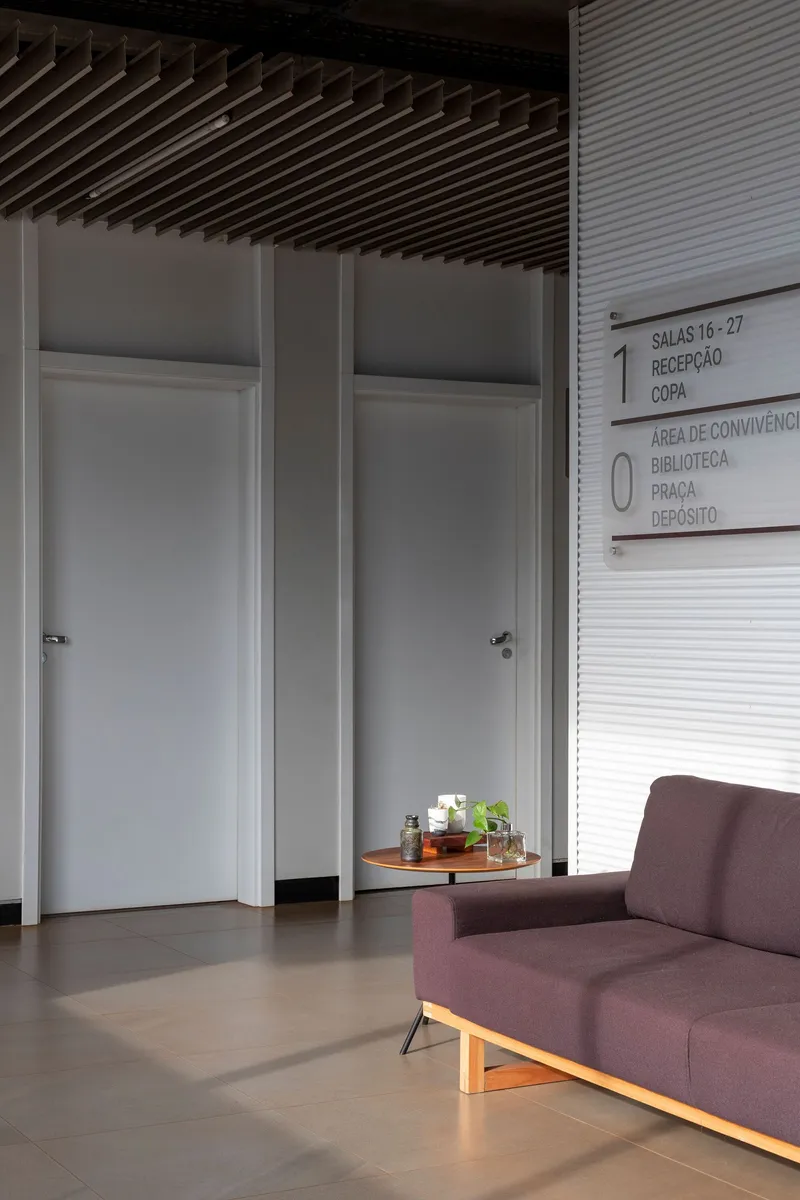

Upstairs, twelve commercial rooms line a central corridor served by a single staircase. The plan is deliberately repetitive, a grid of equivalent offices flanking shared reception and bathroom cores. Variety comes not from spatial gymnastics but from material texture: a slatted metal ceiling (manufactured by CB Metal) runs the length of the corridor, filtering zenith light from a rooftop skylight down into the circulation spine. The effect is spacious and calm, with shifting light patterns replacing the harsh glare that plagued the existing offices on site.
Wayfinding is handled with clean signage mounted flush against white walls, and large-format floor tiles keep the material joints minimal. The overall impression is of a building that knows it is an office, not a museum, and channels its energy into the quality of light and air rather than decorative gestures.
The Blue Volume and Exposed Structure


An exterior stair with metal handrails ascends beneath a cantilevered blue volume, giving the building its most expressive moment. The exposed concrete structure is left raw, with coffered ceilings visible inside the lounge spaces. This is industrial architecture that embraces its own logic rather than concealing it behind finish materials. The blue upholstered seating in the lounge picks up the facade's color, tying interior and exterior into a single graphic language.
The honesty of the structure is not just aesthetic. Exposing the concrete frame kept costs down on a project with a limited budget, and the resulting legibility makes maintenance and future adaptation straightforward. It is a pragmatic decision that also happens to look good.
Plans and Drawings


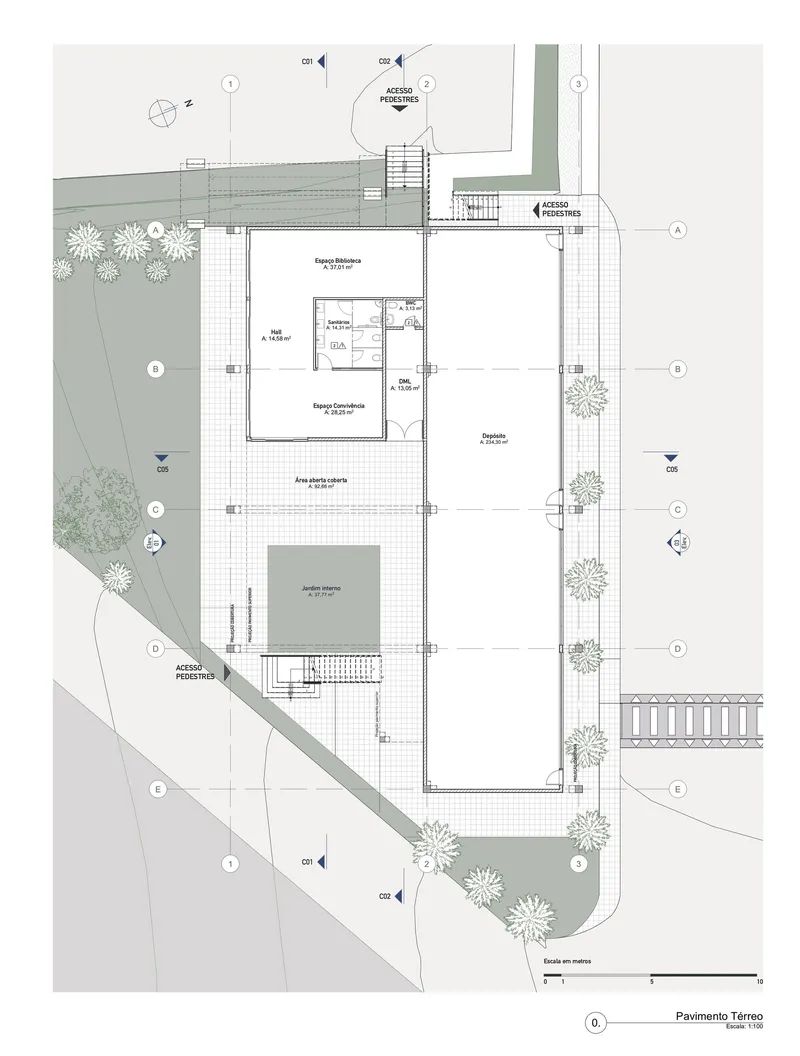
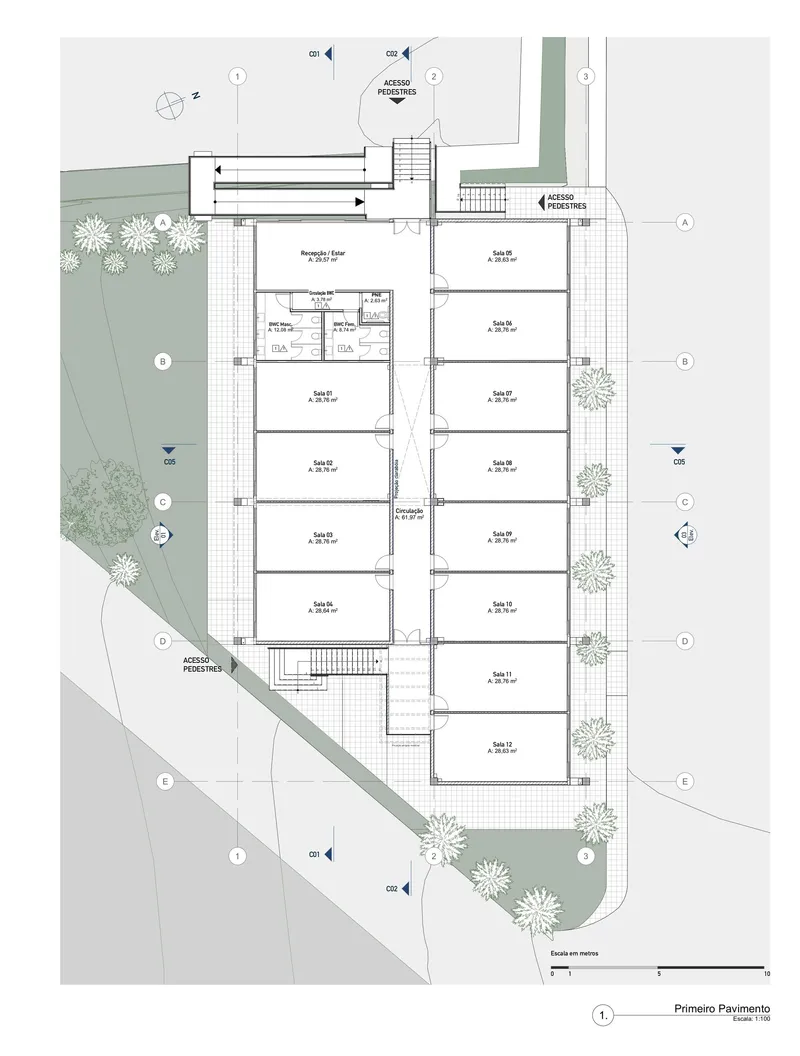
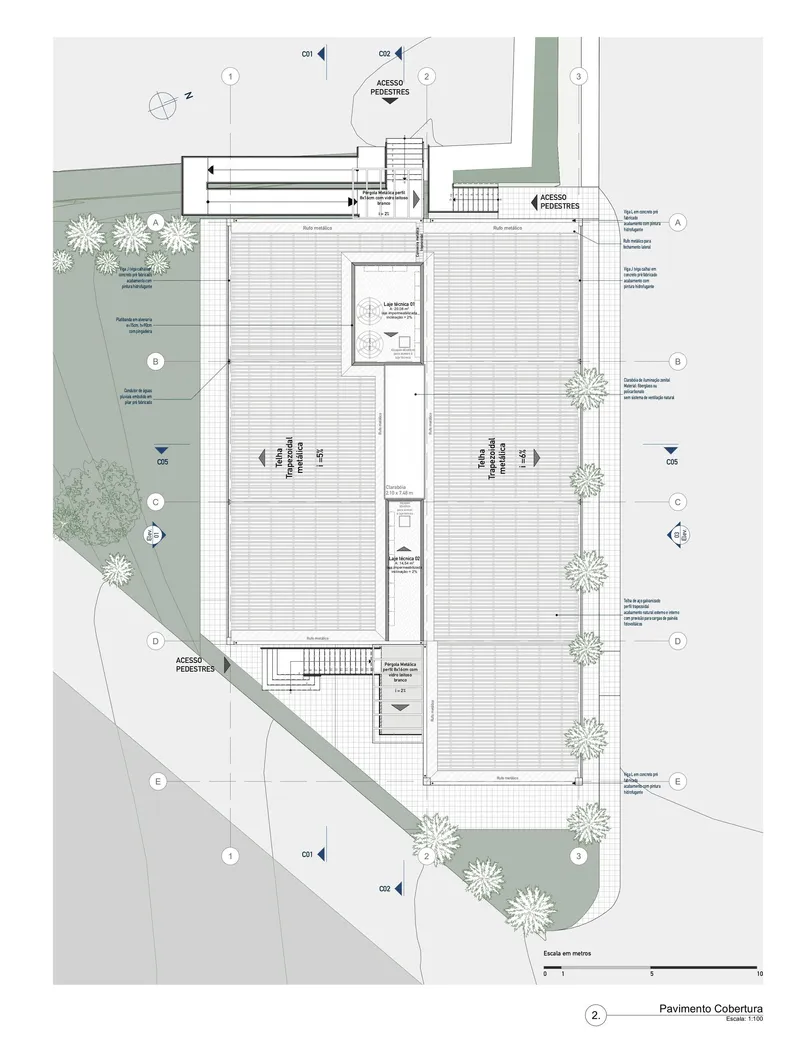

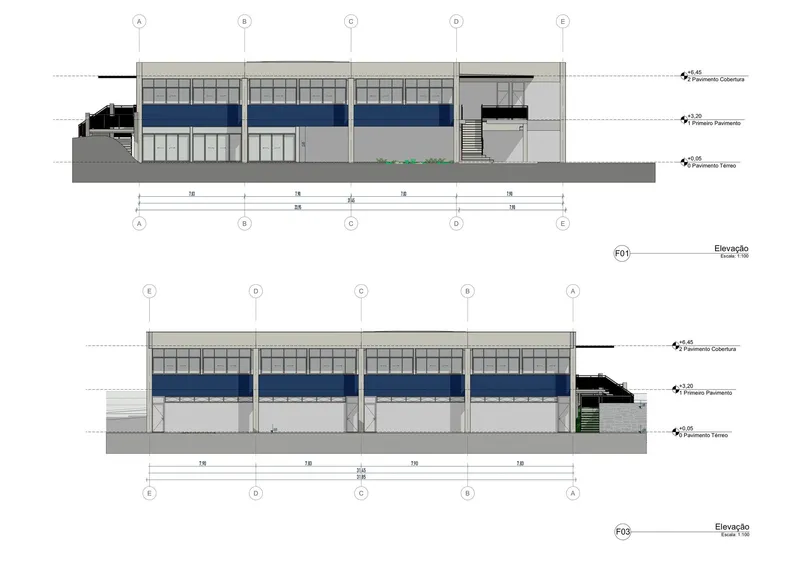

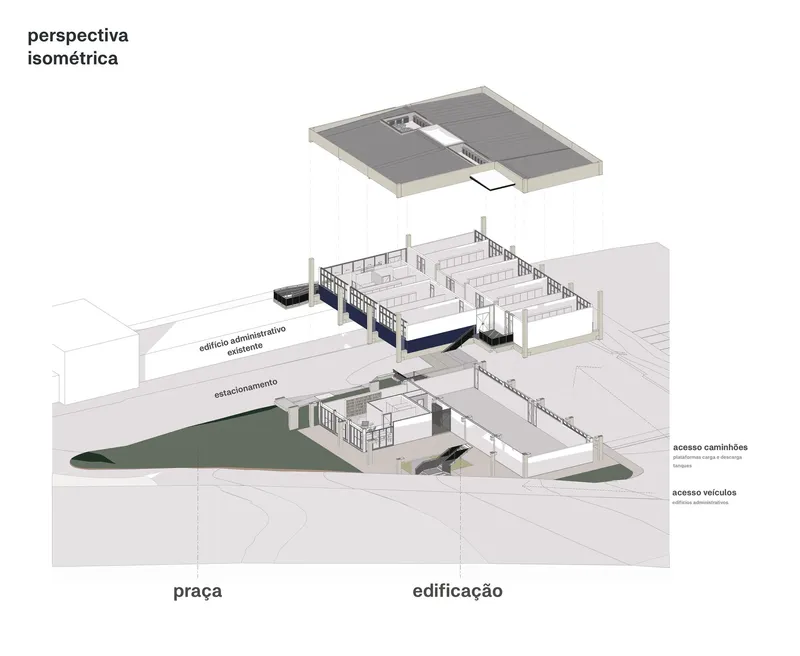
The site plan reveals the constraints that shaped the design: a narrow, angled parcel surrounded by fuel tanks, access roads, and operational infrastructure. The exploded isometric is particularly instructive, showing how the building separates into a public plaza at grade, a parking and service level, an elevated administrative floor, and a roof plane with central skylight. The landscape plan documents every tree species and curving path, confirming that the planting was composed rather than incidental.
Sections cut through the two-story volume illustrate the porticoes' depth and the way the terraces step down with the topography. The construction details, including wall sections, panel profiles, and roof assembly, show a building assembled from standard industrial components with precision rather than extravagance. The elevation drawings make clear how the blue banding unifies what is, in plan, a straightforwardly rational grid.
Why This Project Matters
The Ribeirão Preto Shared Fuel Base Office matters because it demonstrates that workplace quality is not a function of budget or program prestige. A fuel depot is not a tech campus or a museum. It is a place where people go to work every day in conditions that are often overlooked by architects and clients alike. Estúdio Cidade's intervention, introducing a garden, flexible common spaces, filtered natural light, and passive sun control, improves daily life at a facility that would normally never get this level of design attention.
It also offers a compact lesson in doing more with less. Every exposed beam, every relocated tree, every slatted ceiling panel is pulling double duty: structural and environmental, aesthetic and practical. In a moment when architecture frequently confuses complexity with quality, this project makes the opposite case. Clarity of intention, executed with discipline on a constrained site and budget, produces a building that is both generous and legible. That is harder than it looks.
Ribeirão Preto Shared Fuel Base Office, designed by Estúdio Cidade, Ribeirão Preto, Brazil. 1,060 m². Completed in 2020. Photography by Keniche Santos.
About the Studio
Share Your Own Work on uni.xyz
If projects like this are the kind of work you want to make, uni.xyz is a place to publish your own, find collaborators, and enter design competitions.



Popular Articles
Popular articles from the community


The Ocean Hive: Sustainable Architecture for a Self-Sufficient Civilization at Sea
The Ocean Hive imagines sustainable architecture at sea, where modular habitats, algae, wave power and ocean waste sustain a growing colony.

The Musturak Paradise: Senior Living Architecture for a Connected Future in Temara, Morocco
The Musturak Paradise reimagines senior living architecture in Temara via private homes, social spaces, culture, community, and shared care.

Riyadh For All: Intergenerational Urban Design for Active Aging in Rabat
Riyadh For All reimagines urban design in Rabat with intergenerational co-living, adaptive courtyards, and Moroccan cultural exchange today.

Conexión: Biophilic Design Reimagines High-Rise Living in Hong Kong
Conexión reimagines high-rise living in Hong Kong through biophilic design, green facades, shared spaces, daylight, water and nature within.

Similar Reads
You might also enjoy these articles

Bao Huynh Watercolor Atelier: A Serene Art Retreat in Hội An
Bao Huynh Watercolor Atelier in Hội An blends multifunctional art spaces, sustainable design, local materials, and family-friendly living in a serene environment.

Atelier Macri Concept Store Interior Design by CASE-REAL
Atelier Macri store features a "ko" counter, walnut wood details, cork displays, blending retail, gallery, and seamless customer experiences.

Manuel Vargas Izquierdo Stadium and High-Performance Sports Center: Architectural Excellence in Jalpa de Méndez
The Manuel Vargas Izquierdo Stadium blends sustainable design, inclusive sports facilities, and cultural-inspired architecture, revitalizing Jalpa de Méndez’s public spaces.

KAKR Buluh Awar Hall: Revitalizing Community and Ecology Through Bamboo Architecture
Community built bamboo hall revitalizes Buluh Awar village, empowering youth, restoring ecology, celebrating vernacular craftsmanship through sustainable architecture and culture.

Comments (0)
Please login or sign up to add comments
No comments yet. Be the first to comment!