

Estúdio HAA! Splits a Prefab Mountain Retreat into Two Timber Pavilions in Brazil's Serra da Mantiqueira
A 107 m² parametric timber house in Sapucaí-Mirim resolves prefabrication and landscape with two gabled volumes linked by an open spine.


Prefabricated housing has a credibility problem. Too often it arrives as a sealed box, indifferent to slope, view, and wind. Sagarana House, designed by Estúdio HAA! and led by architect Homã Alvico, treats prefabrication as a starting grammar rather than a finished sentence. Two gabled timber volumes sit on a hillside clearing in Sapucaí-Mirim, a municipality tucked into Brazil's Serra da Mantiqueira range, and the 107 m² footprint reads less like a kit home and more like a pair of rural outbuildings that have always been there.
What makes Sagarana worth studying is the tension between its parametric system and its site-specific posture. The house was developed within the framework of PELE, a construtech platform built around personalized prefab components, yet every decision here, from the split plan to the orientation of each pavilion, responds to topography and to the forested mountain ridge behind it. The result is a project that argues prefabrication and landscape architecture are not enemies but collaborators.
Two Pavilions and a Mountain Ridge


From above, the strategy is immediately legible. Two linear gabled volumes anchor a clearing carved from the hillside, their metal roofs catching light against a dense backdrop of Atlantic Forest. The pavilions are not identical twins; they differ slightly in length and program, creating an asymmetry that keeps the composition from looking stamped out. The lawn between them operates as an outdoor room, bounded on one side by the architecture and on the other by the mountain itself.
The choice to split the mass into two wings is critical. A single volume of 107 m² would have sat heavily on the slope. By dividing it, the architects reduce each building's visual weight and allow air and light to move through the site. It is a classic move in rural Brazilian modernism, but here it is executed through a prefab logic that makes the geometry repeatable without making it generic.
Timber Skin, Metal Shell

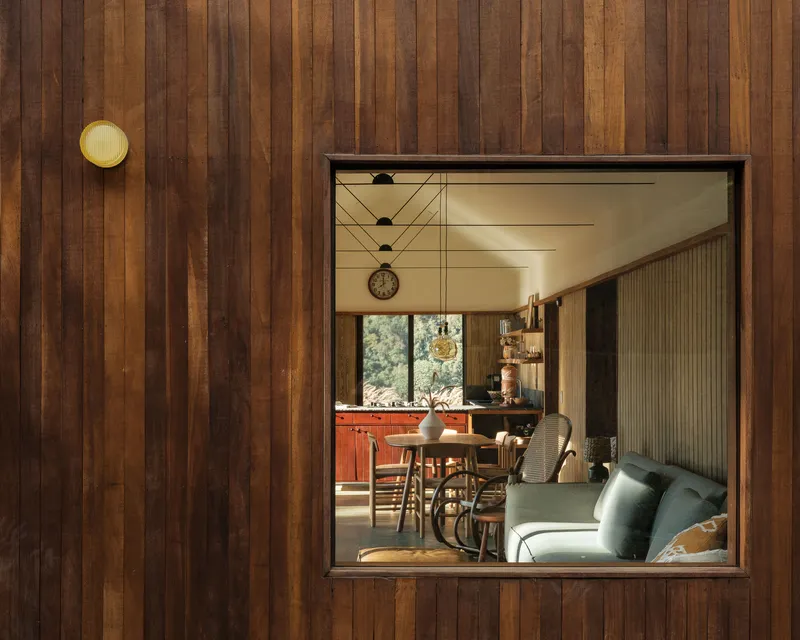

The material palette is disciplined to the point of restraint: vertical timber cladding wraps the walls, plywood lines the ceilings, and standing-seam metal caps each gabled roof. There is no moment where the envelope shifts to plaster or concrete. The consistency reads as confidence, not monotony. Vertical boards run uninterrupted from base to soffit, emphasizing the height of each pavilion and giving the facades a corduroy texture that shifts in color through the day.
Small square windows punched through the timber skin act as viewfinders. One frame, for instance, reveals the dining area with its pendant lights and sofa, composing a scene within a scene. These apertures are deliberately modest, keeping the envelope solid where privacy or thermal performance demand it and opening up only where a specific view or light condition justifies the interruption.
Interior Warmth Without Excess
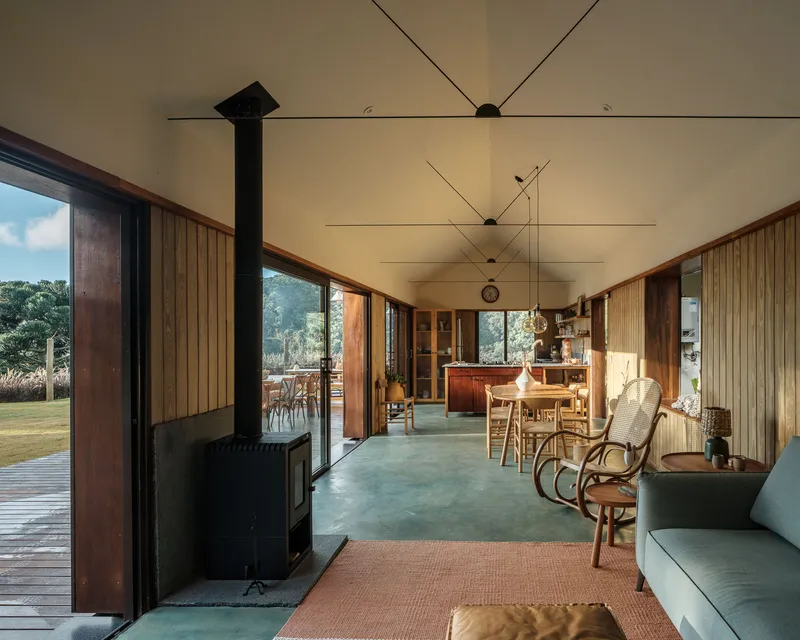

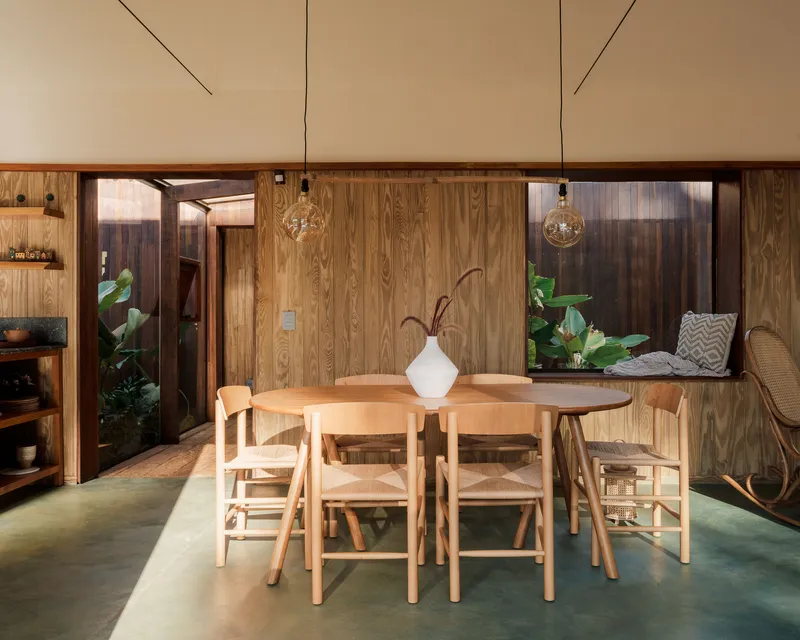
Step inside and the same timber logic continues, creating an unbroken material continuity between exterior and interior. The open-plan living space centers on a freestanding wood stove, a functional anchor in a mountain climate where evenings turn cold. Plywood ceilings follow the gable's rake, making the small rooms feel generous. Afternoon light enters through a long horizontal window in the sitting area, painting a warm band across the timber wall.
The dining zone is compact but carefully proportioned. Pendant lights hang at a low, social height, and the openings onto a courtyard bring cross-ventilation and green views into what could otherwise feel like a cabin interior. Furniture is kept simple: timber chairs, a solid table, nothing competing with the architecture for attention. The restraint pays off. The spaces feel calm, specific, and proportioned for habitation rather than photography.
Bedrooms Under the Gable
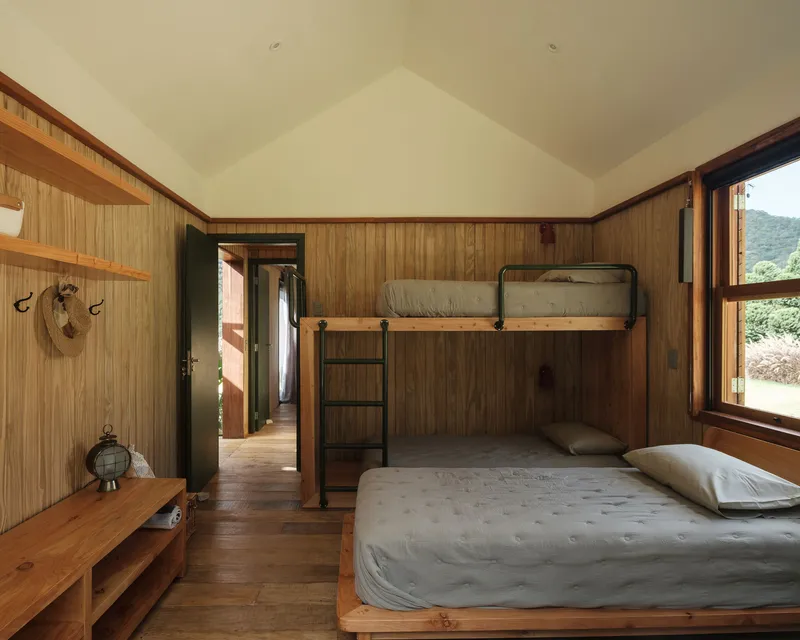

The sleeping quarters demonstrate how a parametric frame can still produce intimate rooms. A bunk bed with a metal ladder slots neatly under the gabled plywood ceiling, turning the roof's pitch into a spatial asset rather than wasted attic. Timber walls wrap the room completely, reinforcing a sense of enclosure and warmth that suits a mountain retreat. It is the kind of space that makes you want to stay the weekend.
Landscape as a Third Room
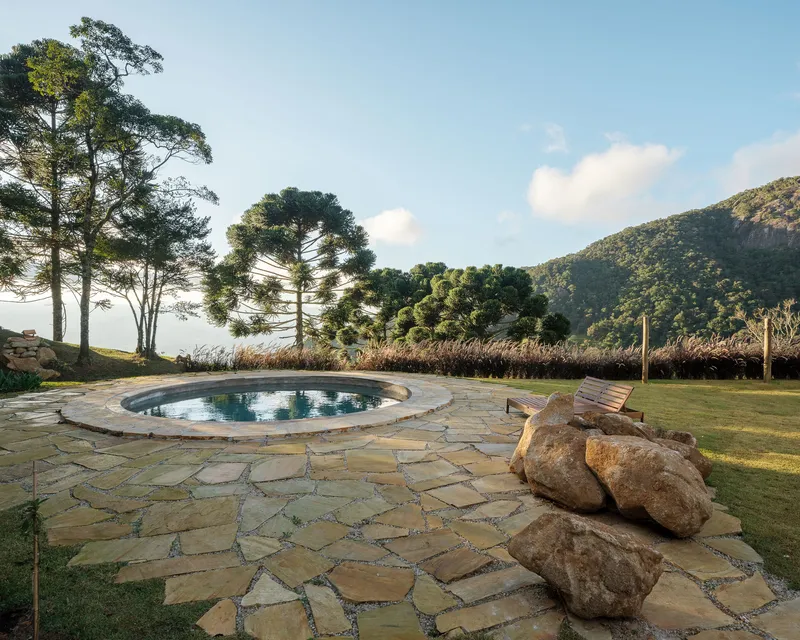

Between and around the two pavilions, the landscape design does significant architectural work. A circular pool, surrounded by flagstone paving, boulders, and ornamental grasses, sits as a focal point facing the forested hills. Its geometry is deliberate: the circle echoes nothing in the rectilinear building plan, creating a counterpoint that prevents the composition from reading as purely orthogonal.
At dusk the two lit volumes glow against the darkening ridge, connected by flagstone paths and a timber deck. The landscape is not decoration applied after the architecture was finished; it is the connective tissue that makes two separate buildings feel like one house. Ornamental grasses soften edges, and the sloping terrain is left largely ungraded, letting the buildings perch rather than dominate.
Plans and Drawings


The site plan confirms what the photographs suggest: the two wings follow the slope's contour lines rather than imposing a foreign grid. The floor plan reveals a central circulation spine connecting the two linear volumes, with living spaces in one wing and bedrooms in the other. A section through both gabled forms shows a flat-roofed link bridging the gap, low enough to read as a threshold rather than a third volume.
The exploded axonometric is the most revealing drawing. It peels apart the timber structural frame from the roof panels and wall envelope layers, exposing the parametric kit-of-parts logic at the heart of the project. You can see how standardized members assemble into the gabled frame and how cladding, insulation, and roof sheeting stack onto that skeleton. It is a clear argument that industrialized construction can still produce architecture with character.
Why This Project Matters
Sagarana House matters because it offers a credible answer to one of the hardest questions in contemporary residential design: how do you build fast, affordably, and repeatably without producing something that looks like it was stamped from a catalog? By splitting the program into two pavilions, grounding each in the topography, and wrapping everything in a consistent timber envelope, Estúdio HAA! proves that a parametric system can generate site-responsive architecture. The prefab logic is there when you look for it in the drawings, but invisible in the lived experience.
In a Brazilian context where rural second homes are frequently oversized concrete villas with little regard for the landscape, a 107 m² timber house that defers to its mountain setting is a quiet but pointed critique. The project suggests that constraint, both in area and in material palette, is not a limitation to overcome but a discipline that produces better buildings. For the growing community of architects and developers experimenting with construtech platforms, Sagarana should be a reference point: proof that the system serves the site, not the other way around.
Sagarana House by Estúdio HAA! (lead architect: Homã Alvico). Sapucaí-Mirim, Brazil. 107 m². Completed 2025. Photography by Pedro Kok.
About the Studio
Share Your Own Work on uni.xyz
If projects like this are the kind of work you want to make, uni.xyz is a place to publish your own, find collaborators, and enter design competitions.


Popular Articles
Popular articles from the community


Juan García Correa, John González and Claudia Rueda Sink a Circular Amphitheater into a Manizales Engineering Building
On the La Nubia campus in Manizales, Colombia, the S1 Building folds labs and offices into a hillside of ramped lawns that double as a campus route.

Cube Design Draws an Ecological Corridor Between Two Shenzhen Hills with the Nankai Building
Beside Shenzhen's container docks, the Nankai Building pairs stacked balconies with a climbing green screen to connect two hillsides across its height.

Architekt Andreas Gruber Scatters 23 Dark Timber Chalets Across a South Tyrolean Forest Edge
In Molini di Tures, Amonti Chalets breaks a resort into a hamlet of gabled timber houses, with parking, storage and services pushed into the slope.

U.GA Architects Wraps an Oval Rooftop Pool in Curved Board-Formed Concrete on Busan's Jeollidan-gil
In Busan's Jeonpo-dong, a 454 m² mixed-use block stacks a neighborhood facility, guest rooms and an oval rooftop pool inside spiraling concrete walls.

Similar Reads
You might also enjoy these articles


LAVA Architecten Gives Vocational Education a Sawtooth-Roofed Face on a Mechelen School Campus
In Mechelen, Belgium, a 2,053 m² STEM school on a 6×6 m grid turns workshops and classrooms into rooms that can be rearranged as teaching changes.

KEMA Studio Turns a Derelict Marvila Attic into a 60 m² Lighthouse Apartment Above Lisbon
In Lisbon's Marvila district, a rebuilt roof, four skylights and two plywood volumes turn an unlivable attic into a bright home facing the Tagus.

Pixel Gardens: One Repeated Module Stacked Into a Terraced Social Housing Tower for Famagusta
Salem Bader's shortlisted housing tower builds a vertical neighbourhood from one repeated module, offsetting units to carve terraces, light and air.

Bao Huynh Watercolor Atelier: A Serene Art Retreat in Hội An
Bao Huynh Watercolor Atelier in Hội An blends multifunctional art spaces, sustainable design, local materials, and family-friendly living in a serene environment.

Explore Residential Building Competitions
Discover active competitions in this discipline

Challenge to design a portable theatre

Challenge to design a portable music platform

Challenge to design an open learning module for the elderly

Challenge to design mud housing for contemporary communities
Comments (0)
Please login or sign up to add comments
No comments yet. Be the first to comment!