
Ethno Cocoa Retreat: Mayan Geometry Reborn as a Cocoa Museum and Cultural Resort
A pyramid becomes a museum, courtyards become procession routes, and cocoa cultivation shapes an entire architectural language in Tabasco, Mexico.


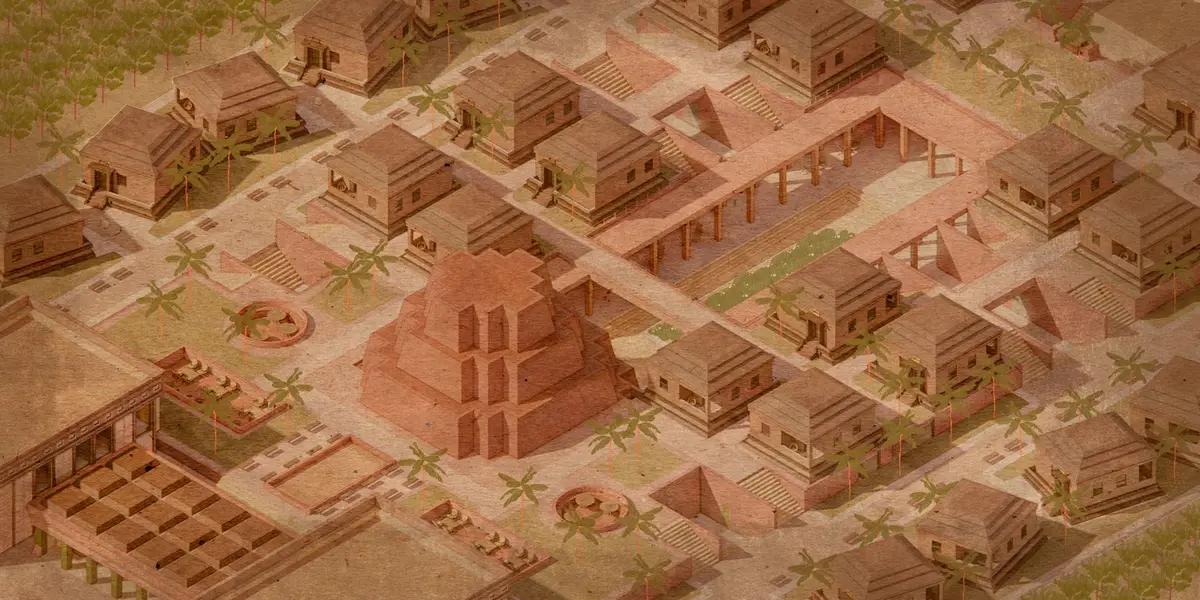
What happens when you treat a cocoa plantation not as an industrial site but as a sacred landscape? In Tabasco, Mexico, between the historic towns of Comalcalco and Chichicapa, a conceptual retreat takes the stepped pyramid, the communal courtyard, and the axial procession route of ancient Mayan cities and recasts them as the organizing principles for a contemporary cultural resort and cocoa museum. The result is a project that refuses to separate agriculture from ceremony, or hospitality from education.
Ethno Cocoa Retreat is designed by Jana Boskovic and entered as a People's Choice Award submission to Xocolatl, a competition centered on the cultural and architectural possibilities of chocolate. The project assembles a hotel complex, a pyramid-form exhibition hall, modular villas, amphitheaters, and cocoa processing workshops into a single campus that reads like a reinterpretation of Classical Period Mayan urbanism, built from clay, bamboo, and timber rather than limestone.
From Uxmal to Tabasco: A Lineage of Stepped Forms
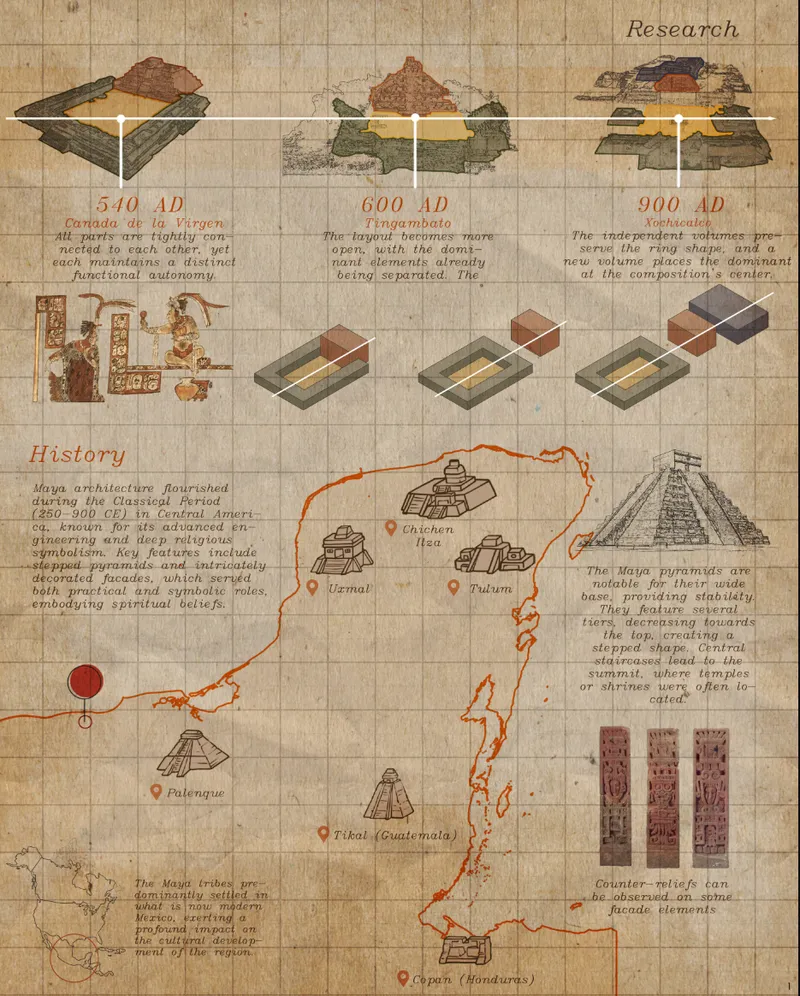
The research diagram above traces the evolution of pyramidal structures across three distinct time periods, rendered in axonometric projection to make the formal logic legible. Boskovic draws explicitly from sites such as Uxmal, Tikal, and Chichen Itza, where stepped pyramids, broad platforms, and ornamented facades carried cosmic meaning. The retreat does not replicate these forms literally. Instead, it distills their spatial principles: hierarchical organization, symmetry, strong axial geometry, and the idea that architecture mediates between earth and sky. The central pyramid in the retreat becomes the museum's main exhibition hall, symbolizing the axis mundi, the sacred vertical connection that anchored Mayan cosmology.
A Flat Tropical Site Organized by Ritual Procession
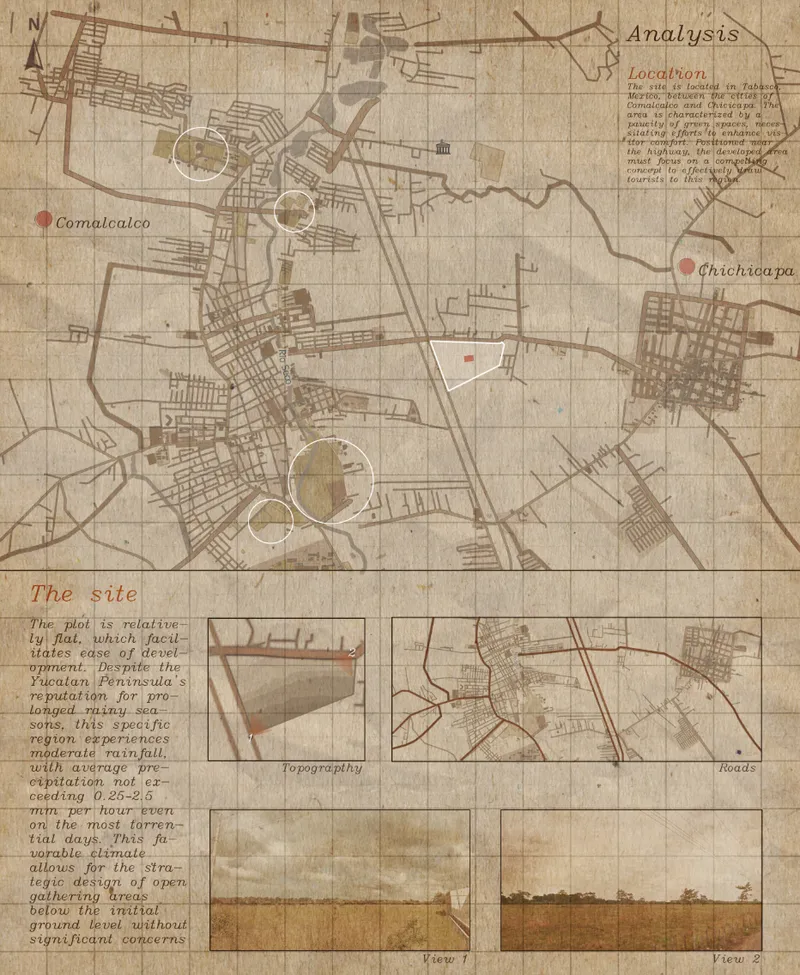
The site analysis map positions the retreat within a flat, fertile landscape with moderate rainfall: ideal conditions for cocoa cultivation. Two settlements are connected by roads, with circular markers identifying key programmatic nodes. Rather than imposing a grid, Boskovic mirrors the planning logic of traditional Mayan settlements, where open courtyards served as both social and ceremonial centers. Paths lead visitors through plazas, past villas, and into cocoa processing facilities in a sequence that echoes the ritual procession routes of ancient cities.
This layout is not just symbolic; it performs. The orientation of buildings and the spacing of open courtyards support cross-ventilation, natural lighting, and passive cooling, all essential in a tropical climate where minimizing artificial intervention is both an ethical and a practical imperative.
Hotel Complex: A Gateway That Teaches Before It Shelters
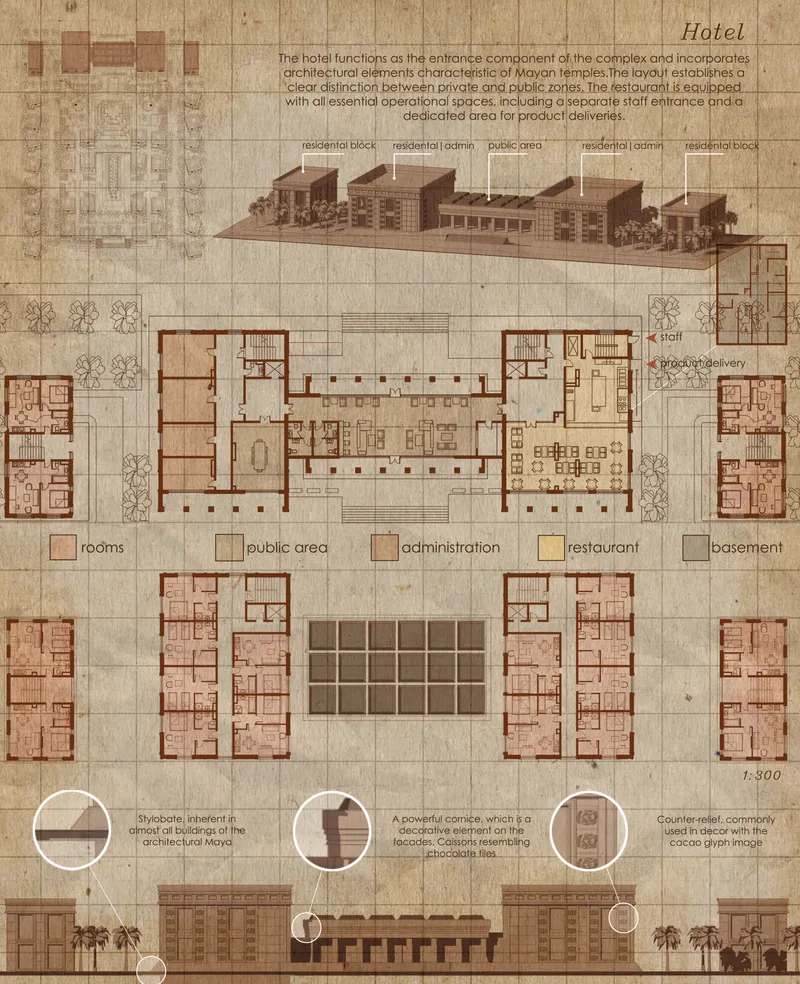
The floor plan and elevation of the hotel complex reveal residential blocks flanking a central courtyard, establishing a clear hierarchy of spaces. Public areas for social interaction give way to semi-private courtyards designed for workshops, which in turn yield to private rooms for rest. This gradient from communal to intimate is a direct translation of Mayan spatial order into a hospitality program. Decorative elements such as counter-reliefs and caissons are shaped to resemble traditional chocolate molds, embedding narrative symbolism into the architecture's surfaces without relying on applied ornament.
The Museum Pyramid: Processing Hall at the Cosmic Center
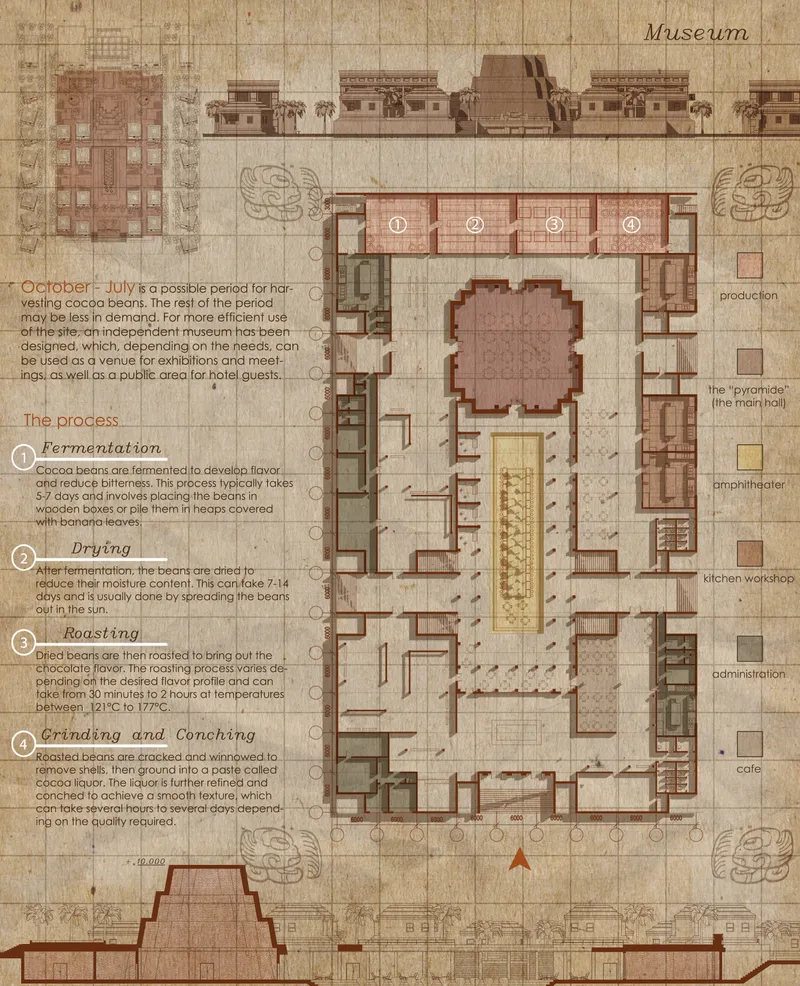
The museum floor plan and section drawings organize exhibition and cocoa processing spaces around a central hall. The stepped pyramid form is not decorative; it structures the visitor's experience vertically, ascending through exhibits that move from agricultural process to cultural history. By placing the processing hall at the geometric center, Boskovic collapses the distance between production and display, treating cocoa cultivation as both subject matter and spatial generator. Visitors do not observe the process from behind glass; they move through it.
Villas Around a Bonfire: Domesticity as Communal Ritual
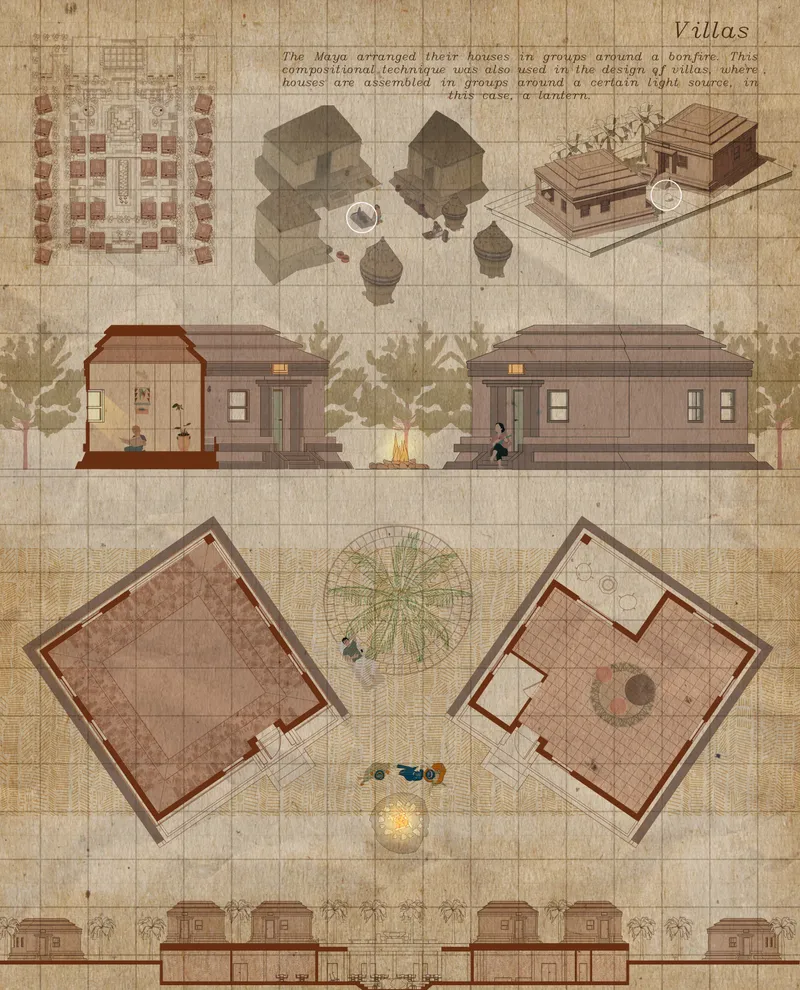
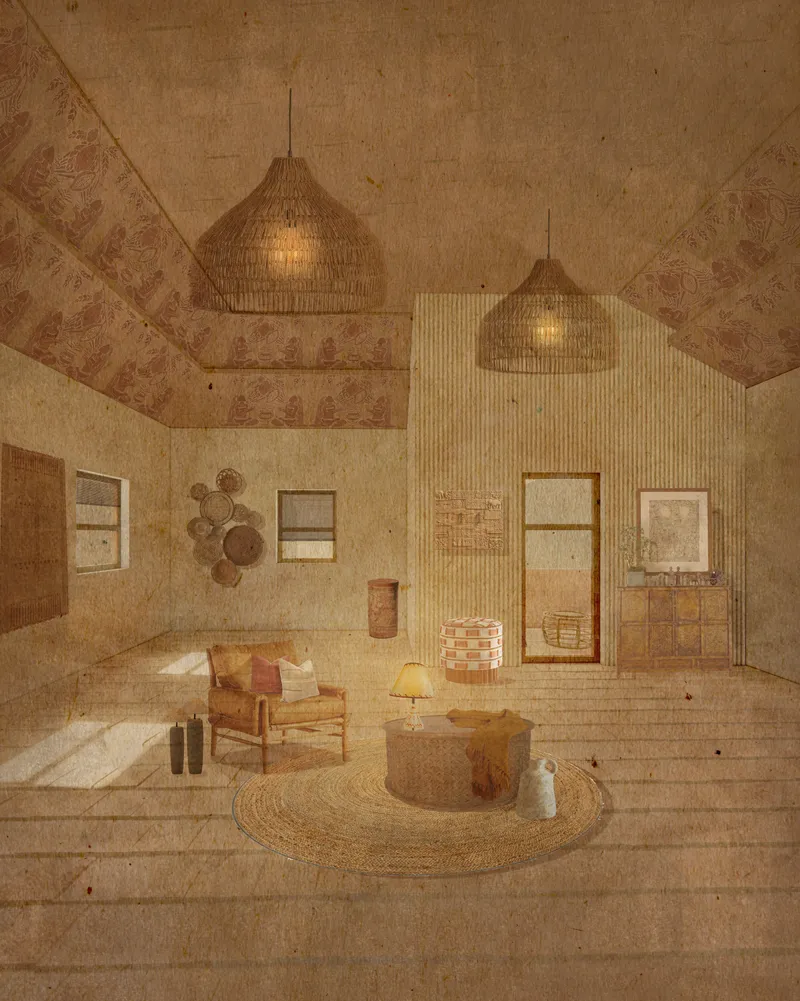
The residential villas are arranged in pairs around a shared bonfire courtyard, a move that reframes the private accommodation unit as a participant in collective life. Sectional drawings show how the stepped platforms and modest volumes keep each villa grounded in the landscape while maintaining visual privacy. Inside, the material palette of woven bamboo, textured clay walls, and handcrafted furniture carries the project's ethos into the most intimate spaces. The interior view, with its woven pendant lights casting warm patterns over a seating area bathed in afternoon sunlight, makes a convincing case that vernacular craftsmanship can produce atmospheres no catalogue furniture ever will.
Each villa is conceived as a sanctuary that connects guests to what Boskovic calls "ancestral rhythms." The locally sourced materials, clay, bamboo, and timber, minimize environmental impact while maintaining the tactile warmth that reinforces the retreat's central argument: that simplicity, when rooted in cultural memory, is its own form of luxury.
Why This Project Matters
Ethno Cocoa Retreat resists the common trap of heritage-themed resort architecture, where cultural signifiers are reduced to surface decoration on otherwise generic buildings. Boskovic works the other way around. The Mayan references here are structural and organizational: axial alignment determines circulation, stepped platforms define program hierarchy, and the courtyard operates as both climate strategy and social infrastructure. The ancient planning principles are not applied as a style; they generate the architecture.
The project also makes a quiet argument about the relationship between agriculture and culture. By weaving cocoa processing into the museum program and siting the entire campus within a landscape shaped by cultivation, the retreat positions the cocoa plant as more than a cash crop. It becomes a medium through which visitors encounter history, ecology, and community. For a competition brief centered on chocolate, that is exactly the kind of depth the subject deserves.
View the Full Project
About the Designers
Designer: Jana Boskovic
Enter a Design Competition on uni.xyz
uni.xyz runs architecture and design competitions year-round that reward proposals with spatial conviction and real site intelligence.
Project credits: Ethno Cocoa Retreat by Jana Boskovic Xocolatl (uni.xyz).


Popular Articles
Popular articles from the community


The Amber Palace Opera: A Geological Fiction Surfaces on Tallinn's Baltic Waterfront
Pierre Brillard reimagines a Baltic legend as a public landscape, opera house, and waterfront promenade rooted in Tallinn's coastal identity.
Faces of the Soviet Avant-Garde: Turning Moscow's Street Names into an Open-Air Museum
A network of sculptural installations across a Moscow residential district transforms forgotten architect names into spatial encounters with cultural memor
Temporary Home for Dogs: A Reversed Zoo Rethinks Animal Shelter Architecture
In Bucharest, a sinuous corridor and freed landscape flip the logic of containment, designing a shelter that works to make itself unnecessary.

Cloaked Colonization: A Mobile Underwater Habitat That Moves Like a Fish
Micah Abaya's shortlisted EHC Pacific entry reimagines ocean settlement as a dispersed network of self-sustaining architectural organisms.

Similar Reads
You might also enjoy these articles

Play: Fragments of Their World: Remembered Architecture Rebuilt as a Modular Playground for Refugee Camps
Tom Gardner abstracts domes, arches and towers from the homelands of displaced families into a kit of child-scaled play parts for camp settlements.
REBIRTH: A Circular Settlement Where Afghan Widows and Their Children Rebuild Life Together
A shortlisted Resile entry turns the circle into a protective ring of timber and brick, gathering homes, classrooms and gardens around a shared landscape.
The Main Dream: A Recycled Plastic Kit That Lets Refugee Children Build Their Own Playground
Thirty-centimetre interlocking cubes that connect on three axes turn play into construction, letting children author the spaces they occupy.

Lunar Spiral: A Fibonacci-Driven Moon Settlement Rising from Shackleton Crater
Golden-spiral geometry organises buried infrastructure and orbiting habitable spheres into a lunar base designed to grow as life on the Moon expands.


Comments (0)
Please login or sign up to add comments
No comments yet. Be the first to comment!