

Expo 2025 Osaka Women’s Pavilion in Collaboration with Cartier by Yuko Nagayama & Associates
The Expo 2025 Osaka Women’s Pavilion by Yuko Nagayama & Associates showcases women’s empowerment, sustainable design, and repurposed KUMIKO façade innovation.


The Expo 2025 Osaka Women’s Pavilion, developed in collaboration with Cartier and designed by Yuko Nagayama & Associates, celebrates women’s empowerment, innovation, and sustainability. This pavilion builds upon the legacy of the Women’s Pavilion at Expo 2020 Dubai, integrating themes of social impact, adaptive reuse, and architectural ingenuity.

Continuing the Legacy of the Women’s Pavilion
The pavilion retains the core mission of its Dubai predecessor: highlighting women’s contributions to society. This edition is a collaborative effort involving Cartier, the Japan Association for the 2025 World Exposition, the Cabinet Office, and the Ministry of Economy, Trade, and Industry, ensuring a fusion of private initiative and public vision. By maintaining the pavilion’s original name and purpose, the Osaka iteration strengthens the narrative of empowerment and cross-cultural dialogue.

Innovative Repurposing of the Japan Pavilion Façade
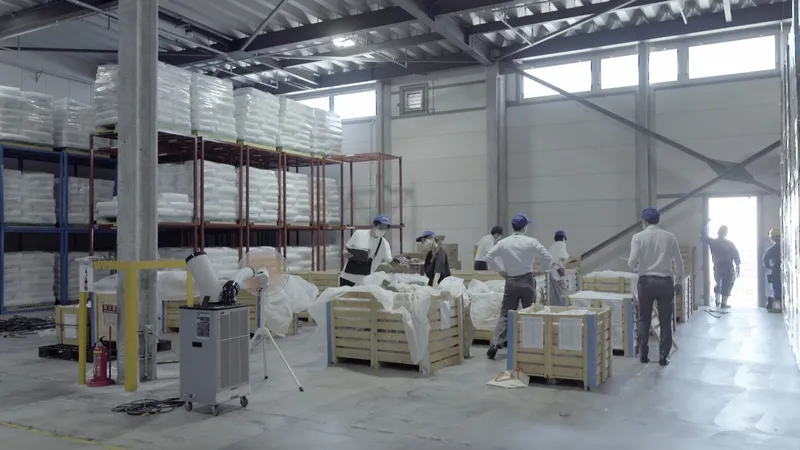
A standout feature of the Osaka pavilion is the repurposed KUMIKO façade from the Japan Pavilion at Expo 2020 Dubai, designed by Yuko Nagayama. This marks one of the first instances in Expo history where materials from a previous pavilion are reused. The process involved complex logistics, including dismantling, transport, and storage, overseen by Obayashi Corporation and Sankyu Inc., with Cartier supporting the sustainability-focused vision.
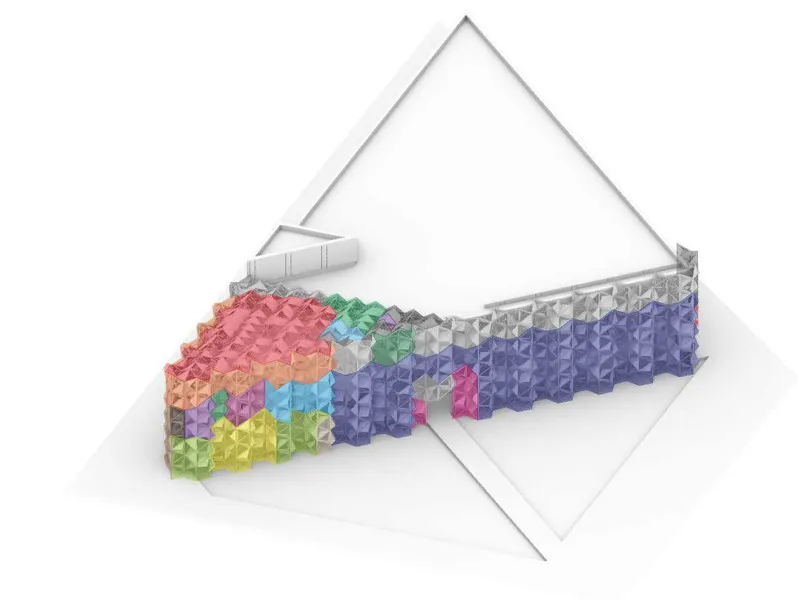
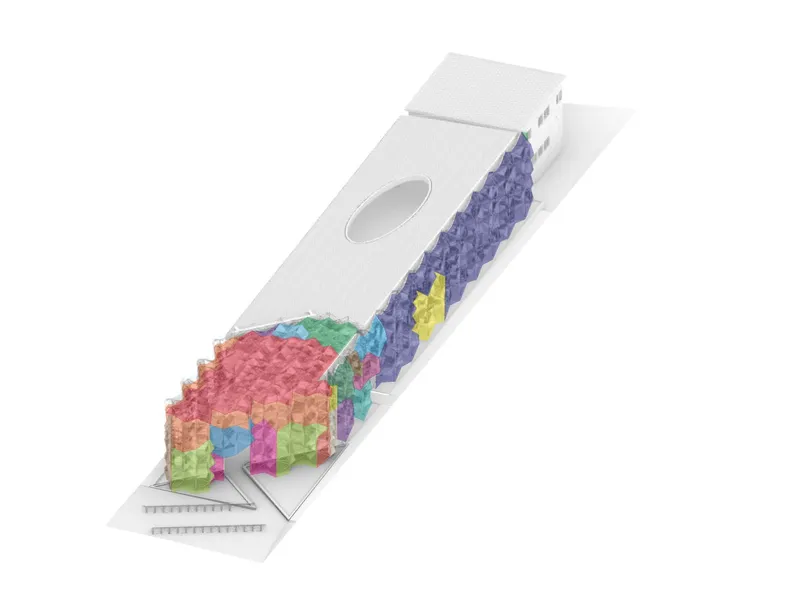
Originally, the Japan Pavilion featured a trapezoidal corner lot with an isosceles triangular form based on the silver ratio, complemented by a KUMIKO lattice acting as a light-filtering buffer. In Osaka, the pavilion occupies a narrow 110m by 18m lot, reminiscent of a traditional Kyoto townhouse, facing the Grand Ring. The KUMIKO façade envelops courtyards and gardens, casting dynamic patterns of sunlight and mimicking the protective canopy of a forest. Native trees sourced from the surrounding Osaka mountains enhance the immersive, nature-inspired design.

Structural Innovation and Sustainability
The ball-joint system of the KUMIKO façade, originally established during Expo 1970 Osaka, ensures high reusability. The dismantling involved roughly 6,000 tubes and 2,000 nodes, packed into 1.5 forty-foot containers and stored in Osaka. Using Obayashi’s ProMIE™ visual project management system, every component was mapped and adapted to fit the new site. Engineering firm Arup developed custom software to reconstruct the pavilion using only existing elements, achieving structural stability while honoring the principle of no new material use.
This adaptive reuse not only exemplifies sustainable architecture but also generates a unique spatial narrative. The components are slated for further reuse in upcoming projects, ensuring a continuous cycle of architectural sustainability and innovation.
WA Space: A Hub for Dialogue
On the second floor, the pavilion introduces the “WA Space”, a dedicated dialogue area inspired by the majlis concept from Expo 2020. This space reflects Nagayama’s original vision for the Japan Pavilion, providing a platform for community engagement, discussion, and empowerment, seamlessly integrating cultural continuity across consecutive Expos.




Popular Articles
Popular articles from the community


The Ocean Hive: Sustainable Architecture for a Self-Sufficient Civilization at Sea
The Ocean Hive imagines sustainable architecture at sea, where modular habitats, algae, wave power and ocean waste sustain a growing colony.

Co-life: Sustainable Architecture for Age-Friendly Community Living
Co-life reimagines sustainable architecture for seniors through courtyards, rammed earth, shared gardens, and spaces designed for belonging.
EW PARK: Sustainable Architecture Reimagines the Future of Urban Parking
EW PARK reimagines city parking as a modular wooden tower combining automation, solar energy, electric mobility, and adaptable urban design.

Conexión: Biophilic Design Reimagines High-Rise Living in Hong Kong
Conexión reimagines high-rise living in Hong Kong through biophilic design, green facades, shared spaces, daylight, water and nature within.


Similar Reads
You might also enjoy these articles


Hodi-Mandai Geram
Project Function: Preservation and revitalization of the Intangible heritage and socio-spatial identity of the Hodi by Housing, Cultural Memory Center, Sacred Grove, landscape, local tourism economy


Olio Towers: A Mid-Rise for Performers That Fuses Housing, Rehearsal, and Stage
Located blocks from Houston's Theater District, this modular tower stacks living units around a central performance atrium.

Oasis: Modular Green Housing Carved into Dhaka's Urban Fabric
A shortlisted Plugin Housing entry reclaims unauthorized settlements in Dhaka with stepped concrete volumes, green roofs, and ventilation-driven design.

Black Hole: A Floating Megastructure for the Post-Physical Era
Emiliano Mazzarotto envisions a spherical, self-scaling arena where e-sports, digital hotels, and holographic stadiums replace traditional public space.


Explore Sustainable Design Competitions
Discover active competitions in this discipline



Challenge to reimagine the Iron Throne


Photograph architecture without architects


Illustrate the lost glory of Angkor Wat - Render Challenge


Design challenge to reuse E-waste
Comments (0)
Please login or sign up to add comments
No comments yet. Be the first to comment!