

Faculty of Sciences: Pontifical Xavierian University by taller de arquitectura de bogotá
A contemporary science faculty in Bogotá combining platform, tower, and landscape to integrate heritage, sustainability, and flexible academic spaces.


Located in Bogotá, the Faculty of Sciences building at the Pontificia Universidad Javeriana represents a significant contemporary intervention within one of Colombia’s most important academic campuses. Completed in 2020, the 19,992 m² project establishes a new academic and urban landmark, balancing heritage, innovation, and environmental responsibility through a clear and coherent architectural strategy.

Designed by taller de arquitectura de bogotá, the project responds to complex contextual, institutional, and urban conditions, seeking to strengthen the identity of the university while enhancing public space, academic functionality, and long-term adaptability.


Context and Urban Integration
The Faculty of Sciences occupies a strategic position along Carrera Séptima, one of Bogotá’s most iconic avenues. This location required the building to perform not only as an academic facility but also as an urban interface between the university and the city.
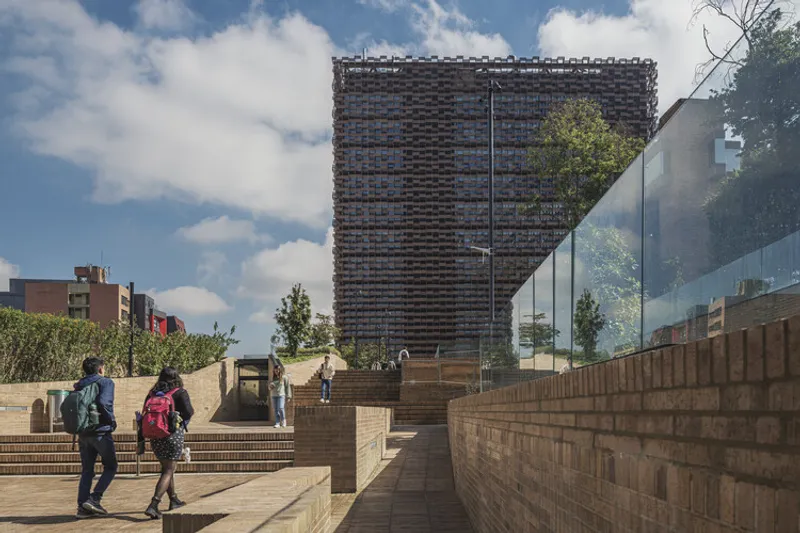
A major challenge was establishing a respectful relationship with the historic Pablo VI building, designed in 1967 by Aníbal Moreno, which remains the only officially protected structure within the campus. Rather than competing with this landmark, the new project was conceived to reinforce its presence and integrate it into a broader architectural ensemble.

The design addresses this condition through a careful balance between scale, materiality, and spatial hierarchy, allowing the new building to enhance the campus identity without overshadowing its architectural heritage.
Conceptual Framework: Platform, Tower, and Landscape
The project is organized around three interrelated architectural components that structure both spatial and functional performance.
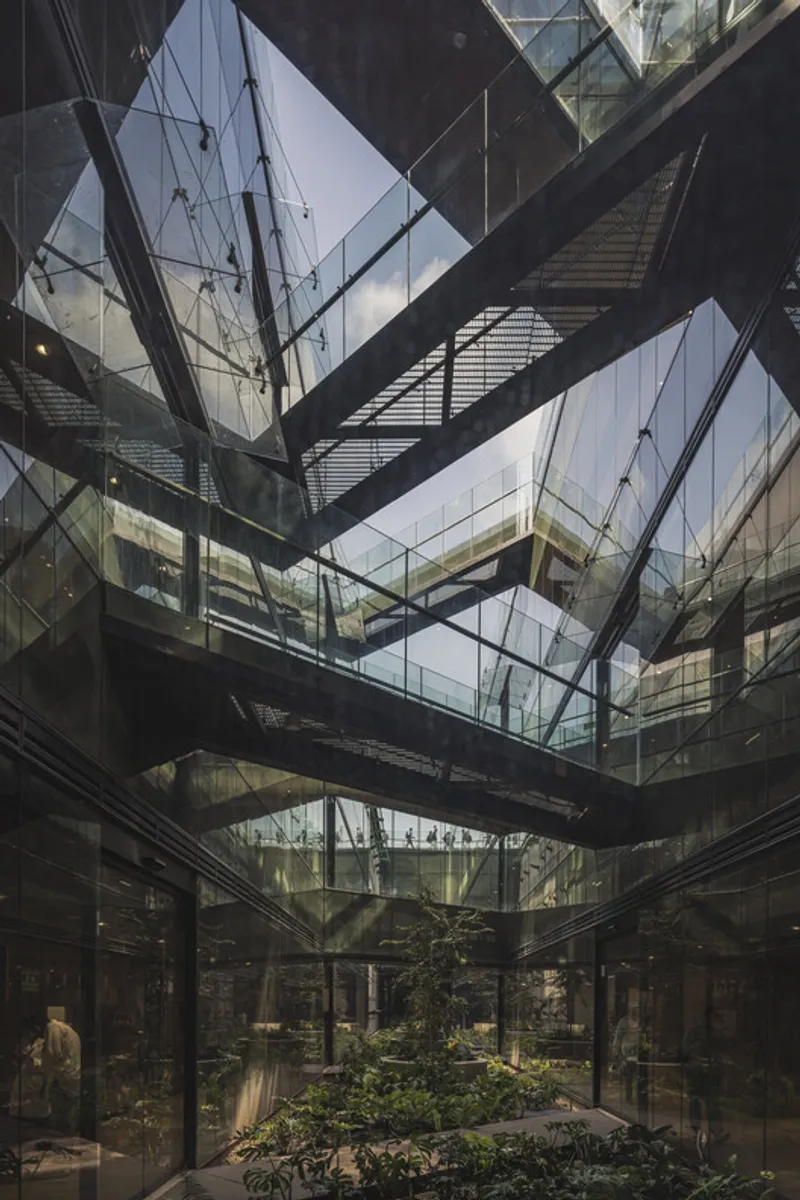
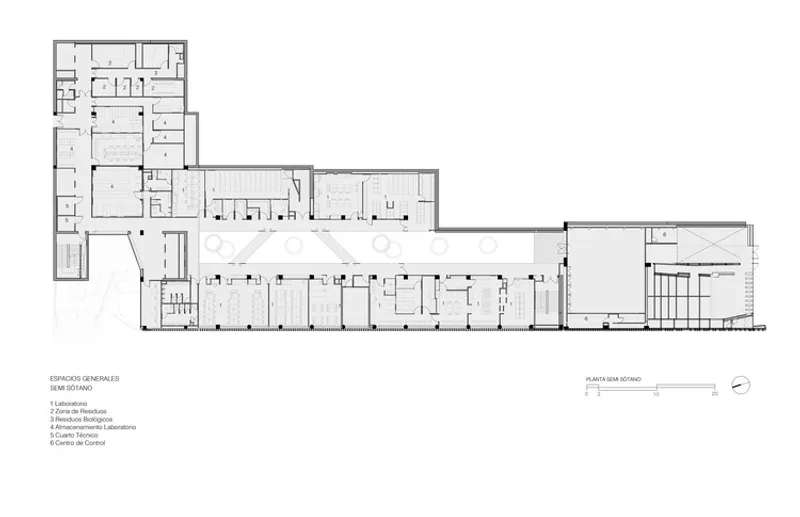
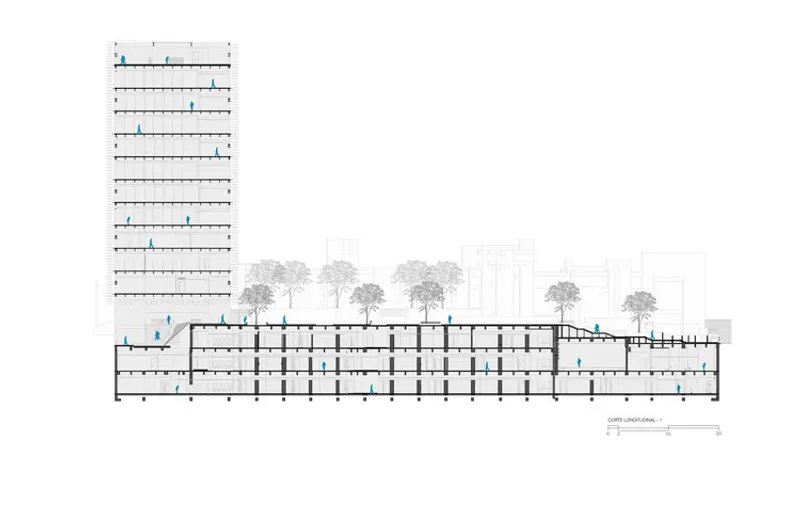
The first is a linear platform that runs parallel to Carrera Séptima. This element establishes a human-scale frontage, consolidating the campus edge and housing most of the teaching and laboratory facilities. The second is a vertical tower with a broad and fluid base, positioned as a new institutional marker and main entrance to the Faculty of Sciences. The third is an extensive landscape system that connects different areas of the campus and reinforces collective life.
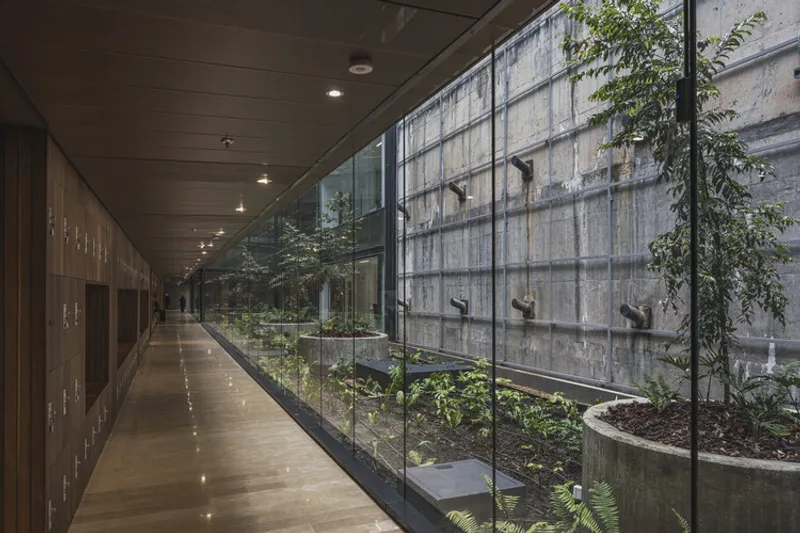
Together, these elements form a unified composition that integrates academic activity, public space, and environmental quality.
The Platform: Academic Infrastructure and Urban Edge
The linear platform defines a new façade for the university toward the city. Its low-rise configuration maintains continuity with the surrounding context while accommodating highly specialized scientific facilities.


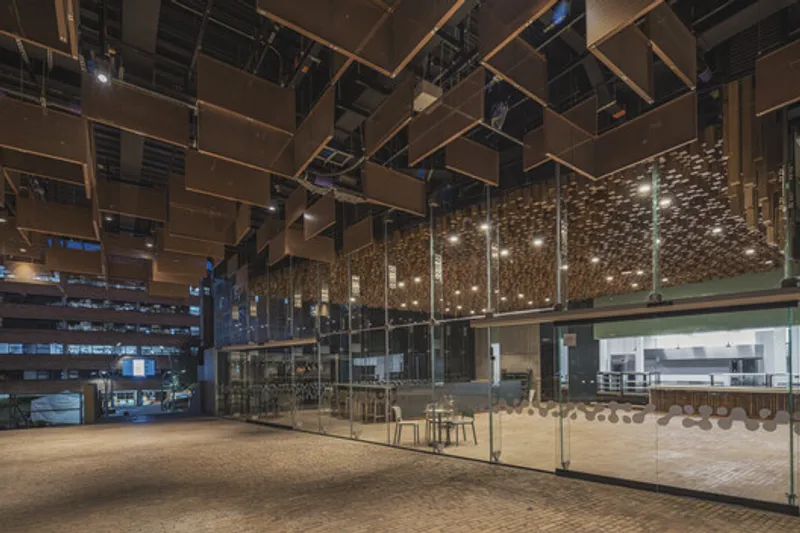
Inside the platform, the architects prioritized spatial quality and environmental performance. Two “English” courtyards were introduced along the length of the building, forming a continuous internal garden. These patios allow natural light and ventilation to penetrate deep into the structure, reducing reliance on artificial systems and improving user comfort.
The platform also revitalizes the forecourt of the historic Pablo VI building, extending public space and reinforcing the presence of brick as a dominant material within the campus. This strategy strengthens visual continuity and material coherence across generations of architecture.


The Tower: Flexibility and Vertical Identity
Rising at the northern edge of the site, the tower acts as a visual backdrop and spatial terminus to the main campus axis connecting the Central Library and surrounding facilities. Its position avoids direct confrontation with the historic building while establishing a strong contemporary presence.

Structurally, the tower is organized around four large concrete cores and a system of perimeter Vierendeel trusses. This configuration maximizes usable floor area and minimizes internal obstructions, allowing for flexible laboratory layouts and future programmatic adaptation.
Such structural clarity supports the long-term evolution of scientific research spaces, ensuring that the building can respond to changing technological and academic requirements.

Façade Design and Environmental Control
The four façades of the tower are clad with metal sun-shading panels featuring variable micro-perforation densities. These panels respond to different solar orientations, reducing heat gain and glare while maintaining consistent visual identity.
This passive environmental strategy contributes to energy efficiency and thermal comfort. At the same time, the perforated envelope creates a subtle play of light and shadow, reinforcing the building’s dynamic appearance throughout the day.
The façade system demonstrates how technical performance and architectural expression can be integrated into a unified design language.

Interior Spaces and Learning Environment
Internally, the Faculty of Sciences is organized to promote clarity, collaboration, and comfort. Circulation spaces are generous and visually connected to courtyards and exterior views, reducing the sense of enclosure often associated with laboratory buildings.
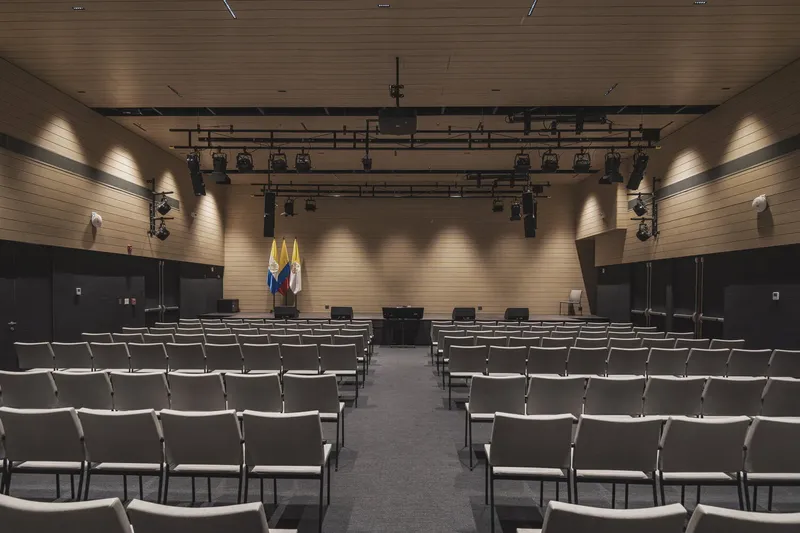
Glazed partitions, open corridors, and shared spaces encourage interdisciplinary interaction and informal exchange among students and researchers. Laboratories, classrooms, and offices are arranged to balance privacy, safety, and accessibility.
Natural light, controlled ventilation, and carefully selected finishes contribute to an atmosphere that supports concentration, experimentation, and long working hours.


Landscape and Collective Space
One of the most distinctive features of the project is the large public space located on the walkable roof of the platform. This elevated landscape connects different campus zones while providing outdoor areas for rest, study, and social interaction.
By concentrating built volume vertically and horizontally, the project occupies less than 30% of the site, allowing the majority of the area to remain green and accessible. This strategy reinforces the concept of a “green campus” and promotes physical and mental wellbeing.

The landscape intervention acts as both ecological infrastructure and social catalyst, strengthening the relationship between architecture and community.
Sustainability and Long-Term Adaptability
Environmental responsibility is embedded in the project through passive design strategies, compact massing, and efficient land use. Natural lighting, ventilation courtyards, shading systems, and reduced site coverage contribute to lower energy demand.

Equally important is the building’s capacity for transformation. The flexible structural system, modular laboratory layouts, and adaptable service zones ensure that the Faculty of Sciences can evolve alongside scientific progress without requiring major reconstruction.
This long-term perspective reflects an understanding of sustainability as both environmental and institutional resilience.
A Contemporary Model for University Architecture
The Faculty of Sciences at Pontificia Universidad Javeriana stands as a benchmark for large-scale educational architecture in Latin America. Through its clear organizational logic, environmental sensitivity, and respect for context, it demonstrates how universities can expand while preserving identity and social responsibility.
The project illustrates that academic buildings can function simultaneously as research infrastructure, public space, and urban landmark. By aligning spatial quality with institutional values, taller de arquitectura de bogotá has produced an enduring model for future campus development.
All the Photographs are works of Alejandro Arango


Popular Articles
Popular articles from the community


Extended Shell: Retrofitting Kolkata's Balconies as Living Urban Thresholds
A modular retrofit system recovers the social and environmental intelligence of Kolkata's historic verandas for contemporary Park Street residents.

Opera on the Sea: Driftwood Logic Shapes a Timber Opera House on Estonia's Coast
Trevor Orgill's opera house translates the entangled drift of floating timber into a civic building where wood, water, and music converge.

Singing Woman: Contemporary Architecture Inspired by Estonia’s Voice and the Sea
Singing Woman turns Estonia’s song culture into flowing opera house architecture, blending public life, landscape, sea, and national memory.
Temporary Home for Dogs: A Reversed Zoo Rethinks Animal Shelter Architecture
In Bucharest, a sinuous corridor and freed landscape flip the logic of containment, designing a shelter that works to make itself unnecessary.

Similar Reads
You might also enjoy these articles


Hodi-Mandai Geram
Project Function: Preservation and revitalization of the Intangible heritage and socio-spatial identity of the Hodi by Housing, Cultural Memory Center, Sacred Grove, landscape, local tourism economy


Olio Towers: A Mid-Rise for Performers That Fuses Housing, Rehearsal, and Stage
Located blocks from Houston's Theater District, this modular tower stacks living units around a central performance atrium.

Oasis: Modular Green Housing Carved into Dhaka's Urban Fabric
A shortlisted Plugin Housing entry reclaims unauthorized settlements in Dhaka with stepped concrete volumes, green roofs, and ventilation-driven design.

Black Hole: A Floating Megastructure for the Post-Physical Era
Emiliano Mazzarotto envisions a spherical, self-scaling arena where e-sports, digital hotels, and holographic stadiums replace traditional public space.

Explore Bogota Competitions
Discover active competitions in this discipline

Challenge to design public laboratory

Challenge to reimagine the Iron Throne

Photograph architecture without architects

Illustrate the lost glory of Angkor Wat - Render Challenge
Comments (0)
Please login or sign up to add comments
No comments yet. Be the first to comment!