

fala 171 Threads a Bold New Structure Through a Porto Rowhouse in the House of Remarks
A 380-square-meter renovation in Porto layers color-coded steel, glass block, and timber into a five-level vertical home.


Most renovation projects in Porto's dense residential fabric try to disappear into the existing shell. fala 171 does the opposite. In the House of Remarks, a new structural system of thin steel columns and a longitudinal I-beam enters a traditional rowhouse on its own terms, announcing itself through color, material contrast, and a refusal to mimic what was already there. The result is not a restoration but a conversation: old stone walls host teal planes, orange beams, and blue columns that read as deliberate insertions rather than cosmetic overlays.
What makes the project genuinely interesting is the economy of its strategy. A single row of painted metal poles carries a beam from the street facade to the rear courtyard, redistributing loads so that interior walls become optional. Freed from structural duty, every partition can be a remark: a red-framed translucent panel here, a glass block window there, a white louvered door that swings open to reveal a stairwell painted in three different colors. The house reads less like a unified composition and more like a sequence of pointed observations about how a narrow, deep lot can be inhabited vertically across five levels.
Street Presence: Loud but Legible
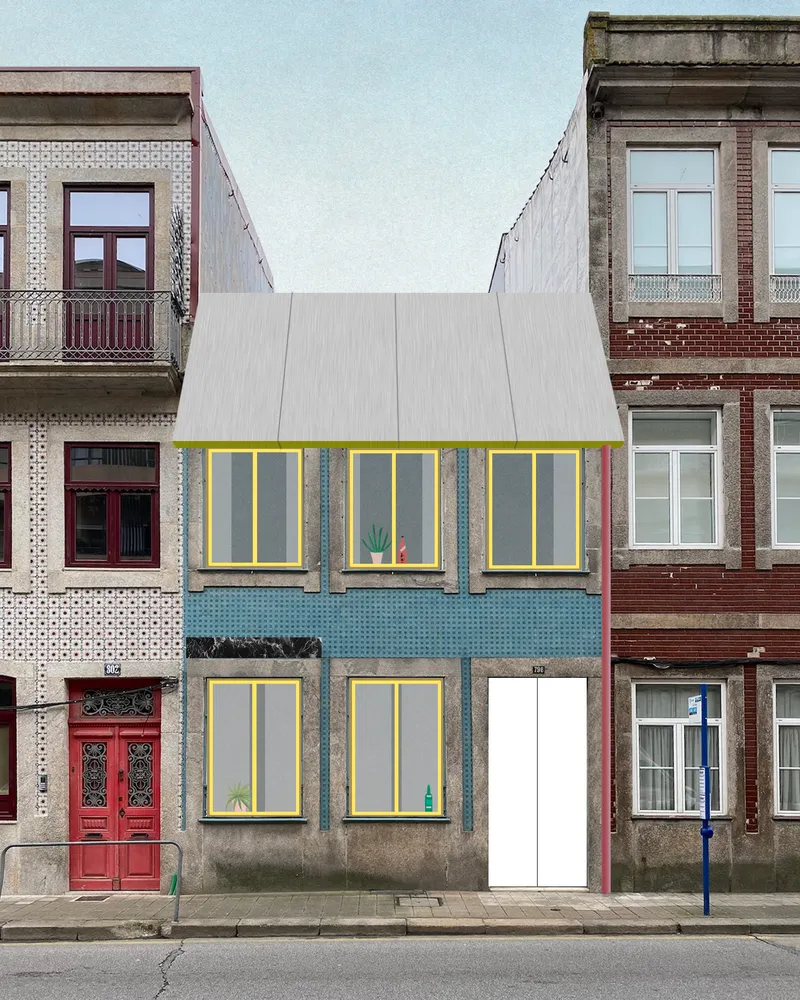
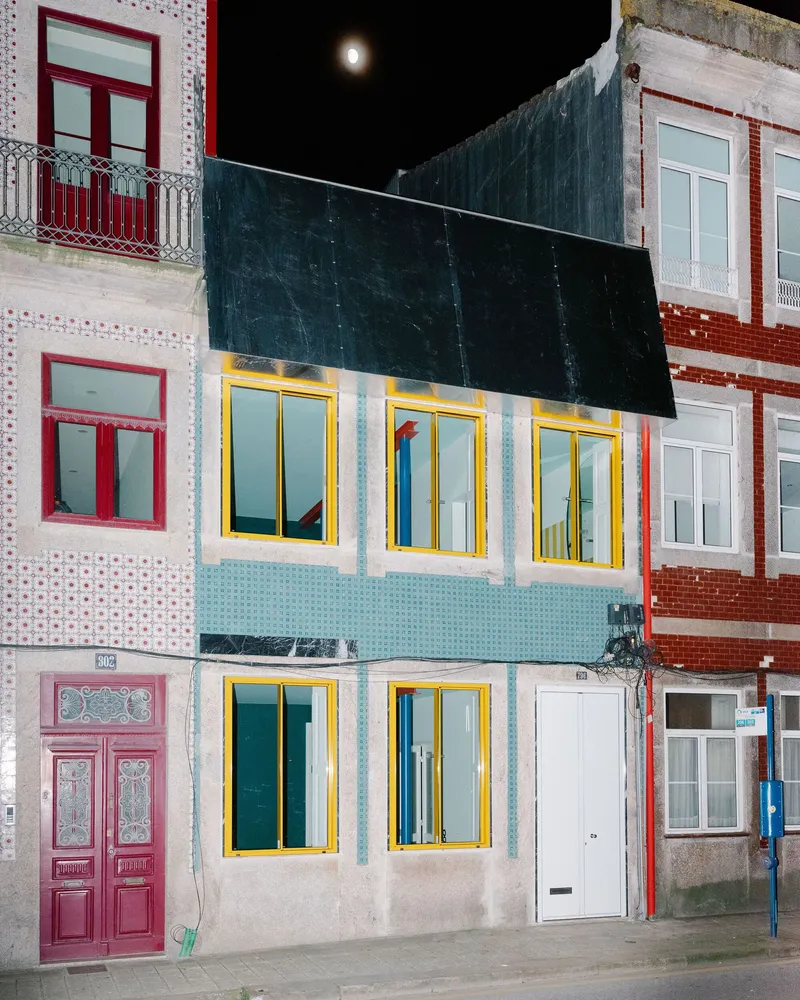
Porto rowhouses typically announce themselves through azulejo tiles and restrained stone trim. The House of Remarks keeps the proportions of a traditional facade but swaps the palette entirely. Yellow-framed windows, teal infill panels, and a dark corrugated upper volume sit within the established street wall without breaking its rhythm. By day, the white entrance door and colored trim feel almost playful against the tiled neighbors. At night, the illuminated windows glow like a chromatic lantern, revealing the depth of the interior color work from the sidewalk.
The facade is not provocative for its own sake. It signals the structural logic inside: the yellow frames correspond to timber, the teal to painted plaster planes, and the dark corrugated metal to the new roof volume that caps the section. Each color carries information. You can read the building's construction from the street if you know what to look for.
The Stairwell as Polychrome Engine

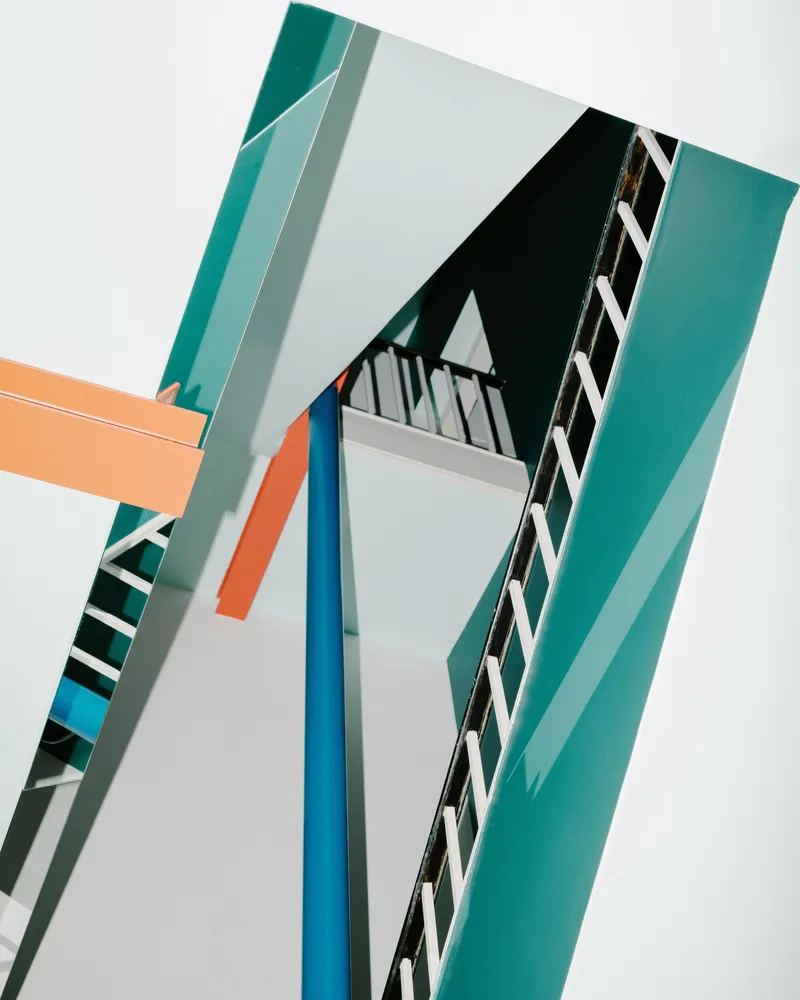

In a house this narrow, the staircase is not just circulation; it is the primary spatial event. fala 171 treats the central stair void as a vertical gallery of color and structure. Looking up through the well, teal, orange, and blue painted beams layer over one another like a Mondrian composition rotated into three dimensions. Black and blue railings intersect at landings. White louvered doors and glass partitions modulate light and privacy between floors.
The stairwell also performs a practical trick: it pulls daylight down through the deep plan. Glass partitions at each landing allow borrowed light to reach interior rooms that would otherwise rely entirely on the front and rear facades. The color coding helps orient residents vertically. You always know which floor you are on because the palette shifts at every level.
Interior Color Logic
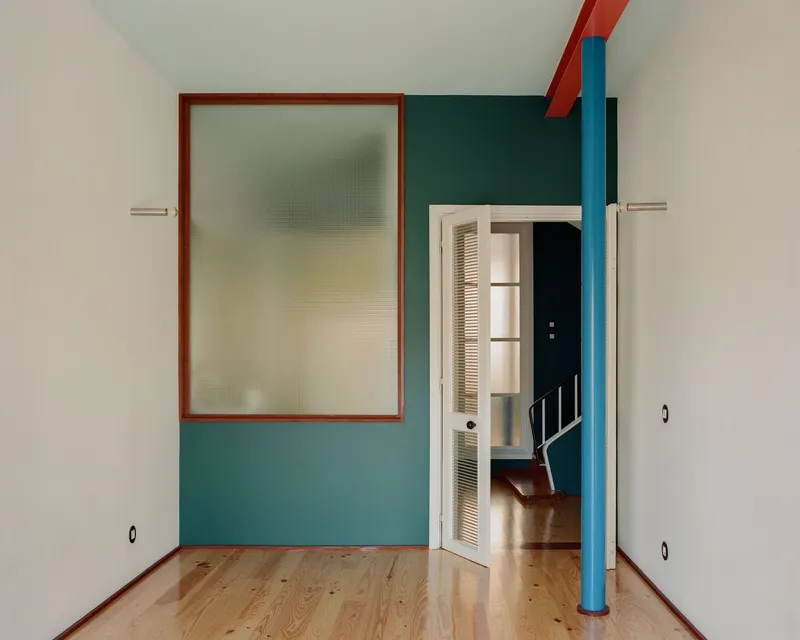
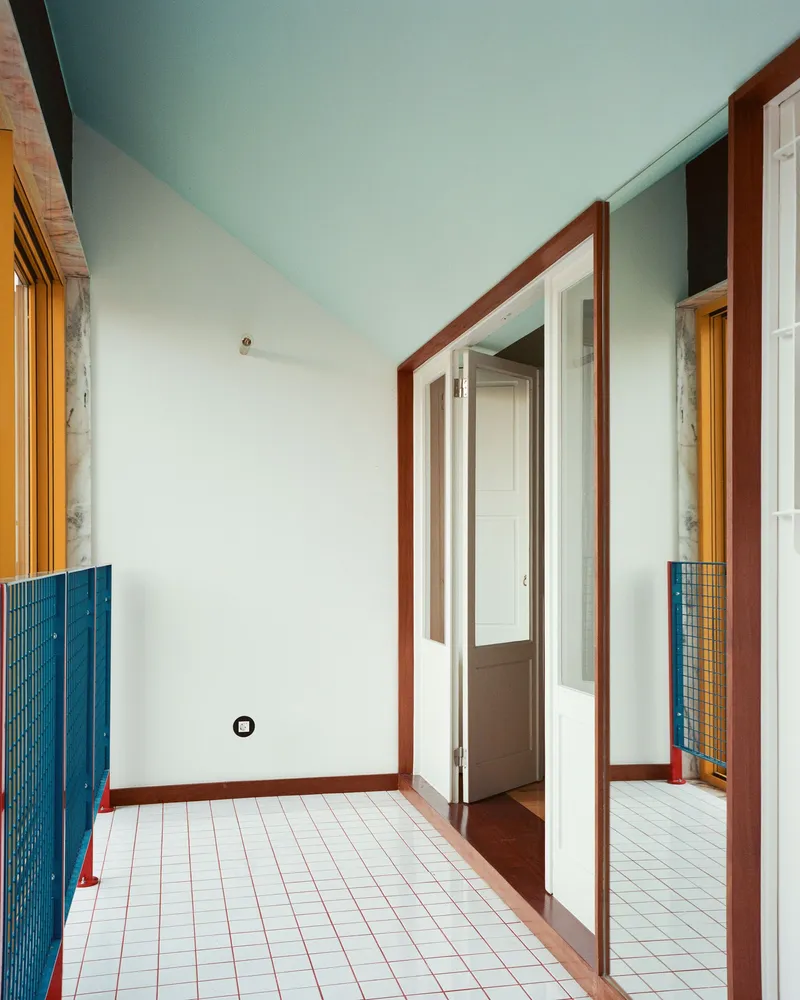

Every surface in the House of Remarks carries a decision. Teal accent walls meet red-framed translucent glass panels. Cylindrical blue columns stand free of the walls they once supported. Corridors lined in white tile receive teal ceilings and red timber doorframes that frame views through successive rooms like a series of nested picture planes. The ceiling detail with radiating teal planes, an orange beam, and a glass block window is a miniature lesson in how color can articulate structure without relying on exposed concrete or raw steel.
None of this is arbitrary. The palette distinguishes between three categories: structural elements in blue, spatial dividers in red and yellow, and enclosing surfaces in teal and white. Once you recognize the code, the house becomes legible as a diagram of forces and boundaries. The glass block panels, which appear in several rooms, soften direct light into a diffuse glow that keeps the saturated colors from becoming overwhelming.
Courtyard and Exterior Stair

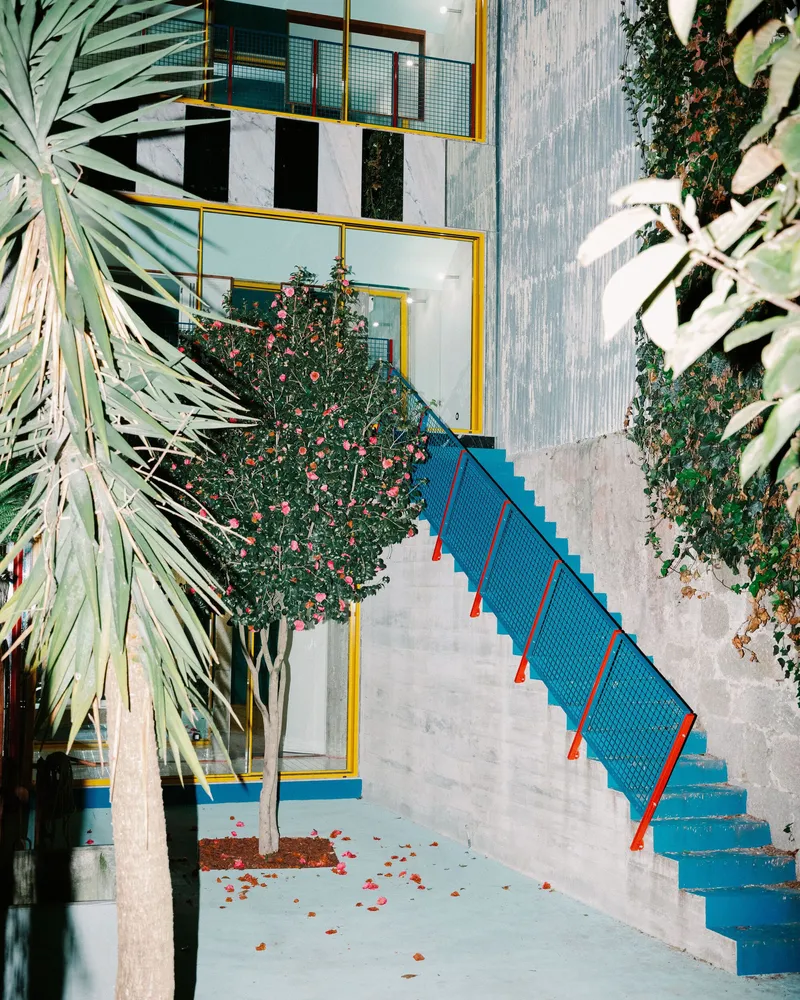
The rear courtyard is small but essential. A flowering tree, ivy-covered party walls, and a glazed facade create a pocket of green that provides the deep plan with its second source of natural light. The blue cantilevered exterior stair with its red-edged mesh balustrade is the most sculptural element in the project, rising past the tree like a piece of infrastructure that wandered in from a different building type entirely.
That exterior stair also solves a practical problem. By moving secondary vertical circulation outside, fala 171 frees interior floor area on each level for rooms rather than corridors. The courtyard becomes an extension of the house's circulation system rather than a purely decorative courtyard garden.
Texture, Light, and Detail

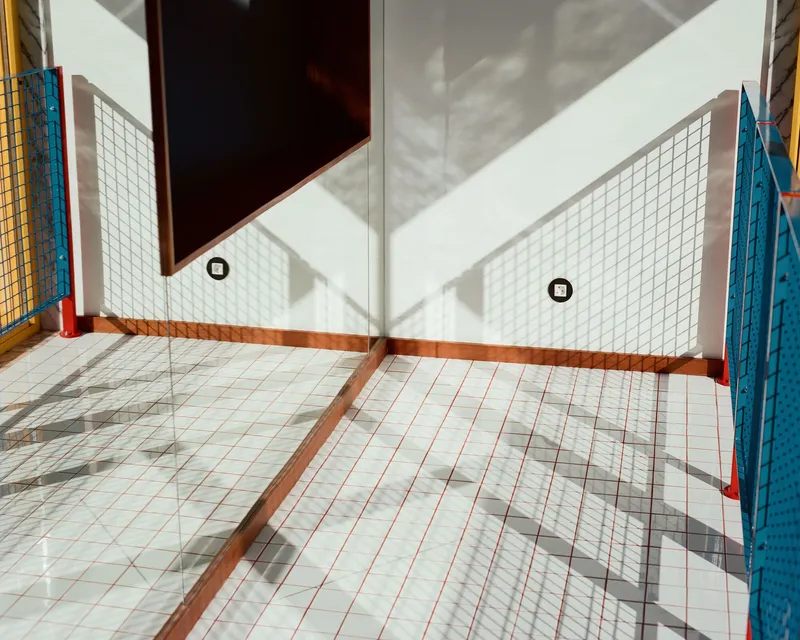
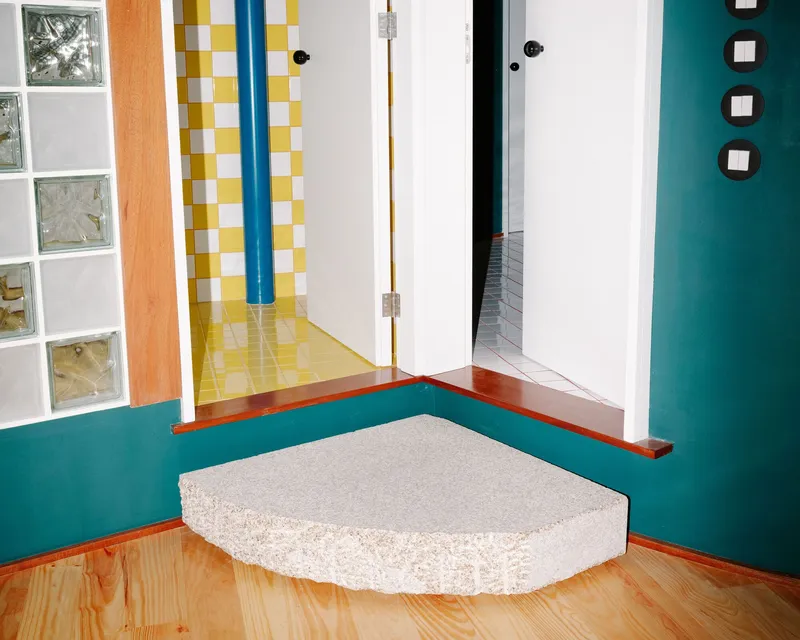
Strip away the color and the house still rewards close looking. Pine flooring runs in a diagonal pattern that widens rooms perceptually. White grid tiles on corridors and landings catch sharp diagonal shadows from adjacent windows, turning the floor into a sundial. A coral-textured plinth in one corner sits against teal walls and a timber baseboard, introducing an organic relief that contrasts with the otherwise geometric language.
These details matter because they prevent the color strategy from flattening the experience. The building has depth: rough plaster next to smooth steel, translucent glass next to opaque panels, warm pine underfoot against cool tile at thresholds. fala 171 understands that polychromy works best when it has tactile variation to push against.
Plans and Drawings
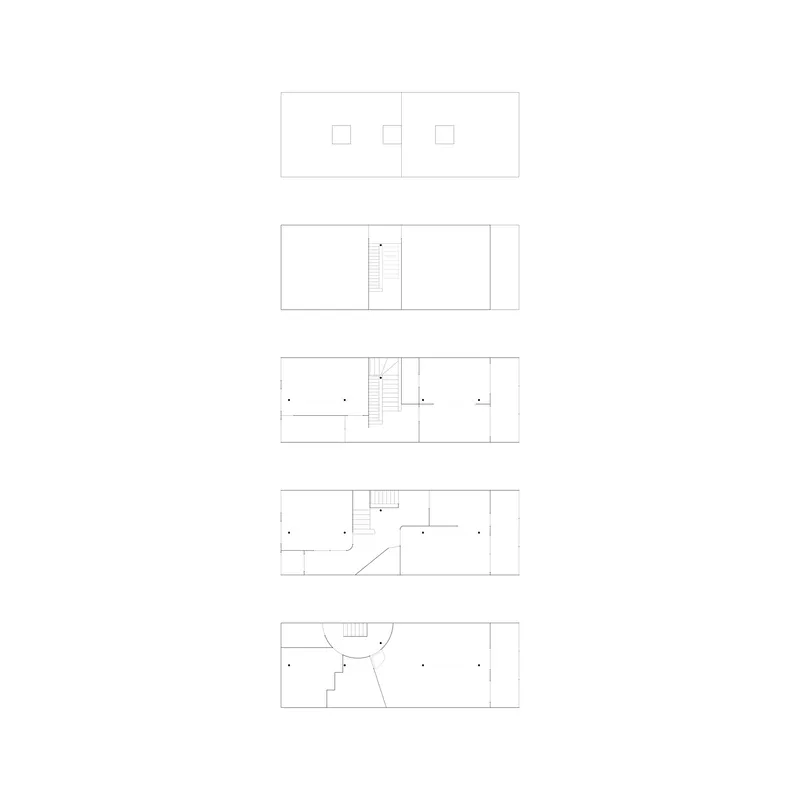
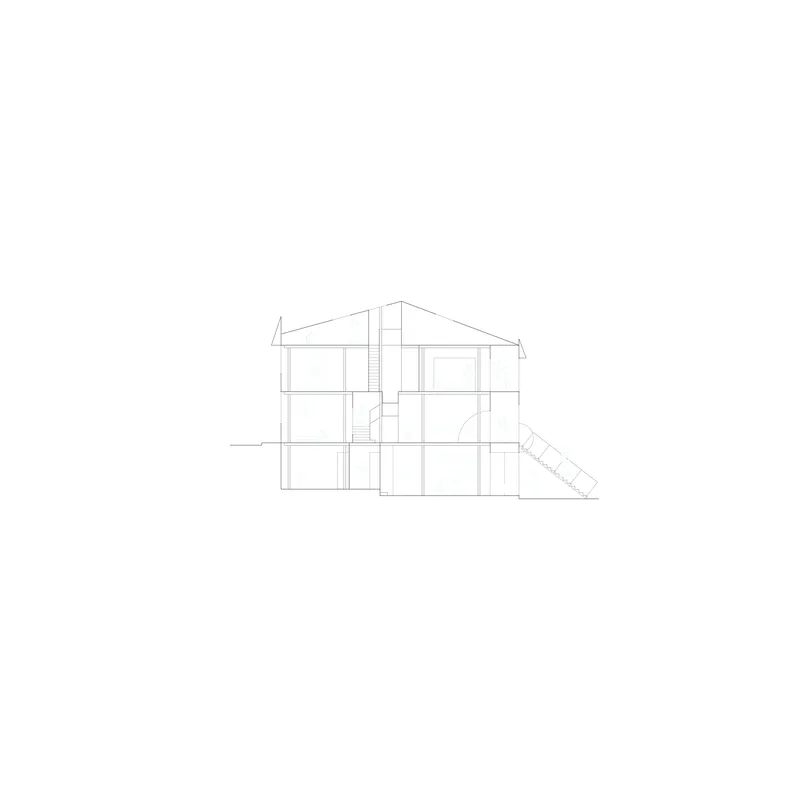
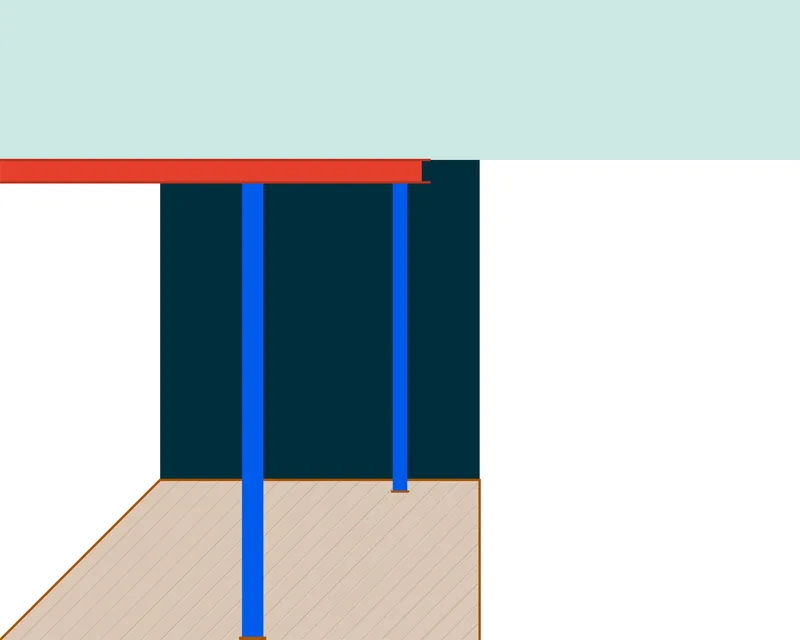
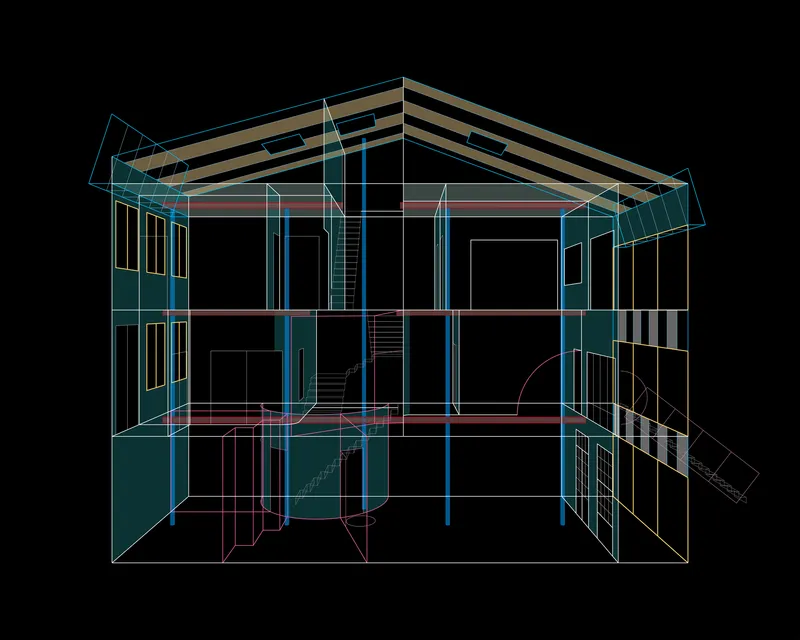

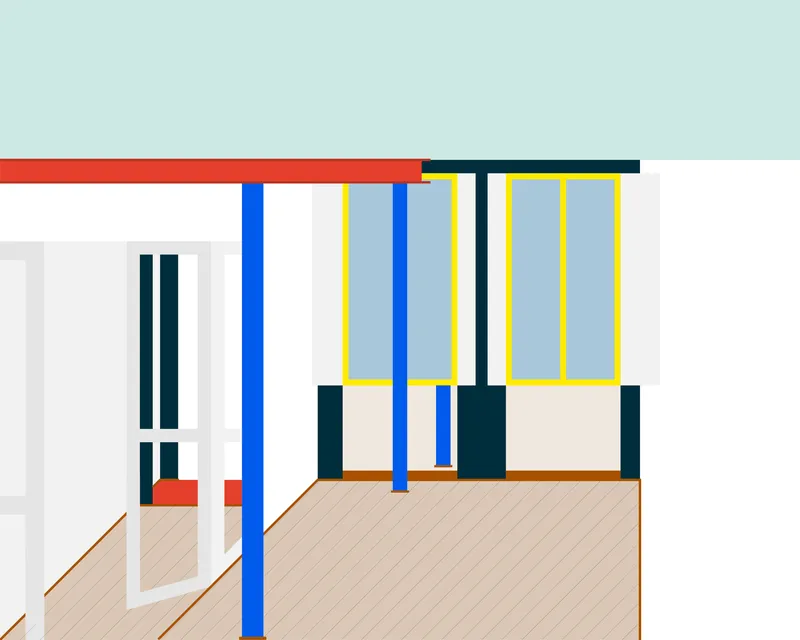
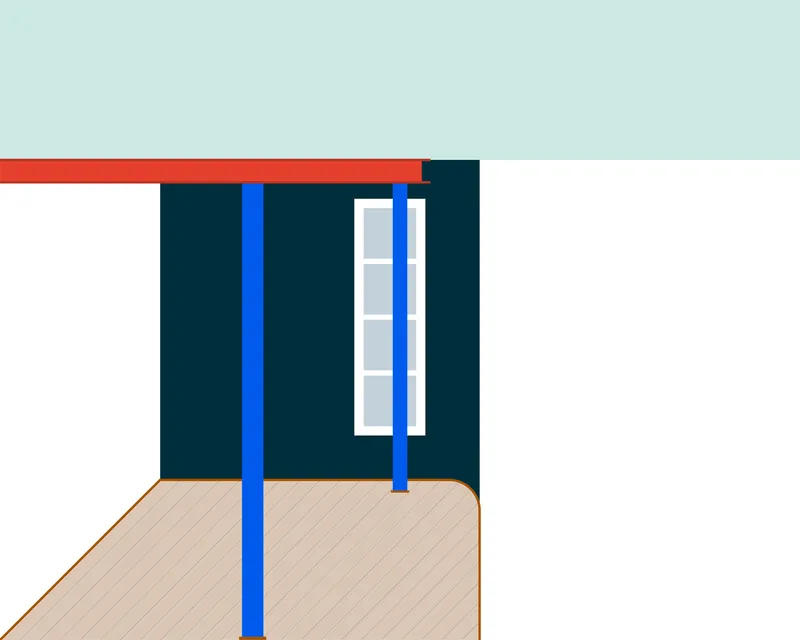
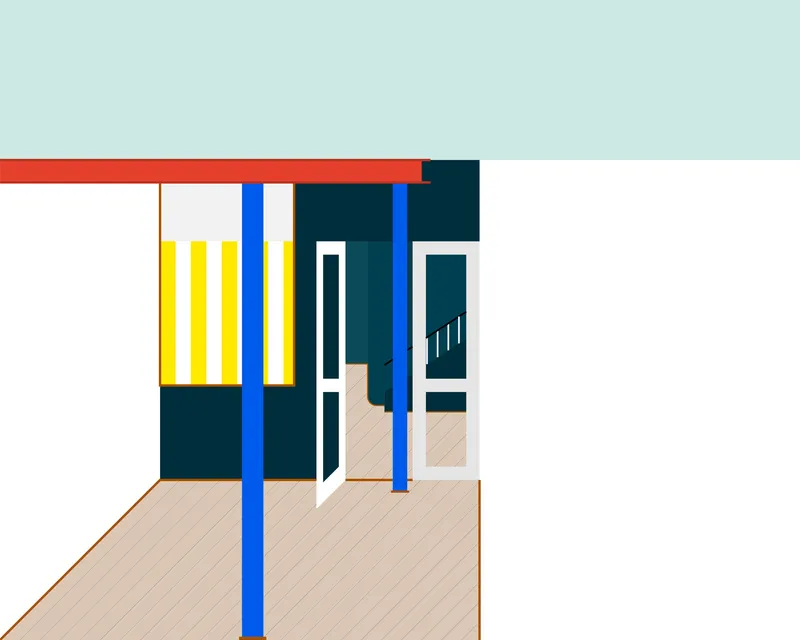
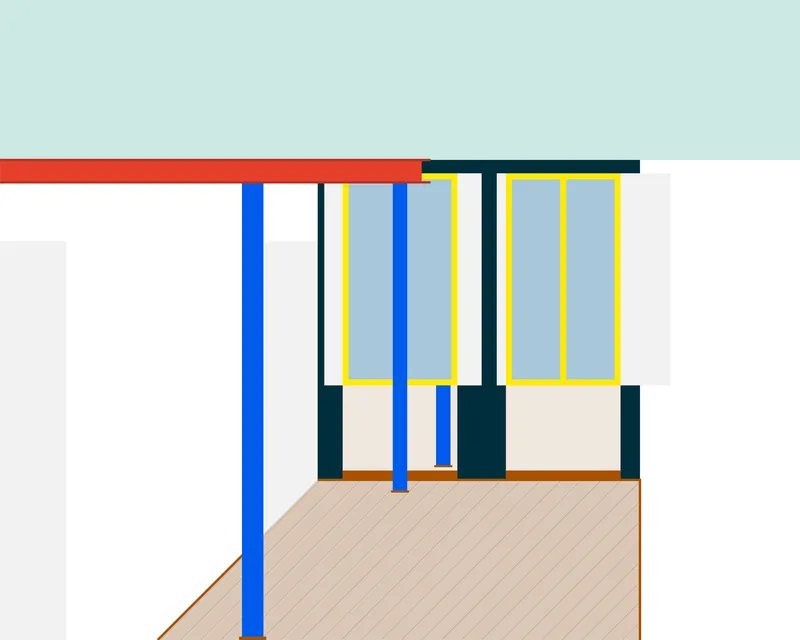
The floor plans confirm the five-level vertical organization with a central staircase threading through varying room layouts on each floor. The section drawing reveals how the new structure, a three-story pitched-roof volume, nests inside the existing envelope with an internal stair and an external ramp connecting levels. Axonometric drawings isolate the blue structural columns supporting the red longitudinal beam, making the load path legible in a single glance. Sectional axonometrics peel away the enclosure to show how stairs and rooms interlock across three levels.
The rendered interior perspectives are unusually instructive. They strip the house to its essential elements: blue columns, yellow-framed partitions, dark teal base panels, and diagonal timber flooring. These drawings communicate the chromatic code more clearly than photographs because they isolate the system from the noise of habitation. They also reveal just how thin the partitions are. Without structural duty, walls can be frames rather than masses.
Why This Project Matters
The House of Remarks is a rebuke to the idea that renovation in a historic city requires either faithful restoration or total gutting. fala 171 proposes a third path: insert a new structural system that liberates the plan, then use color and material as a legible code that distinguishes old from new, structure from partition, circulation from room. The approach is systematic without being rigid, and playful without being frivolous. Every colored surface carries information about what it does and what it is made of.
In a city where rowhouse renovations increasingly default to minimalist white interiors and exposed stone, fala 171's commitment to polychromy and structural honesty is worth paying attention to. The House of Remarks demonstrates that a 380-square-meter renovation on a narrow lot can be spatially rich, structurally inventive, and visually generous without sacrificing legibility or comfort. It is one of the more convincing arguments for color as an architectural tool, not a decorative afterthought, to come out of Porto in recent years.
House of Remarks by fala 171, Porto, Portugal. 380 m². Completed 2024. Photography by Francisco Ascensão.
About the Studio
Share Your Own Work on uni.xyz
If projects like this are the kind of work you want to make, uni.xyz is a place to publish your own, find collaborators, and enter design competitions.


Popular Articles
Popular articles from the community

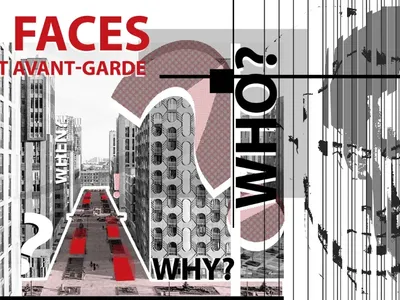
Faces of the Soviet Avant-Garde: Turning Moscow's Street Names into an Open-Air Museum
A network of sculptural installations across a Moscow residential district transforms forgotten architect names into spatial encounters with cultural memor

Cloaked Colonization: A Mobile Underwater Habitat That Moves Like a Fish
Micah Abaya's shortlisted EHC Pacific entry reimagines ocean settlement as a dispersed network of self-sustaining architectural organisms.

Manzana Morphosis: Stretching Barcelona's Grid into a Living Landscape for 2050
A radical reworking of the Eixample manzana turns density into a tool for generous public space, vertical ecology, and environmental performance.

Opera by the Sea Estonia: Three Shells Dissolving Architecture into Tallinn's Coastline
A winning opera house proposal replaces monumental form with interconnected shells that blur the boundary between building, park and Baltic Sea.

Similar Reads
You might also enjoy these articles

Bao Huynh Watercolor Atelier: A Serene Art Retreat in Hội An
Bao Huynh Watercolor Atelier in Hội An blends multifunctional art spaces, sustainable design, local materials, and family-friendly living in a serene environment.

Atelier Macri Concept Store Interior Design by CASE-REAL
Atelier Macri store features a "ko" counter, walnut wood details, cork displays, blending retail, gallery, and seamless customer experiences.

Manuel Vargas Izquierdo Stadium and High-Performance Sports Center: Architectural Excellence in Jalpa de Méndez
The Manuel Vargas Izquierdo Stadium blends sustainable design, inclusive sports facilities, and cultural-inspired architecture, revitalizing Jalpa de Méndez’s public spaces.

KAKR Buluh Awar Hall: Revitalizing Community and Ecology Through Bamboo Architecture
Community built bamboo hall revitalizes Buluh Awar village, empowering youth, restoring ecology, celebrating vernacular craftsmanship through sustainable architecture and culture.

Explore Assembly Building Competitions
Discover active competitions in this discipline

Challenge to design mud housing for contemporary communities

Challenge to design luxury tourism on rails

VR headsets Storefront design competition

Designing a staircase for a client
Comments (0)
Please login or sign up to add comments
No comments yet. Be the first to comment!