Family Hub
Des Moines Stadium project description


What was the concept behind the project?
The stadium has always been the most iconic building in the city.
Large sports facilities not only affect the economy of the area, but also affect the daily life of people, pedestrian and traffic flows, noise and light pollution level, etc. Some stadiums become catalysts for the progress of the surrounding territories, while others, on the contrary, are the causes of decline.
Multifunctionality is becoming a paramount issue for modern stadiums. Modern arenas combine many purposes, strive for the most efficient organization of work, functioning in an almost continuous schedule for different categories of users.
The concept is to create a contextual multi-functional stadium in the City of Des Moines, USA, which, thanks to a large number of additional features, would be interesting not only for fans, but for local residents, tourists and, of course, families.
In the future, such a stadium is conveniently adapted to a new use, it it will always be in demand among visitors.
What are the basic principles of stadium design?
- Pay attention to the surroundings
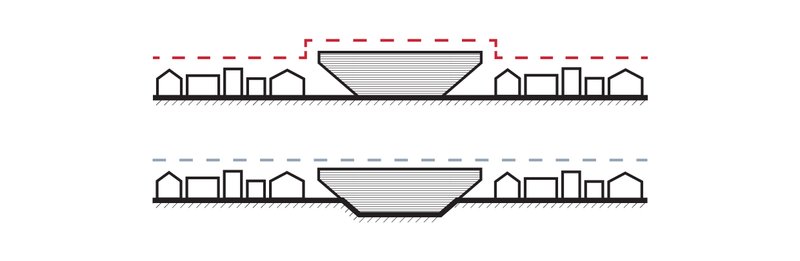
Most stadiums of the past do not consider their surroundings and are too aggressive giants out of context.
The stadium must harmoniously fit into the environment. To avoid excessive differences in height between the stadium and the surrounding buildings, the stadium can be deepened
- Be attractive for everyone
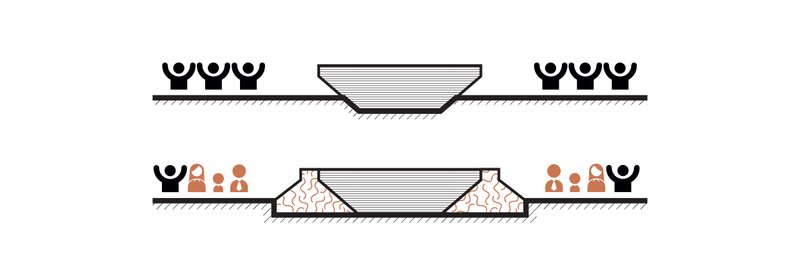
It is impossible to build stadiums only for sporting events, as it was done in the past. This approach leads to the emergence of “white elephants” - unnecessary loss-making stadiums.
By adding new functions the stadium becomes interesting and useful not only for fans but also for other categories, locals, both on match days and on non-match days.
- Go green
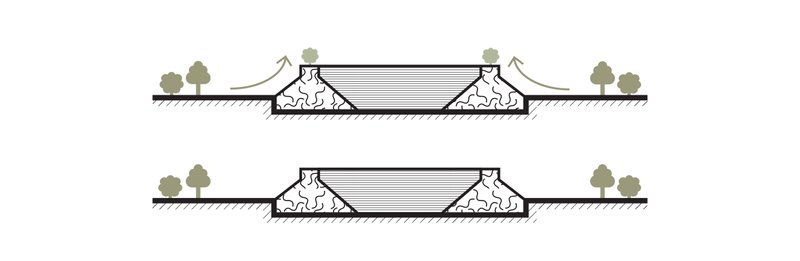
Many stadiums are developing the sustainable design. But the potential of the stadiums in this direction is enormous and not fully utilized.
The roof of the stadium should be used as efficiently as possible for the needs of the environment: rooftop park, photovoltaic panels, water collection, etc.
How the surrounding context influenced the design?
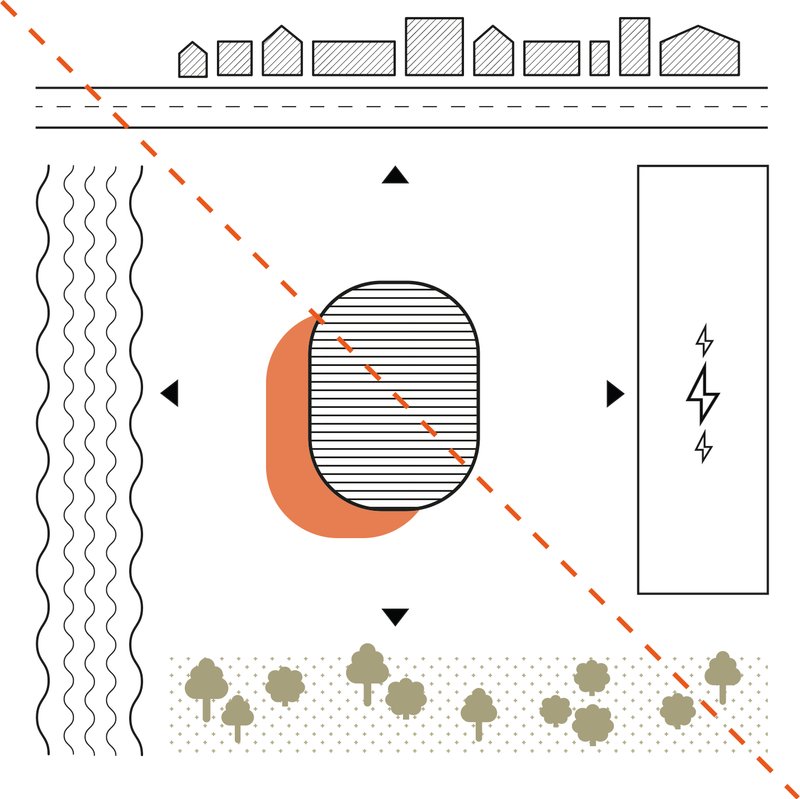
The site is surrounded by 2 different environments: natural (Raccoon River and forest) and man-made (city, W Martin Luther King Jr Parkway and industrial zone with electric post).
The stadium is supposed to develop towards a more pleasant natural environment, breaking the usual symmetry of sports buildings. Therefore, in the plan, the stadium resembles an egg elongated to the sides of the southwest.
The western part of the building is complemented by a large amphitheater facing the river. There is a stage in front of the amphitheater, and a platform for recreation is organized on the river bank.
In the southern part of the stadium there is an amphitheater-like terraced apartment for fans, sportsmen and tourists.
From the side of the river and the forest, a system of ramps was organized to climb the exploited roof.
The main approach to the stadium is organized from the city side. From the side of the electric post, there are service entrances, entrances for media and athletes, a ramp to the underground parking and loading of the building.
What are the main functions of the presented stadium?
The variety of stadium functions starts outside of it.
A large recreation area was organized by the river. Most of the territory is occupied by a PlayHub with playgrounds for different categories of users: playground for older children, playground for babies, inclusive playground, quiet play area.
Next to the PlayHub there is a SportsHub with three universal grounds and a Little League baseball field. Baseball field stands integrated into the roof of the mechanized parking lot. The entire area is riddled with bike and jogging tracks, which are even located on the roof of the stadium.
Functions inside the stadium can be roughly divided into the following groups:
- Sport: soccer field, indoor sports center (table tennis and table soccer, fitness center, squash halls, martial arts hall), activities on exploited roof
- Match Day: security area, information center, VIP and media entrance, VIP skyboxes, media area (conference hall, commentaries, etc), players area (dressing rooms, medical rooms, training rooms), mixed zone.
- Food Service: restaurant, food court, brewery.
- Commercial: shopping center, convenience store and offices
- Special functions: amphitheatre recreation area, museum, apartments for fans, sportsmen and tourists.
- Underground: underground parking for 1500 cars, mechanized parking for 3500 cars, loading and storage.
Such a set of functions will make the stadium usable all year round, it will become a catalyst for the surrounding area.
How will the project transform with the passing time?
At first, the stadium operates for its intended purpose as an arena for 30,000 spectators for the local team. Due to new functions, the stadium becomes interesting for different users, especially families with children.
The stadium also follows the principles of green design and becomes a self-sustaining ecosystem.
Later the stadium will be connected to the city by environmentally friendly and modern transport, such as Hyperloop. The mechanized underground parking is being transformed into a vacuum tube train station.
After the stadium is decommissioned for a bigger stadium in a different location, the stadium will retain the function of hosting events, but will rethink it. The central space will become a botanical garden. And spaces for holding e-sports competitions will be located along the perimeter of the field.
Due to technological progress any competition or event can be viewed in the arena in the form of a holographic projection. Thanks to this technology, spectators around the world will watch the Olympics or Super Bowl not in one stadium, but in thousands.
Finally, spectator seats will no longer be static. Moving flying capsules will replace VIP skyboxes.