
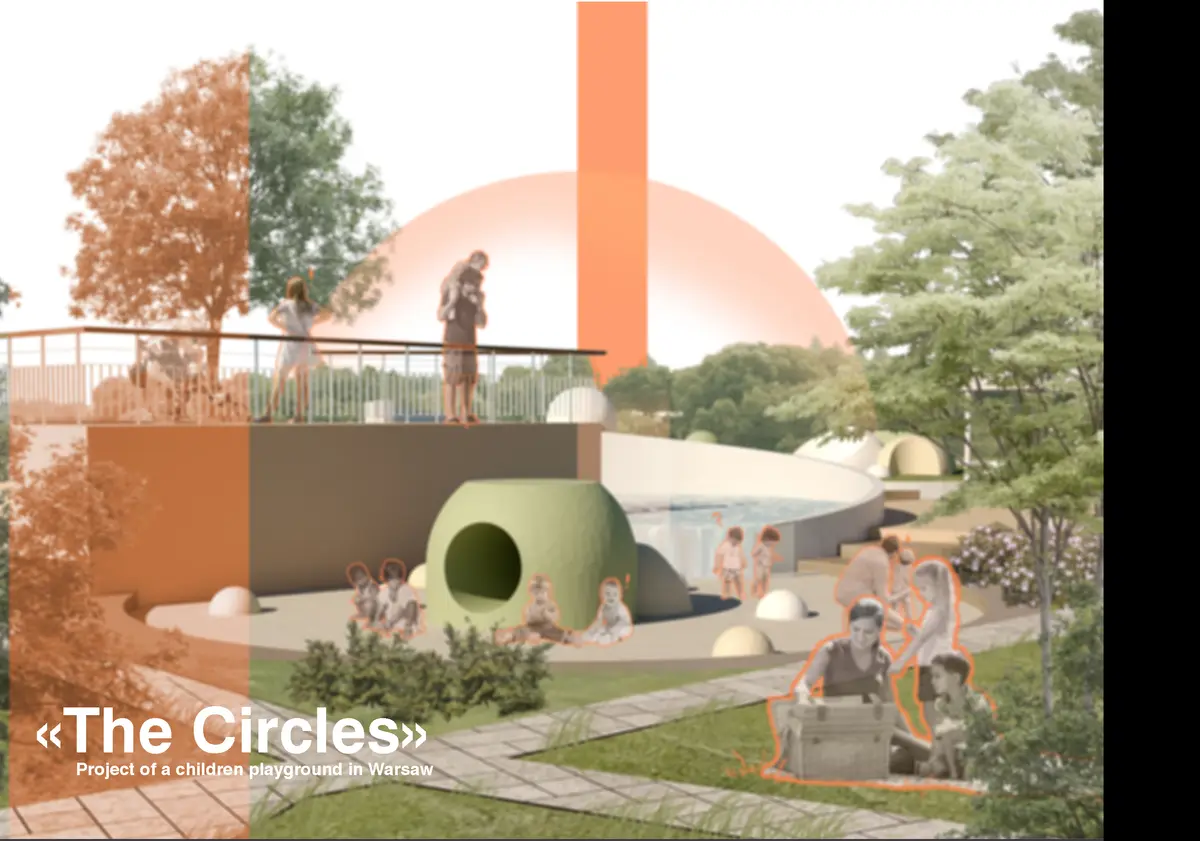
FAQ Questions for The Circles.
The project of playground in Warsaw.

1. Describe the concept/idea of the project.
The main concept was to create a space that would contribute to the development of such character traits as curiosity, inquisitiveness, purposefulness and interest in children. After the research, we took as a basis the thesis that children are very inquisitive by nature, but they do not have enough space to unleash their potential, the real world is inferior to the virtual in this matter. With our project, we want to help develop interest in the search process and craving for knowledge, giving children the opportunity to creatively realize themselves through playing in the real world.
2. How did the concept change by time?
The overall concept of the project changed several times before we settled on the current one. We started working on a project by studying children's perception, trying to put ourselves in the child's shoes and imagine how they see the world and what they want from it, subsequently putting ourselves in the parents' place, thinking about what a child needs for harmonious and timely development. And in the end, I think we managed to find a compromise between children's desires and needs.
3. How were the modules designed?
The main form of modular objects is a circle, which for us is associated with many positive things: friendship, joy, creativity, infinity. It is a difficult form to combine, but as a result there is an unusual constructor that will never assemble the same way twice. The abstractness of the form does not limit the child's imagination and makes the equipment multifunctional, interesting and diverse.
4. What/how were the materials selected?
We tried to choose eco-friendly and affordable materials for this project. Where possible, we have left the lawn as the most natural option for covering the playground. The project uses a special soft rubber coating with a memory effect that reduces the level of injury risk, and there is also sand on the playground for younger children.
Aluminum, a light metal, and a rubber shell were chosen for the equipment. It was decided to make the modules hollow to facilitate the construction so that children could drag objects themselves.


Popular Articles
Popular articles from the community

Extended Shell: Retrofitting Kolkata's Balconies as Living Urban Thresholds
A modular retrofit system recovers the social and environmental intelligence of Kolkata's historic verandas for contemporary Park Street residents.

Opera on the Sea: Driftwood Logic Shapes a Timber Opera House on Estonia's Coast
Trevor Orgill's opera house translates the entangled drift of floating timber into a civic building where wood, water, and music converge.
Temporary Home for Dogs: A Reversed Zoo Rethinks Animal Shelter Architecture
In Bucharest, a sinuous corridor and freed landscape flip the logic of containment, designing a shelter that works to make itself unnecessary.
Tsunami Convergenics: Turning Catastrophic Ocean Forces into Underwater Housing Infrastructure
A speculative underwater settlement off the coast of Onagawa, Japan, treats tsunamis and typhoons as energy sources rather than threats.

Similar Reads
You might also enjoy these articles

The Rhythm of Seasons
A Farmers' Market Connecting Nature and the City

More Than a Building-Designing a Living System
More Than a Building-Designing a Living System
Base Beyond
DESERT COMPOUND ARID: TOURISM OF ABSENCE AND ABUNDANCE


Comments (0)
Please login or sign up to add comments
No comments yet. Be the first to comment!