

Farm.F.actor.Y: Merging Agriculture, Housing, and Public Life Along the Thames
A shortlisted urban design proposal that stitches farming infrastructure, working-class housing typologies, and green corridors into one self-sustaining di


What if the antidote to gentrification were not policy alone but physical design: a district where food production, housing, and public gathering share the same street? Farm.F.actor.Y proposes exactly that. The project lays out an integrated urban ecosystem near the Thames where farmers' houses sit adjacent to cultivated green fields, a new transit station called Meal Mine anchors the masterplan, and roof gardens blur the line between productive landscape and inhabited architecture. It is a model for a city that feeds itself, socially and literally.
Designed by Simone Zurli, Farm.F.actor.Y was shortlisted in the Urban Meal Mine competition. The brief called for sustainable urban farming strategies, and Zurli responded with something broader: a complete district framework that treats agriculture not as an overlay but as the organizing logic for housing, transport, and community space. The architectural language draws deliberately from traditional Anglo-Saxon working-class housing, grounding contemporary modularity in a recognizable, socially rooted form.
A Masterplan That Reads Urban Fabric as Agricultural Infrastructure
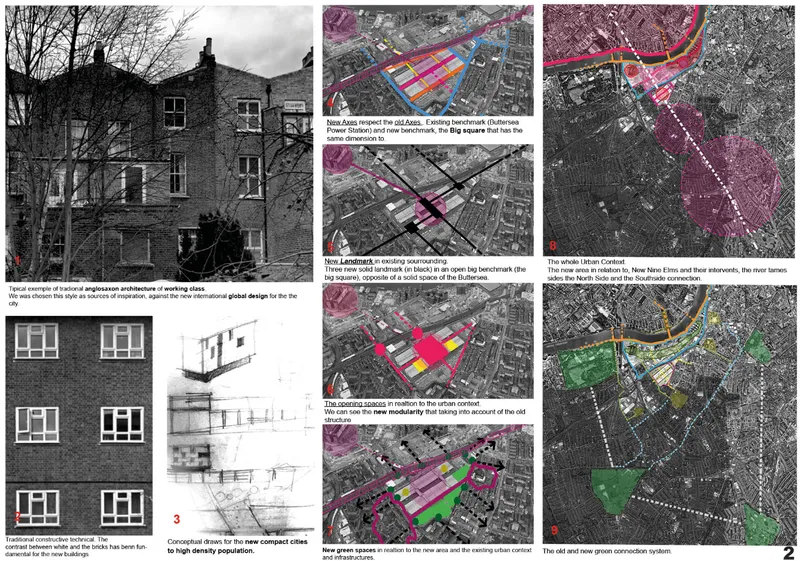
The aerial plan diagrams make the intervention legible at a glance. Colorful site insertions are overlaid on a black-and-white rendering of the existing urban fabric, clarifying what is new and what is preserved. Three landmark buildings structure the district: a farm-building dedicated to food production and processing, a multifunctional public space for community gathering, and the Meal Mine station building that connects the development to the wider transport network. Between these anchors, farmers' houses are placed directly alongside green areas, collapsing the distance between dwelling and cultivation.
The layout is structured yet adaptable. Public and private greenspaces weave through the plan as roof gardens, parks, and tree-lined pathways, each contributing to biodiversity while keeping the district walkable and accessible. Green corridors link old neighborhoods to new ones, ensuring that the project does not create an island but instead extends connections through the existing city grid. The result is a masterplan that positions agriculture as connective tissue, not peripheral amenity.
Working-Class Housing Typologies Reimagined for Density
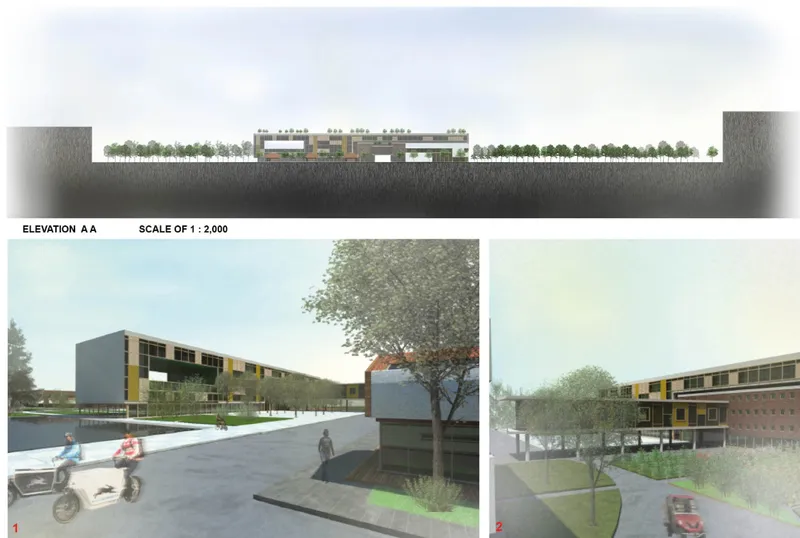
The elevation drawings and street-level renderings reveal a linear complex with rooftop planting and mature trees lining the public frontage. Zurli's decision to draw from Anglo-Saxon working-class housing is not nostalgic; it is strategic. These typologies carry historical associations with social integration and neighborhood solidarity. By adapting their proportions and material logic to contemporary modular construction, the design achieves compact, efficient housing that remains legible as part of a collective urban tradition rather than a developer's speculative grid.
Rooftop planting is not decorative here. It extends the productive landscape vertically, turning the building section into a layered diagram of living and growing. Street trees and planted frontages reinforce the idea that the boundary between architecture and agriculture dissolves at every scale, from the masterplan down to the individual building elevation.
Sectional Logic: Perimeter Blocks in a Productive Landscape

The territorial section drawings and axonometric view expose the project's three-dimensional strategy. Perimeter block housing defines clear edges between semi-private courtyards and the larger landscape, creating a gradient of intimacy from the open agricultural fields to sheltered domestic spaces. The section reveals how the ground plane operates: community squares and open gathering spaces punctuate the block structure, acting as social anchors where residents encounter one another outside the routines of work and home.
The axonometric is particularly revealing. It shows the complex sitting within its broader landscape context, making visible the scale relationship between the built intervention and the surrounding terrain. The project respects existing urban axes near the Thames while introducing new pedestrian and green connections that enhance mobility. Transport integration via the Meal Mine station is not an afterthought; it is embedded in the spatial sequence from public square to platform.
An Aerial View of the District as Productive Ground

The aerial rendering confirms what the diagrams promise. Green fields and housing blocks are inserted into the existing urban fabric with surgical precision, creating a rectilinear district that is simultaneously agricultural and residential. The proportion of open, cultivated ground to built footprint is striking: this is not a token community garden tucked behind a parking structure but a genuine productive landscape scaled to feed and employ a neighborhood. Residents are expected to participate in cycles of food production, consumption, and recreation, transforming what could be passive green space into a shared cultural and ecological resource.
Why This Project Matters
Farm.F.actor.Y refuses the assumption that urban density and agricultural productivity are incompatible. By grounding its architectural language in working-class housing traditions and organizing its masterplan around food systems rather than speculative land value, the project offers a coherent counter-model to the gentrification pressures that dominate Thames-side development. The inclusion of a transit station, community squares, and green corridors ensures the district is not self-isolating but actively integrated into the city's circulatory system.
Zurli's contribution to the Urban Meal Mine competition goes beyond a clever site plan. It articulates a political position through spatial design: that equity, belonging, and collective identity can be built into the physical structure of a neighborhood. The strongest move here is the refusal to separate the question of food from the question of housing. When the place where you live is also the place where you grow, process, and share food, urbanism stops being a real estate problem and becomes, again, a social project.
View the Full Project
About the Designers
Designer: Simone Zurli
Enter a Design Competition on uni.xyz
uni.xyz runs architecture and design competitions year-round that reward proposals with spatial conviction and real site intelligence.
Project credits: Farm.F.actor.Y by Simone Zurli Urban Meal Mine (uni.xyz).


Popular Articles
Popular articles from the community


Faces of the Soviet Avant-Garde: Turning Moscow's Street Names into an Open-Air Museum
A network of sculptural installations across a Moscow residential district transforms forgotten architect names into spatial encounters with cultural memor

The Amber Palace Opera: A Geological Fiction Surfaces on Tallinn's Baltic Waterfront
Pierre Brillard reimagines a Baltic legend as a public landscape, opera house, and waterfront promenade rooted in Tallinn's coastal identity.

Opera on the Sea: Driftwood Logic Shapes a Timber Opera House on Estonia's Coast
Trevor Orgill's opera house translates the entangled drift of floating timber into a civic building where wood, water, and music converge.

Extended Shell: Retrofitting Kolkata's Balconies as Living Urban Thresholds
A modular retrofit system recovers the social and environmental intelligence of Kolkata's historic verandas for contemporary Park Street residents.

Similar Reads
You might also enjoy these articles

Play: Fragments of Their World: Remembered Architecture Rebuilt as a Modular Playground for Refugee Camps
Tom Gardner abstracts domes, arches and towers from the homelands of displaced families into a kit of child-scaled play parts for camp settlements.
REBIRTH: A Circular Settlement Where Afghan Widows and Their Children Rebuild Life Together
A shortlisted Resile entry turns the circle into a protective ring of timber and brick, gathering homes, classrooms and gardens around a shared landscape.
The Main Dream: A Recycled Plastic Kit That Lets Refugee Children Build Their Own Playground
Thirty-centimetre interlocking cubes that connect on three axes turn play into construction, letting children author the spaces they occupy.

Lunar Spiral: A Fibonacci-Driven Moon Settlement Rising from Shackleton Crater
Golden-spiral geometry organises buried infrastructure and orbiting habitable spheres into a lunar base designed to grow as life on the Moon expands.

Comments (0)
Please login or sign up to add comments
No comments yet. Be the first to comment!