

FarModular: A Modular Market That Grows, Shrinks, and Feeds the City
Beyzanur Özdemir's shortlisted competition entry rethinks urban marketplaces as prefabricated, demountable systems tied to agriculture.


What if a marketplace could behave like a crop rotation: expanding in summer, contracting in winter, shifting its program with the seasons? FarModular takes that premise literally, organizing a 2,154 m² site into a grid of 4x4-meter modules that can be assembled, disassembled, and reconfigured as demand changes. The result is not a building so much as an agricultural infrastructure dressed in timber and glass, where the act of buying food sits alongside the act of growing it.
Designed by Beyzanur Özdemir, FarModular was a shortlisted entry in the Farm to CITY competition. The brief asked designers to reimagine the relationship between agricultural production and urban consumption. Özdemir's response collapses that distance entirely, weaving market stalls, cafés, and greenhouses into a single modular framework elevated on a 4-meter base, oriented by sun and wind analysis, and built from wood, glass, and hemp insulation.
A Grid That Breathes: Site Organization and Courtyard Logic
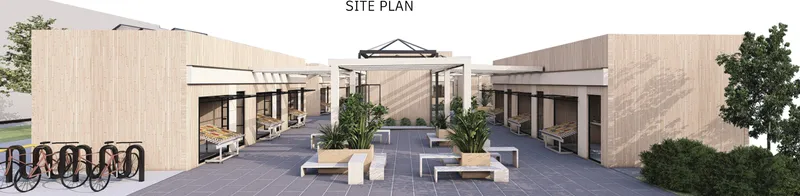
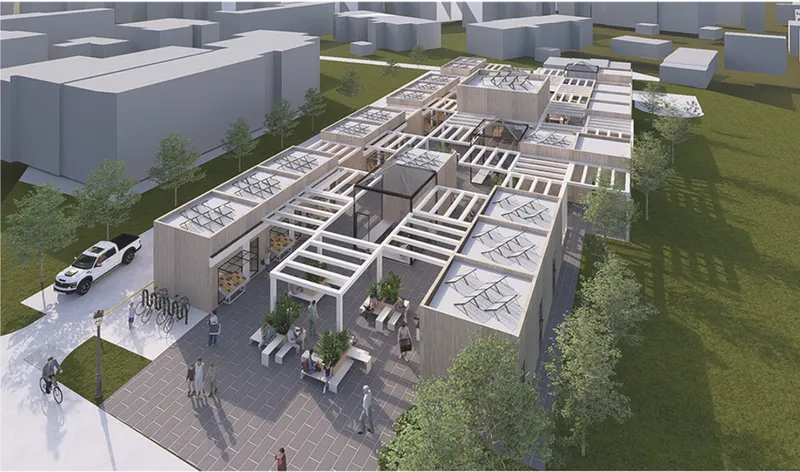
The rendered site plan reveals the project's fundamental move: carving circulation corridors through a modular grid to create open courtyards and shaded gathering nodes. Timber-clad pavilions line the perimeter, with bike parking integrated at the edges to keep vehicles out and pedestrians in. From above, the aerial view shows how alternating open and enclosed bays generate rhythm across the site. People cluster beneath canopies and between volumes, occupying the gaps as naturally as they would a traditional souk or covered bazaar.
These courtyard spaces are not leftover voids. They are the social heart of the project, designed to host community programs, seasonal events, and informal gathering. By subdividing the site into a repeatable grid and then strategically removing modules, Özdemir creates a porosity that invites airflow, daylight, and spontaneous occupation. The result reads less like a shopping center and more like a small neighborhood organized around shared open ground.
Three Modules, One System: Market, Café, and Greenhouse
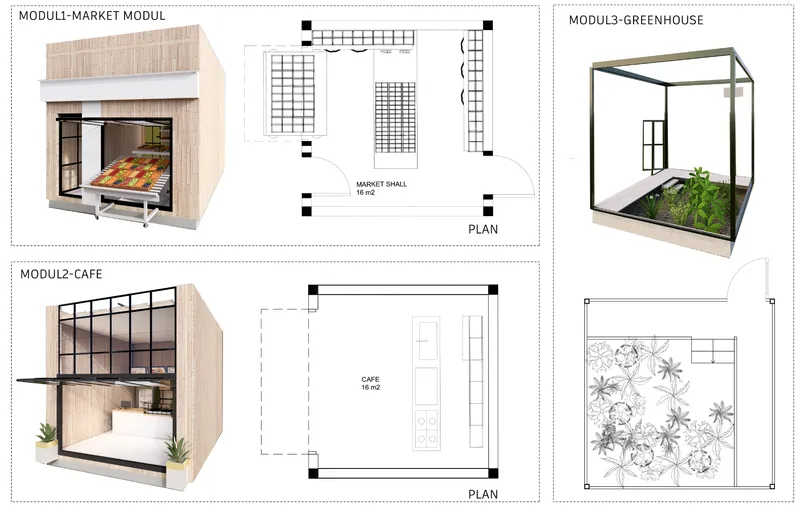
The axonometric diagram lays out the project's three core typologies. The market module and café module each occupy 16 m², with front façades that fully open to dissolve the boundary between indoor and outdoor space. Display counters and shelving systems face outward, making goods visible and accessible. The greenhouse module introduces a different register entirely: it is a productive space rather than a transactional one, encouraging hands-on engagement with urban agriculture. All three share a common structural logic, passive solar strategies including operable façades and cross ventilation, and solar-powered lighting systems that reduce operational energy consumption.
What makes the system convincing is its clarity. Each module is prefabricated and demountable, meaning the entire market can be relocated or reconfigured without generating significant construction waste. The material palette of locally sourced wood, glass, and hemp insulation keeps the carbon footprint low while maintaining a tactile warmth that feels appropriate for a food market. The diagram communicates this economy of means effectively: three simple types, repeated and varied, producing spatial richness through combination rather than formal complexity.
Under the Glass Canopy: Where Commerce Meets Rest
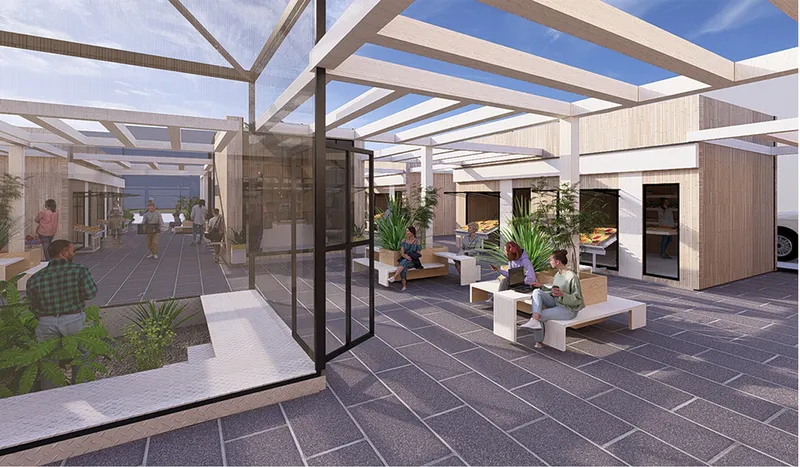
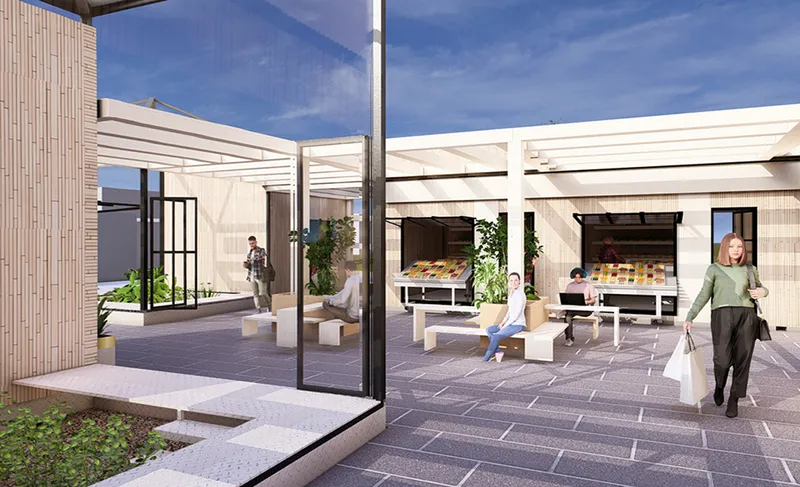
The courtyard perspective is the project's most atmospheric image. A steel-framed glass canopy stretches overhead, filtering light onto planted beds and white seating blocks below. People sit, talk, rest. The space reads as a garden rather than a commercial corridor, and that inversion is deliberate. Greenhouses and pocket gardens scattered across the site add layers of biodiversity while reducing heat gain and improving air quality, creating a microclimate that makes lingering comfortable rather than merely tolerable.
Viewed from the threshold of an open steel-framed glass door, the courtyard reveals its layered depth: market stalls in the middle distance, timber-clad volumes beyond, sky above. The transparency of the structural frame means sightlines extend across the entire complex, connecting vendors to customers and cultivation to consumption in a single visual field. Permeable surfaces underfoot manage stormwater while reinforcing the sense that this is ground shared with nature, not sealed against it.
The Market Corridor: Linear Flow and Vendor Visibility
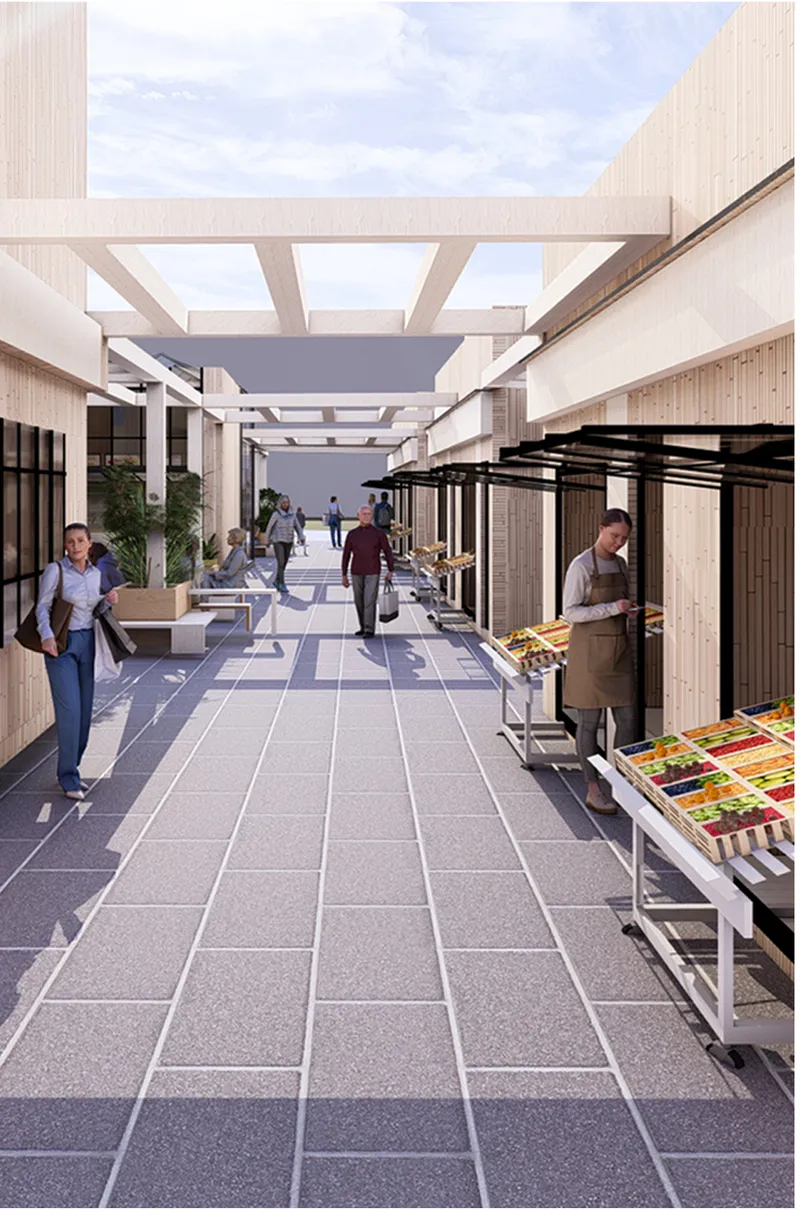
The linear market corridor is where the project's spatial logic becomes most legible at eye level. Overhead beams establish a strong rhythm, while vendor stalls line one side with their goods on open display. Pedestrians move through a generously proportioned path that avoids the cramped feeling of many conventional market halls. The cross-ventilation strategy is visible here too: the corridor is open at both ends, channeling breezes through the section and keeping the space cool without mechanical systems.
This image captures something that plans and diagrams cannot: the experience of walking through a market where architecture recedes and social life takes over. The beams frame the sky. The stalls frame the produce. The people frame the space. Özdemir's modular system succeeds precisely because it provides just enough structure to organize activity without constraining it.
Why This Project Matters
FarModular's strength lies in its refusal to treat the marketplace as a fixed architectural object. By designing a system of prefabricated, demountable modules rather than a singular building, Özdemir proposes a marketplace that can evolve with its community. Seasonal shifts, changing vendor populations, new agricultural programs: all can be absorbed without demolition or major renovation. In a discipline still dominated by permanent structures, this kind of circular thinking deserves attention.
More importantly, the project reconnects two activities that industrial food systems have pulled apart: buying and growing. Greenhouses sit alongside cafés. Planted beds share ground with vendor stalls. The market becomes a place where urban residents can witness, participate in, and benefit from the agricultural process rather than encountering its products in vacuum-sealed isolation. That integration of ecology, commerce, and community, achieved through a simple and repeatable modular kit, is what makes FarModular a compelling model for future urban marketplaces.
View the Full Project
About the Designers
Designer: Beyzanur Özdemir
Enter a Design Competition on uni.xyz
uni.xyz runs architecture and design competitions year-round that reward proposals with spatial conviction and real site intelligence.
Project credits: FarModular by Beyzanur Özdemir Farm to CITY (uni.xyz).


Popular Articles
Popular articles from the community


The Amber Palace Opera: A Geological Fiction Surfaces on Tallinn's Baltic Waterfront
Pierre Brillard reimagines a Baltic legend as a public landscape, opera house, and waterfront promenade rooted in Tallinn's coastal identity.

Cloaked Colonization: A Mobile Underwater Habitat That Moves Like a Fish
Micah Abaya's shortlisted EHC Pacific entry reimagines ocean settlement as a dispersed network of self-sustaining architectural organisms.
Tsunami Convergenics: Turning Catastrophic Ocean Forces into Underwater Housing Infrastructure
A speculative underwater settlement off the coast of Onagawa, Japan, treats tsunamis and typhoons as energy sources rather than threats.

Extended Shell: Retrofitting Kolkata's Balconies as Living Urban Thresholds
A modular retrofit system recovers the social and environmental intelligence of Kolkata's historic verandas for contemporary Park Street residents.

Similar Reads
You might also enjoy these articles

Play: Fragments of Their World: Remembered Architecture Rebuilt as a Modular Playground for Refugee Camps
Tom Gardner abstracts domes, arches and towers from the homelands of displaced families into a kit of child-scaled play parts for camp settlements.
REBIRTH: A Circular Settlement Where Afghan Widows and Their Children Rebuild Life Together
A shortlisted Resile entry turns the circle into a protective ring of timber and brick, gathering homes, classrooms and gardens around a shared landscape.
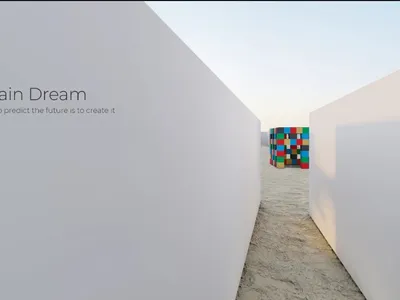
The Main Dream: A Recycled Plastic Kit That Lets Refugee Children Build Their Own Playground
Thirty-centimetre interlocking cubes that connect on three axes turn play into construction, letting children author the spaces they occupy.

Lunar Spiral: A Fibonacci-Driven Moon Settlement Rising from Shackleton Crater
Golden-spiral geometry organises buried infrastructure and orbiting habitable spheres into a lunar base designed to grow as life on the Moon expands.

Explore Modular Farm Competitions
Discover active competitions in this discipline

Challenge to visualize a collision of the future and past

Challenge to visualize future spaces of waste

Challenge to visualize slums of 2080

Challenge to illustrate the ruins of Petra
Comments (0)
Please login or sign up to add comments
No comments yet. Be the first to comment!