
Birdseye Anchors a Cedar and Plaster Farmhouse to the Edge of a Rhode Island Meadow
Field House in South Kingstown pairs two gabled volumes with oak, lime plaster, and western red cedar against a backdrop of forest and field.


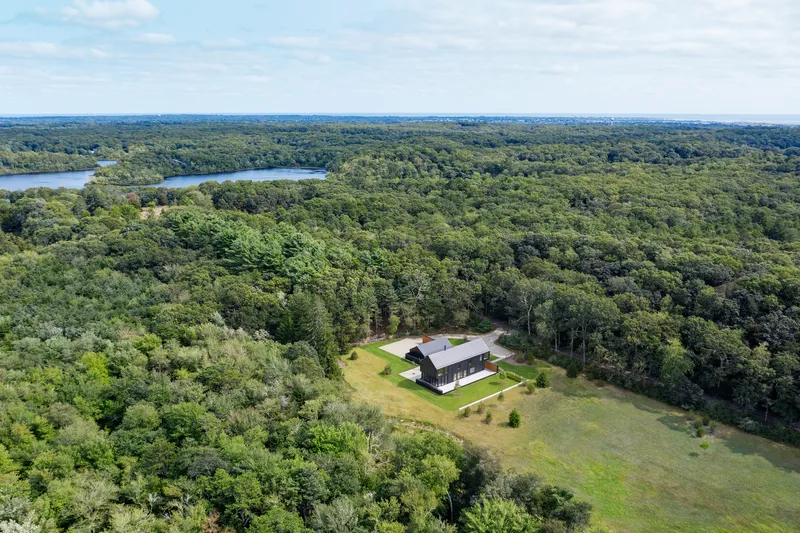
There is a recurring temptation in rural residential architecture to either mimic the barns and sheds of the surrounding landscape or reject them entirely in favor of glass pavilions. Birdseye, the Vermont-based firm behind Field House, does something more precise. The project, completed in 2020 in South Kingstown, Rhode Island, takes the elementary gable form, familiar to every New England dirt road, and strips it to its structural logic. Two volumes, one two stories and one single story, sit at the northeast corner of a parcel where forest meets open meadow. They are linked not by a hallway but by a perpendicular exterior walkway defined by a full-height site wall, a detail that turns the act of moving between house and garage into a framed encounter with the landscape.
What makes Field House genuinely interesting is its restraint under pressure. A 3,000 to 5,000 square foot house with an art studio, a screened porch, and three bedrooms could easily sprawl into pastiche. Instead, the building reads as a single compositional gesture: dark volumes grounded by a continuous boardwalk, oriented west to pull meadow light deep into every primary room. The 2020 AIAVT Merit Award recognized this calibration, and it holds up. The house feels both inevitable and carefully argued.
Two Volumes, One Argument
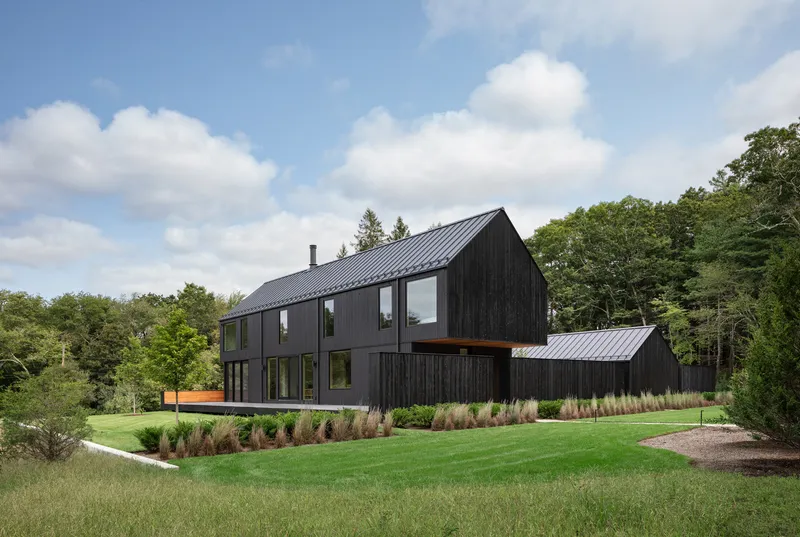
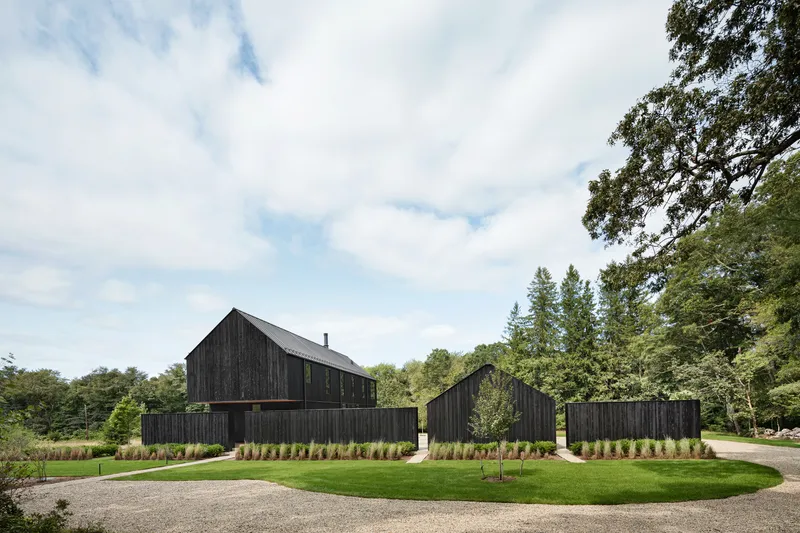
The massing is disarmingly simple. A two-story main house and a one-story garage share the same black-stained western red cedar cladding and metal standing seam roofs, presenting a unified silhouette from a distance. Up close, the separation between them is the whole point. The perpendicular walkway, bracketed by a cantilevered upper volume on one side and a natural cedar-clad wall on the other, creates a compressed threshold before the house opens to the field beyond. A circular gravel drive and an extended garage wall complete the arrival sequence, channeling visitors between built form and forest edge.
The southern facade reads as a series of gables punctuated by horizontal and vertical reveals. These are not decorative; they are gaps that let you understand the building as an assembly of parts rather than a monolith. The horizontal slit where the cantilevered gable lifts off the entry wall below it is particularly effective, a detail that announces the structural independence of each element.
The Threshold as Event
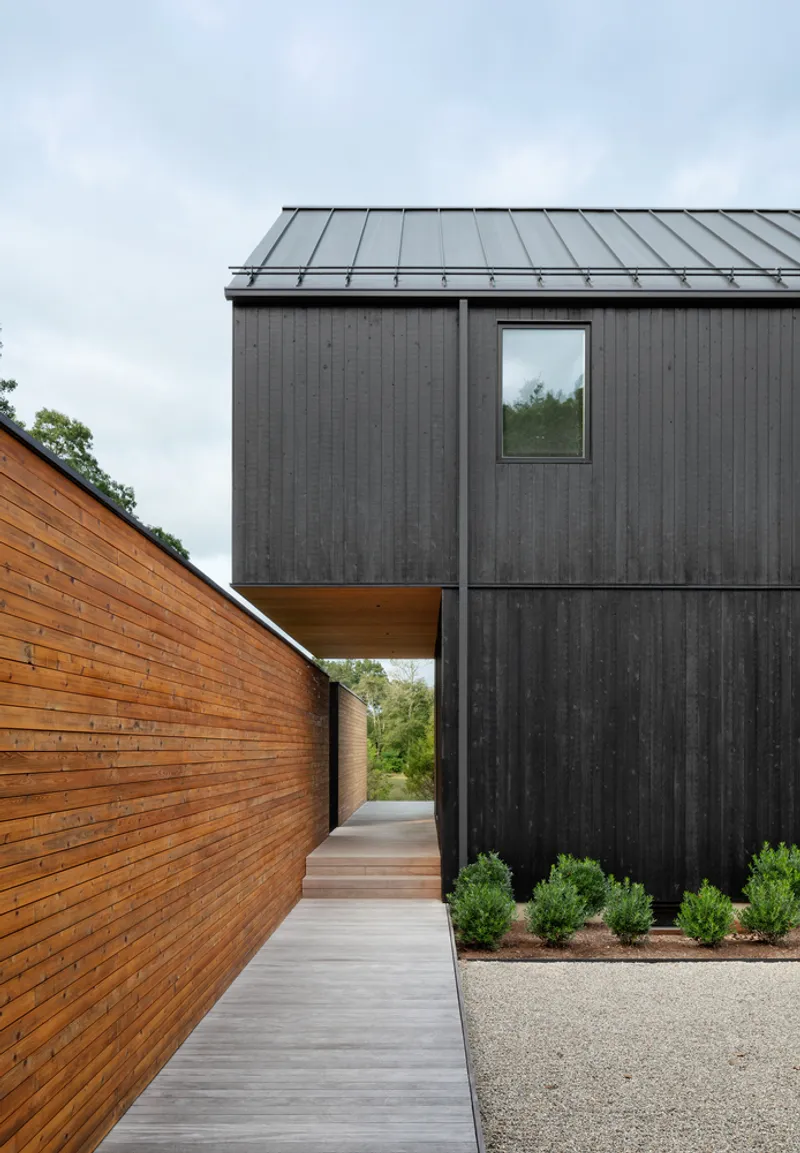
The covered breezeway between the two volumes deserves its own discussion. Black charred siding on one face, clear cedar on the other, a strip of sky above: Birdseye treats the passage as a decompression chamber between the public road and the private interior. You arrive by car through the auto court, pass beneath the cantilever, and only then encounter the meadow view that the house has been orienting itself toward. It is a sequence borrowed from courtyard traditions but executed in the lean vocabulary of New England agricultural buildings.
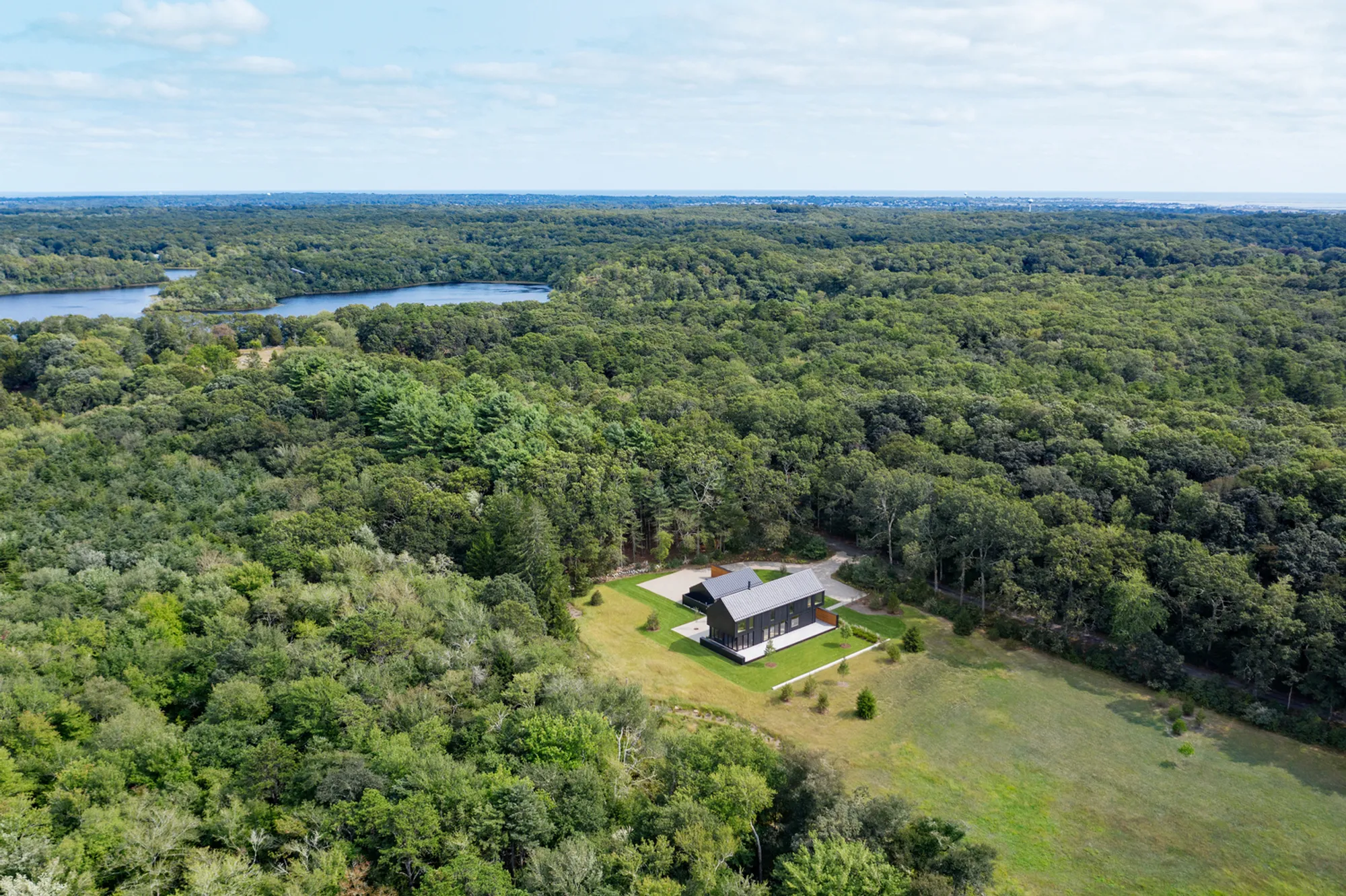
The aerial view confirms what the ground-level experience implies. The house sits tight to the tree line, its dark cladding nearly merging with the forest canopy, while the clearing and distant lake stretch west. Siting the building in the northeast corner of the parcel was the critical first move; everything else follows from that decision.
Oak, Plaster, and the Discipline of a Limited Palette
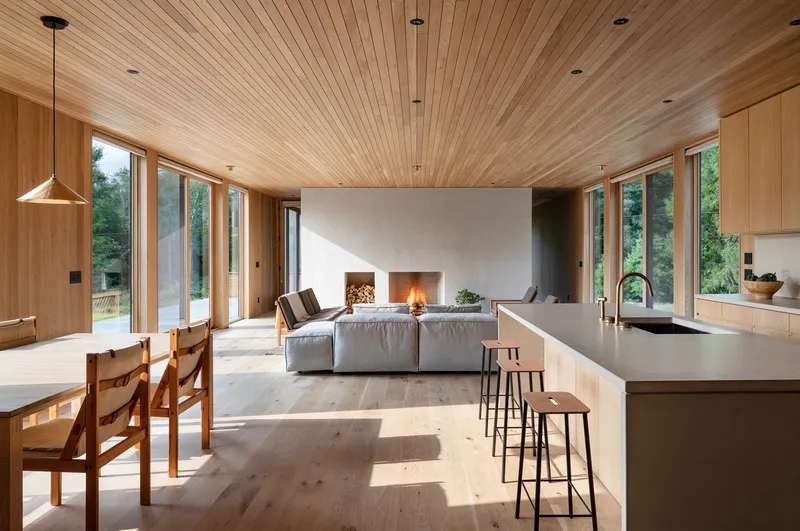
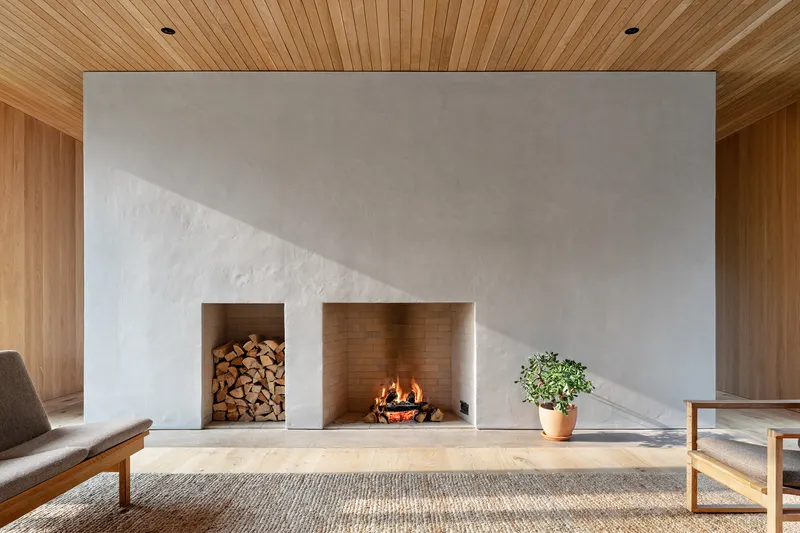
Inside, the material count is deliberately low. Vertical plank oak walls, oak floors, and tongue-and-groove oak ceilings wrap the ground floor in a warm, continuous grain. Against this backdrop, the raw lime plaster fireplace wall operates as a quiet anchor. Its matte, mineral surface absorbs light differently from the timber, and the firewood storage alcove beneath the hearth turns a functional need into a textural counterpoint. Concrete countertops and backsplashes in the kitchen extend the palette of honest, unfinished surfaces.
Brass light fixtures and fittings are specified as "living brass," meaning they will patinate over time rather than hold a polished finish. It is a small choice that signals a larger commitment: the house is designed to age alongside its site, not to resist the passage of time.
Rooms That Frame the Landscape
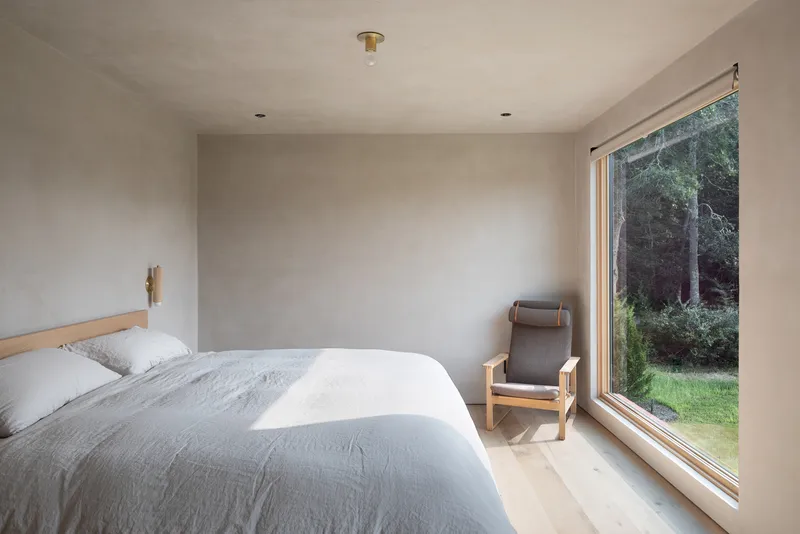
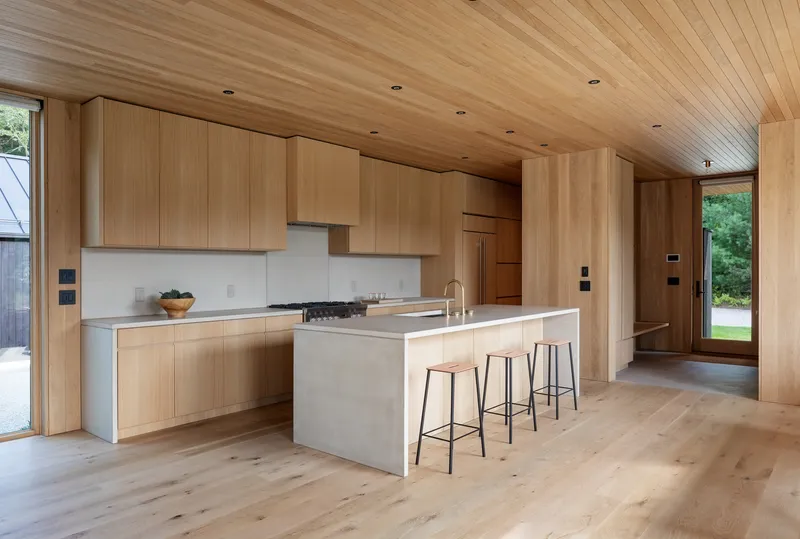
All primary living spaces face west toward the meadow, but Birdseye modulates that orientation room by room. The open-plan kitchen and living area receive light through full-height glass doors that dissolve the boundary between interior and lawn. Upstairs, the bedrooms take a different approach. A floor-to-ceiling timber-framed window in one bedroom captures the forested hillside in soft afternoon light, offering a more intimate, portrait-like view. The kitchen, by contrast, sits under a generous tongue-and-groove ceiling and pulls in light from above, giving the work of cooking a different quality of illumination than the rest of the ground floor.
The screened porch and art studio extend the first floor program outward, reinforcing the idea that the boundary between house and field is permeable. A continuous wooden boardwalk wraps the structure, blurring the line further.
Considered Details in the Private Rooms
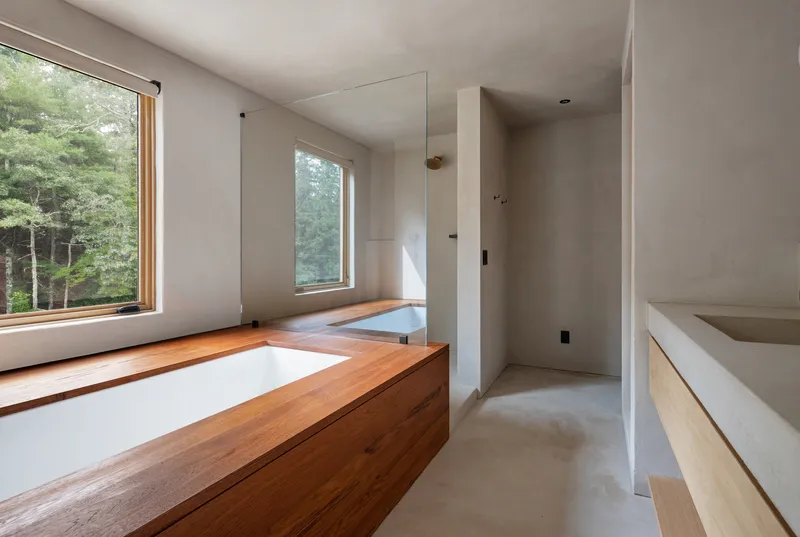
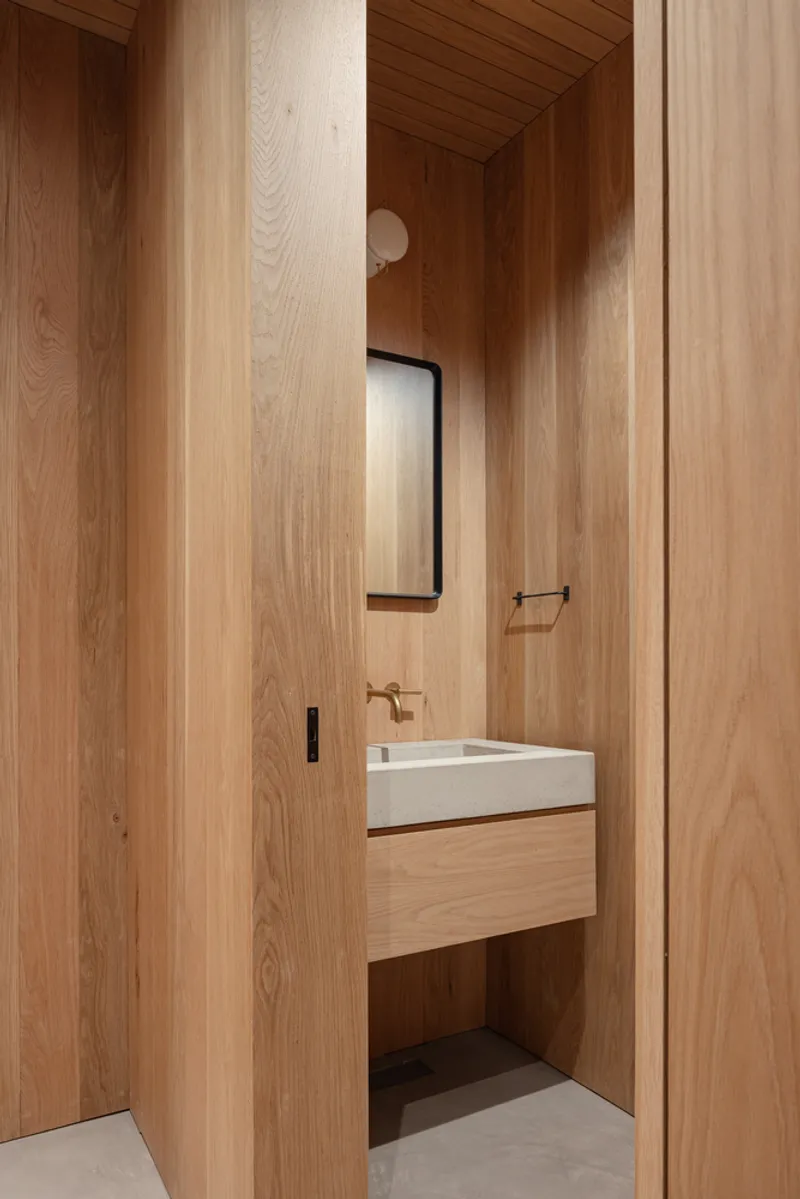
The bathrooms demonstrate that the same material discipline governs even the smallest rooms. A timber-clad soaking tub sits beneath a deep window sill, its wood tone continuous with the surrounding wall paneling, while white hand-troweled lime plaster above keeps the space from feeling enclosed. In another bathroom, vertical oak paneling frames a compact vanity with an integrated sink and black mirror. There is no tile, no marble, no gratuitous contrast. The rooms succeed because they commit fully to the vocabulary established elsewhere in the house.
Interiors were handled by Allie Genoa, whose selections complement the architecture without competing with it. The coordination between interior finish and structural expression, particularly the way lime plaster walls on the upper level carry through from the public fireplace wall below, gives the house a coherence that many collaborations between architect and interior designer lack.
Performance Without Spectacle
Field House achieves serious energy performance without making sustainability its headline. Closed-cell spray foam insulation delivers R-38 walls and R-60 roofs, numbers that exceed most residential code requirements by a wide margin. A high-efficiency natural gas boiler with variable air volume delivery handles heating, while a mechanical energy recovery ventilation system ensures fresh air exchange without thermal loss. Energy Star windows, all-LED dimmable lighting, and low-VOC materials round out the strategy. On the site, collected rainwater disperses into a dry swale and bio-retention area, managing stormwater as part of the landscape rather than piping it offsite.
None of these systems are visible. That is the point. The house looks and feels like a series of simple gabled rooms in a field. The engineering is embedded, not exhibited, which is the more honest way to build sustainably.
Why This Project Matters
Field House makes a compelling case that the vernacular gable, far from being exhausted, remains one of the most productive forms in residential architecture. Birdseye's contribution is not to reinvent it but to subject it to real rigor: precise siting, disciplined material selection, and a spatial sequence that rewards slow experience. The breezeway between the two volumes alone justifies the project's reputation, turning a piece of connective tissue into the building's most memorable moment.
In a market saturated with farmhouse aesthetics applied as wallpaper, this project earns its rural character through construction logic. The cedar will silver, the brass will darken, and the meadow grasses will grow up to the boardwalk. Field House is designed for a long, quiet life in its landscape, and that is the most ambitious thing a house can try to be.
Field House by Birdseye, South Kingstown, Rhode Island, United States. Approximately 3,000 to 5,000 sq ft. Completed 2020. Built by Horrigan Builders. Interiors by Allie Genoa. Photography by Michael Moran Photography.
About the Studio
Share Your Own Work on uni.xyz
If projects like this are the kind of work you want to make, uni.xyz is a place to publish your own, find collaborators, and enter design competitions.



Popular Articles
Popular articles from the community


The Earth Pod: 3D Printed Homes for Resilient Refugee Communities
The Earth Pod reimagines refugee housing through 3D printed homes made from clay, combining resilience, self-sufficiency, and rapid shelter.

The Ocean Hive: Sustainable Architecture for a Self-Sufficient Civilization at Sea
The Ocean Hive imagines sustainable architecture at sea, where modular habitats, algae, wave power and ocean waste sustain a growing colony.

The Musturak Paradise: Senior Living Architecture for a Connected Future in Temara, Morocco
The Musturak Paradise reimagines senior living architecture in Temara via private homes, social spaces, culture, community, and shared care.

Co-life: Sustainable Architecture for Age-Friendly Community Living
Co-life reimagines sustainable architecture for seniors through courtyards, rammed earth, shared gardens, and spaces designed for belonging.


Similar Reads
You might also enjoy these articles


Hodi-Mandai Geram
Project Function: Preservation and revitalization of the Intangible heritage and socio-spatial identity of the Hodi by Housing, Cultural Memory Center, Sacred Grove, landscape, local tourism economy


Olio Towers: A Mid-Rise for Performers That Fuses Housing, Rehearsal, and Stage
Located blocks from Houston's Theater District, this modular tower stacks living units around a central performance atrium.

Oasis: Modular Green Housing Carved into Dhaka's Urban Fabric
A shortlisted Plugin Housing entry reclaims unauthorized settlements in Dhaka with stepped concrete volumes, green roofs, and ventilation-driven design.

Black Hole: A Floating Megastructure for the Post-Physical Era
Emiliano Mazzarotto envisions a spherical, self-scaling arena where e-sports, digital hotels, and holographic stadiums replace traditional public space.

Explore Housing Competitions
Discover active competitions in this discipline



Challenge to reimagine the Iron Throne


Photograph architecture without architects


Illustrate the lost glory of Angkor Wat - Render Challenge


Design challenge to reuse E-waste
Comments (0)
Please login or sign up to add comments
No comments yet. Be the first to comment!