
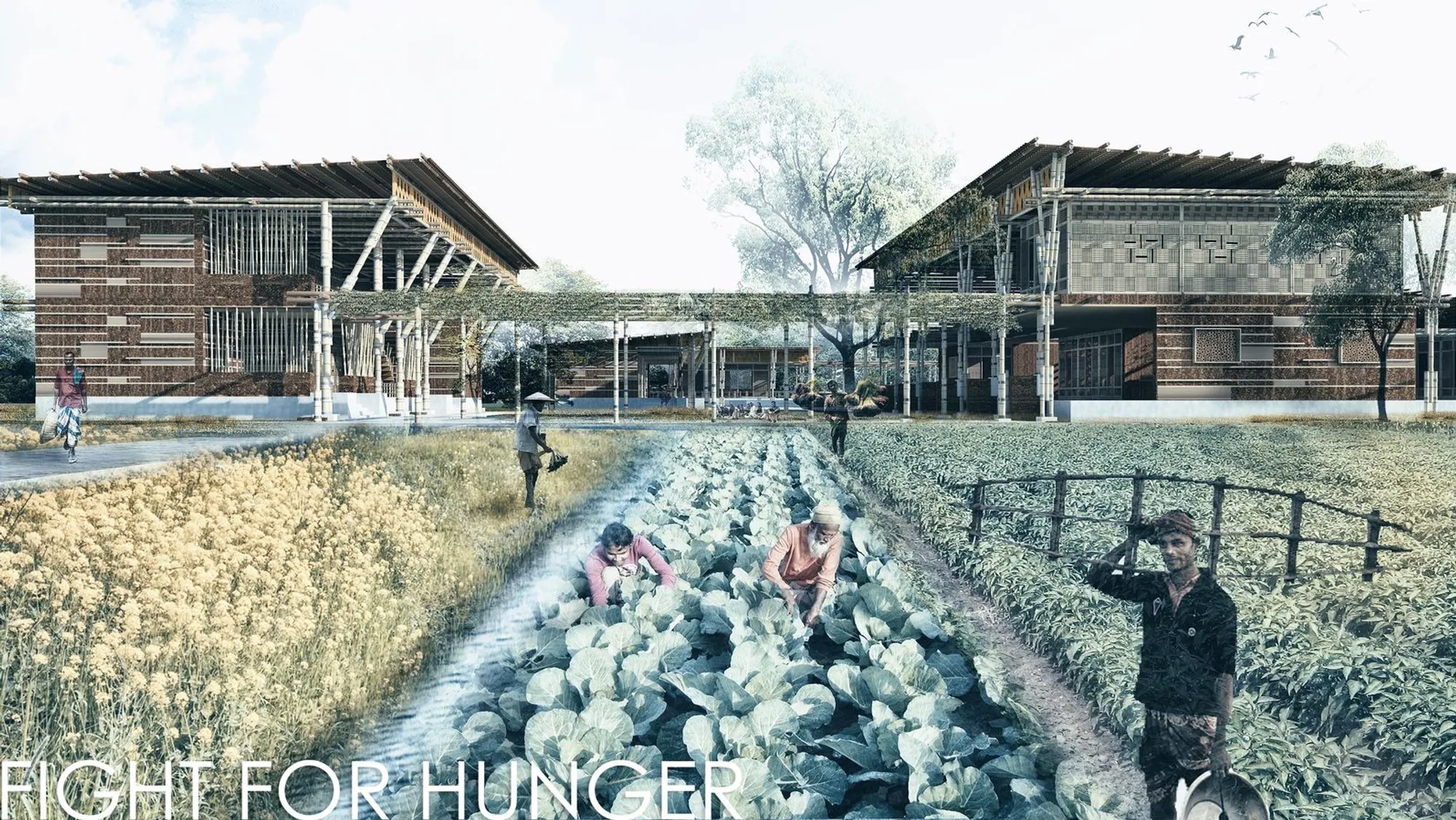
Fight for Hunger: An Institution for Low-Income Farmers
An architecture-led agricultural institution empowering low-income farmers through sustainable design, education, and community-driven food systems.


Fight for Hunger: An institution for low income farmer is an architecture‑driven social institution envisioned as a catalyst for agricultural empowerment, food security, and rural development. Designed as a platform for low‑income farmers, the project explores how sustainable architecture can become an active agent in reducing hunger, unemployment, and poverty while strengthening local food systems. Rather than treating architecture as a static backdrop, the proposal positions the built environment as an educational, productive, and regenerative framework that directly supports farming communities.
Conceived by Matiur Jony, the project was awarded an Honorable Mention at UnIATA ’18, recognizing its strong social intent and integrated architectural thinking.
Context and Social Challenge
Rapid population growth, shrinking agricultural land, and limited access to education have placed immense pressure on small‑scale farmers. In many rural contexts, farmers remain trapped in cycles of low productivity, unemployment, and food scarcity: not due to lack of effort, but due to lack of resources, skills, and systemic support.
Fight for Hunger responds to this challenge by proposing an institution rooted in sustainable architecture, where training, production, community interaction, and environmental stewardship coexist within a single ecosystem. The project acknowledges farmers as the guardians of land and positions them at the center of social and spatial planning.
Architectural Vision
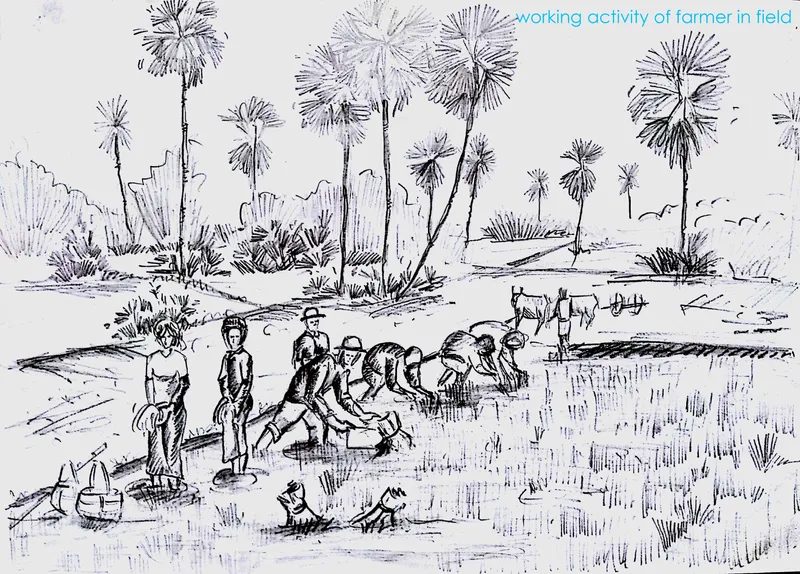
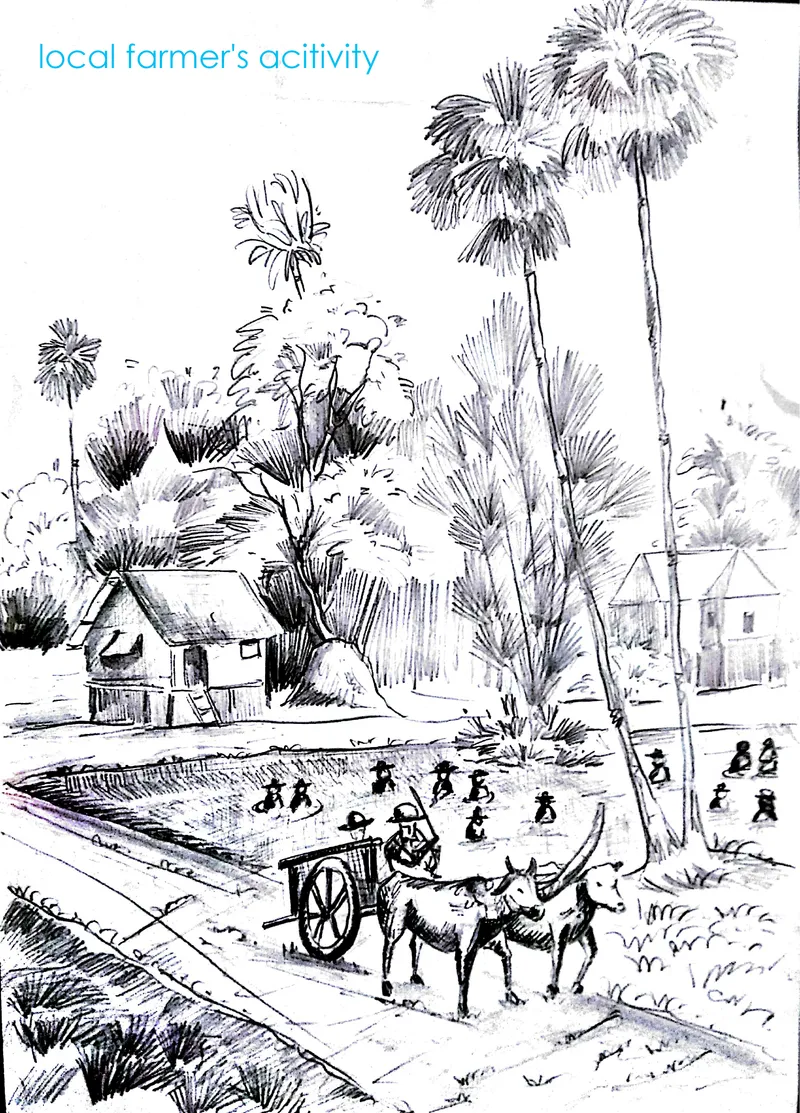
The architectural language draws inspiration from traditional rural settlements: courtyards, shaded working spaces, and clustered structures, reinterpreted through contemporary sustainable design principles. Hand‑drawn perspectives illustrate everyday farmer activities: cultivation, transportation of produce, communal workspaces, and domestic life seamlessly interwoven with productive landscapes.
The institution is organized around open courtyards that function as shared working zones, training grounds, and social spaces. These courtyards enhance natural ventilation, daylight access, and visual connectivity, reinforcing a sense of community while reducing dependence on mechanical systems.

Sustainable Architecture as a System
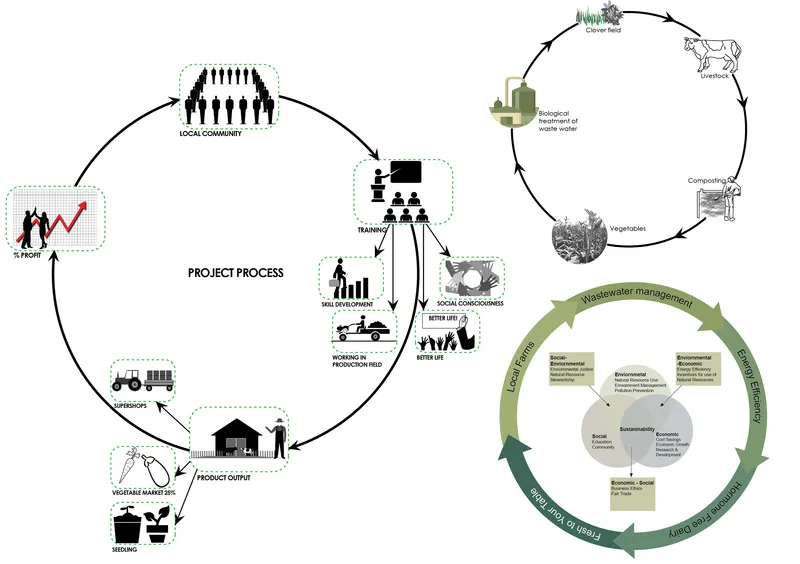
At its core, the project operates as a closed‑loop system where architecture, agriculture, and ecology reinforce one another:
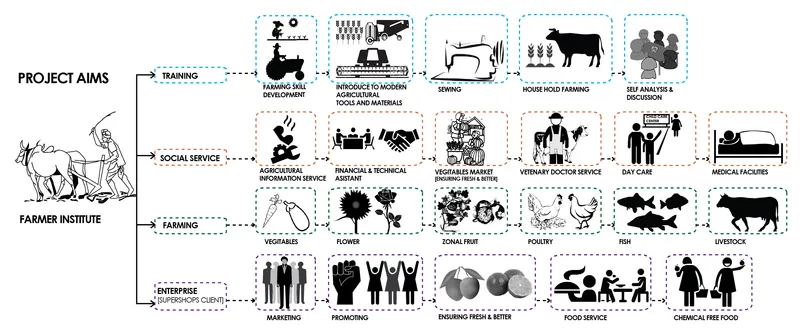
- Training and Skill Development: Dedicated learning spaces enable farmers to gain modern agricultural skills while respecting traditional knowledge systems.
- Production Fields: Integrated farming zones allow immediate application of learned techniques, bridging theory and practice.
- Waste and Water Management: Organic waste is composted and reintegrated into farming cycles, while wastewater undergoes biological treatment for reuse.
- Energy Efficiency: Passive design strategies and efficient resource use reduce operational costs and environmental impact.
This systemic approach transforms the institution into a living example of sustainable architecture in action.
Community‑Driven Growth Model
The project process diagram illustrates a circular model of growth:
Local communities engage in training programs, develop skills, work in production fields, and generate agricultural output. Produce is distributed to markets and local supply chains, creating income opportunities and improving food accessibility. Economic gains are reinvested into the community, fostering social consciousness, education, and long‑term resilience.
By anchoring economic activity within the architectural framework, the institution ensures that development remains inclusive and locally rooted.
From Local Impact to Global Relevance
Mapping studies trace the project’s potential scalability, from selected production zones in Bangladesh to the national level, and ultimately as a replicable global model. While the architectural response is context‑specific, its principles of sustainable architecture, education‑driven development, and community empowerment are universally applicable.
The project demonstrates how thoughtful architectural interventions can address global issues such as hunger, unemployment, and environmental degradation without imposing generic solutions.
Fight for Hunger redefines the role of architecture in addressing social and environmental crises. Through sustainable architecture, the project creates a holistic institution where learning, production, ecology, and community coexist. It offers a future‑oriented vision in which farmers are empowered not only as producers of food, but as active participants in shaping resilient societies.
Recognized with an Honorable Mention at UnIATA ’18, the project stands as a compelling example of architecture’s potential to drive meaningful change, starting from the local field and extending toward a global impact.




Popular Articles
Popular articles from the community


Hill & Cross Opera: Sculptural Opera House Architecture Shaped by Tallinn’s Landscape and Identity
Hill & Cross Opera reimagines opera house architecture in Tallinn through its sculptural hill, civic plaza, glass wave and a luminous cross.

Riyadh For All: Intergenerational Urban Design for Active Aging in Rabat
Riyadh For All reimagines urban design in Rabat with intergenerational co-living, adaptive courtyards, and Moroccan cultural exchange today.

The Musturak Paradise: Senior Living Architecture for a Connected Future in Temara, Morocco
The Musturak Paradise reimagines senior living architecture in Temara via private homes, social spaces, culture, community, and shared care.

Co-Life: Senior Housing Design That Reconnects Older Adults With the City
Co-Life reimagines senior housing design through healing gardens, shared streets, workshops, and a sustainable community across generations.


Similar Reads
You might also enjoy these articles

Eco Chapel: A Green Architecture Pavilion Designed in Symbiosis with the Forest
Eco Chapel uses green architecture to weave prayer, learning and reuse into a forest pavilion shaped by modular hexagonal canopies for life.
Kaffeebühnen: Coffee Shop Architecture Designed as a Civic Stage Between Vienna’s City and Park
Kaffeebühnen turns coffee shop architecture into a civic stage, linking Vienna’s park edge, urban life, warm timber yards, and coffee craft.
Healing Façade: Sustainable Architecture for Reforestation, Community, and Sacred Ecology in Ethiopia
Healing Façade reimagines sustainable architecture as a living wall that restores soil, catches water and renews Ethiopia's forest churches.


Urban Forest: A Vertical Ecosystem for 5,000 Workers in Singapore's Changi Business Park
Radially stacked pods and layered green decks turn a 7-acre plot into 47 acres of ecological workspace projected for 2040.


Explore Infrastructure Design Competitions
Discover active competitions in this discipline



Challenge to reimagine the Iron Throne


Photograph architecture without architects


Illustrate the lost glory of Angkor Wat - Render Challenge


Design challenge to reuse E-waste
Comments (0)
Please login or sign up to add comments
No comments yet. Be the first to comment!