
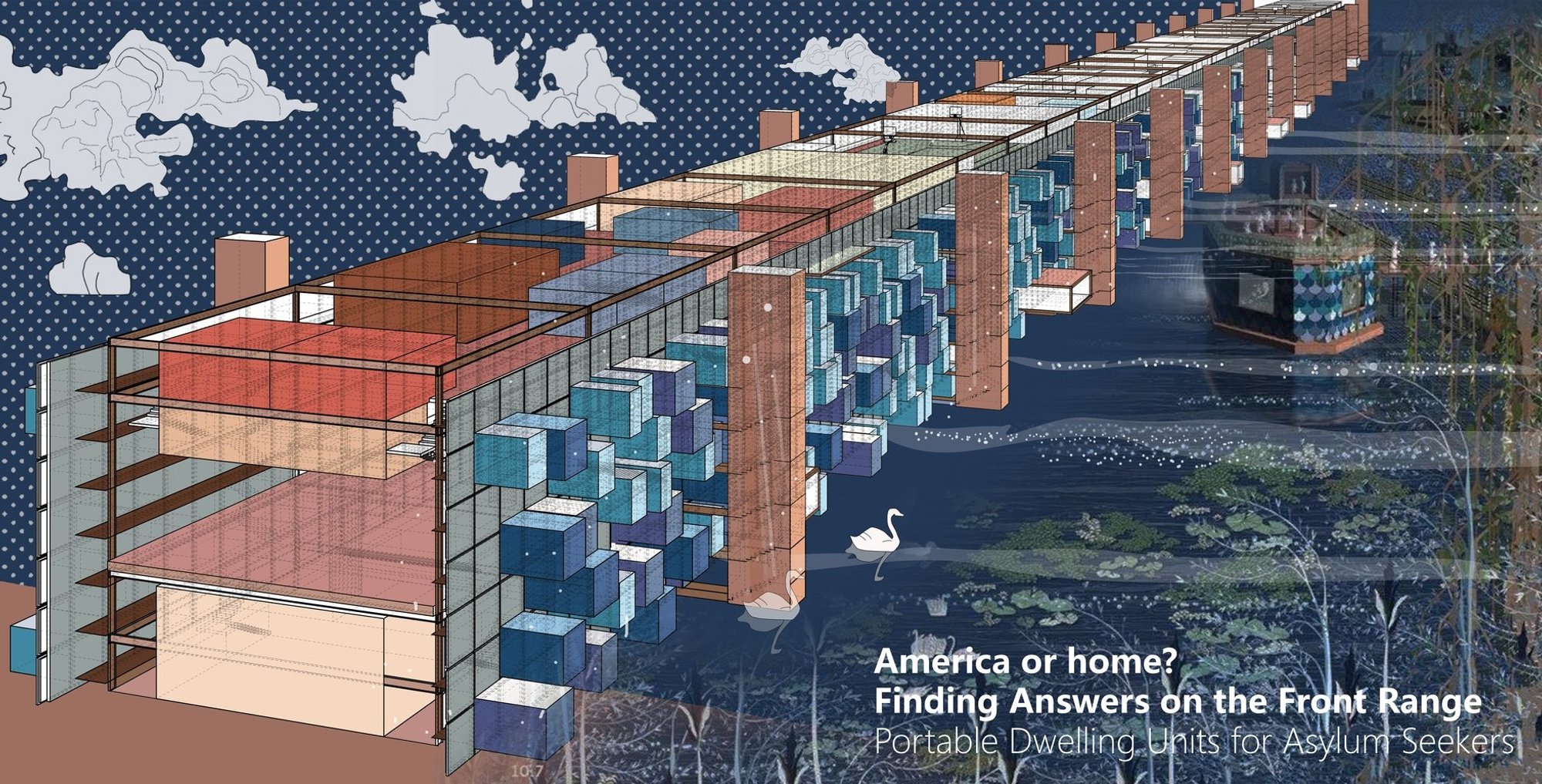
Finding Answers on the Front Range
A visionary refugee housing architecture that transforms a border bridge into a moving habitat, enabling asylum seekers to reflect, adapt, and rebuild.

Project by LYU LIQI and Peiyuan Song Shortlisted Entry – No Man’s Land
In contemporary discourse, refugee housing architecture is no longer limited to emergency shelters or temporary camps. It is increasingly positioned as a spatial and psychological framework that mediates transition, uncertainty, and identity. Finding Answers on the Front Range redefines this paradigm through an ambitious infrastructural proposal that transforms a border bridge into a dynamic living system for asylum seekers.
Rather than treating displacement as a static condition, the project frames migration as a temporal and experiential journey. The bridge becomes both a connector and a lived environment, where architecture operates as an active participant in the process of adaptation, reflection, and decision-making.
Architecture as a Transitional Landscape
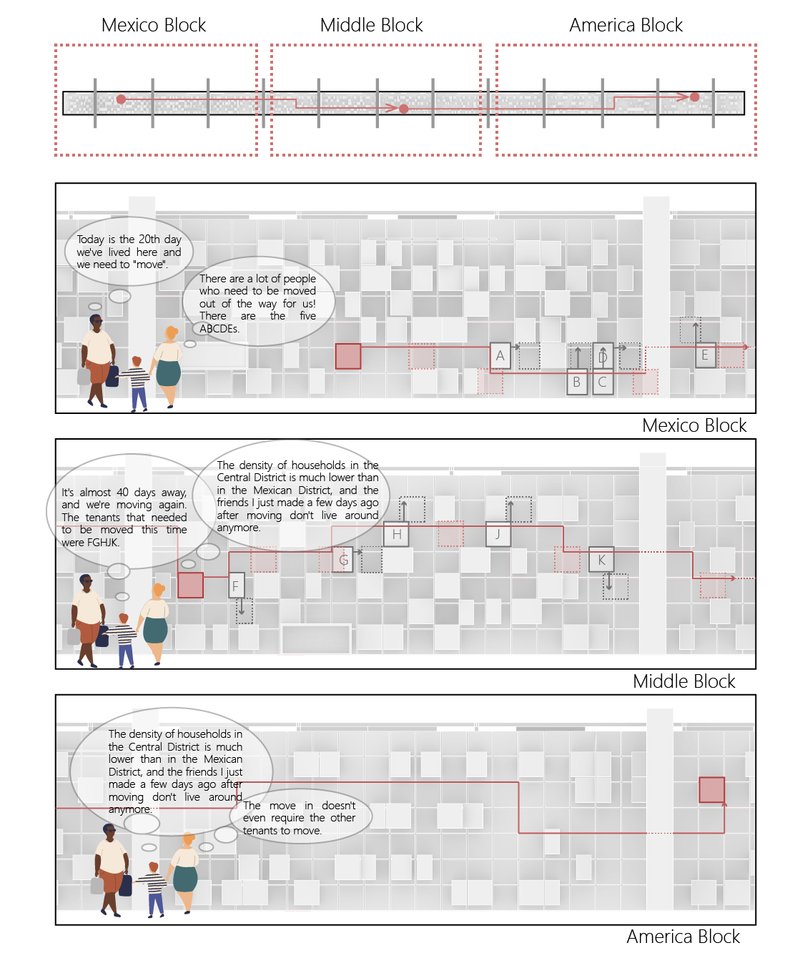
Situated conceptually between Mexico and the United States, the project reimagines the border not as a rigid line, but as a layered spatial condition. The bridge is divided into three distinct zones: the Mexico block, the central transitional block, and the America block. Each zone represents a shift in density, spatial organization, and atmosphere, simulating the evolving conditions migrants experience as they move between contexts.
This zoning strategy introduces a critical architectural narrative. High-density, informal arrangements gradually transition into more regulated and structured environments, reflecting the socio-spatial contrasts between the two nations. The design thus becomes a pedagogical device, allowing residents to physically experience these differences rather than encounter them abruptly.
Portable Dwelling Units: Mobility as Experience
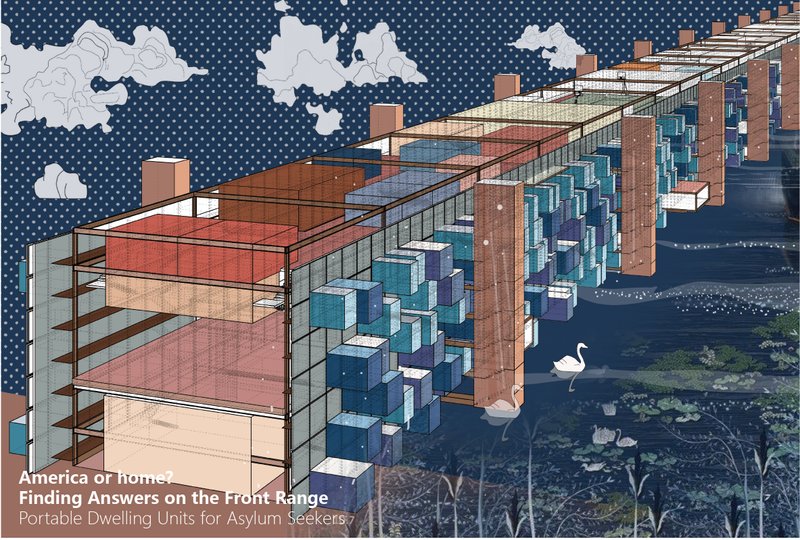
At the core of this refugee housing architecture is a system of portable dwelling units. These compact living modules are designed to move along a track embedded within the bridge infrastructure. Unlike conventional housing, where permanence is a defining characteristic, these units require occupants to actively participate in their movement.
Each unit must be relocated periodically, encouraging residents to engage with time, change, and uncertainty. This deliberate instability is not punitive but reflective. It mirrors the lived realities of migration, where individuals must constantly adapt to shifting circumstances.
The units are categorized into single, double, and triple configurations, enabling different household structures. With a total capacity of approximately 1500 residents, the system balances density with flexibility, ensuring both efficiency and personal agency.
Mechanical Infrastructure and Spatial Logic
The project introduces a sophisticated mechanical system that governs the movement of dwelling units. Sliding tracks, rotational gears, and orbital paths allow units to shift positions both horizontally and vertically. This kinetic architecture transforms the building into a constantly evolving matrix of habitation.
From a design standpoint, this introduces a new typology within refugee housing architecture: one that integrates infrastructure, housing, and movement into a single system. The architecture is no longer static but behaves as a responsive organism, continuously reorganizing itself based on temporal cycles.
Public Space as Social Infrastructure
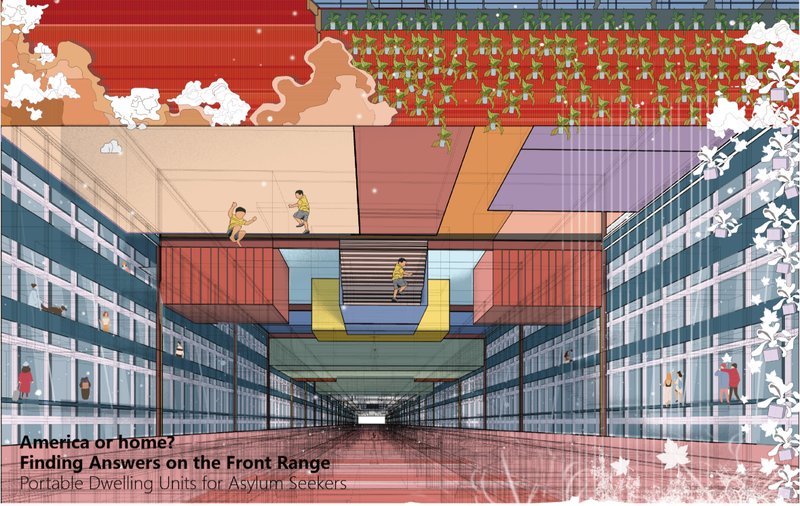
Beyond housing, the bridge incorporates a comprehensive network of public and communal spaces. These include training areas, medical facilities, retail zones, spaces of worship, and recreational environments. Such programs are distributed along the length of the bridge, ensuring accessibility across all zones.
These spaces perform a critical role. They transform the bridge from a mere transit corridor into a respite center, where asylum seekers can interact, learn, and rebuild social connections. The inclusion of educational and communication spaces further supports integration and future planning, aligning architecture with broader humanitarian objectives.
Psychological Dimension of Movement
One of the most compelling aspects of the project lies in its psychological framing. The gradual transition from one zone to another, combined with the movement of dwelling units, creates a continuous state of anticipation and reflection.
Residents are not passively housed but actively engaged in their journey. The act of moving a unit becomes symbolic, reinforcing awareness of time and progress. The changing density and atmosphere across the bridge subtly influence perception, preparing individuals for the realities of their potential destination.
This approach positions refugee housing architecture as a medium for emotional and cognitive transformation, not just physical shelter.
Structural Strategy and Spatial Organization
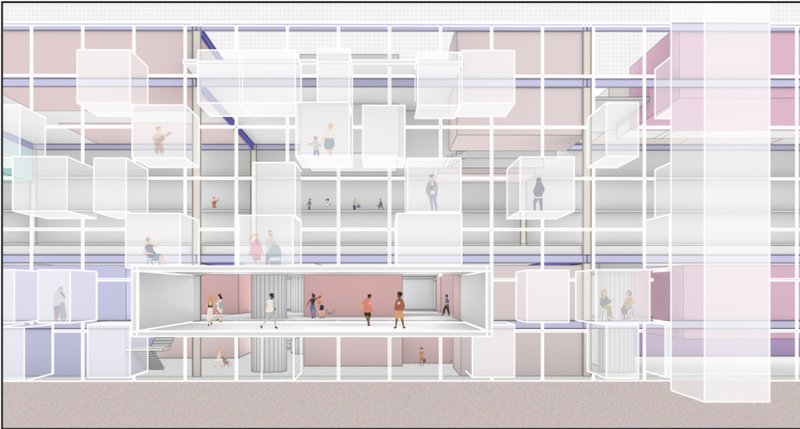
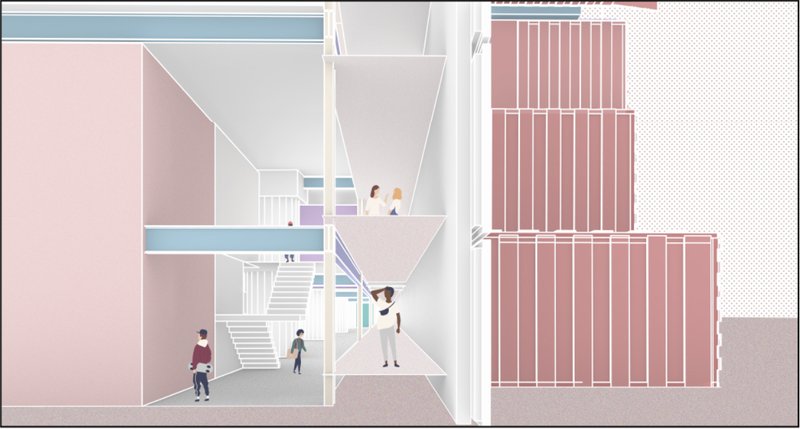
The bridge is conceived as a layered system, with circulation corridors embedded within structural walls. These corridors connect dwelling units to internal public spaces, ensuring seamless interaction between private and communal domains.
Units are suspended on rails along the façade, allowing them to extend outward while maintaining protection within the structural envelope. This strategy enhances ventilation, daylight access, and visual connectivity with the surrounding landscape.
The vertical organization of public service areas at varying heights further introduces spatial diversity, accommodating different functions without compromising the linear continuity of the bridge.
Redefining the Border Condition
Traditionally, border architecture is associated with control, surveillance, and exclusion. This project challenges that paradigm by introducing an architecture of empathy and engagement.
The bridge becomes a space of negotiation rather than division. It acknowledges the realities of border control while simultaneously creating an environment that prioritizes human dignity, interaction, and growth.
In doing so, the project expands the scope of refugee housing architecture beyond emergency response, positioning it within a broader socio-political and spatial discourse.
Finding Answers on the Front Range proposes a radical rethinking of how architecture can respond to migration. By integrating mobility, infrastructure, and social programming, it creates a dynamic environment that supports both survival and transformation.
This project demonstrates that refugee housing architecture can move beyond temporary solutions to become a meaningful spatial framework for transition. It challenges architects to reconsider the role of design in addressing global displacement, not as a problem to contain, but as a condition to engage with thoughtfully and creatively.
Ultimately, the project is not just about providing shelter. It is about constructing a journey, one where architecture becomes a catalyst for reflection, resilience, and the possibility of a new beginning.




Popular Articles
Popular articles from the community

Kaffeebühnen: Coffee Shop Architecture Designed as a Civic Stage Between Vienna’s City and Park
Kaffeebühnen turns coffee shop architecture into a civic stage, linking Vienna’s park edge, urban life, warm timber yards, and coffee craft.
Eco Chapel: A Green Architecture Pavilion Designed in Symbiosis with the Forest
Eco Chapel uses green architecture to weave prayer, learning and reuse into a forest pavilion shaped by modular hexagonal canopies for life.
PLATAFORMArq Folds a Concrete Roof Over the Portuguese Mountains in House #474
A 220-square-meter residence in Teixoso, Portugal, wraps board-formed concrete into an angular canopy that frames the Serra da Estrela foothills.

The Faith: Modular Architecture for Play, Learning, and Hope in Kutupalong Refugee Camp
A modular playground architecture project in Bangladesh where play, learning, safety, and hope rebuild childhood inside a refugee camp anew.

Similar Reads
You might also enjoy these articles
Eco Chapel: A Green Architecture Pavilion Designed in Symbiosis with the Forest
Eco Chapel uses green architecture to weave prayer, learning and reuse into a forest pavilion shaped by modular hexagonal canopies for life.
Kaffeebühnen: Coffee Shop Architecture Designed as a Civic Stage Between Vienna’s City and Park
Kaffeebühnen turns coffee shop architecture into a civic stage, linking Vienna’s park edge, urban life, warm timber yards, and coffee craft.
Healing Façade: Sustainable Architecture for Reforestation, Community, and Sacred Ecology in Ethiopia
Healing Façade reimagines sustainable architecture as a living wall that restores soil, catches water and renews Ethiopia's forest churches.


Urban Forest: A Vertical Ecosystem for 5,000 Workers in Singapore's Changi Business Park
Radially stacked pods and layered green decks turn a 7-acre plot into 47 acres of ecological workspace projected for 2040.


Explore Architecture Competitions
Discover active competitions in this discipline




The International Standard for Design Portfolios


The Global Benchmark for Architecture Dissertation Awards


The Global Benchmark for Graduation Excellence


Challenge to reimagine the Iron Throne
Comments (0)
Please login or sign up to add comments
No comments yet. Be the first to comment!