
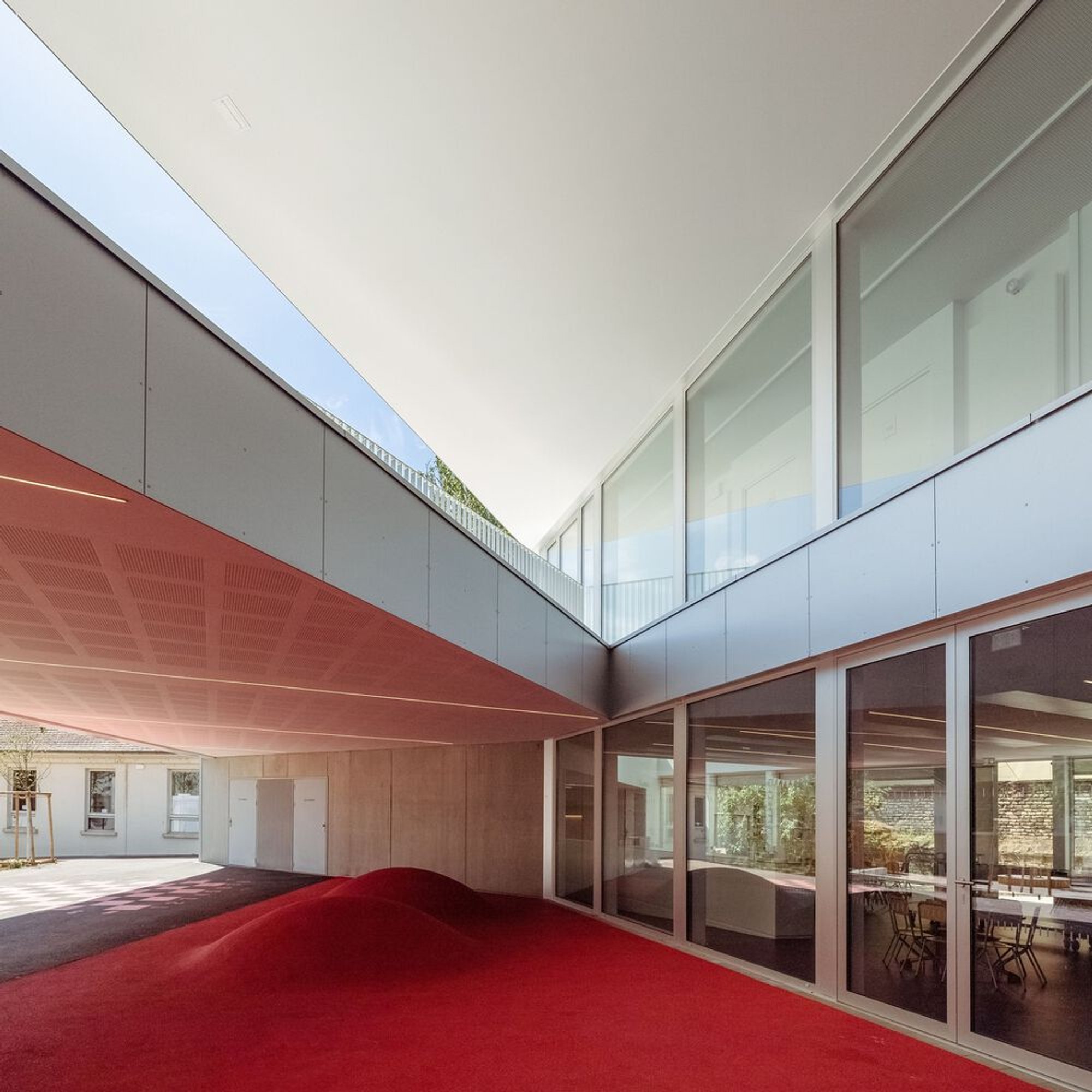
rhb architectes Weaves a Layered School Extension into Strasbourg's Historic Finkwiller Quarter
A €6.5 million cafeteria and activity wing emerges from the playground of a 1960s school near the Ponts Couverts and the river Ill.

Strasbourg's Finkwiller neighborhood is the kind of urban tissue that punishes lazy architecture. Timber-framed houses lean against residential blocks, the civil hospital looms nearby, and a historic stone wall wraps the school playground like a relic daring anyone to ignore it. When rhb architectes was tasked with adding a 2,524 m² extension to a 1960s school group here, the challenge was not simply to build more square meters but to knit a new piece of city into a neighborhood that already has strong opinions about what belongs.
What makes this project genuinely interesting is its refusal to treat the extension as an object. Instead, the architects describe a layered architecture that "emerges" from the playground, with volumes that shift and overlap to stitch the nursery school to the primary school through a shared cafeteria and first-floor hall. The result reads less like an addition and more like a landscape event: a building that rises out of, rather than lands on, its site. Completed at the end of 2022 after a two-and-a-half-year construction period, the Finkwiller School Group is a quiet argument that school buildings can be both civic and intimate.
A Street-Level Conversation
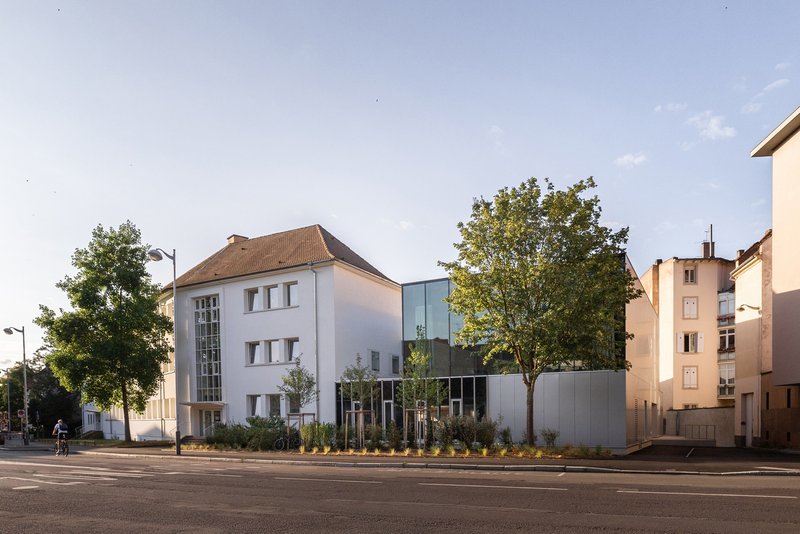
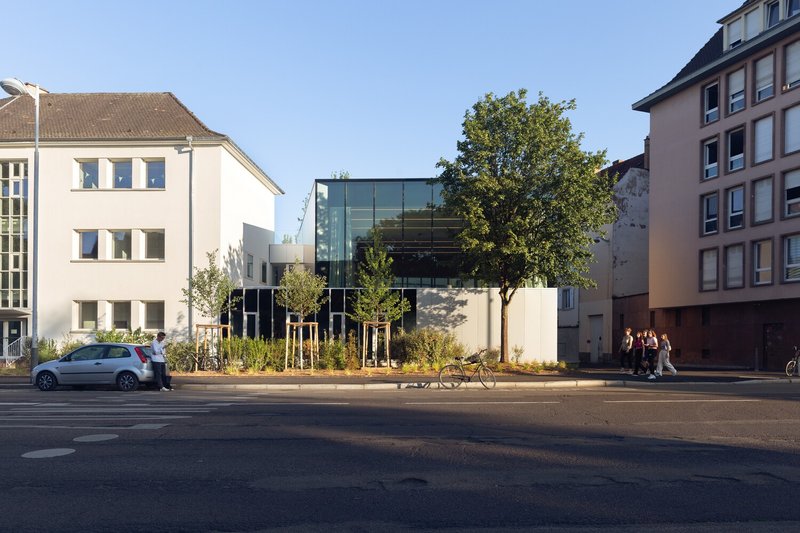
From Finkwiller Street, the extension presents two distinct faces. The white plastered volume of the original school holds its ground, while a glass pavilion pushes forward beneath mature street trees, its transparency making the interior life of the school legible to passersby. This is a deliberate move: the activity room behind that generous glazed facade is meant to be seen, turning the school into a kind of civic theater where children's movement becomes part of the streetscape.
The setback from the existing stone enclosure wall is critical. Rather than butting up against heritage, the new volume pulls away to create a patio that showcases the old wall as a found object. The gap is not wasted space; it is the hinge around which the entire project pivots, giving both schools a shared outdoor room and allowing the architecture to breathe where density might otherwise suffocate.
The Covered Courtyard as Threshold
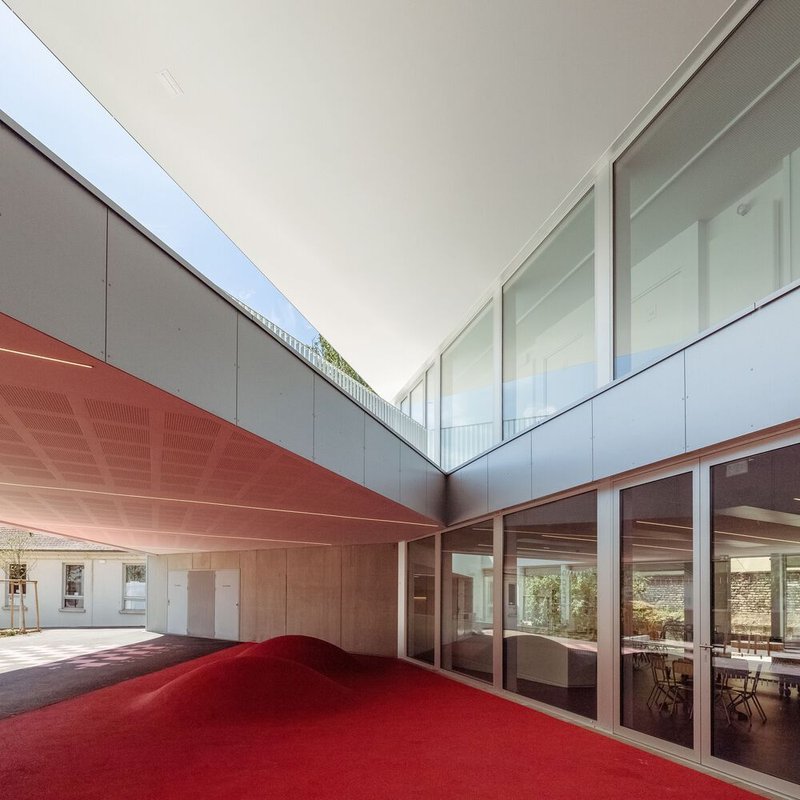
The sheltered courtyard is the project's most compelling spatial invention. A copper-paneled soffit hovers over a red-floored outdoor room enclosed by glazed walls, creating a transitional zone that is neither fully inside nor fully out. Children pass through it moving between the playground and the cafeteria, and it functions as a decompression chamber: a place to slow down, to register the shift from running to sitting, from noise to something approaching calm.
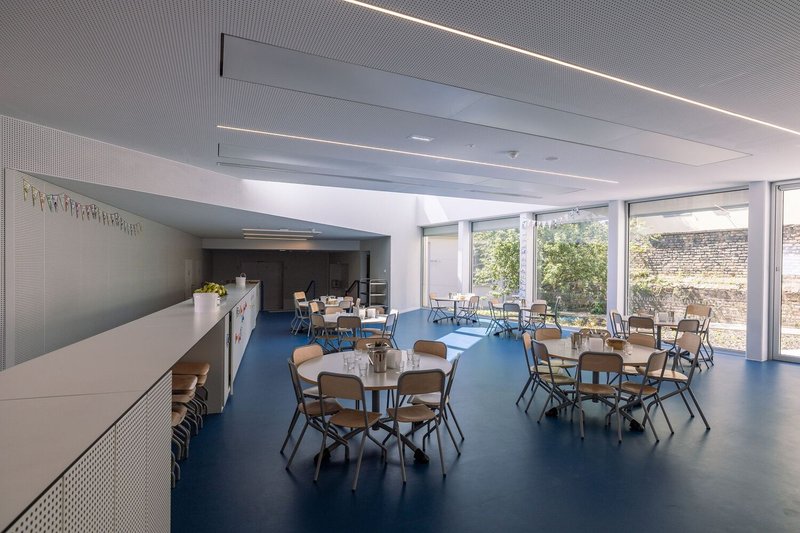
Step through the glass wall and you arrive in the cafeteria itself, where blue rubber flooring and round tables set a tone that is colorful without being chaotic. Full-height windows frame the courtyard from the other side, so that even during lunch the connection to exterior space is continuous. The warm, diffused light on the ground floor is no accident; the architects calibrated the relationship between solid and transparent surfaces to keep the dining area bright but not glaring, a small detail that matters enormously when you are feeding several hundred children in shifts.
Materiality and Warmth in Circulation
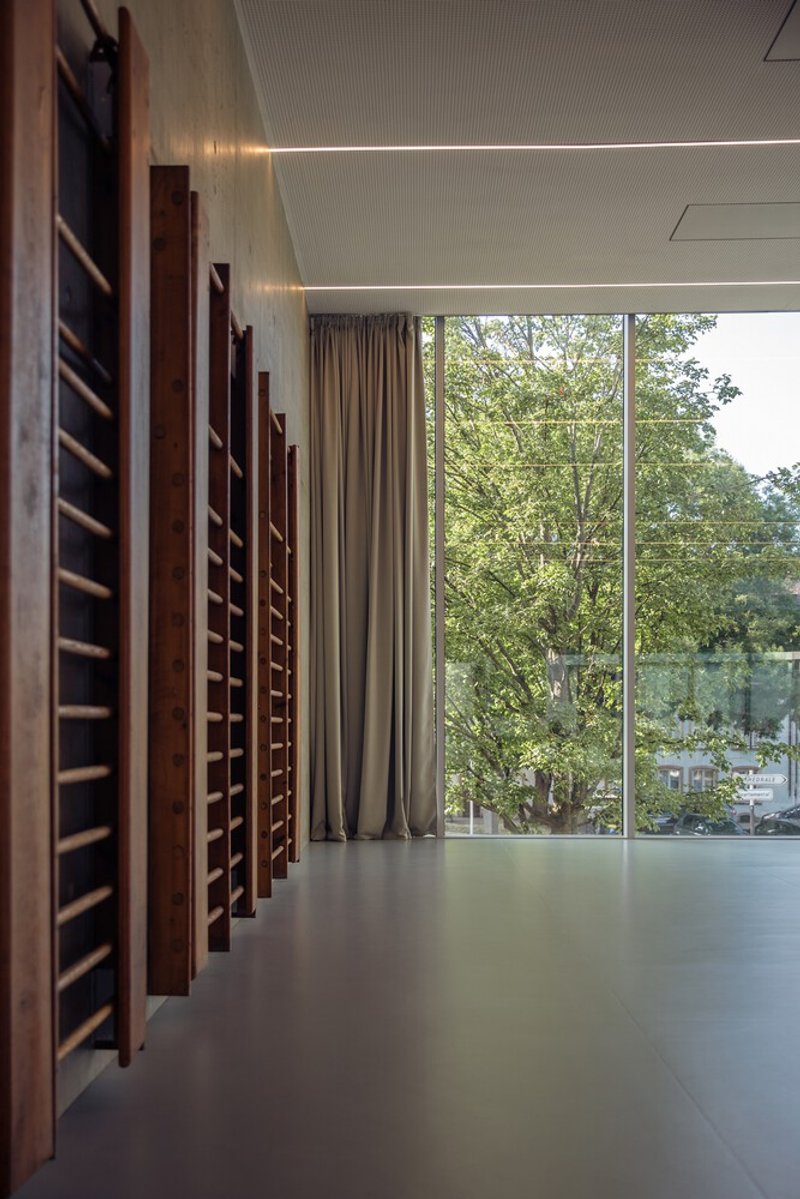
Corridors in school buildings are often afterthoughts, dimensioned for fire compliance and finished in whatever was cheapest. rhb architectes treats them differently here. Timber-louvered wall panels line one passage, filtering light from floor-to-ceiling windows that frame exterior trees. Beige curtains add a domestic softness that is unusual in an institutional corridor and suggests a designer who has actually watched how young children move through space: tentatively, tactilely, drawn to surfaces they can touch.
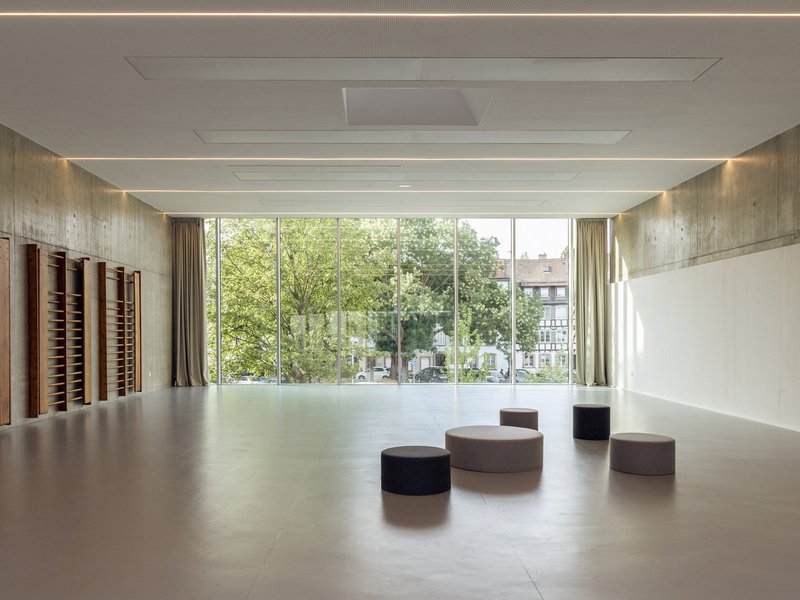
The main interior hall adopts a different register. Concrete walls and perforated ceiling panels create a more civic atmosphere, appropriate for the first-floor volume that articulates the primary school with the extension program. Double-height glazing floods this space with strategic light, and scattered round seating elements turn what could be a through-route into a place where students might actually linger. It is a space designed for accidental encounter, which is precisely what the best school architecture enables.
The Evening Facade
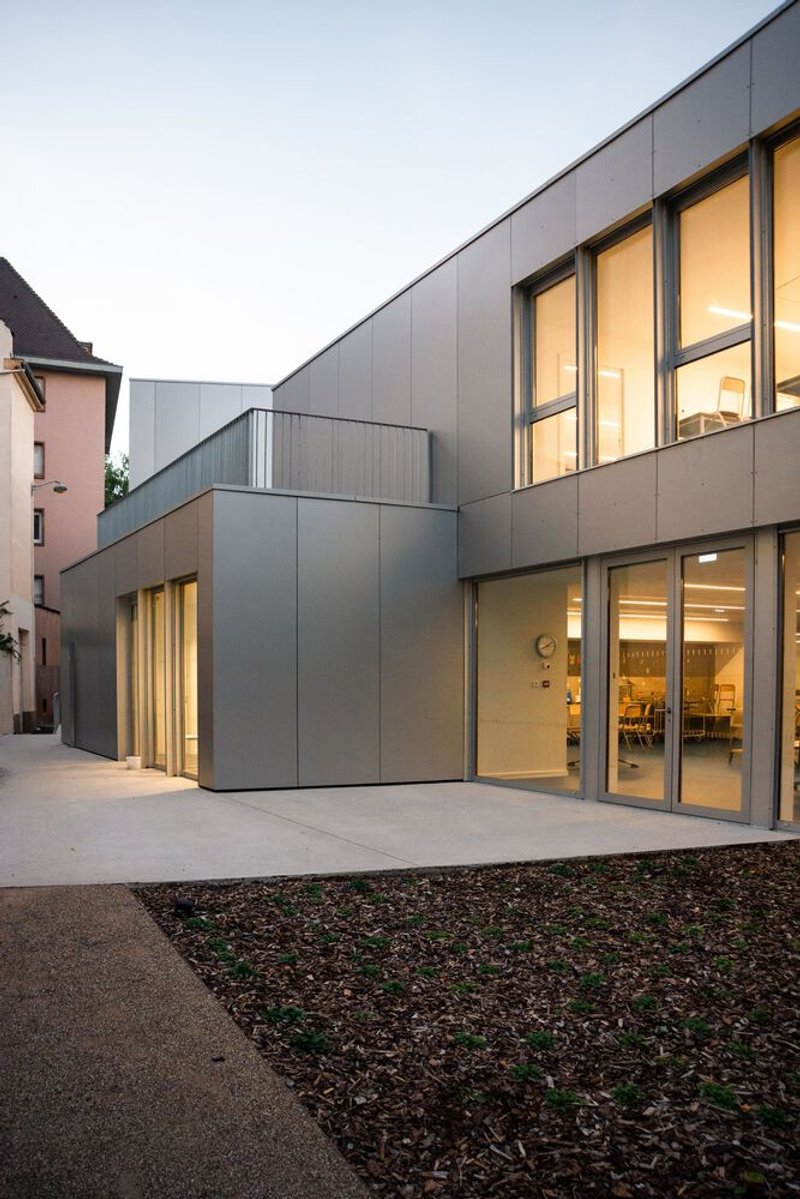
At dusk, the grey metal panel facade transforms. Interior lighting spills through the floor-to-ceiling glazing, turning the building into a lantern that signals civic presence on a residential street. The metal cladding, restrained and utilitarian during the day, gains depth against an evening sky, and the contrast between opaque panels and illuminated voids becomes the primary architectural expression. It is a simple trick, but it works: the school announces itself without shouting.
The dual materiality of metal panel and white plaster also helps the extension negotiate between its two contexts. Toward the historic quarter, the building is lighter, more deferential. Along the street edge, it toughens up. This is not a building trying to be one thing; it is a building that understands it faces multiple audiences and addresses each on appropriate terms.
Why This Project Matters
School extensions in European city centers tend to fall into two traps: they either mimic historical context so slavishly that they add nothing, or they arrive as alien objects that ignore everything around them. The Finkwiller School Group sidesteps both. By treating the playground as the generative datum and layering volumes outward from it, rhb architectes produced a building that feels both rooted and contemporary. The patio, the covered courtyard, the double-height hall: these are not gestures for publication photographs but genuine spatial devices that improve how children and teachers experience the school day.
At €6.5 million for 2,524 m² of program, the budget is not extravagant. What the project demonstrates is that careful siting, intelligent section work, and a willingness to invest in the quality of in-between spaces can produce architecture that feels generous without excess. In a moment when school construction across France is under pressure to deliver quickly and cheaply, Finkwiller is a useful counter-example: proof that speed and economy need not come at the cost of civic dignity.
Finkwiller School Group by rhb architectes. Strasbourg, France. 2,524 m². Completed 2022. Photography by Florry Simons and Cloudy Prod.
About the Studio
Share Your Own Work on uni.xyz
If projects like this are the kind of work you want to make, uni.xyz is a place to publish your own, find collaborators, and enter design competitions.




Popular Articles
Popular articles from the community

VEIVE Architects Builds a Mountain Hostel That Disappears into a Hangzhou Hillside
On the Huihang Ancient Trail in Xiangjian Village, a shelter of wood, steel, and rammed earth roots itself in the rural landscape.
OMCM arquitectos Builds a Summer House in Paraguay from Quarry Waste Blocks and Three Sacred Trees
In the young hillside neighborhood of Altos, a 696-square-meter concrete volume hovers on six pillars around three preserved native Yvyraju trees.
gru.a Builds a 70 m² Timber Shelter That Opens Like a Farm Door in Brazil's Valley of the Vines
In the mountainous region near Rio de Janeiro, a compact retreat uses plywood panels and deep eaves to blur the line between inside and out.
BAUEN Builds Two Rammed Earth Volumes in Paraguay Inspired by the Ovenbird's Nest
In San Bernardino, a house of compacted earth channels the instinct of a constructive bird to shelter life from the Paraguayan summer.


Similar Reads
You might also enjoy these articles

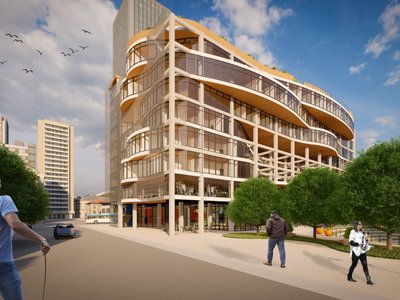
Olio Towers: A Mid-Rise for Performers That Fuses Housing, Rehearsal, and Stage
Located blocks from Houston's Theater District, this modular tower stacks living units around a central performance atrium.
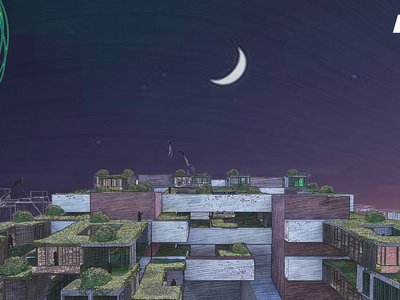
Oasis: Modular Green Housing Carved into Dhaka's Urban Fabric
A shortlisted Plugin Housing entry reclaims unauthorized settlements in Dhaka with stepped concrete volumes, green roofs, and ventilation-driven design.

Black Hole: A Floating Megastructure for the Post-Physical Era
Emiliano Mazzarotto envisions a spherical, self-scaling arena where e-sports, digital hotels, and holographic stadiums replace traditional public space.
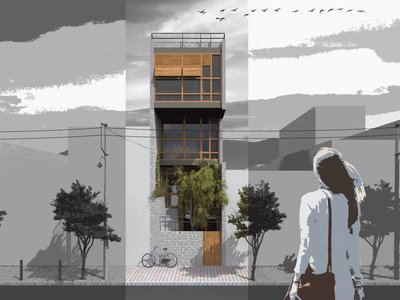
Compact & Sustainable Living in Piraeus: A Four-Level Family Home Built Around Light and Air
A narrow townhouse in one of Greece's densest port cities uses a central atrium and passive strategies to house three generations under one roof.


Explore Architecture Competitions
Discover active competitions in this discipline




The International Standard for Design Portfolios


The Global Benchmark for Architecture Dissertation Awards


The Global Benchmark for Graduation Excellence


Challenge to design public laboratory
Comments (0)
Please login or sign up to add comments
No comments yet. Be the first to comment!