

Five Studios Reimagine the Parthenon as a Living Canvas in Melbourne's NGV Garden
Temple of Boom builds a one-third-scale Parthenon from glass-reinforced concrete and lets Melbourne's street artists transform it over nine months.


The Parthenon is architecture's most cited ruin: a form so deeply embedded in the discipline's DNA that every reproduction risks cliché. Temple of Boom, the 2022 NGV Architecture Commission, sidesteps that problem by treating the ancient temple not as a thing to copy but as a substrate for change. Designed collaboratively by Adam Newman, Kelvin Tsang, Drez, Manda Lane, and David Lee Pereira, the installation sat in the Grollo Equiset Garden at NGV International from November 2022 to August 2023, evolving continuously as Melbourne-based artists painted, layered, and repainted its surfaces in three distinct phases.
What makes Temple of Boom genuinely interesting is its thesis about time. Every building changes: weathering, graffiti, renovation, decay. Most architecture commissions pretend otherwise, delivering a polished object and hoping it stays that way for the photo shoot. Here the transformation was the project. A colonnade of 350-kilogram glass-reinforced concrete columns, built at one-third the scale of the original Parthenon, served as the armature. Over months, its clean surfaces gave way to flower motifs, optical illusions, and rainbow gradients that referenced scholarship suggesting the real Parthenon was itself once brilliantly polychromatic. The ruin-as-canvas met the canvas-as-ruin.
A Modular Temple on Borrowed Ground


The structural logistics alone deserve attention. The garden sits above the NGV's loading dock, meaning the design team had to distribute the weight of dozens of concrete columns across a surface spanning a cavernous void. The solution was a modular system of structural timber box beams for the entablature and pediments, keeping mass concentrated in the columns while allowing the upper structure to be lighter and easier to assemble. The whole thing was conceived to be decommissioned and rebuilt, a quality that lent it an honest temporality rare in even temporary pavilions.
Cleverly, the team reused the pink plinth left behind by the previous NGV commission, Pond[e]r, turning one year's leftover into the next year's foundation. It is a small move, but it reinforces the project's central argument: architecture does not start from zero, and it does not end cleanly either. It accumulates.
Concrete Columns, Rainbow Skins


The columns are the most photogenic element, and for good reason. Each 350-kilogram glass-reinforced concrete cylinder started as a clean, fluted form before being wrapped in bands of gradient color that shift from base to capital. The pixelated tiling effect gives the surfaces a digital texture, as if a classical order had been run through a low-resolution filter. Close up, the banding reads as mosaic; from a distance, it dissolves into a smooth gradient that makes the colonnade shimmer against Melbourne's typically overcast sky.
The rainbow palette is not arbitrary decoration. Historical evidence indicates the Parthenon's marble was once painted in vivid reds, blues, and golds. Temple of Boom takes that evidence and exaggerates it, using contemporary color to argue that our image of a pristine white antiquity is itself a fiction produced by centuries of erosion. The columns literalize the idea that what we see as timeless was always, in fact, time-bound.
The Floor as Field


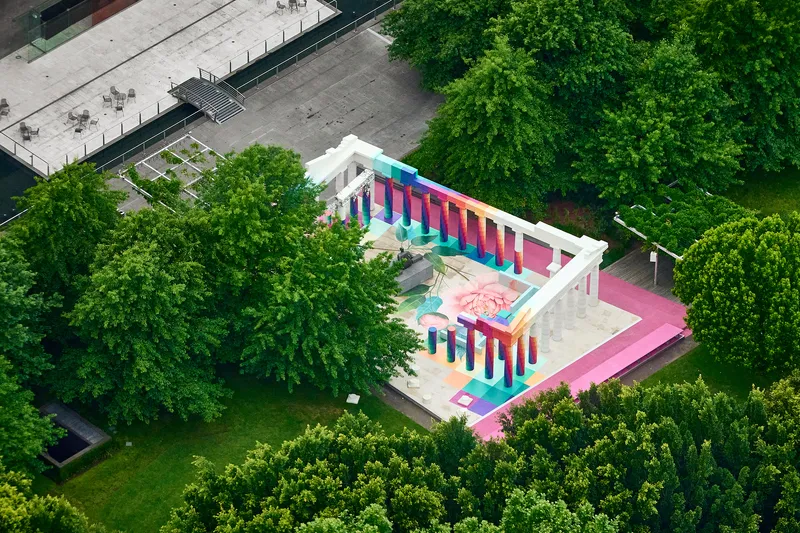
Look down and the project delivers a second composition entirely. The pink platform inherited from Pond[e]r became the ground for large-scale floral murals, most prominently a peony blossom that fills the central field between the column rows. From the air, the colonnade reads as a frame for an enormous painting, the structural grid and the organic motif held in deliberate tension. The flowers are the work of the three mural artists on the team: Drez, Manda Lane, and David Lee Pereira, each contributing in successive phases so the ground itself recorded the passage of time through layered brushwork.
The aerial perspective reveals something a ground-level visit never quite can: the pink perimeter deck operates as a datum, a clean edge that separates the wild interior surface from the manicured lawn. It is a frame within a frame, and it turns the garden into a gallery with no walls.
A Bronze Guest at the Center


Henry Moore's 1958 bronze Draped seated woman occupies the heart of the colonnade, sitting on its grey stone plinth as though it had always been there. The juxtaposition is potent: a mid-century modernist sculpture inside a pop-classical pavilion, both surrounded by street art murals. Three distinct cultural registers collide without hierarchy. Moore's figure becomes a kind of cella statue, the sacred image at the center of the temple, recontextualized so thoroughly that it reads as both anchor and anomaly.
The decision to design around an existing artwork rather than relocating it signals a collaborative spirit that extends beyond the five-studio team. Temple of Boom does not clear the site to make space for itself; it folds the existing context into its own narrative.
Walking the Colonnade

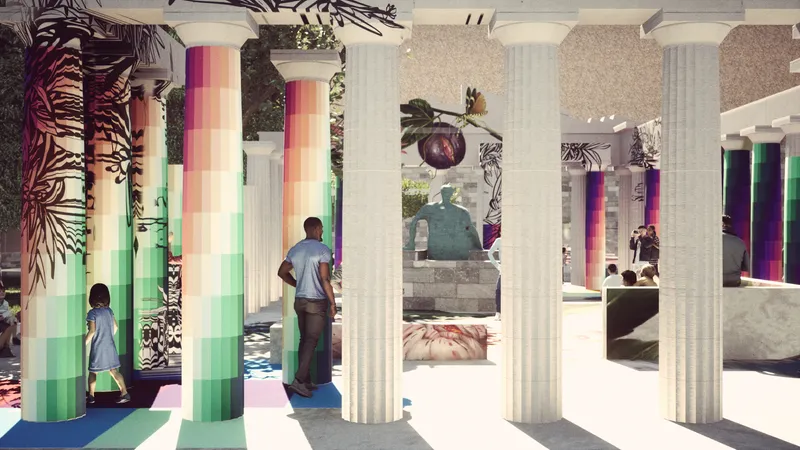
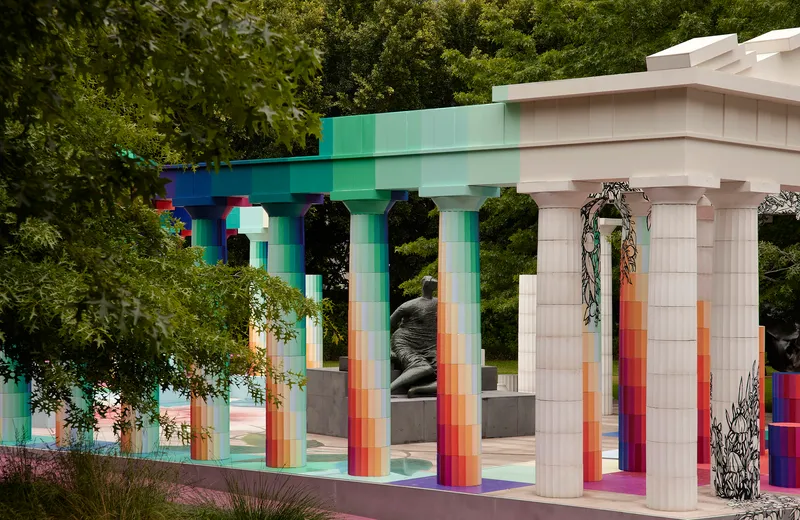
At eye level, the experience is less about spectacle and more about rhythm. The spacing of the concrete columns creates a measured cadence, each intercolumniation framing a different slice of garden, city, or sky. Trailing vines drape from the timber entablature, softening the geometry and introducing an element of genuine growth alongside the painted simulation of it. Visitors move through filtered light, the rainbow gradients casting faint colored reflections on the pink floor.
Fluted cylindrical seats placed between the columns invite pause, turning the colonnade from a processional space into a genuinely communal one. During the commission's nine-month run, the structure hosted live music, performances, and public programs, fulfilling the brief of a community meeting place rather than a precious art object roped off from touch.
Urban Context and Canopy


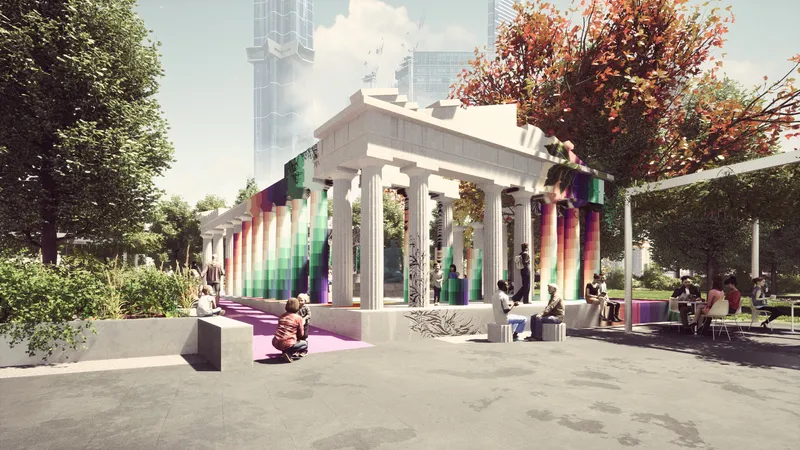
Melbourne's Southbank towers loom in several views, a reminder that this one-third-scale Parthenon exists in one of Australia's densest urban corridors. The mature tree canopy of the Grollo Equiset Garden wraps the installation in green, creating a buffer that makes the interior of the colonnade feel surprisingly sheltered. It is a pocket acropolis, elevated not by a rocky outcrop but by the psychological distance that art and landscape create from the surrounding traffic.
The relationship between pavilion and canopy shifts with the seasons. Early images show the structure in full sun, the colours almost garish against bright green foliage. Later shots reveal autumn tones in the trees, the warm yellows echoing the gradient columns and softening the overall palette. The building did not change form between those moments, but it changed appearance, which was the whole point.
Plans and Drawings
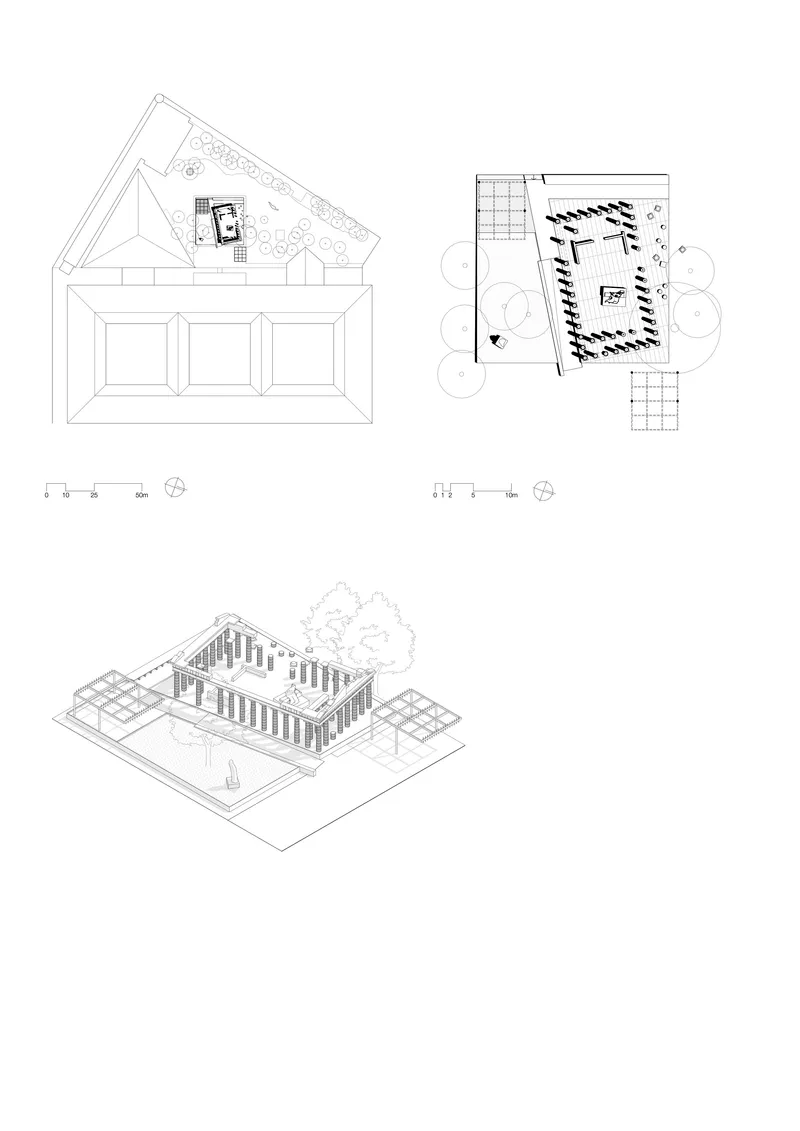


The architectural drawings reveal the project's disciplined proportional system. Section, plan, and axonometric views show the colonnade as a rigorous grid, each bay dimensionally consistent, the entablature stepping down in clean horizontal layers. Elevation drawings confirm the one-third scale relationship to the Parthenon's footprint and demonstrate how the pavilion sits within the garden's existing tree line, its height calibrated to remain below the canopy.
What the drawings cannot convey is the noise: the music, the crowd, the brushstrokes accumulating over months. That gap between the measured line of the architectural drawing and the lived reality of the finished work is exactly the territory Temple of Boom was built to occupy.
Why This Project Matters
Temporary architecture commissions often fall into one of two traps. Either they deliver a tightly controlled formal object that photographs well and disappears without consequence, or they prioritize participation so aggressively that the architectural proposition dissolves into event programming. Temple of Boom threads a narrow path between the two. The concrete and timber structure is a serious piece of construction, engineered to solve real load distribution challenges on a compromised site. But it was also designed, from the outset, to be painted over, to be layered, to be transformed by hands other than the architects'. That generosity is structural, not cosmetic.
The project also offers a useful corrective to the way architects talk about classical precedent. The Parthenon is invoked constantly but almost always as an idealized white geometry, frozen in time. By making the process of accretion visible, by letting street artists rewrite the surfaces in real time, the five collaborating studios reminded us that the original building was itself a palimpsest: temple, church, mosque, ammunition store, ruin, tourist attraction. Architecture does not hold still. The best temporary projects admit that from the start.
Temple of Boom, designed by Adam Newman, Kelvin Tsang, Drez, Manda Lane, and David Lee Pereira. Located at the Grollo Equiset Garden, NGV International, Melbourne, Australia. Completed in 2022 as the NGV Architecture Commission. Photography by Eugene Hyland, NGV, and Sean Fennessy.
About the Studio
Share Your Own Work on uni.xyz
If projects like this are the kind of work you want to make, uni.xyz is a place to publish your own, find collaborators, and enter design competitions.


Popular Articles
Popular articles from the community


Singing Woman: An Opera House That Performs Before the Curtain Rises
Ovidiu Cristian Pavel's conceptual opera house translates Estonia's choral identity into a sculpted waterfront landmark facing the Baltic Sea.

Cloaked Colonization: A Mobile Underwater Habitat That Moves Like a Fish
Micah Abaya's shortlisted EHC Pacific entry reimagines ocean settlement as a dispersed network of self-sustaining architectural organisms.
Temporary Home for Dogs: A Reversed Zoo Rethinks Animal Shelter Architecture
In Bucharest, a sinuous corridor and freed landscape flip the logic of containment, designing a shelter that works to make itself unnecessary.

Manzana Morphosis: Stretching Barcelona's Grid into a Living Landscape for 2050
A radical reworking of the Eixample manzana turns density into a tool for generous public space, vertical ecology, and environmental performance.

Similar Reads
You might also enjoy these articles

Pixel Gardens: One Repeated Module Stacked Into a Terraced Social Housing Tower for Famagusta
Salem Bader's shortlisted housing tower builds a vertical neighbourhood from one repeated module, offsetting units to carve terraces, light and air.

Bao Huynh Watercolor Atelier: A Serene Art Retreat in Hội An
Bao Huynh Watercolor Atelier in Hội An blends multifunctional art spaces, sustainable design, local materials, and family-friendly living in a serene environment.

Atelier Macri Concept Store Interior Design by CASE-REAL
Atelier Macri store features a "ko" counter, walnut wood details, cork displays, blending retail, gallery, and seamless customer experiences.

Manuel Vargas Izquierdo Stadium and High-Performance Sports Center: Architectural Excellence in Jalpa de Méndez
The Manuel Vargas Izquierdo Stadium blends sustainable design, inclusive sports facilities, and cultural-inspired architecture, revitalizing Jalpa de Méndez’s public spaces.

Explore Temple Competitions
Discover active competitions in this discipline

Challenge to design a portable theatre

Design Challenge - Contemporary interpretation of a religious complex

Challenge to design a portable music platform

Challenge to design an open learning module for the elderly
Comments (0)
Please login or sign up to add comments
No comments yet. Be the first to comment!