

IAAC Builds an Ecological Research Tower from Local Pine Trees in Barcelona's Collserola Park
The FLORA Observatory rises 8.5 meters into the forest canopy using CLT panels milled from seventy pine trees harvested on site.


Seventy pine trees were felled from Barcelona's Collserola Natural Park under a Sustainable Forest Management Plan, hauled to a sawmill a short walk away, pressed into cross-laminated timber panels, and reassembled as an 8.5-meter research tower in the same forest they once grew in. That closed loop, what the Institute for Advanced Architecture of Catalonia (IAAC) calls a "zero-kilometer" philosophy, is both the most radical and most legible idea in the FLORA Observatory. No supply chain. No imported steel. Just the forest feeding its own infrastructure.
Completed in 2022 by students and researchers of the Master in Advanced Ecological Buildings and Biocities (MAEBB) program, under the direction of Vicente Guallart and Daniel Ibañez, FLORA (Forest Lab for Observational Research and Analysis) houses bird-monitoring equipment, a weather station, a projection space, and a compact sleeping cabin for short-term researcher stays. Inspired by the canopy walkways of American biologist Margaret D. Lowman, the structure is designed less as a building and more as a piece of scientific equipment: a permanent scaffold for studying biodiversity at every vertical stratum, from underground root networks to the sky above the tree line.
Threading Through the Canopy
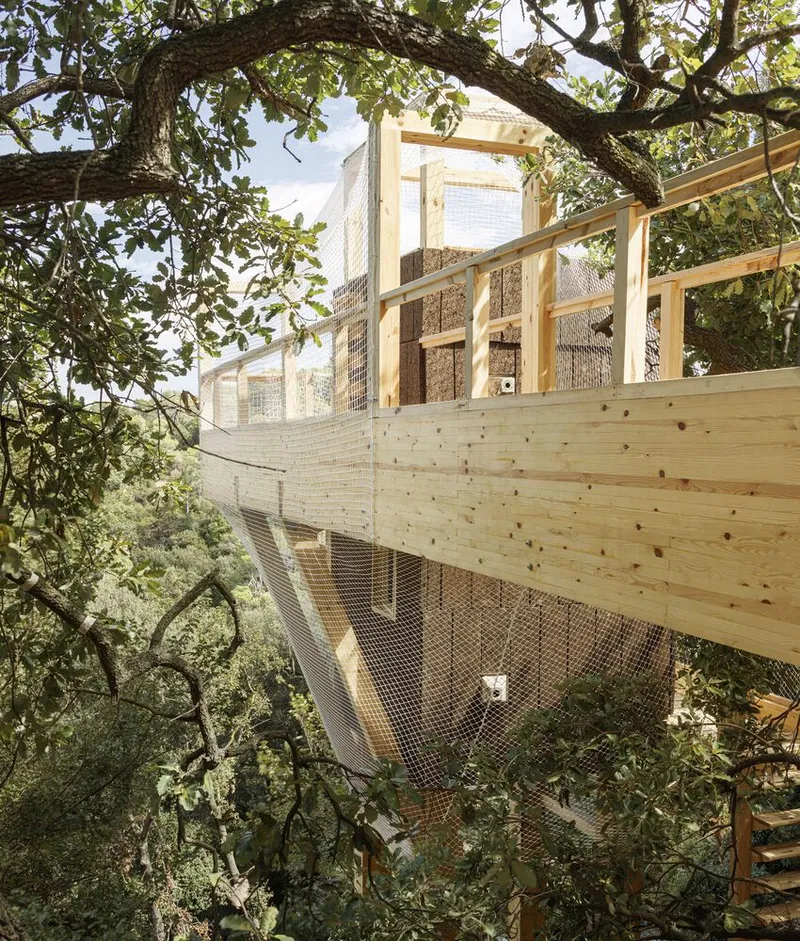
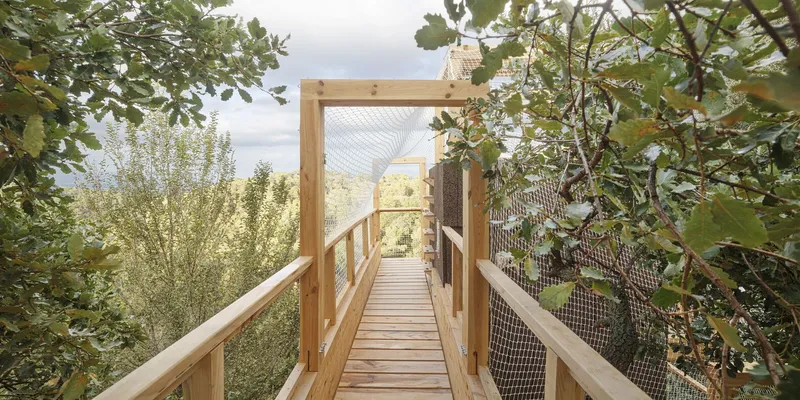
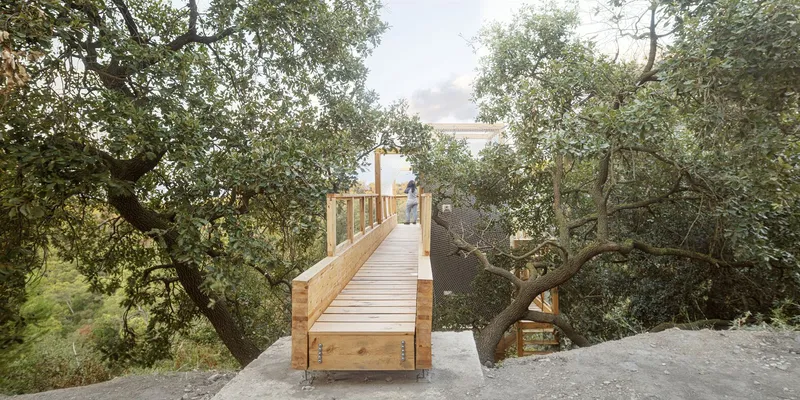
The project's most striking spatial move is not the tower itself but the series of suspended walkways that wrap around the sloped site and thread between mature oak and pine trees. The longest bridge spans roughly twelve meters, built from glulam timber beams that flex just enough to remind you that you are no longer on solid ground. Slatted timber decks let rain pass through, and wire-mesh handrails dissolve the edges of the path so the canopy feels continuous rather than interrupted.
Setting the cabin back from the hillside and connecting it by bridge was a deliberate choice: the structure touches the earth at only four 30 x 30 cm glulam columns, minimizing foundation disturbance. The walkways curve to avoid existing trunks rather than cutting through them. It is a simple principle, but one that too many elevated structures ignore: if the forest is the subject, the architecture should defer to its geometry.
The Mesh Skin
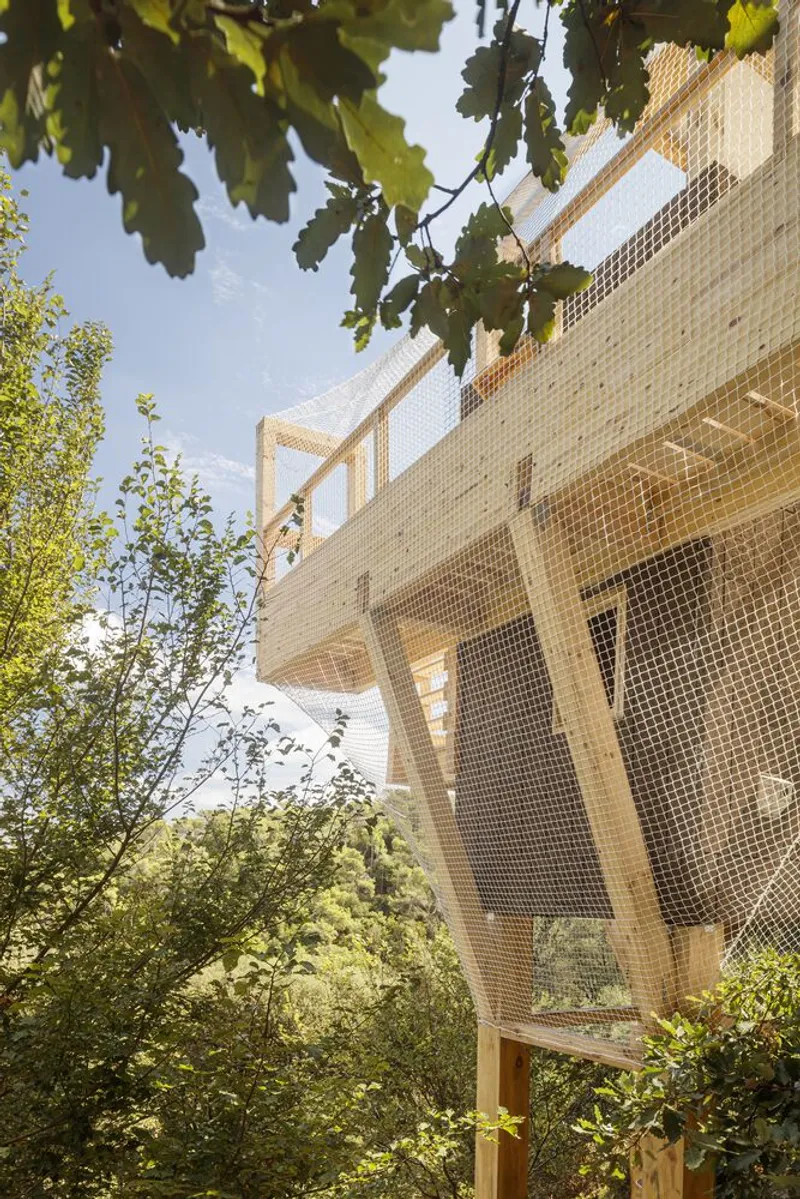
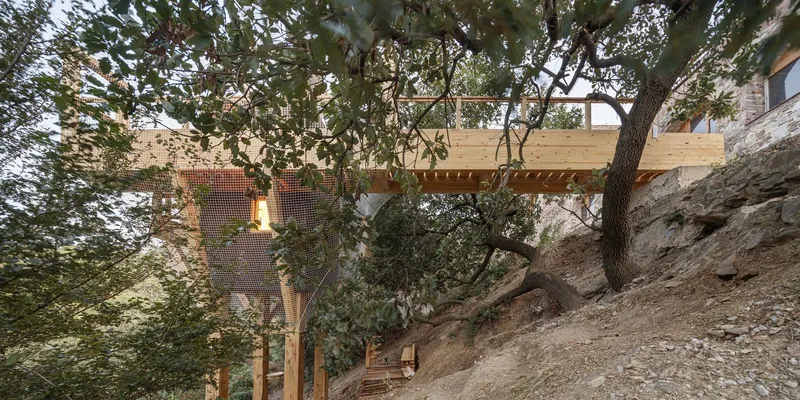
A digitally designed, hand-knotted mesh wraps the tower and walkways, borrowed conceptually from hunters' camouflage netting. The idea is straightforward: the mesh provides a substrate for climbing plants to colonize, gradually merging the observatory with the forest it studies. Over time, the distinction between architecture and canopy is meant to erode. Seen from below through grape vine leaves and surrounding trees, the tower already reads more as a thickening of branches than as a foreign object.
Functionally, the mesh also works as a lightweight enclosure that allows air and light to pass while providing enough psychological containment for researchers working at canopy height. It is not weatherproofing; that role falls to the cork-insulated cabin volumes. Instead, the net defines an intermediate zone, neither inside nor outside, that becomes the primary space of observation.
Cork Cabins and the Interior Life of Research

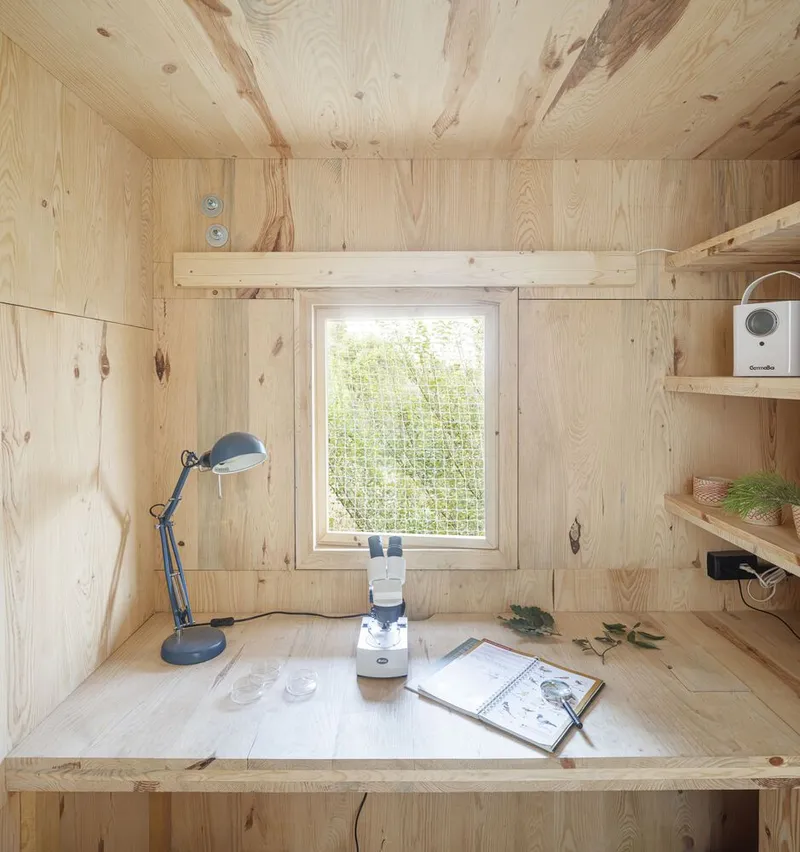
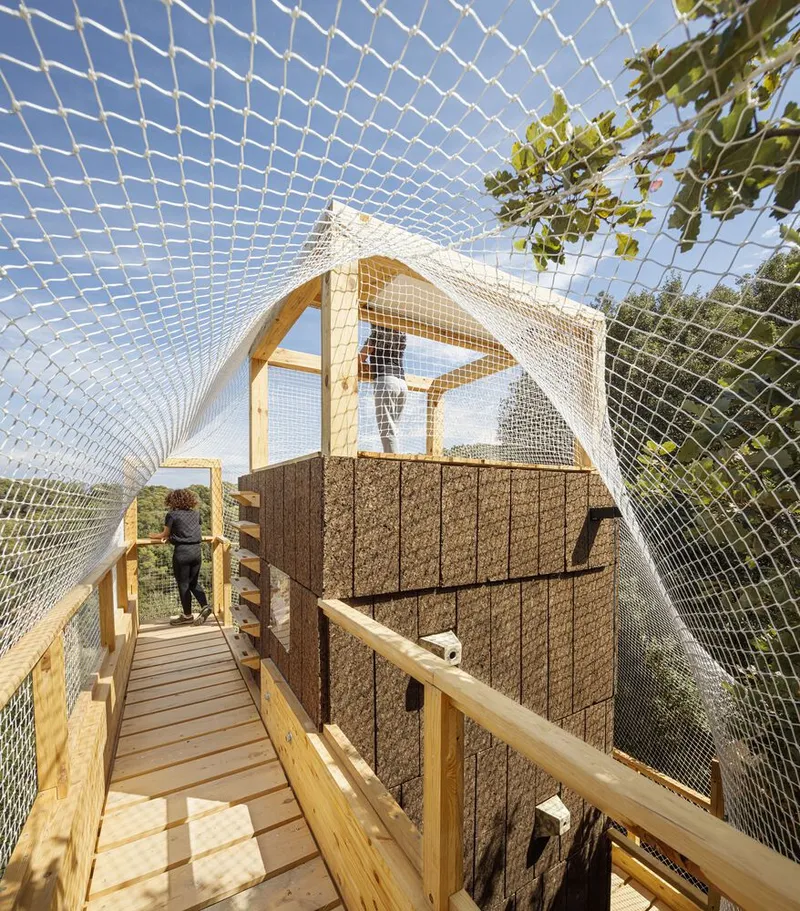
Where the mesh is porous, the habitable volumes are sealed. Two layers of natural cork panels clad the working and sleeping spaces, providing thermal and acoustic insulation with a material that has deep roots in Iberian building culture. Cork is lightweight, fire-resistant, and harvested without killing the tree, making it a natural complement to the CLT structure. The resulting interiors are compact and warm: plywood walls, a folding desk, a task lamp, a single window that frames nothing but foliage.
The austerity is intentional. FLORA is designed for a researcher on a short-term stay, not for comfort tourism. The study nook visible in the interior photographs is closer to a ship's cabin than a retreat; every surface does double duty. That economy of means extends to the construction itself: all components were prefabricated at Valldaura Labs and assembled on site using a crane in a sequence that the team describes as "highly intricate," a polite term for logistically intense.
A Zero-Kilometer Timber Structure
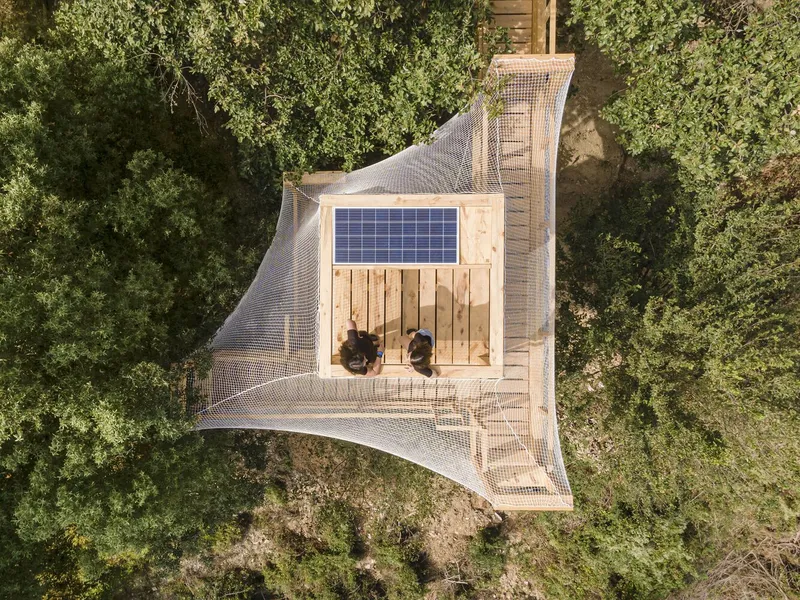
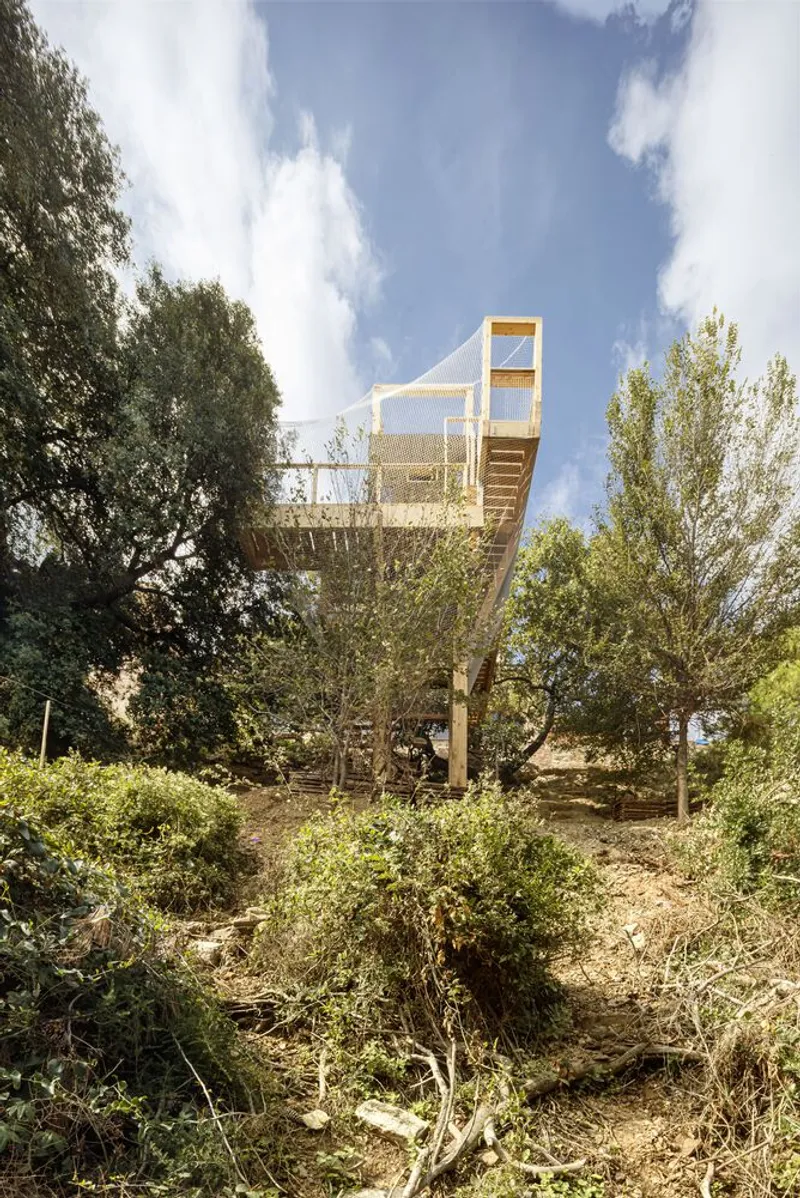
The zero-kilometer claim is not marketing; it is the structural logic of the project. The seventy harvested pines were Aleppo pines, an extended species in Collserola that sustainable management plans aim to thin in order to give native oak trees room to recover. Removing them was an act of ecological restoration as much as material sourcing. IAAC's students processed the logs with a small sawmill and a CLT press at Valldaura Labs, the 130-hectare former farm where the MAEBB program is based. The CLT panels form the central core, while glulam beams carry the bridges and define the columnar structure.
What makes the approach persuasive is not ideology but proximity. The distance between standing tree and finished panel was measured in hundreds of meters, not hundreds of kilometers. That compresses a feedback loop that is usually invisible: the students who designed the tower also felled, milled, and assembled it. When architects understand their material at the level of the grain, the details tend to be better. Here, the exposed timber joinery and carefully dimensioned column sections suggest exactly that kind of familiarity.
Collserola as Context and Client
Collserola Natural Park covers more than 8,000 hectares and stretches seventeen kilometers long and six kilometers wide, with its highest peak at Tibidabo (512 meters). It is the largest green space in the Barcelona metropolitan area, home to 190 vertebrate species, an estimated 1,000 plant species, and dense Aleppo pine forests. It is also acutely vulnerable to climate change, drought, and fire. The park is not wilderness; it is a managed landscape under pressure, and FLORA is positioned as a tool for understanding what that pressure does at every ecological layer.
The tower's program reflects that ambition. Bird radio equipment and birdhouses track avian populations. A weather station monitors microclimate shifts. The projection and working spaces allow researchers to visualize data on site rather than in a distant office. By organizing the structure vertically, from underground to sky level, the observatory creates observation points at each biodiversity stratum. It is an instrument calibrated to Collserola's specific ecology, not a generic lookout with a research label attached.
Why This Project Matters
FLORA is a small building with an outsized argument. It proposes that architecture can participate in forestry, that construction material can be harvested and processed within walking distance of the building site, and that the act of building can be, simultaneously, an act of ecological management. The thinning of invasive pines to source CLT panels is not a neutral choice; it is a design decision that benefits the forest's long-term health. Very few projects can claim that their construction literally improved the biodiversity of their site.
Beyond the material story, the project succeeds as spatial experience. The mesh walkways, the cork-clad cabins, the twelve-meter timber bridges: these are not just clever details but carefully sequenced thresholds that move a researcher from the ground plane into the canopy, progressively dissolving the boundary between observer and ecosystem. If IAAC's goal was to build an "ecological interactive prototype," FLORA delivers on the promise. It is architecture that knows its place, in every sense of the phrase.
FLORA Observatory by IAAC (Institute for Advanced Architecture of Catalonia), Collserola Natural Park, Barcelona, Spain. Completed 2022. Photography by Adrià Goula.
About the Studio
Share Your Own Work on uni.xyz
If projects like this are the kind of work you want to make, uni.xyz is a place to publish your own, find collaborators, and enter design competitions.


Popular Articles
Popular articles from the community


U.GA Architects Wraps an Oval Rooftop Pool in Curved Board-Formed Concrete on Busan's Jeollidan-gil
In Busan's Jeonpo-dong, a 454 m² mixed-use block stacks a neighborhood facility, guest rooms and an oval rooftop pool inside spiraling concrete walls.

GROUP A Strips a 1969 Rotterdam Harbor Headquarters to Its Frame and Wraps It in Timber Louvers
In Rotterdam's M4H harbor district, Ferro Offices reuses a 1969 frame, adds one timber storey and reaches BREEAM-NL Outstanding.

Architekt Andreas Gruber Scatters 23 Dark Timber Chalets Across a South Tyrolean Forest Edge
In Molini di Tures, Amonti Chalets breaks a resort into a hamlet of gabled timber houses, with parking, storage and services pushed into the slope.

LT2A and OPEN Architectes Thread a Brick and Glass High School Through a Wooded Belgian Campus
In Braine-l'Alleud, a 3,000 m² wing for Collège Cardinal Mercier pairs pale brick with a glazed colonnade, deferring to a small chapel and a dense wood.

Similar Reads
You might also enjoy these articles


Hodi-Mandai Geram
Project Function: Preservation and revitalization of the Intangible heritage and socio-spatial identity of the Hodi by Housing, Cultural Memory Center, Sacred Grove, landscape, local tourism economy


Olio Towers: A Mid-Rise for Performers That Fuses Housing, Rehearsal, and Stage
Located blocks from Houston's Theater District, this modular tower stacks living units around a central performance atrium.

Oasis: Modular Green Housing Carved into Dhaka's Urban Fabric
A shortlisted Plugin Housing entry reclaims unauthorized settlements in Dhaka with stepped concrete volumes, green roofs, and ventilation-driven design.

Black Hole: A Floating Megastructure for the Post-Physical Era
Emiliano Mazzarotto envisions a spherical, self-scaling arena where e-sports, digital hotels, and holographic stadiums replace traditional public space.

Explore Architecture Competitions
Discover active competitions in this discipline

Design challenge to equip cities with modern furniture

Challenge to reimagine the Iron Throne

Photograph architecture without architects

Illustrate the lost glory of Angkor Wat - Render Challenge
Comments (0)
Please login or sign up to add comments
No comments yet. Be the first to comment!