

Flow: Reimagining the Startup Center Through a Child's Eyes
A child's drawing inspires a unique and sustainable startup center design in Pittsburgh.


"FLOW" an innovative architectural design for a startup center in Pittsburgh, Pennsylvania, created by IremNur Ozkok and Almina Aydin, Winner entry of Child's Perspective. The project, conceived through a unique collaboration with a child, challenges conventional workspace design by prioritizing a child's perspective on flow, movement, and interaction within the built environment.
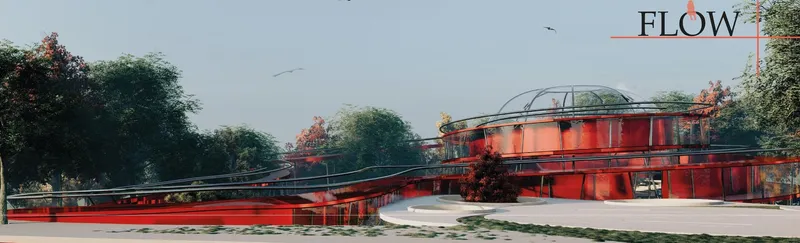
A Child-Centered Approach
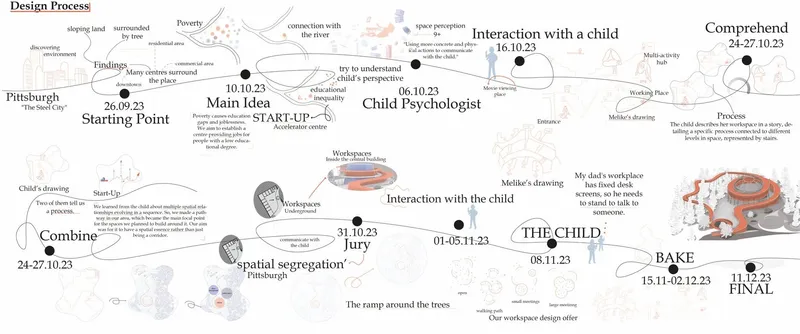
The core concept of FLOW stems from a child's drawing, which depicted their ideal workspace as a multi-level, interconnected environment with designated spaces for various activities. This childlike vision, characterized by fluid movement and spatial segregation, became the driving force behind the design. Recognizing the socio-economic challenges and educational inequalities in Pittsburgh, the designers saw a startup center as an ideal solution, merging community needs with a child's imaginative perspective.

Site Analysis and Integration
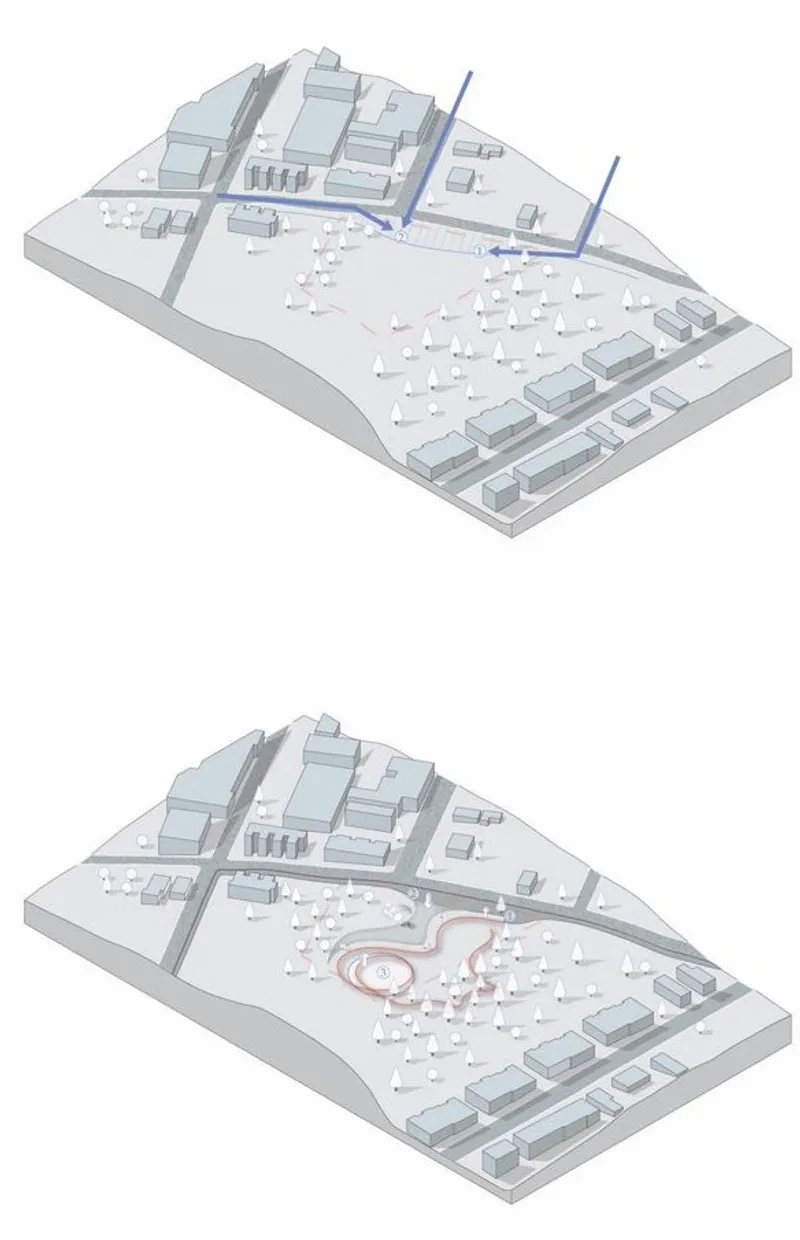
Situated at the confluence of two rivers in Pittsburgh, the site is surrounded by diverse neighborhoods. Despite its proximity to the city center, the area suffers from low income levels and high unemployment rates, largely due to historical underinvestment and educational disparities. FLOW aims to address these challenges by creating a dynamic hub for entrepreneurship and innovation.

Architectural Response
The design manifests as a series of interconnected, domed structures, evoking a playful and organic aesthetic. Key design elements include:
The Ramp: A continuous ramp winds through the center, connecting different levels and functions while offering panoramic views of the Monongahela River. This element embodies the "flow" concept, encouraging movement and exploration.
Event Hall: Located at the lowest level, the event hall hosts startup competitions and presentations, serving as a launchpad for entrepreneurial ventures.
Exhibition Space: The ramp itself transforms into an exhibition space, showcasing the work of competition participants to investors and the public.
Workspaces: Elevated workspaces offer flexible and adaptable environments, featuring movable screens inspired by the child's observation of traditional office layouts.
Amphitheater: An amphitheater provides a dynamic space for presentations, guest speakers, and idea sharing.
Multi-Media Center: A dedicated multi-media zone facilitates communication and collaboration among entrepreneurs.
Cafe: A central cafe fosters informal interaction and networking.
Sustainability and Thermal Performance
The domed structures, constructed using earth-based materials, utilize thermal mass to regulate temperature. This passive strategy minimizes energy consumption while creating a comfortable and sustainable environment.
Design Process and Collaboration
The design process involved close collaboration with a child, whose drawings and insights were instrumental in shaping the final concept. This unique approach ensured that the design reflected a child's intuitive understanding of space and movement.

Impact
FLOW presents a compelling case study in child-centered design, demonstrating how a child's perspective can inform and enrich architectural solutions. By prioritizing flow, interaction, and a playful aesthetic, the project creates an environment that nurtures creativity, collaboration, and innovation. Ultimately, FLOW aims to empower aspiring entrepreneurs and contribute to the revitalization of Pittsburgh's underserved communities.


Popular Articles
Popular articles from the community


Tsunami Convergenics: Turning Catastrophic Ocean Forces into Underwater Housing Infrastructure
A speculative underwater settlement off the coast of Onagawa, Japan, treats tsunamis and typhoons as energy sources rather than threats.

Opera by the Sea Estonia: Three Shells Dissolving Architecture into Tallinn's Coastline
A winning opera house proposal replaces monumental form with interconnected shells that blur the boundary between building, park and Baltic Sea.

Singing Woman: Contemporary Architecture Inspired by Estonia’s Voice and the Sea
Singing Woman turns Estonia’s song culture into flowing opera house architecture, blending public life, landscape, sea, and national memory.
Temporary Home for Dogs: A Reversed Zoo Rethinks Animal Shelter Architecture
In Bucharest, a sinuous corridor and freed landscape flip the logic of containment, designing a shelter that works to make itself unnecessary.

Similar Reads
You might also enjoy these articles

Day and Night Park: A Time-Based Urban Newsstand in Beijing
A temporary urban newsstand in Beijing blending travel, light, and reading through poetic colors, compact form, and community-focused design.

Modernist Patio Renovation in El Masnou, Barcelona by Oliver Segura Arquitectura + Cebrià Arquitectura
Modernist patio renovation blending tradition and innovation with a movable pool, leveled floors, and Catalan materials in El Masnou.

Alto Residencial Coop: Cooperative Housing Development in Santiago de Compostela by Carbajo Barrios Arquitectos
A linear cooperative housing complex blending white volumes and perforated metal façades, enhancing community living, natural light, privacy, and urban integration.
Vil Genis School by BPA ARCHITECTURE – Massy, France
Vil Genis School in Massy, France, features sustainable design, south-facing classrooms, community integration, accessible spaces, and modern educational architecture.

Explore Flowing Space Competitions
Discover active competitions in this discipline

Challenge to visualize a collision of the future and past

Challenge to visualize future spaces of waste

Challenge to visualize slums of 2080

Challenge to illustrate the ruins of Petra
Comments (0)
Please login or sign up to add comments
No comments yet. Be the first to comment!