
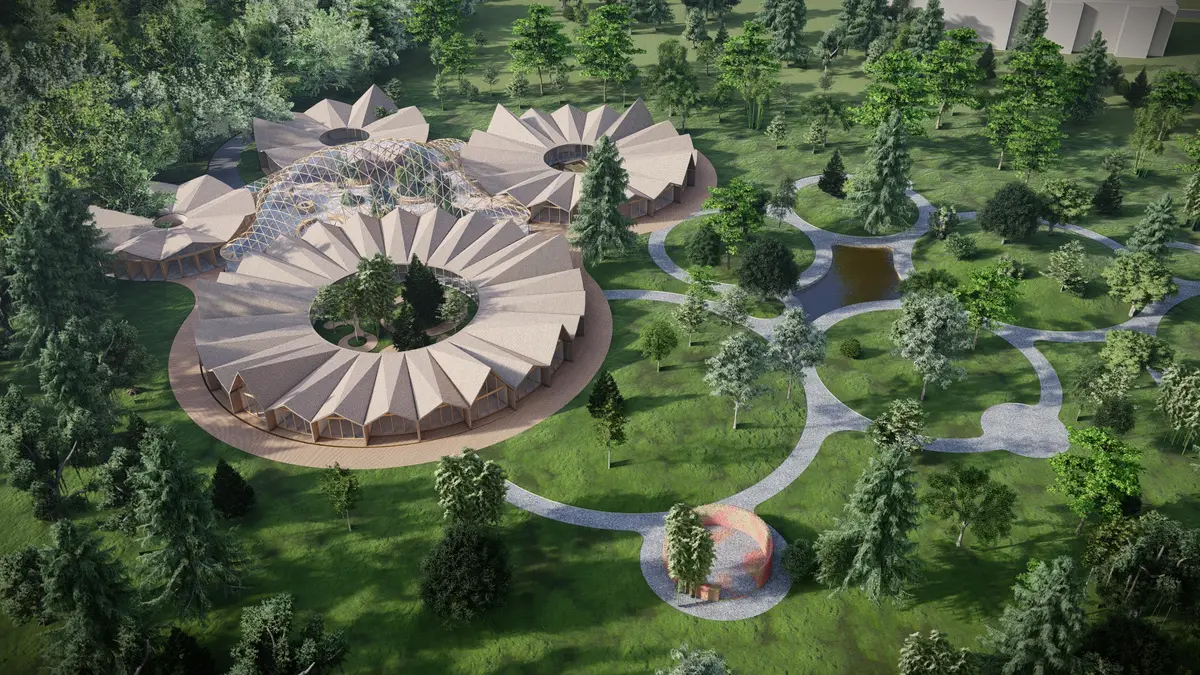
Flower
Nature centric hospice

When we read the brief of the competition,
Respites 2.0, we immediately understood that we wanted to
design a project where a hospice, in intimate relationship
with nature, feels as much as possible like home.
Hospices as we know them today, are functional but
they are cold, uncaring, lonely, artificial, confusing
large institutions and we feel that they are not ideal for
spending the last days of our lives.
Architecture should aim to ensure the best quality of
life to the patients, staff and family members who are
going to spend their time there. This should include,
not only the medical treatment, but also the most enjoyable
aspects of life.
We aim to create spaces that are warm like a home,
caring as a family, stimulating as a community, where
the inhabitants can be as independent as possible to
enjoy the time they have left in close connection to
nature.
We believe a hospice should have intimate spaces for
meditation and contemplation, mourning and grief,
and also more lively spaces for sharing, playing and socializing
in a safe and caring space integrated to
nature.


Popular Articles
Popular articles from the community


FCC Arquitectura Expands a Portuguese Granite House with a Board-Marked Concrete Wing
In Portugal, JV House pairs a cleaned-up whitewashed and granite dwelling with a timber-shuttered concrete extension, courtyards and a garden pool.


Singing Woman: An Opera House That Performs Before the Curtain Rises
Ovidiu Cristian Pavel's conceptual opera house translates Estonia's choral identity into a sculpted waterfront landmark facing the Baltic Sea.

Aquadapt: An Underwater Habitat That Rewrites Its Rooms by the Hour
Curved modules ring the seabed while one shell shifts from breakfast room to cinema, farm and football pitch as residents' needs change.

Juan García Correa, John González and Claudia Rueda Sink a Circular Amphitheater into a Manizales Engineering Building
On the La Nubia campus in Manizales, Colombia, the S1 Building folds labs and offices into a hillside of ramped lawns that double as a campus route.

Similar Reads
You might also enjoy these articles

Vereda Arquitetos Renovates a 40-Square-Meter Apartment Inside Niemeyer's Copan Building
A compact unit in São Paulo's most iconic residential tower gets a material overhaul that pairs exposed concrete with bold blue Formica.

Shakur's House: Exposed Brick as an Interior Organiser in a 168 m² Mashhad Residence
Brick moves indoors in this Mashhad residence, where masonry walls, glass partitions and teal planes sequence a compact home without closing it off.

Day and Night Park: A Time-Based Urban Newsstand in Beijing
A temporary urban newsstand in Beijing blending travel, light, and reading through poetic colors, compact form, and community-focused design.

Modernist Patio Renovation in El Masnou, Barcelona by Oliver Segura Arquitectura + Cebrià Arquitectura
Modernist patio renovation blending tradition and innovation with a movable pool, leveled floors, and Catalan materials in El Masnou.

Comments (0)
Please login or sign up to add comments
No comments yet. Be the first to comment!