

The Footprints: Culture-First Desert Architecture
A settlement built into a Mauritanian gorge where daily life patterns, local materials, and courtyard traditions shape the architecture.


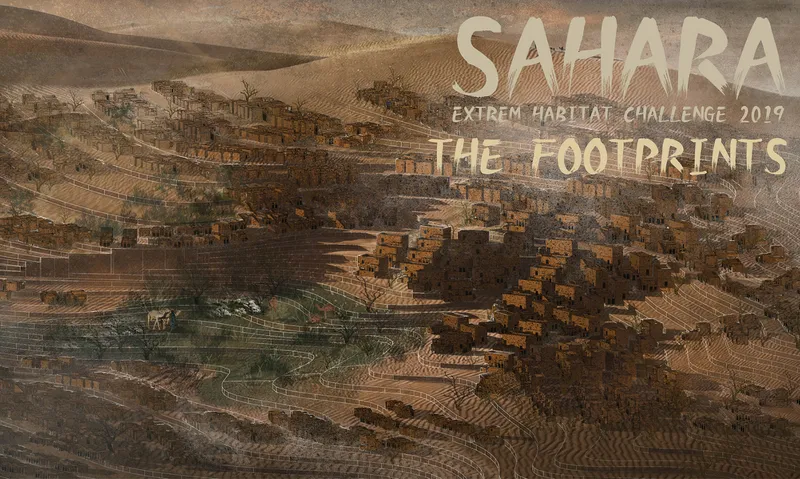
Footprints are evidence that someone was here. In the Sahara, they are also evidence of how people move: where they walk, where they stop, where they gather. The Footprints, a project by Xueying Zhang, uses that idea as a design principle. The settlement is shaped by the traces of daily life, not imposed on top of them.
Shortlisted in the Extreme Habitat Challenge: Sahara on uni.xyz, the project proposes a community built into a gorge in Mauritania. It is one of the most culturally grounded entries in the competition: architecture drawn from local building traditions, social patterns, and the specific topography of a real site.
Site: A Gorge in Mauritania
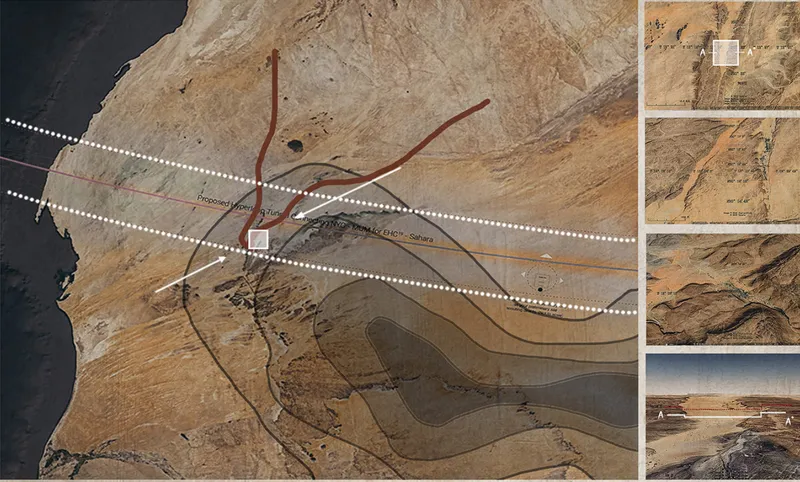
The site is not abstract desert. It is a specific gorge in Mauritania with defined edges, a microclimate sheltered from wind, and access to subsurface water. The gorge walls provide shade for most of the day. The topography creates natural terracing. The designer chose this site because it already does half the work of shelter.
The site analysis maps climate data, geological layers, and terrain sections. This is the kind of homework that separates entries that could be built from those that float in a generic sandy void. The gorge is real. The constraints are real. The design responds to both.
Programme: Locals and Outsiders
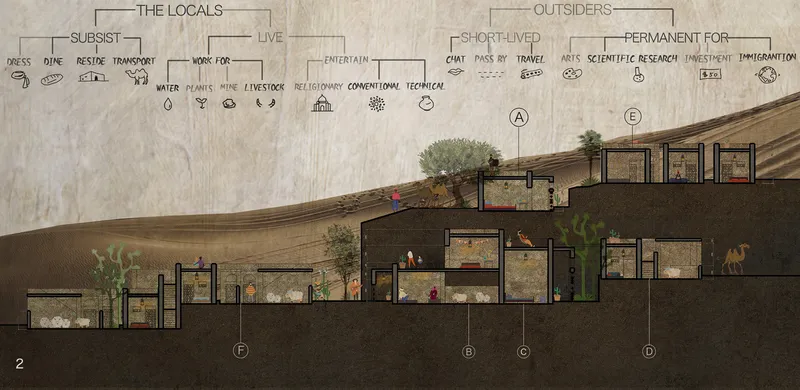
The cross-section through the gorge reveals the programme logic. The settlement is organised around two populations: locals who live there permanently (dressing, dining, working, worshipping) and outsiders who pass through for trade, scientific research, arts, or travel. The architecture provides for both without forcing them into the same spaces.
This dual population model is realistic. Desert settlements have always functioned as waypoints for traders, travellers, and scholars. Designing for that mix, rather than pretending the community is closed, makes the project more honest and more useful.
Daily Life as Design Driver
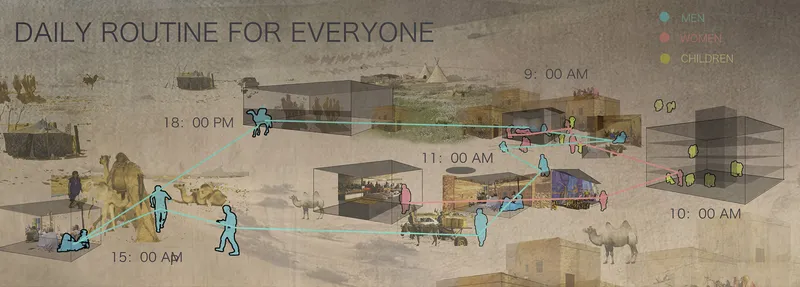
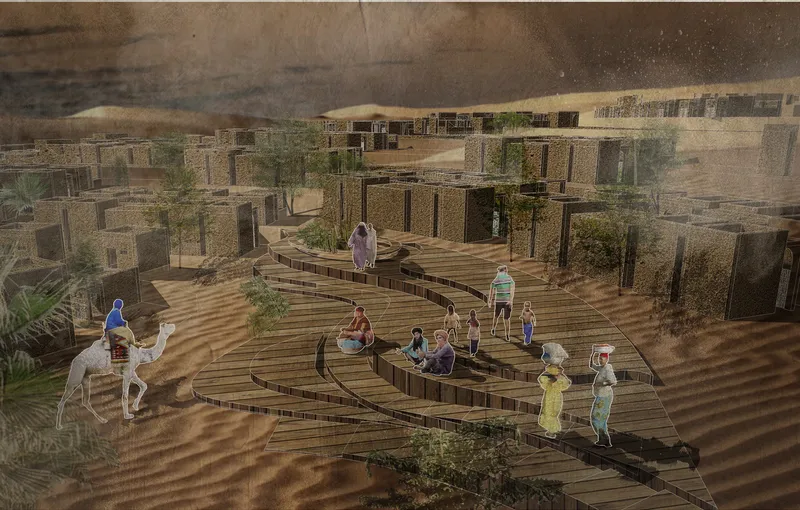
One of the project's strongest boards maps the daily routine of men, women, and children through the settlement from morning to evening. Movement patterns generate spatial requirements: where people gather at 9am for tea, where children play at noon, where the community assembles at sunset. The plan follows these patterns rather than dictating them.
The terraced communal spaces, with curved timber walkways winding between stone buildings and palms, are designed for these gatherings. The walkways are not circulation. They are places. People sit on them, trade on them, talk on them. The path is the programme.
Building Culture: Stone, Earth, and Craft
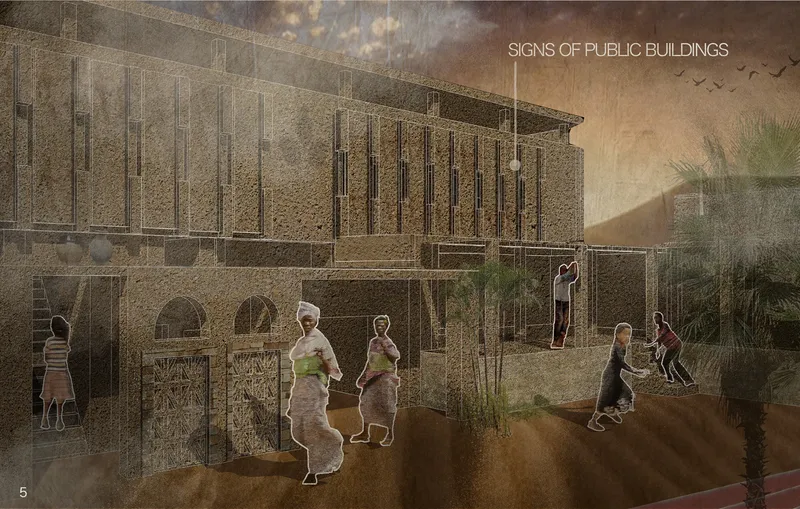
The buildings use stone and earth construction with vertical timber screens and arched openings. These are not references to traditional Saharan architecture. They are traditional Saharan architecture, adapted and extended. The material palette comes from the gorge itself: stone quarried from the walls, earth mixed on site, timber from local palms.
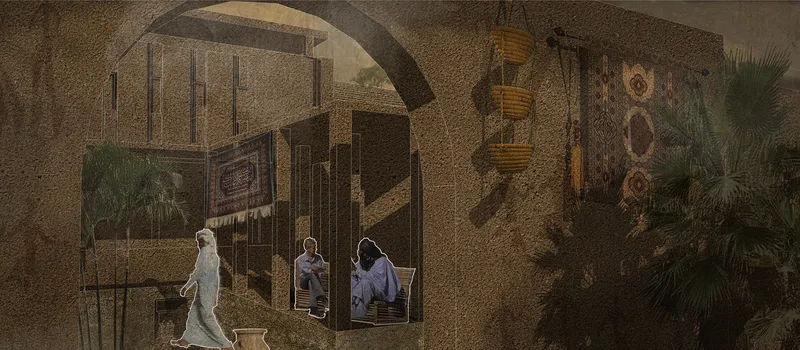
The interiors are rich. The tea house rendering shows arched stone walls hung with woven textiles and baskets. This is architecture that accepts decoration as part of the structure, not separate from it. The walls are surfaces for craft. The rooms are stages for social life. Nothing is blank.
Privacy, Community, and the Courtyard
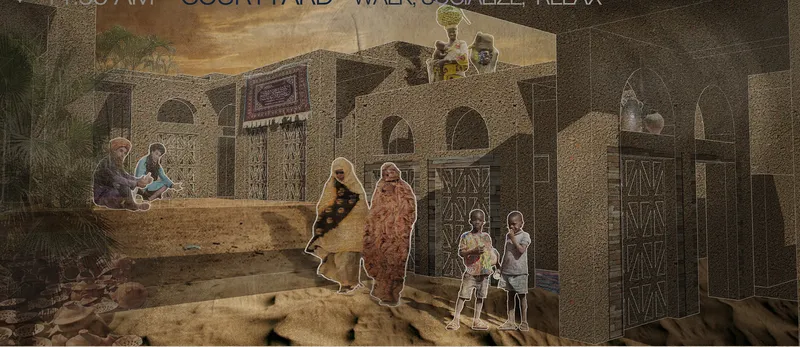
The courtyard is the fundamental spatial unit. Private rooms open inward to shared courts. Courts open to streets. Streets open to the gorge. The gradient from private to public is continuous and legible. You always know where you are in the social hierarchy of the settlement.
This courtyard logic is the same logic that organises traditional Mauritanian, Moroccan, and Algerian desert towns. The project does not reinvent it. It applies it carefully, with modern spatial standards, to a new site. The result is a settlement that looks as if it has always been there.
Why This Project Matters
Most extreme habitat proposals prioritise technology over culture. They solve the engineering problem and ignore the social one. The Footprints does the opposite. It starts with how people live, what they make, where they gather, and how they move, then builds architecture around those patterns.
The result is a settlement that feels inhabited before anyone moves in. The drawings are full of people doing things: drinking tea, walking with children, trading in courtyards, sitting on terraces. This is architecture imagined from the inside out, and it is one of the most convincing entries in the EHC Sahara series.
View the Full Project
About the Designer
Designer: Xueying Zhang
Enter a Design Competition on uni.xyz
If culturally grounded, site-specific architecture is the kind of work you want to produce, uni.xyz runs competitions year-round that reward projects rooted in real places and real communities.
Project credits: The Footprints by Xueying Zhang. Shortlisted, Extreme Habitat Challenge: Sahara (uni.xyz).


Popular Articles
Popular articles from the community


U.GA Architects Wraps an Oval Rooftop Pool in Curved Board-Formed Concrete on Busan's Jeollidan-gil
In Busan's Jeonpo-dong, a 454 m² mixed-use block stacks a neighborhood facility, guest rooms and an oval rooftop pool inside spiraling concrete walls.

longwave studio Reorganizes a 112 m² Tainan Apartment Around the Daily Routines of a Family and Two Cats
In Tainan, Taiwan, birch plywood, rust-red furniture and a freestanding plaster wall link arrival, storage, work and family life in one apartment.

GROUP A Strips a 1969 Rotterdam Harbor Headquarters to Its Frame and Wraps It in Timber Louvers
In Rotterdam's M4H harbor district, Ferro Offices reuses a 1969 frame, adds one timber storey and reaches BREEAM-NL Outstanding.

Cube Design Draws an Ecological Corridor Between Two Shenzhen Hills with the Nankai Building
Beside Shenzhen's container docks, the Nankai Building pairs stacked balconies with a climbing green screen to connect two hillsides across its height.

Similar Reads
You might also enjoy these articles


Vereda Arquitetos Renovates a 40-Square-Meter Apartment Inside Niemeyer's Copan Building
A compact unit in São Paulo's most iconic residential tower gets a material overhaul that pairs exposed concrete with bold blue Formica.

Shakur's House: Exposed Brick as an Interior Organiser in a 168 m² Mashhad Residence
Brick moves indoors in this Mashhad residence, where masonry walls, glass partitions and teal planes sequence a compact home without closing it off.

Day and Night Park: A Time-Based Urban Newsstand in Beijing
A temporary urban newsstand in Beijing blending travel, light, and reading through poetic colors, compact form, and community-focused design.

Modernist Patio Renovation in El Masnou, Barcelona by Oliver Segura Arquitectura + Cebrià Arquitectura
Modernist patio renovation blending tradition and innovation with a movable pool, leveled floors, and Catalan materials in El Masnou.

Explore Desert Architecture Competitions
Discover active competitions in this discipline

Challenge to design a shop stop sunk in the city

Challenge to illustrate the ruins of Petra

Challenge to design mud housing for contemporary communities
Comments (0)
Please login or sign up to add comments
No comments yet. Be the first to comment!