
Form Follows Climate: Passive Design Principles Shape a Children's Learning Space in Mainz
Three stepped volumes, rammed earth cores, and thermal buffer zones create a climate-responsive kindergarten along the Rhine.


What happens when a building's form is literally dictated by temperature swings, sun angles, and prevailing winds? In Mainz, Germany, where winters hover near zero and summers push past 35°C, Tobias Tröster answers that question with a kindergarten whose every architectural decision originates from a climatic fact. The result is not an exercise in green aesthetics but a working diagram of passive performance: deep overhangs calibrated to solar geometry, rammed earth walls sized for thermal mass, and circulation zones that toggle between insulating envelope and ventilated terrace depending on the season.
A shortlisted entry in the Form Follows Climate 2020 competition, the project sits in a Rhine-influenced maritime temperate zone with an annual mean temperature of 9.8°C. Rather than fighting those conditions with mechanical systems, Tröster treats them as generative inputs. Three gabled volumes organize the programme of childcare and education spaces, while the gaps between them become green courts that double as climatic buffers, daylight channels, and play zones.
Three Stepped Volumes and One Enclosing Wall
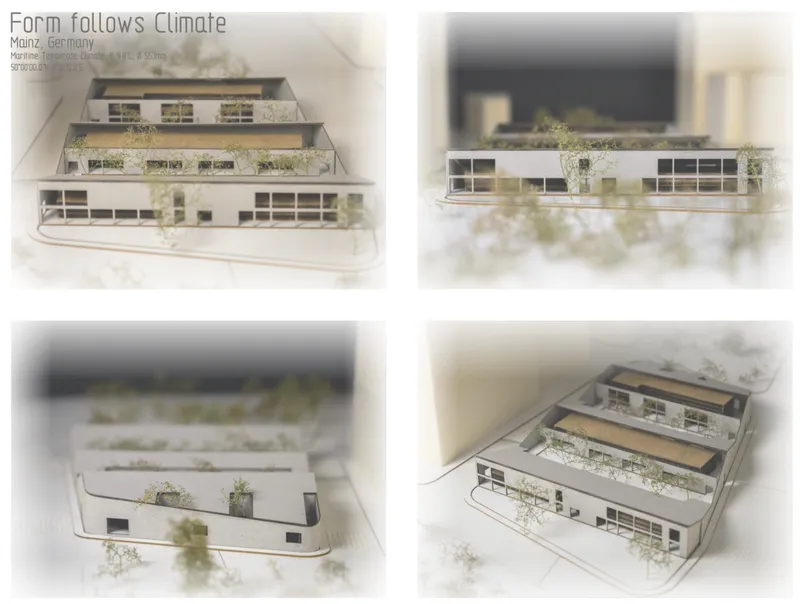
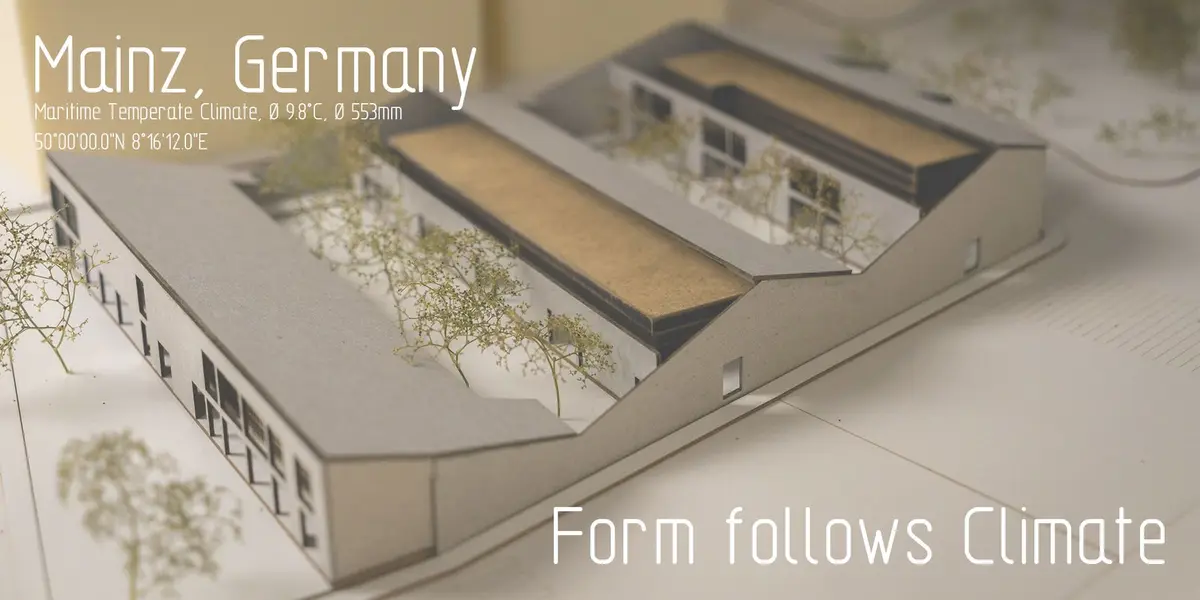
The physical model reveals the project's primary compositional move: three similarly shaped buildings, each slightly varying in height, producing a stepped profile that recalls the familiar double-pitched roof of domestic architecture. That residential silhouette is deliberate. A kindergarten needs to feel approachable and warm, not institutional, and the gabled forms achieve this without ornament. A continuous wooden outer wall binds the trio into a single entity, drawing a clear boundary between the street and the protected world within. Between the perimeter wall and the building cores, a shaded circulation zone emerges, one of the scheme's most important climatic inventions.
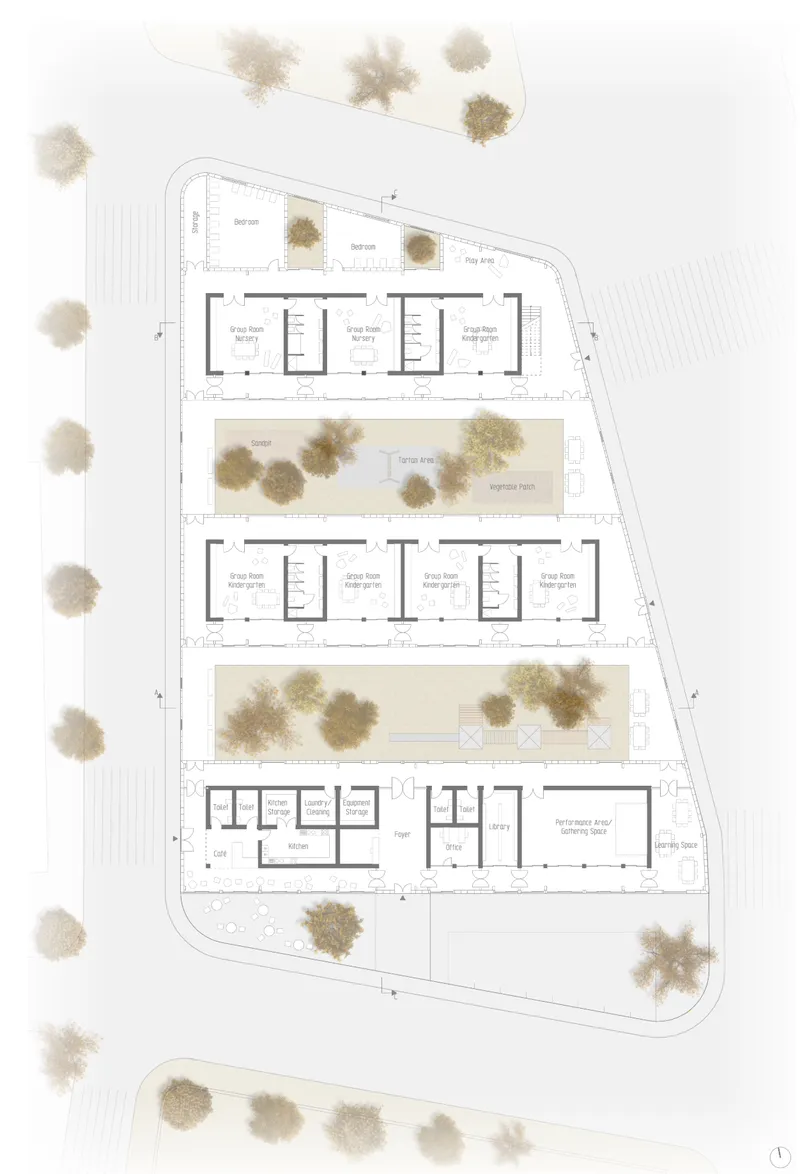
The site plan shows how the three linear buildings carve out courtyards planted with scattered trees. These are not leftover voids; they are active environmental devices. Each court channels natural daylight into adjacent classrooms, enables cross-ventilation through the building sections, and provides children with direct outdoor exposure to seasonal change. The arrangement guarantees that no interior space is more than a few metres from a green zone, embedding ecology into the daily experience of the school.
Southern Overhangs and the Seasonal Sun
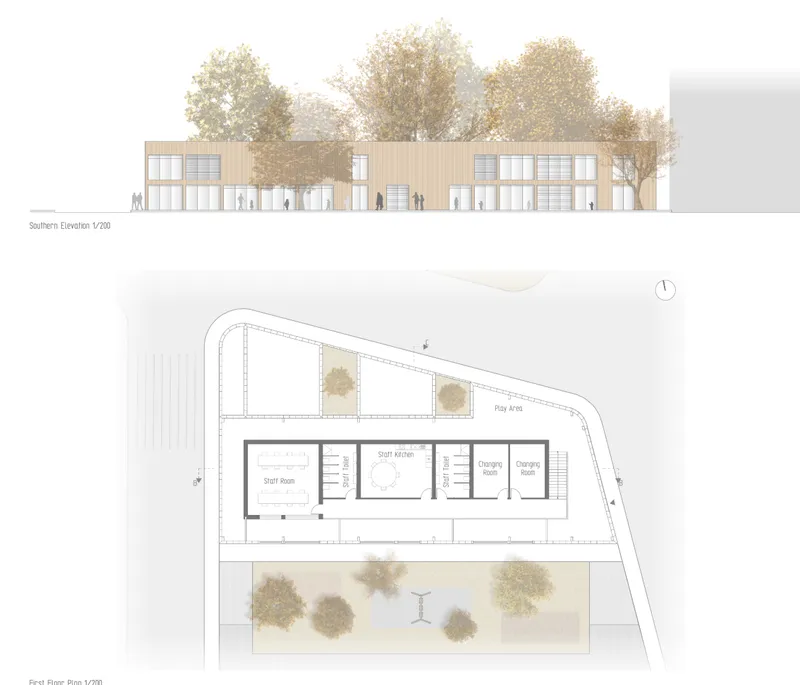
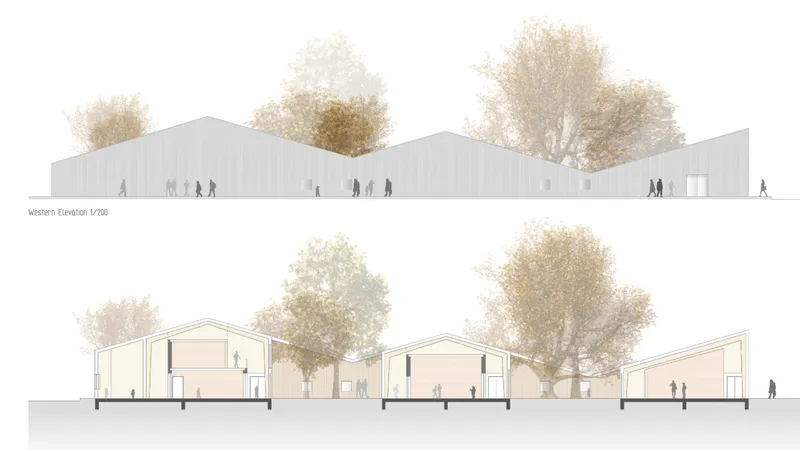
The southern elevation drawing makes the passive solar strategy legible at a glance. Deep roof overhangs extend across the façade, sized to block the high summer sun that can push Mainz temperatures to 40°C while admitting the low-angle winter light that warms interior surfaces during the coldest months. Below those overhangs, horizontal window bands open the classrooms to daylight without exposing children to glare or overheating. Figures and trees rendered in autumn foliage hint at the transitional seasons when these elements perform most visibly, moderating interior temperatures with no energy input.
From the west, the section drawings reveal the gabled roof forms in profile and confirm a key spatial hierarchy. The thermal buffer zone, the shaded space between the outer wooden wall and the inner rammed earth cores, reads as a generous covered veranda in summer and as a sealed insulating layer in winter. The silhouetted figures suggest that this zone is not simply a corridor; it is a flexible programme space whose function shifts with the calendar, absorbing play, gathering, and circulation as conditions demand.
Rammed Earth Cores and the Logic of Thermal Mass
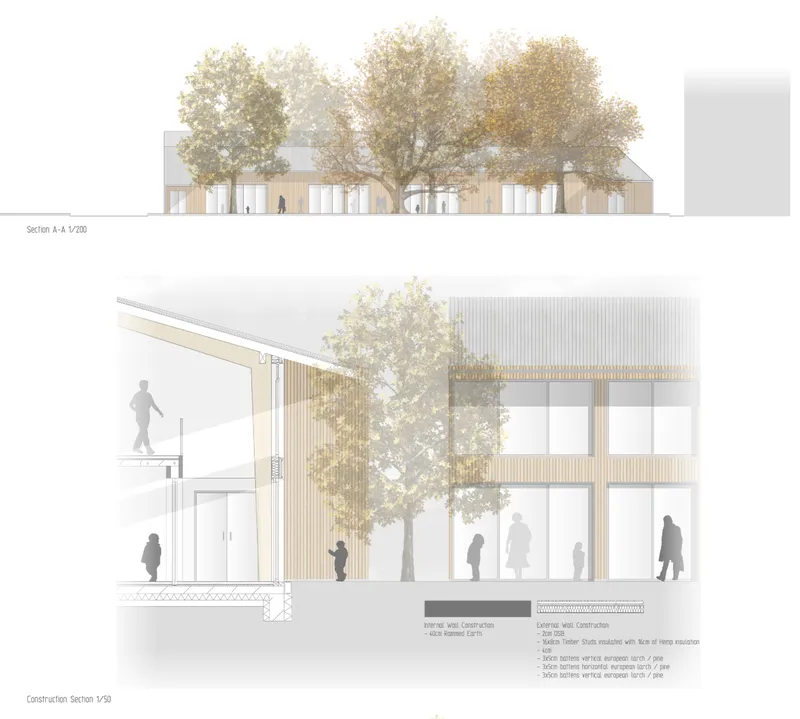
The construction detail section exposes the material logic that holds the passive strategy together. Inner cores built from thick rammed earth walls absorb daytime heat and release it slowly through the evening, flattening the temperature curve that a lightweight structure would suffer. In Mainz's continental summers, these cores remain the coolest spaces in the building; in winter, they become the warmest. Vertical timber cladding on the outer enclosure completes a layered system: wood for weather protection and visual warmth, air gap for ventilation, and earth for mass. Vents integrated into the façade respond to pollutant levels, opening and closing automatically to maintain indoor air quality without relying on heavy mechanical HVAC systems.
A Range of Environments from Warm Core to Open Court

The northern elevation and section drawings illustrate the full gradient of spaces the project offers. Enclosed rammed earth rooms sit at one extreme, providing stable warmth and shelter during colder months. Wide covered zones along the perimeter extend usable space during summer rain or intense sunlight. Open green courts at the centre of the composition ventilate freely in mild weather. Between these poles lie mixed thermal zones whose character shifts with the season: a semi-outdoor play area in May becomes a buffered corridor in January. For children, this layered environment means the architecture itself becomes a daily lesson in climate awareness, each space legible as a response to sun, wind, or temperature.
Why This Project Matters
Climate-responsive design is often discussed in terms of office towers and housing complexes, where energy savings translate directly into cost savings at scale. Tröster's kindergarten reminds us that the argument is equally powerful, perhaps more so, when the occupants are children. The passive strategies here are not invisible engineering buried in a wall assembly; they are spatially legible, experienced through the thickness of an earth wall, the shade of an overhang, the breeze in a courtyard. A child who grows up moving between these zones develops an intuitive understanding of how buildings and weather interact.
The project also demonstrates that climate responsiveness does not require formal novelty. Three gabled volumes, a perimeter wall, courtyards with trees: the elements are familiar, even archaic. What distinguishes the scheme is the precision with which each element is calibrated to Mainz's specific conditions, from summer peaks above 35°C to winter lows near freezing. That calibration is the real design work, and it produces architecture that is simultaneously low-energy, spatially rich, and genuinely kind to its youngest users.
View the Full Project
About the Designers
Designer: Tobias Tröster
Enter a Design Competition on uni.xyz
uni.xyz runs architecture and design competitions year-round that reward proposals with spatial conviction and real site intelligence.
Project credits: Form Follows Climate by Tobias Tröster Form Follows Climate 2020 (uni.xyz).


Popular Articles
Popular articles from the community


GROUP A Strips a 1969 Rotterdam Harbor Headquarters to Its Frame and Wraps It in Timber Louvers
In Rotterdam's M4H harbor district, Ferro Offices reuses a 1969 frame, adds one timber storey and reaches BREEAM-NL Outstanding.

longwave studio Reorganizes a 112 m² Tainan Apartment Around the Daily Routines of a Family and Two Cats
In Tainan, Taiwan, birch plywood, rust-red furniture and a freestanding plaster wall link arrival, storage, work and family life in one apartment.

U.GA Architects Wraps an Oval Rooftop Pool in Curved Board-Formed Concrete on Busan's Jeollidan-gil
In Busan's Jeonpo-dong, a 454 m² mixed-use block stacks a neighborhood facility, guest rooms and an oval rooftop pool inside spiraling concrete walls.

Juan García Correa, John González and Claudia Rueda Sink a Circular Amphitheater into a Manizales Engineering Building
On the La Nubia campus in Manizales, Colombia, the S1 Building folds labs and offices into a hillside of ramped lawns that double as a campus route.

Similar Reads
You might also enjoy these articles


Aquadapt: An Underwater Habitat That Rewrites Its Rooms by the Hour
Curved modules ring the seabed while one shell shifts from breakfast room to cinema, farm and football pitch as residents' needs change.

Play: Fragments of Their World: Remembered Architecture Rebuilt as a Modular Playground for Refugee Camps
Tom Gardner abstracts domes, arches and towers from the homelands of displaced families into a kit of child-scaled play parts for camp settlements.
REBIRTH: A Circular Settlement Where Afghan Widows and Their Children Rebuild Life Together
A shortlisted Resile entry turns the circle into a protective ring of timber and brick, gathering homes, classrooms and gardens around a shared landscape.
The Main Dream: A Recycled Plastic Kit That Lets Refugee Children Build Their Own Playground
Thirty-centimetre interlocking cubes that connect on three axes turn play into construction, letting children author the spaces they occupy.

Explore Environmental Architecture Competitions
Discover active competitions in this discipline

Design challenge to equip cities with modern furniture

Design challenge to reuse E-waste
Comments (0)
Please login or sign up to add comments
No comments yet. Be the first to comment!