
Form Follows Climate: Sanctuary, a Daycare Shaped Entirely by Climatic Logic
A timber-framed daycare facility in a dense urban plot uses sawtooth roofs, clay plaster, and wool insulation to achieve near self-sufficiency.


What if the form of a children's daycare were determined not by aesthetic preference or programmatic convention, but entirely by the forces of climate? Form Follows Climate: Sanctuary takes that question literally. The building's elongated massing, sawtooth roof geometry, and facade openings are all direct consequences of solar orientation, ventilation logic, and thermal performance targets. Sustainability here is not a bolt-on certification strategy; it is the generative principle behind every architectural decision, from the roof profile down to the clay plaster on the walls.
Designed by Arno Laber for the Form Follows Climate 2020 competition, the project situates a contemporary daycare facility on a compact urban plot surrounded by dense development. Rather than dispersing the program across multiple pavilions, the design consolidates functions into a single elongated structure stretching north to south. The result is a building that reduces exterior wall area to lower heat loss, while courtyards and voids punch through the plan to deliver daylight and natural ventilation deep into the interior.
A Single Volume Calibrated to Its Urban Plot
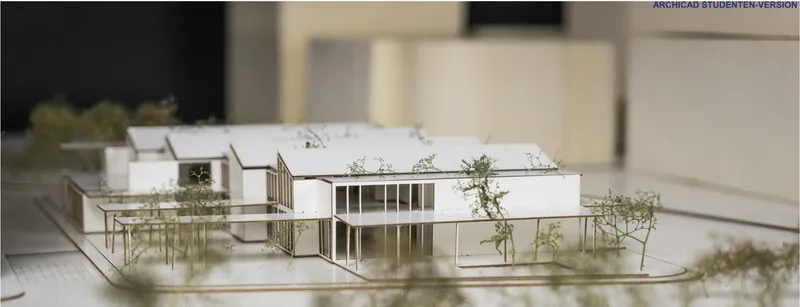
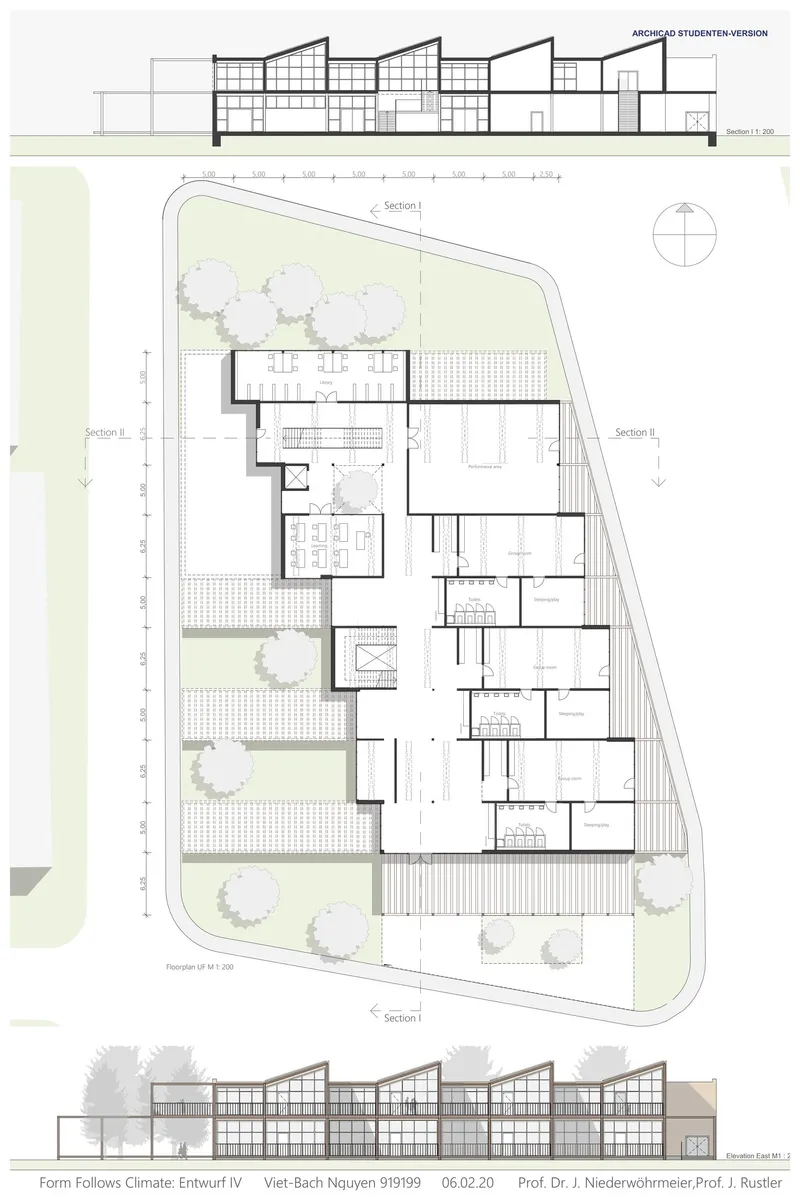
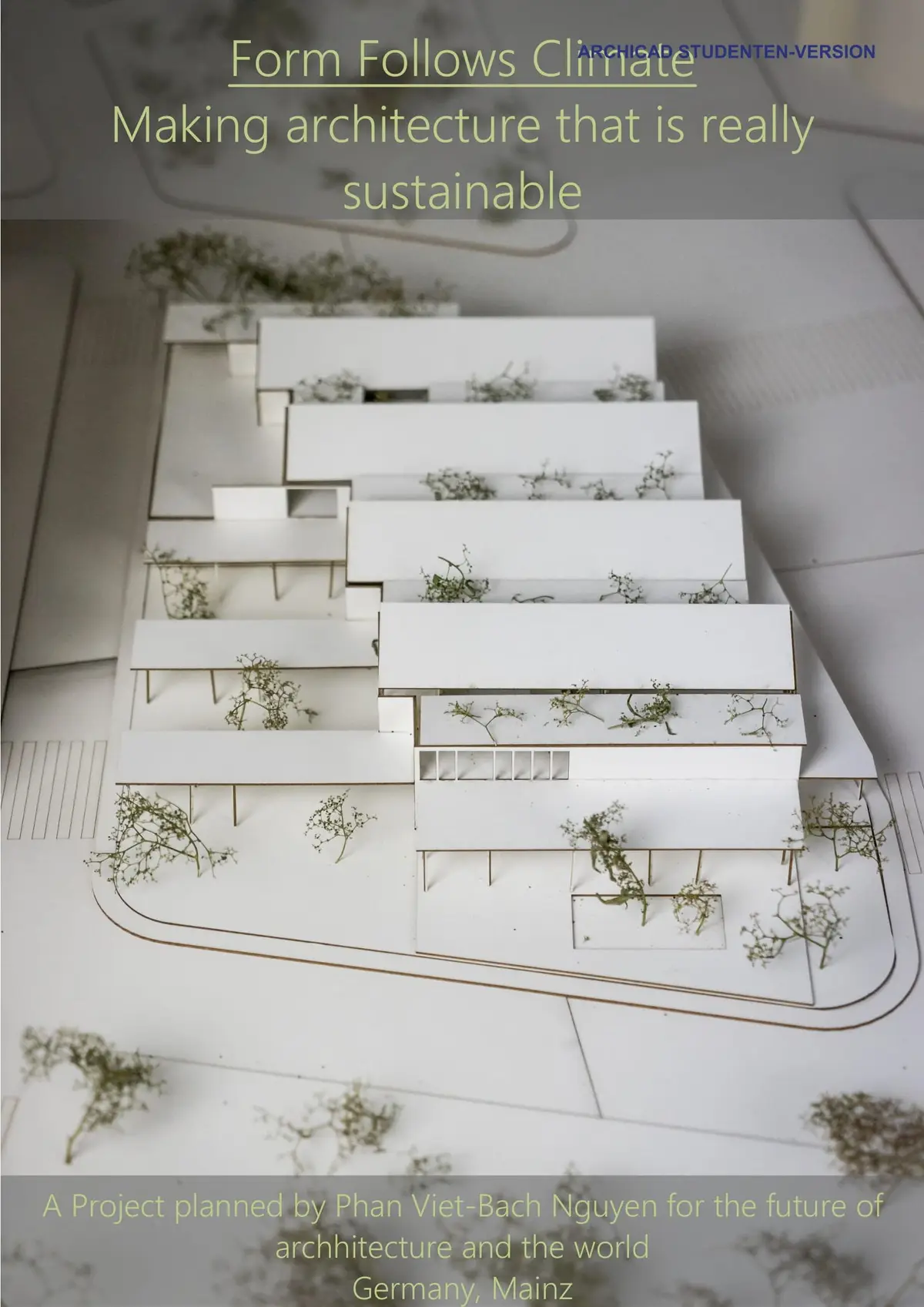
The physical model reveals the project's essential move: one continuous volume, not a campus of fragments. By consolidating the daycare into a single elongated bar, Laber dramatically cuts the ratio of exterior surface to interior floor area. Fewer exposed walls mean less thermal bridging and reduced heat loss, a strategy that reads clearly in the section drawings where the sawtooth roof profiles step across the building's length. The north-south orientation secures optimal solar access on the long facades, while the southern elevation becomes an active energy-generating surface fitted with photovoltaic panels.
The site plan shows how courtyards punctuate the plan at key intervals, pulling landscape into the building's core. These voids are not decorative; they are environmental instruments that introduce cross-ventilation pathways and daylight to rooms that would otherwise sit too deep within the floor plate. Miniature trees placed on the model indicate planted areas that soften the boundary between interior and exterior, giving children direct contact with greenery even on a tight urban site.
Sawtooth Roofs as Climate Machines
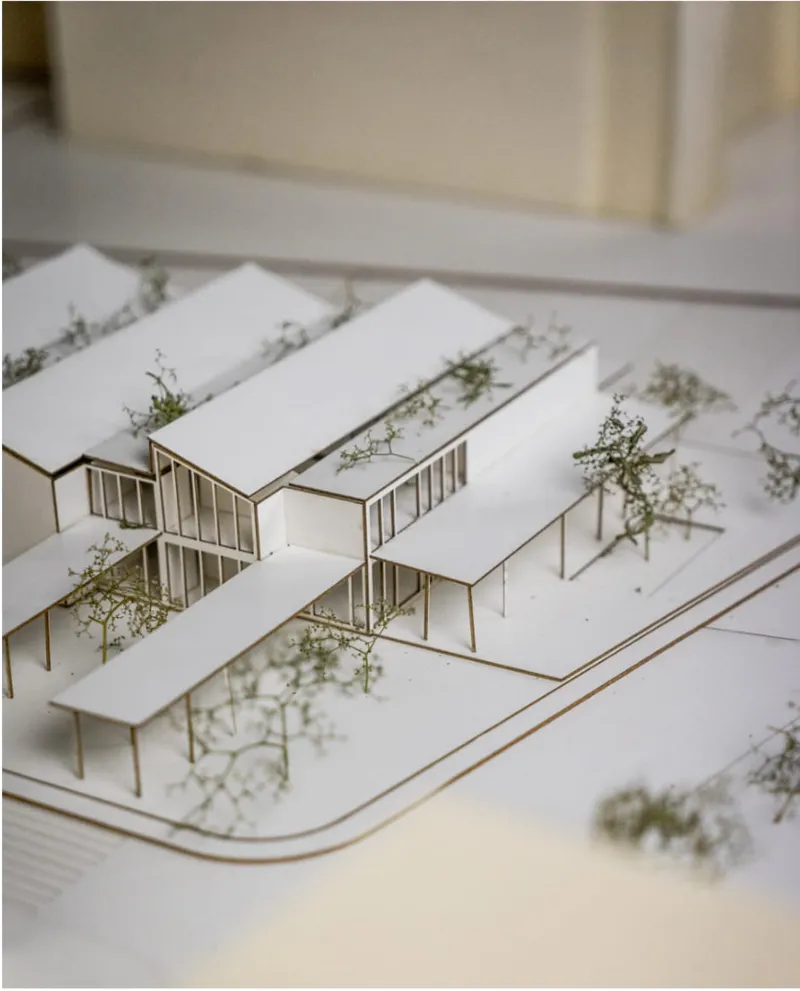

The defining formal gesture of the project is its sawtooth roof system, oriented toward the south. Viewed from an angle, the interlocking volumes with their glazed walls create a rhythmic silhouette that is pure climatic logic made visible. Each tooth of the roof integrates clerestory windows on the south-facing slope, maximizing winter sunlight intake while the stepped profile generates varying ceiling heights that enhance natural air circulation. Warm air rises to the highest points and escapes, drawing cooler air through the building without mechanical assistance.
The overhead view of the model is particularly revealing. Interior room divisions are clearly legible, organized around a central courtyard dense with vegetation. The flat roof sections between the sawtooth peaks are planted as green roofs, improving insulation, managing rainwater naturally, and contributing to local biodiversity. What emerges is a building where the roof is not a neutral lid but a multi-functional environmental surface: part solar collector, part ventilation driver, part habitat.
Timber, Clay, and Wool: A Material Palette with Near-Zero Toxicity
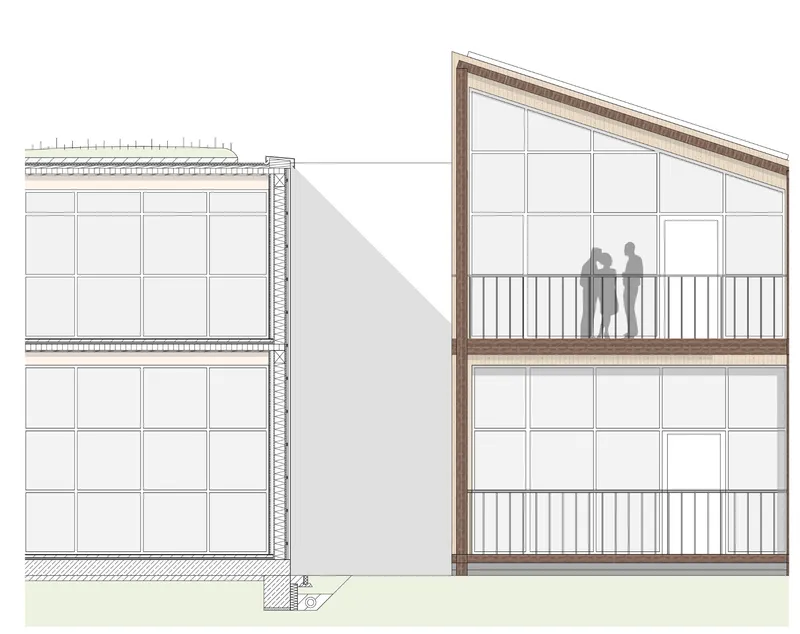
The section drawing through the sloped glazed facade reveals the building's material layering with precision. The primary structure is a timber frame, deliberately avoiding excessive use of concrete to keep embodied energy low. Interior surfaces are finished with clay plaster, a material capable of absorbing and releasing moisture to regulate indoor humidity, a critical consideration for spaces occupied by young children. Insulation is made from wool rather than synthetic compounds, reinforcing a commitment to non-toxic, biodegradable materials throughout the assembly.
Triple-glazed windows with minimal thermal bridging line the facades, visible in the section as generous openings that balance insulation performance with solar gain. The two figures standing inside the drawing give a sense of the spatial generosity these windows create: rooms flooded with natural light, framed by warm timber and clay surfaces. The balcony railing at the upper level suggests outdoor learning spaces integrated directly into the building envelope, extending the usable area without increasing the thermal footprint.
Passive Strategies That Displace Mechanical Systems
The project layers passive and active environmental strategies into a comprehensive system aimed at near self-sufficiency. Passive daylighting arrives through large openings, roof windows, and internal voids that distribute natural light across all floors. Natural ventilation relies on operable windows, vertical voids, and corridor layouts that enable cross-ventilation without fans or ductwork. Thermal regulation depends on the combined performance of clay plaster, timber construction, and high-performance wool insulation, all working together to stabilize indoor temperatures. On the active side, photovoltaic panels on the sawtooth roof produce renewable energy for daily operations. Together, these strategies reduce dependency on mechanical systems and external energy sources to a minimum.
Why This Project Matters
Sanctuary matters because it demonstrates that climate-responsive architecture need not result in austere or technically obsessive buildings. The daycare is warm, light-filled, and spatially generous, qualities that emerge directly from its environmental logic rather than in spite of it. The sawtooth roofs that maximize solar gain also create dynamic interior volumes with shifting ceiling heights. The courtyards that enable cross-ventilation also give children outdoor rooms for play. Every climate strategy doubles as a spatial quality, which is precisely the synthesis the competition brief demanded.
Laber's project also makes a quiet argument about material honesty in children's environments. Clay plaster that regulates humidity, wool insulation free of synthetic off-gassing, timber frames that sequester carbon: these are not abstract sustainability metrics but tangible qualities that directly affect the health and comfort of the building's youngest occupants. In a field where green certifications often float above the lived experience of a space, Sanctuary anchors its environmental ambition in the textures, temperatures, and light that children will actually inhabit every day.
View the Full Project
About the Designers
Designer: : Arno Laber
Enter a Design Competition on uni.xyz
uni.xyz runs architecture and design competitions year-round that reward proposals with spatial conviction and real site intelligence.
Project credits: Form Follows Climate: Sanctuary by : Arno Laber Form Follows Climate 2020 (uni.xyz).


Popular Articles
Popular articles from the community


LT2A and OPEN Architectes Thread a Brick and Glass High School Through a Wooded Belgian Campus
In Braine-l'Alleud, a 3,000 m² wing for Collège Cardinal Mercier pairs pale brick with a glazed colonnade, deferring to a small chapel and a dense wood.

David Macias Steps a Doorless Stone and Plaster House Down a Tropical Colombian Hillside
In the humid hills of Colombia, Threshold House replaces the front door with an open void and terraces its 850 m² down the slope instead of fighting it.

Jaramillo Van Sluys Arquitectura and Urbanismo Turn a Demolished Registry Lot in Quito into an Orchard Plaza
In Quito's Centro Histórico, a 2,800 m² plaza exposes the San Agustín convent wall and redraws its lost Augustinian orchard in volcanic stone.

Cube Design Draws an Ecological Corridor Between Two Shenzhen Hills with the Nankai Building
Beside Shenzhen's container docks, the Nankai Building pairs stacked balconies with a climbing green screen to connect two hillsides across its height.

Similar Reads
You might also enjoy these articles


Aquadapt: An Underwater Habitat That Rewrites Its Rooms by the Hour
Curved modules ring the seabed while one shell shifts from breakfast room to cinema, farm and football pitch as residents' needs change.

Play: Fragments of Their World: Remembered Architecture Rebuilt as a Modular Playground for Refugee Camps
Tom Gardner abstracts domes, arches and towers from the homelands of displaced families into a kit of child-scaled play parts for camp settlements.
REBIRTH: A Circular Settlement Where Afghan Widows and Their Children Rebuild Life Together
A shortlisted Resile entry turns the circle into a protective ring of timber and brick, gathering homes, classrooms and gardens around a shared landscape.
The Main Dream: A Recycled Plastic Kit That Lets Refugee Children Build Their Own Playground
Thirty-centimetre interlocking cubes that connect on three axes turn play into construction, letting children author the spaces they occupy.


Comments (0)
Please login or sign up to add comments
No comments yet. Be the first to comment!