
FORT CROISSANT - Design Brief
"Child Play" Competition Entry
Everyday brings more changes to our lifestyle, habits, technology and world around us, but one thing remains constant – children want to have fun. Many of us quickly came to conclusion that kids have become more reluctant to spending their time outdoors in favour of online entertainment.
Are the dynamics of digital world with its gadgets really that appealing, or perhaps the reason lies elsewhere?
In the pursuit of finding possible causes and solutions to this statement, I have carefully considered alternatives that children have today. Apparently, in fast-paced environment we forgot that the time to play should not be carefully scheduled, programmed nor planned, as it is exhausting for any human, doesn’t matter if big or small in age or size. We tend to forget that children have more time to observe and learn from adults and draw their own conclusions, so when it comes to play it is best to listen and provide suitable challenges and opportunities for younger adventurers.
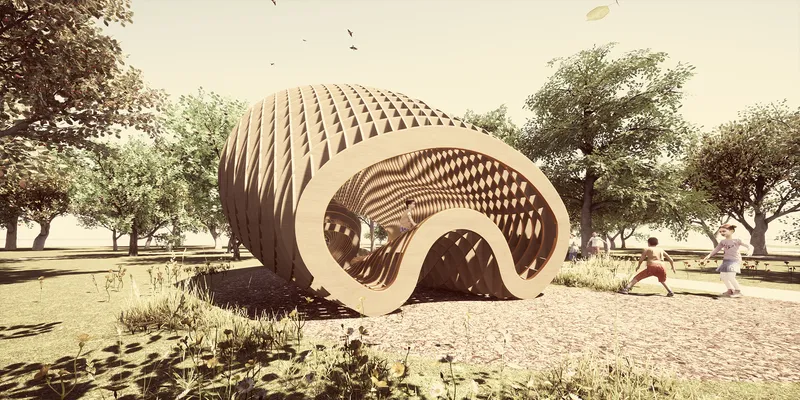
In my design I have aimed to create a space that would spark interest – first with visually attractive and abstract form, then with the invitation to explore the possibilities of interacting with the proposed object. There are many ways, I imagine, a child could try to cross/climb/walk over it, with potentially dozens of more ways with every new creative visitor. Hence the openness as how to interpret the object and how to play with it, on it, under it, or even around it.
From my side, I have tried to provide a waffle-type structure, designed to be safe and accessible to possibly widest group of children, disregard of age or abilities.
The object was formed on a 20cm x 20cm planar grid, loosely inspired by the popular playground game -Hopscotch. Here, instead of hopping or jumping through drawn rectangles, we have raised the challenge and added the third dimension – height and balancing on intersecting elements of the structure.
The dynamically changing organic shape not only provides opportunities for physical activities, it also serves as a hideout for various role-playing, a meeting point, or even an unusual type of urban furniture for just relaxing or resting.
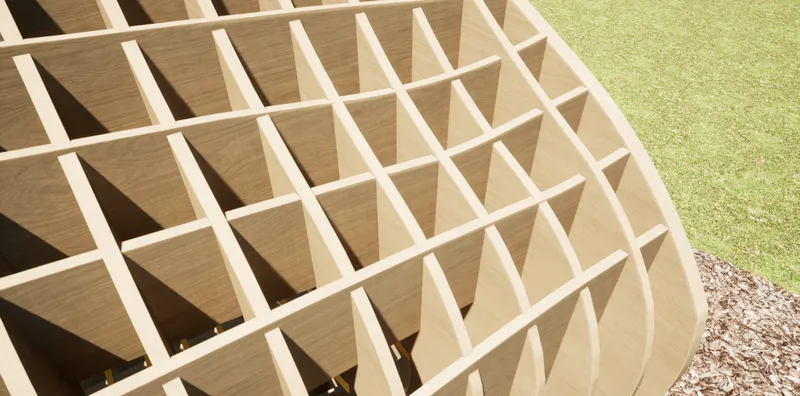
In order to create positive impact on the environment, the structure is made of laminated timber elements, which can be easily assembled and disassembled on site. Using egg crate construction method, the half-cut vertical and horizontal members create a stable and sustainable object, with very little material waste. Each element – rib – is finished with a strip of natural rubber with natural pigments for high visibility, safe grip and provision of anti-slippery surface in case of damp weather.
Furthermore, the choice of materials and openwork form give opportunities to engage children sensory play. Along with physical activity, natural wood elements can stimulate the sense of touch and smell, while the lights and shadows inside the structure, changing throughout the day and with different weather, can stimulate the sight.
With our living spaces shrinking and distance between participants growing, it is vital to invest the time and resources to create friendly landscapes that can keep up with fast-changing cities. Places, where everyone can just stop for a brief moment to enjoy themselves and open up to adventure, both for children and others who might just want to feel like children.


Popular Articles
Popular articles from the community


The Musturak Paradise: Senior Living Architecture for a Connected Future in Temara, Morocco
The Musturak Paradise reimagines senior living architecture in Temara via private homes, social spaces, culture, community, and shared care.

Riyadh For All: Intergenerational Urban Design for Active Aging in Rabat
Riyadh For All reimagines urban design in Rabat with intergenerational co-living, adaptive courtyards, and Moroccan cultural exchange today.

Conexión: Biophilic Design Reimagines High-Rise Living in Hong Kong
Conexión reimagines high-rise living in Hong Kong through biophilic design, green facades, shared spaces, daylight, water and nature within.

The Ocean Hive: Sustainable Architecture for a Self-Sufficient Civilization at Sea
The Ocean Hive imagines sustainable architecture at sea, where modular habitats, algae, wave power and ocean waste sustain a growing colony.

Similar Reads
You might also enjoy these articles

Day and Night Park: A Time-Based Urban Newsstand in Beijing
A temporary urban newsstand in Beijing blending travel, light, and reading through poetic colors, compact form, and community-focused design.

Modernist Patio Renovation in El Masnou, Barcelona by Oliver Segura Arquitectura + Cebrià Arquitectura
Modernist patio renovation blending tradition and innovation with a movable pool, leveled floors, and Catalan materials in El Masnou.

Alto Residencial Coop: Cooperative Housing Development in Santiago de Compostela by Carbajo Barrios Arquitectos
A linear cooperative housing complex blending white volumes and perforated metal façades, enhancing community living, natural light, privacy, and urban integration.
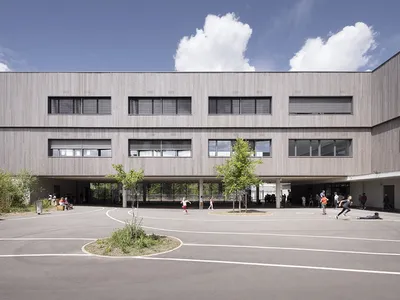
Vil Genis School by BPA ARCHITECTURE – Massy, France
Vil Genis School in Massy, France, features sustainable design, south-facing classrooms, community integration, accessible spaces, and modern educational architecture.
Explore Children Design Competitions
Discover active competitions in this discipline



Challenge to design a portable theatre


Challenge to design a portable music platform

Challenge to design an open learning module for the elderly


Design challenge to reuse E-waste
Comments (0)
Please login or sign up to add comments
No comments yet. Be the first to comment!