
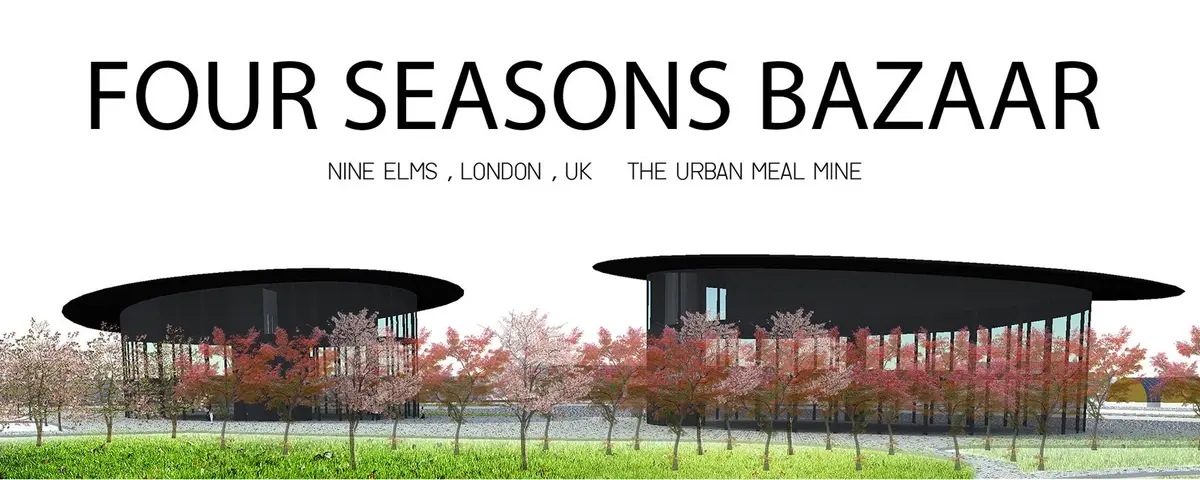
Four Seasons Bazaar: A Year-Round Urban Food Landmark for London
Seasonal agriculture, renewable energy, and cultural programming converge beneath a rotating pavilion concept in London's urban core.


What if a single building could harvest strawberries in June, host a fire festival in May, shelter a Christmas market in December, and grow leafy greens through a February frost? The Four Seasons Bazaar proposes exactly that: a circular pavilion system in London that treats seasonality not as a constraint but as the primary generator of architectural form, programme, and identity. Rather than fighting the British climate, the design leans into it, calibrating temperature, crop cycles, and public events to each quarter of the year.
Designed by Cwarakarn and developed through the Urban Meal Mine competition brief, the Four Seasons Bazaar sits at the intersection of food production, renewable energy, and cultural celebration. The masterplan threads together vertical farming zones, organic food hubs, culinary workshops, food courts, co-working spaces, and educational areas into a pedestrian-friendly network that links London's suburban edges to its centre. It is a serious attempt to address food security, community well-being, and carbon reduction within a single urban precinct.
A Pavilion That Changes with the Calendar
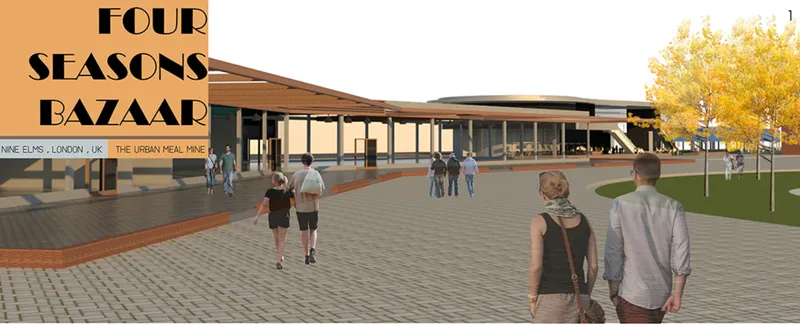
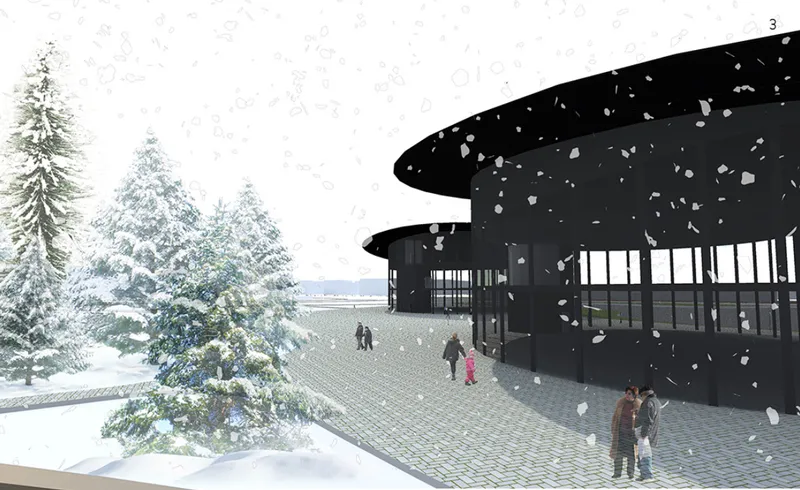
The core architectural gesture is a low-slung circular pavilion whose glass curtain walls allow the interior climate to be visually and environmentally legible from the surrounding plaza. In the autumn rendering, the building reads as a lantern set against amber foliage, its sloping roof channeling rainwater while paved terraces invite foot traffic. In winter, the same structure takes on a darker, more introverted character: snow settles on the cantilevered roof disc, evergreen trees frame the perimeter, and the glass enclosure becomes a warm refuge. The building does not transform mechanically between seasons; instead, its simple palette of dark roof, slender columns, and transparent walls allows the landscape and programme to do the seasonal storytelling.
Innovative temperature control technologies inside the glass envelope enable year-round cultivation of fruits and vegetables, producing high yields aligned with London's shifting crop cycles. Spring crops give way to summer harvests, which transition into autumn root vegetables and winter greens. The architecture acts as a controlled greenhouse whose internal conditions are powered by renewable energy systems, reducing the carbon footprint of both food production and building operations.
Terraces, Escalators, and the Pedestrian Network
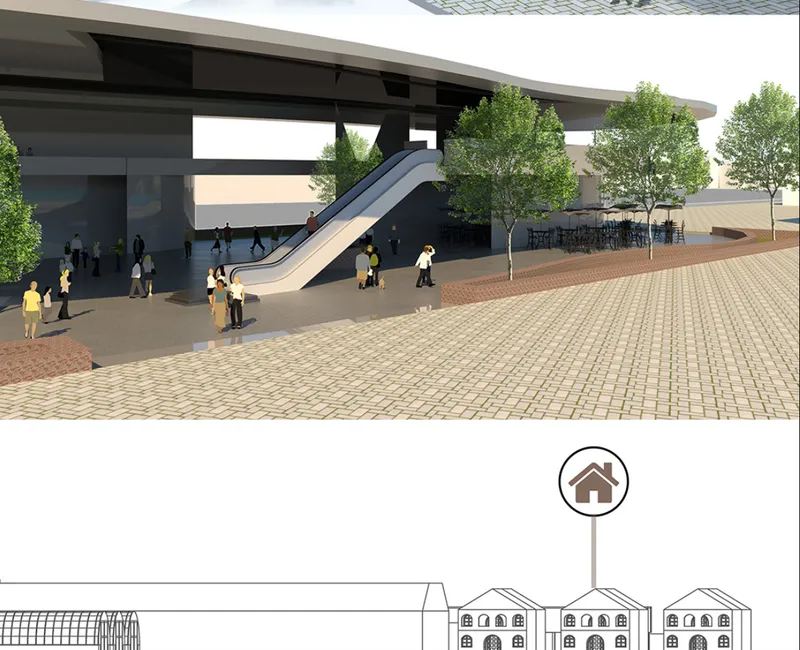
Connectivity is central to the masterplan. An outdoor escalator descends beneath a curved overhang, delivering visitors from an upper terrace level down to a paver gathering area below. The section suggests a multi-level organization where agricultural zones, retail areas, and public gathering spaces are stacked and linked by generous circulation. Dedicated pathways for bicycles, cars, and service trucks run alongside pedestrian-dominated corridors that double as historic walking routes, tying the bazaar into London's existing street hierarchy of main roads, side streets, and car-free zones.
By making the descent into the market a visible, almost theatrical experience, the design signals that this is not a conventional retail shed but a cultural destination. Visitors arrive, pause, observe the activity below, and then descend into it. That choreography of movement builds anticipation and reinforces the sense that the bazaar is a place worth lingering in, not simply passing through.
Floating Roof Discs Among Flowering Trees
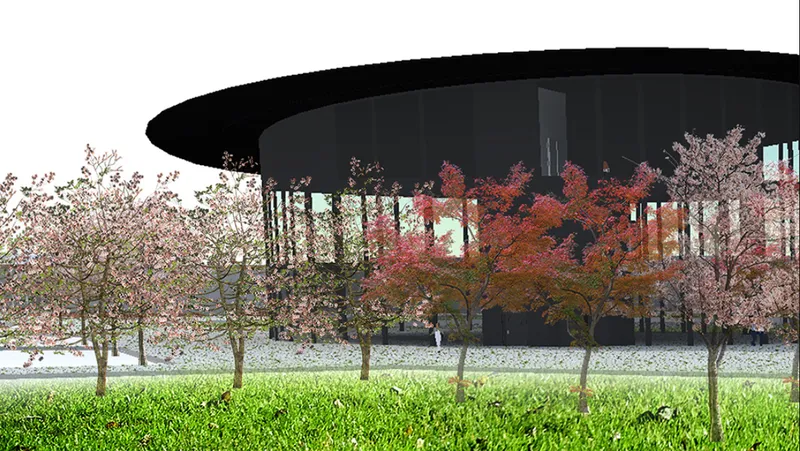
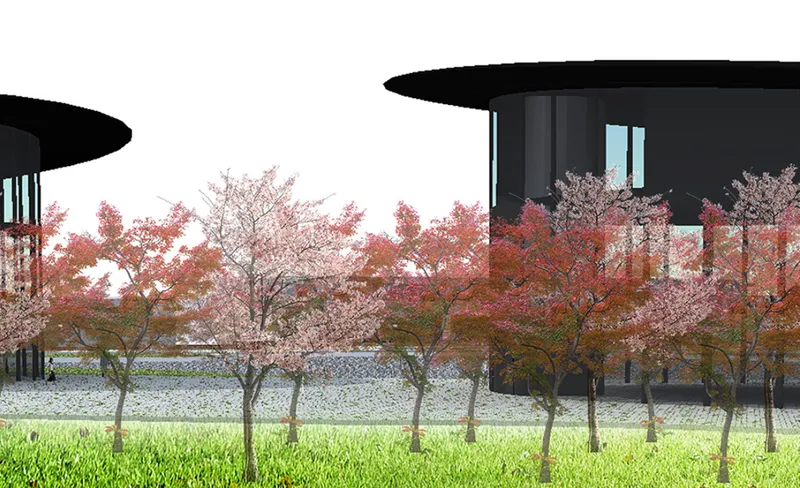
The most striking images of the project show the circular dark roof cantilevering dramatically over glass walls while rows of flowering trees, pink and red, occupy the foreground. In one view a single disc hovers; in another, two discs float on slender columns amid an orchard-like grid of blossoming trees. The effect is both monumental and light. The roof provides shade and weather protection for the programme below, while the column spacing is generous enough to preserve sightlines across the landscape. The trees are not decorative afterthoughts; they are integral to the seasonal narrative, marking the spring and summer periods with colour and fragrance that draw visitors outdoors.
This pairing of heavy canopy and delicate planting creates a productive tension. The architecture is clearly engineered and assertive, yet the ground plane belongs to nature and to people. Farmers can sell seasonal crops beneath the sheltered perimeter, culinary workshops can spill onto the lawn, and festival events, from Beltane fire celebrations in spring to street food markets in summer to Halloween gatherings in autumn, can occupy the open space between the columns without requiring temporary structures.
Programming for Every Stakeholder
The user-centred approach distinguishes the project from purely formal exercises. Farmers gain a permanent platform to produce and sell seasonal crops. Local residents access fresh, healthier food and community events year-round. Health enthusiasts find a landmark oriented around nutrition, wellness, and active living. Tourists encounter a cultural hub where seasonal festivals, from Glastonbury-inspired summer programming to Christmas markets, offer genuine encounters with London's traditions rather than generic retail experiences.
The programme list is ambitious: vertical farming zones, organic food hubs, food courts, co-working spaces, culinary workshops, and educational zones for both food and flowers. What holds it together is the seasonal calendar, which acts as an organizational spine. Each quarter of the year brings a different crop profile, a different set of cultural events, and a different microclimate within the pavilion. The architecture does not try to flatten these differences; it amplifies them.
Why This Project Matters
The Four Seasons Bazaar tackles a genuinely difficult question: how can a single piece of urban architecture support food production, renewable energy generation, cultural identity, and community health simultaneously? Rather than proposing a hyper-technical solution, Cwarakarn's answer is fundamentally spatial. A generous roof, transparent walls, and a landscape-first ground plane create the conditions for all of those activities to coexist. The seasonal framework gives the building a narrative logic that static architecture rarely achieves.
For London, a city grappling with food insecurity, rising energy costs, and the erosion of neighbourhood identity, a project like this offers a provocation worth taking seriously. It argues that sustainability is not an add-on but the very engine of architectural character, that a market can be a landmark, and that the most resilient buildings are the ones designed to change.
View the Full Project
About the Designers
Designer: Cwarakarn
Enter a Design Competition on uni.xyz
uni.xyz runs architecture and design competitions year-round that reward proposals with spatial conviction and real site intelligence.
Project credits: Four Seasons Bazaar by Cwarakarn.


Popular Articles
Popular articles from the community


Co-life: Sustainable Architecture for Age-Friendly Community Living
Co-life reimagines sustainable architecture for seniors through courtyards, rammed earth, shared gardens, and spaces designed for belonging.

The Musturak Paradise: Senior Living Architecture for a Connected Future in Temara, Morocco
The Musturak Paradise reimagines senior living architecture in Temara via private homes, social spaces, culture, community, and shared care.

Play: Fragments of Their World
Familiar architecture becomes modular playground design, creating safe spaces where displaced children can learn, connect, imagine and play.

Lunar Spiral: Space Architecture Shaped by the Mathematics of the Universe
Lunar Spiral reimagines space architecture through Fibonacci geometry, lunar regolith, levitating habitats, and self-sustaining Moon living.

Similar Reads
You might also enjoy these articles

ALGAL REALM: A Bio-Integrated Lunar Habitat Design for Life Beyond Earth
ALGAL REALM reimagines lunar habitat design with algae-powered life support, 3D-printed regolith, and vertical living for a lunar future.

Cinema Futurismo: Futuristic Architecture Reimagining the Future of Cinema
Cinema Futurismo merges futuristic architecture, holographic projection, intimate seating, and landscape into a new social cinema.

Little Red Riding Hood: Architectural Design as a Journey Through Fear, Light, and Storytelling
Little Red Riding Hood reimagines the fairy tale through architectural design shaped by fear, light, scale, memory, uncertainty, and choice.

Playducation: Modular Architecture That Turns Play Into a Space for Learning
Playducation transforms modular architecture into a flexible world of play, learning, and healing for children in refugee settlements.

Explore Conceptual Architecture Competitions
Discover active competitions in this discipline

Challenge to reimagine the Iron Throne

Photograph architecture without architects

Illustrate the lost glory of Angkor Wat - Render Challenge

Design challenge to reuse E-waste
Comments (0)
Please login or sign up to add comments
No comments yet. Be the first to comment!