
Fragmentos Weaves a Medina into a Ruined Algarve Palace to Create Hotel Palácio de Tavira
A 19th-century noble residence on Tavira's historic square is reborn as a 36-room hotel with a labyrinthine new wing inspired by Moorish urbanism.


For decades, the Palácio de Tavira sat in ruins on the left bank of the Gilão River, a hollowed-out monument to the aristocratic life that once animated its salons. Built across the 18th and 19th centuries by the Tavares family, the palace had been the social nucleus of Tavira's historic center: a place for receptions, political debates, and the rituals of regional power. Its collapse was a slow erasure, leaving behind stone pilasters, friezes, and balconies that remembered a building the city had forgotten. Fragmentos, led by Pedro Silva Lopes and Marcus Cerdeira, has now turned this absence into a hotel of 36 rooms across 2,350 square meters, and the most interesting decision they made was not about restoring the palace. It was about building a second one.
The project splits into two distinct halves. The original Palácio wing, facing the calçada-paved town square, preserves spacious rooms with hand-restored oak floors and the original stone staircase. Behind it, a new wing called the Medina unfolds as an entirely contemporary structure organized through patios, passages, stairs, and terraces that replicate the organic grain of Moorish urbanism. The result is a hotel where one half channels the memory of Portuguese nobility and the other channels the memory of North Africa, fusing two cultural currents that have always coexisted in the eastern Algarve but are rarely given equal architectural weight.
The Palace Meets the Square
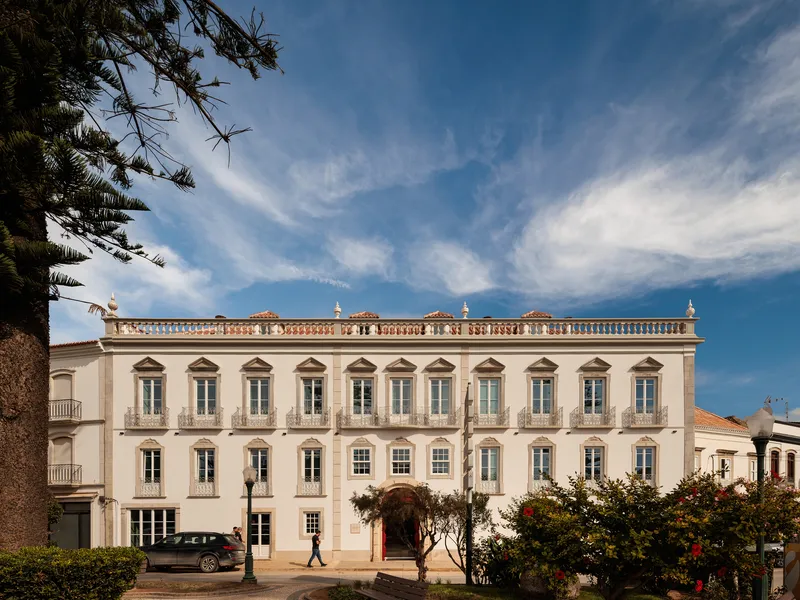
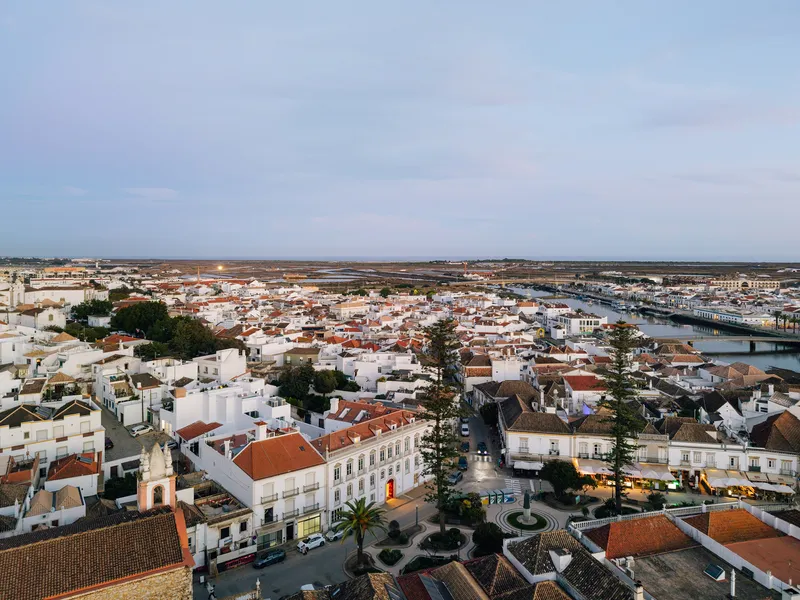
The street facade reads as a careful act of restitution rather than reconstruction. Symmetrical window openings, a balustraded roofline, and restored stone cantaria elements re-establish the palace's civic posture on the town square. The ground floor connects directly to the plaza and the city beyond, making the hotel legible as a public building rather than a hermetic retreat. This is not a boutique hotel that turns its back on its context; it is one that physically opens onto it.
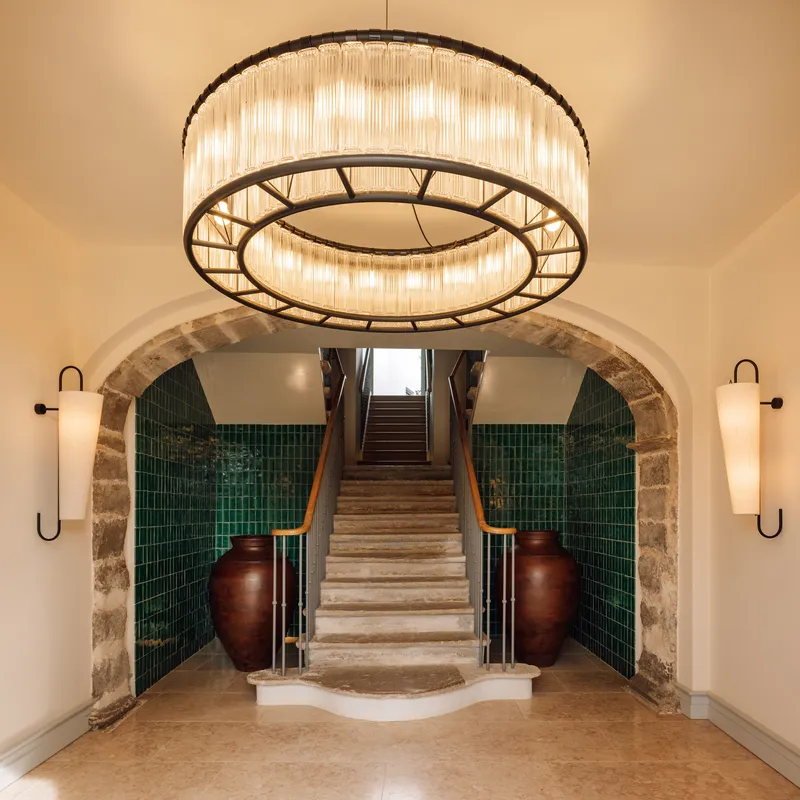
Step inside and the entry vestibule sets the tonal register: a stone arch frames green tile walls, a circular chandelier hangs above a marble staircase, and ceramic vessels by local artisans from the Algarve's remaining olarias signal that regionalism here is not decorative but structural. The palette of clay, lime, limestone, and linen runs through the entire project, materials chosen for their local provenance and their ability to age alongside the building.
The Medina: Labyrinth as Logic
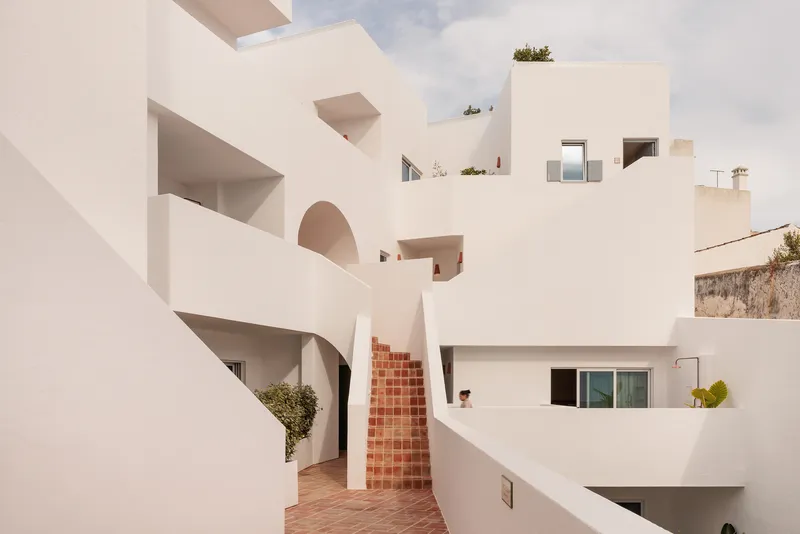
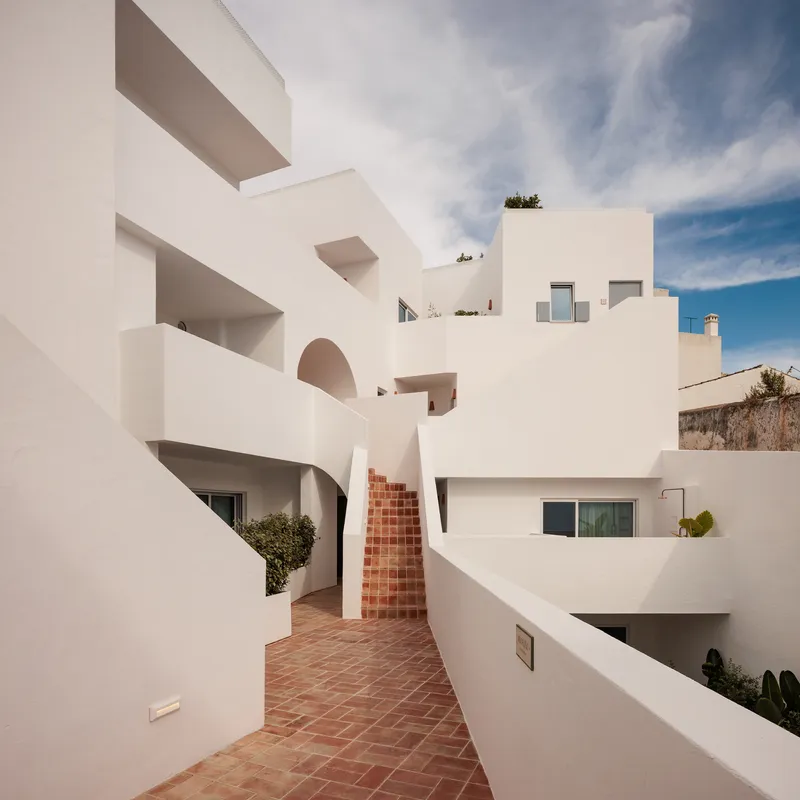
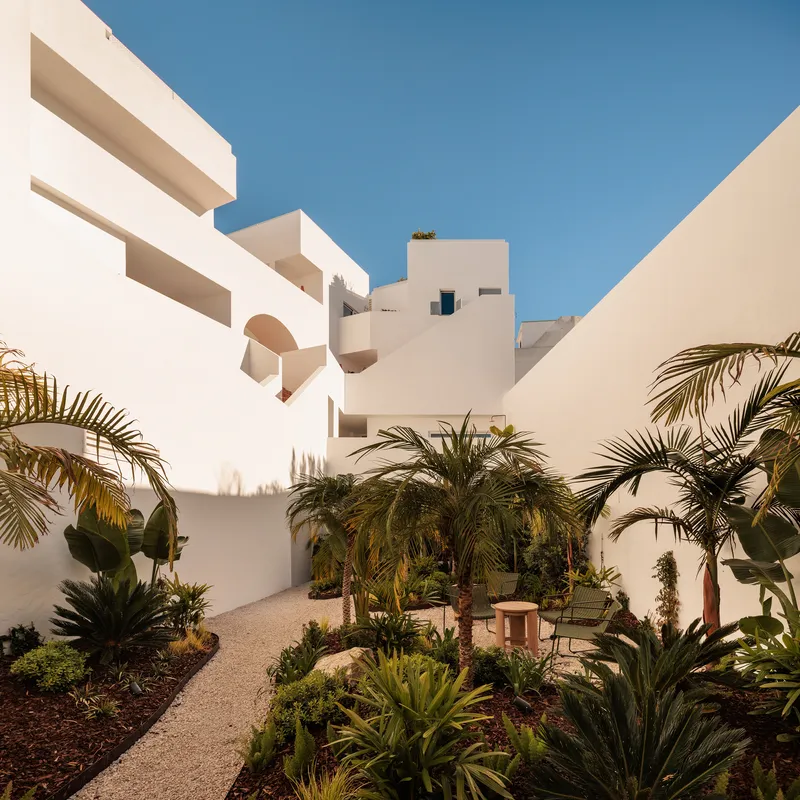
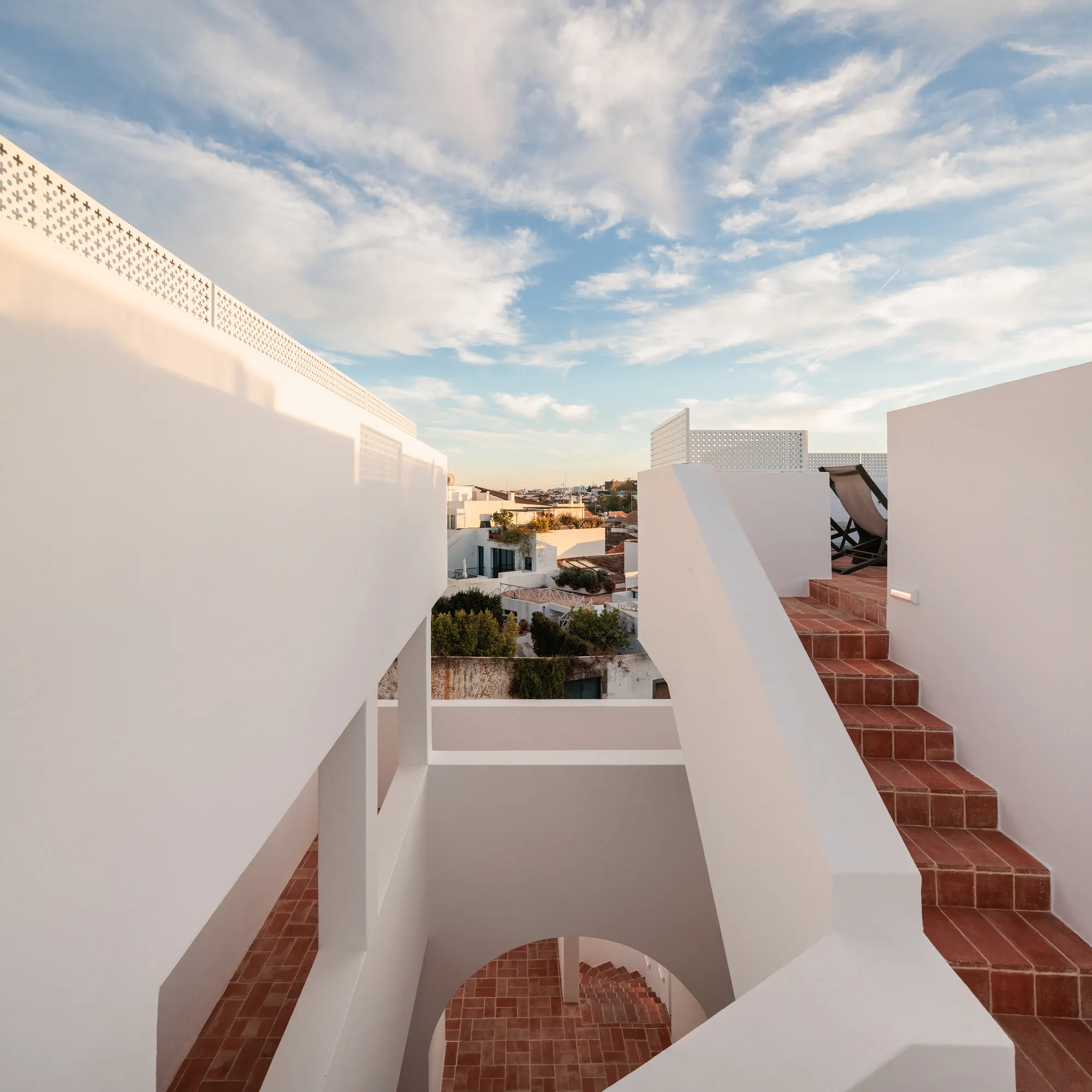
The new wing is where the project gets genuinely provocative. Rather than extending the palace's formal language, Fragmentos invented a small urban quarter. White stucco volumes step and shift at irregular heights, connected by terracotta brick staircases and traversed by an interior street that operates at multiple levels, giving direct access to rooms without conventional corridors. The apparent irregularity conceals precise logic: a succession of solids and voids, height variations, and serpentine paths that produces a labyrinthine spatial experience consonant with the surrounding historic fabric.
The Medina wing is not a metaphor. It is a functional reinterpretation of the urban typology that shaped Tavira's own street pattern before centuries of overlay simplified it. Rooms are arranged around tiled patios and gardens; courtyards are shaded by citrus trees. The design makes an explicit argument: that the Moorish inheritance of southern Portugal is not a historical footnote but a living spatial tradition worth building from.
Courtyards and Interior Gardens
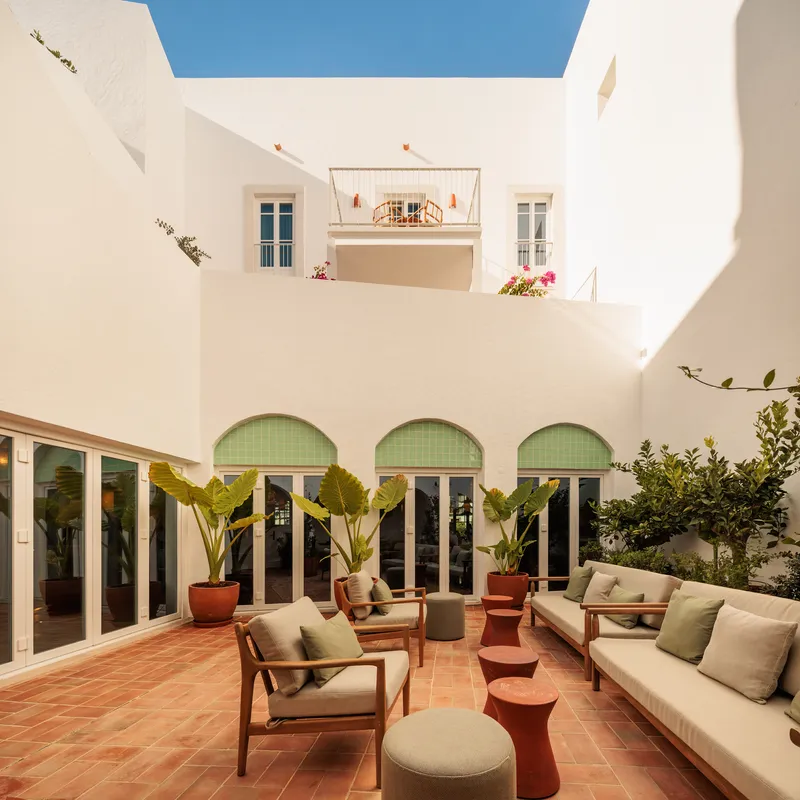
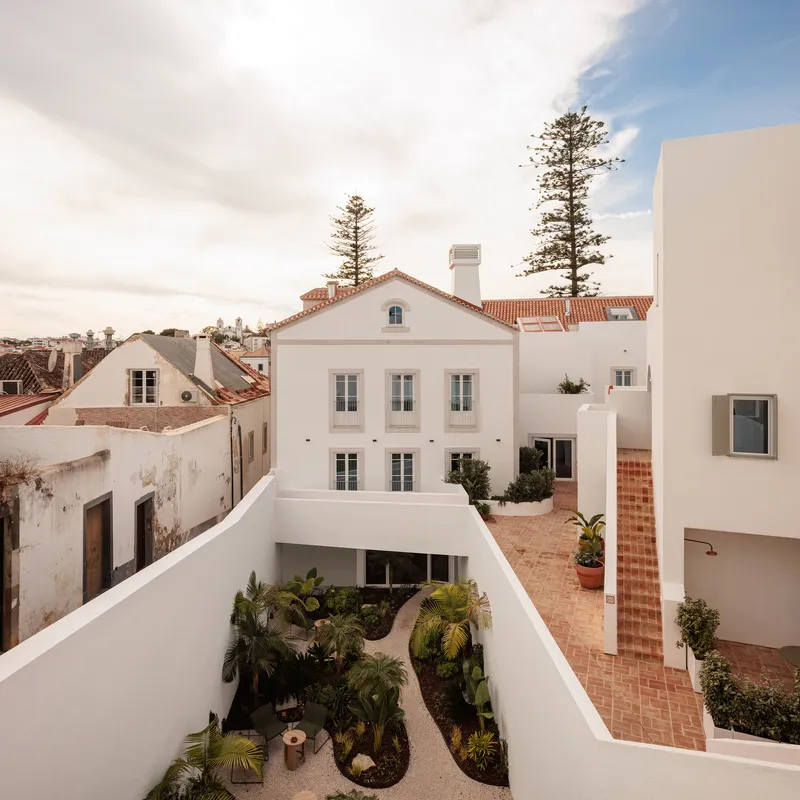
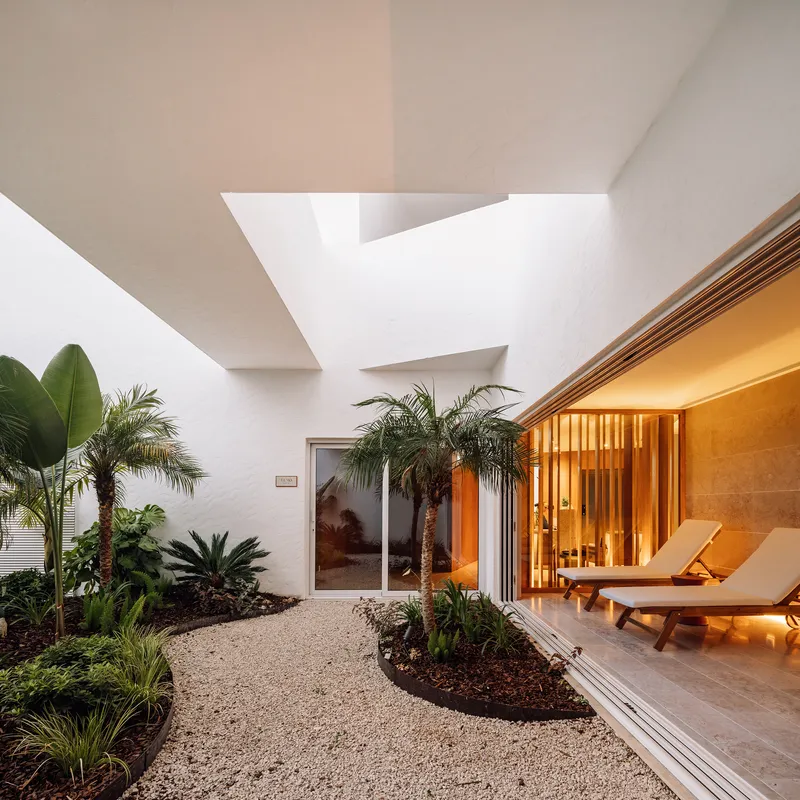
The courtyards are the project's breathing apparatus. One interior courtyard lines its arched openings with green tile and terracotta paving, banana plants reaching toward a blue-tinted skylight overhead. Another opens to the sky with planted beds and gravel paths, framing views of neighboring tile-roofed buildings beyond the hotel's boundary. These are not leftover spaces between rooms; they are the organizational spine around which rooms, circulation, and program are wrapped.
At dusk, the spa courtyard transforms into something closer to a stage set: gravel pathways wind between tropical palms, and a timber-screened treatment room glows warmly against the cooling blue of the sky. The passive design benefit of these voids is real. They maximize natural light, encourage cross-ventilation through thick walls, and create microclimates of shade and moisture that temper the Algarve summer. But they also operate emotionally, producing a rhythm of compression and release that keeps the hotel from ever feeling monotonous.
Rooftop Terraces and the Algarve Skyline
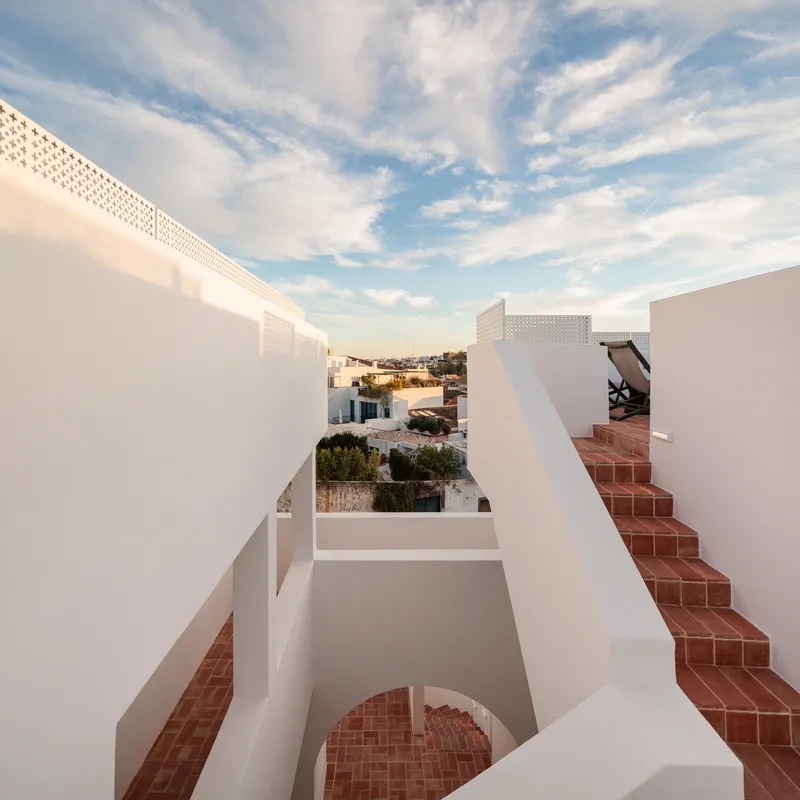
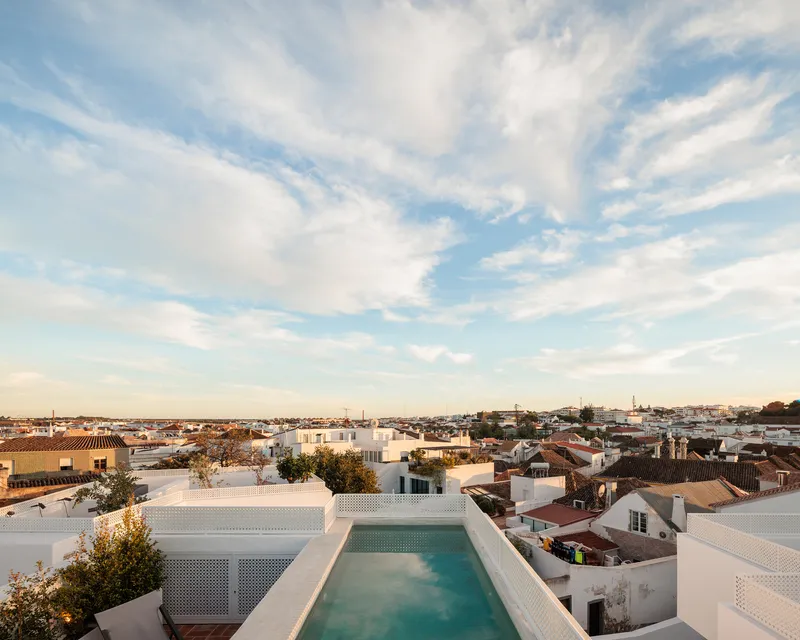
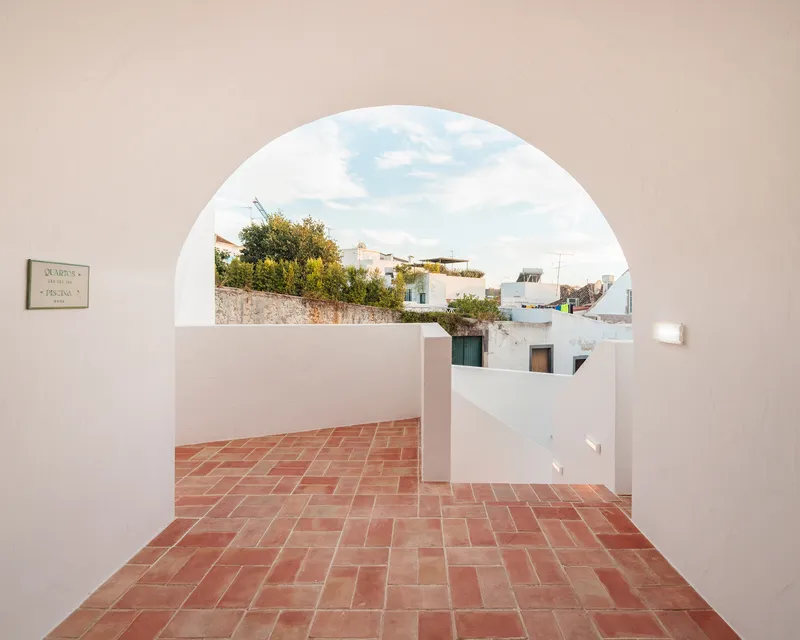
The rooftop is where the project's two cultural registers merge most clearly. The açoteia, the flat rooftop terrace characteristic of the eastern Algarve, is deployed across the Medina wing as a usable surface: terracotta stairs climb between white parapets, connecting pools, sun decks, and viewpoints that look out over Tavira's terracotta roofscape toward the distant wetlands of the Ria Formosa. Two rooftop pools sit at the top of this sequence, one edged with perforated white screening that filters the dusk light and frames the horizon.
From a terracotta-paved terrace framed by an arched opening, you can see neighboring white buildings and trees arranged in a composition that feels almost painterly. These vantage points are not accidental. They reference the relationship between the coastal population and the sea, a connection that historically made açoteias functional lookout points for returning fishing boats. In this hotel, the terraces perform the same spatial act: they orient you toward the landscape and remind you where you are.
Material Restraint and Regional Craft
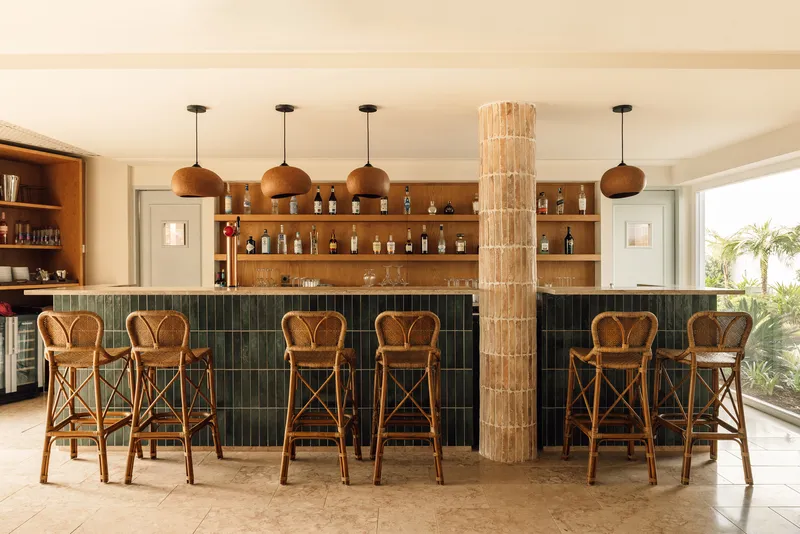
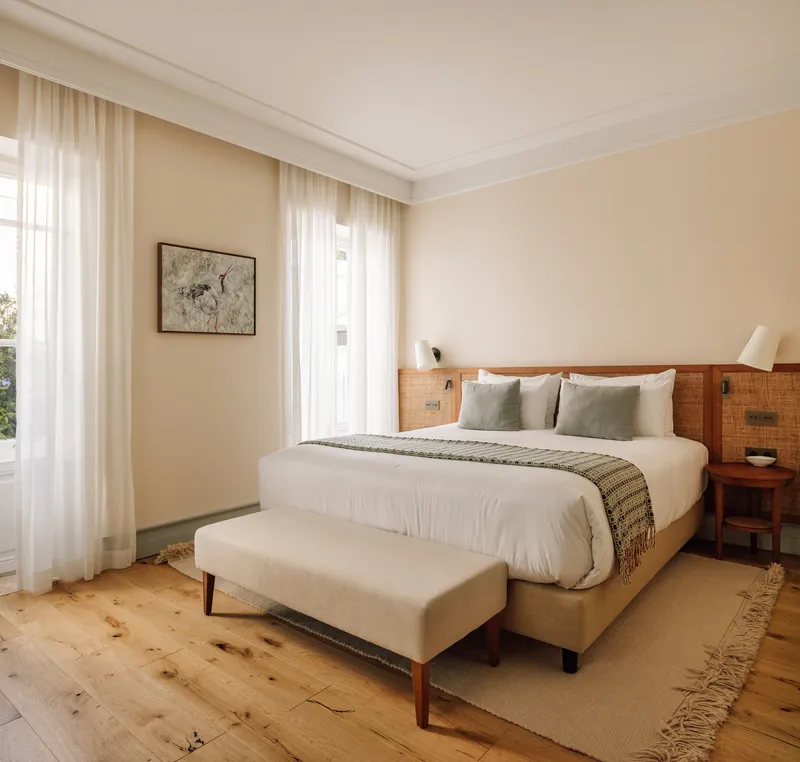
The interiors operate with deliberate restraint. A bar clad in green tile with rattan stools, timber shelving, and a tubular glass column suggests a sensibility closer to a well-loved neighborhood café than a hotel lobby. Bedrooms in the palace wing are stripped to essentials: timber headboards, knotted pine flooring, sheer curtains filtering daylight. There is no over-designed millwork, no imported marble, no attempt to signal luxury through material excess. The luxury here is spatial: rooms designed to let in light, shadow, and silence.
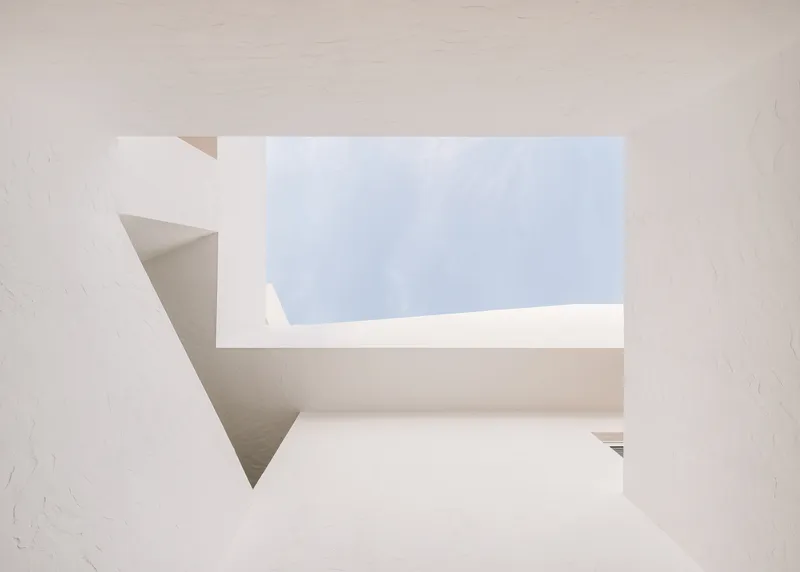
Fragmentos collaborated with local artisans throughout the project, sourcing pottery from Olaria António Mestre, Olaria Jeremias, and Olaria Xico Tarefa. Burel wool rugs, Santa Catarina terracotta tiles, and whitewashed walls form a material vocabulary drawn almost entirely from the eastern Algarve. The angular skylight openings carved into white stucco walls frame fragments of blue sky like secular rose windows, a detail that is both sculptural and climate-responsive, pulling zenithal light deep into the Medina's interior.
Plans and Drawings
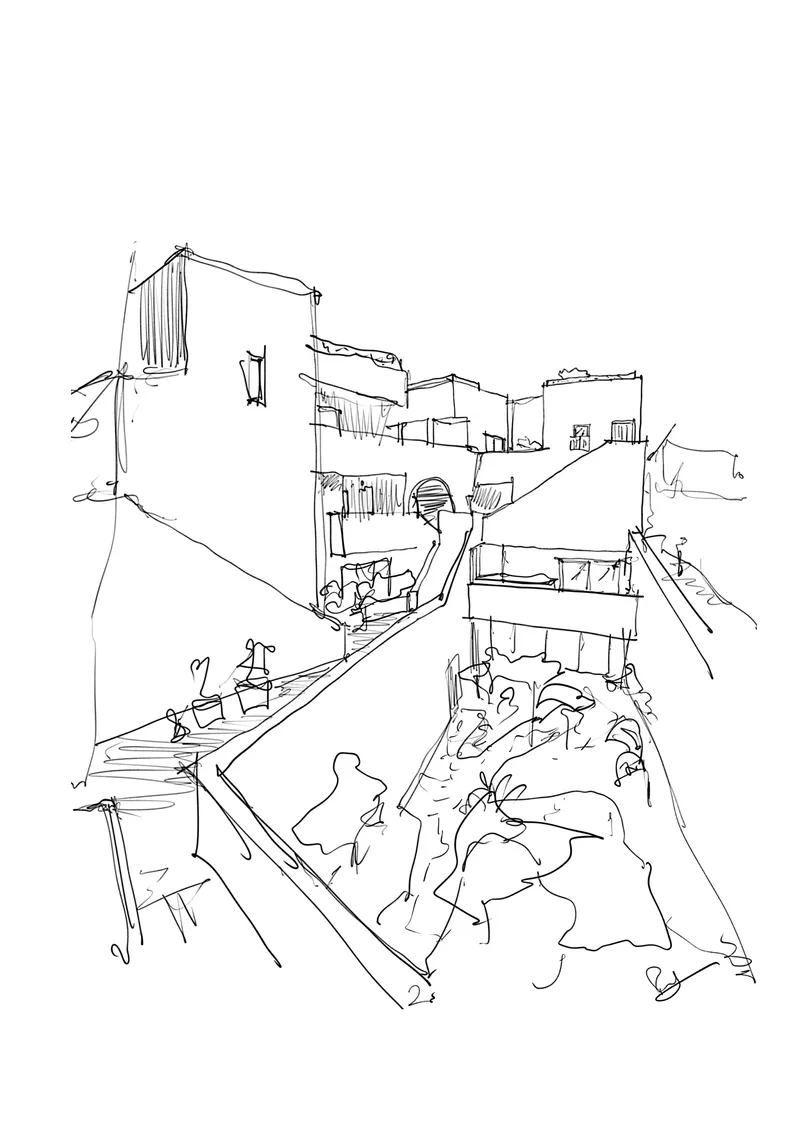
The sectional sketch reveals the Medina wing's true complexity: rooms stacked at half-levels, stairs linking terraces to courtyards to subterranean spa spaces, and planted landscape elements integrated into the section rather than applied to its surface. The drawing makes visible what the photographs can only suggest, that this is not a single building but a miniature urban fabric, organized vertically as much as horizontally, with each room occupying a unique position in the topographic sequence.
Why This Project Matters
Hotel Palácio de Tavira matters because it refuses the easy binary that heritage projects usually fall into: either faithful restoration or conspicuous contemporary insertion. Fragmentos chose a third path. They restored the palace with discipline and then built something new that draws not from the vocabulary of contemporary minimalism but from the deeper spatial logic of the Algarve's own Moorish inheritance. The Medina wing is not pastiche. It is a contemporary building that happens to be organized like a pre-modern quarter, and the result is a spatial experience that no conventional hotel plan could produce.
The project also offers a quiet rebuke to the globalized hospitality template that has overtaken much of southern Portugal. By sourcing almost every material and craft element from within the region, and by drawing its formal logic from local typologies rather than imported ones, Fragmentos has made a hotel that could only exist in Tavira. That specificity is its greatest achievement. In a market saturated with interchangeable boutique hotels draped in the same pale plaster and imported terrazzo, this is a building that knows exactly where it stands.
Hotel Palácio de Tavira by Fragmentos (Pedro Silva Lopes, Marcus Cerdeira), Tavira, Portugal. 2,350 m², completed 2025. Photography by Francisco Nogueira.
About the Studio
Share Your Own Work on uni.xyz
If projects like this are the kind of work you want to make, uni.xyz is a place to publish your own, find collaborators, and enter design competitions.




Popular Articles
Popular articles from the community


Co-life: Sustainable Architecture for Age-Friendly Community Living
Co-life reimagines sustainable architecture for seniors through courtyards, rammed earth, shared gardens, and spaces designed for belonging.

Play: Fragments of Their World
Familiar architecture becomes modular playground design, creating safe spaces where displaced children can learn, connect, imagine and play.

Co-Life: Senior Housing Design That Reconnects Older Adults With the City
Co-Life reimagines senior housing design through healing gardens, shared streets, workshops, and a sustainable community across generations.

Lunar Spiral: Space Architecture Shaped by the Mathematics of the Universe
Lunar Spiral reimagines space architecture through Fibonacci geometry, lunar regolith, levitating habitats, and self-sustaining Moon living.

Similar Reads
You might also enjoy these articles

Bao Huynh Watercolor Atelier: A Serene Art Retreat in Hội An
Bao Huynh Watercolor Atelier in Hội An blends multifunctional art spaces, sustainable design, local materials, and family-friendly living in a serene environment.

Atelier Macri Concept Store Interior Design by CASE-REAL
Atelier Macri store features a "ko" counter, walnut wood details, cork displays, blending retail, gallery, and seamless customer experiences.

Manuel Vargas Izquierdo Stadium and High-Performance Sports Center: Architectural Excellence in Jalpa de Méndez
The Manuel Vargas Izquierdo Stadium blends sustainable design, inclusive sports facilities, and cultural-inspired architecture, revitalizing Jalpa de Méndez’s public spaces.

KAKR Buluh Awar Hall: Revitalizing Community and Ecology Through Bamboo Architecture
Community built bamboo hall revitalizes Buluh Awar village, empowering youth, restoring ecology, celebrating vernacular craftsmanship through sustainable architecture and culture.




Comments (0)
Please login or sign up to add comments
No comments yet. Be the first to comment!