
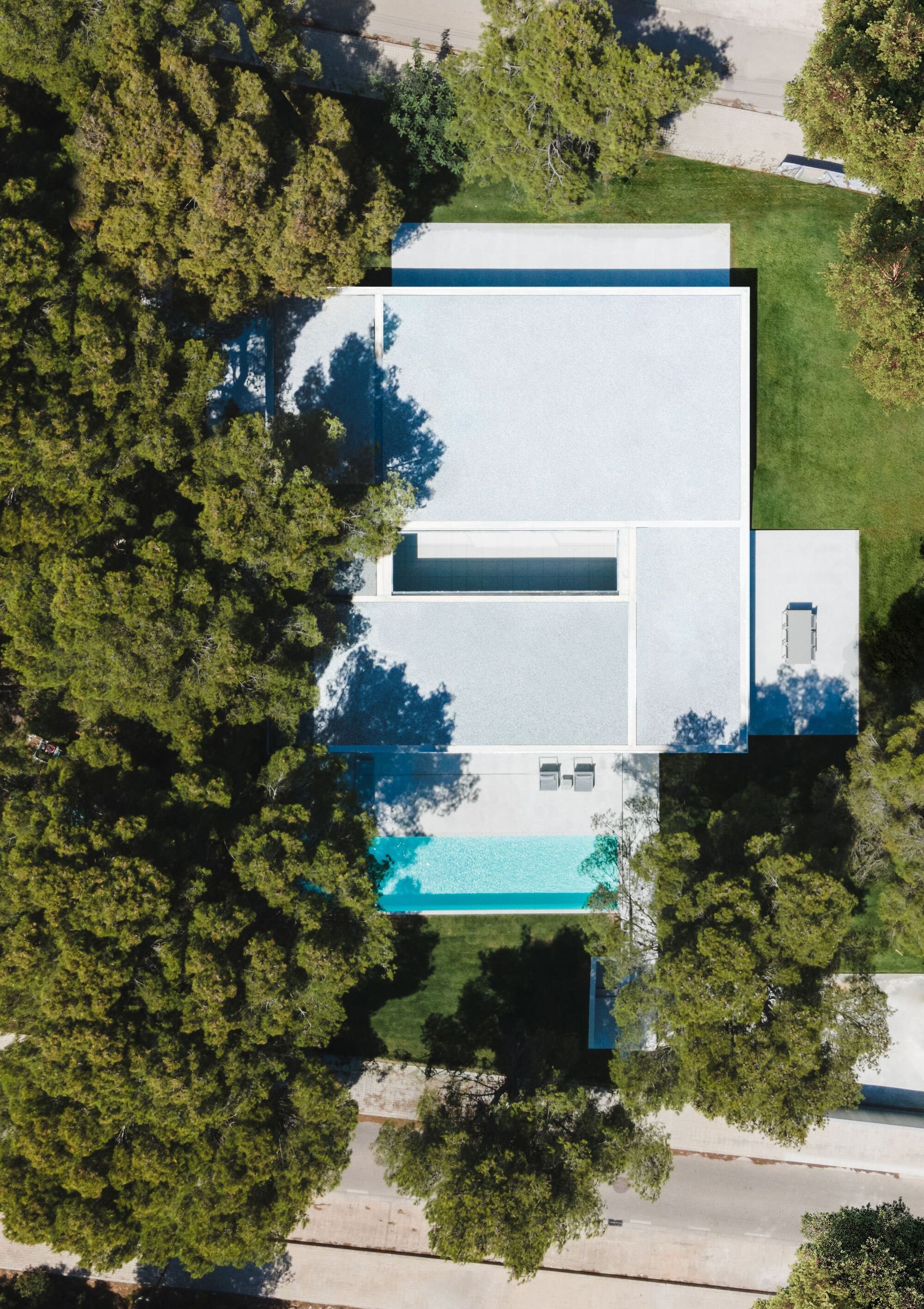
Fran Silvestre Arquitectos Interlocks Four Aluminum Volumes Around a Courtyard in Madrid
The N290 NIU House uses prefabricated precision to weave indoor and outdoor life through a pine grove on a sloping site.

There is a particular kind of ambition in trying to make a prefabricated home feel site-specific. The N290 NIU House, completed in 2022 by Fran Silvestre Arquitectos in Madrid, pursues exactly that paradox. Developed with NIU, a Mallorca-based practice specializing in systematized construction, the project proposes a dwelling made from four identical morphological pieces, extruded in aluminum and radially interlocked around a central courtyard. The system is designed so that every home it produces is, in the studio's words, "the same and unique from the rest." What distinguishes each iteration is its relationship with the site, and in this case, the site is a sloping plot shaded by imposing pine trees that the architects chose to preserve rather than remove.
The result is a single-story glass pavilion that reads less like a manufactured product and more like a refined courtyard house in the tradition of the Roman impluvium. Four volumes, each open along its long sides and closed on its short sides, rotate around a bright central void to create four distinct outdoor zones: one for the day area, one for the kitchen, one related to the bedrooms, and one for the pedestrian entrance. Interior rooms extend outward to meet terraces of exactly the same dimension, making the boundary between inside and outside a matter of shade and climate control rather than solid walls. The aluminum cladding shifts in appearance throughout the day as the temperature of light changes, lending the house a quiet dynamism that belies the rigor of its construction logic.
A Pavilion in the Pines
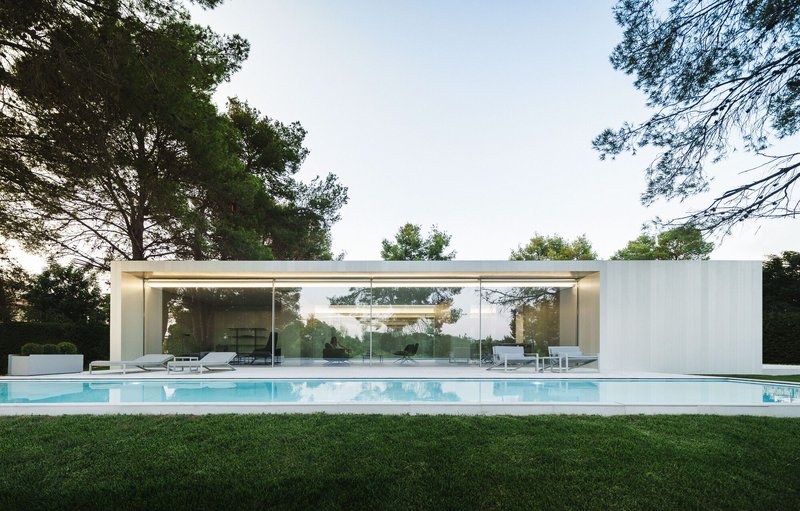
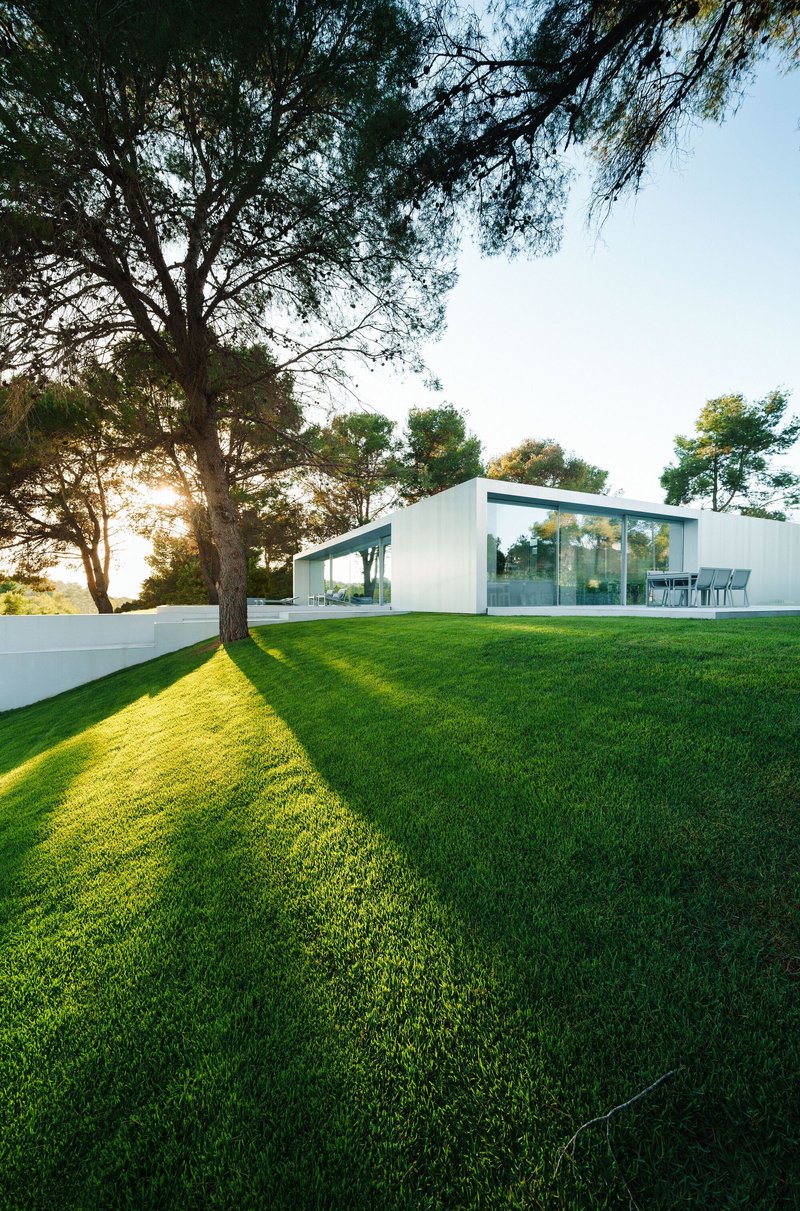
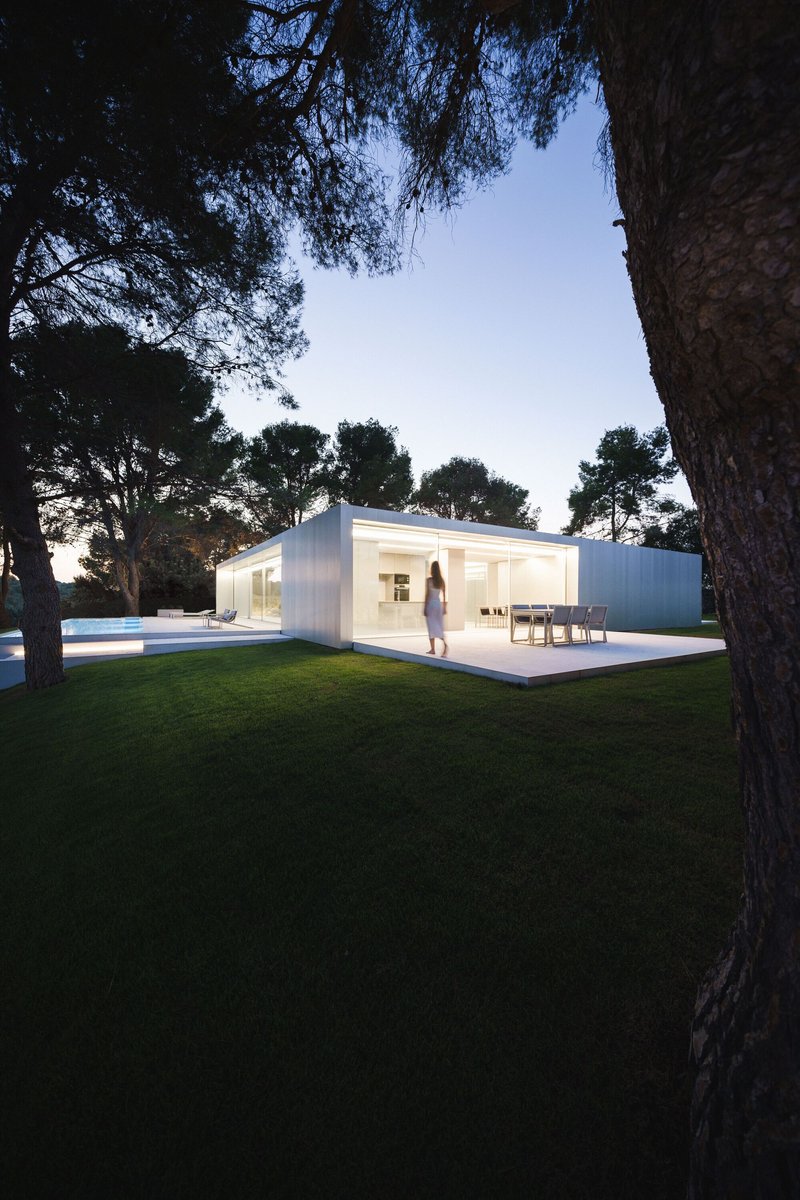
From ground level, the house presents itself as a series of white horizontal planes floating just above a manicured lawn, framed and filtered by mature pine trees. The canopy of existing trees was the non-negotiable starting point: the building steps around trunks, and the flat roofline sits well below the lowest branches. In late afternoon light, the interplay between the crisp geometry of the pavilion and the organic forms of the pines produces a quality of dappled shadow that no rendering could predict.
The nearly frameless sliding glass walls reinforce this reading. They dissolve the facade into reflections of the surrounding landscape, so the house alternates between opacity and transparency depending on your angle and the time of day. It is a controlled disappearing act, and the restraint of the palette, white concrete, aluminum, glass, keeps attention on the relationship between built form and tree canopy.
Navigating the Slope
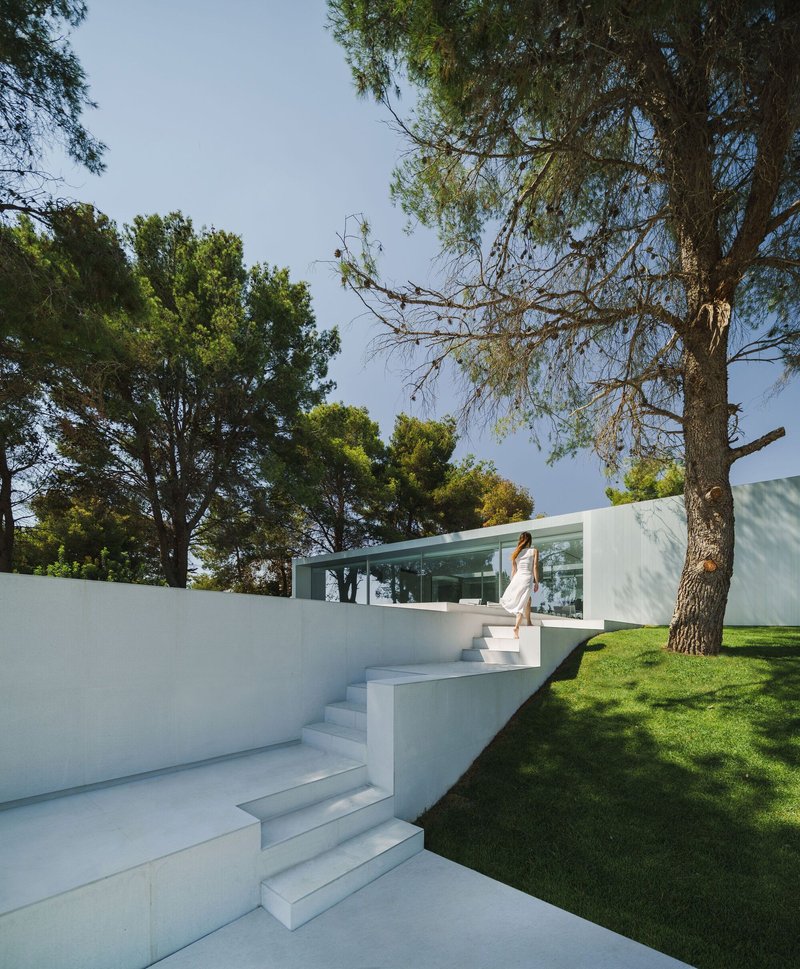
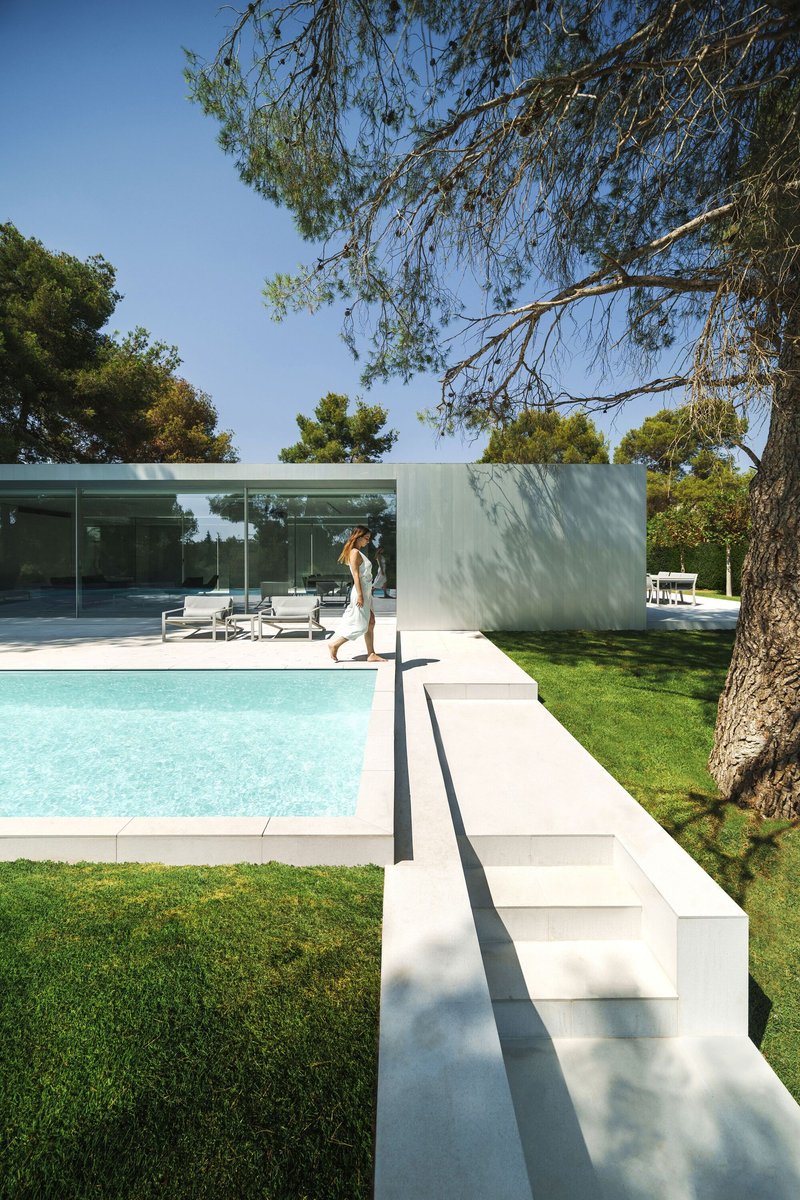
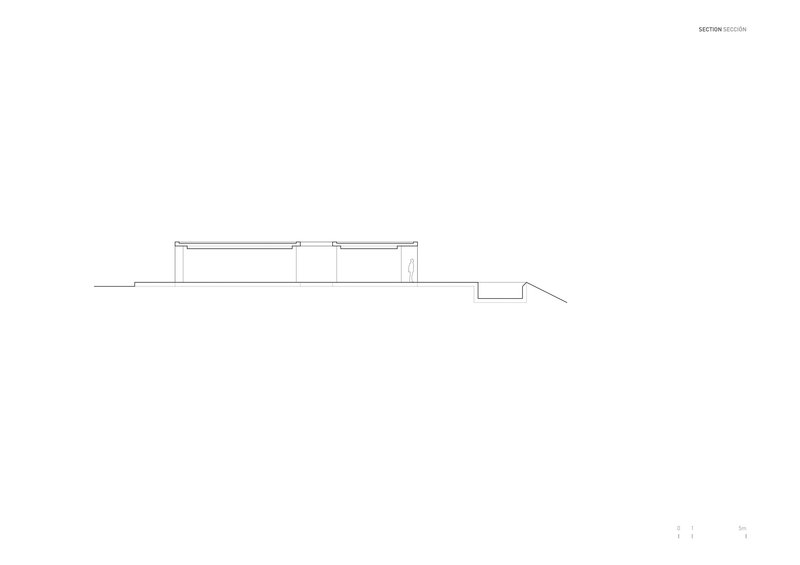
The site's topography required the architects to solve a basic problem: how to arrive at a single-story house set partway down a hill. A white concrete staircase ascends through the lawn to deliver visitors to the glazed volume, while on the pool side, steps descend from the living level to the terrace and water. The section is deceptively simple, but it does the critical work of anchoring a prefabricated system to an uneven landscape.
This is where the NIU system earns its credibility. A kit-of-parts approach could easily produce something that sits on top of a site like a shipping container on a flatbed. Here, the access staircase, the grade changes, and the careful placement around pine roots all demonstrate that the systematized volumes were adapted, not merely deposited. The prefabrication is a means of precision, not a shortcut around the complexities of a real plot of land.
Living Between Glass Walls
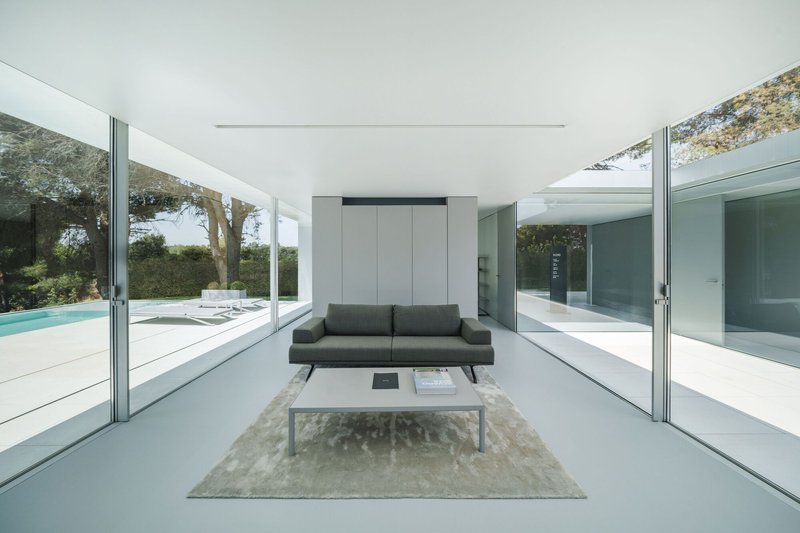
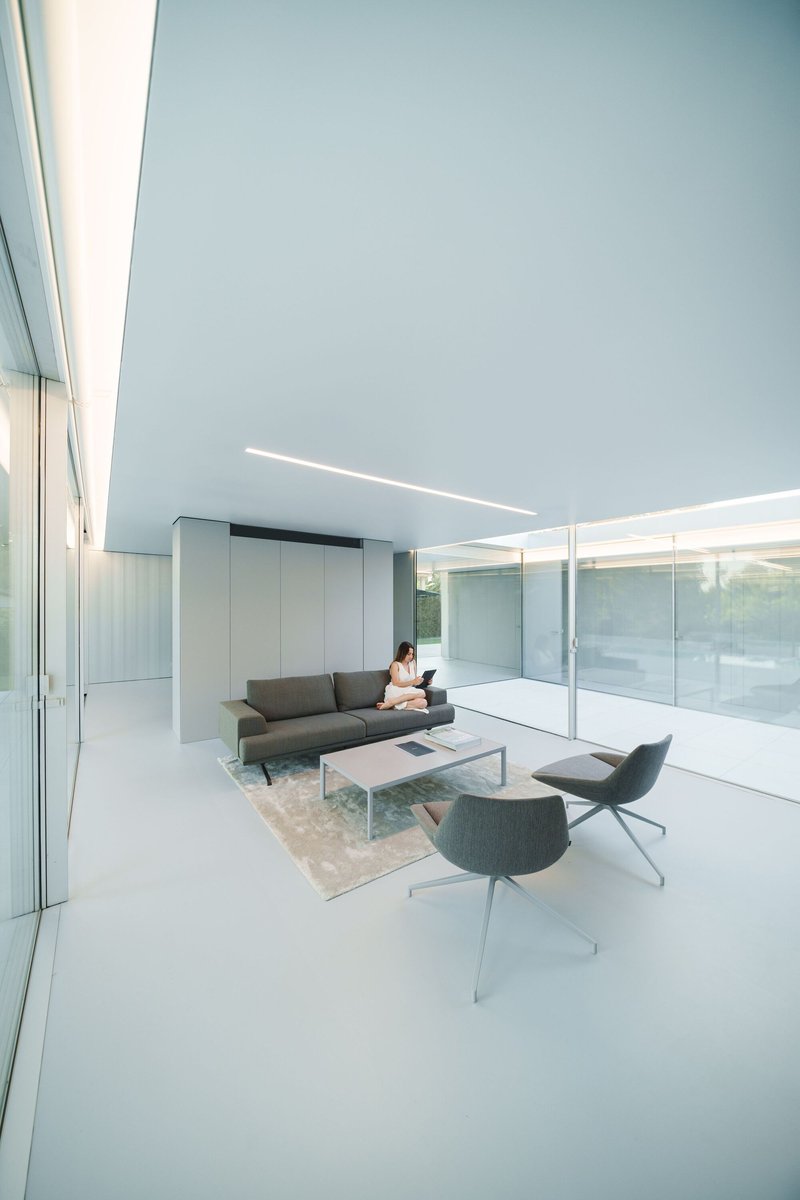
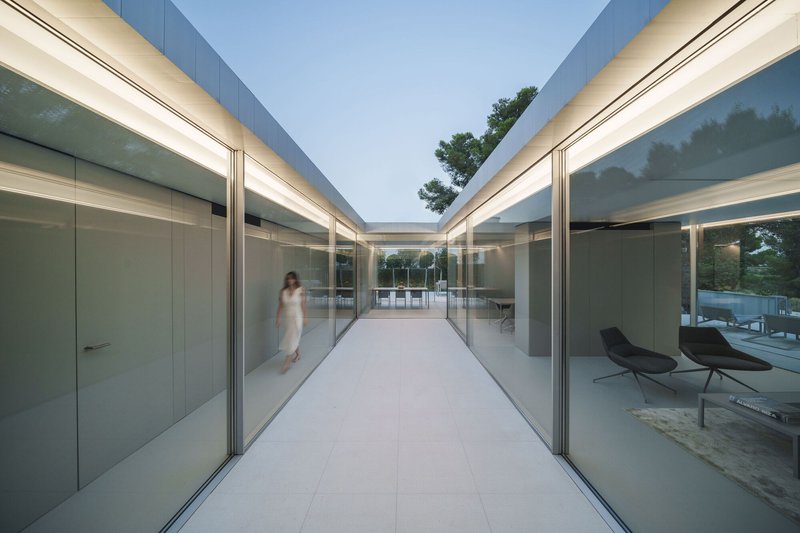
Inside, the living spaces are defined by a continuous linear ceiling slot that pulls daylight deep into the plan and doubles as a graphic device, drawing the eye along the length of each volume. The floor is a seamless white surface that runs uninterrupted from interior to terrace, erasing the threshold between the two conditions. Floor-to-ceiling glass on both long sides of the living room makes it a transparent tube: you look through the house to landscape on either side.
A glass corridor linking two of the pavilion wings acts as a kind of cloister walk. Photographed at twilight with a figure mid-stride, it captures the spatial logic of the whole project: you are always moving between volumes, always in view of the courtyard or the garden, never enclosed in the conventional sense. The interior design, handled by Alfaro Hofmann, maintains the same discipline of reduction, letting materials and light do the work of atmosphere.
Kitchen and Terrace as One Room
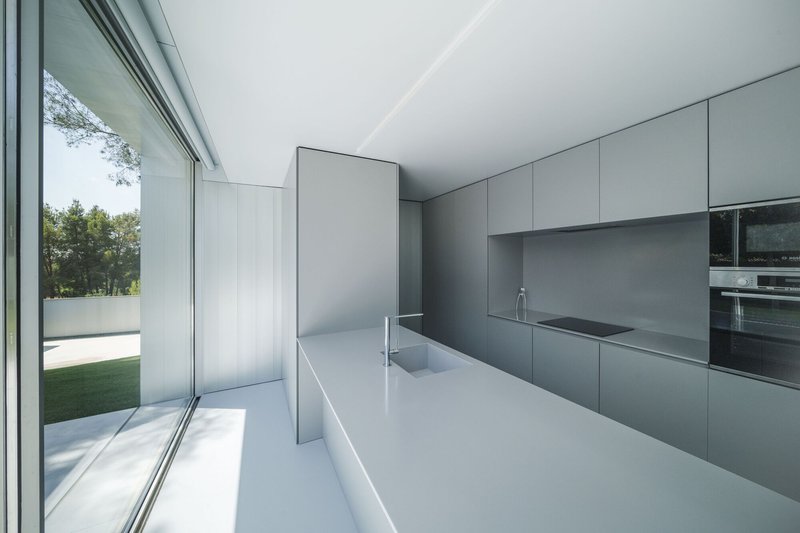
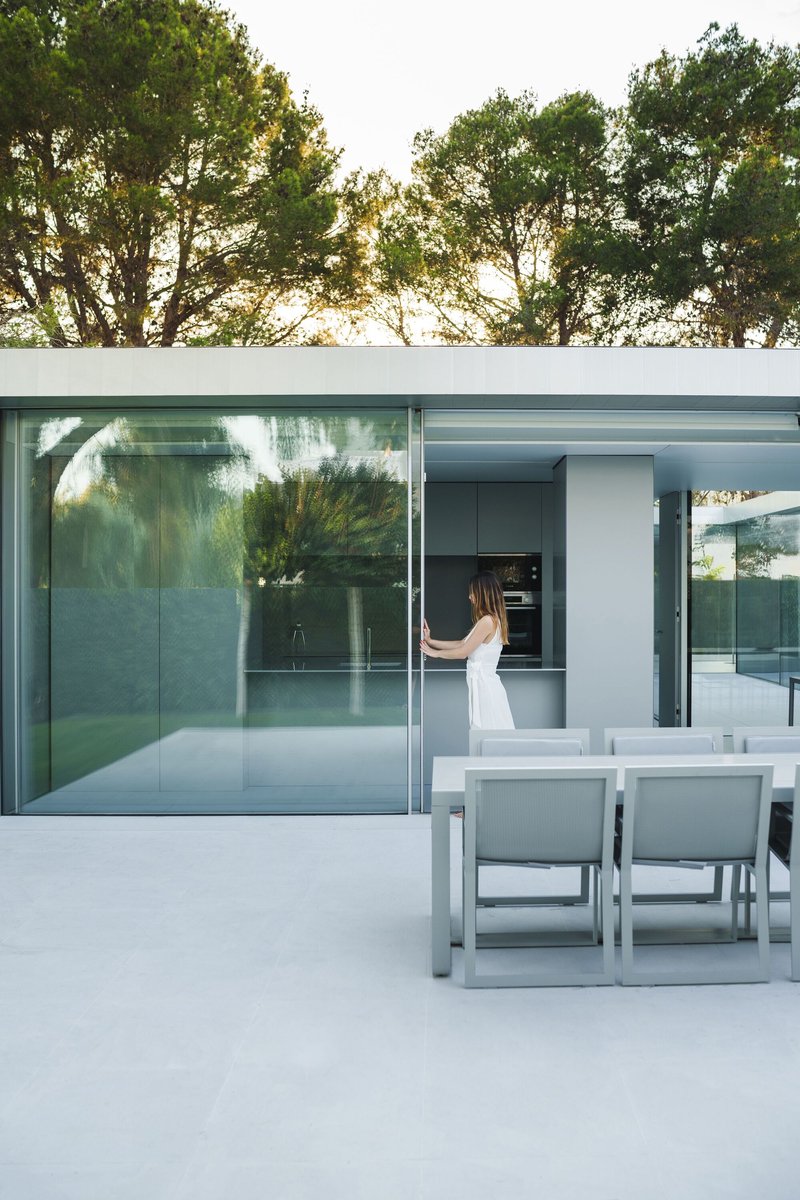
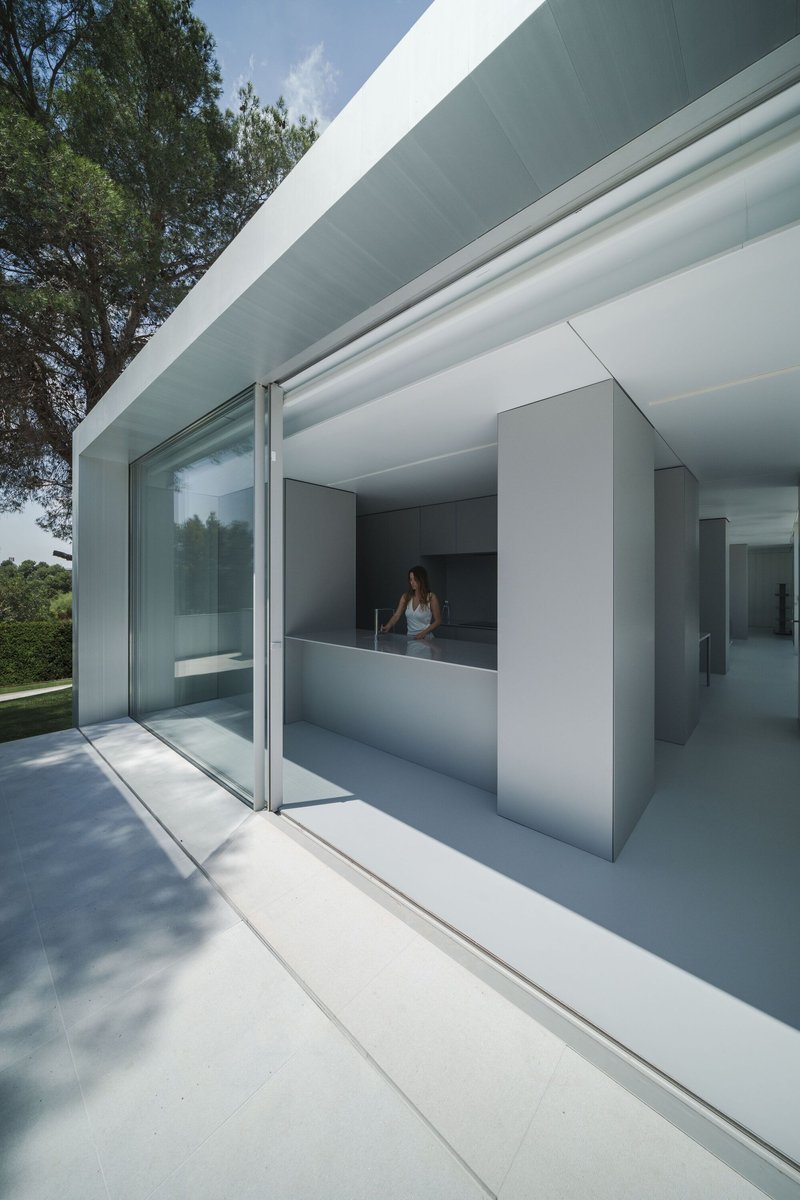
The kitchen exemplifies the project's core spatial move. Grey wall cabinetry and a white island sit beneath the same recessed ceiling slot found throughout the house, but the real event is the sliding glass wall that opens the entire long side to an outdoor dining terrace. At dusk, the boundary dissolves completely: the terrace, canopied by pine branches, becomes an extension of the kitchen, and the experience of cooking and eating moves fluidly between conditioned and unconditioned space.
The corner threshold detail where glass panels meet at the junction of two volumes is worth noting. There is no mullion, no column, nothing to interrupt the continuity of the opening. It is the kind of detail that prefabrication makes feasible through tight tolerances and factory-controlled assembly, and it rewards the investment in systematized construction with a moment of genuine architectural elegance.
Private Rooms and the Quality of Light
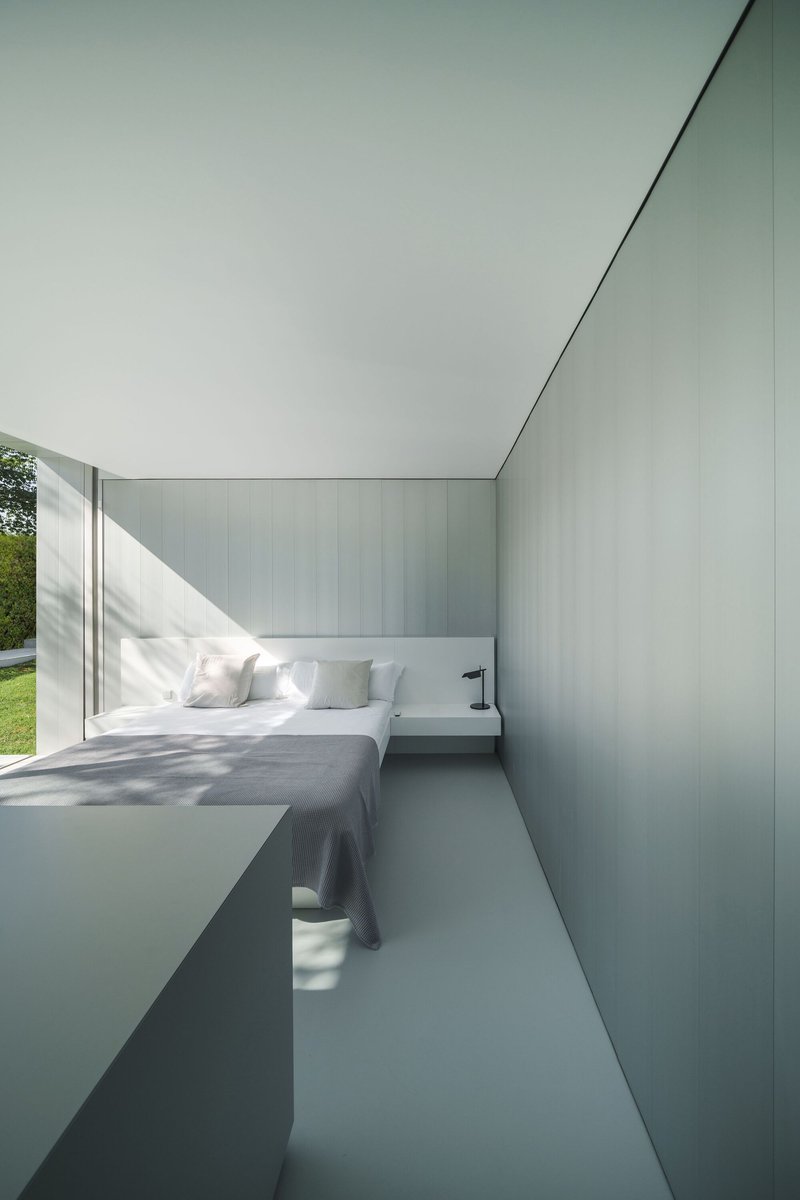
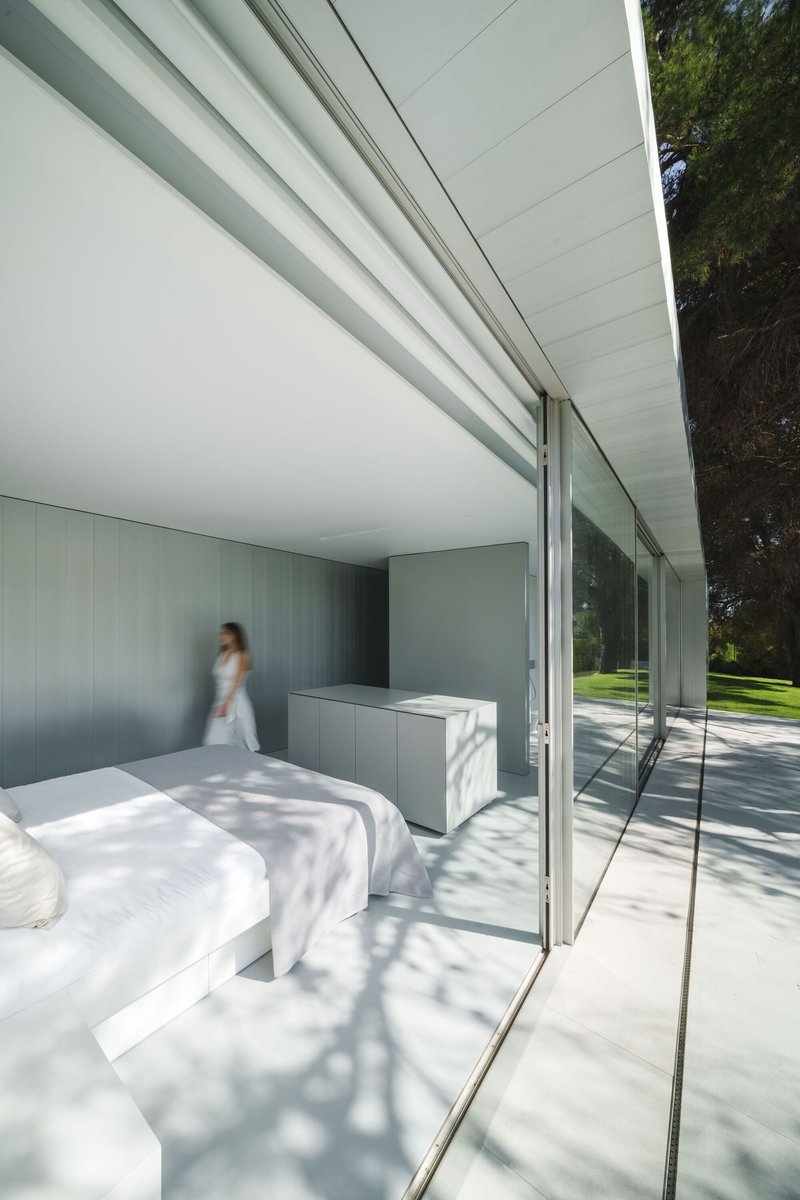
The bedrooms occupy one wing of the pinwheel and open to their own outdoor zone, separate from the pool terrace and the kitchen garden. A platform bed sits against white built-in cabinetry, receiving afternoon sunlight through a full-height glass wall. The effect is monastic in its simplicity: no applied decoration, no accent walls, just a calibrated relationship between a sleeping surface and the movement of the sun.
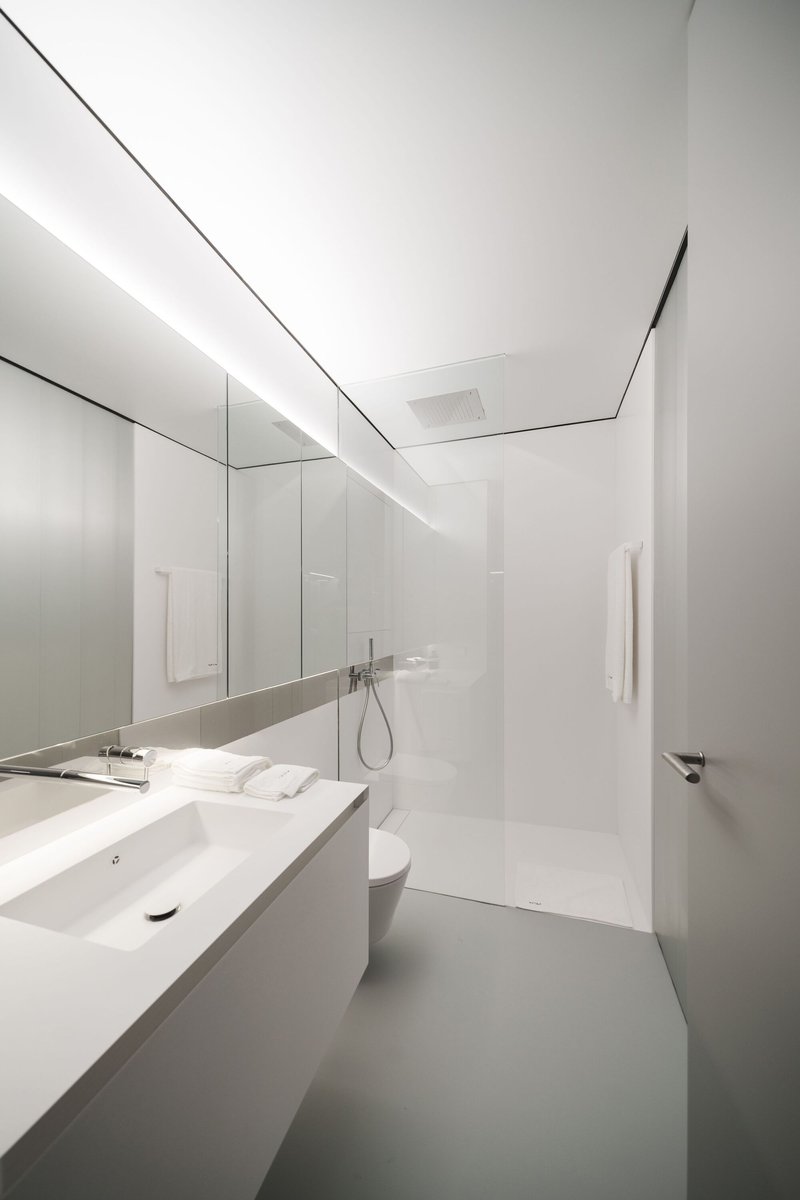
In the bathrooms, the same linear slot lighting continues above continuous mirror walls and floating vanities. The consistency of these details across the house is a direct product of the prefabricated approach. Every ceiling, every slot, every junction follows the same dimensional logic. When the system is this coherent, even a bathroom reads as a deliberate architectural space rather than a utilitarian afterthought.
Water, Light, and the Courtyard Void
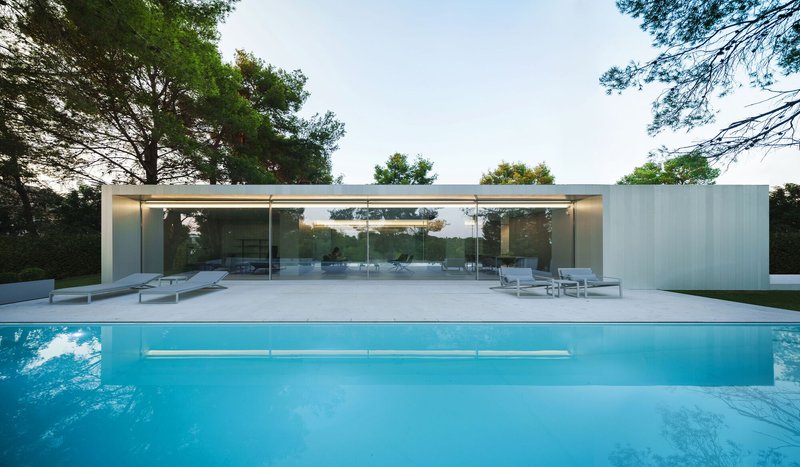
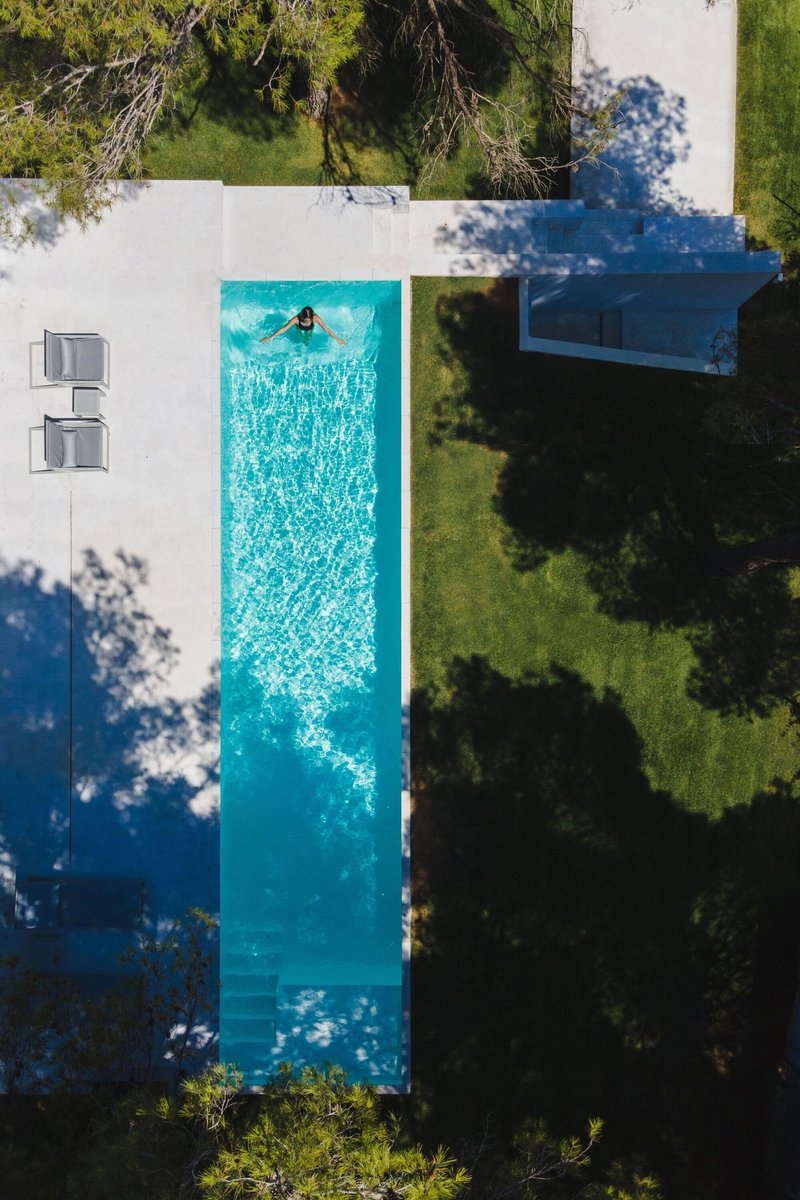
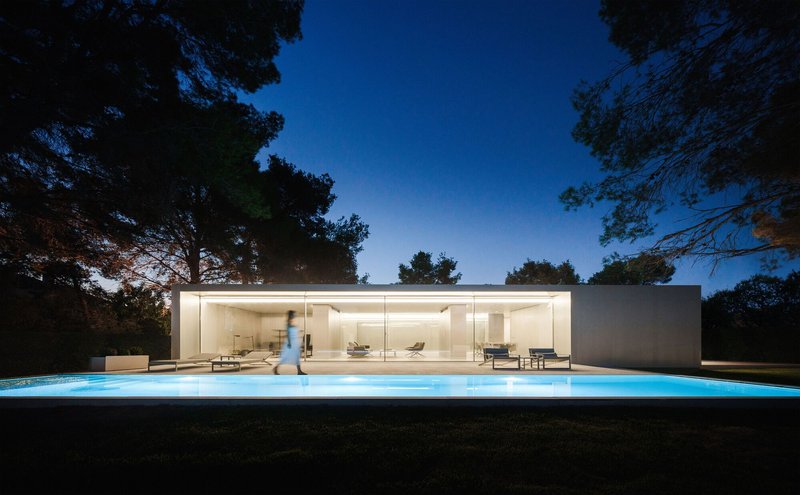
The swimming pool runs along one of the four outdoor zones, its edge cantilevered over the deck to create a sharp line against the glass facade. From the aerial view, a swimmer cuts a lone wake through water that reflects the surrounding pines, a scene that underscores the house's strategy of framing landscape within its orthogonal grid. The pool is not a luxury appendage; it is the primary outdoor room of one quadrant, equal in status to the entrance garden, the kitchen terrace, and the bedroom patio.
At twilight, the house inverts. The glass walls glow from within, and the figure walking along the pool terrace is silhouetted against the illuminated interior. The aluminum surfaces, which appear matte and almost chalky during the day, take on a warmer tone under artificial light. It is a reminder that the material choice is not simply aesthetic: aluminum's reflective properties make the building a register of ambient light conditions, changing constantly without any intervention.
Plans and Drawings
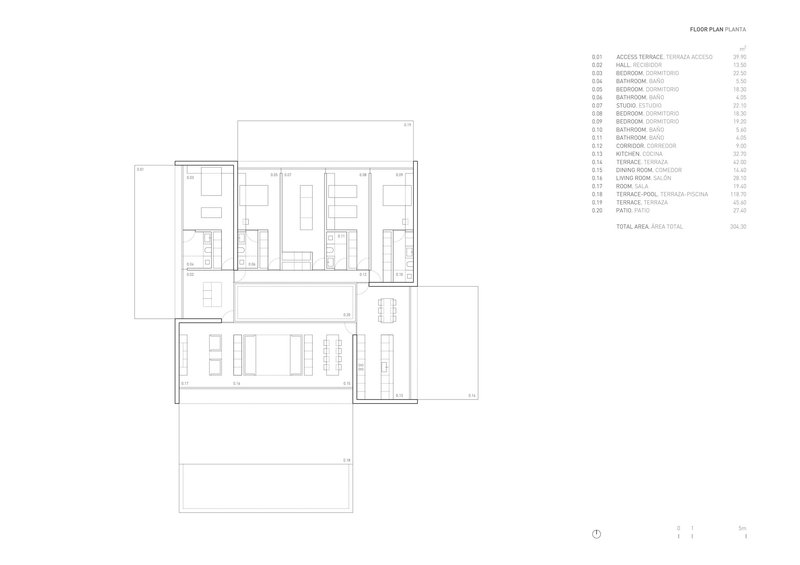
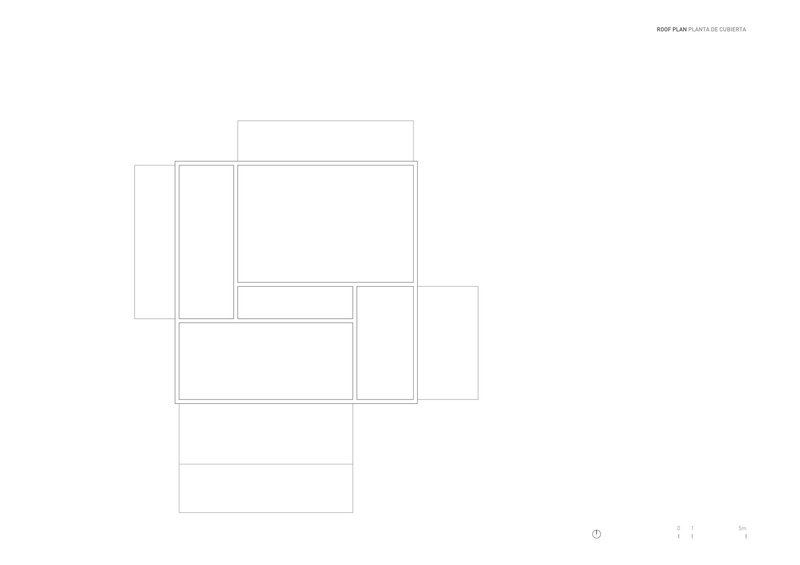
The floor plan reveals the pinwheel clearly: four rectangular volumes, offset from one another, rotate around the central courtyard void. One wing holds the bedrooms and master suite, the other accommodates the living room and kitchen, and the connections between them create the covered thresholds visible in the photographs. The roof plan, read as a figure-ground diagram, shows how the overlapping volumes produce a compact footprint while generating four distinct outdoor spaces of nearly equal size.
The section drawing is perhaps the most informative. Flat roof planes step down the sloped site in subtle increments, confirming that the single-story reading from the garden side conceals real topographic work. The relationship between the ceiling slots and the roof structure becomes legible here: daylight enters through narrow gaps between the overlapping volumes, illuminating the interiors without conventional skylights. It is a clean piece of architectural engineering, and it validates the claim that prefabrication can handle sectional complexity.

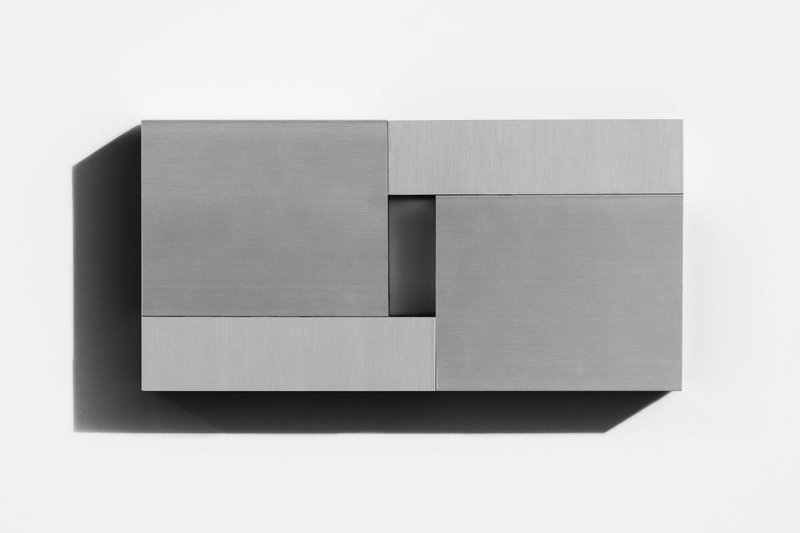

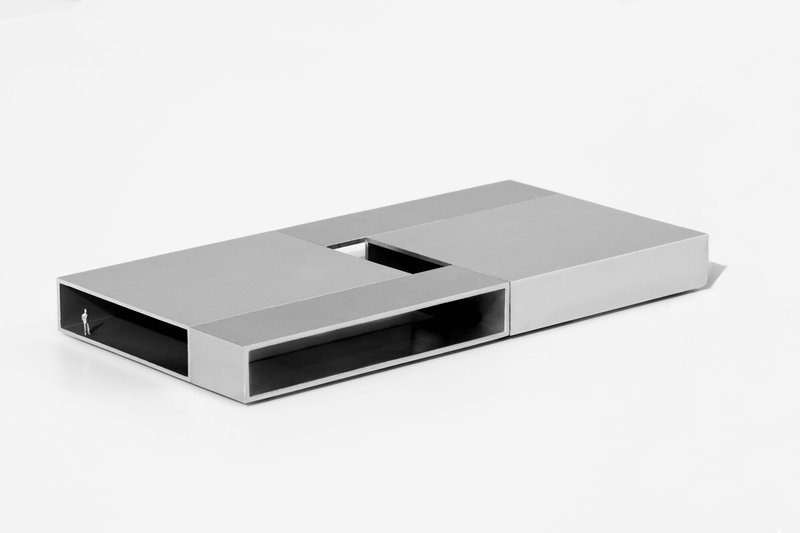
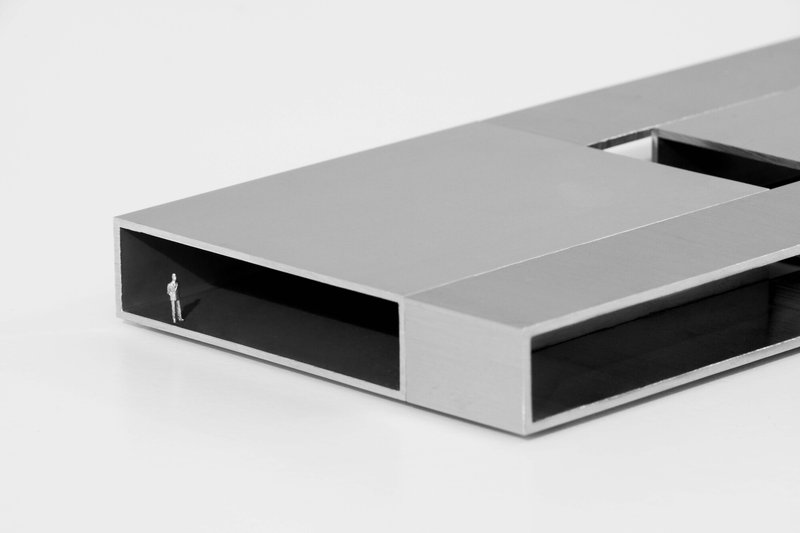
The physical models reinforce what the drawings describe. Viewed from above, the four volumes read as a tightly interlocked composition with the courtyard punched through the center. From the side, the horizontal window slits and the deep shadow recesses communicate the proportions of the openings more viscerally than any plan can. These models were clearly instrumental in developing the radial composition, and their inclusion in the project documentation speaks to a design process that valued three-dimensional testing alongside digital precision.
Why This Project Matters
Prefabricated housing carries a persistent stigma of uniformity, the worry that systematized construction will produce rows of identical boxes indifferent to their surroundings. The N290 NIU House makes a credible counterargument. By locating the system's flexibility in the relationship between building and site rather than in the shape of the components themselves, Fran Silvestre Arquitectos demonstrates that standardization and specificity are not mutually exclusive. The four identical volumes become something entirely particular to this hillside in Madrid, shaped by the angles of existing pines, the slope of the grade, and the orientation of the sun.
The broader lesson is about where precision matters most. Industrialized construction excels at tight tolerances, consistent finishes, and repeatable details. The frameless glass corners, the continuous ceiling slots, the seamless floor surfaces are all easier to achieve when components are fabricated off-site under controlled conditions. What the NIU system adds to this is an organizational idea, the radial courtyard plan, that is adaptable enough to respond to topography and vegetation while remaining structurally and logistically reproducible. If prefabrication is going to move beyond prototypes and pilot projects, it will need more strategies like this one: systems that are genuinely indifferent to the shape of the land they land on, but architecturally alive to it.
N290 NIU House by Fran Silvestre Arquitectos, with interior design by Alfaro Hofmann. Located in Madrid, Spain. Completed in 2022. Photography by Jesús Orrico.
About the Studio
Share Your Own Work on uni.xyz
If projects like this are the kind of work you want to make, uni.xyz is a place to publish your own, find collaborators, and enter design competitions.




Popular Articles
Popular articles from the community

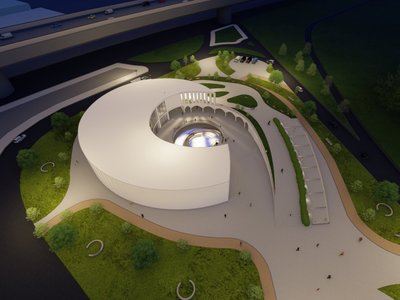
The Heart of Milano: Slow Fashion Architecture for a New Circular Culture
The Heart of Milano turns slow fashion architecture into a civic landmark where learning, making, sharing, and circular culture meets daily.

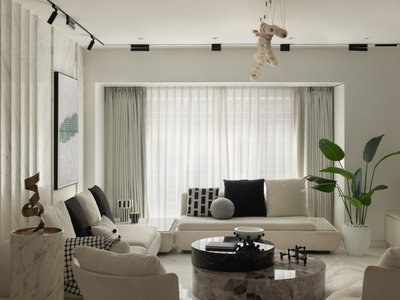
Inside a Timeless Mumbai Residence by Aether Studio
Aether Studio's 2,250 sq ft apartment in Malad, Mumbai uses marble, brass, boucle, and disciplined restraint to build a quiet retreat from the city.
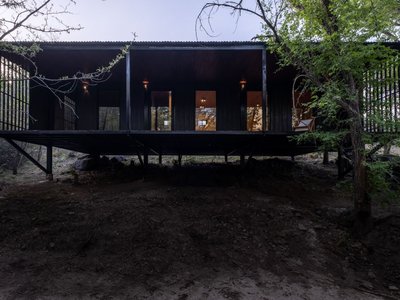
Pablo Senmartin Suspends a Steel-and-Timber Refuge Above a River Forest in Córdoba
An 80-square-meter dwelling on pilotis camouflages itself among the trees of Mayu Sumaj, designed to be dismantled without waste.
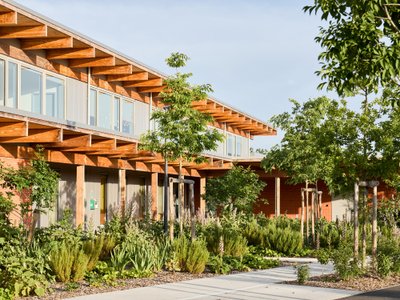
GGR Architectes Anchors a New Neighborhood in Frouzins with a Brick and Timber School Complex
A cruciform plan of terracotta brick and exposed wood frames four courtyards for 140 students outside Toulouse, France.


Similar Reads
You might also enjoy these articles
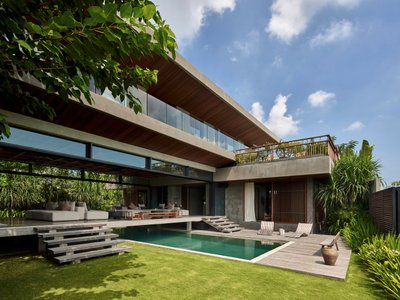
Freebird Residence by Alexis Dornier: A Tropical Modernist Sanctuary in Bali
Floating living pavilion above pool anchors H-shaped tropical villa, blending Japanese minimalism, sustainable strategies, lush landscape, and sculptural interiors.
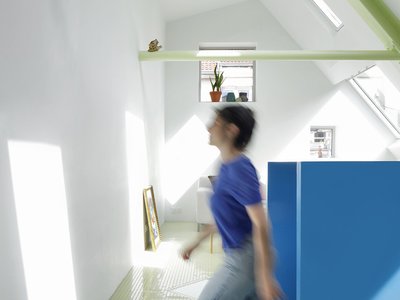
127af Flips a Tiny Bagnolet Rowhouse Upside Down with a Handcrafted Roof Extension
A 55-square-meter terraced house on the edge of Paris gains a luminous upper living floor through lightweight timber and steel.
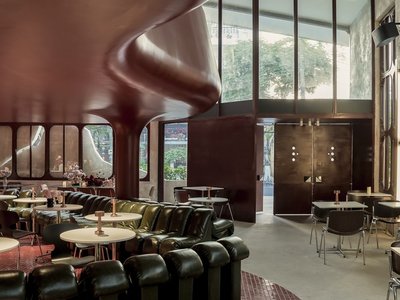
1.61 Design Workshop Wraps a 600-Square-Meter Café in Vietnam in Sculptural Burgundy Drama
Reden Café & Bistro pairs a helical staircase, mosaic floors, and deep red interiors to rethink Vietnamese hospitality space.

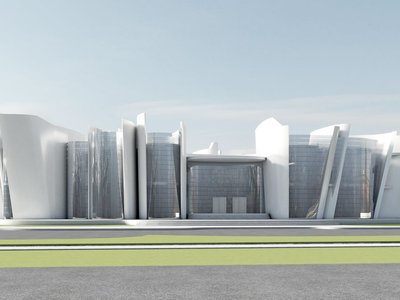
The Unbound Brain: A School Shaped by Cognitive Architecture
Cylindrical learning pods radiate like neurons from a central cortex, turning the floor plan into a spatial model of human thought.


Explore Residential Building Competitions
Discover active competitions in this discipline




The Global Benchmark for Architecture Dissertation Awards


Challenge to design a portable theatre


Challenge to design a portable music platform


Challenge to design an open learning module for the elderly
Comments (0)
Please login or sign up to add comments
No comments yet. Be the first to comment!