

Frič Brothers Elementary School: Innovative and Sustainable Educational Design in Ondřejov, Czechia
Frič Brothers Elementary School in Ondřejov combines sustainable passive-house design, daylight-filled interiors, exposed educational systems, and community-focused, student-centered learning spaces.


The Frič Brothers Elementary School, designed byAtelier 6,is a modern, sustainable educational facility located in Ondřejov, Czech Republic. Completed in 2024, the school serves 540 students and occupies a 3,012 m² site adjacent to a football field. Developed jointly by the municipalities of Ondřejov, Zvánovice, and Kaliště, this municipal elementary school emphasizes community integration, sustainability, and student-centered learning.


Harmonious Village Integration and Thoughtful Layout
Sited on a green, sloping meadow, the school blends seamlessly with Ondřejov’s village context of small family homes and gardens. The building is divided into three distinct volumes, preventing a monolithic appearance.
- The first volume, designed for younger pupils, features general classrooms, art and music rooms, after-school spaces, and a library.
- The second volume serves upper-grade students, incorporating six specialized classrooms, a cafeteria, administrative offices, and a food service area.
- The third volume, partly embedded into the slope, houses the sports hall.
These main structures are interconnected by a lower connecting building, which accommodates the entrance foyer, vestibule, and a covered outdoor area for informal teaching and recreation during warmer months.


Exterior Design and Site Transformation
The site underwent a complete transformation, evolving from a grazing meadow to a fully equipped school complex with Kiss & Ride parking, a bus stop, and shared parking for the school and nearby sports facilities. A generously scaled forecourt is paved with granite stones and centered around a linden tree, encircled by a round bench, creating a welcoming social space.
The façades are clad with brick slips, breaking down the scale of the buildings and creating a warm, tactile finish. The sports hall and adjacent covered area are rendered in a soft white-gray façade, while green accents on windows and fencing reference the aesthetic of the nearby Ondřejov Observatory, creating a subtle but strong visual identity.


Interior Design, Daylight, and Energy Efficiency
Interior planning focused on clarity, daylight, and functional circulation. Dedicated changing rooms are on the entrance level, with lockers along corridors on upper floors. Central corridors incorporate north-facing skylights, providing daylight, passive ventilation, and a surface for photovoltaic panels on the southern slopes.
The building is designed to passive house standards, ensuring high energy efficiency. Ground-source heat pumps draw energy from twenty 140-meter-deep boreholes, while mechanical ventilation with heat recovery ensures optimal indoor air quality. Operable windows are included throughout, allowing students and staff access to fresh air as needed.


Educational Transparency Through Exposed Systems
A key feature of the school is its transparent design, showcasing the building’s inner workings as an educational tool. Ventilation ducts, heating, water pipes, sewage lines, and electrical conduits are left exposed in corridors, demonstrating the building’s “veins, arteries, airways, and intestines” to students. Similarly, exposed reinforced concrete structures in circulation areas highlight structural design, creating a learning opportunity through architecture.
Acoustic comfort was another priority. Suspended circular panels in corridors absorb sound from both sides and evoke the night sky, while wooden wall cladding in the cafeteria enhances acoustics and adds warmth.


Visual Identity, Wayfinding, and Interior Art
HMS Design, led by Filip Heyduk, developed the school’s comprehensive visual identity and signage system. Inspired by the constellation under which the Frič brothers were born, the design principle informed all pictograms, creating a cohesive visual language.
In collaboration with artist Pavla Gregorová Šípová, interior floors were designed to evoke starry skies and human communication. Social areas like the cafeteria and school club feature comic-style speech bubbles, while the entrance foyer showcases a stylized star extending rays into corridors and classrooms. Floor colors differentiate age groups: brighter tones for younger students, muted palettes for older students and staff.


Furniture, Materials, and Sports Facilities
Winning the interior design competition allowed Atelier 6 to ensure material and color continuity. Furniture is primarily white or wood-toned, complemented by colorful accents in seating, storage units, and student spaces. Laboratories remain predominantly white for a focused environment. The sports hall features wooden trusses, acoustic wall panels, exposed concrete, and a warm gray multipurpose floor.
The project highlights the value of interdisciplinary collaboration with artists and graphic designers, resulting in an inspiring, educational, and future-ready school environment.
All photographs are works of
Peter Fabo


Popular Articles
Popular articles from the community

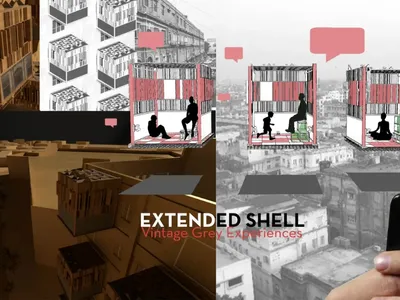
Extended Shell: Retrofitting Kolkata's Balconies as Living Urban Thresholds
A modular retrofit system recovers the social and environmental intelligence of Kolkata's historic verandas for contemporary Park Street residents.
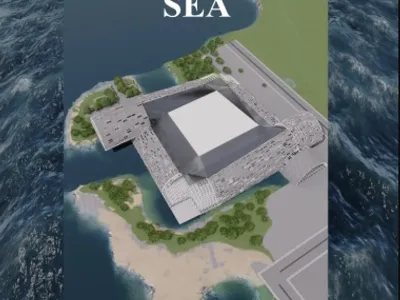
Opera on the Sea: Driftwood Logic Shapes a Timber Opera House on Estonia's Coast
Trevor Orgill's opera house translates the entangled drift of floating timber into a civic building where wood, water, and music converge.
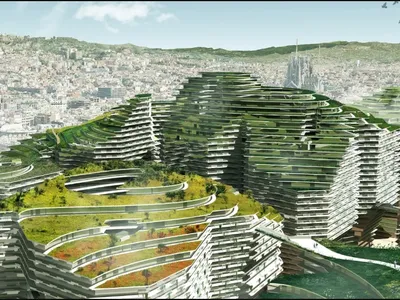
Manzana Morphosis: Stretching Barcelona's Grid into a Living Landscape for 2050
A radical reworking of the Eixample manzana turns density into a tool for generous public space, vertical ecology, and environmental performance.
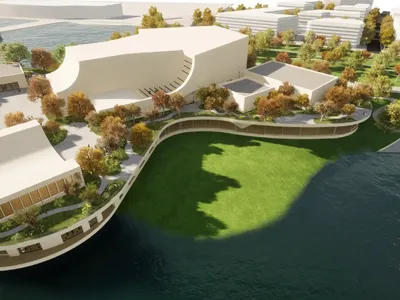
The Amber Palace Opera: A Geological Fiction Surfaces on Tallinn's Baltic Waterfront
Pierre Brillard reimagines a Baltic legend as a public landscape, opera house, and waterfront promenade rooted in Tallinn's coastal identity.

Similar Reads
You might also enjoy these articles


Hodi-Mandai Geram
Project Function: Preservation and revitalization of the Intangible heritage and socio-spatial identity of the Hodi by Housing, Cultural Memory Center, Sacred Grove, landscape, local tourism economy


Olio Towers: A Mid-Rise for Performers That Fuses Housing, Rehearsal, and Stage
Located blocks from Houston's Theater District, this modular tower stacks living units around a central performance atrium.

Oasis: Modular Green Housing Carved into Dhaka's Urban Fabric
A shortlisted Plugin Housing entry reclaims unauthorized settlements in Dhaka with stepped concrete volumes, green roofs, and ventilation-driven design.

Black Hole: A Floating Megastructure for the Post-Physical Era
Emiliano Mazzarotto envisions a spherical, self-scaling arena where e-sports, digital hotels, and holographic stadiums replace traditional public space.

Explore Educational Building Competitions
Discover active competitions in this discipline

Challenge to design public laboratory

Challenge to reimagine the Iron Throne

Photograph architecture without architects

Illustrate the lost glory of Angkor Wat - Render Challenge
Comments (0)
Please login or sign up to add comments
No comments yet. Be the first to comment!