
Studio Gram Converts a Dormant Adelaide Basement into a 138 m² Bar of Layered Illusion
Fugazzi Basement Bar turns a forgotten service space beneath Adelaide's streets into a walnut-lined world of geometric deception and warmth.

Two years after completing the Italo-New York-inspired dining room above it, Studio Gram returned to the same Adelaide address to tackle what lay below: a dormant, uninviting service basement that had never earned its keep. The result, Fugazzi Basement Bar, is a 138 m² function space that accommodates up to 100 guests for formal dining, private parties, or conferences. Project directors Dave Bickmore and Graham Charbonneau, with interior design led by Tess Sporn, turned a liability into the building's most compelling room.
What makes the project worth studying is the tension between constraint and generosity. The floor plate is tight, the ceilings are low, natural light barely exists. Rather than fighting those facts, the team leaned into them, using bi-tonal walnut panelling, reflective marble, and a meticulous lighting palette to manufacture a sense of depth and atmosphere that an above-ground room could never replicate. The name itself, Fugazzi, meaning fake or illusory, is the design brief made literal: every surface conspires to suggest a space larger, older, and more mysterious than it actually is.
Thresholds and Arrival
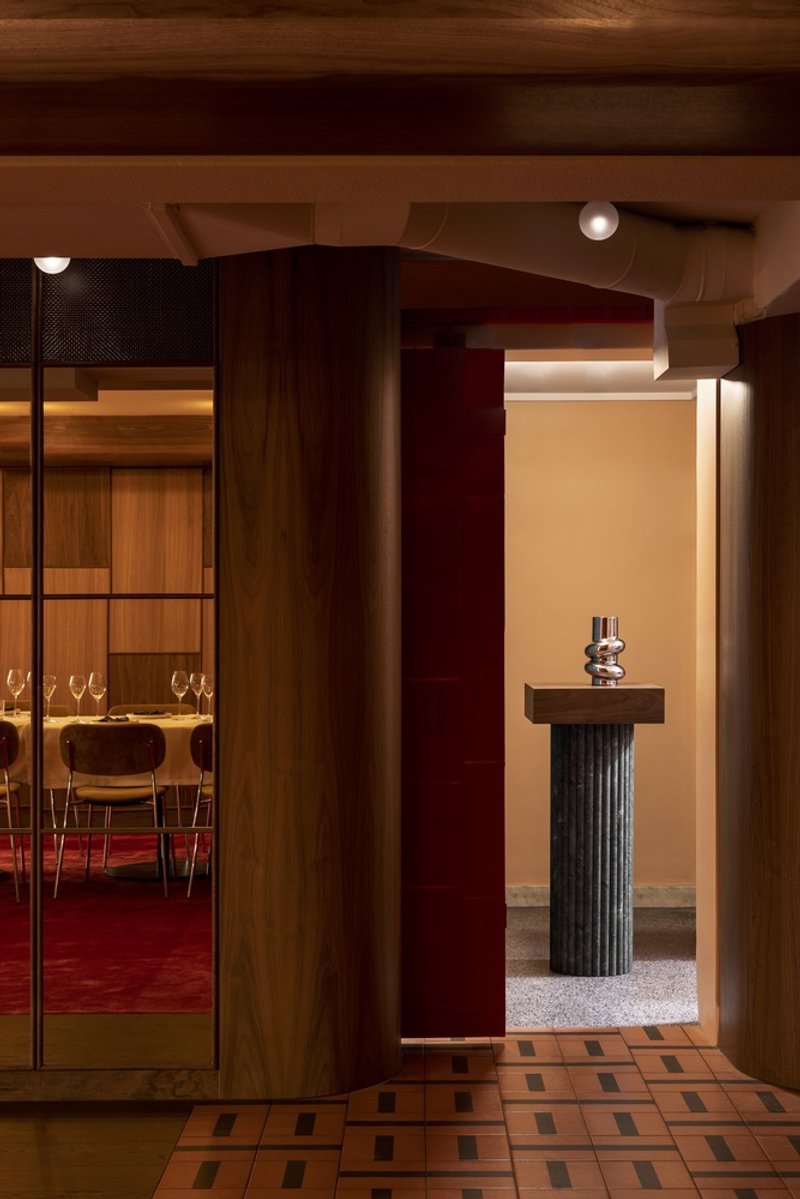
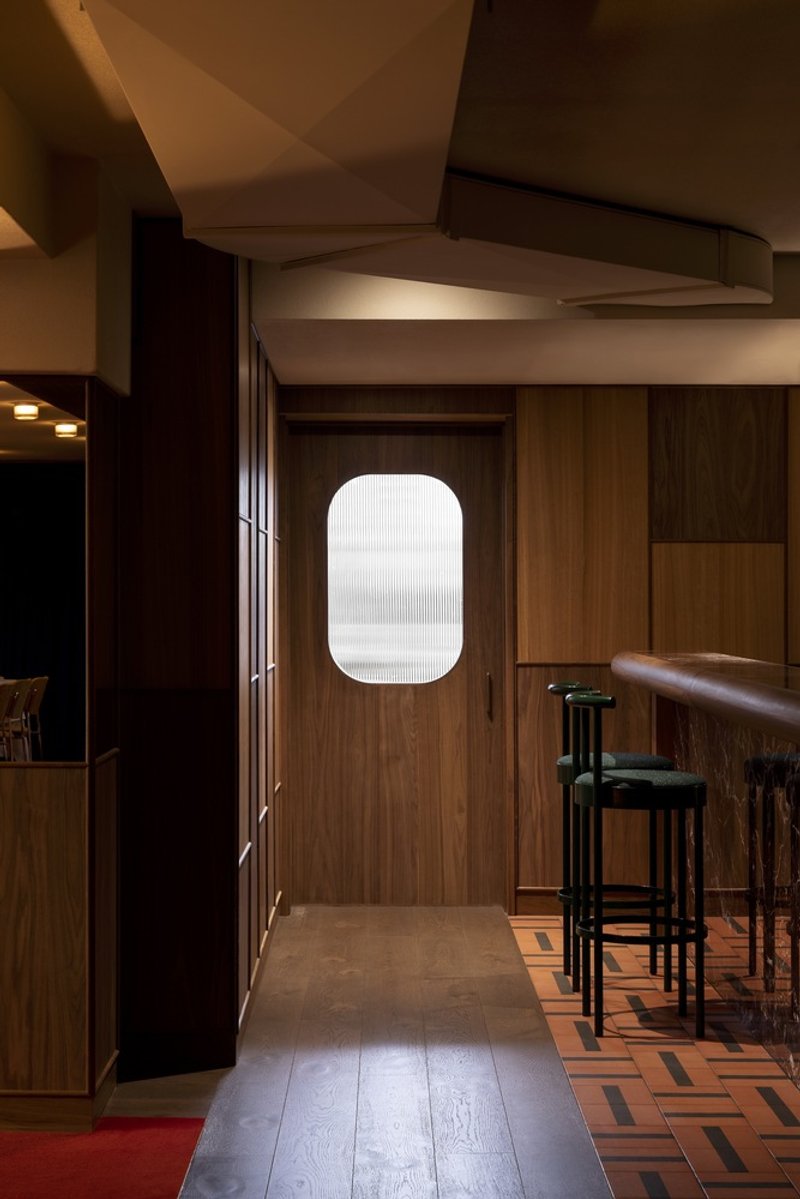
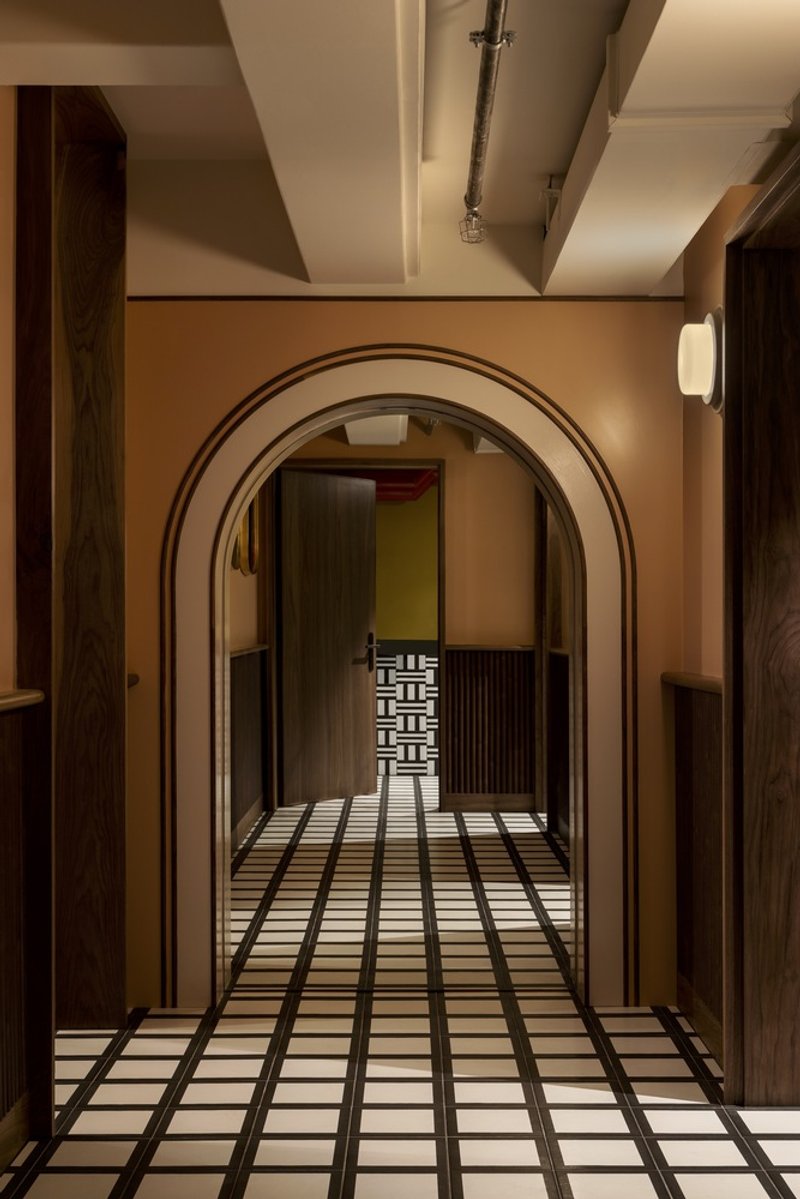
The descent matters. A terrazzo floor and an illuminated sculptural niche greet you at the entry threshold, signalling a shift in register before you take a single step down. The rounded window set into walnut panelling and the herringbone tile floor beneath a curved soffit compress the space just enough to make the rooms beyond feel like a release. Then comes the arched doorway framed by bold black-and-white striped tiles, a visual punch that borrows from Italian palazzo corridors without copying any single reference.
Each of these moments is compact, almost domestic in scale, yet they generate the kind of spatial anticipation you normally associate with much larger buildings. The sequence works because nothing is accidental: tile patterns shift at every transition, ceiling heights adjust, and the lighting temperature drops as you move deeper underground.
The Bar as Centerpiece
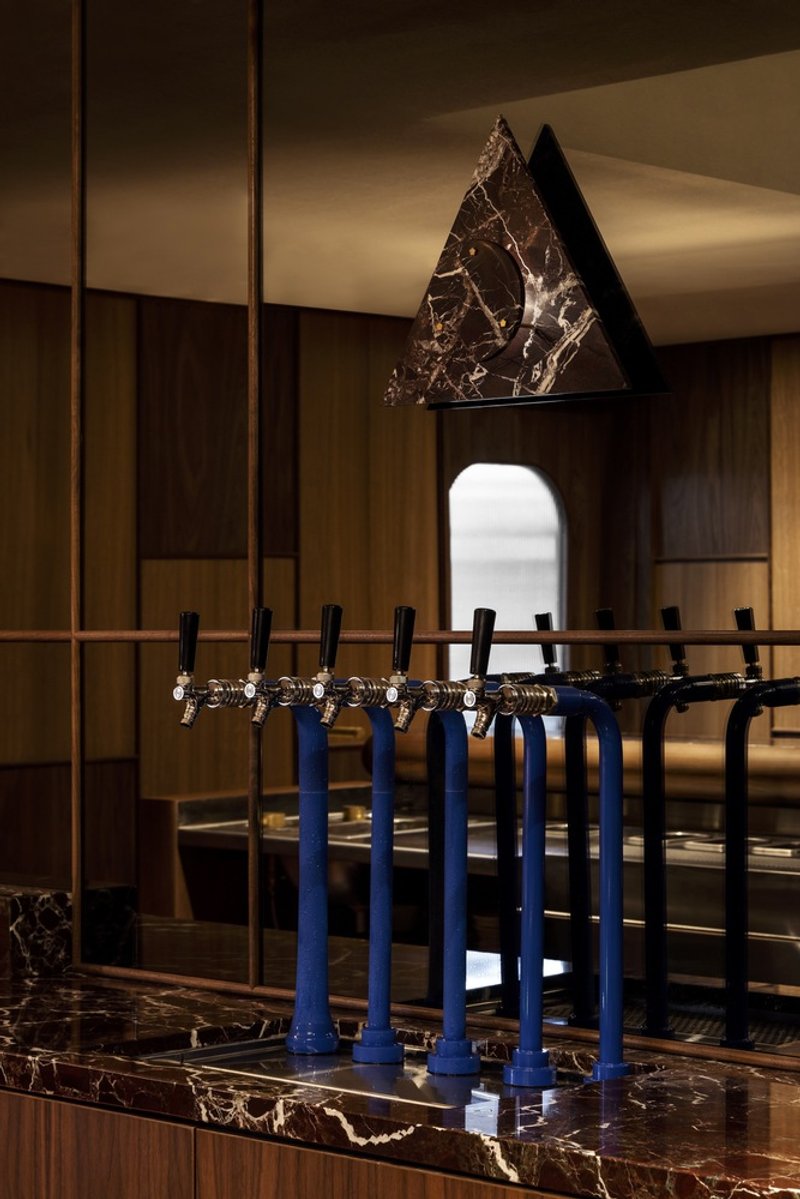
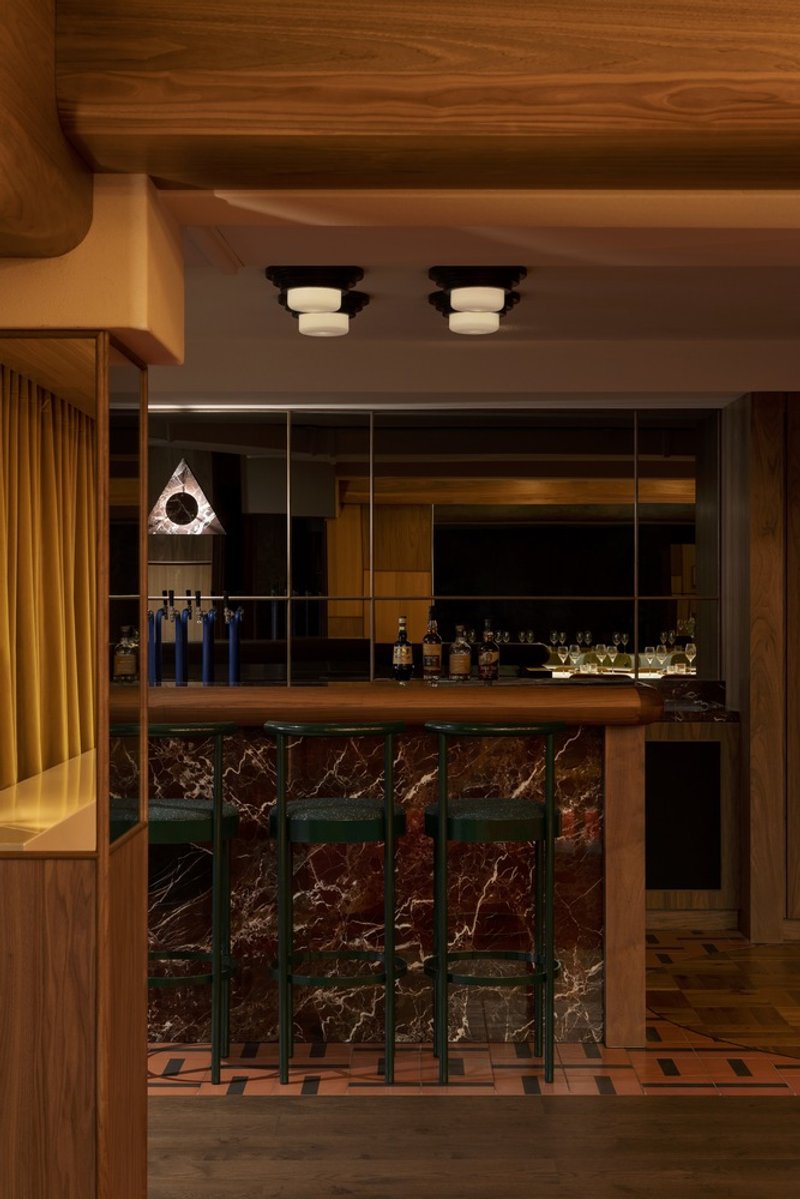
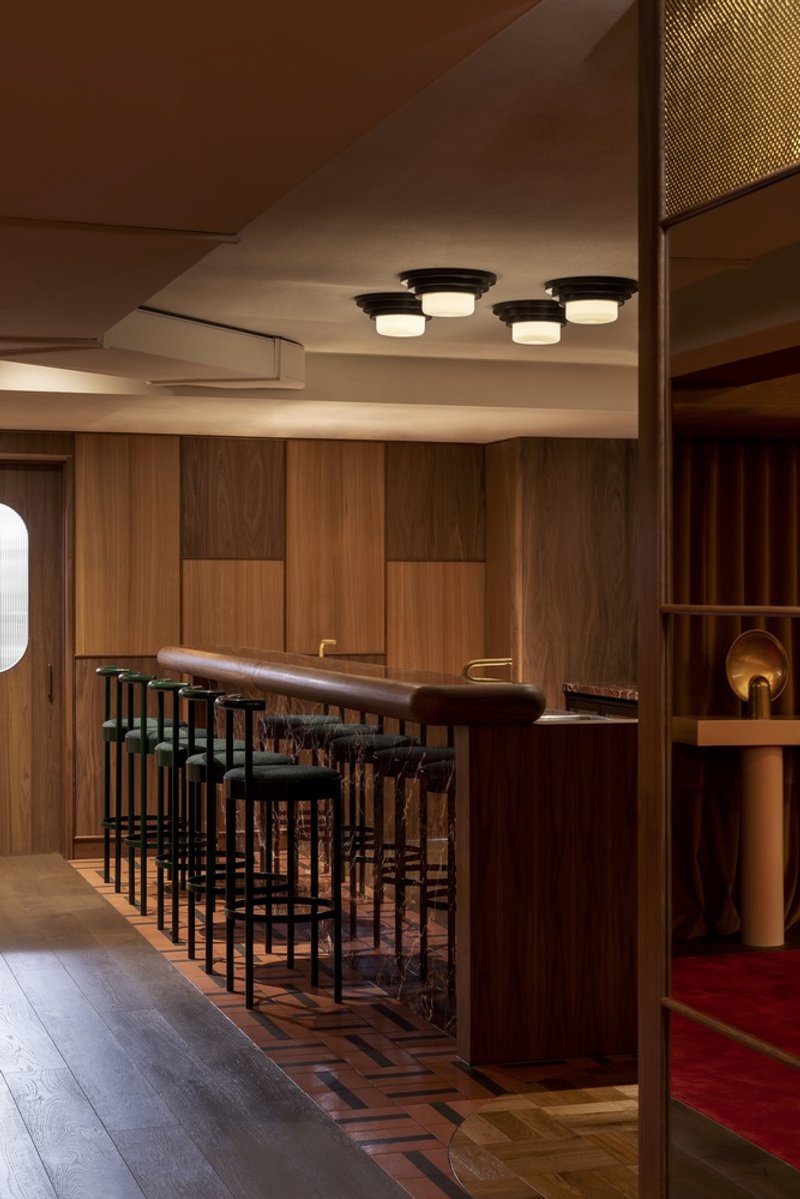
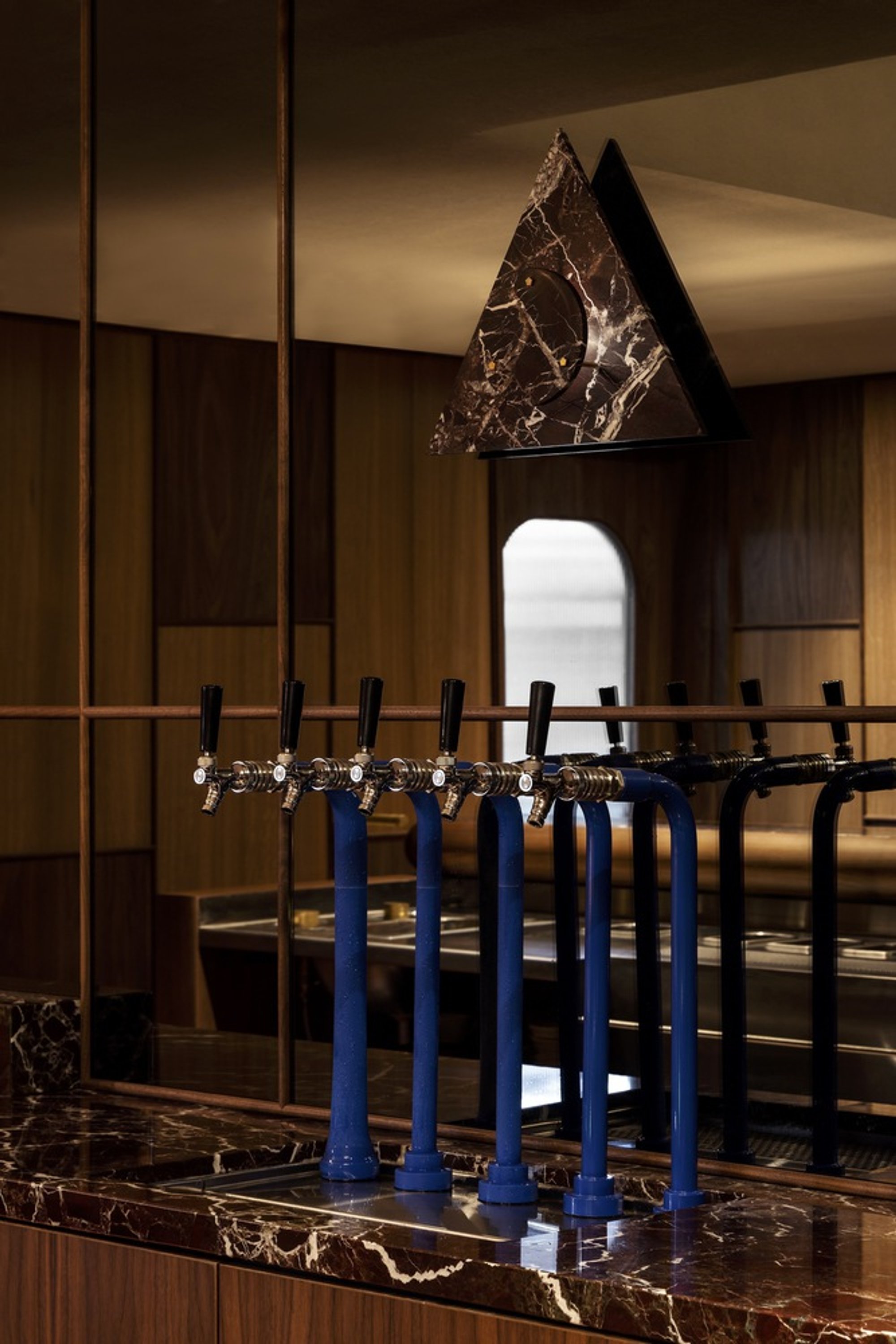
The bar counter anchors the plan. Its triangular marble hood, suspended beneath a dense walnut storage wall stacked with bottles, reads as both functional and totemic. Blue tap handles punctuate the surface, a controlled burst of colour against the dark palette. From the opposite angle, the bar front reveals dark marble cladding paired with a mirrored wall that doubles the visual depth of the room and bounces the herringbone floor into infinity.
Leather-wrapped edges and metal stools line the counter, and flush-mounted ceiling fixtures keep the overhead plane clean. The deliberate absence of pendant lights here is a smart call: in a low-ceilinged basement, anything hanging would feel oppressive. Instead, light arrives from recessed sources that graze the walnut grain and catch the marble's veining, creating an effect that feels warm without being murky.
Timber Craft and Material Layering
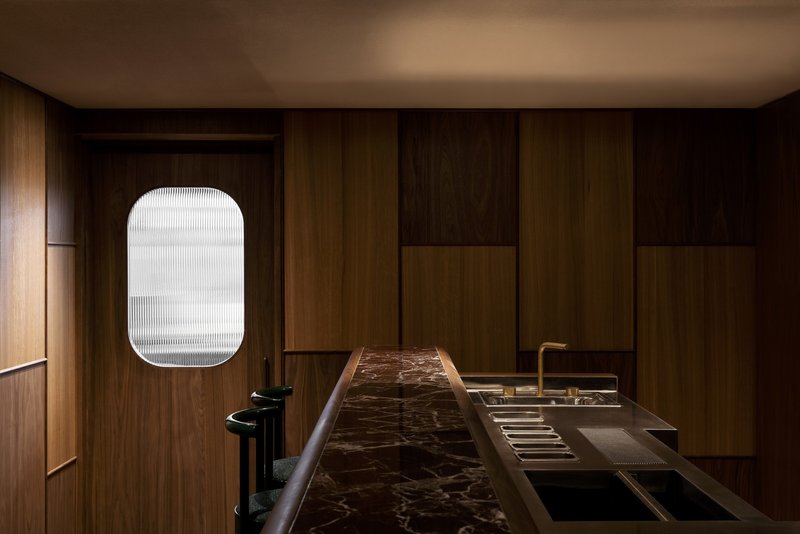
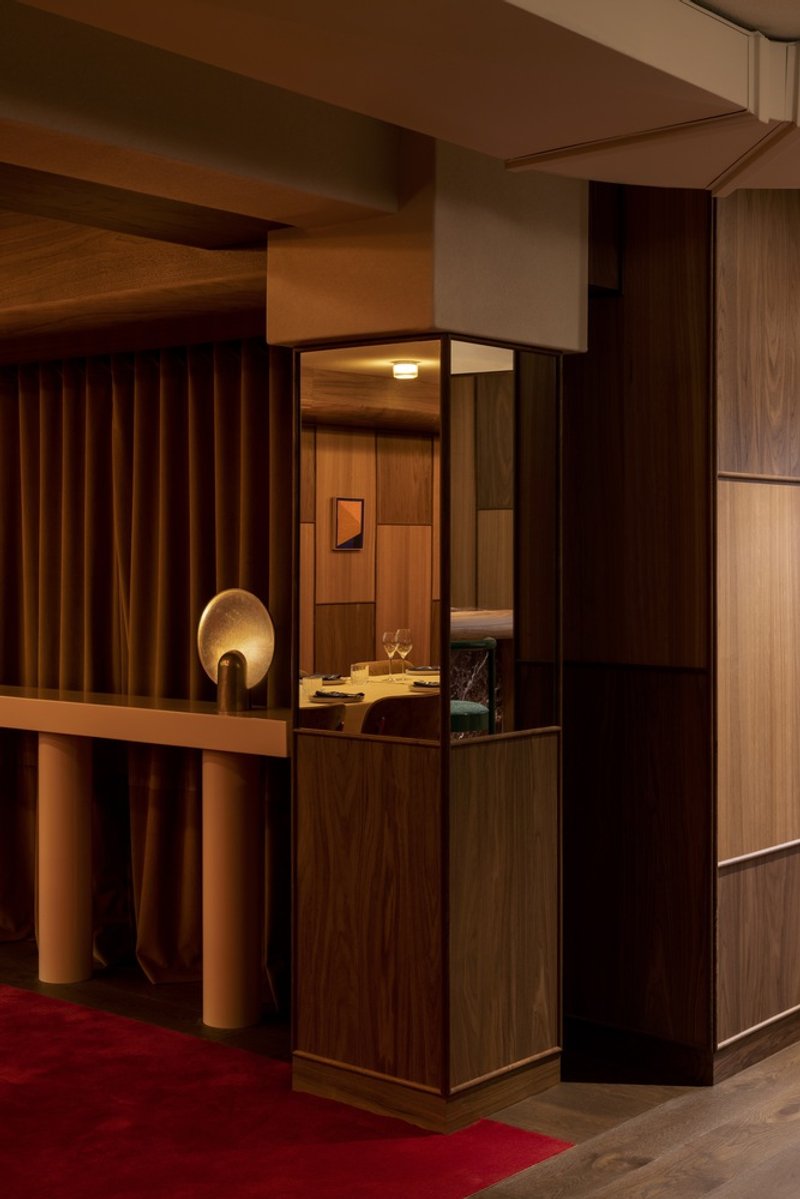
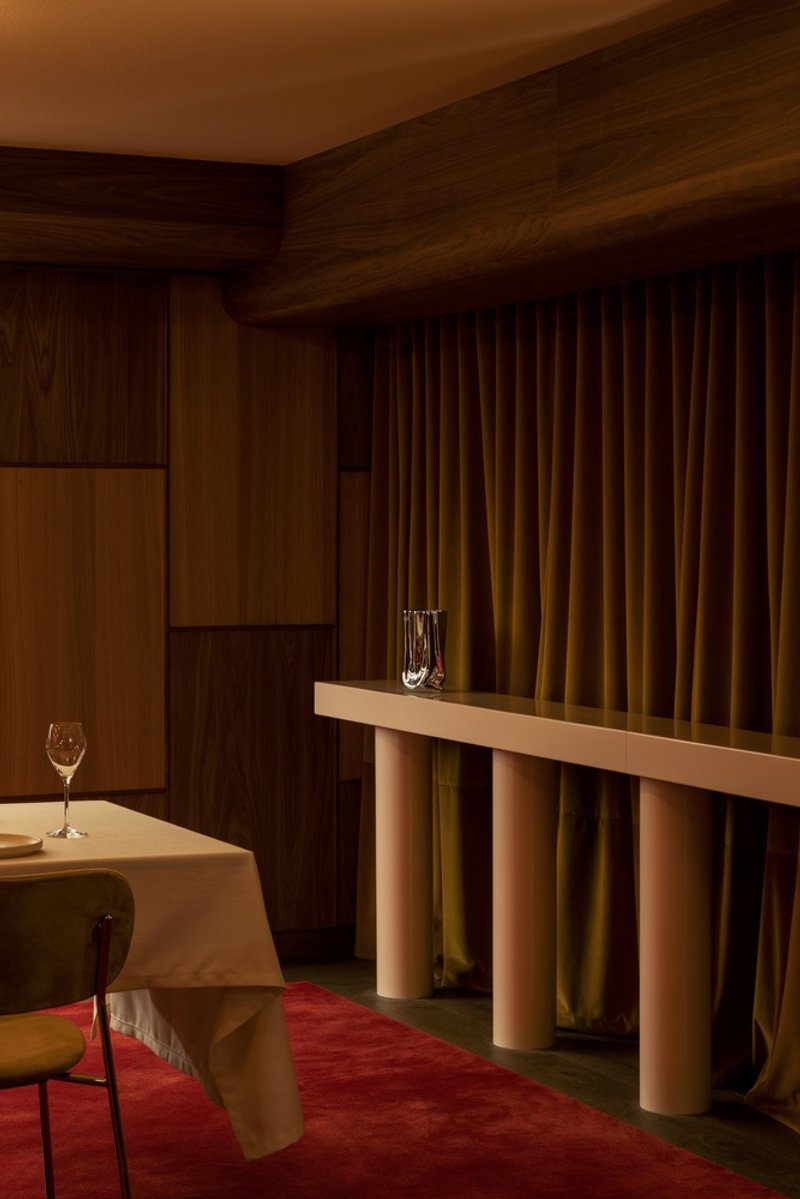
The custom timber work is the project's quiet showpiece. Walnut panels wrap almost every vertical surface, but their treatment varies enough to prevent monotony. In one room, a rounded reeded glass window filters what little daylight reaches the basement into soft, diffused bands across a marble countertop. Elsewhere, a display niche with brass lamp and open shelving sits off a red-carpeted corridor, a vignette that could have been lifted from a 1970s members' club. Vertical fluted wall panels and cylindrical columns in another corner introduce a different rhythm entirely, shifting the grain direction and the scale of the moulding.
The two-toned quality of the timber is key. Lighter and darker walnut cuts alternate across panels and furniture, producing a visual vibration that keeps surfaces from reading as flat. Paired with marble, velvet upholstery, and geometric tile, the wood provides a warm, tactile baseline that holds the material palette together without dominating it.
The Dining Room and Its Versatility
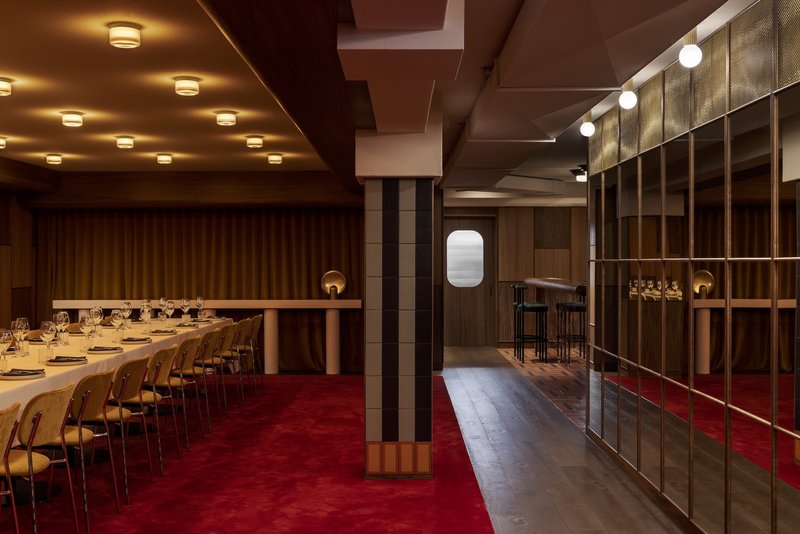
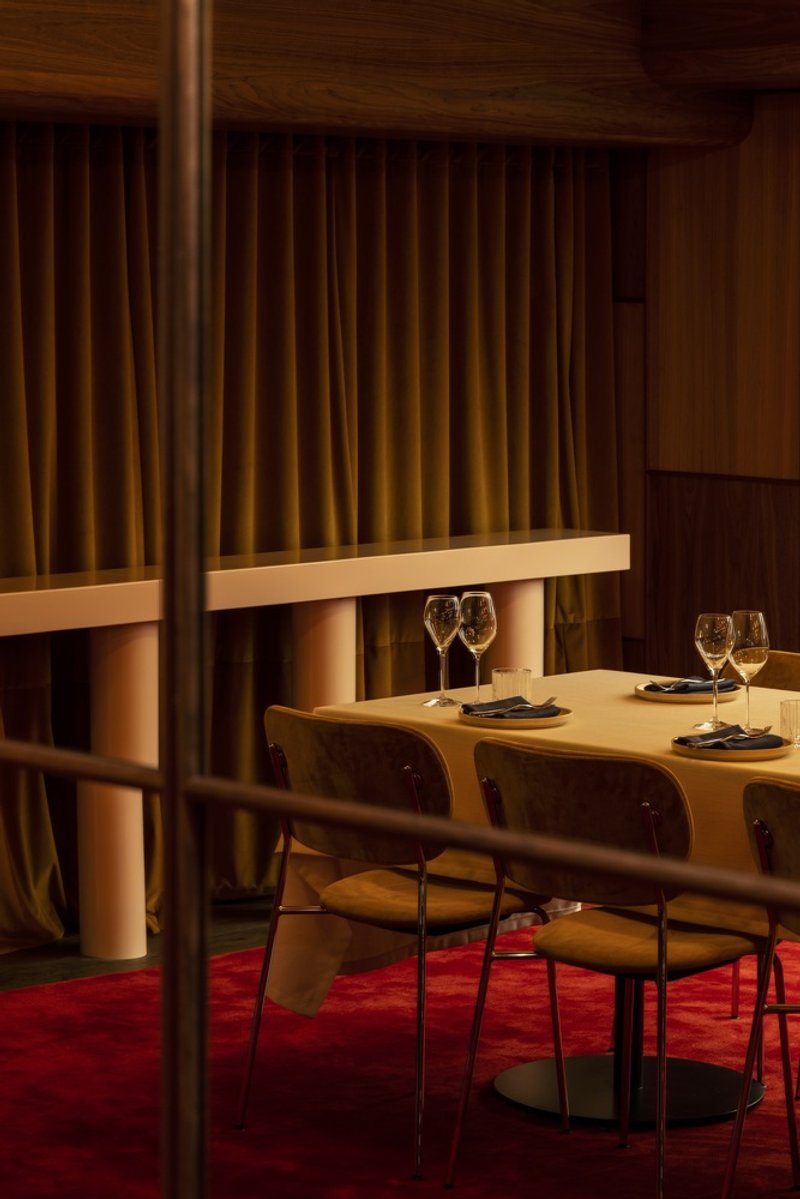
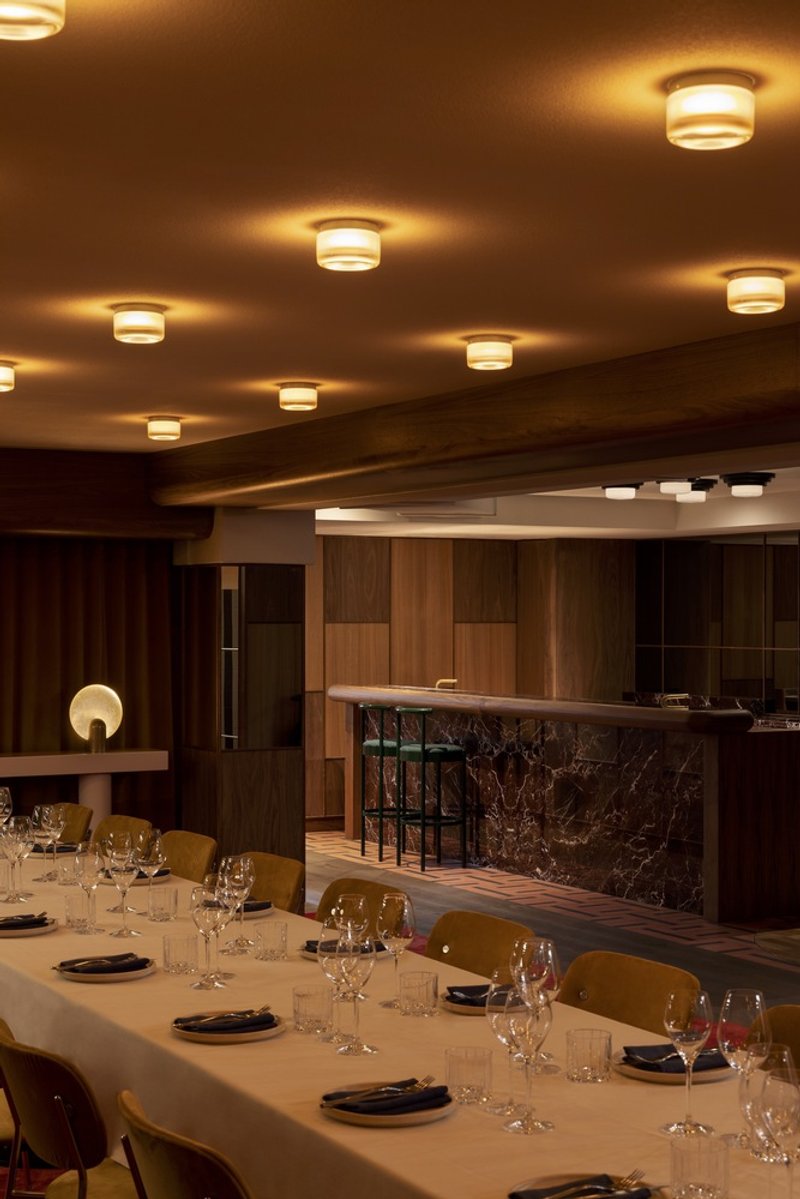
Fugazzi's programmable identity is perhaps its most practical achievement. A long dining table, separated from the bar by a glass partition, sits on a floor that transitions from red carpet to timber, a material shift that subtly zones the room without walls. Cylindrical columns and a pleated fabric backdrop frame the table for formal settings, while the grid of ceiling-mounted lights above can modulate the mood from boardroom to banquet.
The glassware-set table photographed against the marble bar beyond demonstrates how the space collapses distance: you always see through to the next zone, the next material, the next light condition. For a room that must serve conferences on a Tuesday and a 100-person party on a Saturday, that layered transparency is critical. It lets the space feel intimate at half capacity and full at peak, which is a harder trick than it sounds in 138 square metres.
Why This Project Matters
Basement conversions are a known quantity in hospitality design, but most of them trade on darkness as a shortcut to atmosphere. What Studio Gram does here is more controlled and more interesting: they use material specificity, walnut grain, marble veining, geometric tile, and a careful lighting palette, to manufacture depth in a space that has almost none. The illusion is not theatrical fog and neon but the slower deception of surfaces that seem to recede, glow, and multiply.
The project also demonstrates how a small studio can build continuity across a single address. By returning to a building they already knew, Studio Gram gave the upstairs and basement distinct identities while keeping them legible as parts of the same brand. That kind of long-game thinking, designing not just a room but a relationship between rooms over time, is rarer than it should be in hospitality work. Fugazzi Basement Bar, on Kaurna Country in Adelaide, is a strong case study in squeezing maximum spatial intelligence out of minimum square metres.
Fugazzi Basement Bar by Studio Gram. Interior design by Tess Sporn. Project directors: Dave Bickmore and Graham Charbonneau. Adelaide, Australia. 138 m². Completed 2023. Photography by Timothy Kaye.
About the Studio
Share Your Own Work on uni.xyz
If projects like this are the kind of work you want to make, uni.xyz is a place to publish your own, find collaborators, and enter design competitions.




Popular Articles
Popular articles from the community

PLATAFORMArq Folds a Concrete Roof Over the Portuguese Mountains in House #474
A 220-square-meter residence in Teixoso, Portugal, wraps board-formed concrete into an angular canopy that frames the Serra da Estrela foothills.
Reincarnation Weaves a Three-Story Retreat into the Green Landscape of Rural Bangladesh
Ara Manor in Narsingdi dissolves the line between domestic architecture and its lush surroundings through screens, courtyards, and planted rooftops.
Eco Chapel: A Green Architecture Pavilion Designed in Symbiosis with the Forest
Eco Chapel uses green architecture to weave prayer, learning and reuse into a forest pavilion shaped by modular hexagonal canopies for life.
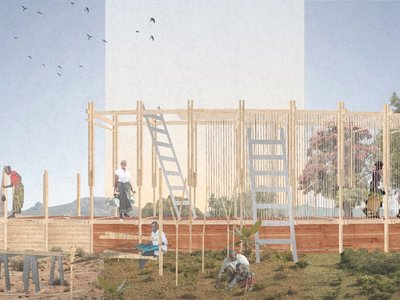
Healing Façade: Sustainable Architecture for Reforestation, Community, and Sacred Ecology in Ethiopia
Healing Façade reimagines sustainable architecture as a living wall that restores soil, catches water and renews Ethiopia's forest churches.


Similar Reads
You might also enjoy these articles

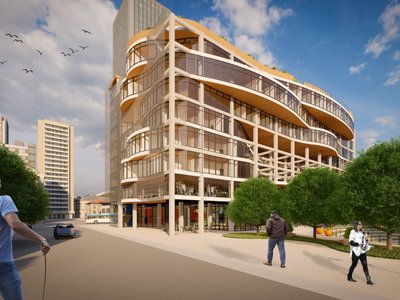
Olio Towers: A Mid-Rise for Performers That Fuses Housing, Rehearsal, and Stage
Located blocks from Houston's Theater District, this modular tower stacks living units around a central performance atrium.
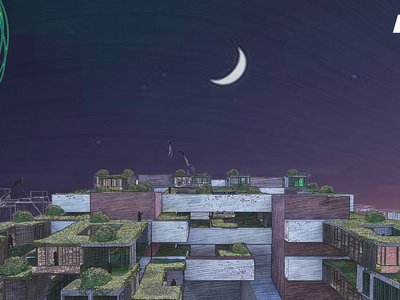
Oasis: Modular Green Housing Carved into Dhaka's Urban Fabric
A shortlisted Plugin Housing entry reclaims unauthorized settlements in Dhaka with stepped concrete volumes, green roofs, and ventilation-driven design.

Black Hole: A Floating Megastructure for the Post-Physical Era
Emiliano Mazzarotto envisions a spherical, self-scaling arena where e-sports, digital hotels, and holographic stadiums replace traditional public space.
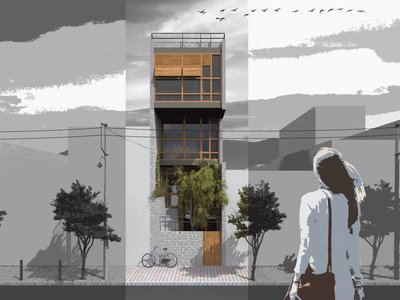
Compact & Sustainable Living in Piraeus: A Four-Level Family Home Built Around Light and Air
A narrow townhouse in one of Greece's densest port cities uses a central atrium and passive strategies to house three generations under one roof.
Explore Interior Design Competitions
Discover active competitions in this discipline




The International Standard for Design Portfolios


The Global Benchmark for Architecture Dissertation Awards


The Global Benchmark for Graduation Excellence


Challenge to design luxury tourism on rails
Comments (0)
Please login or sign up to add comments
No comments yet. Be the first to comment!