
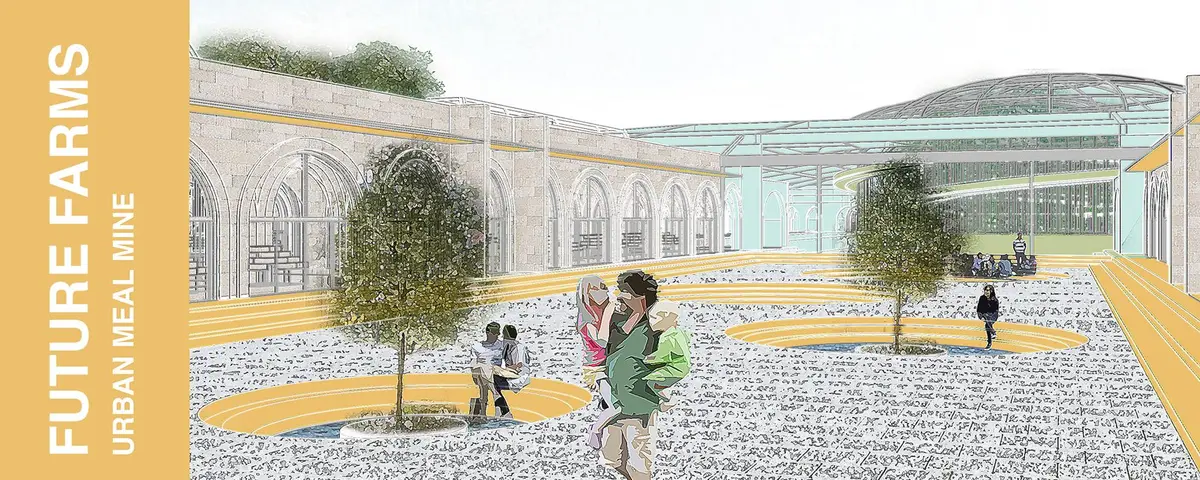
Future Farms: Where Aquaponics, Markets, and Public Life Converge Under Glass
A transparent urban food system weaves aquaponic towers, greenhouse pavilions, and stormwater infrastructure into the civic fabric of the city.


What if the most honest thing a building could do is show you exactly where your next meal comes from? Future Farms proposes a civic architecture in which aquaponic towers, greenhouse pavilions, and rooftop growing zones are not tucked away behind walls but placed at the center of public life, visible through glazed domes, accessible from spiraling ramps, and framed by arched market corridors where citizens shop for produce harvested meters from where they stand.
Designed by Cesar Elias Q and Sarwat Yunus, the project was developed as part of the Urban Meal Mine initiative. Its ambition is architectural as much as agricultural: integrate food production, education, stormwater management, and community gathering into a single legible structure that rewires the relationship between a city and the ecological systems that feed it.
A Glazed Core Built Around Vertical Growing Towers
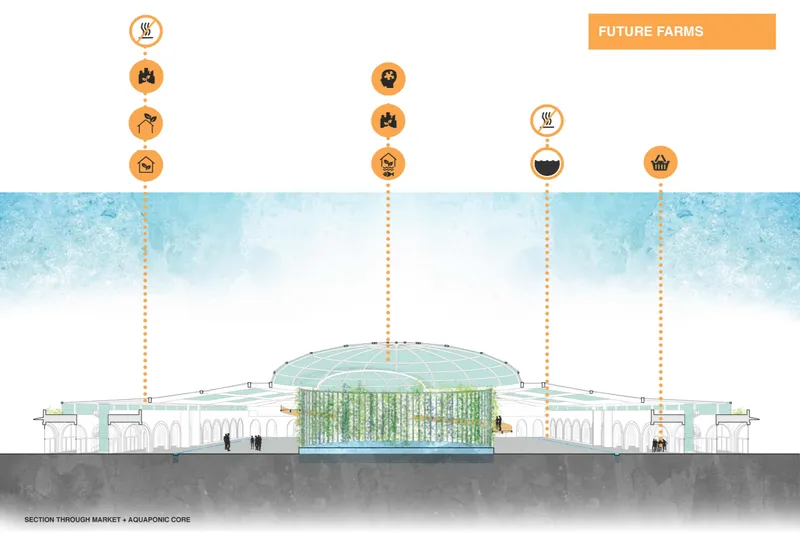
The section drawing cuts through the project's conceptual heart: a central glazed dome that houses vertical growing towers and the aquaponic system at its base. The transparency is deliberate. Rather than concealing the mechanics of food production, the design turns them into spectacle. The dome functions simultaneously as greenhouse, laboratory, and learning center, allowing visitors to observe nutrient cycles, fish tanks, and plant growth in real time. It is the building's thesis rendered in glass and steel.
Flanking the dome, the section reveals market zones and circulation paths that keep the public moving through and around the growing infrastructure. The aquaponic core is not an annex; it is the spatial anchor from which every other program radiates. This arrangement makes food literacy unavoidable: you cannot move through the building without encountering the systems that sustain it.
A Spiraling Orange Ramp Through Hydroponic Columns
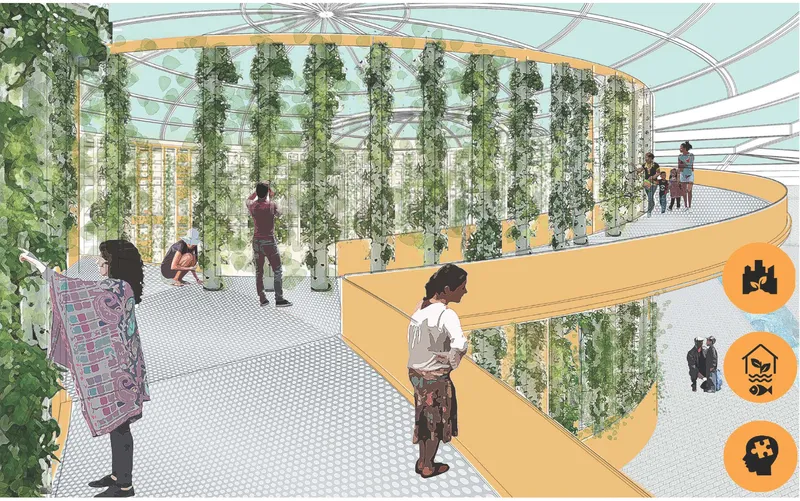
Inside the glazed volume, a curved orange ramp spirals past vertical hydroponic growing columns, creating a promenade that is part botanical experience, part circulation device. The ramp pulls visitors upward through layers of cultivation, transforming a routine change of level into an encounter with living food systems. Light filters through the glazed roof above, sustaining the plants while bathing the interior in a warm, diffused glow that softens the industrial logic of the hydroponic infrastructure.
The color and curvature of the ramp are worth noting. Against the green verticals and the steel structure, the bold orange acts as a wayfinding element and a signal that this space is designed for people, not just crops. It invites lingering. The designers seem to understand that an education hub only works if people actually want to be inside it.
Arched Market Corridors Where Produce Meets Public Life
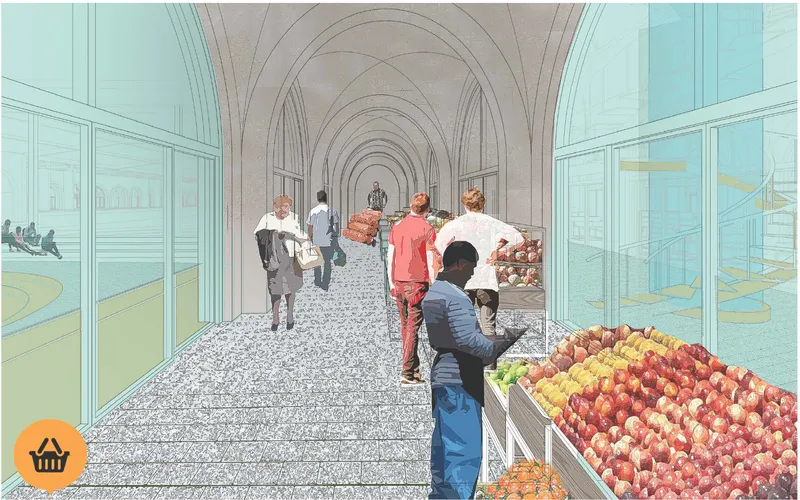
The vaulted market corridor introduces a different spatial register. A series of arches defines a generous, rhythmic passageway lined with produce displays and populated by visitors. The atmosphere reads as part greenhouse, part bazaar, bridging the production zones with public commerce. By embedding the market directly within the architectural envelope of the farm, Future Farms collapses the supply chain to almost nothing: food grown on site is sold steps away.
This is where the project's community ambitions become most tangible. The corridor is not a supermarket aisle; it is a civic space. People gather, browse, and interact in a setting that makes the origin of their food self-evident. The arched structure overhead lends a sense of occasion, elevating what might otherwise be a utilitarian transaction into something closer to a daily ritual.
Three Circular Pavilions and Rectangular Growing Zones
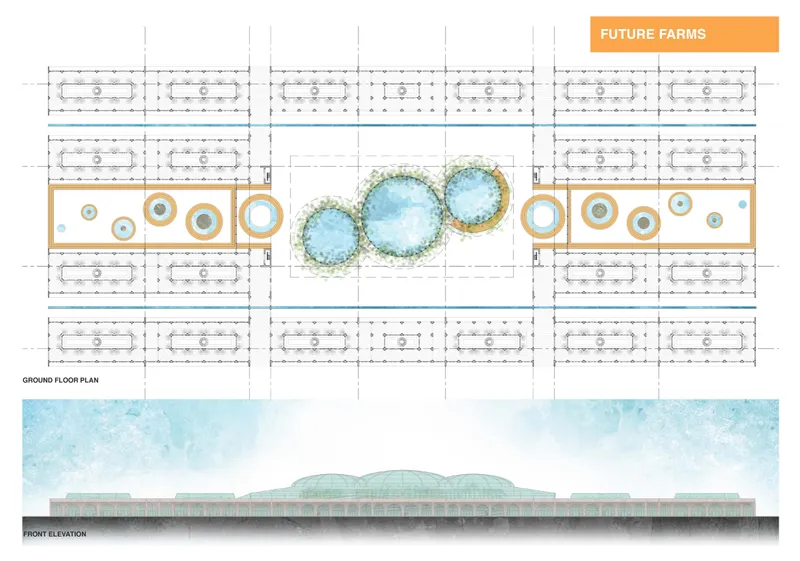
The ground floor plan and front elevation clarify the project's organizational logic. Three circular glass pavilions, the primary programmatic volumes, sit within a landscape of rectangular growing zones. The geometry is purposeful: the circles concentrate public activity, while the orthogonal fields maximize planting area and accommodate rooftop farming, green roofs, and stormwater infrastructure including artificial water bodies and permeable pavers.
Beyond food production, these landscape strategies address the Urban Heat Island effect. Water bodies and green roofing surfaces reduce ambient temperatures, turning the project into a microclimate intervention as much as a food system. The elevation confirms the pavilions' transparency, their glass skins dissolving the boundary between interior growing environments and the surrounding urban context. The message is clear: nothing here is hidden.
Why This Project Matters
Future Farms matters because it refuses to treat food production as a problem to be solved offscreen. In most cities, the journey from farm to plate is invisible, a black box of logistics that citizens never question. This project dismantles that opacity by placing aquaponics, hydroponics, and greenhouse cultivation at the center of public architecture, then wrapping them in glass, ramps, and market corridors that make engagement unavoidable. The result is not just a building; it is an argument for a different kind of urban contract, one where infrastructure nourishes rather than merely houses.
The work of Cesar Elias Q and Sarwat Yunus demonstrates a mature understanding of how spatial design can shift public behavior. By fusing education, commerce, recreation, and ecological performance into a single integrated system, they offer a credible template for resilient urban futures. Future Farms does not speculate about tomorrow; it assembles proven techniques, aquaponics, green roofs, stormwater management, into an architecture that is ready to be tested today.
View the Full Project
About the Designers
Designers: Cesar Elias Q, Sarwat Yunus
Enter a Design Competition on uni.xyz
uni.xyz runs architecture and design competitions year-round that reward proposals with spatial conviction and real site intelligence.
Project credits: Future Farms - Urban Meal Mine by Cesar Elias Q, Sarwat Yunus.


Popular Articles
Popular articles from the community


Jaramillo Van Sluys Arquitectura and Urbanismo Turn a Demolished Registry Lot in Quito into an Orchard Plaza
In Quito's Centro Histórico, a 2,800 m² plaza exposes the San Agustín convent wall and redraws its lost Augustinian orchard in volcanic stone.

Architekt Andreas Gruber Scatters 23 Dark Timber Chalets Across a South Tyrolean Forest Edge
In Molini di Tures, Amonti Chalets breaks a resort into a hamlet of gabled timber houses, with parking, storage and services pushed into the slope.

GROUP A Strips a 1969 Rotterdam Harbor Headquarters to Its Frame and Wraps It in Timber Louvers
In Rotterdam's M4H harbor district, Ferro Offices reuses a 1969 frame, adds one timber storey and reaches BREEAM-NL Outstanding.

Cube Design Draws an Ecological Corridor Between Two Shenzhen Hills with the Nankai Building
Beside Shenzhen's container docks, the Nankai Building pairs stacked balconies with a climbing green screen to connect two hillsides across its height.

Similar Reads
You might also enjoy these articles

Gil Mello Arquitetura Tilts a Single Roof Toward the Waterfalls on a Plateau Above Aiuruoca, Brazil
In Aiuruoca, Minas Gerais, a 200 m² house of local labor and reclaimed poles pairs a low valley veranda with a tall mountain one.

U.GA Architects Wraps an Oval Rooftop Pool in Curved Board-Formed Concrete on Busan's Jeollidan-gil
In Busan's Jeonpo-dong, a 454 m² mixed-use block stacks a neighborhood facility, guest rooms and an oval rooftop pool inside spiraling concrete walls.

Felipe Hess Arquitetos Turns a Blind Stone Wall to the Street and Opens a Brazilian House onto a Courtyard and Canal
A canal-front house in Brazil hides behind painted stone and planting, then opens to an olive-tree courtyard, a reed-ceilinged porch and a curving pool.

David Macias Steps a Doorless Stone and Plaster House Down a Tropical Colombian Hillside
In the humid hills of Colombia, Threshold House replaces the front door with an open void and terraces its 850 m² down the slope instead of fighting it.

Explore Sustainable Urbanism Competitions
Discover active competitions in this discipline

Challenge to design a shop stop sunk in the city

Render competition to represent the city as a machine

Design challenge to equip cities with modern furniture

Design challenge to reuse E-waste
Comments (0)
Please login or sign up to add comments
No comments yet. Be the first to comment!