
Melike Altınışık Architects Lands a Robotically Welded Sphere in the Heart of Seoul
The Seoul Robot and AI Museum in Chang-dong deploys 3,422 CNC-cut panels to house a new temple for artificial intelligence.

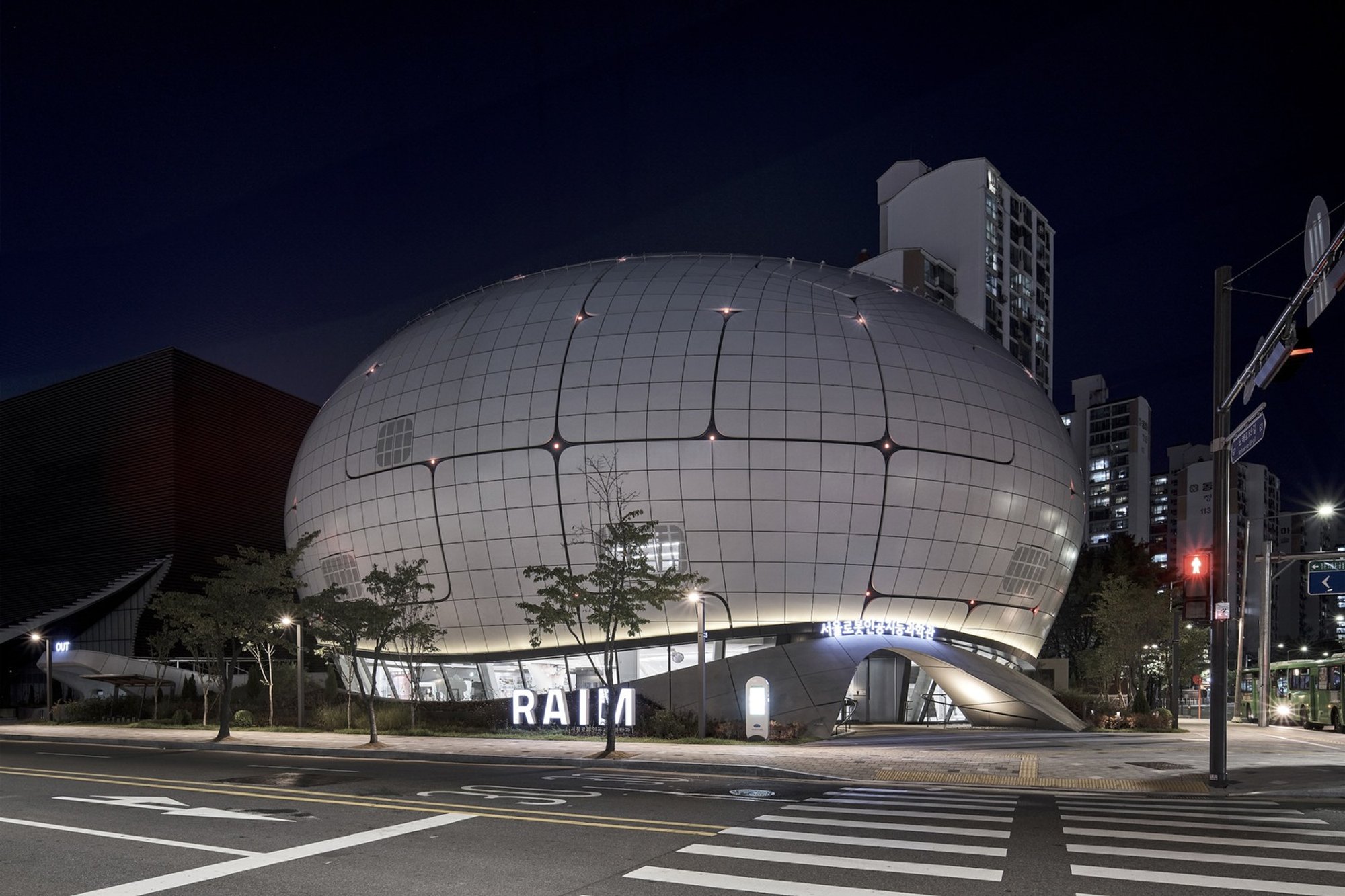
A bulbous white volume has appeared between the residential towers of Chang-dong in Seoul's northeastern Dobong-gu district, and it looks like nothing else on the block. The Seoul Robot and AI Museum, known as RAIM, is a 7,400-square-meter institution designed by Melike Altınışık Architects and completed in 2024 after a five-year development that began with an international competition in 2019. It is, by most accounts, the first museum on the planet dedicated entirely to robotics and artificial intelligence, and the architecture takes that mandate literally: the building was fabricated using robotic welding, CNC machining, and 3D scanning, turning the structure itself into Exhibit A.
What makes RAIM worth studying is not merely its sci-fi silhouette but the degree to which the construction process mirrors the subject matter. Every one of its 3,422 exterior panels was modeled in 3D, laser-cut, and robot-welded before being assembled on site with the help of precision surveying. The result is a spherical, non-directional form that refuses to give you a front or a back, an architecture that orbits its own center of gravity. Underneath, the program stacks six levels, two below grade and four above, from car parks and service zones at the bottom to permanent and temporary exhibition galleries at the top. It is a serious building dressed in a very unusual skin.
A Sphere Among Towers
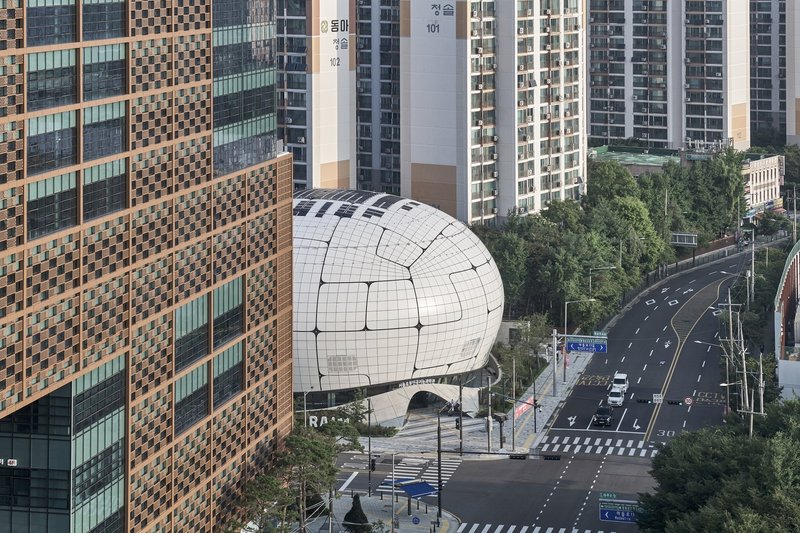
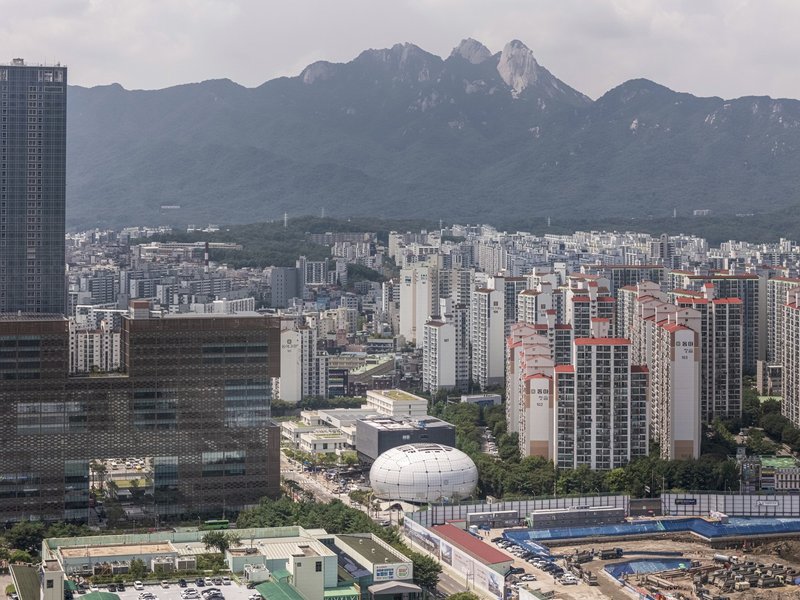
From the air, RAIM reads as a geological anomaly dropped into a tightly packed urban fabric of mid-rise apartments and commercial blocks. The building occupies a site of roughly 2,500 square meters, with a footprint of only about 1,430 square meters, so it sits compactly enough to leave breathing room for landscaped perimeter zones. The aerial perspective also reveals the curving roadway that wraps around the site, reinforcing a sense of the museum as a kind of island.
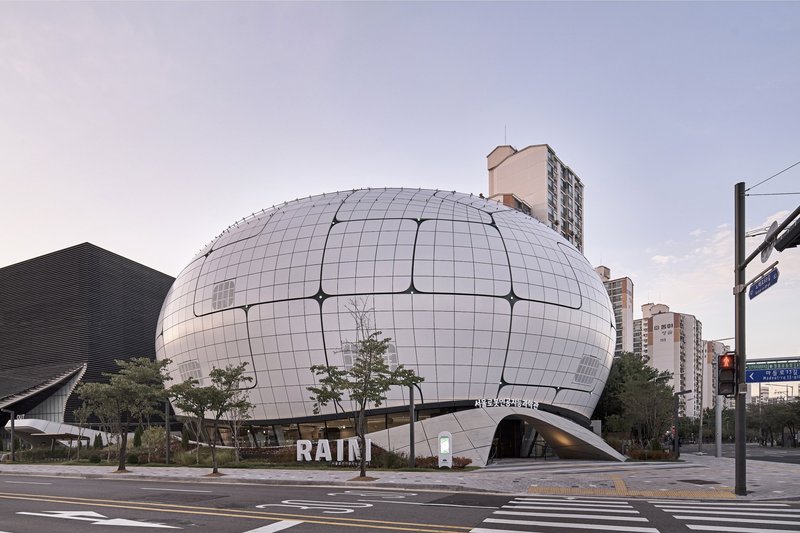
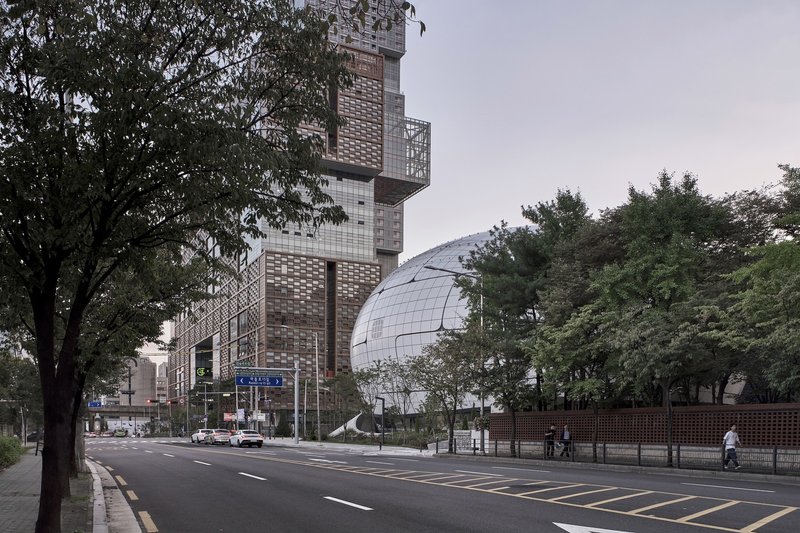
At street level the scale shift is dramatic. The dome rises above scattered trees and utility poles, its checkerboard pattern of metal panels catching light differently depending on the angle. Against the flat, repetitive facades of the surrounding towers, the sphere registers as genuinely alien. That tension is productive: RAIM announces a new district identity for Chang-dong, a neighborhood undergoing transformation and looking for a cultural anchor.
The Panelized Skin
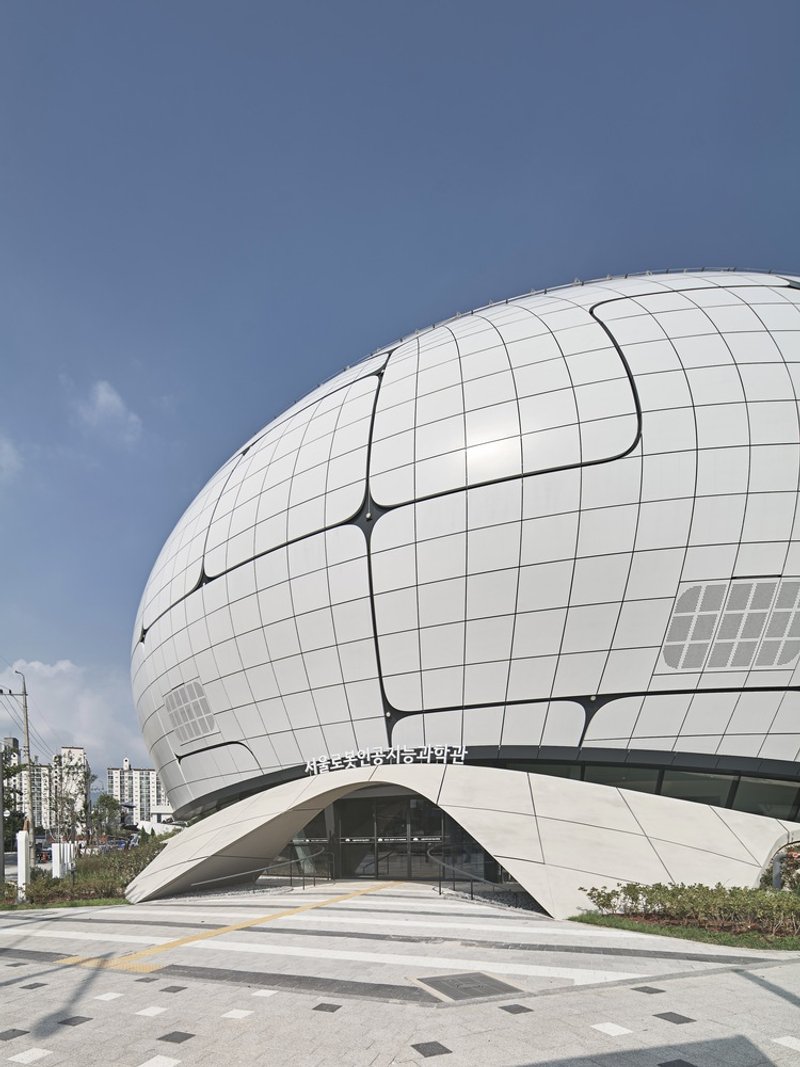
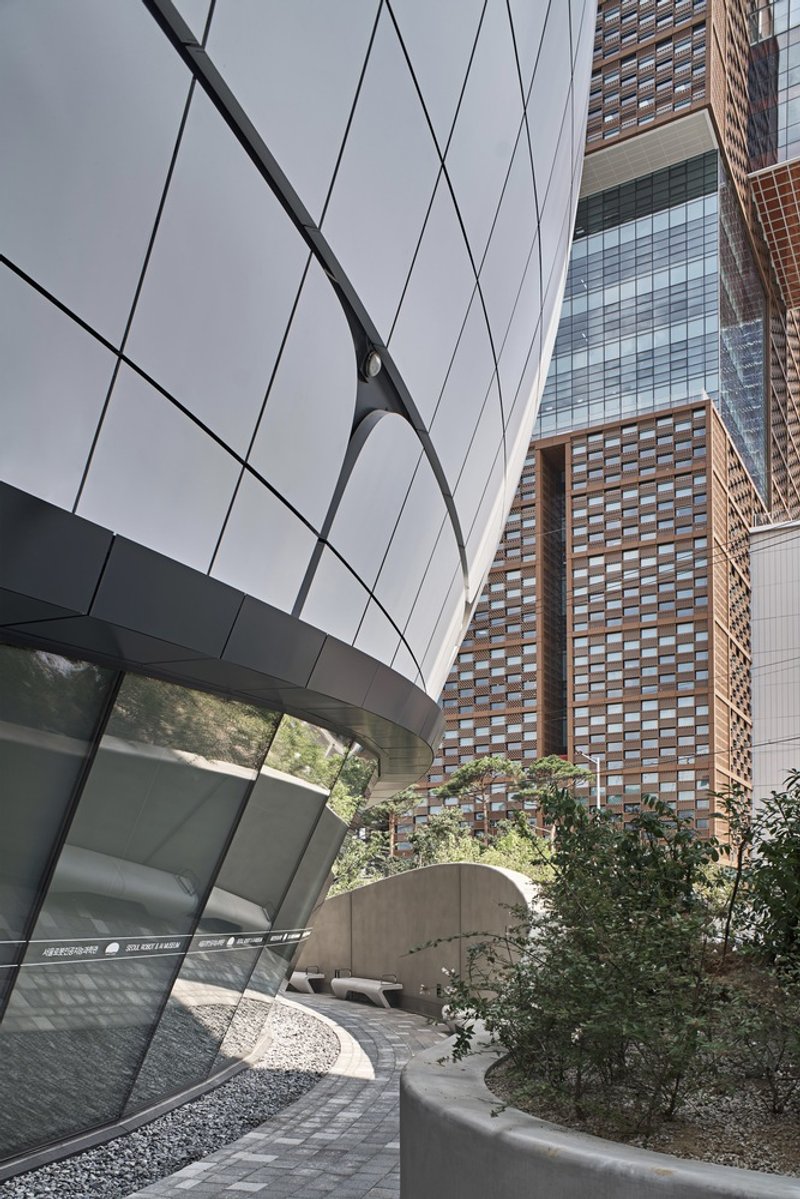
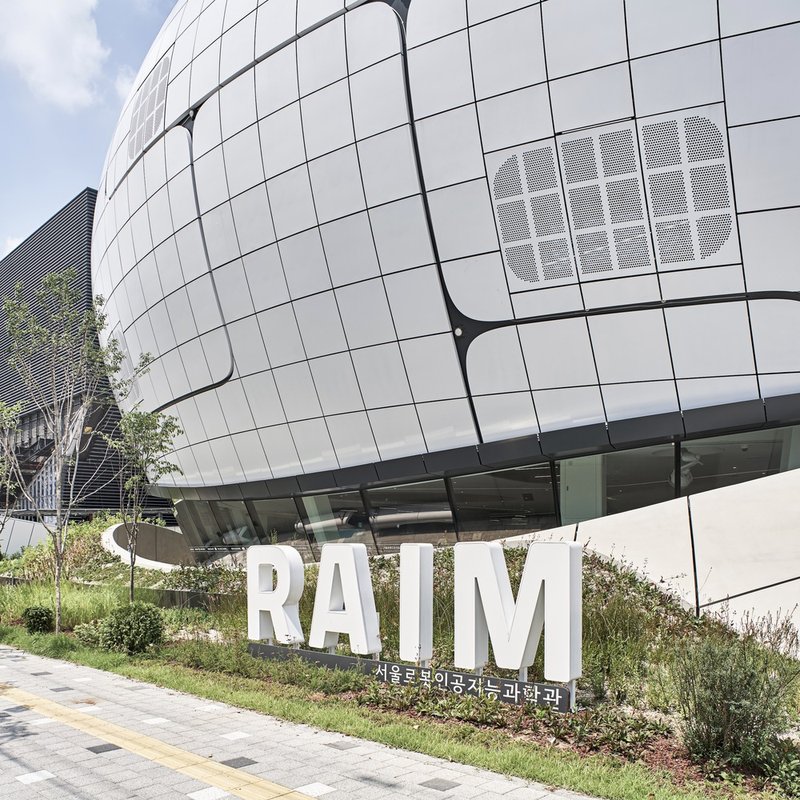
Get closer and the building reveals its seams. The 3,422 panels are arranged in a checkerboard logic with alternating surface treatments, creating a rhythmic texture that prevents the facade from reading as a single monolithic surface. Dark seam lines trace geodesic paths across the curvature, lending the whole form a slightly gridded, almost reptilian quality. In places the skin lifts to expose perforated ventilation screens; elsewhere it meets landscaped beds and concrete seating elements that anchor the sphere to the ground plane.
The fabrication sequence is the real story here. Each panel was digitally modeled, CNC-processed, and then robot-welded, with 3D scanning used to verify tolerances before assembly. This is Off-Site Construction (OSC) applied to a doubly curved geometry that would be punishing to build with traditional methods. The wing-shaped entrance gate, made of GFRC (glass fiber reinforced concrete), was installed in just eight days using the same prefabrication logic. The result is a facade that looks organic but is, in every measurable sense, industrial.
Entrance and Ground Floor
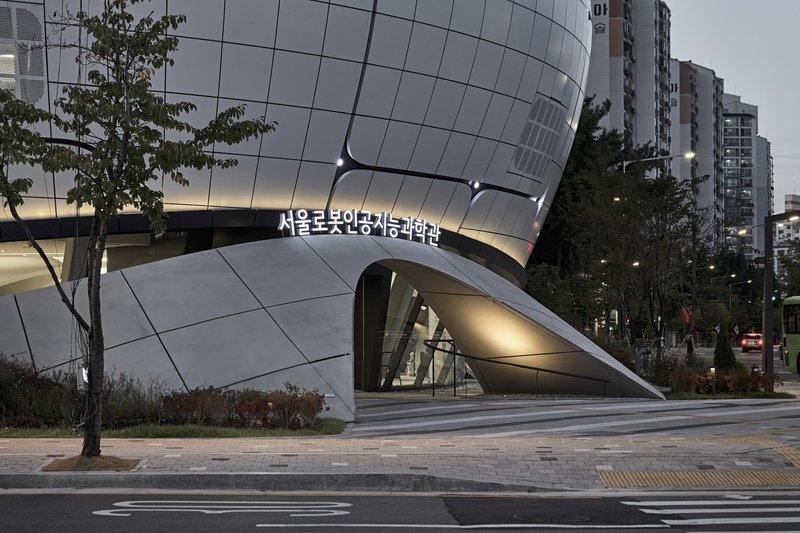
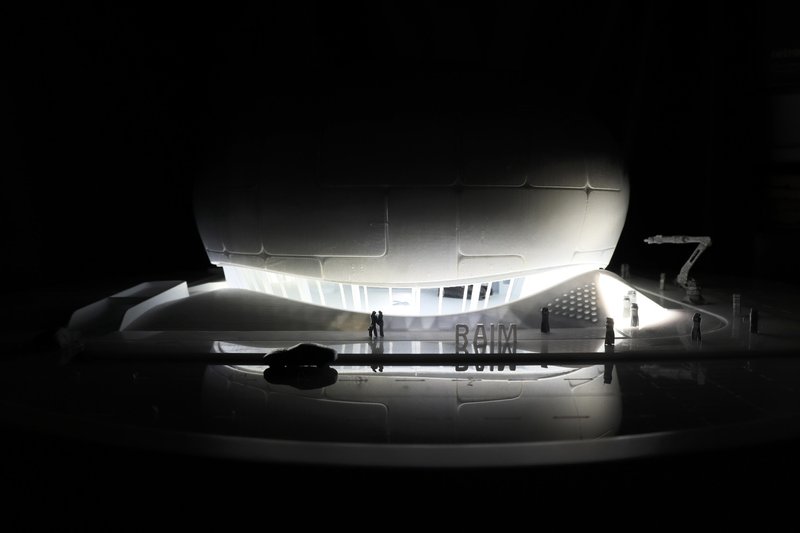
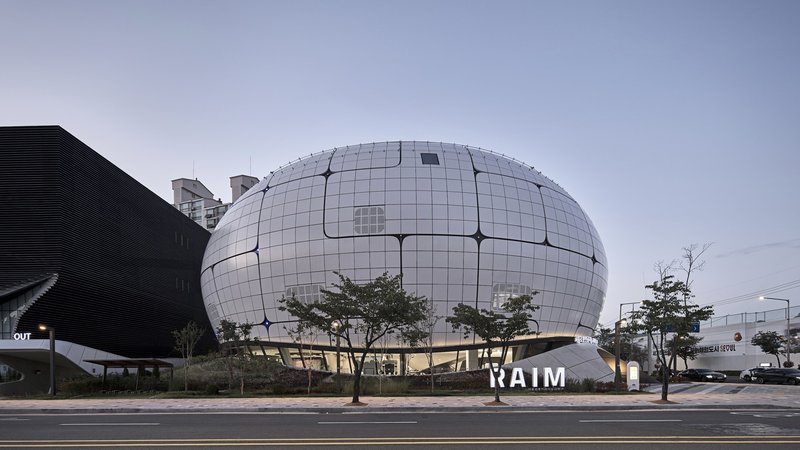
The museum's entrance condition is handled through a folded metal canopy that peels away from the main volume, creating a sheltered threshold between the street and the interior. At night, the canopy glows from within, and the silhouettes of visitors become part of the composition. The ground floor houses a cafe, shop, library, and entrance lobby, all organized around a strip of windows that lets daylight into the otherwise opaque sphere.
There is something generous about placing the social and commercial program at grade rather than burying it underground. Visitors entering for the first time encounter a public living room before committing to the exhibition journey above. The chequered brick tower visible in several views appears to be a neighboring structure, and the way the museum's smooth curves converse with that rougher texture gives the streetscape a layered, almost geological quality.
Interior Volumes
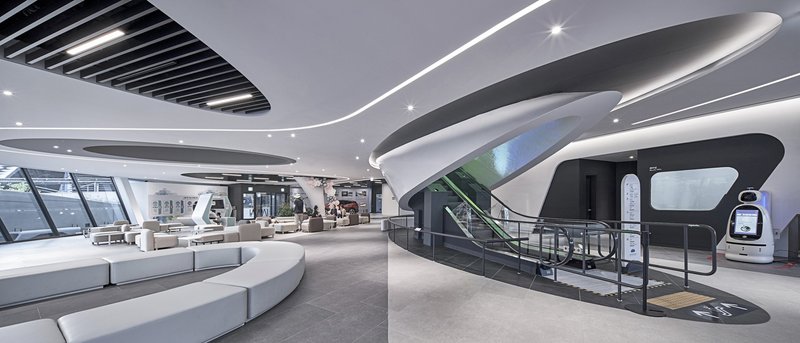
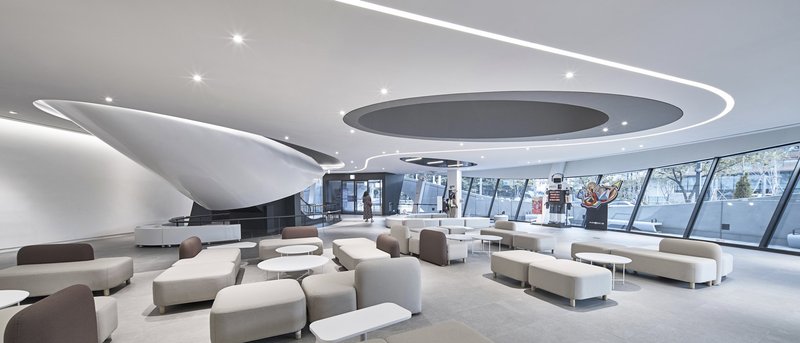
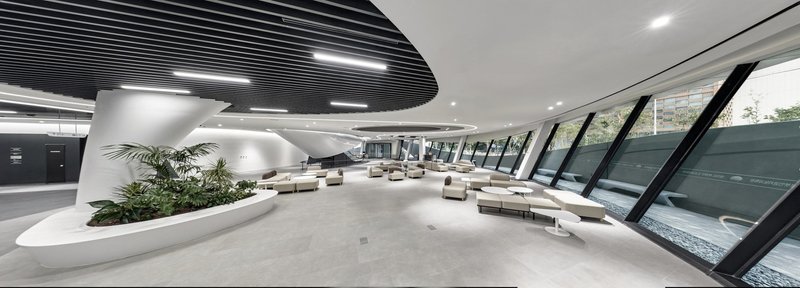
Inside, the ceiling undulates in sweeping white curves that mirror the exterior geometry. A tubular escalator rises from the lobby toward the upper exhibition levels, passing beneath a suspended black form that reads as a piece of infrastructure and sculpture simultaneously. This central vertical exhibition tunnel, built using aerospace and marine industry technologies, is the spine of the circulation system, pulling visitors upward through the building's core.
On the upper floors, the relationship between interior and exterior becomes more nuanced. Angled windows and slanted glazing panels offer selective views out while maintaining a cave-like enclosure for the galleries. Curved planters, ribbed ceilings, and modular seating zones soften the transition between exhibition areas and rest spaces. The lounge area with its curved ceiling cutout is especially effective, framing daylight as if it were another exhibit.
Gallery Spaces
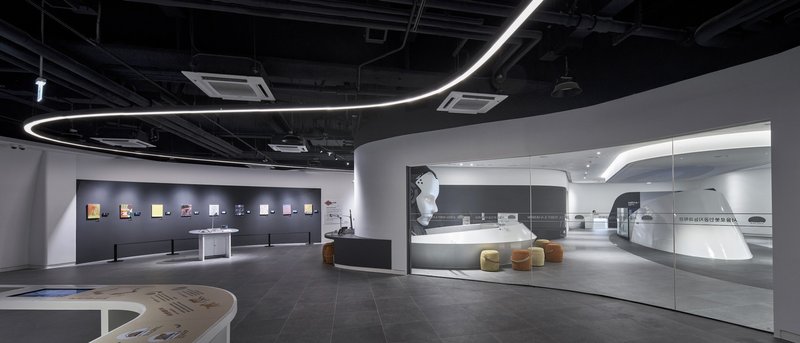
The third and fourth floors are dedicated to permanent and temporary exhibitions, and the gallery interiors are deliberately neutral: dark ceilings, curved lighting tracks, and white partitions that allow display cases and installations to dominate. The architecture steps back here, providing a controlled environment for curators rather than competing with the objects on show. The second floor, by contrast, houses education and administrative facilities, suggesting a clear vertical hierarchy from public spectacle at ground level to specialized programming above.
RAIM's strategic location near universities and research institutes in the Chang-dong area is not incidental. The building is designed to function as a bridge between academic research and public engagement, and the inclusion of educational facilities alongside exhibition galleries makes that ambition programmatically legible. Whether it succeeds in becoming a genuine research hub rather than a tourist attraction will depend on the institution's operations, but the architecture has at least set the table.
After Dark
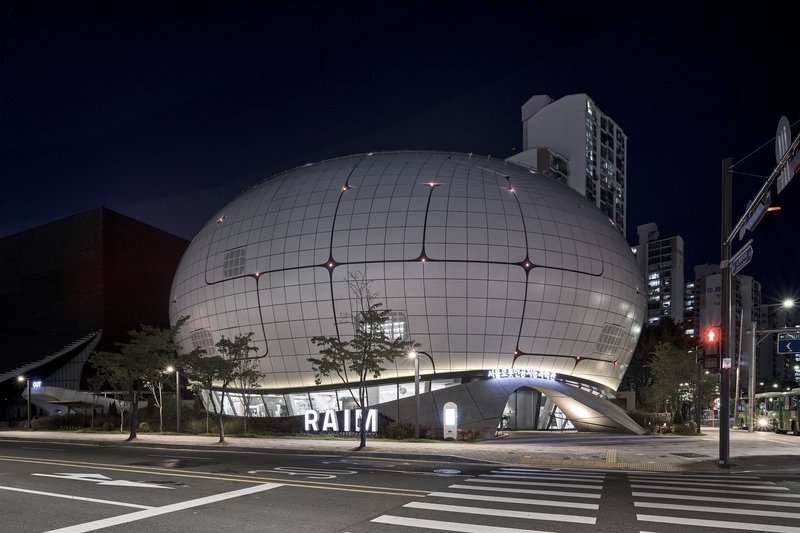
RAIM is arguably more compelling at night. The gridded metal panels transform from opaque white surfaces into a luminous membrane, with interior lighting bleeding through the seams to reveal the building's structural skeleton. The sphere becomes a lantern, a beacon in a residential neighborhood that otherwise dims after business hours. The night views also clarify the entrance sequence: the glowing canopy and interior warmth pull pedestrians toward the building with an almost magnetic effect.
Plans and Drawings

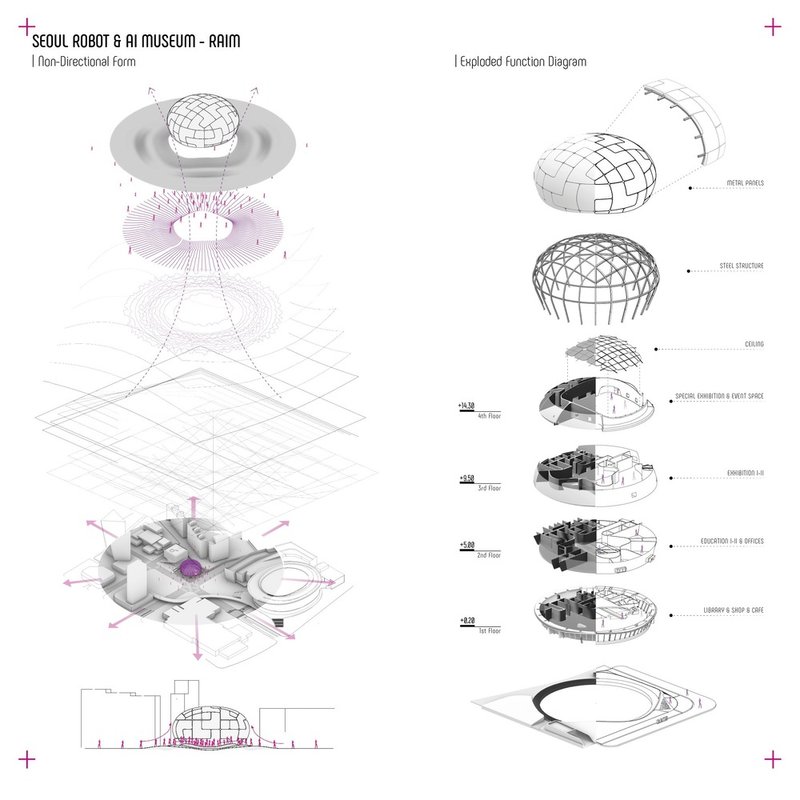
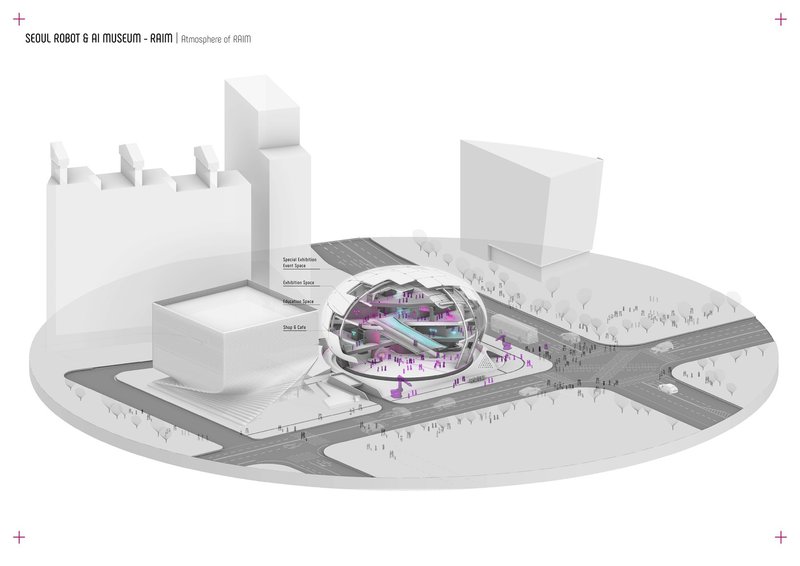
The exploded axonometric is the most revealing drawing in the set, breaking the building into its constituent layers: structural steel frame, floor plates, facade panels, and sectional relationships. It confirms that the sphere is not a pure geometry but a slightly elliptical form that accommodates different floor-to-floor heights as the program changes vertically. The physical model in dramatic lighting shows the segmented dome resting on a circular base with radiating folds, a hint at the GFRC entrance canopy's origami-like geometry.
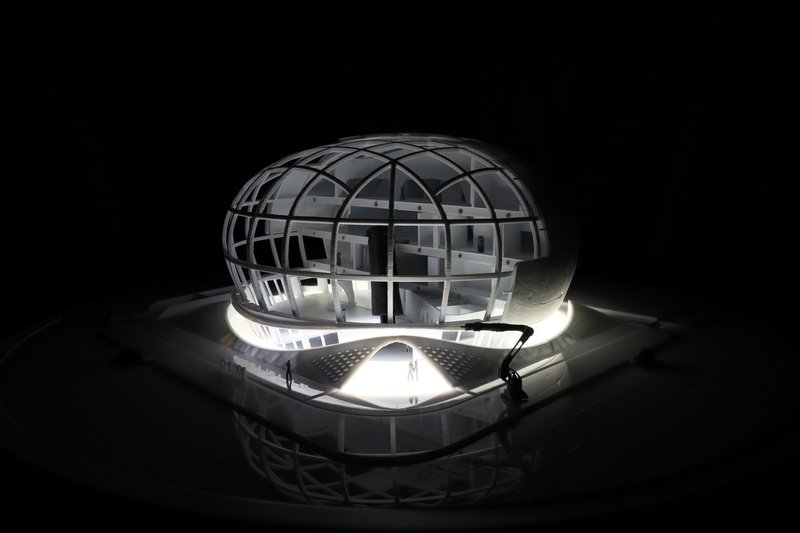
The site model with purple-highlighted interior volumes gives a clear read of how much of the building's bulk sits below grade. Two full basement levels of parking and services disappear beneath the landscape, allowing the above-ground form to appear lighter than its actual mass. The illuminated physical model reinforces this reading, with glowing interior cavities visible through the gridded skin.
Why This Project Matters
RAIM matters because it takes the logic of digital fabrication and makes it legible as architecture. Too many buildings that claim to be technologically advanced hide their innovations behind conventional finishes. Here, the construction technique is the aesthetic: robotic welding, CNC machining, and 3D scanning are not backstage processes but the visible language of the facade. The building is, in that sense, its own permanent exhibit, a demonstration of what happens when you let the tools of the Fourth Industrial Revolution shape the enclosure rather than merely facilitate it.
The larger question is whether a building this formally assertive can sustain public interest beyond its novelty. Museums thrive on programming, not geometry, and RAIM's long-term relevance will depend on its capacity to evolve its exhibitions and deepen its ties to the research community in Chang-dong. But as a proof of concept for robotically fabricated, computationally designed public architecture, it sets a high bar. Melike Altınışık Architects have delivered a building that does not merely house the future but performs it, panel by precisely welded panel.
Seoul Robot & AI Museum (RAIM) by Melike Altınışık Architects, in collaboration with Withworks A&E Architects. Chang-dong, Dobong-gu, Seoul, South Korea. 7,400 square meters. Completed 2024. Landscape architects: Green Culture, AU Landscape. Photography by Namsun Lee and MAA.
About the Studio
Share Your Own Work on uni.xyz
If projects like this are the kind of work you want to make, uni.xyz is a place to publish your own, find collaborators, and enter design competitions.



Popular Articles
Popular articles from the community

The Faith: Modular Architecture for Play, Learning, and Hope in Kutupalong Refugee Camp
A modular playground architecture project in Bangladesh where play, learning, safety, and hope rebuild childhood inside a refugee camp anew.
Milan Crossover: Sustainable Architecture for a New Fashion Culture in Milan
Milan Crossover transforms fashion culture through sustainable architecture, linking material libraries, remake studios, and public runways.

Reincarnation Weaves a Three-Story Retreat into the Green Landscape of Rural Bangladesh
Ara Manor in Narsingdi dissolves the line between domestic architecture and its lush surroundings through screens, courtyards, and planted rooftops.
IKC de Geluksvogel: Sustainable School Architecture Designed for Free Movement and Digital Learning
IKC de Geluksvogel turns sustainable school architecture into a flexible Maastricht campus for digital learning, nature, and free movement.


Similar Reads
You might also enjoy these articles

Olio Towers: A Mid-Rise for Performers That Fuses Housing, Rehearsal, and Stage
Located blocks from Houston's Theater District, this modular tower stacks living units around a central performance atrium.
Oasis: Modular Green Housing Carved into Dhaka's Urban Fabric
A shortlisted Plugin Housing entry reclaims unauthorized settlements in Dhaka with stepped concrete volumes, green roofs, and ventilation-driven design.

Black Hole: A Floating Megastructure for the Post-Physical Era
Emiliano Mazzarotto envisions a spherical, self-scaling arena where e-sports, digital hotels, and holographic stadiums replace traditional public space.
Compact & Sustainable Living in Piraeus: A Four-Level Family Home Built Around Light and Air
A narrow townhouse in one of Greece's densest port cities uses a central atrium and passive strategies to house three generations under one roof.


Explore Architecture Competitions
Discover active competitions in this discipline




The International Standard for Design Portfolios


The Global Benchmark for Architecture Dissertation Awards


The Global Benchmark for Graduation Excellence


Challenge to reimagine the Iron Throne
Comments (0)
Please login or sign up to add comments
No comments yet. Be the first to comment!