

Futuristic Service Stations: The Dawn of a New Era in Transportation Architecture
Explore "BACK TO THE FUTURE," an innovative concept redefining service stations with sustainable architecture and multipurpose facilities.


In the wake of urban expansion and technological advancement, our transportation infrastructures have beckoned for innovation that not only harmonizes with modern aesthetics but also serves practicality and sustainability. The "Service Station" project, aptly named "BACK TO THE FUTURE," Runner-Up entry of Overhaul stands at the forefront of this revolution, embodying a leap into a realm where design, functionality, and environment coalesce.

The Genesis of the Concept
The visionary minds behind "BACK TO THE FUTURE" – Lizaveta Vizner and Aliaksandra Rapeiko – have unveiled a service station concept that is a marvel of architectural innovation. This concept breaks the traditional mold, presenting a universal service station adaptable to various environments. The project resonates with the need for spaces that save not only room but also the time of the users, reflecting a deep understanding of the urban fabric and its intricate dance with vehicular motion.
Structural Integrity and Environmental Considerations
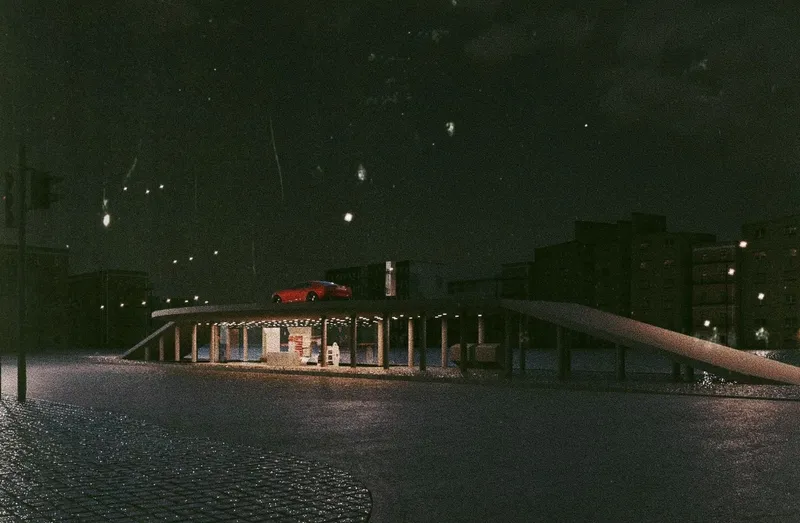
At the heart of the concept lies the structural ethos of steel and concrete. These materials are celebrated for their strength and flexibility, forming the backbone of a lightweight yet sturdy construction that gracefully carves out its presence. The station itself, a sanctum of steel and glass, stands as a testament to minimalist elegance. It's not just a service station; it's a panoramic viewpoint that acknowledges and enhances the environment's visual aspects.

A Multipurpose Haven for Travelers
Envisioned as a multifaceted haven, "BACK TO THE FUTURE" service stations promise to cater to all car-related utilities such as gas and electricity charging stations, and even extend their warm embrace to weary travelers seeking respite in a café or other convenience facilities. This is not merely a pit-stop; it is a destination where convenience meets necessity.
The Architectural Flow of Efficiency
One of the most compelling features of this design is its elevated architecture. It promises an optimized use of space, allowing vehicles to utilize ramps leading to service areas, thus freeing up valuable ground space. This architectural maneuver is twofold in its benefits: it facilitates quicker service times and mitigates traffic congestion, thus addressing two critical urban challenges.

Redefining Spaces for Commerce
Beyond servicing vehicles and their owners, "BACK TO THE FUTURE" stations are envisioned as hubs of commercial opportunity. The space beneath the stations opens a new realm for other commercial uses, potentially becoming hotspots for markets, pop-up events, or even community gatherings, redefining the utility of service stations.
The Visual Narrative
The provided visualizations of the project offer a narrative of growth and development, each image a storyboard of innovation coming to life. From the foundational steps of laying out the primary structure to the integration of service elements and green spaces, these images depict the project's metamorphosis from concept to concrete reality.
"BACK TO THE FUTURE" serves as a blueprint for futuristic service stations, marrying the elegance of modern architecture with the pressing need for efficiency and environmental mindfulness in our urban landscapes. As we step into the future, such projects herald a new chapter in transport architecture, one that promises a journey as pleasant as the destination itself.
In our pursuit of architectural excellence, we must strive to create structures that not only stand the test of time but also anticipate the needs of the future. With projects like "BACK TO THE FUTURE," we are well on our way to reimagining the fabric of our cities and the arteries that keep them alive. Let us embrace this transformative vision and propel our infrastructures into a future where innovation knows no bounds.


Popular Articles
Popular articles from the community


Manzana Morphosis: Stretching Barcelona's Grid into a Living Landscape for 2050
A radical reworking of the Eixample manzana turns density into a tool for generous public space, vertical ecology, and environmental performance.
Opera by the Sea Estonia: Three Shells Dissolving Architecture into Tallinn's Coastline
A winning opera house proposal replaces monumental form with interconnected shells that blur the boundary between building, park and Baltic Sea.

Extended Shell: Retrofitting Kolkata's Balconies as Living Urban Thresholds
A modular retrofit system recovers the social and environmental intelligence of Kolkata's historic verandas for contemporary Park Street residents.
Temporary Home for Dogs: A Reversed Zoo Rethinks Animal Shelter Architecture
In Bucharest, a sinuous corridor and freed landscape flip the logic of containment, designing a shelter that works to make itself unnecessary.

Similar Reads
You might also enjoy these articles

Shakur's House: Exposed Brick as an Interior Organiser in a 168 m² Mashhad Residence
Brick moves indoors in this Mashhad residence, where masonry walls, glass partitions and teal planes sequence a compact home without closing it off.

Day and Night Park: A Time-Based Urban Newsstand in Beijing
A temporary urban newsstand in Beijing blending travel, light, and reading through poetic colors, compact form, and community-focused design.

Modernist Patio Renovation in El Masnou, Barcelona by Oliver Segura Arquitectura + Cebrià Arquitectura
Modernist patio renovation blending tradition and innovation with a movable pool, leveled floors, and Catalan materials in El Masnou.

Alto Residencial Coop: Cooperative Housing Development in Santiago de Compostela by Carbajo Barrios Arquitectos
A linear cooperative housing complex blending white volumes and perforated metal façades, enhancing community living, natural light, privacy, and urban integration.

Explore Futuristic Design Competitions
Discover active competitions in this discipline

Challenge to reimagine the Iron Throne

Photograph architecture without architects

Illustrate the lost glory of Angkor Wat - Render Challenge

Design challenge to reuse E-waste
Comments (0)
Please login or sign up to add comments
No comments yet. Be the first to comment!