

Gallareta House by OJA: A Harmonious Retreat in Patagonia’s Native Forest
Gallareta House by OJA blends sustainable modular cabins with Patagonia’s forest, offering immersive, minimalist retreats using natural materials.


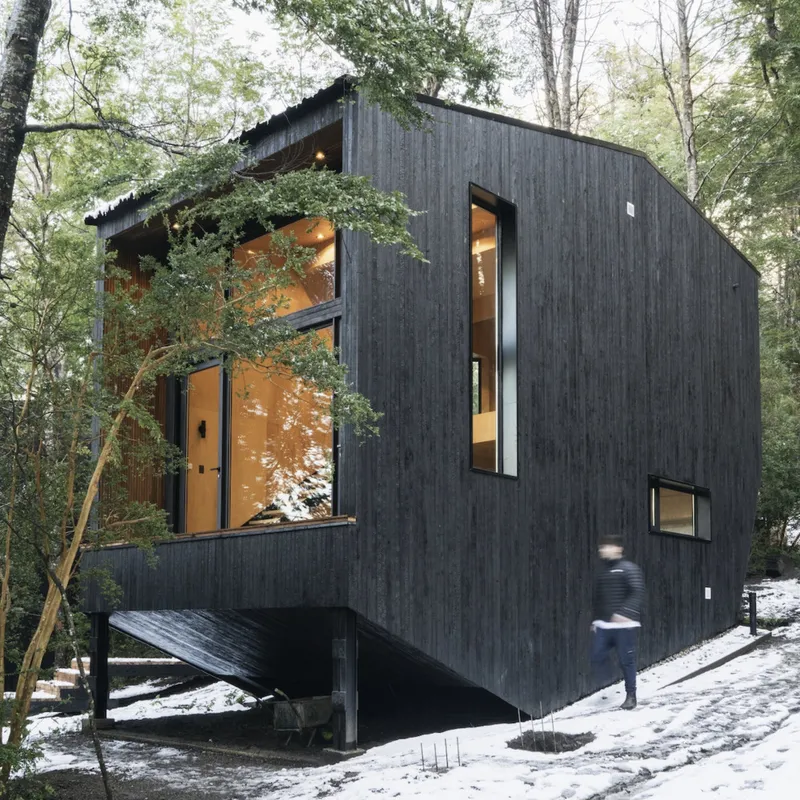
Gallareta House, designed by OJA (Organic and Joyful Architecture), is a captivating example of sustainable and context-sensitive architecture nestled in the heart of Villa La Angostura, Patagonia, Argentina. Completed in 2023, this 250 m² boutique-scale tourist complex blends seamlessly into the breathtaking landscape of Coihues and Arrayanes trees on the shores of Lake Correntoso.
A Deep Connection to Place
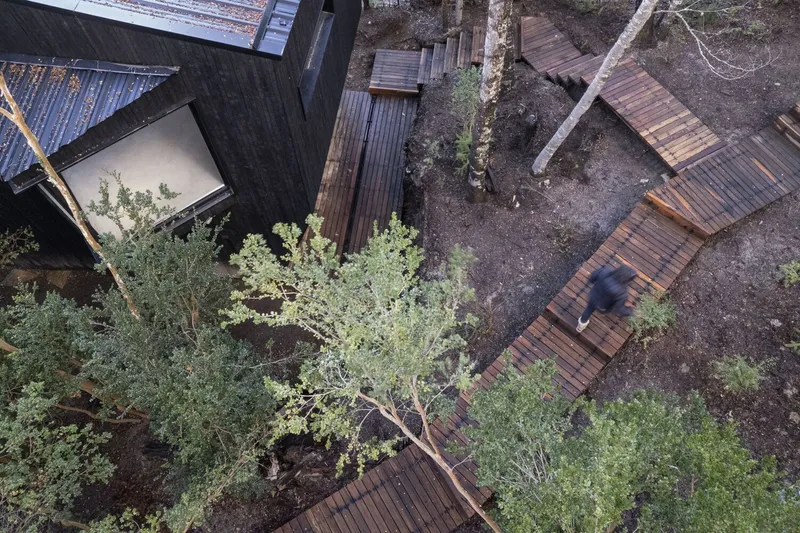
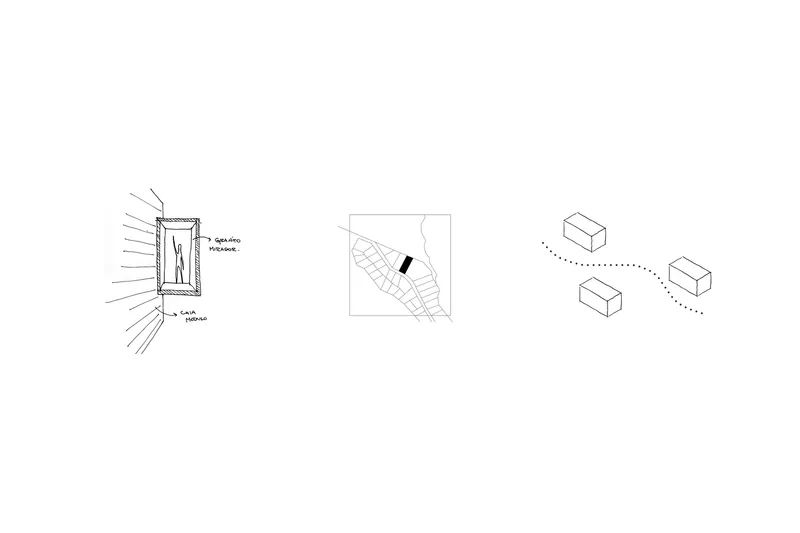
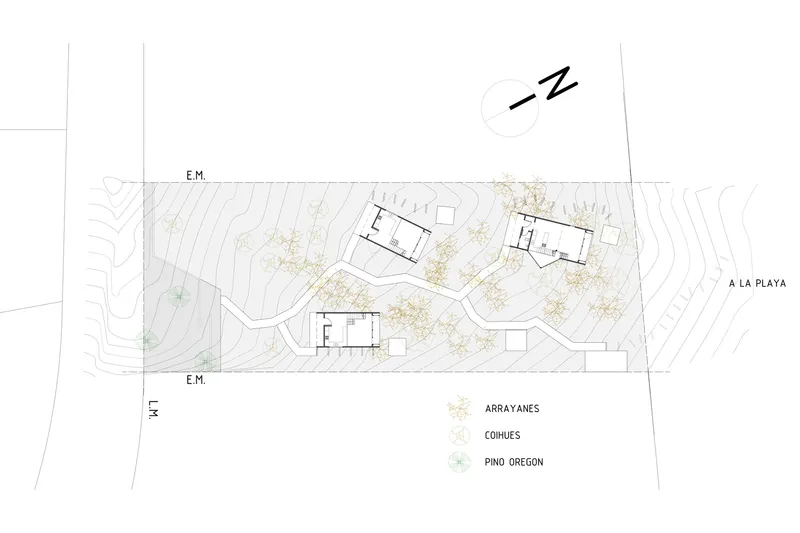
The project holds a deeply personal resonance for architect Juan Segundo Diaz Dopazo, who grew up in Patagonia, and his partner, María Ayelén Olivieri Martinez. Their firm, OJA, approached the design of Gallareta House with the goal of creating architecture that not only respects but coexists with the native forest. Without cutting down a single tree, they inserted a collection of “landscape cabins” into the gaps between the vegetation, achieving a delicate balance between human presence and nature.
Designing with Nature
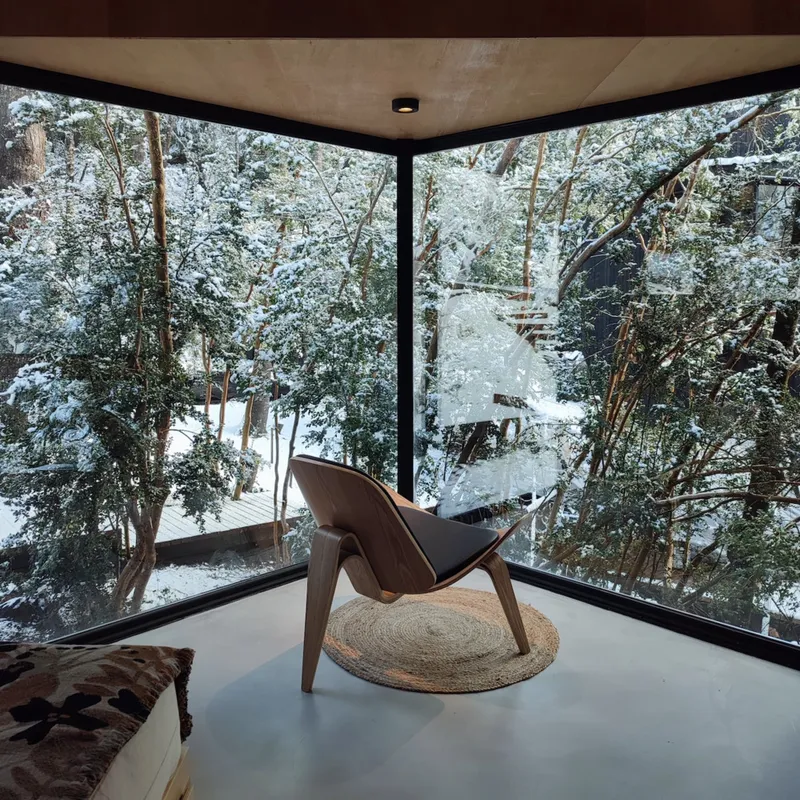
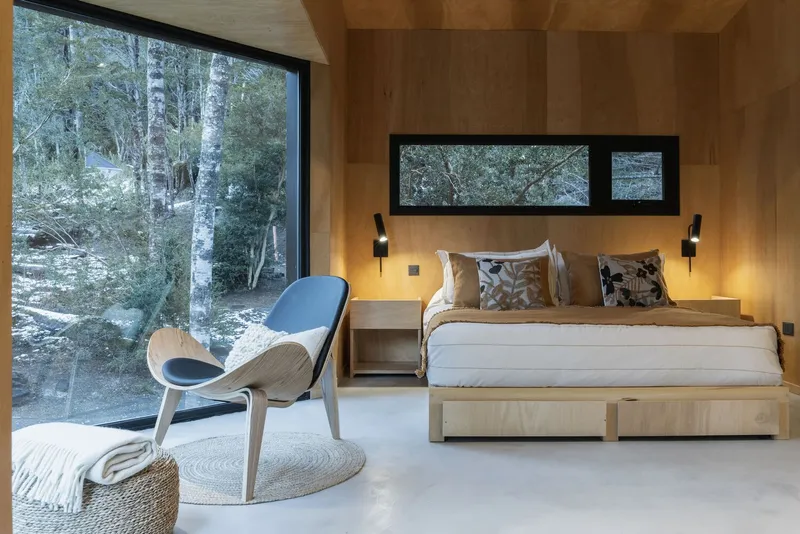
The complex features modular cabins designed for two or three people, each carefully positioned in vacant spaces within the forest. These half-floor monospace cabins are unified by a shared architectural language yet maintain subtle differences to preserve a sense of individuality. Large, strategically placed windows extend sightlines into the surrounding landscape, drawing in light filtered through the dense Myrtle tree canopies. This design strategy blurs the boundary between indoors and outdoors, offering guests a true immersive forest experience.
Crafting Comfort and Privacy
Inside, the cabins are warm and inviting. The largest unit features a freestanding bathtub placed by a picture window, offering stunning views of the snowfall—a moment of serene luxury in the wild. The spacious and thoughtfully designed bathrooms enhance comfort without compromising the compact cabin footprint.
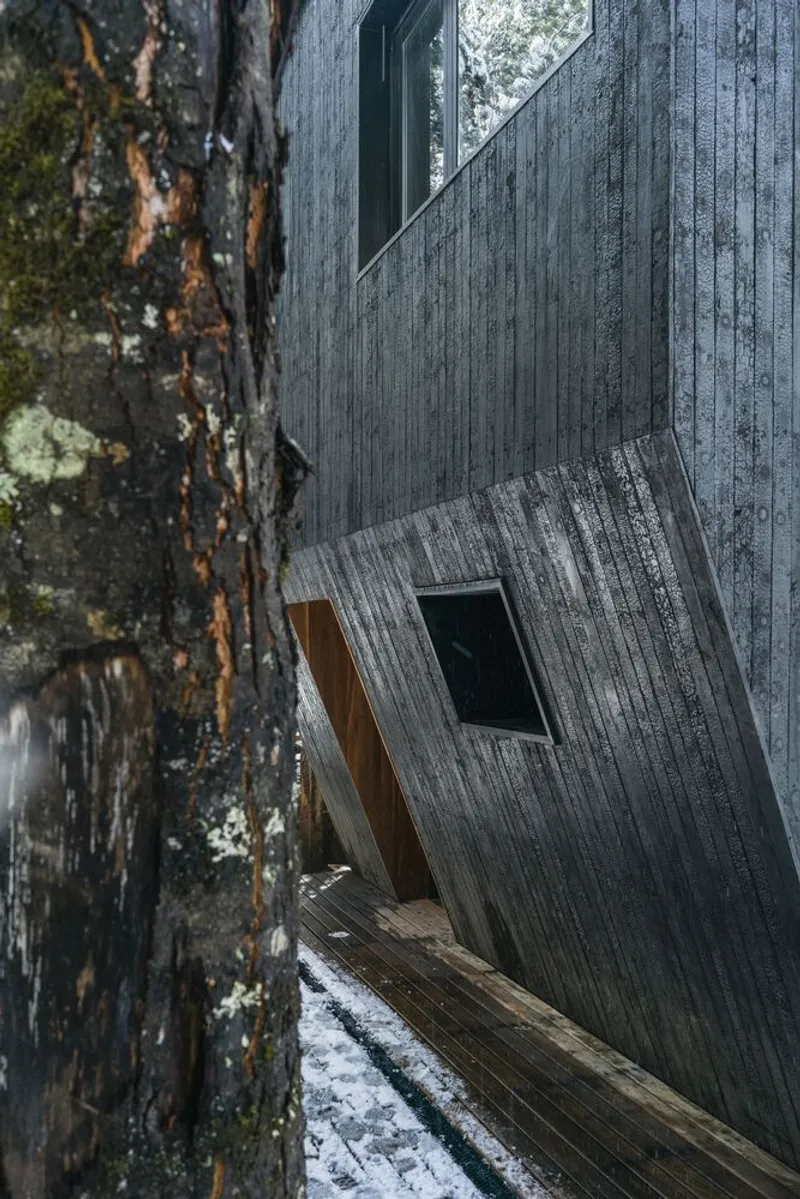
To manage the challenges of a steep slope and narrow site, the architects employed dry construction on reinforced concrete foundations, ensuring minimal impact on the terrain. The result is a complex that feels light on the land yet deeply rooted in its environment.
Materials: Tradition Meets Innovation
The exteriors of the cabins are clad in Shou Sugi Ban-treated eucalyptus, a traditional Japanese technique of charring wood to improve durability, water resistance, fire retardancy, and sustainability. The blackened wood contrasts beautifully with the vibrant greens of the forest and the winter snow, while additional touches of Lapacho wood, black zinc detailing, glass, and exposed concrete enrich the material palette.
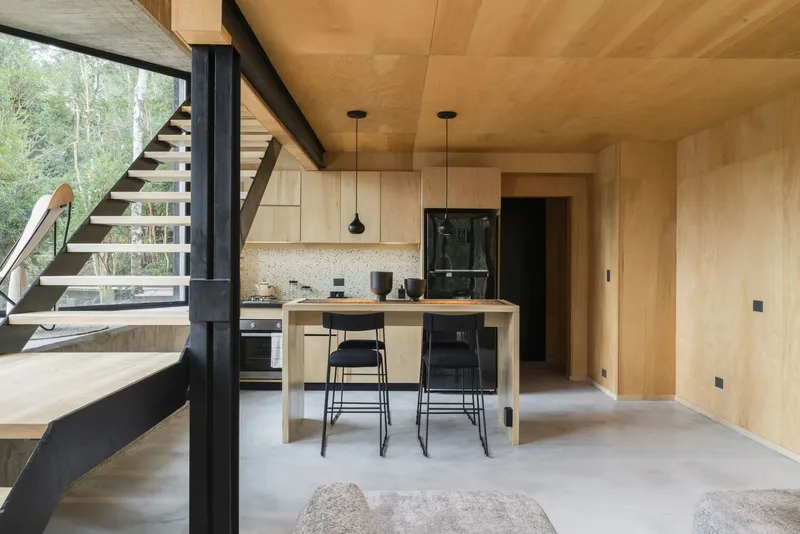
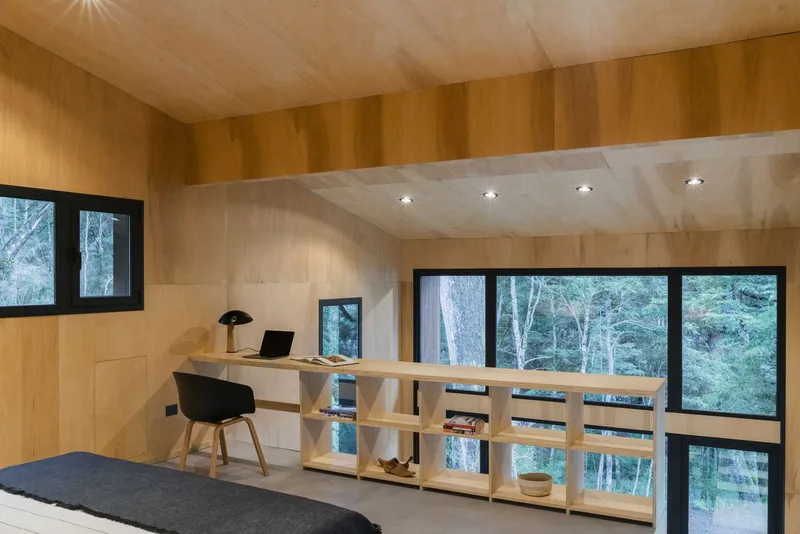
Inside, a continuous surface of Guatambú wood—a pale, knot-free material—creates a bright, spacious atmosphere that contrasts with the dark exterior. Custom Guatambú furniture reinforces the monolithic and minimalist feel, virtually dissolving the boundaries between walls and furnishings.
A Model for Sustainable and Joyful Living
Gallareta House is more than just a destination; it’s a model for sustainable architecture that honors its natural setting. By prioritizing minimal environmental impact, using local and durable materials, and offering immersive experiences within nature, OJA has crafted a project that speaks to both heart and habitat.
All Photographs are works of Juan Segundo Diaz Dopazo


Popular Articles
Popular articles from the community


Juan García Correa, John González and Claudia Rueda Sink a Circular Amphitheater into a Manizales Engineering Building
On the La Nubia campus in Manizales, Colombia, the S1 Building folds labs and offices into a hillside of ramped lawns that double as a campus route.

David Macias Steps a Doorless Stone and Plaster House Down a Tropical Colombian Hillside
In the humid hills of Colombia, Threshold House replaces the front door with an open void and terraces its 850 m² down the slope instead of fighting it.

GROUP A Strips a 1969 Rotterdam Harbor Headquarters to Its Frame and Wraps It in Timber Louvers
In Rotterdam's M4H harbor district, Ferro Offices reuses a 1969 frame, adds one timber storey and reaches BREEAM-NL Outstanding.

Cube Design Draws an Ecological Corridor Between Two Shenzhen Hills with the Nankai Building
Beside Shenzhen's container docks, the Nankai Building pairs stacked balconies with a climbing green screen to connect two hillsides across its height.

Similar Reads
You might also enjoy these articles


Hodi-Mandai Geram
Project Function: Preservation and revitalization of the Intangible heritage and socio-spatial identity of the Hodi by Housing, Cultural Memory Center, Sacred Grove, landscape, local tourism economy


Olio Towers: A Mid-Rise for Performers That Fuses Housing, Rehearsal, and Stage
Located blocks from Houston's Theater District, this modular tower stacks living units around a central performance atrium.

Oasis: Modular Green Housing Carved into Dhaka's Urban Fabric
A shortlisted Plugin Housing entry reclaims unauthorized settlements in Dhaka with stepped concrete volumes, green roofs, and ventilation-driven design.

Black Hole: A Floating Megastructure for the Post-Physical Era
Emiliano Mazzarotto envisions a spherical, self-scaling arena where e-sports, digital hotels, and holographic stadiums replace traditional public space.

Explore Architecture Competitions
Discover active competitions in this discipline

Challenge to reimagine the Iron Throne

Photograph architecture without architects

Illustrate the lost glory of Angkor Wat - Render Challenge

Design challenge to reuse E-waste
Comments (0)
Please login or sign up to add comments
No comments yet. Be the first to comment!