
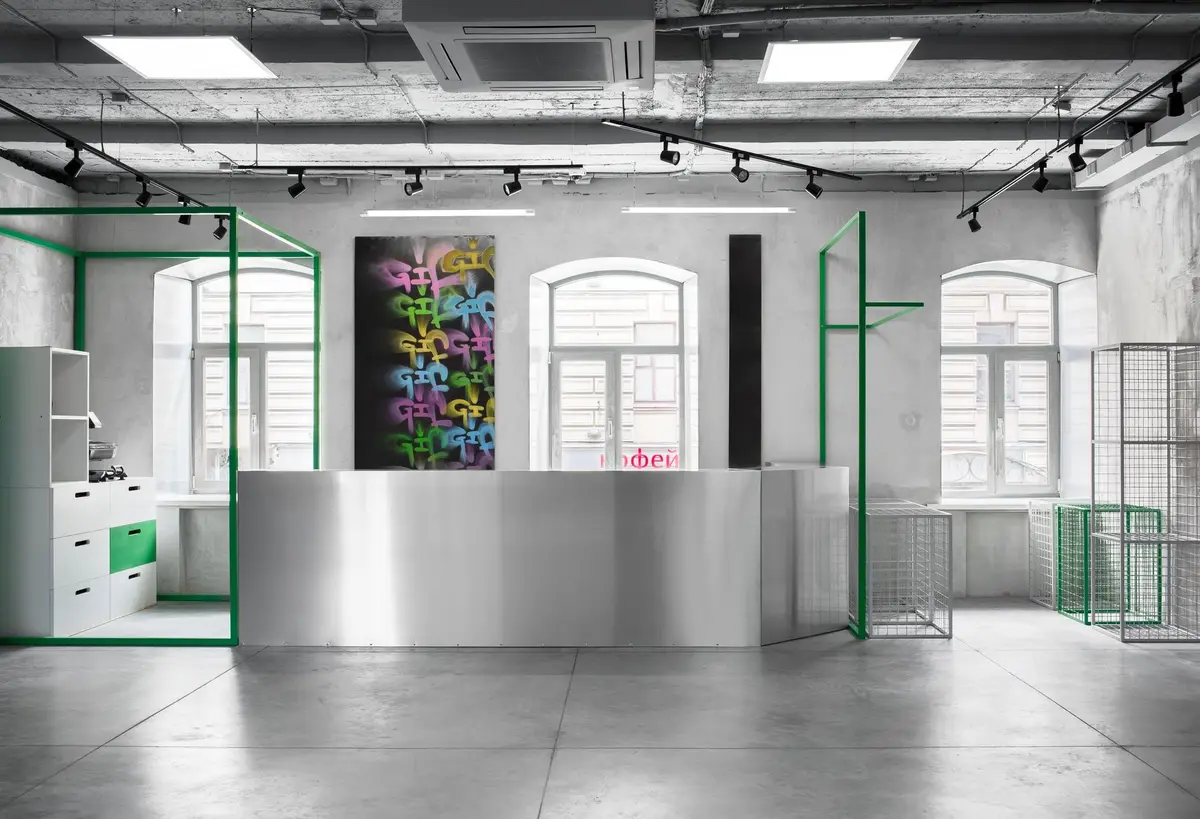
Gallery Gif – Adaptive Retail Architecture
An adaptive retail architecture project transforming a former café into a dynamic showroom where brands, exhibitions, and community converge.


Jury Commendation, Interiors ‘20
Gallery GIF emerges as a precise exploration of adaptive retail architecture, where spatial flexibility, minimal intervention, and programmatic hybridity redefine the conventional showroom. Designed by Сергей Питерский, the project transforms a former café into a multi-brand exhibition environment that operates simultaneously as a retail platform, cultural venue, and community interface.
The original interior was stripped down to its bare structural shell. Floors, ceilings, walls, and outdated utilities were completely dismantled, allowing for a fresh spatial logic to be introduced. This process was not merely demolition, but a deliberate architectural reset that enabled the design team to construct a new identity from first principles. Working within tight budgetary and temporal constraints, decisions were made rapidly and executed in parallel, reflecting an agile design-build methodology.
Spatial Flexibility as a Core Design Strategy
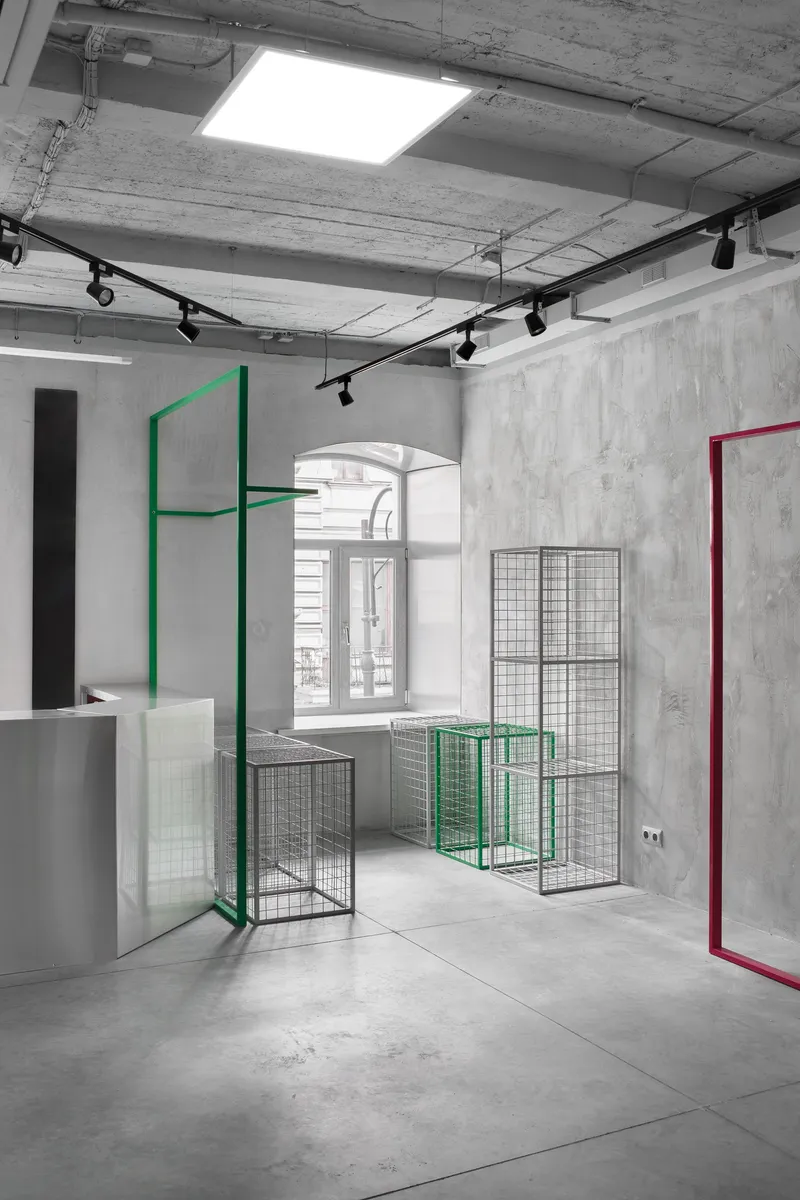
At the heart of this adaptive retail architecture project lies mobility. The client envisioned a showroom that could continuously evolve, accommodating different brands, exhibitions, and events without requiring structural modifications. In response, the design prioritizes open spatial planning, leaving the central area unobstructed to support presentations, lectures, masterclasses, and temporary installations.
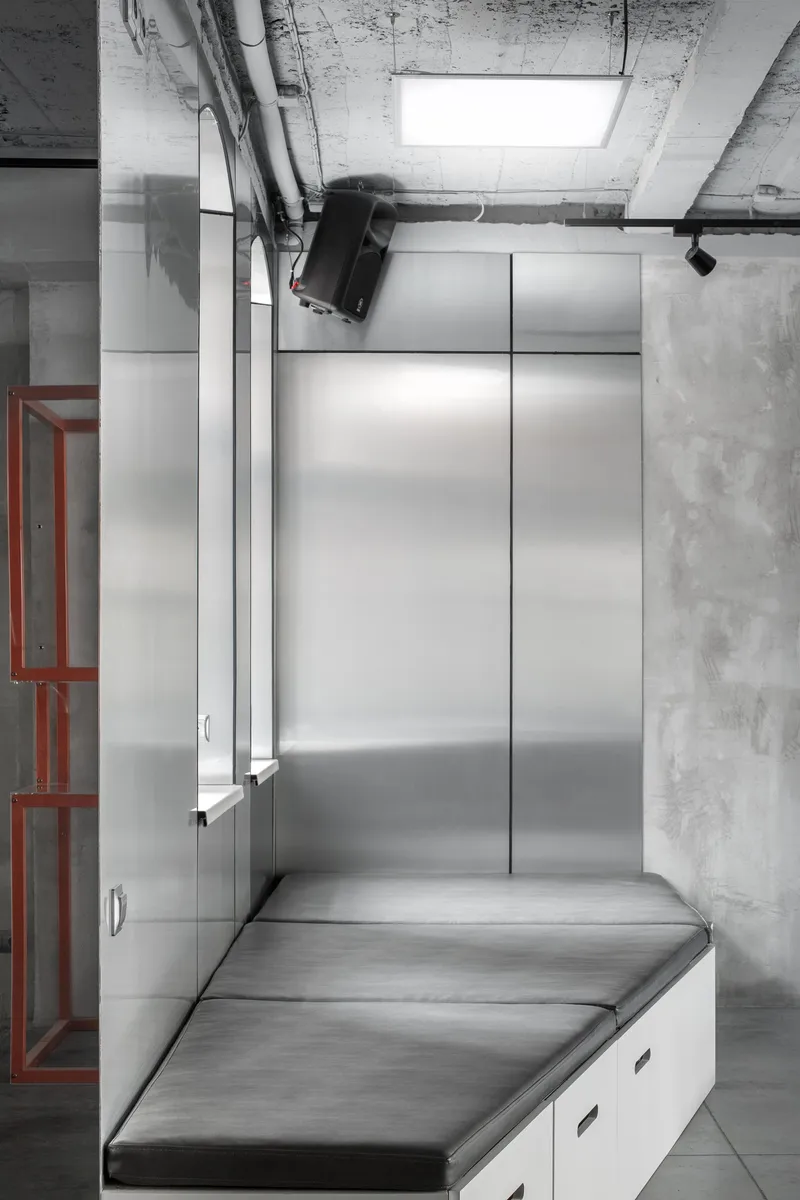
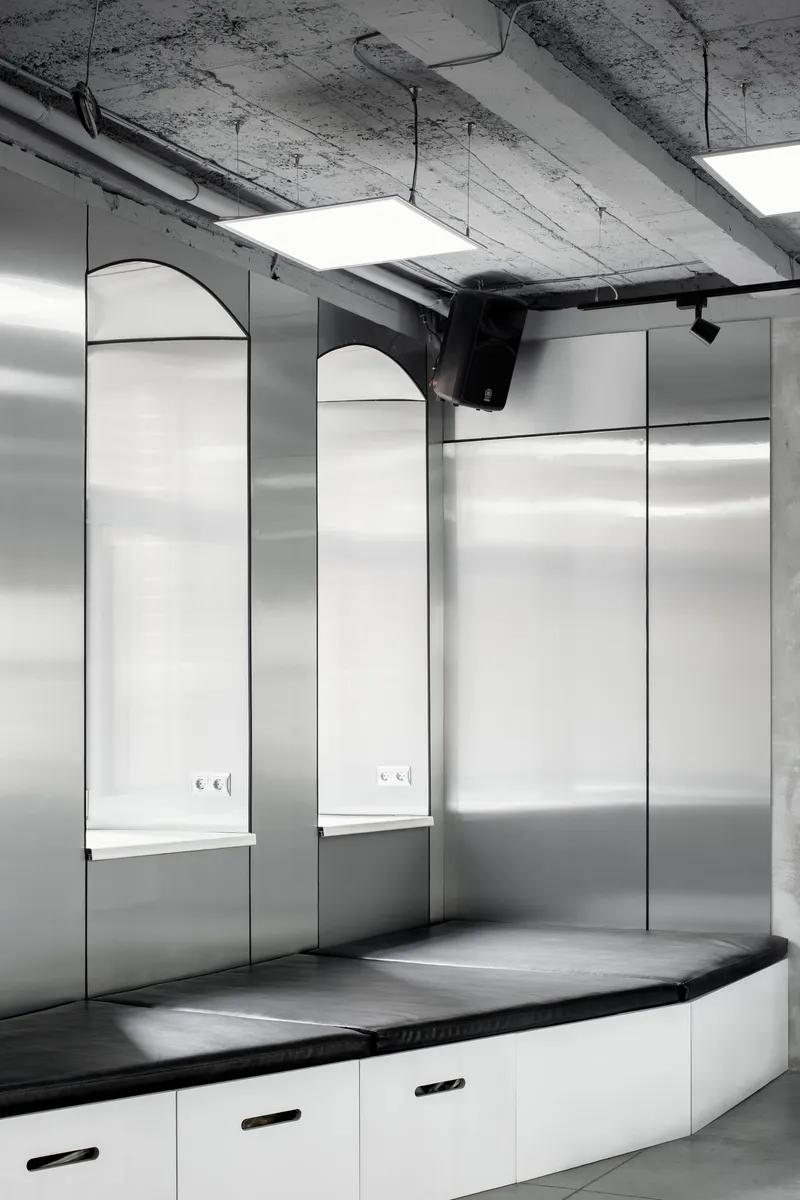
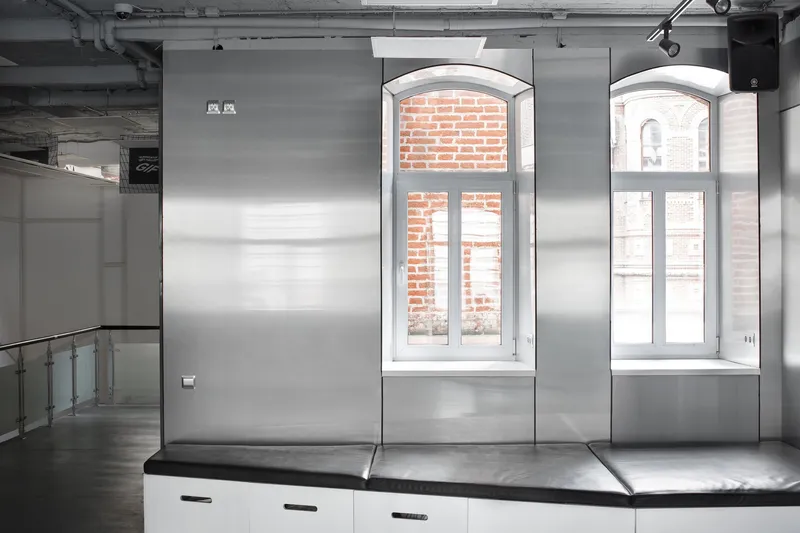
A soft pedestal seating system anchors this central zone. Beyond its primary function, it integrates concealed storage, reinforcing the project’s emphasis on multifunctionality. This approach transforms static furniture into active architectural components, capable of adapting to changing use scenarios.
Modular Display Systems and Visual Identity
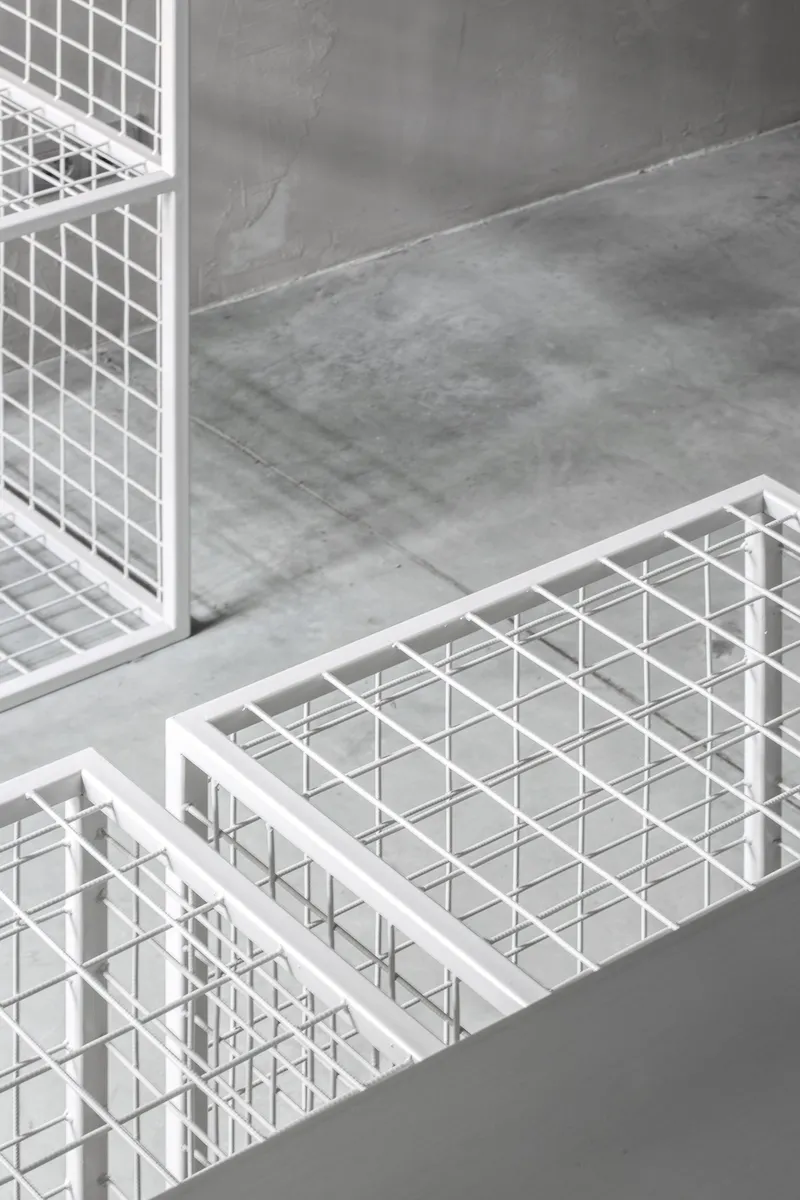
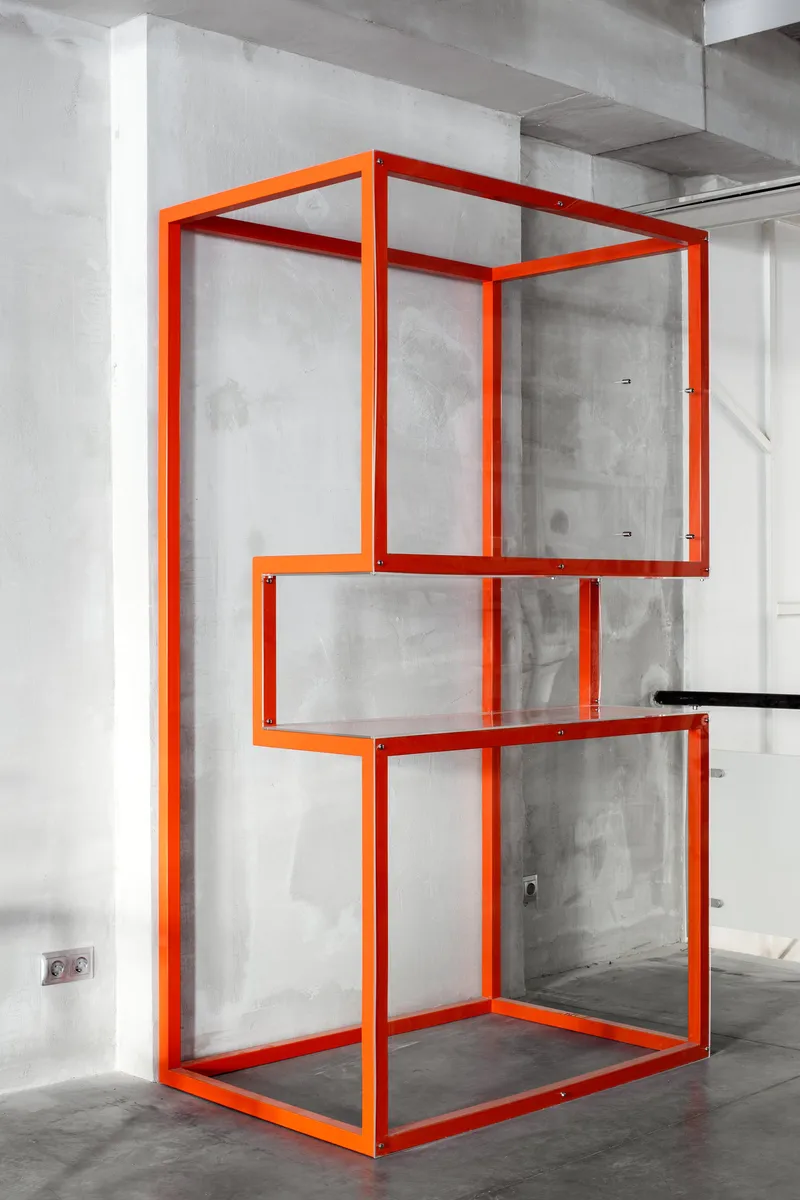
The perimeter of the showroom is defined by a series of custom-designed metal exhibition stands. Each unit is tailored for specific brands, enabling distinct identities to coexist within a unified spatial framework. Color becomes a critical tool here. While the architectural envelope remains deliberately monochrome, individual stands introduce vibrant hues, allowing each display to function as an independent visual object.
This contrast between neutral architecture and expressive elements is a key characteristic of adaptive retail architecture. It ensures that the space remains timeless and flexible, while branding can evolve independently. The modular nature of these stands also allows for reconfiguration, ensuring long-term usability and relevance.
Material Strategy and Minimal Intervention
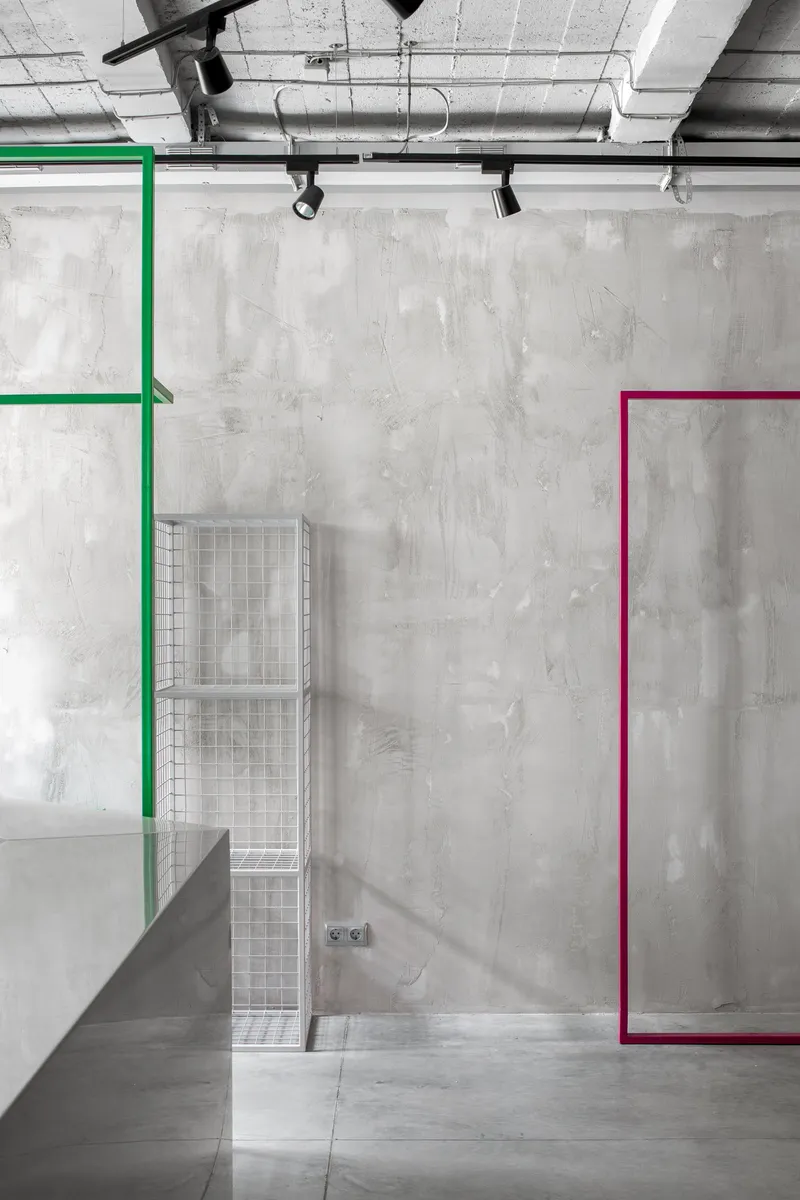
Material selection reinforces the project’s conceptual clarity. Concrete, plaster, and metal dominate the palette, creating a raw and industrial aesthetic that foregrounds the objects and installations within the space. This restrained approach reduces visual noise and enhances the legibility of temporary exhibits.
Minimalism here is not purely stylistic. It extends to the implementation process itself. By limiting material complexity and construction layers, the project achieves efficiency in both cost and time. The result is a space that feels intentionally unfinished, yet highly controlled in its architectural expression.
Lighting as an Adaptive System
Lighting plays a critical role in maintaining the flexibility of the showroom. Ceiling-mounted track systems with adjustable spotlights allow for dynamic reconfiguration of light accents. As exhibition stands shift or new installations are introduced, the lighting can be recalibrated without invasive modifications.
This adaptability ensures that each configuration of the space can be optimized visually, reinforcing the narrative of each brand or event. The lighting system, therefore, acts as an extension of the architectural framework, supporting continuous transformation.
Hybrid Program: Retail Meets Exhibition
Gallery GIF operates at the intersection of retail and exhibition design. It challenges the traditional boundaries between commercial and cultural spaces, proposing a hybrid typology where products are displayed with the same curatorial intent as artworks.
The inclusion of event-based programming further amplifies this hybridity. The space is not limited to passive consumption but encourages interaction, learning, and community engagement. This shift reflects broader trends in adaptive retail architecture, where experience becomes as important as transaction.
A Platform for Emerging Brands
Beyond its architectural qualities, the project functions as an ecosystem for young local brands. By providing a flexible and visually coherent platform, Gallery GIF enables designers to present their work in a professional yet experimental context.
The modular infrastructure supports rapid turnover and variation, allowing multiple brands to coexist and evolve within the same space. This adaptability ensures that the showroom remains relevant over time, continuously refreshed by new content and perspectives.
Gallery GIF demonstrates how adaptive retail architecture can transform constraints into opportunities. Through strategic minimalism, modular systems, and spatial flexibility, the project creates a dynamic environment capable of constant reinvention.
It is not a fixed design, but a framework. A system that accommodates change, supports creativity, and redefines how retail spaces can operate in contemporary urban contexts.


Popular Articles
Popular articles from the community


Hill & Cross Opera: Sculptural Opera House Architecture Shaped by Tallinn’s Landscape and Identity
Hill & Cross Opera reimagines opera house architecture in Tallinn through its sculptural hill, civic plaza, glass wave and a luminous cross.

Co-Life: Senior Housing Design That Reconnects Older Adults With the City
Co-Life reimagines senior housing design through healing gardens, shared streets, workshops, and a sustainable community across generations.

The Musturak Paradise: Senior Living Architecture for a Connected Future in Temara, Morocco
The Musturak Paradise reimagines senior living architecture in Temara via private homes, social spaces, culture, community, and shared care.

ALGAL REALM: A Bio-Integrated Lunar Habitat Design for Life Beyond Earth
ALGAL REALM reimagines lunar habitat design with algae-powered life support, 3D-printed regolith, and vertical living for a lunar future.

Similar Reads
You might also enjoy these articles

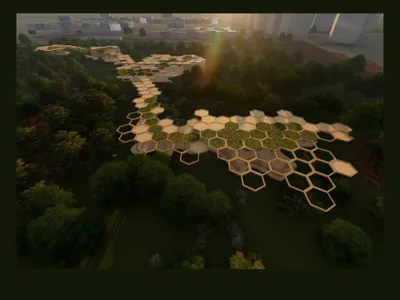
Eco Chapel: A Green Architecture Pavilion Designed in Symbiosis with the Forest
Eco Chapel uses green architecture to weave prayer, learning and reuse into a forest pavilion shaped by modular hexagonal canopies for life.
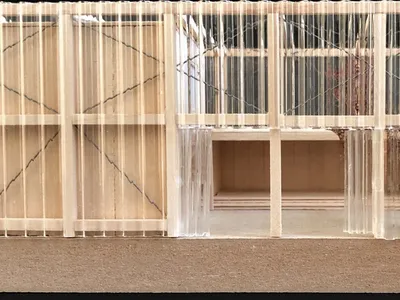
Kaffeebühnen: Coffee Shop Architecture Designed as a Civic Stage Between Vienna’s City and Park
Kaffeebühnen turns coffee shop architecture into a civic stage, linking Vienna’s park edge, urban life, warm timber yards, and coffee craft.
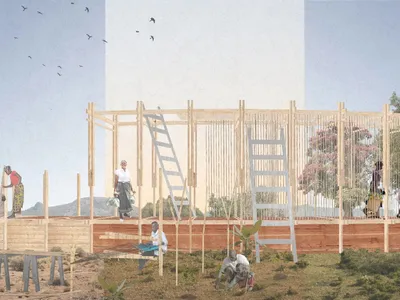
Healing Façade: Sustainable Architecture for Reforestation, Community, and Sacred Ecology in Ethiopia
Healing Façade reimagines sustainable architecture as a living wall that restores soil, catches water and renews Ethiopia's forest churches.


Urban Forest: A Vertical Ecosystem for 5,000 Workers in Singapore's Changi Business Park
Radially stacked pods and layered green decks turn a 7-acre plot into 47 acres of ecological workspace projected for 2040.

Explore Exhibition Space Competitions
Discover active competitions in this discipline

Challenge to design luxury tourism on rails

Challenge to reimagine the Iron Throne

Photograph architecture without architects

VR headsets Storefront design competition
Comments (0)
Please login or sign up to add comments
No comments yet. Be the first to comment!