

GAM Arquitetos Lets the Chapada Diamantina Landscape Speak Through UVVA Winery's Interior
A 487-square-meter interior intervention in Mucugê, Brazil, strips back ornament so vineyards and mountains become the primary material.


Designing the interior of a winery is an exercise in restraint more than expression. At UVVA, set against 52 hectares of vineyards and an 80-kilometer panorama toward Serra do Sincorá, GAM Arquitetos understood that the most powerful design decision was knowing when to step aside. Their 487-square-meter interior intervention sits inside a four-level concrete structure by architect Vanja Hertcert, a specialist in winery architecture whose building already commands attention through its raw material presence and landform scale. GAM's task was to furnish, partition, and light the interior without competing with either the architecture or the landscape it frames.
The result is an interior that functions as a calibrated lens. Timber slats, concrete surfaces, and cement floors compose a deliberately limited palette, each element worked in its most unadorned form. Nothing here is decorative for its own sake. Every screen, every ceiling plane, every piece of furniture serves to direct the eye outward or to soften the monolithic concrete envelope just enough to make guests linger. It is a Brazilian winery that feels neither rustic nor slick, occupying a careful middle ground where technology, material honesty, and warmth coexist.
Framing the View
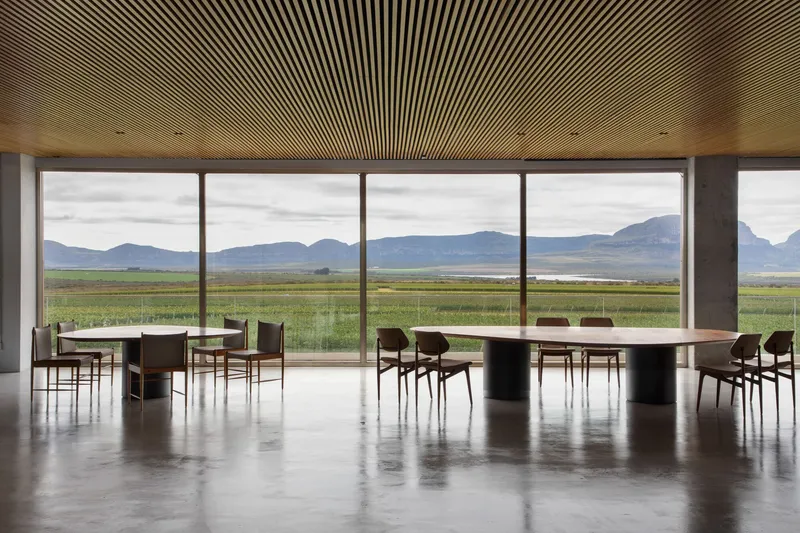


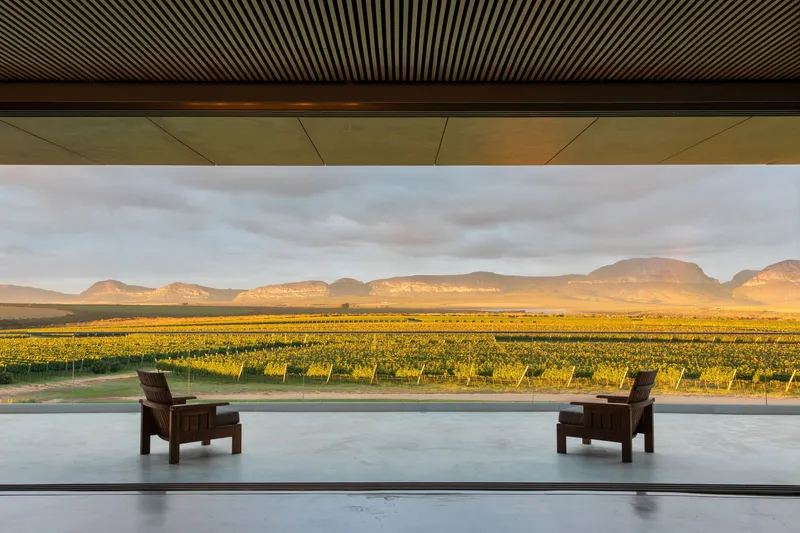
The dining spaces on the first level treat floor-to-ceiling glazing not as a wall material but as an editing tool. The slatted timber ceiling overhead creates rhythm and directionality, pulling your gaze toward the vineyard rows and the distant hills beyond. In image after image, the landscape reads as a live mural, its color shifting with the weather and the hour. The interior palette of warm timber and cool concrete recedes, giving the green fields and moody skies full ownership of the room's atmosphere.
GAM Arquitetos describe this as an "inside-out" concept, where the interior minimizes its own presence so that nature remains the dominant experience. It is a strategy that depends entirely on the quality of the glazing details and the proportions of the framing elements. Here, the execution holds: the mullions are thin, the glass is generous, and the timber overhead provides just enough enclosure to keep you aware that you are inside a building.
Timber as a Mediator
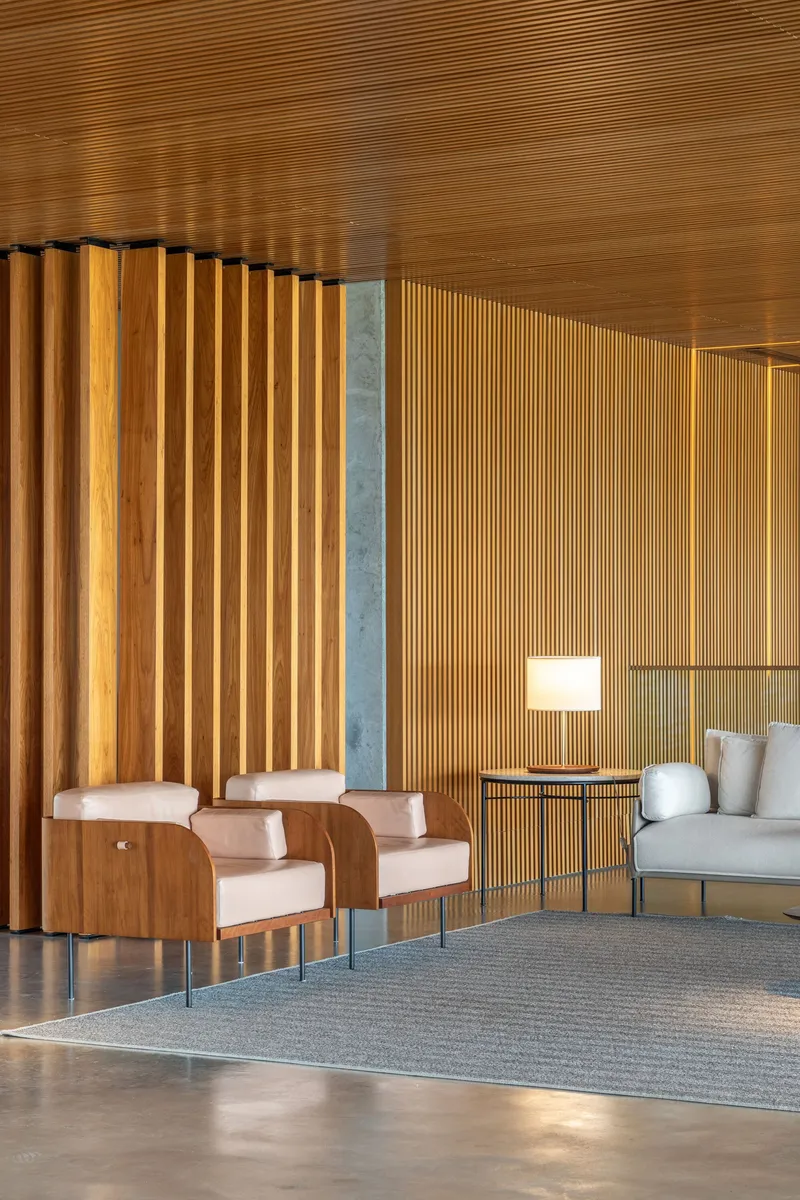

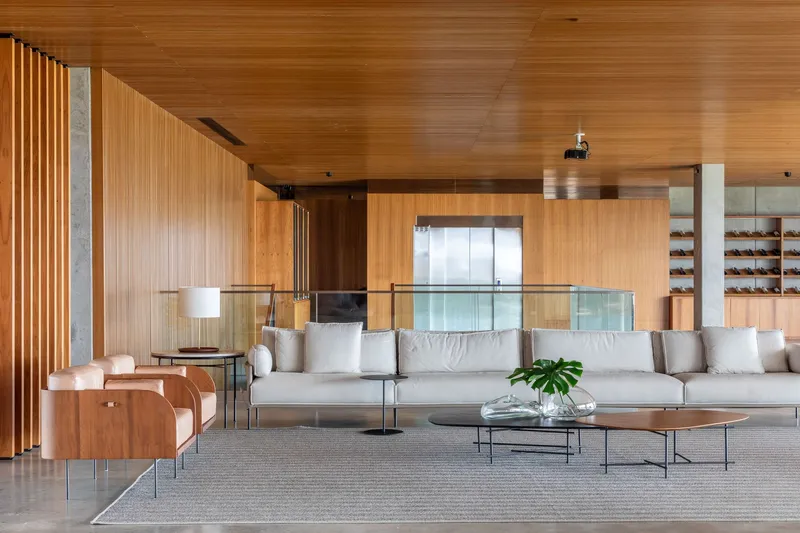
Concrete alone can be cold, especially at the scale Hertcert deployed it. GAM's primary softening agent is wood, applied in three distinct configurations: vertical slat partitions that filter views between zones, horizontal plank ceilings that compress and warm the overhead plane, and radiating slat patterns that create a subtle sense of movement. The vertical screens are particularly effective. They function as spatial dividers without becoming walls, allowing light and sound to pass while giving each zone its own identity.
The reception area uses a concrete desk anchored between two seating zones, with the slatted timber ceiling unifying everything overhead. It is a simple organizational move, but the material contrast between the heavy desk and the light, rhythmic ceiling keeps the space from feeling static. Track lighting mounted directly on timber members keeps the ceiling plane clean and avoids the clutter of exposed conduit.
The Terrace Threshold
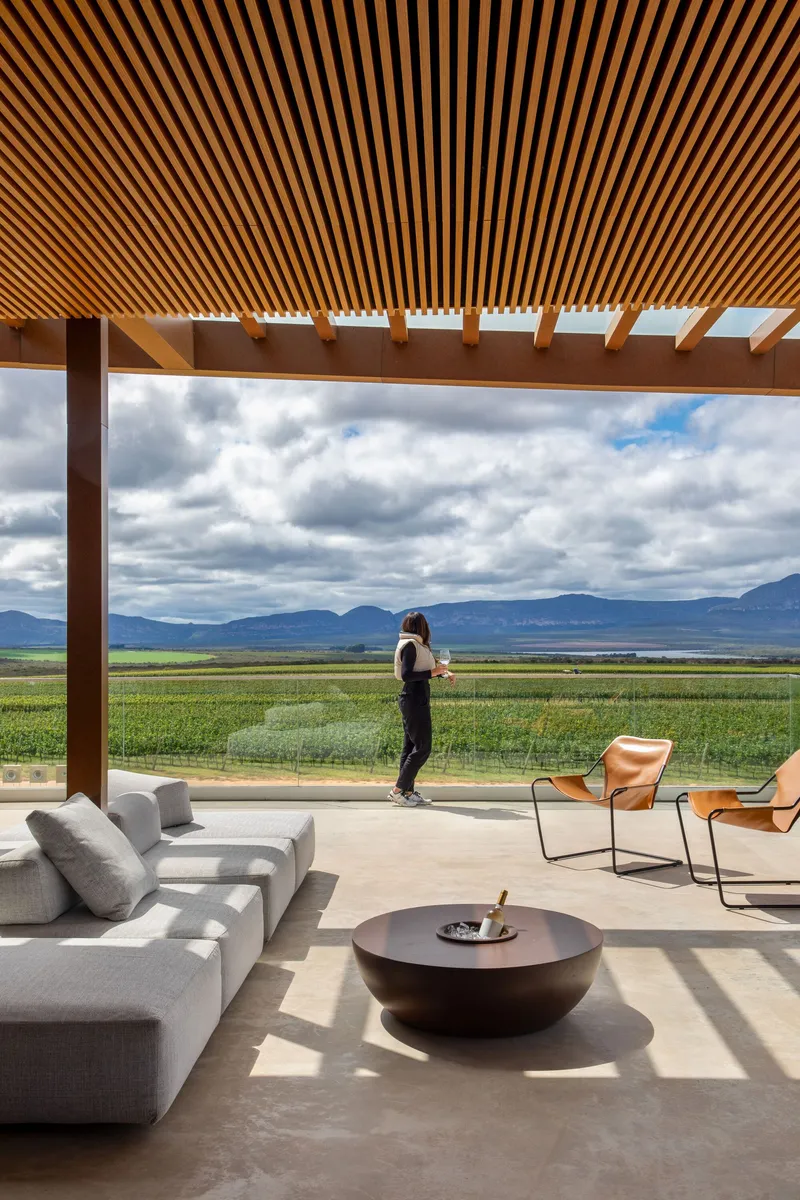
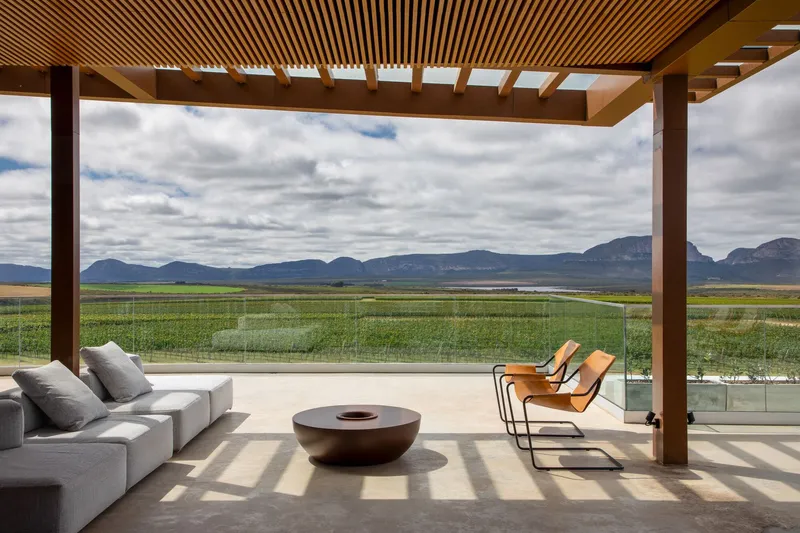

The contemplation terrace is where the interior project dissolves into the landscape. Exposed timber pergola beams extend outward, casting linear shadows across the deck and establishing a gradient from enclosed to open. A horizontal louvered screen at one edge silhouettes visitors against the vineyard, creating what might be the project's most photogenic moment. It is also a functional climate device: the ventilated facade and deep overhangs control solar gain in Bahia's subtropical latitude while maintaining uninterrupted views.
GAM's furniture choices on the terrace are deliberately minimal. Two timber lounge chairs angled toward the afternoon sun is all it takes. The restraint is the point. In a setting with views extending 80 kilometers, adding anything more would be noise.
Concrete, Stone, and the Weight of Place


The polished concrete floors and exposed columns belong to Hertcert's architectural shell, but GAM's interior decisions activate them. Reflections on the cement flooring double the timber screen patterns above, creating a visual depth that the material alone would not achieve. The concrete columns are left entirely unclad, their surface marks and formwork textures visible. Against the warm timber cladding of the walls, these columns register as structural fact rather than aesthetic gesture.
There is a dialogue here between Mucugê's geological identity and the building's material choices. The Chapada Diamantina is defined by exposed rock, quartzite ridges, and stone walls that have structured the town's architecture for centuries. Using concrete and stone inside UVVA feels continuous with that tradition rather than imposed upon it.
Where Wine Lives

The barrel room anchors the winery's identity in the most literal way. Wooden casks sit on metal racks against an exposed red rock wall, the raw geology of the site making a direct appearance in the production space. It is one of the few moments where GAM and Hertcert's work is nearly indistinguishable: the architecture provides the rock face, and the interior design lets it speak without embellishment.
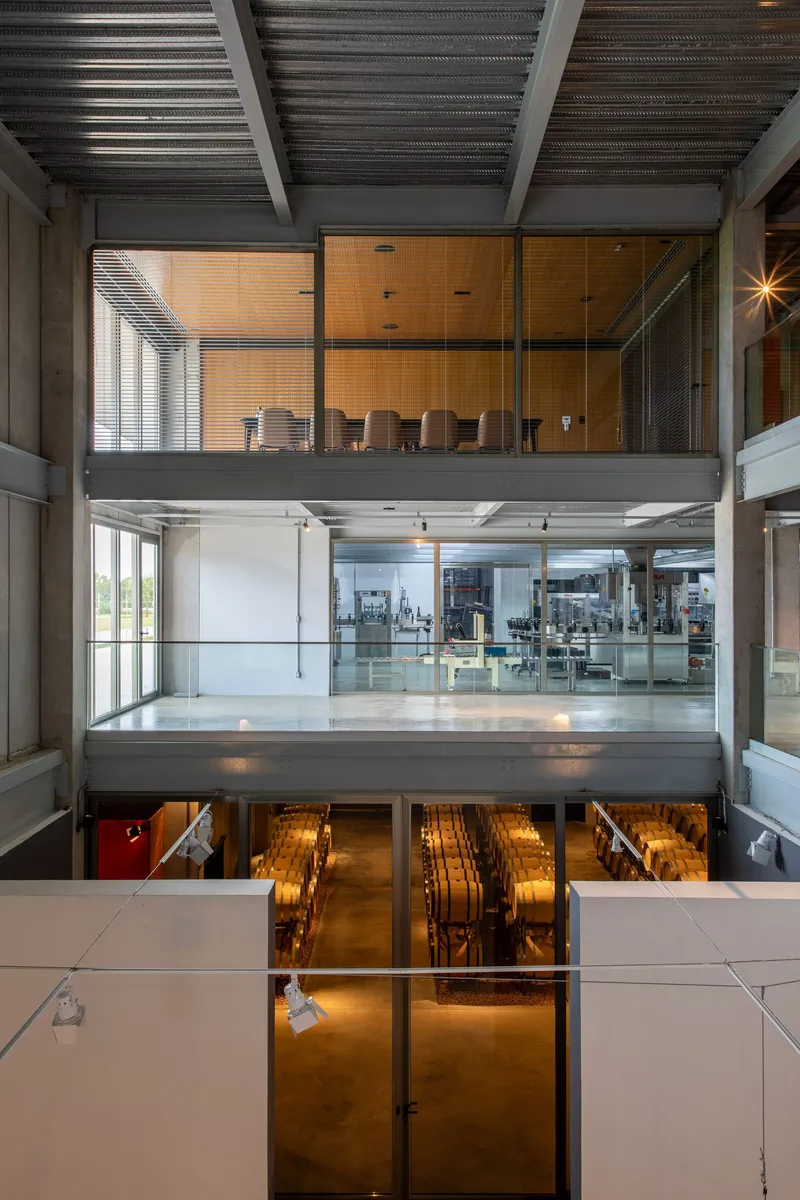
The three-story atrium reveals the building's sectional ambition, stacking production, enology, and hospitality across four levels connected by concrete beams and glass walls. From the upper levels, visitors can see down into the vinification and bottling spaces below. This transparency is pedagogical. It turns the winemaking process into something observable rather than hidden, which is consistent with the project's broader commitment to visibility and openness.
Warmth After Dark


The lighting strategy shifts the interior's character dramatically between day and night. Under daylight, the timber slats are silhouettes against bright glazing. After dark, warm track lighting transforms the same surfaces into golden planes that glow against the concrete. The lounge seating along the wood plank walls reads as intimate rather than austere, and the dining space with its orange upholstered chairs takes on a convivial warmth that the daytime images only hint at.
GAM's use of perforated metal screens near the lobby adds another layer of filtered light, creating patterns that shift as you move through the space. These screens work as transitional devices, easing the passage from bright exterior views to more contained interior zones. The effect is subtle, which is exactly the point.
The Lobby and Spatial Sequence

Arrival at UVVA is orchestrated. The lobby sits between the wine shop and the self-service lounge, with the concrete reception desk marking a threshold between public circulation and the more curated hospitality zones beyond. The slatted ceiling is consistent throughout, creating a unified overhead canopy that ties disparate programmatic areas together. It is a classic move in hospitality interior design, using a single material gesture to create coherence across a complex program.
Plans and Drawings
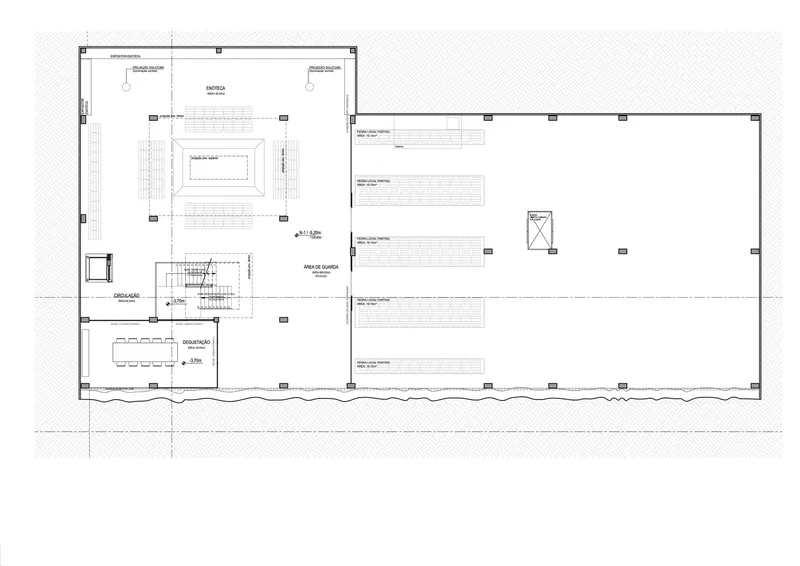


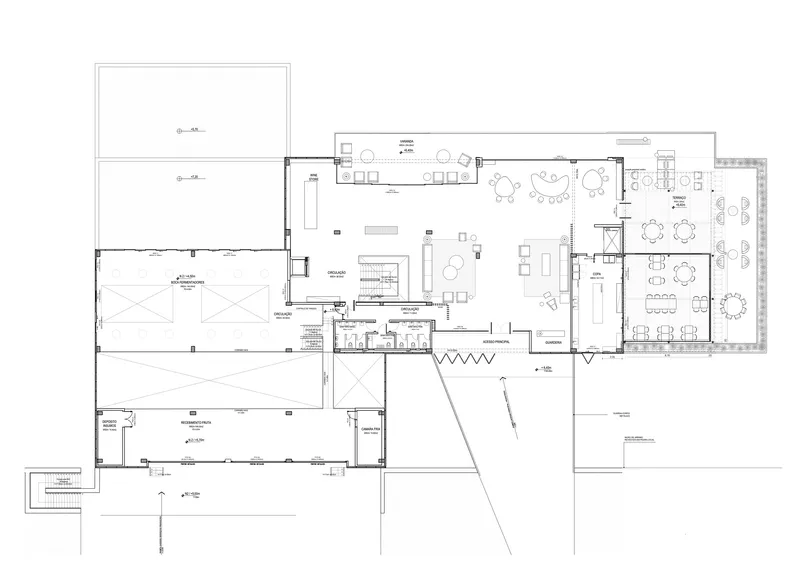
The floor plans reveal the building's organizational logic across its four levels. Two connected rectangular volumes share a central circulation and service core, with the upper levels offsetting slightly to create covered terraces and cantilevered viewing platforms. A zigzag circulation spine on the uppermost level connects dining and lounge areas, breaking the rectilinear grid just enough to introduce visual interest without disrupting the structural clarity. The diagonal paths through the residential zones on the second floor suggest a deliberate effort to avoid corridor-like sequences, routing visitors through spaces rather than past them.
Why This Project Matters
UVVA Winery matters because it demonstrates what interior design can accomplish when it treats subtraction as its primary tool. GAM Arquitetos inherited a powerful concrete building in one of Brazil's most dramatic landscapes and resisted the temptation to compete with either. Instead, they built a material vocabulary of timber and concrete that amplifies the existing architecture while making it inhabitable, warm, and legible to visitors who come for wine and stay for the view.
The project also challenges assumptions about Brazilian wine. Chapada Diamantina is not Napa, not Mendoza, not Bordeaux. It is a semi-arid highland in Bahia, a state more associated with carnival than Cabernet Sauvignon. By housing ten grape varieties in an interior this considered, UVVA asserts that serious winemaking and serious design can emerge from unexpected geographies. The 80-kilometer view toward Serra do Sincorá is not backdrop. It is argument.
UVVA Winery, interior design by GAM Arquitetos, architecture by Vanja Hertcert. Mucugê, Bahia, Brazil. 487 m² (interior). Completed 2021. Photography by Denilson Machado – MCA Estúdio.
About the Studio
Share Your Own Work on uni.xyz
If projects like this are the kind of work you want to make, uni.xyz is a place to publish your own, find collaborators, and enter design competitions.


Popular Articles
Popular articles from the community


Manzana Morphosis: Stretching Barcelona's Grid into a Living Landscape for 2050
A radical reworking of the Eixample manzana turns density into a tool for generous public space, vertical ecology, and environmental performance.

Faces of the Soviet Avant-Garde: Turning Moscow's Street Names into an Open-Air Museum
A network of sculptural installations across a Moscow residential district transforms forgotten architect names into spatial encounters with cultural memor

Opera by the Sea Estonia: Three Shells Dissolving Architecture into Tallinn's Coastline
A winning opera house proposal replaces monumental form with interconnected shells that blur the boundary between building, park and Baltic Sea.

Extended Shell: Retrofitting Kolkata's Balconies as Living Urban Thresholds
A modular retrofit system recovers the social and environmental intelligence of Kolkata's historic verandas for contemporary Park Street residents.

Similar Reads
You might also enjoy these articles

Pixel Gardens: One Repeated Module Stacked Into a Terraced Social Housing Tower for Famagusta
Salem Bader's shortlisted housing tower builds a vertical neighbourhood from one repeated module, offsetting units to carve terraces, light and air.

Bao Huynh Watercolor Atelier: A Serene Art Retreat in Hội An
Bao Huynh Watercolor Atelier in Hội An blends multifunctional art spaces, sustainable design, local materials, and family-friendly living in a serene environment.

Atelier Macri Concept Store Interior Design by CASE-REAL
Atelier Macri store features a "ko" counter, walnut wood details, cork displays, blending retail, gallery, and seamless customer experiences.

Manuel Vargas Izquierdo Stadium and High-Performance Sports Center: Architectural Excellence in Jalpa de Méndez
The Manuel Vargas Izquierdo Stadium blends sustainable design, inclusive sports facilities, and cultural-inspired architecture, revitalizing Jalpa de Méndez’s public spaces.

Explore Winery Competitions
Discover active competitions in this discipline

Challenge to reimagine the Iron Throne

Photograph architecture without architects

Illustrate the lost glory of Angkor Wat - Render Challenge

Design challenge to reuse E-waste
Comments (0)
Please login or sign up to add comments
No comments yet. Be the first to comment!