
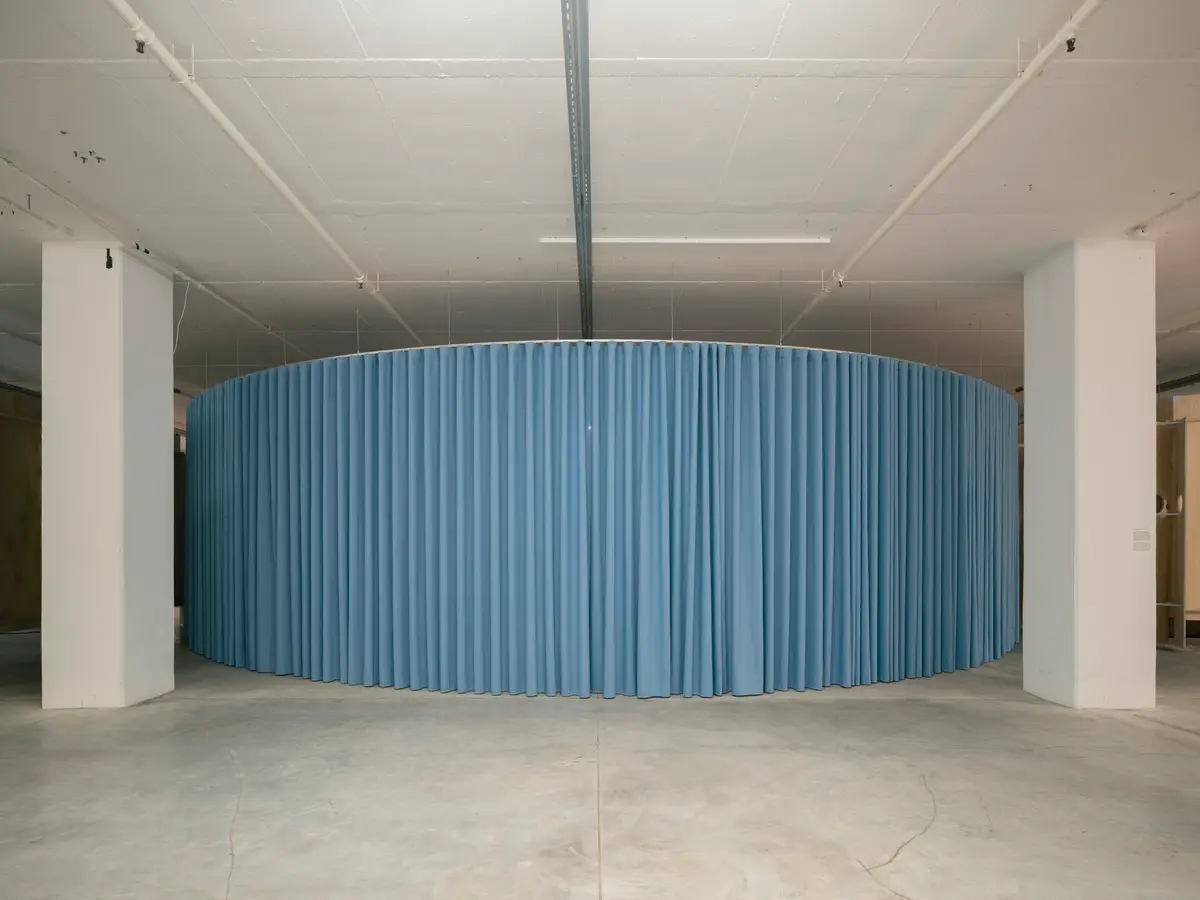
Garage Encounters Turns a Parking Structure Into Art
BUREAU transforms a Lisbon parking garage into a cultural venue where raw infrastructure and curving plywood scenography collide with intention.


Architecture has spent decades insisting that its noblest expressions require purpose-built shells, pristine galleries, or landmark commissions. BUREAU's Garage Encounters in Lisbon pushes back against that assumption with a 2,200-square-metre cultural venue carved out of an existing parking structure. The project, completed in 2025, treats the mundane concrete grid of columns, exposed ducts, and polished floors not as obstacles to overcome but as a generous framework to inhabit. Daniel Zamarbide, Carine Pimenta, and Galliane Zamarbide have delivered something closer to theatrical scenography than conventional renovation, and the result is more compelling for it.
What makes this project genuinely interesting is its refusal to hide. The interventions are legible, temporary in spirit, and materially distinct from their host. Sweeping walls of blue corrugated metal curve between existing columns. Freestanding plywood partitions with oversized circular cutouts create rhythm without enclosure. A tiered plywood grandstand suggests assembly and performance. Every added element reads as a guest in someone else's house, polite enough to stand on its own feet and bold enough to change the conversation.
Blue Walls and Borrowed Structure
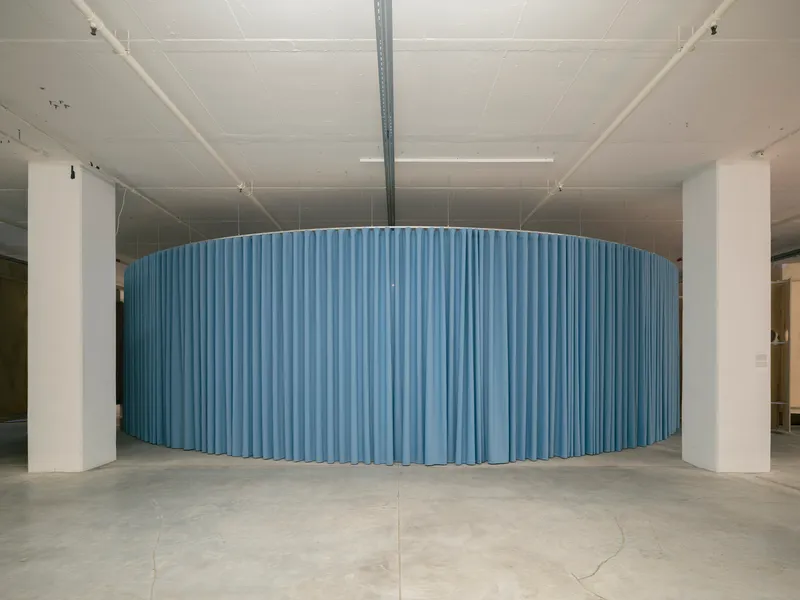
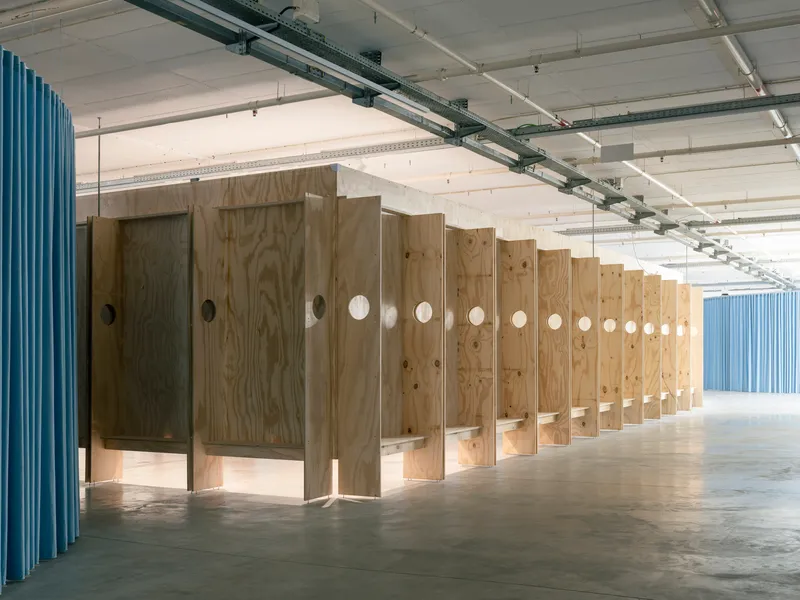
The most striking gesture in the project is the use of corrugated blue metal as a curving partition material. These walls arc between the garage's existing white cylindrical columns, creating soft divisions of space without ever touching the ceiling. The blue is saturated and industrial, a deliberate contrast to the neutral concrete and white paint that define the existing envelope. It signals that these are inserted objects, not permanent walls.
The plywood partitions that flank these blue curves operate on a different register. Their circular openings provide visual porosity, framing views through successive layers of the exhibition. Together, the two materials establish a call and response: opaque curves against perforated planes, corrugated metal against smooth birch veneer. The colonnade of existing columns ties everything into a single spatial rhythm, giving the inserted elements a grid to push against.
Plywood as a Universal Language
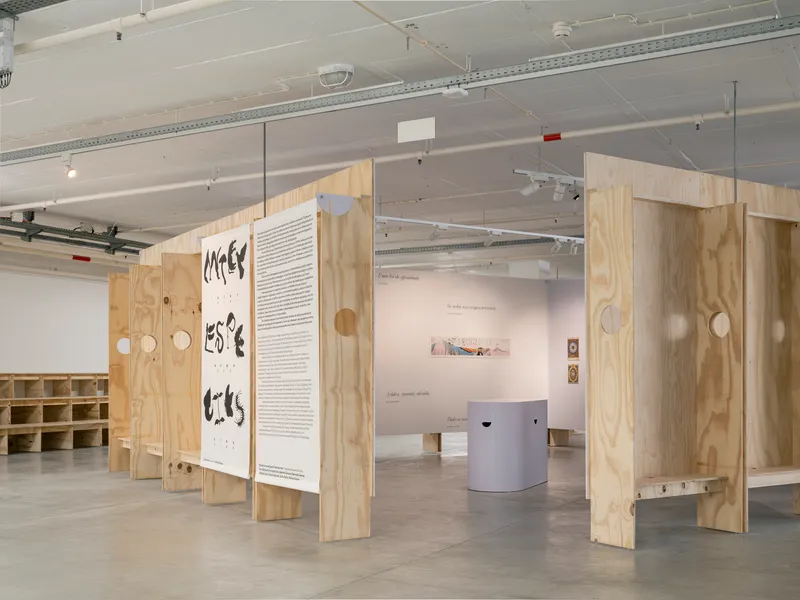
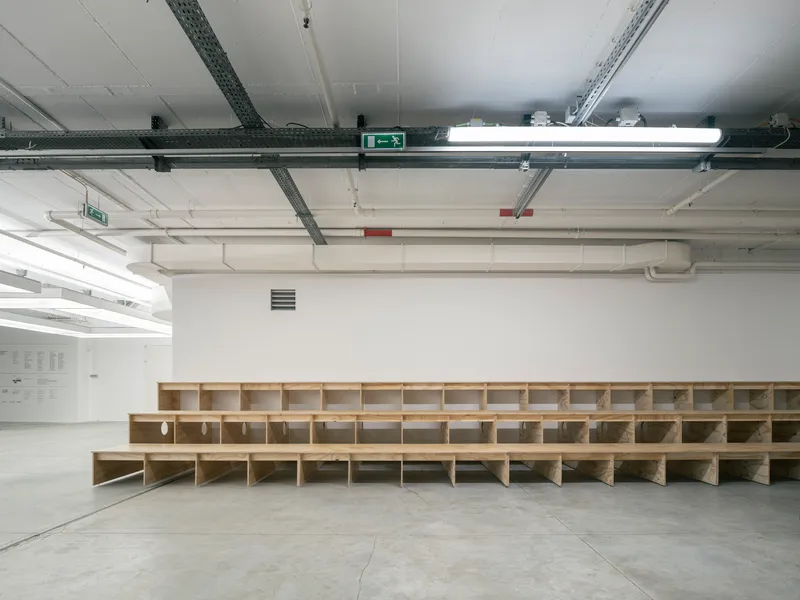
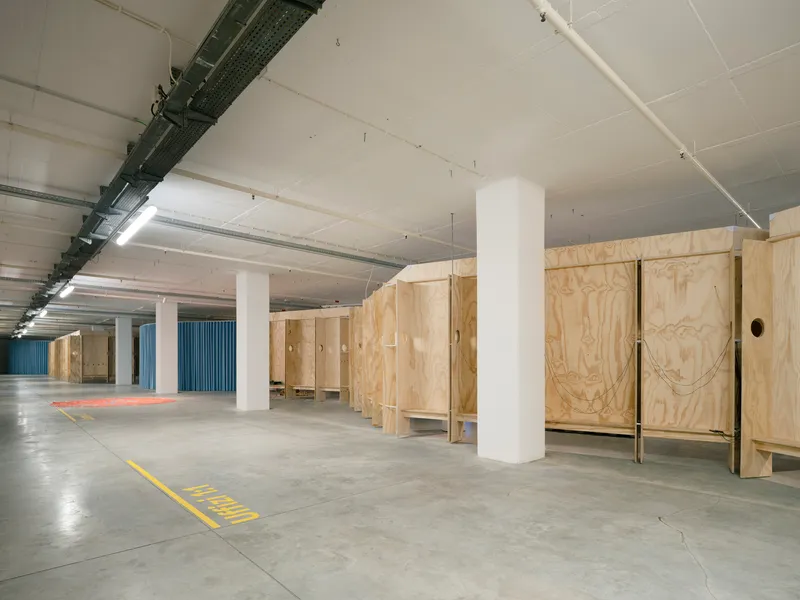
Plywood does an enormous amount of work here, and BUREAU deploys it across nearly every programmatic need. It forms the freestanding display partitions with their punched circles and integrated text panels. It becomes a long tiered seating structure, stepped and precise, that could host a lecture or simply orient visitors' bodies toward a focal point. It shows up again as storage units and benches, all with the same honest, unfinished material expression.
The consistency of material reads as both practical and principled. Plywood is affordable, workable, and easy to remove when the exhibition changes. But its warmth also counterbalances the garage's hard surfaces: the polished concrete, the fluorescent lighting, the exposed ductwork above. BUREAU understands that a single material, used with discipline, can unify a sprawling space without homogenizing it.
Exhibition Rooms Without Rooms
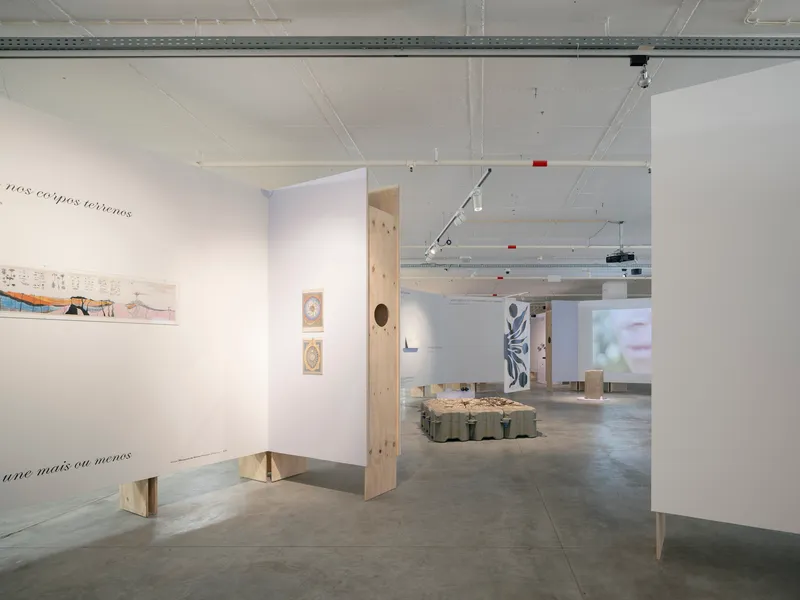
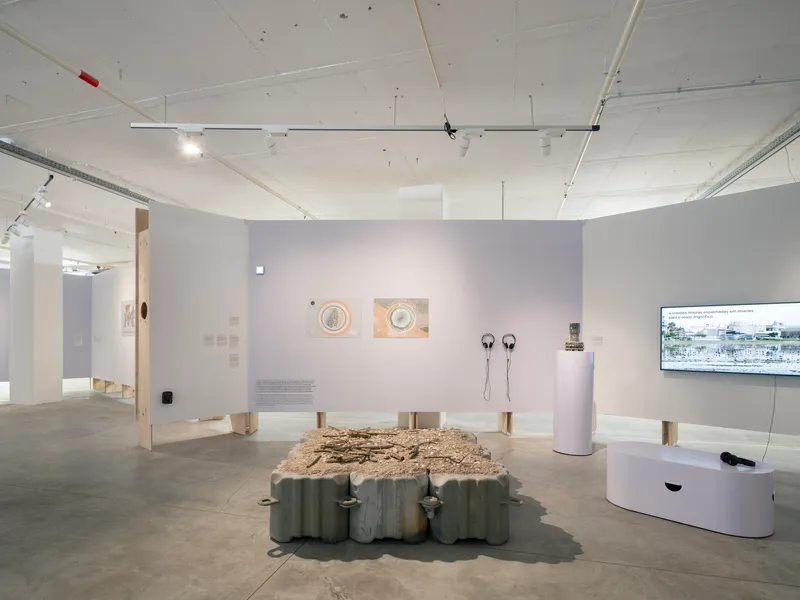
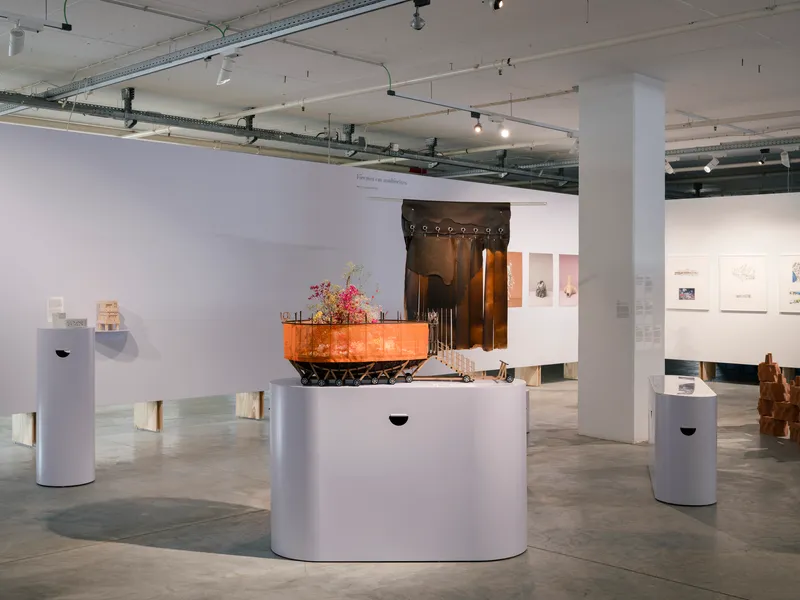
The gallery spaces operate somewhere between open plan and enclosed rooms. White display walls define zones for individual artworks, but they stop short of creating sealed chambers. You can glimpse projections through gaps, catch sight of a sculptural installation over a low partition, or follow the colonnade through to a distant wall. The spatial experience is cinematic: each step shifts the composition.
Track lighting and pendant fixtures pick up where the architecture leaves off, defining territories of attention within the larger volume. A central table with a textured surface sits under focused illumination, reading as both a work of art and a piece of furniture. A white plinth holds a sculptural object beneath the raw ceiling infrastructure. These moments succeed because the architecture provides enough structure to frame them without competing for attention.
Atmosphere Through Color and Softness
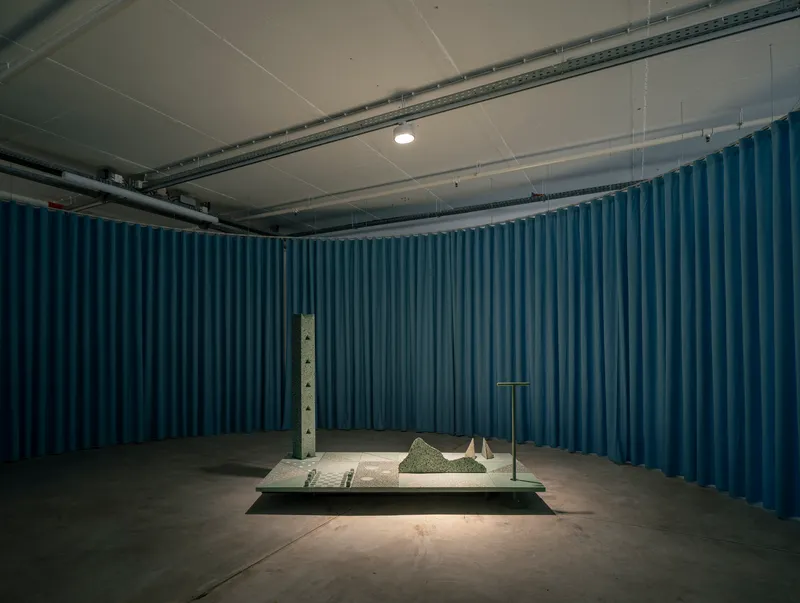
Not every space in Garage Encounters relies on hard surfaces and exposed systems. An enclosed alcove deploys deep blue curtain walls to create a contemplative pocket around a centered sculptural installation. The fabric absorbs sound and softens light, offering a moment of withdrawal from the garage's extrovert energy. It is a reminder that exhibition design is as much about controlling atmosphere as it is about arranging walls.
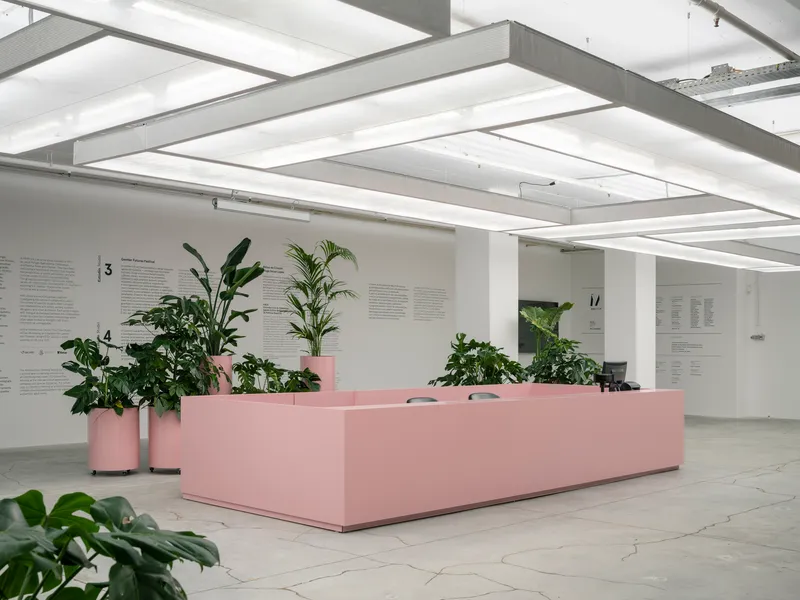
At the reception, a pink desk with cylindrical planters and tropical foliage introduces another tonal register entirely. The white coffered ceiling above, with its linear lighting, is almost domestic. These moments of warmth and color prevent the project from becoming a monotone exercise in raw materiality. They reveal BUREAU's instinct for calibrating mood across a long spatial sequence.
Workshop and Assembly
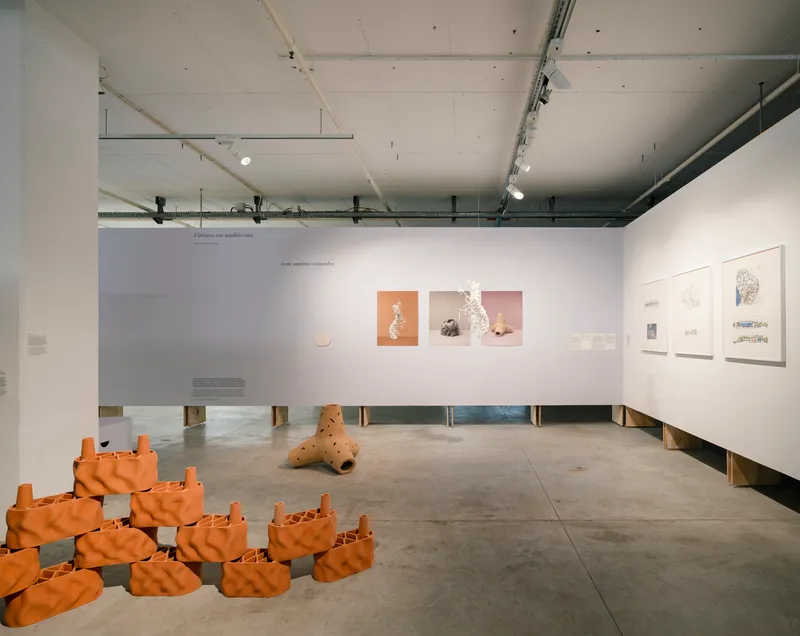
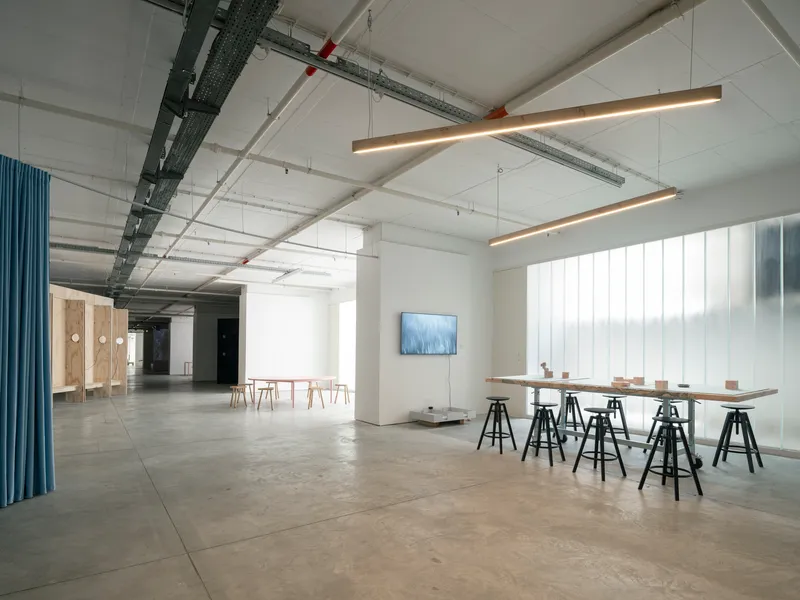
Certain areas of the venue lean toward the productive rather than the contemplative. A work table on trestles, flanked by vertical white panel walls, suggests a studio or workshop condition. Elsewhere, terracotta sculptural objects line the floor beside a long plywood bench, blurring the boundary between finished artwork and works in progress. These zones acknowledge that a cultural venue does not need to be precious. Making, viewing, and gathering can coexist within the same structural bay.
Plans and Drawings
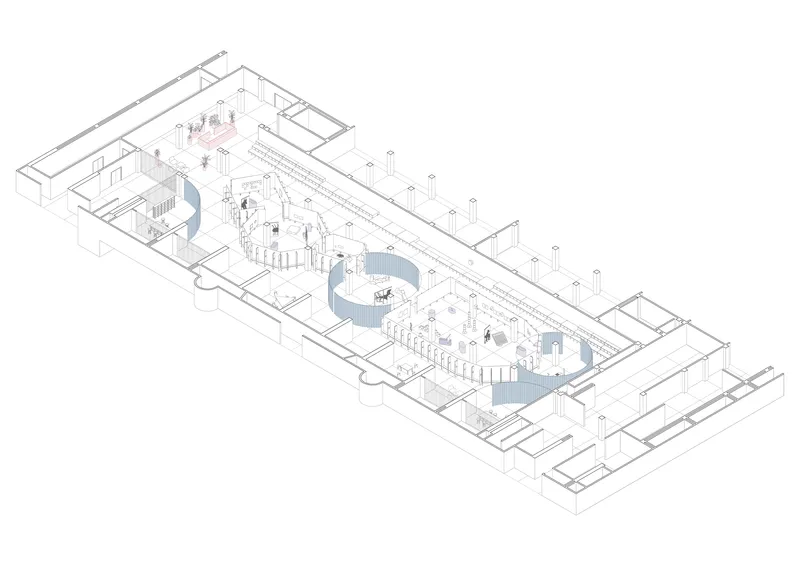
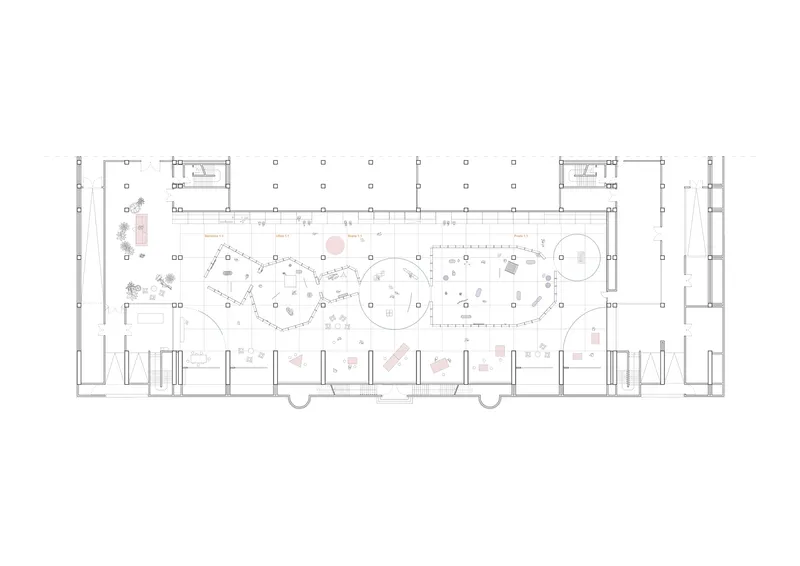
The axonometric drawing reveals the project's organizational logic with clarity. Three curved blue partitions punctuate an elongated interior, while a central colonnade of existing columns provides the datum line. The floor plan confirms what the photographs suggest: these curving walls operate independently of the rectangular envelope, creating pockets and passages that never fully close off from one another. The circular elements visible in plan correspond to the punched openings in the plywood partitions, establishing a geometry of porosity that pervades the scheme.
What the drawings make especially clear is how little of the existing structure has been altered. The interventions are almost entirely additive, layered on top of an infrastructure that was never designed for cultural use. This economy of means is the project's quiet strength.
Why This Project Matters
Garage Encounters matters because it demonstrates that cultural architecture does not require cultural buildings. A parking garage in Lisbon, with its generic columns and utilitarian ceiling, becomes a legitimate venue for art, assembly, and exchange through precise, reversible interventions. BUREAU has not disguised the host building or apologized for its origins. They have amplified its spatial generosity while adding just enough character to make the experience specific and memorable.
The project also offers a persuasive model for how architects can work within constrained budgets and existing footprints without defaulting to minimalism or ironic detachment. The blue corrugated walls, the plywood universe, the curtained alcoves: these elements are confident, even joyful, without being wasteful. In a moment when the profession is reckoning with the environmental cost of new construction, projects like this point toward a more resourceful and imaginative future.
Garage Encounters by BUREAU (Daniel Zamarbide, Carine Pimenta, Galliane Zamarbide). Lisboa, Portugal. 2,200 m². Completed 2025. Photography by Dylan Perrenoud.
About the Studio
Share Your Own Work on uni.xyz
If projects like this are the kind of work you want to make, uni.xyz is a place to publish your own, find collaborators, and enter design competitions.


Popular Articles
Popular articles from the community


Singing Woman: An Opera House That Performs Before the Curtain Rises
Ovidiu Cristian Pavel's conceptual opera house translates Estonia's choral identity into a sculpted waterfront landmark facing the Baltic Sea.


David Ortega Stacks a Two-Story Mexico City Penthouse Around a Steel Stair and a Pergola-Shaded Roof Terrace
In Colonia Roma, a 300 m² penthouse uses oak joinery, a planted steel stair and a slatted roof pergola to make a new-build apartment feel like a house.

Opera on the Sea: Driftwood Logic Shapes a Timber Opera House on Estonia's Coast
Trevor Orgill's opera house translates the entangled drift of floating timber into a civic building where wood, water, and music converge.

Aquadapt: An Underwater Habitat That Rewrites Its Rooms by the Hour
Curved modules ring the seabed while one shell shifts from breakfast room to cinema, farm and football pitch as residents' needs change.

Similar Reads
You might also enjoy these articles

LAVA Architecten Gives Vocational Education a Sawtooth-Roofed Face on a Mechelen School Campus
In Mechelen, Belgium, a 2,053 m² STEM school on a 6×6 m grid turns workshops and classrooms into rooms that can be rearranged as teaching changes.

KEMA Studio Turns a Derelict Marvila Attic into a 60 m² Lighthouse Apartment Above Lisbon
In Lisbon's Marvila district, a rebuilt roof, four skylights and two plywood volumes turn an unlivable attic into a bright home facing the Tagus.

Pixel Gardens: One Repeated Module Stacked Into a Terraced Social Housing Tower for Famagusta
Salem Bader's shortlisted housing tower builds a vertical neighbourhood from one repeated module, offsetting units to carve terraces, light and air.

Bao Huynh Watercolor Atelier: A Serene Art Retreat in Hội An
Bao Huynh Watercolor Atelier in Hội An blends multifunctional art spaces, sustainable design, local materials, and family-friendly living in a serene environment.

Explore Cultural Architecture Competitions
Discover active competitions in this discipline

Challenge to design luxury tourism on rails

VR headsets Storefront design competition

Bring back Drive In's

Designing a staircase for a client
Comments (0)
Please login or sign up to add comments
No comments yet. Be the first to comment!