
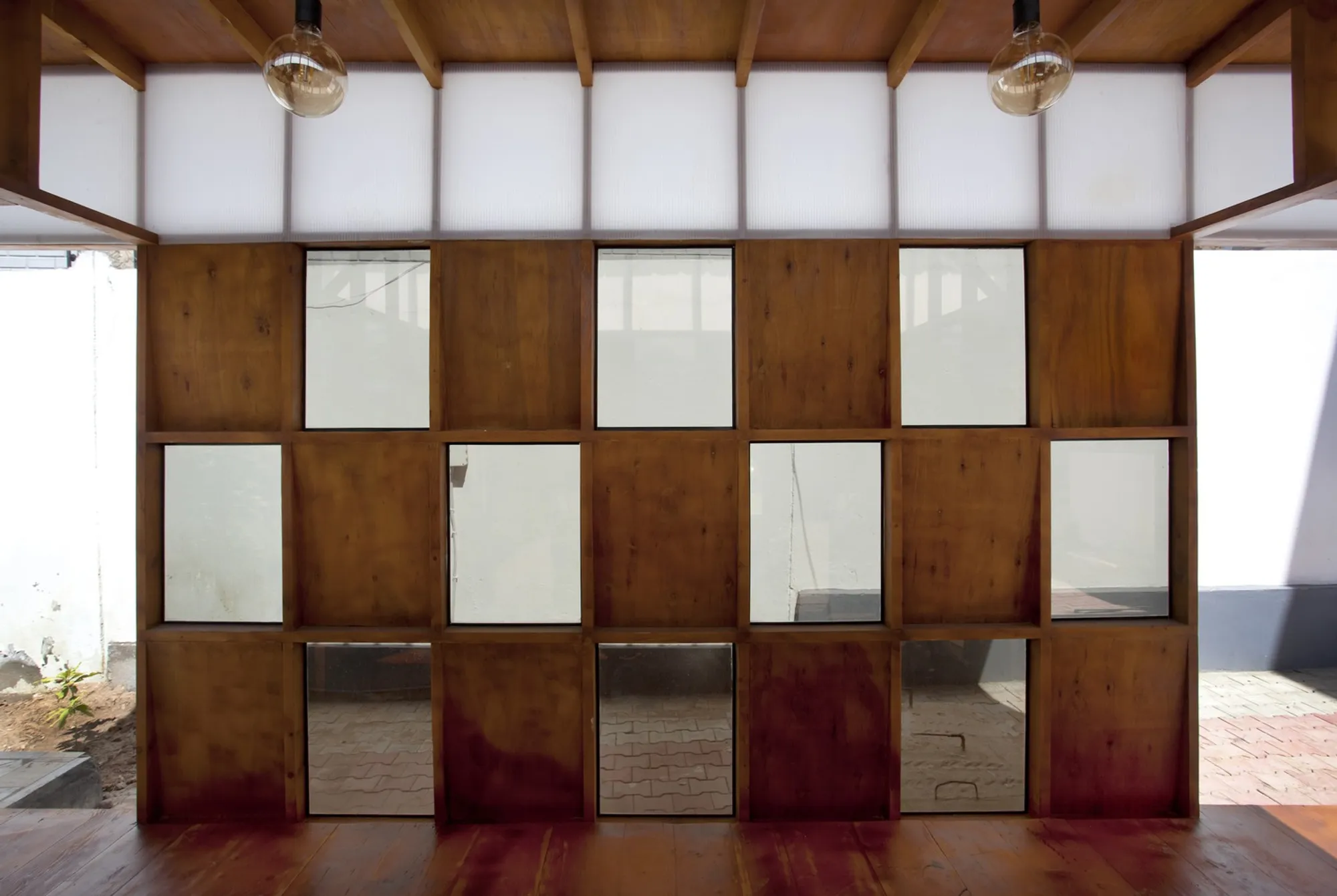
Rashid Ali Architects Builds a Timber Pavilion for Women's Education in Hargeisa
A 30-square-meter garden tea room in Somalia introduces unfamiliar materials and construction techniques to a dense residential neighborhood.


In a dense residential quarter of Hargeisa, the capital of the self-declared republic of Somaliland, a private garden has become something more than a retreat. Rashid Ali Architects designed a 30-square-meter timber pavilion that sits within the paved grounds of a house, open not only to the owner but to neighbors and invited guests. The Garden Tea Room is a reading room, a socializing space, an outdoor classroom for children, and, perhaps most critically, a venue for workshops teaching business literacy to women. That last function gives the project a civic weight far beyond its modest footprint.
What makes the pavilion architecturally interesting is the deliberate foreignness of its construction. Hargeisa's built fabric is dominated by flat, textured masonry. Rashid Ali introduced timber framing, plywood infill, tinted glass, and polycarbonate: materials that are largely unfamiliar in the local context. The result is a building that doesn't pretend to be indigenous. It announces itself as an experiment, a provocation, and an invitation to reconsider what construction in this part of the world can look and feel like.
Structural Pattern as Ornament
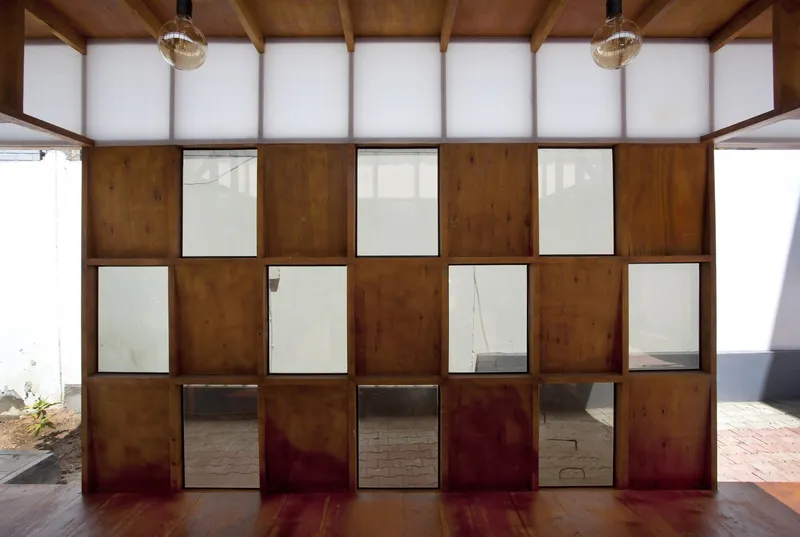
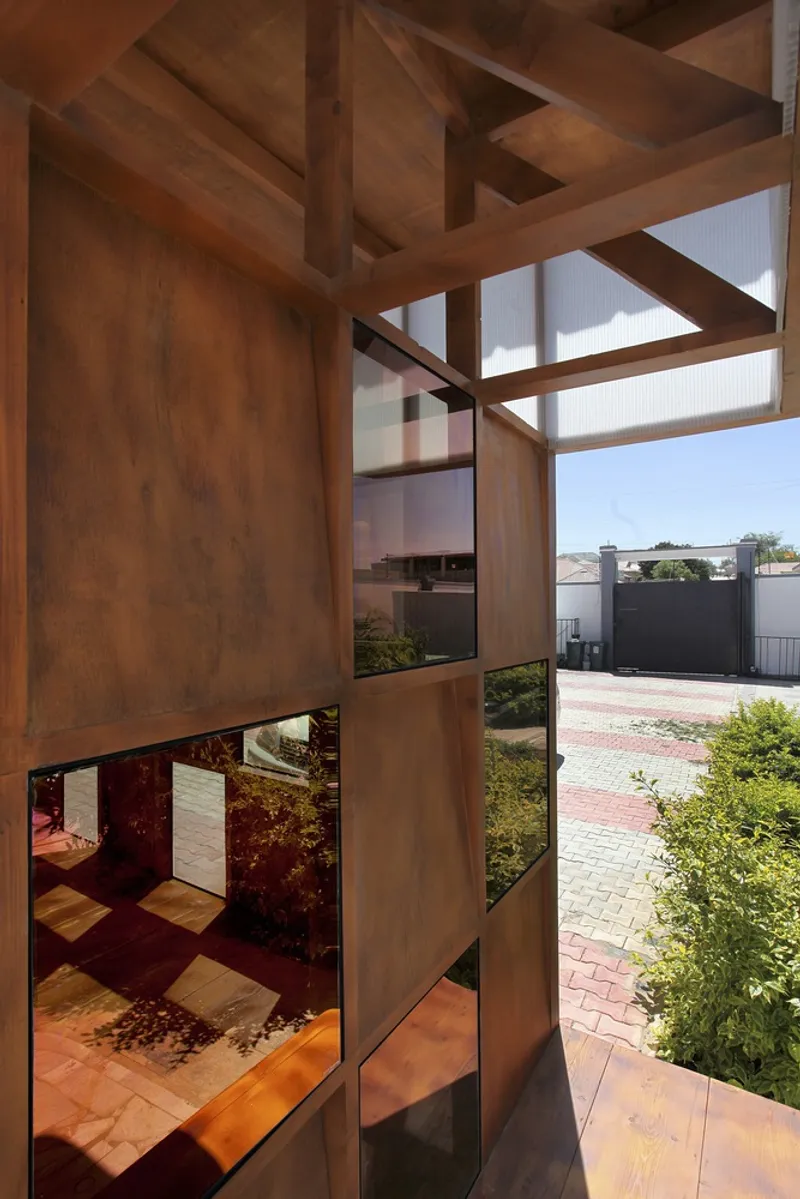
The pavilion's most recognizable move is the chequered facade produced by its timber grid. Rather than concealing the structure behind cladding, the architects turned the frame itself into the building's primary visual language. Squares of plywood alternate with panels of tinted glass and polycarbonate, producing a pattern that reads simultaneously as wall, screen, and decorative surface. The logic is simple: express the grid, then fill it selectively.
Tinted glass offers filtered views of the garden while maintaining a degree of privacy for those inside. The polycarbonate panels, concentrated at clerestory level, soften overhead daylight into a diffuse glow. At night, the hierarchy reverses. Interior lighting turns the entire pavilion into a lantern, its chequered skin radiating warmth into the garden. The building changes character with the clock, serving different moods at different hours.
Threshold and Canopy
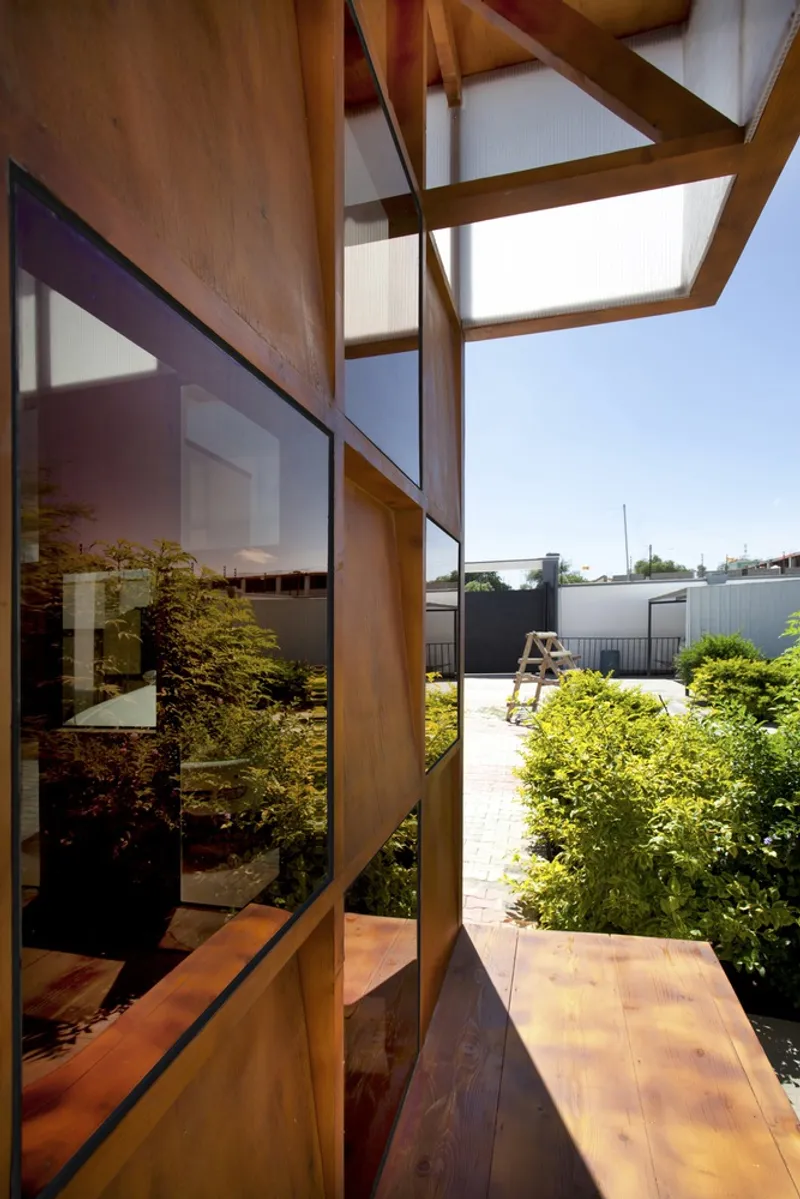
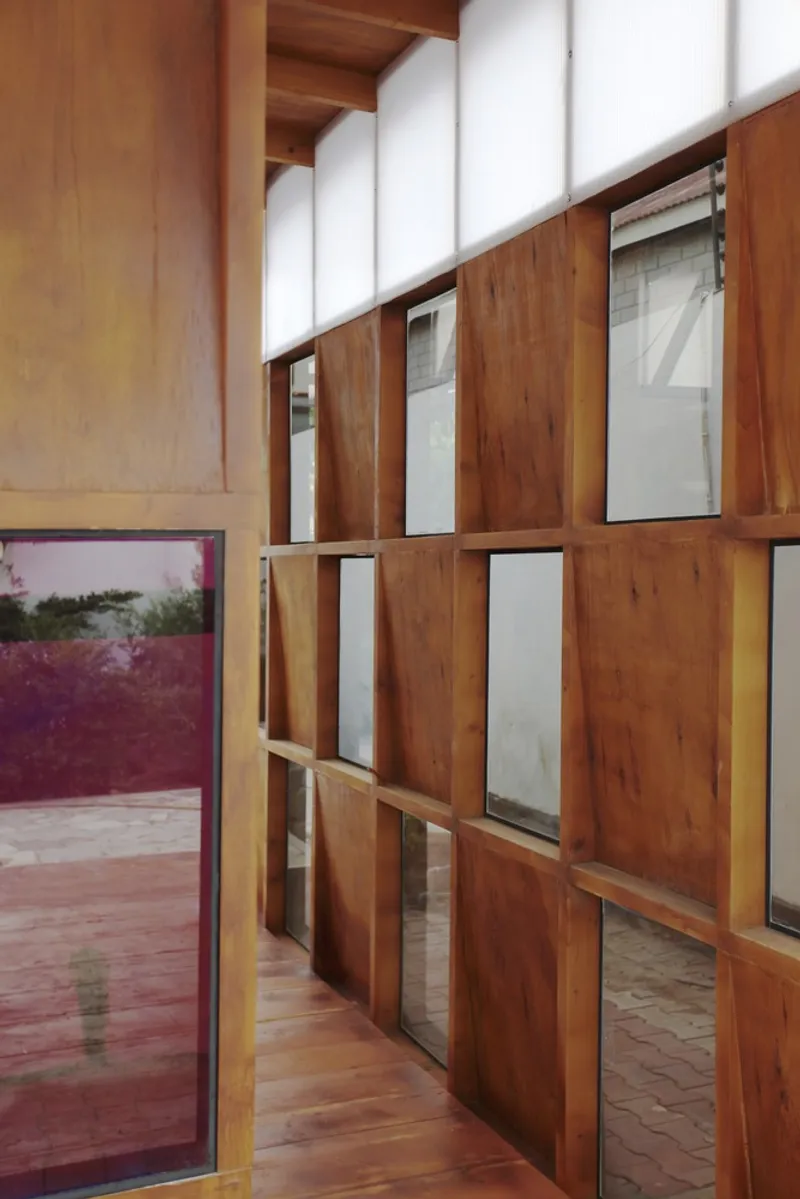
The upper section of the timber frame extends outward to form a cantilevered canopy over the two entrances, creating a generous threshold between garden and interior. Lined with polycarbonate, this overhang reinforces the layered materiality of the project while sheltering the transition zone from direct sun. The short sides of the pavilion are left partially open, allowing cross-ventilation to cool the interior without mechanical systems. In Hargeisa's climate, that passive strategy is not a luxury; it is essential.
Walking along the corridor between the glazed partition wall and the garden edge, you experience the pavilion as a sequence of filtered views rather than a single room. Timber beams overhead create rhythm. The pendant lights, two spherical glass fixtures, hang low enough to signal intimacy even within a structure that is, by any measure, compact.
Interior Light and Material Warmth
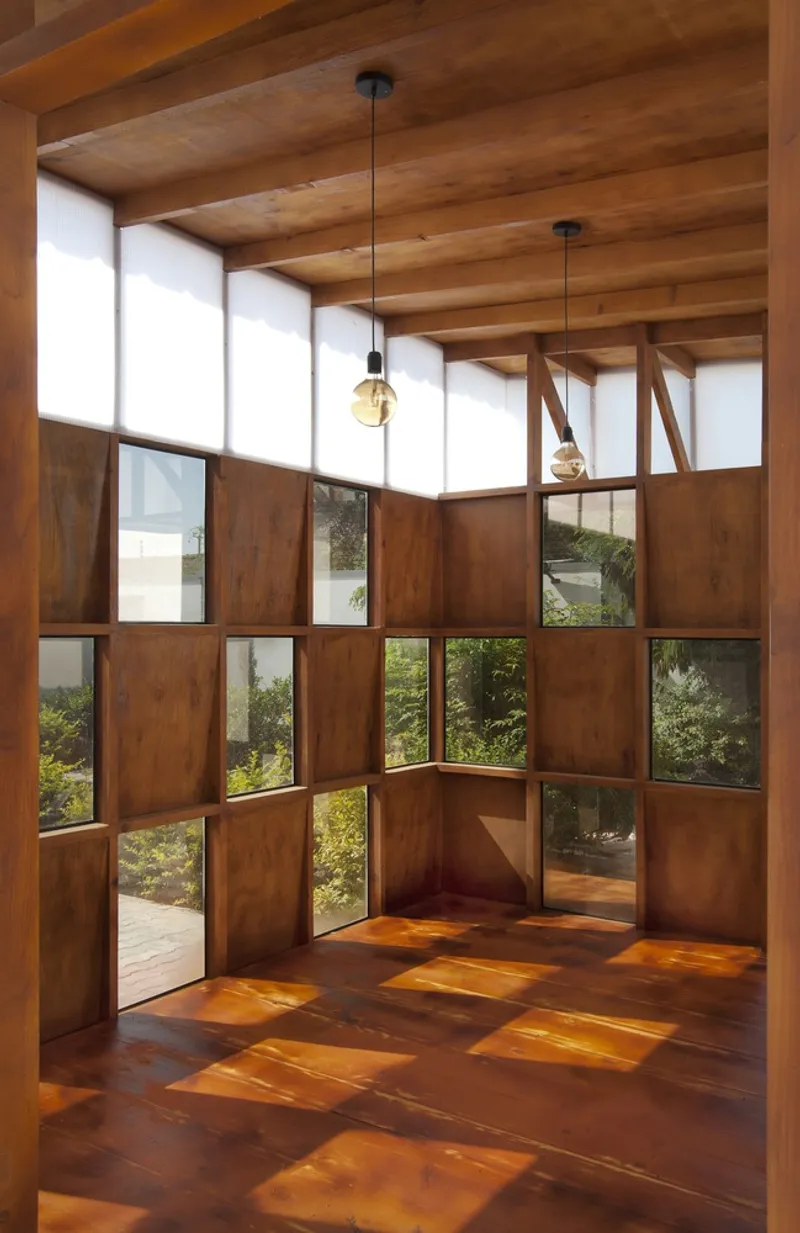
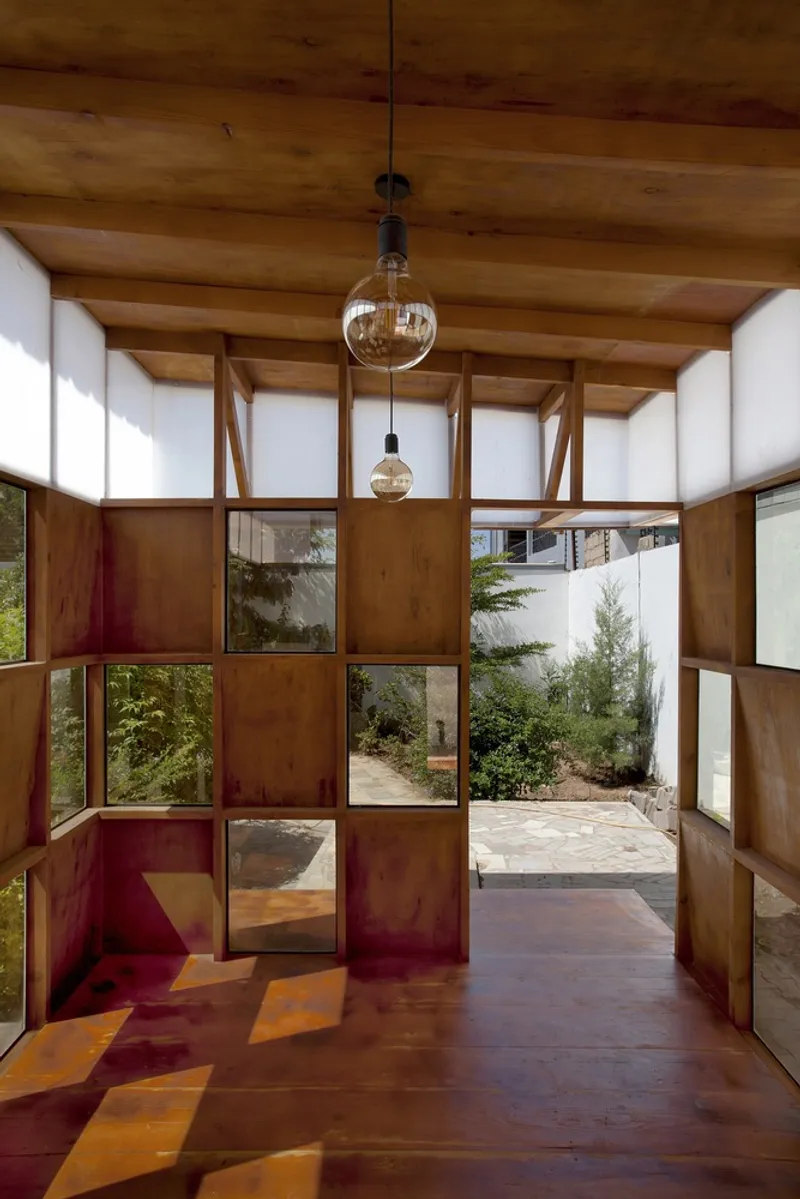
Inside, the exposed timber ceiling and frame dominate the sensory experience. Plywood panels give the walls a warm, amber tone that complements the courtyard's greenery visible through every glazed opening. The architects clearly wanted to blur the boundary between sitting inside and sitting in the garden, and the proportions support that ambition: window seats, low sightlines, and a ceiling that feels close enough to touch. The pavilion is scaled to conversation, not spectacle.
The interplay of solid and transparent infill means that daylight is never uniform. Bright washes arrive through the glass panels while plywood sections absorb and reflect softer, warmer tones. The effect is a continuously shifting interior atmosphere that responds to the sun's angle throughout the day. For a space that hosts reading, discussion, and children's play, that variety of light conditions is both practical and generous.
Why This Project Matters
The Garden Tea Room is a test case for portable, replicable architecture in a context where such experiments are rare. Its timber frame construction was designed for rapid workshop assembly and future disassembly, meaning the pavilion can be relocated or its materials reused. In a region where imported construction methods tend to arrive as finished commodities rather than transferable techniques, a project that foregrounds legible structure and accessible joinery carries pedagogical value beyond its immediate program.
More importantly, the building works because it is programmed to matter. A pavilion that only served tea would be pleasant. A pavilion that teaches women business skills and gives children a place to learn outdoors justifies the effort of importing unfamiliar materials and convincing a community to try something new. Rashid Ali Architects understood that architecture's most persuasive argument is not form but function, and the Garden Tea Room makes that argument in 30 square meters.
Garden Tea Room by Rashid Ali Architects, Hargeisa, Somalia. 30 m². Completed 2023. Photography by Lyndon Douglas.
About the Studio
Share Your Own Work on uni.xyz
If projects like this are the kind of work you want to make, uni.xyz is a place to publish your own, find collaborators, and enter design competitions.




Popular Articles
Popular articles from the community


Conexión: Biophilic Design Reimagines High-Rise Living in Hong Kong
Conexión reimagines high-rise living in Hong Kong through biophilic design, green facades, shared spaces, daylight, water and nature within.

The Ocean Hive: Sustainable Architecture for a Self-Sufficient Civilization at Sea
The Ocean Hive imagines sustainable architecture at sea, where modular habitats, algae, wave power and ocean waste sustain a growing colony.

Hill & Cross Opera: Sculptural Opera House Architecture Shaped by Tallinn’s Landscape and Identity
Hill & Cross Opera reimagines opera house architecture in Tallinn through its sculptural hill, civic plaza, glass wave and a luminous cross.

The Earth Pod: 3D Printed Homes for Resilient Refugee Communities
The Earth Pod reimagines refugee housing through 3D printed homes made from clay, combining resilience, self-sufficiency, and rapid shelter.


Similar Reads
You might also enjoy these articles


Hodi-Mandai Geram
Project Function: Preservation and revitalization of the Intangible heritage and socio-spatial identity of the Hodi by Housing, Cultural Memory Center, Sacred Grove, landscape, local tourism economy


Olio Towers: A Mid-Rise for Performers That Fuses Housing, Rehearsal, and Stage
Located blocks from Houston's Theater District, this modular tower stacks living units around a central performance atrium.

Oasis: Modular Green Housing Carved into Dhaka's Urban Fabric
A shortlisted Plugin Housing entry reclaims unauthorized settlements in Dhaka with stepped concrete volumes, green roofs, and ventilation-driven design.

Black Hole: A Floating Megastructure for the Post-Physical Era
Emiliano Mazzarotto envisions a spherical, self-scaling arena where e-sports, digital hotels, and holographic stadiums replace traditional public space.


Explore Architecture Competitions
Discover active competitions in this discipline



Challenge to reimagine the Iron Throne


Photograph architecture without architects


Illustrate the lost glory of Angkor Wat - Render Challenge


Design challenge to reuse E-waste
Comments (0)
Please login or sign up to add comments
No comments yet. Be the first to comment!