
One-aftr Designs a 99-Square-Meter Culinary Theater That Loops Guests Through a Full Circuit
Gastro Circuit in Seoul compresses a private kitchen studio for twelve into a scenographic loop of red tile, steel, and soft curtains.


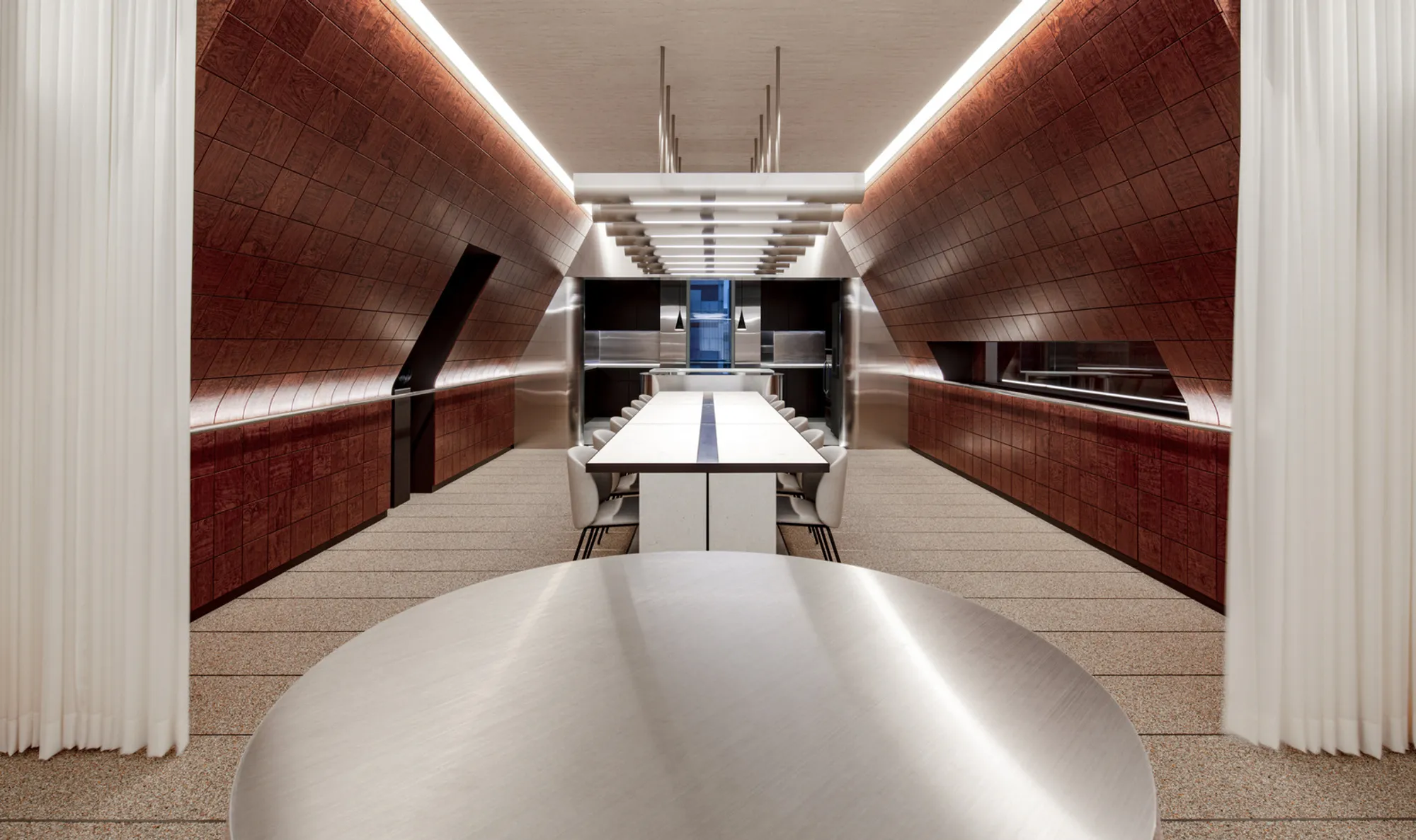
A private dinner for twelve people needs two things to work: proximity and spectacle. one-aftr's Gastro Circuit in Seoul delivers both inside a tight 99-square-meter footprint by treating the entire floor plan as a single looping sequence. Guests enter through a dark corridor, pass through a luminous waiting area, dine at a long communal table, watch the chef prepare their meal in a mirrored kitchen, and exit back through the corridor from the opposite end. The name is literal: it is a circuit, and the architecture exists to make you feel every stage of it.
What makes the project genuinely interesting is its refusal to behave like a restaurant. There is no host stand, no menu board, no signage. Instead, one-aftr borrows from theater and exhibition design, using scenographic techniques like concealed sightlines, material thresholds, and controlled lighting shifts to choreograph the evening. The rotating chef model means no two visits are the same, so the space itself has to carry the identity. It does.
Red Tile as Architectural Character
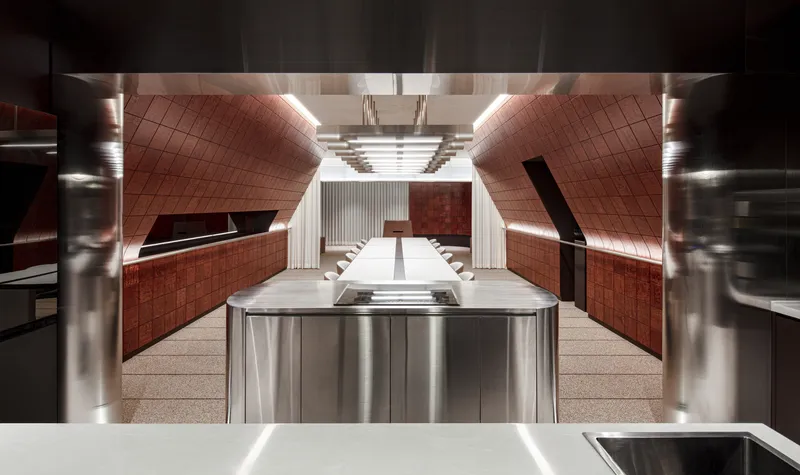
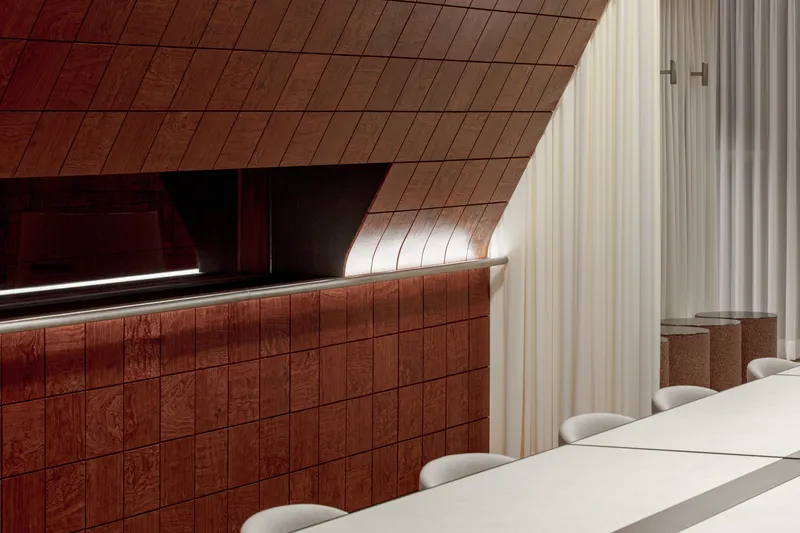
The most immediately striking material decision is the angled red tile that wraps the kitchen counter and dining walls. These are not decorative accents. The tiles define the spatial hierarchy, sloping inward to compress attention toward the center of the room and the cooking surface. Against the stainless steel base of the kitchen island and the linear ceiling fixtures, the warm terracotta hue reads as both earthy and precise, a material that could belong in a Roman bath or a contemporary gallery.
The tile surfaces also do practical work. Their angle creates a soffit that conceals linear lighting, washing the countertops in even, shadow-free illumination suited to both food preparation and close-range viewing. The junction where red tile meets white curtain is handled cleanly, letting natural light rake across the textured surface without any fussy trim or transition piece.
A Dining Room That Funnels Focus
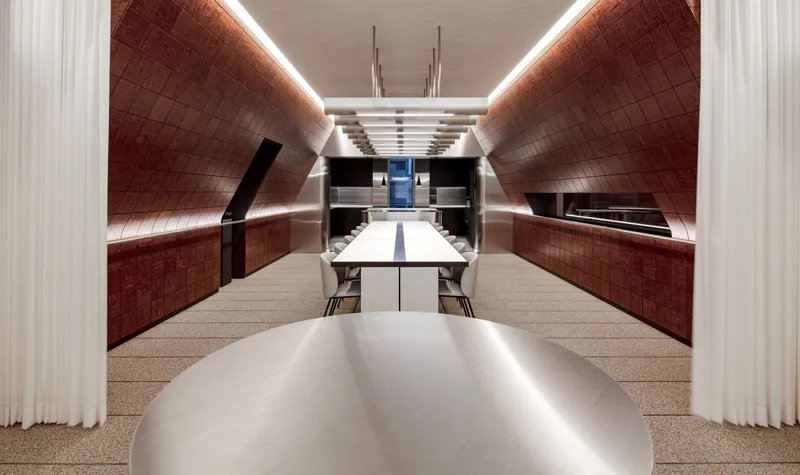
The long white dining table is the gravitational center of Gastro Circuit. Flanked by curved red-tiled walls that lean gently inward, the room narrows perceptually as your eye travels toward the kitchen. Suspended ceiling lights drop at regular intervals along the table's axis, reinforcing the sense of directed movement. The effect is less "dining room" and more "refectory tunnel," which suits the intimate, communal format of a twelve-person meal.
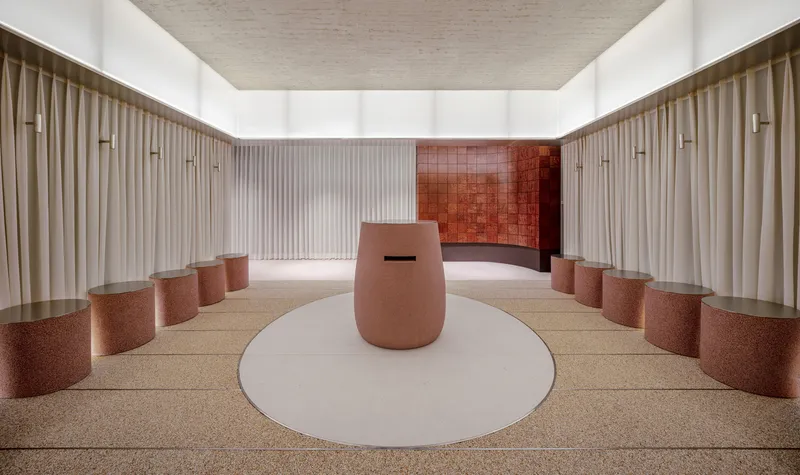
Pink cylindrical stools provide seating around a secondary gathering zone marked by a white circular rug and a recessed ceiling detail. This area appears to function as the waiting or reception space that bridges the entry corridor and the main table. The pink forms are deliberately playful, softening the otherwise controlled palette and introducing a note of whimsy that keeps the space from feeling overly austere.
Curtains, Thresholds, and Controlled Revelation
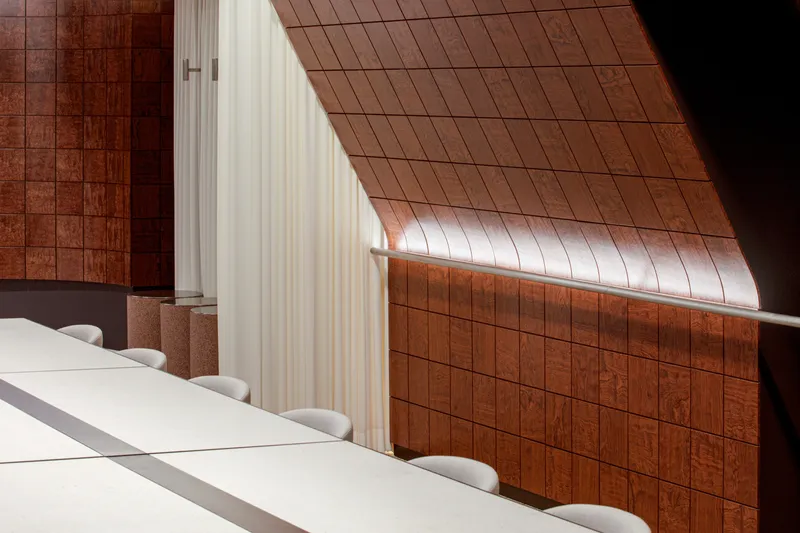
one-aftr uses white curtain panels as soft partitions throughout the space, and the move is smarter than it first appears. A curtain is not a wall: it suggests a boundary without enforcing one. When natural light streams across the angled red tile and catches the translucent fabric, the result is a layered depth that a solid partition could never produce. You see the suggestion of what lies beyond before you see the thing itself, which is pure scenography.
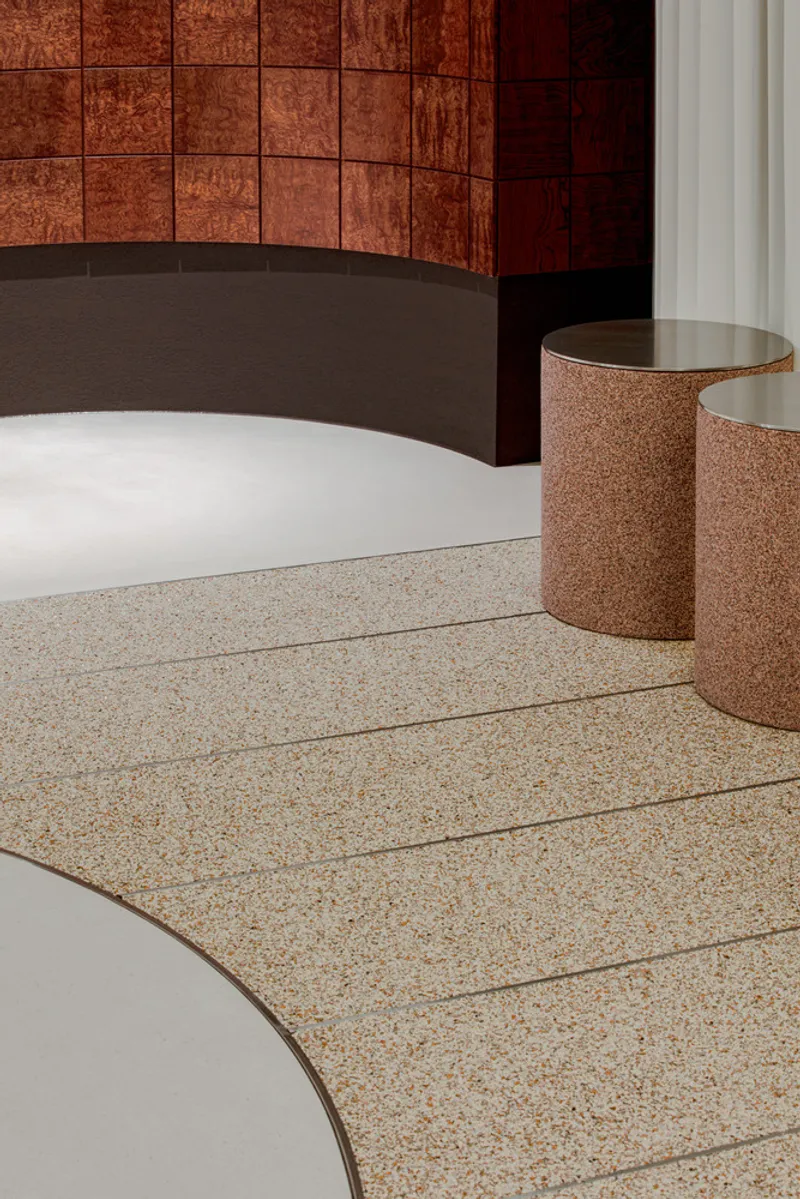
At floor level, the detail work is equally deliberate. Terrazzo flooring meets the curved white platform edge and the pink cylindrical elements with clean, radiused junctions. The gravel-like aggregate in the terrazzo echoes the earthy materiality of the tile and wood elsewhere, grounding the lighter, more theatrical elements above. Every threshold in Gastro Circuit is a negotiation between revelation and concealment, and the material transitions reinforce that.
The Stainless Steel Kitchen as Destination
The open kitchen occupies the far end of the loop, and one-aftr marks the shift with a sudden change in material register. Reflective stainless steel replaces the warm tile, creating a high-contrast zone that reads as both professional and performative. The chef works on a central island that is visible from the dining table, collapsing the traditional front-of-house and back-of-house divide. For a space that hosts rotating chefs with different styles and cuisines, this openness is essential: the kitchen must be legible and adaptable rather than branded.
The circuit closes as guests exit through the kitchen and re-enter the corridor from the opposite direction. It is a simple plan gesture, but it means you never retrace your steps. The experience has a beginning, a middle, and an end, and the architecture enforces the sequence without any signage or instruction.
Why This Project Matters
Gastro Circuit belongs to a growing category of hospitality projects where the architect is not decorating a restaurant but designing an experience from scratch. With no fixed chef, no fixed menu, and only twelve seats, the space cannot rely on branding or repeat visual cues. one-aftr's response is to make the architecture itself the constant: the corridor, the reveal, the communal table, the mirrored kitchen, the exit. These spatial facts persist regardless of who is cooking, and they give every iteration of the dinner a shared narrative structure.
At 99 square meters, the project also demonstrates how much atmosphere you can generate with a small footprint and a focused material palette. Wood, steel, polycarbonate, tile, terrazzo, and fabric. Nothing exotic, nothing imported from a luxury catalog. The power comes from sequencing: how you encounter each material, in what light, and at what moment in the circuit. That is a lesson worth more than any amount of square footage.
Gastro Circuit by one-aftr. Seoul, South Korea. 99 m². Completed 2023. Photography by Jang Mi.
About the Studio
Share Your Own Work on uni.xyz
If projects like this are the kind of work you want to make, uni.xyz is a place to publish your own, find collaborators, and enter design competitions.




Popular Articles
Popular articles from the community


Co-life: Sustainable Architecture for Age-Friendly Community Living
Co-life reimagines sustainable architecture for seniors through courtyards, rammed earth, shared gardens, and spaces designed for belonging.

Conexión: Biophilic Design Reimagines High-Rise Living in Hong Kong
Conexión reimagines high-rise living in Hong Kong through biophilic design, green facades, shared spaces, daylight, water and nature within.

Hill & Cross Opera: Sculptural Opera House Architecture Shaped by Tallinn’s Landscape and Identity
Hill & Cross Opera reimagines opera house architecture in Tallinn through its sculptural hill, civic plaza, glass wave and a luminous cross.

Play: Fragments of Their World
Familiar architecture becomes modular playground design, creating safe spaces where displaced children can learn, connect, imagine and play.


Similar Reads
You might also enjoy these articles


Hodi-Mandai Geram
Project Function: Preservation and revitalization of the Intangible heritage and socio-spatial identity of the Hodi by Housing, Cultural Memory Center, Sacred Grove, landscape, local tourism economy


Olio Towers: A Mid-Rise for Performers That Fuses Housing, Rehearsal, and Stage
Located blocks from Houston's Theater District, this modular tower stacks living units around a central performance atrium.

Oasis: Modular Green Housing Carved into Dhaka's Urban Fabric
A shortlisted Plugin Housing entry reclaims unauthorized settlements in Dhaka with stepped concrete volumes, green roofs, and ventilation-driven design.

Black Hole: A Floating Megastructure for the Post-Physical Era
Emiliano Mazzarotto envisions a spherical, self-scaling arena where e-sports, digital hotels, and holographic stadiums replace traditional public space.


Explore Hospitality Building Competitions
Discover active competitions in this discipline



Challenge to reimagine the Iron Throne


Photograph architecture without architects


Illustrate the lost glory of Angkor Wat - Render Challenge


Design challenge to reuse E-waste
Comments (0)
Please login or sign up to add comments
No comments yet. Be the first to comment!