

Gaya Sofoyan Peels Back Soviet-Era Plaster to Reveal the Soul of a Yerevan Restaurant
Niko Restaurant occupies 150 square meters inside a Soviet-period building in central Yerevan, turning decay into design intention.


Most restaurant interiors try to hide the past. Niko Restaurant, a 150 square meter dining space in central Yerevan designed by Gaya Sofoyan, does something rarer and harder: it turns the building's accumulated history into the primary design material. Set inside a Soviet-period structure, the project treats distressed plaster, exposed concrete, and layered paint not as problems to solve but as textures to celebrate. The result is a space that feels simultaneously ancient and unfinished, as if the building is still in the process of becoming.
What makes the project genuinely interesting is the discipline with which Sofoyan resists the urge to overdesign. The palette is almost entirely derived from what was already there: concrete ceilings left raw, plaster walls stripped to reveal terracotta and white substrata, floors polished to a terrazzo gleam. New interventions, like oxidized copper bar fronts and cast concrete pendant lights, slot into this archaeological landscape with a material frankness that avoids the trap of performative "rawness." It is a restaurant that trusts its bones.
The Street and the Threshold

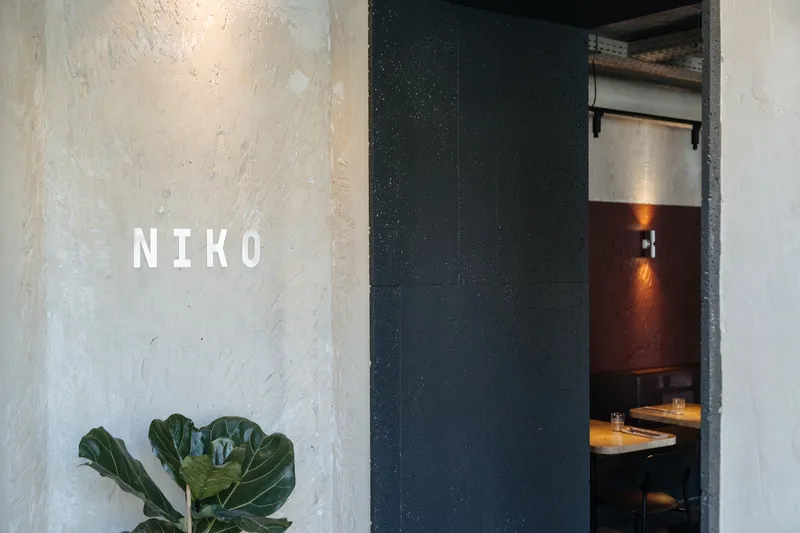
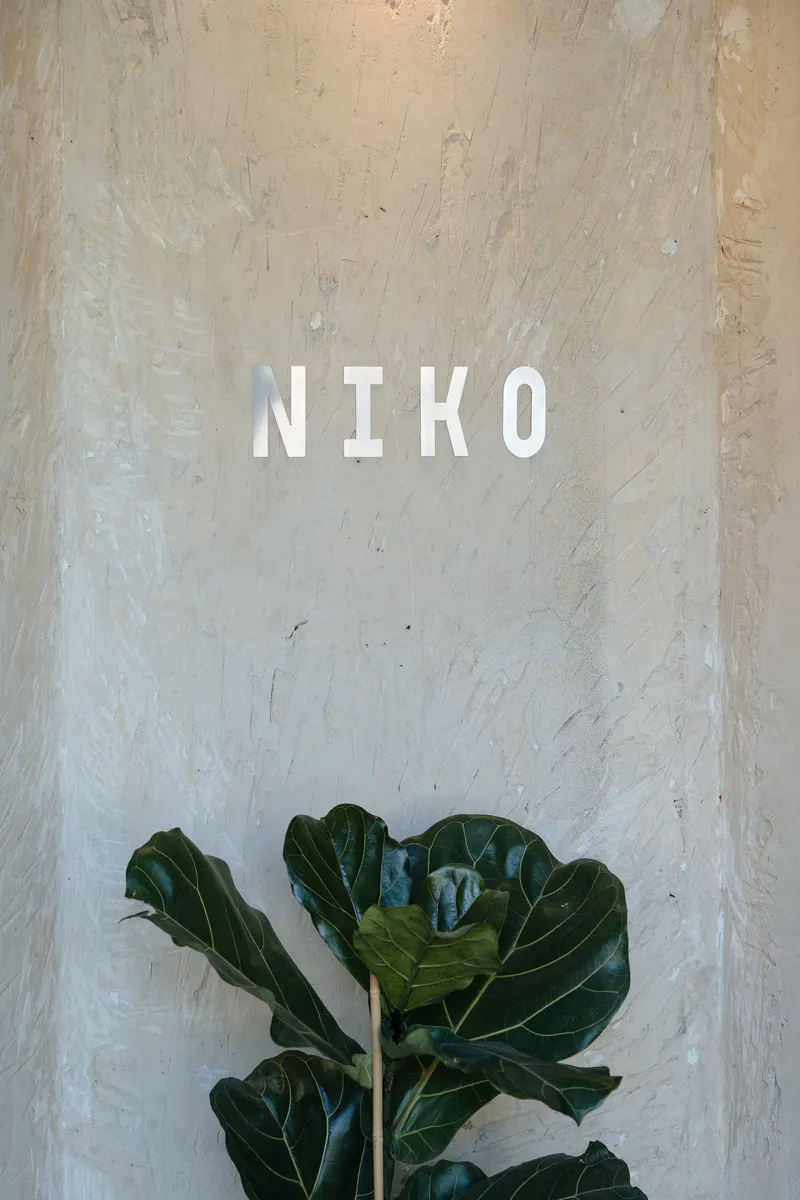
From the street, Niko announces itself quietly. The Soviet facade retains its original character: white plaster, dark stone quoins, iron balconies. There is no flashy signage war, just white lettering mounted on a wall whose distressed surface already tells a story. The entrance sequence, framed by a fiddle-leaf fig and a dark doorway, compresses the visitor's field of vision before releasing it into the dining room. It is a classic threshold trick, and Sofoyan deploys it without fuss.
Weathered Walls as Wallpaper
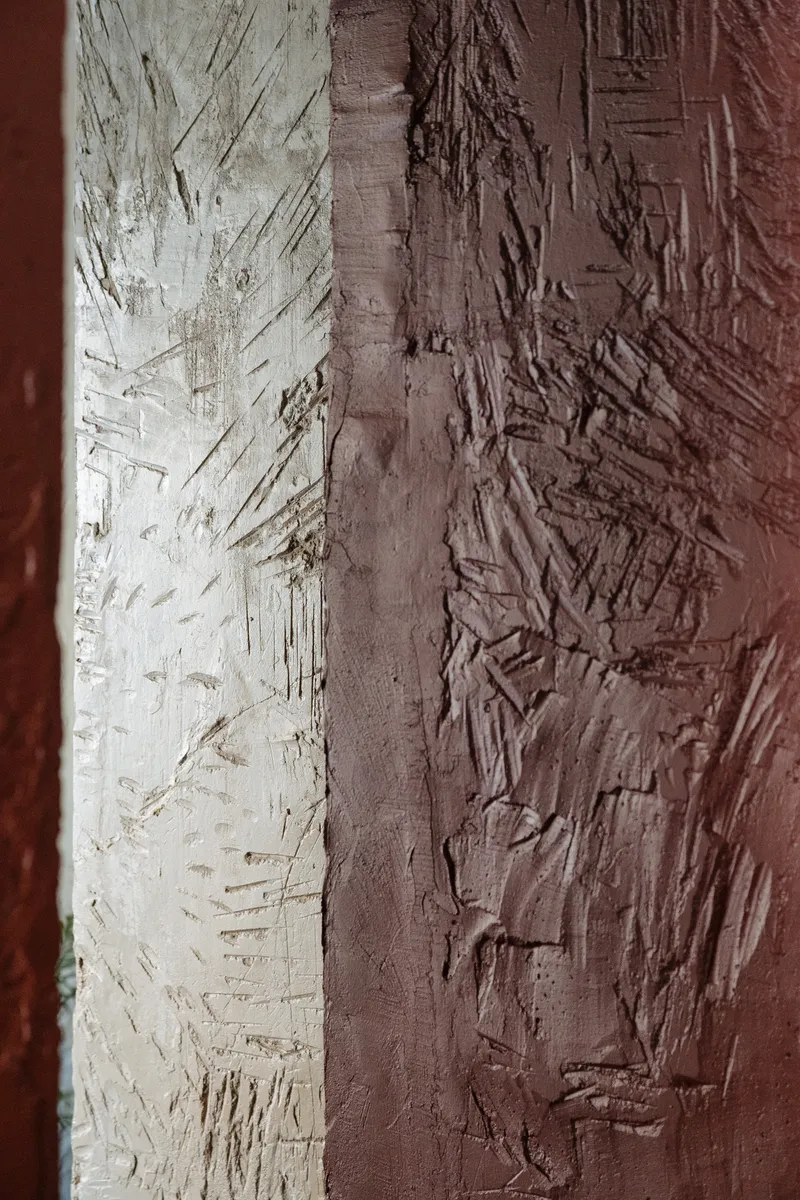
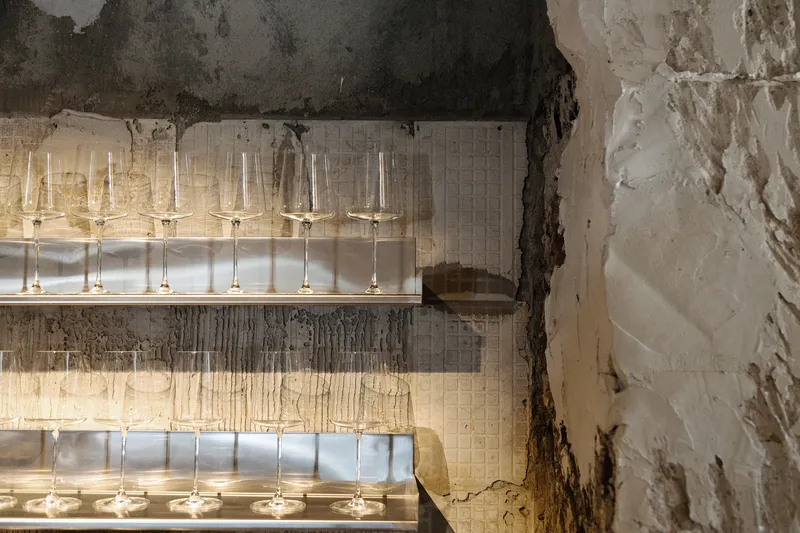
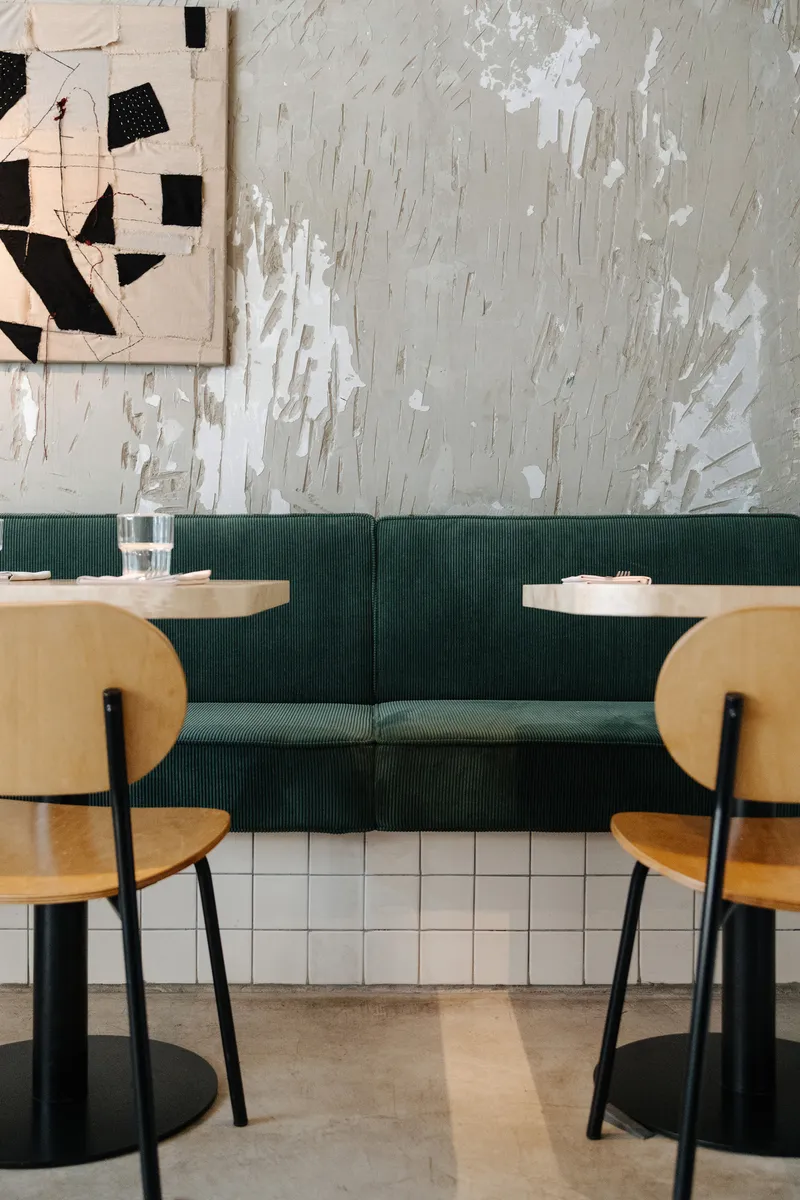
The walls are the project's defining gesture. Sofoyan has selectively stripped, scraped, and preserved layers of plaster and paint that accumulated over decades. The transitions from white to terracotta, complete with visible trowel marks, function like geological cross-sections. Against one wall, wine glasses sit on illuminated shelves, the old finishes behind them reading like an abstract painting. None of this is accidental. The distressed surfaces required careful editing: knowing what to peel away and what to leave demanded as much judgment as any fresh application of material.
A green upholstered banquette against a wall of peeling paint might sound like a Pinterest cliché, but here the contrast works because the furniture is restrained. Round timber tables, simple cushions, and low-key lighting let the wall do the talking. The palette stays warm: cream, terracotta, olive, copper. There is no cold grey minimalism competing with the patina.
Concrete Structure, Exposed Logic

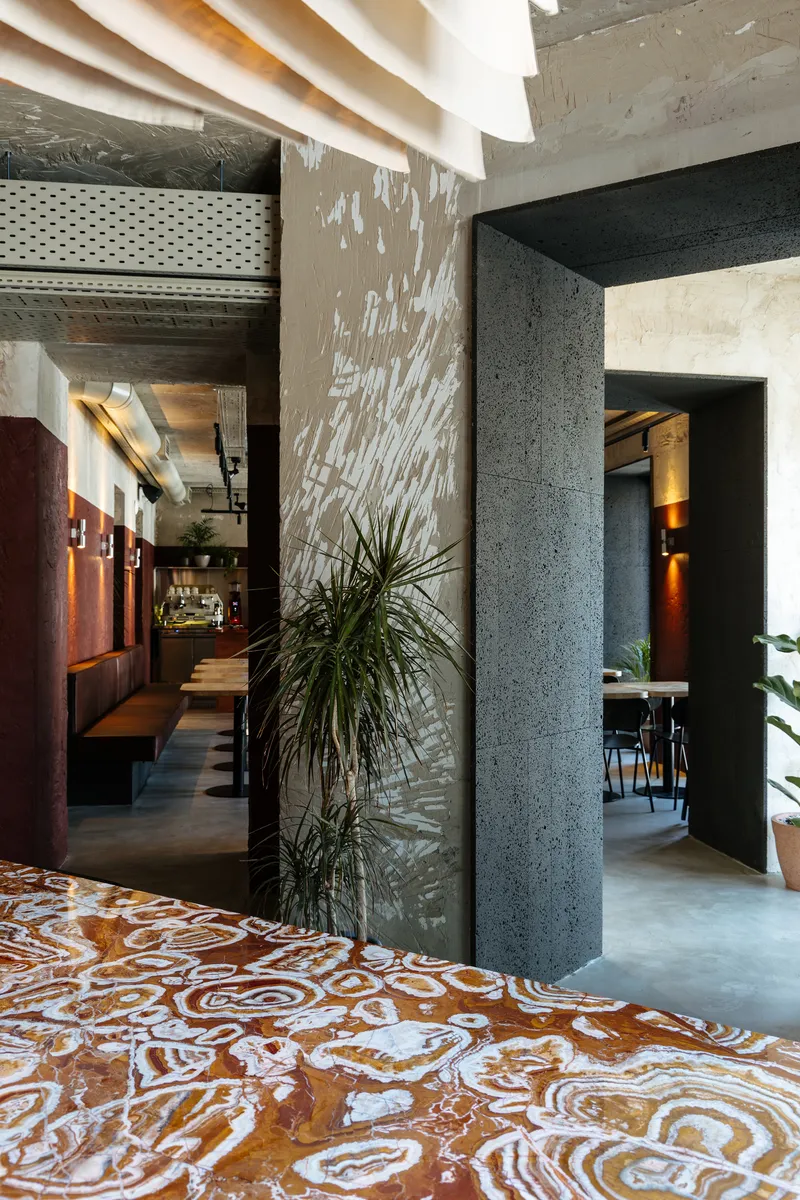
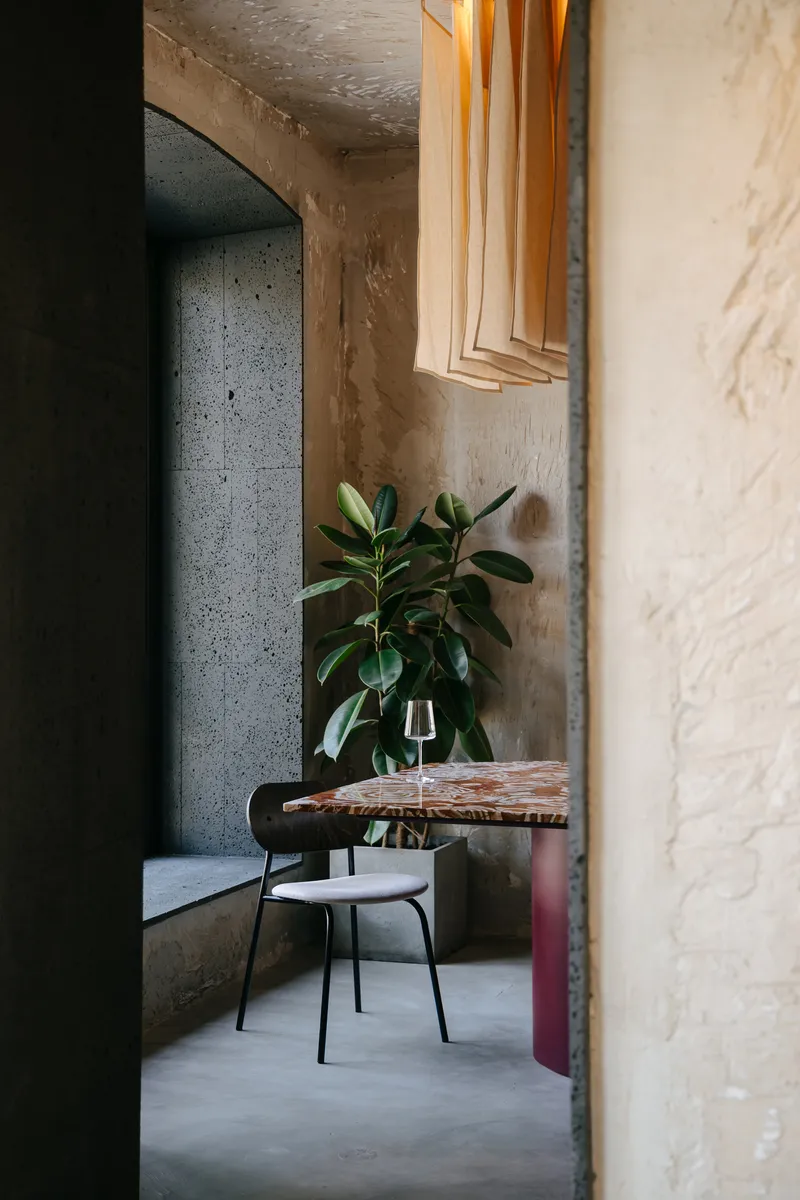
Where the plaster walls tell a story of time, the exposed concrete ceiling and columns tell a story of structure. The Soviet-era concrete grid is left fully visible, its beams and soffits forming a rhythmic canopy over the dining areas. Large palms positioned at column bases soften the geometry and introduce a vertical green counterpoint to the horizontal grey. The polished terrazzo floor, with its embedded pattern, acts as a mediator between the rough overhead plane and the carefully set tables below.
Sofoyan uses the existing columns to define spatial zones rather than inserting new partitions. A doorway framed by concrete and weathered plaster creates a clear room-to-room sequence without doors. The layering of thresholds, each offering a slightly different view through potted greenery and dappled light, gives the compact 150 square meter plan a sense of depth that belies its actual footprint.
The Bar as Copper Anchor
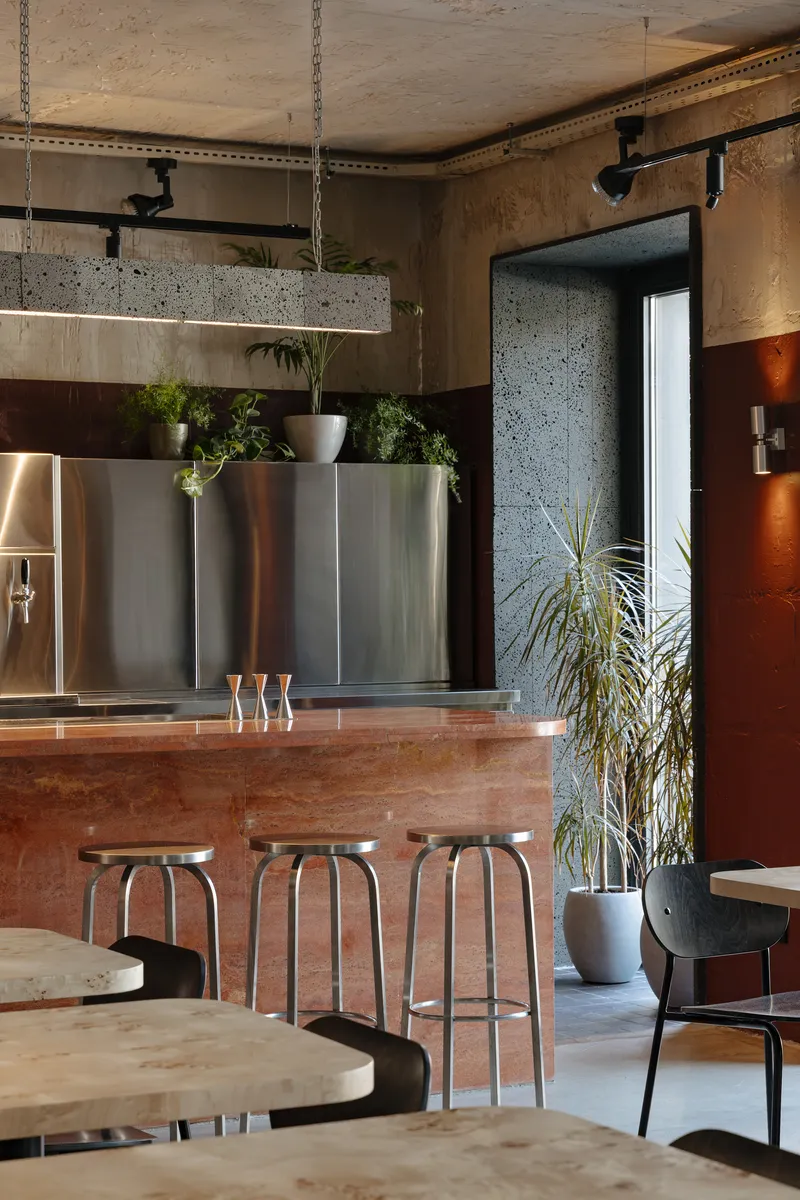
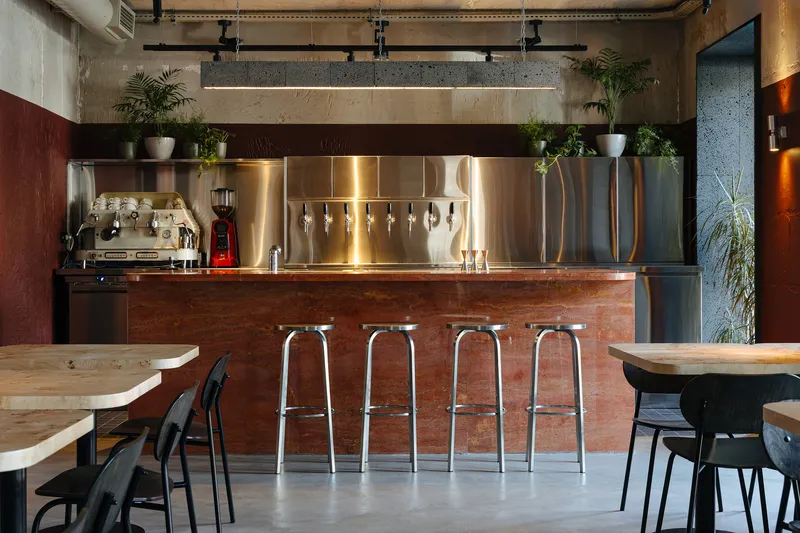

The bar counter is one of the few moments where a distinctly new material takes center stage. Its oxidized copper face catches warm light and will patina further with use, a deliberate echo of the aging strategy applied to the walls. Behind it, a stainless steel backsplash and commercial tap setup signal function without pretense. Metal stools at the counter keep the material family tight: copper, steel, concrete.
A second, smaller counter with a white tile face and textured plaster column appears elsewhere in the plan, suggesting that the bar program is distributed rather than centralized. This dispersal keeps the compact space from bottlenecking around a single service point and gives different seating zones their own relationship to food and drink.
Light, Plants, and the Table
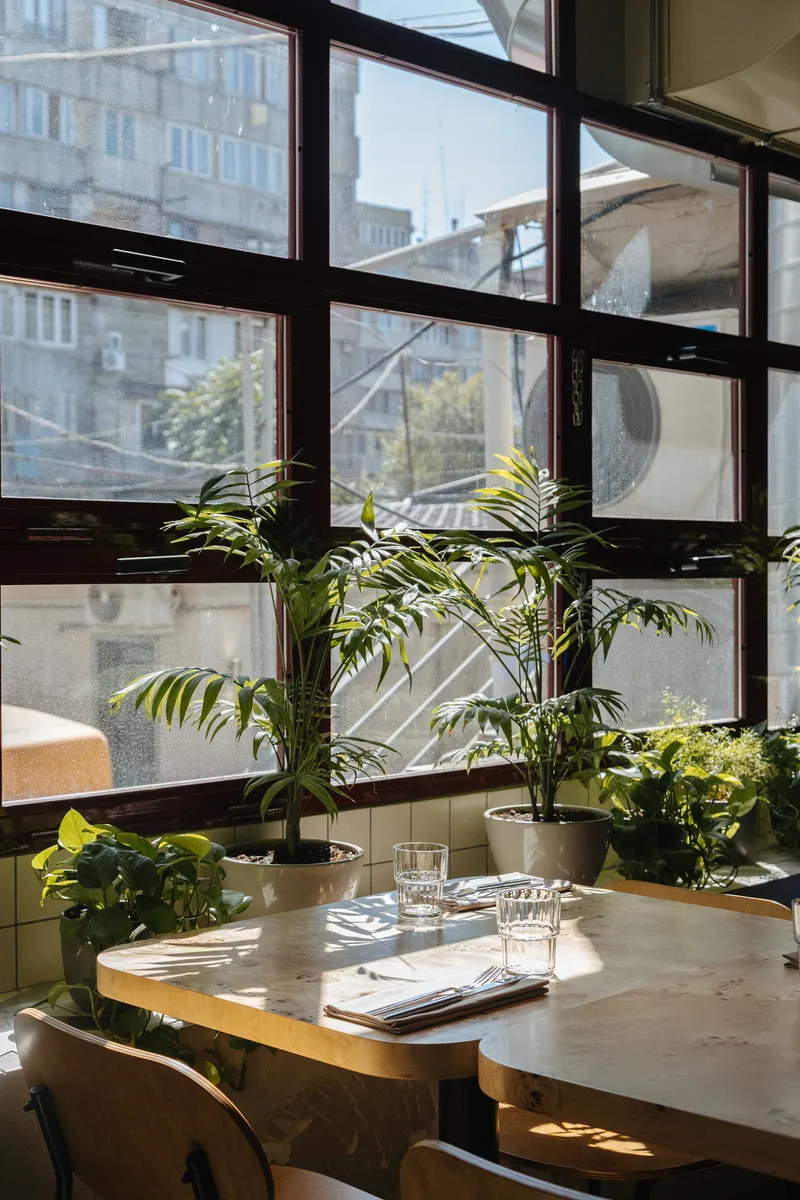
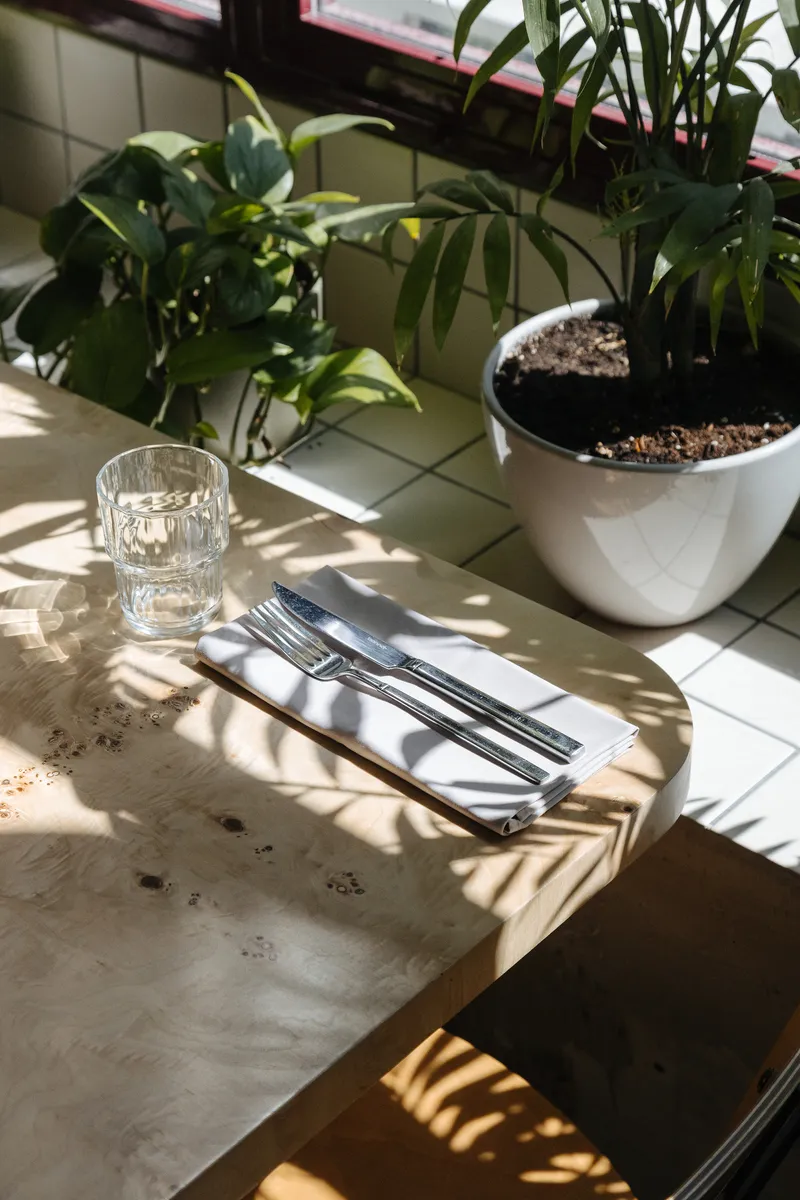
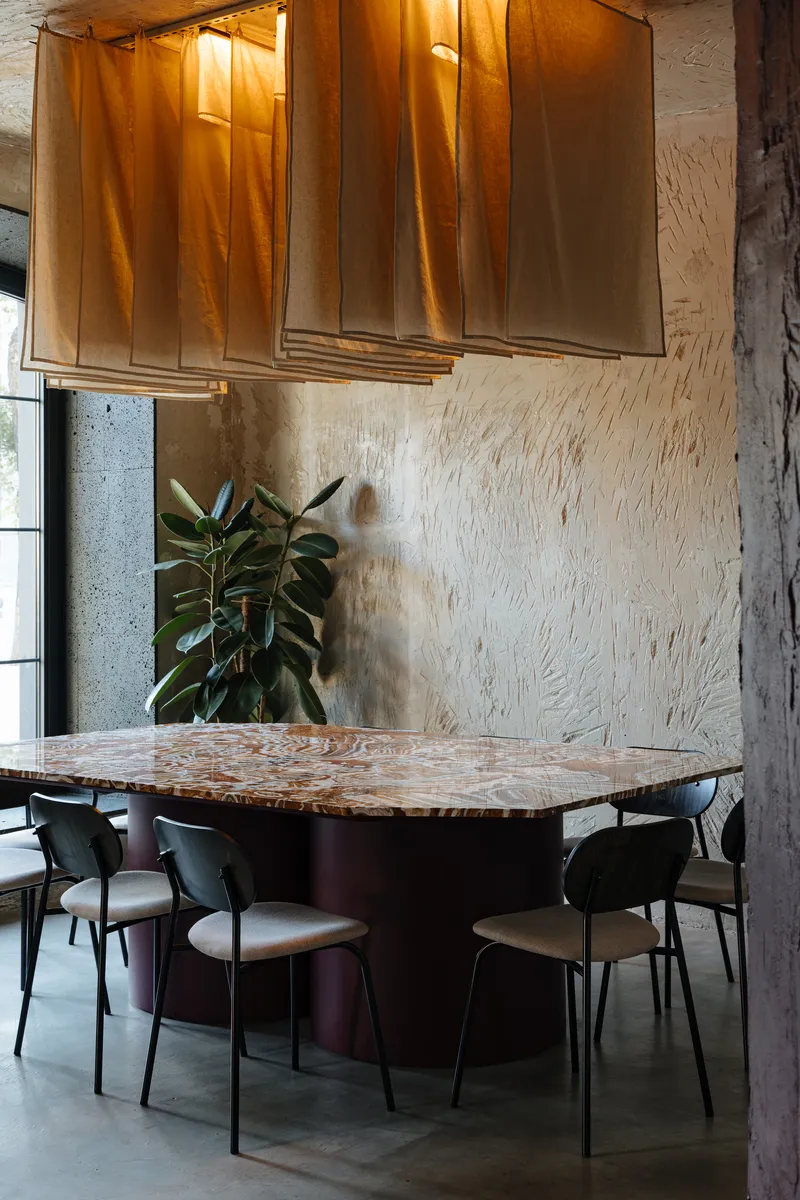
Natural light enters through windows fitted with dark metal grids, casting dappled shadows across table surfaces and plants. Sofoyan appears to have choreographed the planting specifically for this effect: palms on sills filter the Armenian sun into shifting patterns on cast concrete tabletops and tile surfaces. The experience of sitting at a window table here would change measurably over the course of an afternoon.
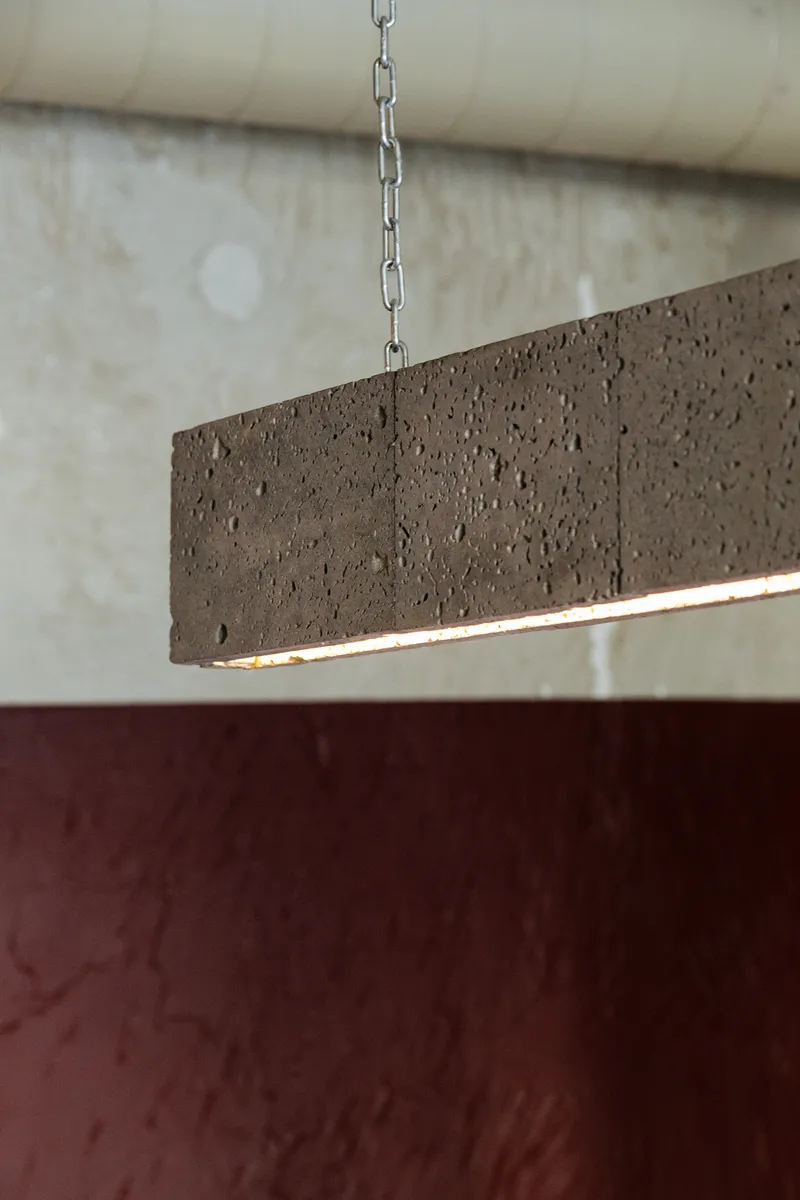
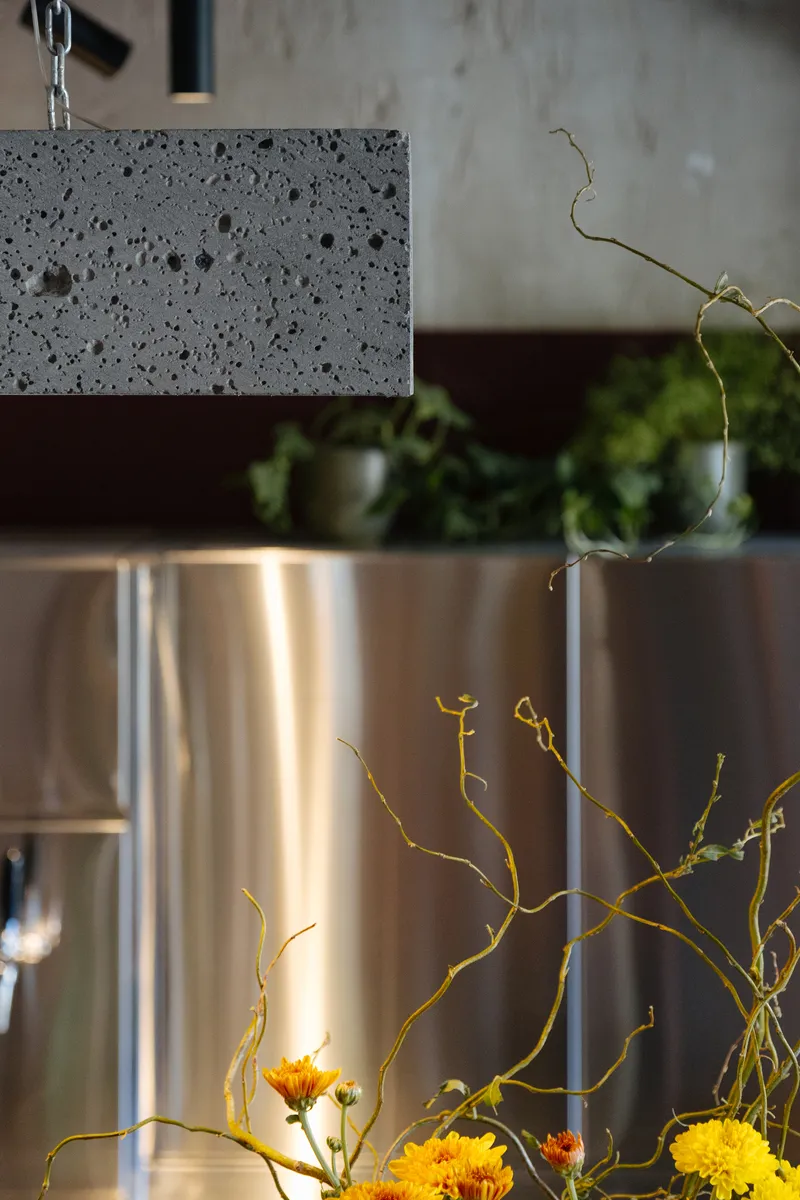
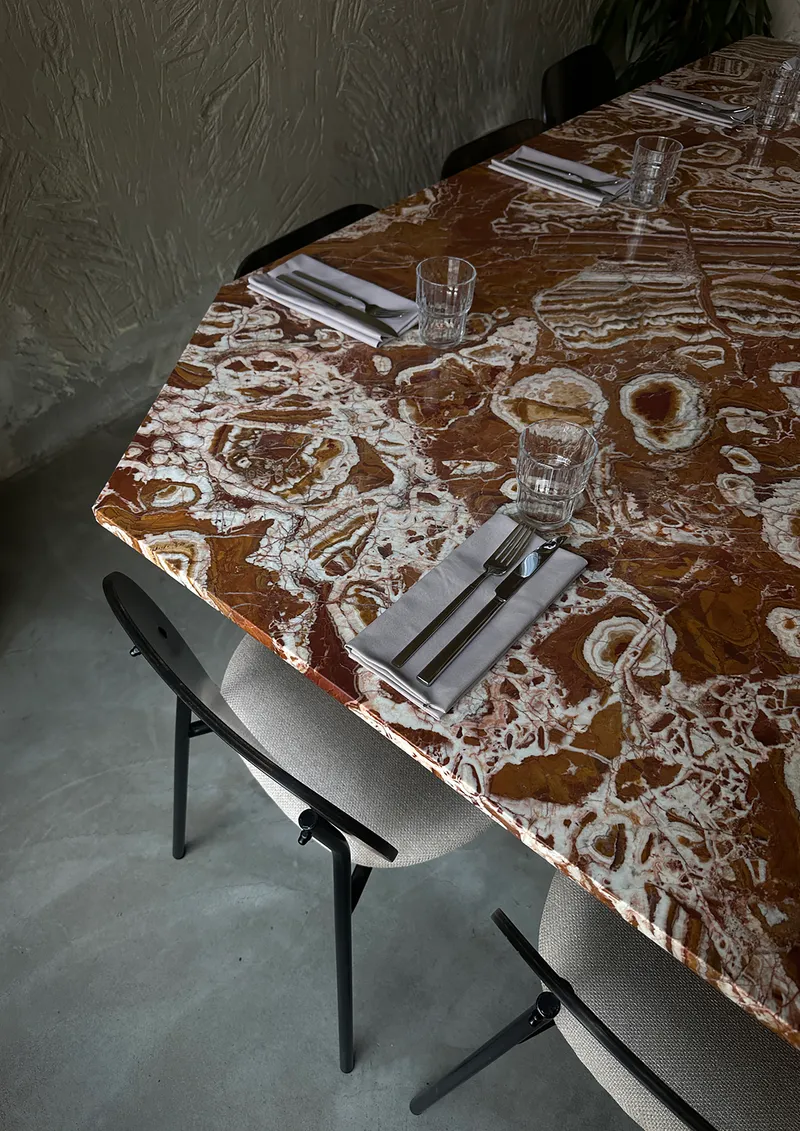
Custom lighting fixtures reinforce the material language. Suspended rectangular pendants in textured brown concrete, hung on chains, bring a handmade quality to the overhead plane. They read as small architectural objects in their own right, their integrated linear illumination offering warm, directed light without the clinical quality of track fixtures. On the tables, marbled stone surfaces with organic veining provide a geological texture that rhymes with the stripped walls. Every surface here has grain.
Seating Details and Material Juxtapositions
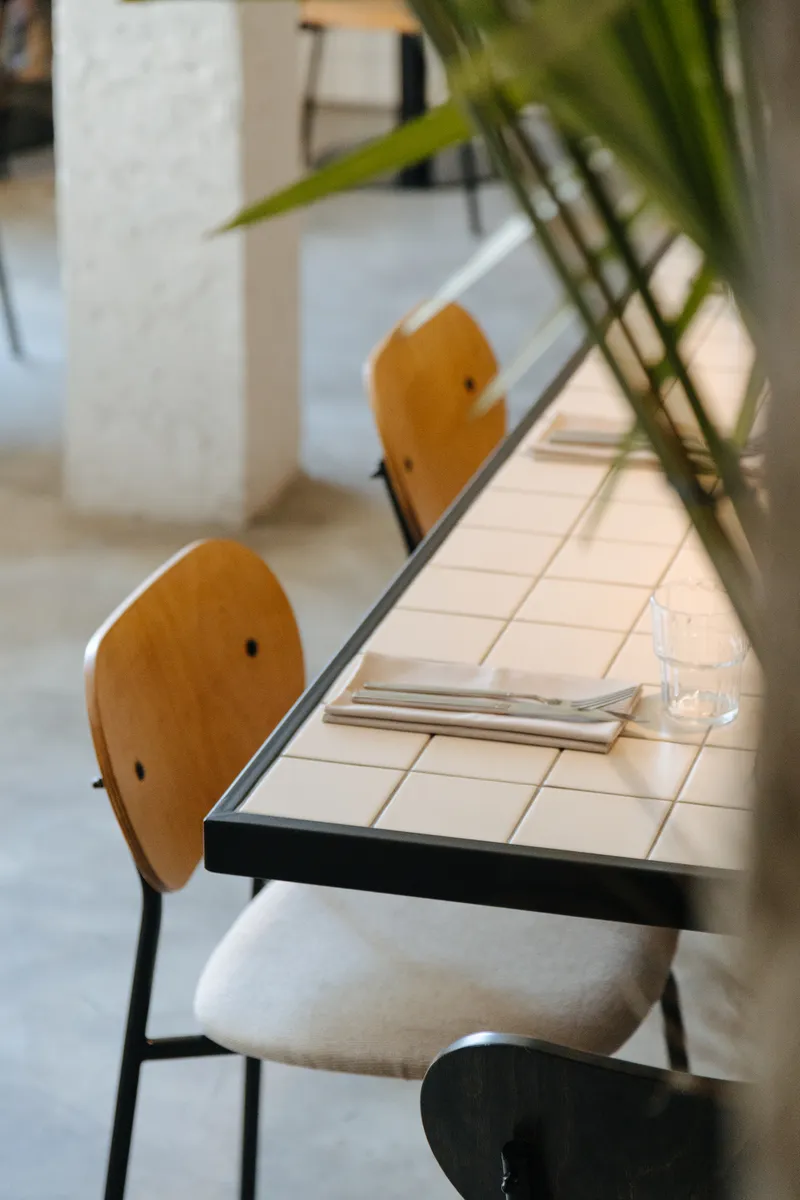
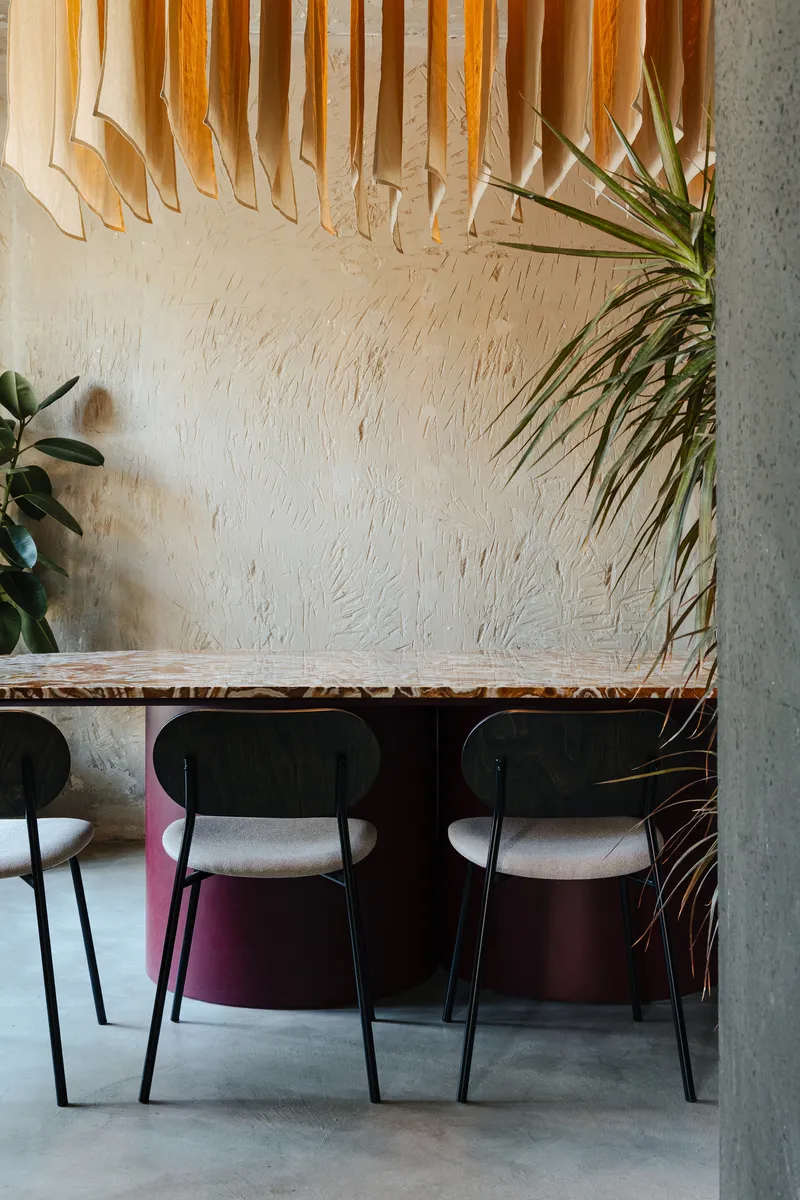
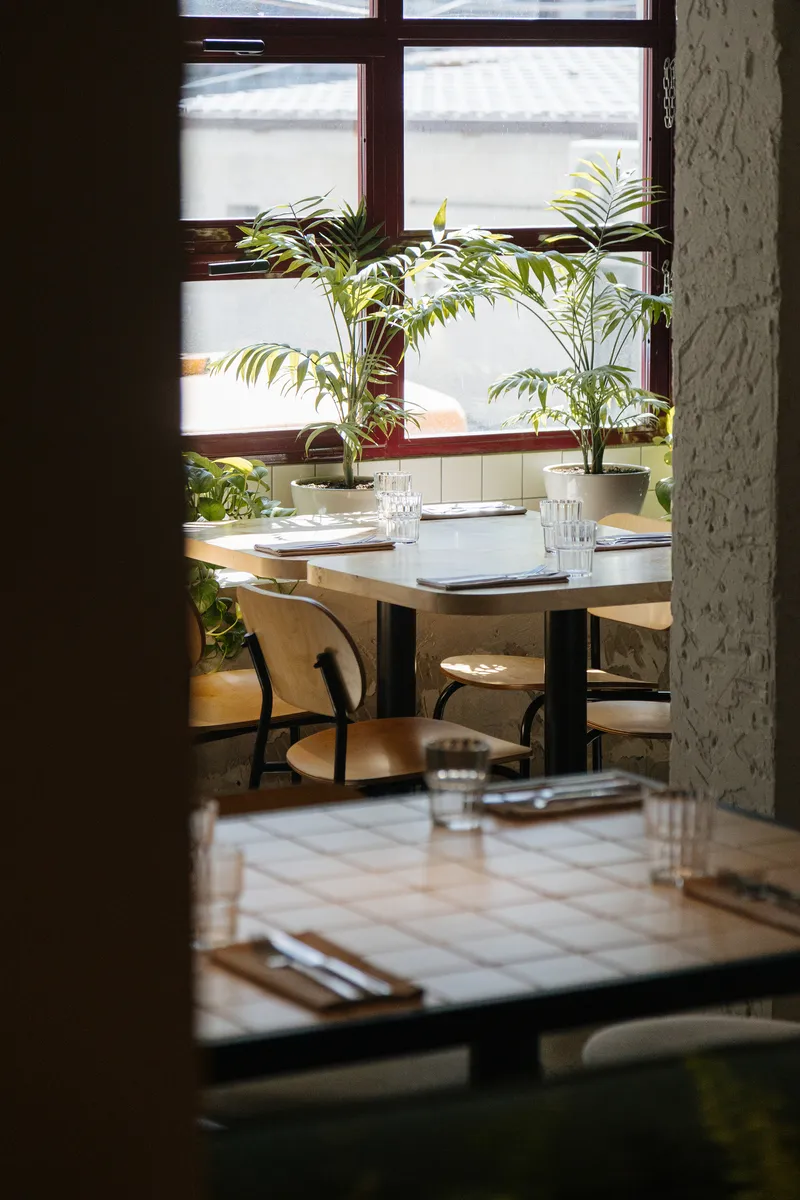
The seating strategy mixes fixed banquettes, tiled bench seats with rounded plywood backrests, and freestanding chairs. Each zone has its own character without breaking the overall material covenant. A slatted timber ceiling feature above one table set creates a canopy effect, differentiating the space below from the raw concrete elsewhere. The tiled bench seating, with its curved plywood, introduces a softer geometry that contrasts productively with the rectilinear column grid.
Below Grade: Stairs and Restrooms
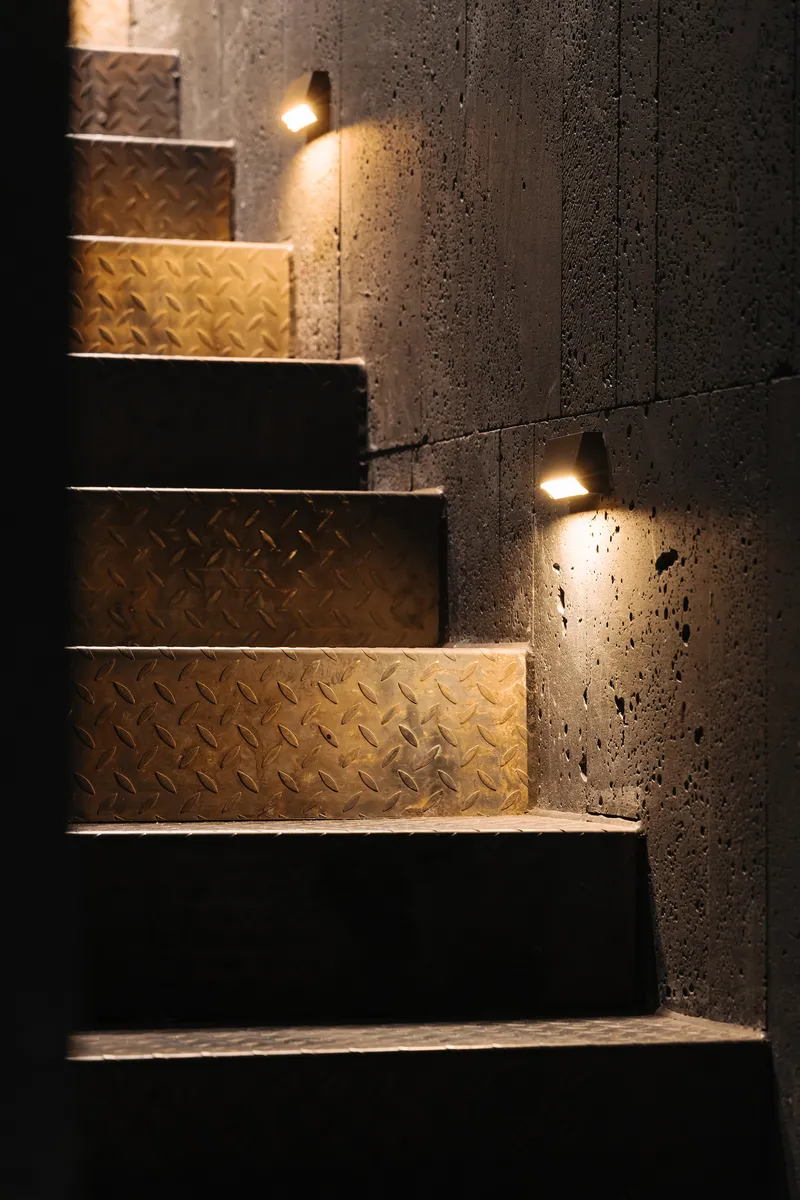
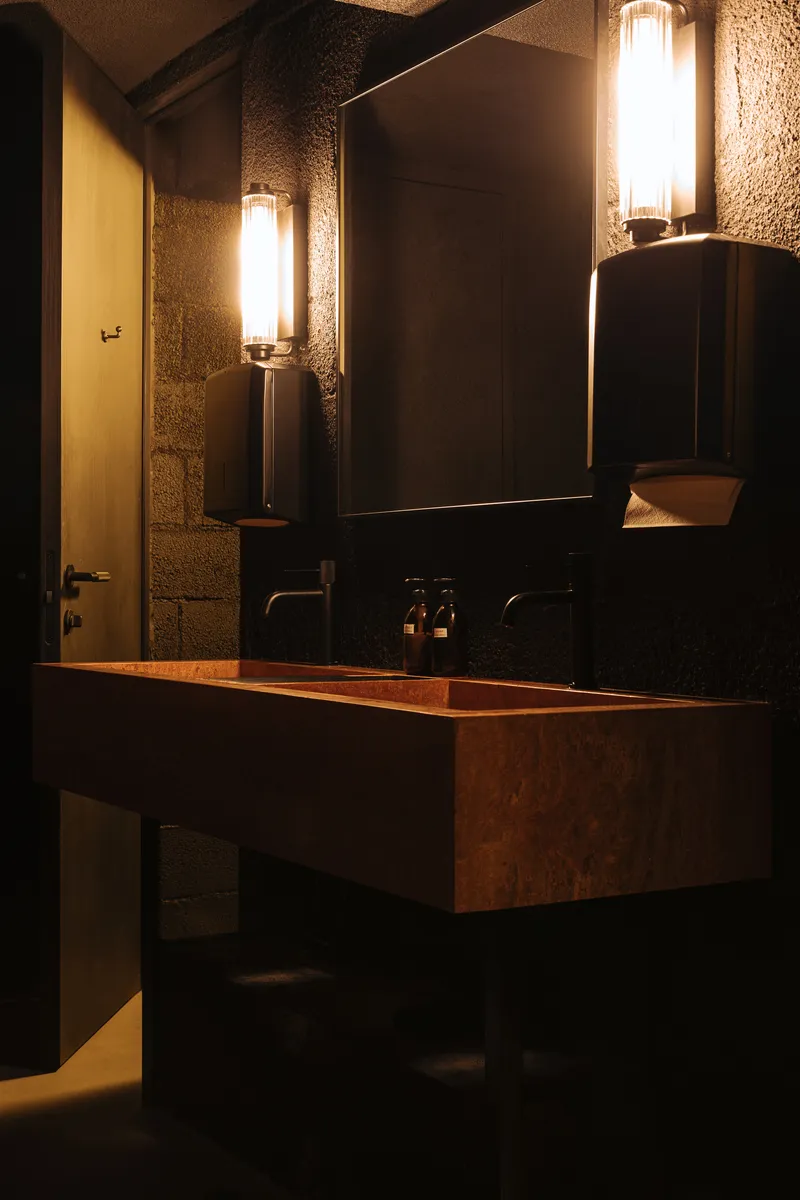
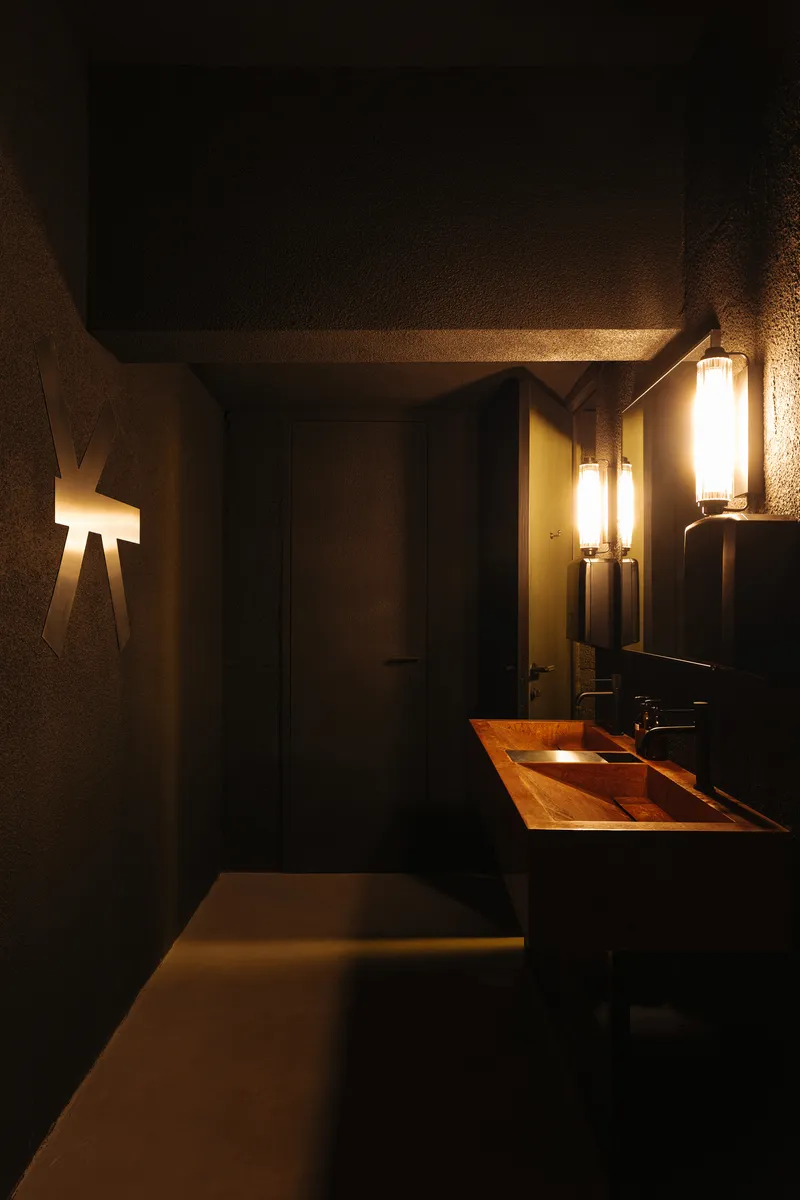
A staircase with diamond-plate metal treads descends to restrooms that continue the project's material logic at a more intimate scale. Concrete walls, copper sinks, cylindrical wall sconces, and low ambient lighting give these rooms a cave-like intensity. The copper vanity ties directly to the bar counter upstairs, maintaining a legible material thread from the most public to the most private moment in the building. The recessed stair lighting marks each tread with a precise line, a moment of controlled precision amid all the deliberate roughness.
Additional Details

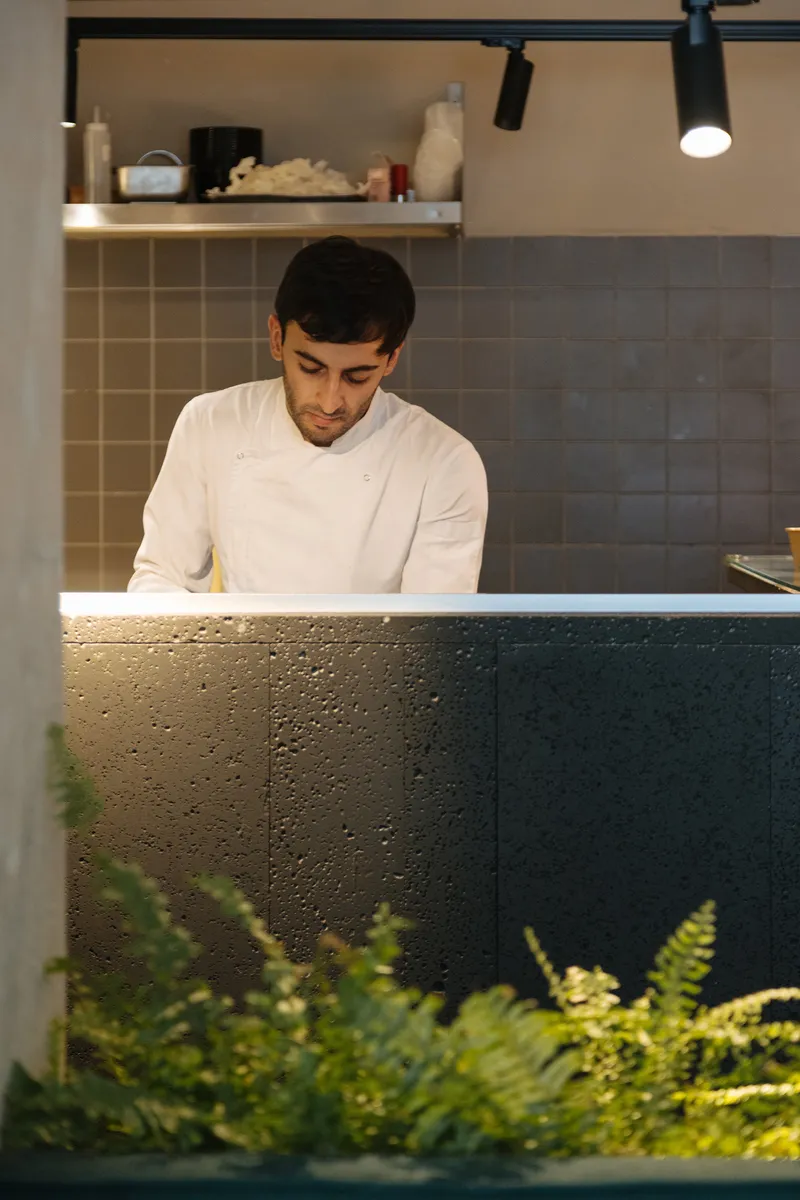
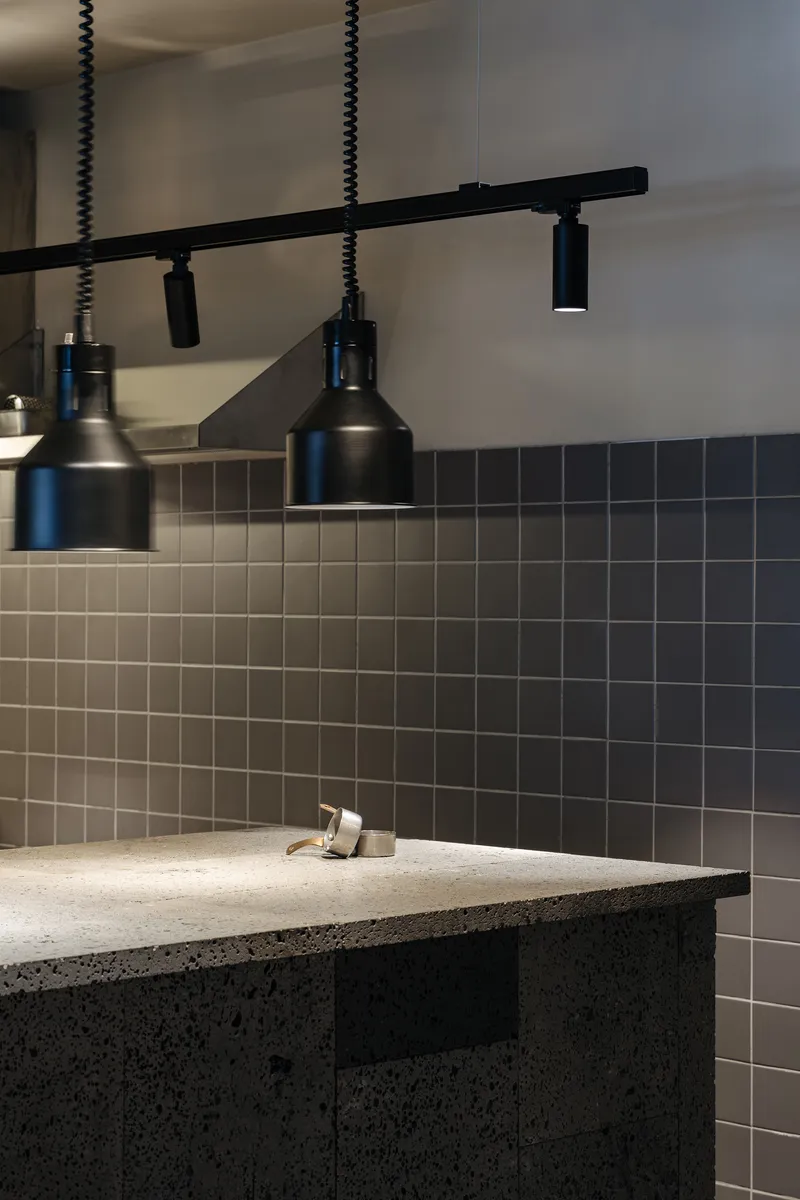
Smaller moments accumulate to reinforce the whole. A black doorway framed by a concrete column and a fiddle-leaf fig. A service counter with integrated strip lighting above a textured dark base. A bathroom sink backed by dark mosaic tile. Each detail operates within the same restricted vocabulary of concrete, copper, tile, plaster, and greenery. The consistency is not monotonous because the textures vary so widely within each material family. Concrete alone appears as raw ceiling, polished floor, cast pendant, and troweled wall.
Plans and Drawings
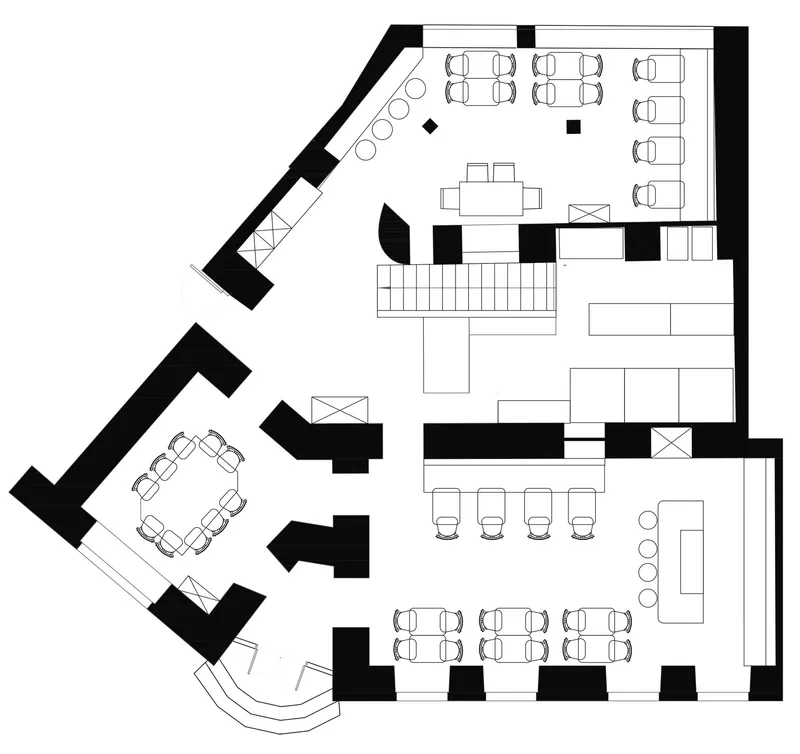

The floor plan confirms what the photographs suggest: the layout wraps booth and table seating around a central staircase, using the existing column grid to partition the space into distinct but visually connected zones. There are no gratuitous curves or forced geometries. The plan is a pragmatic response to the Soviet structural shell, and the architecture's intelligence lies in what it chose to keep rather than what it added.
Why This Project Matters
Niko Restaurant matters because it demonstrates that a compelling restaurant interior does not require a blank canvas or a large budget for new finishes. In a city like Yerevan, where Soviet-era buildings form the backbone of the urban fabric, the question of how to inhabit these structures without erasing them is both cultural and practical. Sofoyan's answer is persuasive: treat the building as a collaborator, not an obstacle, and let its material history do work that no amount of imported cladding could replicate.
The project also offers a useful corrective to the trend of artificially distressed interiors. Here, nothing is faked. The peeling paint is real. The concrete is structural. The patina is earned. In a global restaurant design culture saturated with manufactured nostalgia, that honesty is the most radical thing about Niko.
Niko Restaurant, Yerevan, Armenia. Architect: Gaya Sofoyan. Area: 150 m². Year completed: 2025. Photography: Sergey Akopyan.
About the Studio
Share Your Own Work on uni.xyz
If projects like this are the kind of work you want to make, uni.xyz is a place to publish your own, find collaborators, and enter design competitions.


Popular Articles
Popular articles from the community


Juan García Correa, John González and Claudia Rueda Sink a Circular Amphitheater into a Manizales Engineering Building
On the La Nubia campus in Manizales, Colombia, the S1 Building folds labs and offices into a hillside of ramped lawns that double as a campus route.

David Macias Steps a Doorless Stone and Plaster House Down a Tropical Colombian Hillside
In the humid hills of Colombia, Threshold House replaces the front door with an open void and terraces its 850 m² down the slope instead of fighting it.

David Ortega Stacks a Two-Story Mexico City Penthouse Around a Steel Stair and a Pergola-Shaded Roof Terrace
In Colonia Roma, a 300 m² penthouse uses oak joinery, a planted steel stair and a slatted roof pergola to make a new-build apartment feel like a house.

GROUP A Strips a 1969 Rotterdam Harbor Headquarters to Its Frame and Wraps It in Timber Louvers
In Rotterdam's M4H harbor district, Ferro Offices reuses a 1969 frame, adds one timber storey and reaches BREEAM-NL Outstanding.

Similar Reads
You might also enjoy these articles


LAVA Architecten Gives Vocational Education a Sawtooth-Roofed Face on a Mechelen School Campus
In Mechelen, Belgium, a 2,053 m² STEM school on a 6×6 m grid turns workshops and classrooms into rooms that can be rearranged as teaching changes.

KEMA Studio Turns a Derelict Marvila Attic into a 60 m² Lighthouse Apartment Above Lisbon
In Lisbon's Marvila district, a rebuilt roof, four skylights and two plywood volumes turn an unlivable attic into a bright home facing the Tagus.

Pixel Gardens: One Repeated Module Stacked Into a Terraced Social Housing Tower for Famagusta
Salem Bader's shortlisted housing tower builds a vertical neighbourhood from one repeated module, offsetting units to carve terraces, light and air.

Bao Huynh Watercolor Atelier: A Serene Art Retreat in Hội An
Bao Huynh Watercolor Atelier in Hội An blends multifunctional art spaces, sustainable design, local materials, and family-friendly living in a serene environment.

Comments (0)
Please login or sign up to add comments
No comments yet. Be the first to comment!