

Torab Home Resurrects a Qajar-Era Courtyard House in the Heart of Yazd
Gazorgah House recovers the spatial logic of Persian courtyard living through meticulous brick restoration and restrained modern insertions.


Yazd is one of the world's oldest continuously inhabited cities, and its domestic architecture carries a particular intelligence: thick earthen walls, sunken courtyards, wind towers, and deep iwans that collectively negotiate a desert climate where summer temperatures routinely exceed 40°C. The courtyard house is not a stylistic preference here; it is infrastructure. When Torab Home took on the restoration of Gazorgah House, a Qajar-period residence in the city's historic fabric, the task was less about aesthetics than about recovering the environmental and spatial logic that centuries of incremental neglect had obscured.
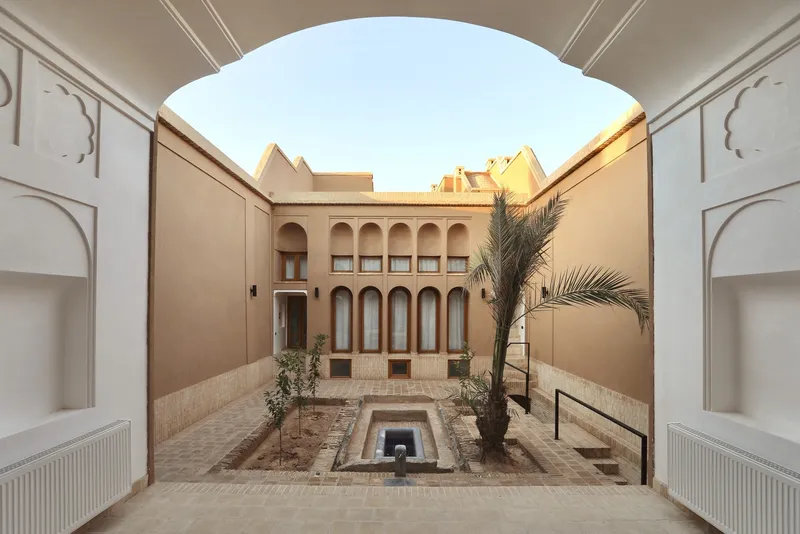
What makes this project worth studying is the discipline of its interventions. Rather than layering contemporary gestures over historic walls for contrast, the studio treated the original building as a working system that needed to be made legible again. New steel handrails, timber frames, and dark tile surfaces appear where they are functionally necessary, and they read as insertions rather than additions. The courtyard, with its sunken pool, young palms, and brick paving, has been restored as the organizing center of the plan, the way it was always meant to work.
The Courtyard as Engine
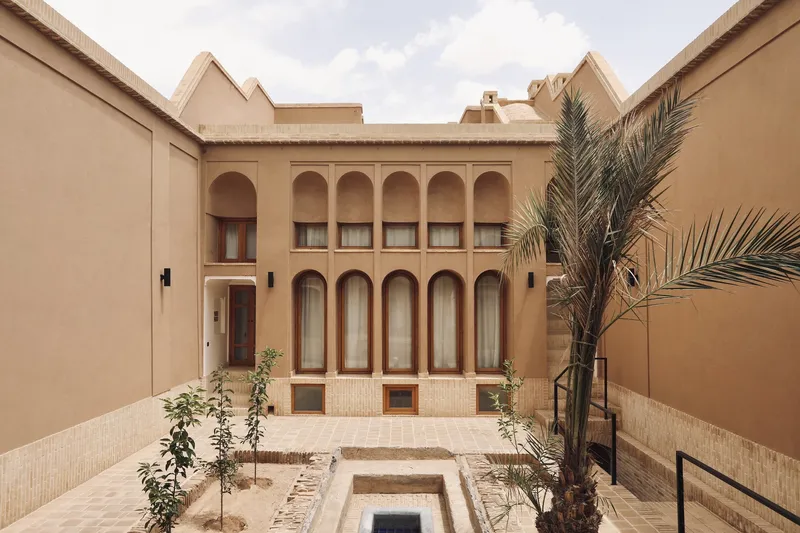
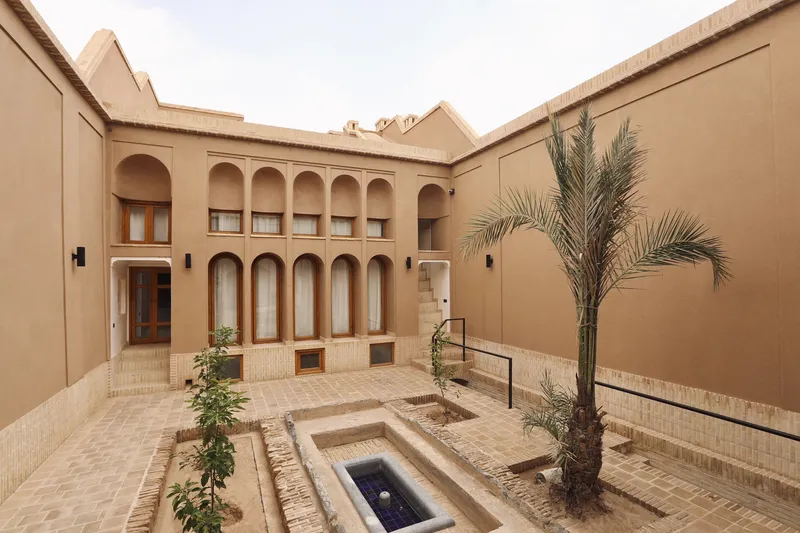
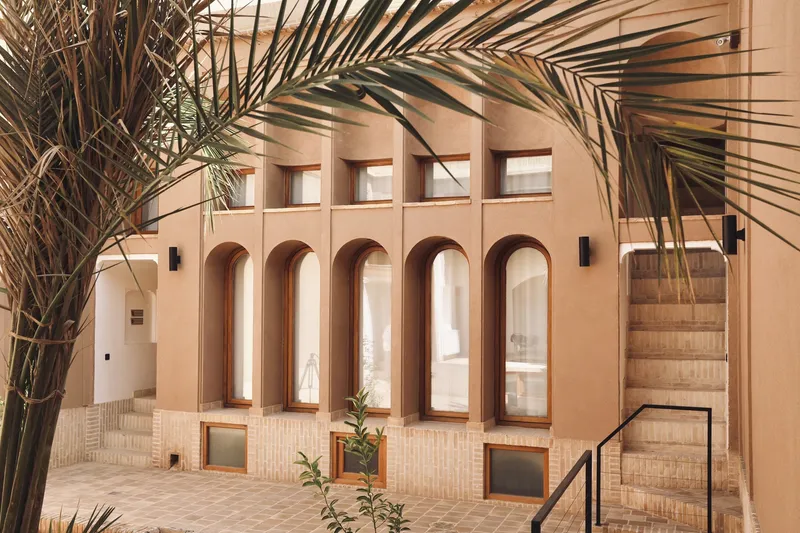
In Yazdi courtyard typology, the central open space is not a garden for looking at. It is a thermal regulator, a light well, and a social clearing in one. Gazorgah House reasserts this principle with clarity. The sunken pool sits at the lowest point of the courtyard, gathering coolness. Arched arcades ring the perimeter, providing shaded transition zones between the harsh exterior climate and the tempered interiors. Young palm trees have been planted not for decoration but to eventually provide canopy shade that will lower surface temperatures across the brick paving.
The proportions of the courtyard feel generous without being monumental. Two stories of arched openings face inward, their rhythm steady and unbroken. Rendered walls alternate with exposed brick in a way that suggests honest repair rather than decorative intent. You can read the history of the building in these surfaces: where original material survived, it has been kept; where it was lost, new brick fills the gap without apology.
Thresholds and Passages
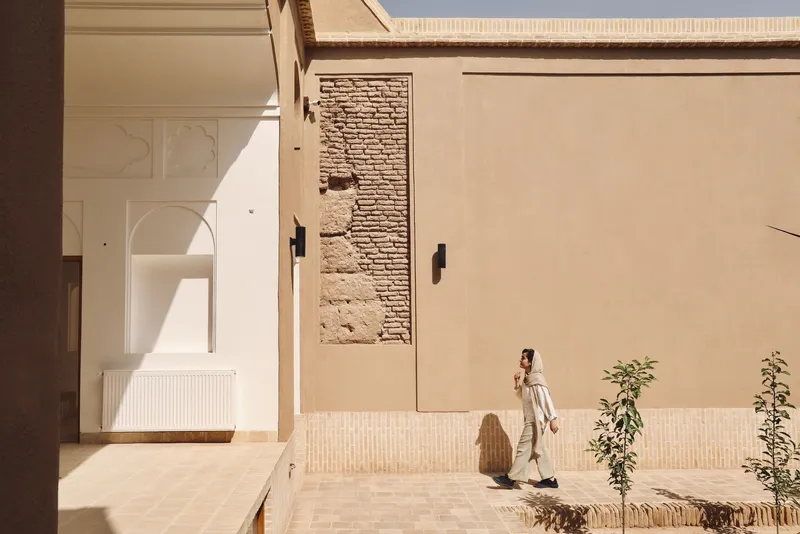
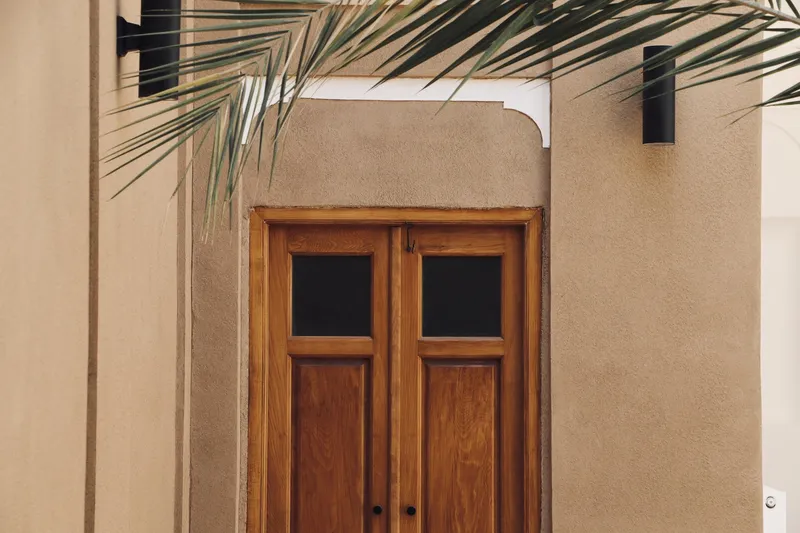
Some of the most compelling moments in Gazorgah House occur at the edges between inside and outside. A figure in white moves through a passage where exposed brick meets tiled wainscoting, caught in the warm directionality of afternoon light. A timber double door sits within an arched opening, framed by a single palm frond, offering the kind of composed entrance that Qajar builders understood instinctively. These thresholds are thick, deep, and slow. You do not pass through them quickly.
The view through a pointed arch toward the sunken fountain at golden hour is arguably the most evocative image of the project. It captures the way this architecture frames experience: every room looks through something before it looks at something. The layering of planes, from archway to courtyard to far wall, produces a spatial depth that flat facades simply cannot achieve.
Facade Craft and Shadow Play
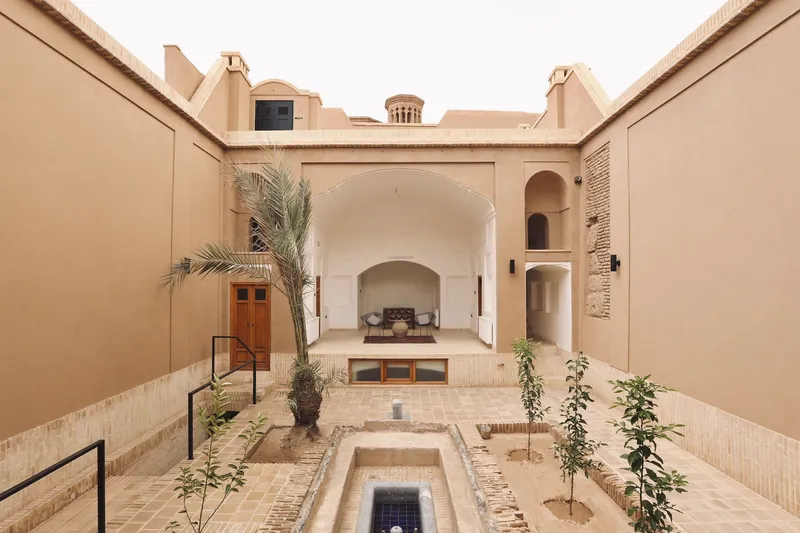
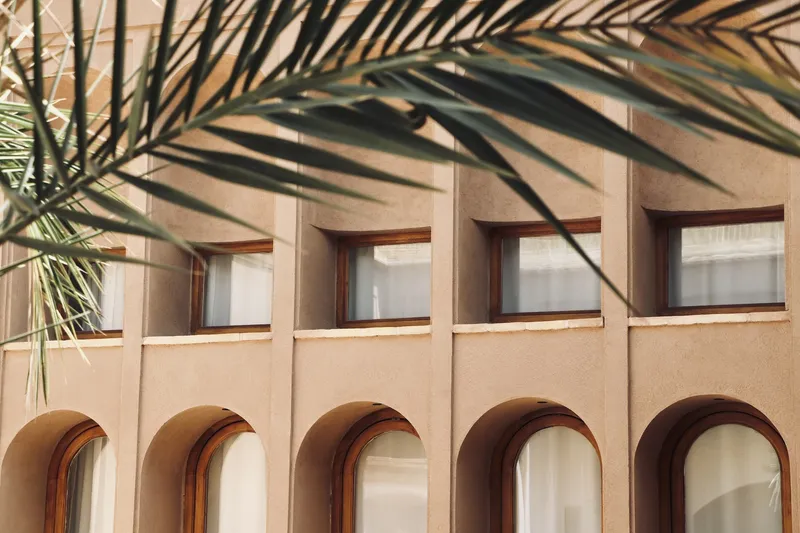
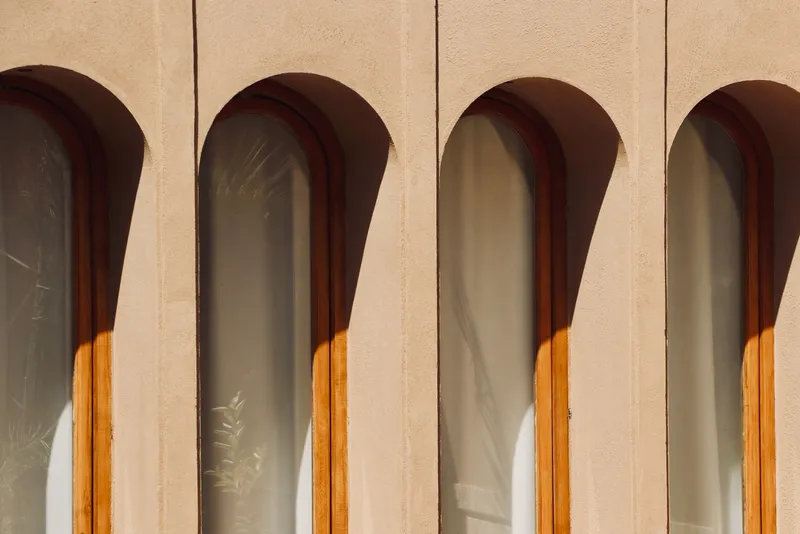
The deep iwan on the courtyard facade is the most assertive architectural element in the composition. It projects a cavernous shadow even in direct sun, creating a zone of cool air at the building's most public face. Flanking it, arched and rectangular windows with timber frames punctuate the plastered surfaces, their proportions carefully calibrated to admit light without heat gain. Palm shadows fall across the stucco, adding a temporal layer that changes by the hour.
Torab Home has resisted the temptation to over-restore these surfaces. The brick detailing is precise where it survives and honest where it has been repaired. A row of arched windows set into a sunlit facade reads as both delicate and robust, the timber frames providing warm contrast to the pale plaster. There is no attempt to make the building look new. It looks maintained, which is exactly the right register for a structure of this age.
Interior Spaces and Vaulted Geometry
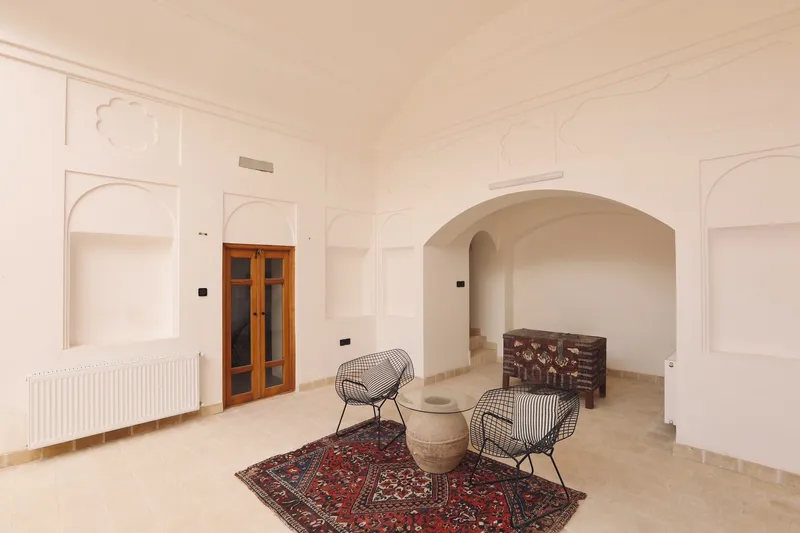
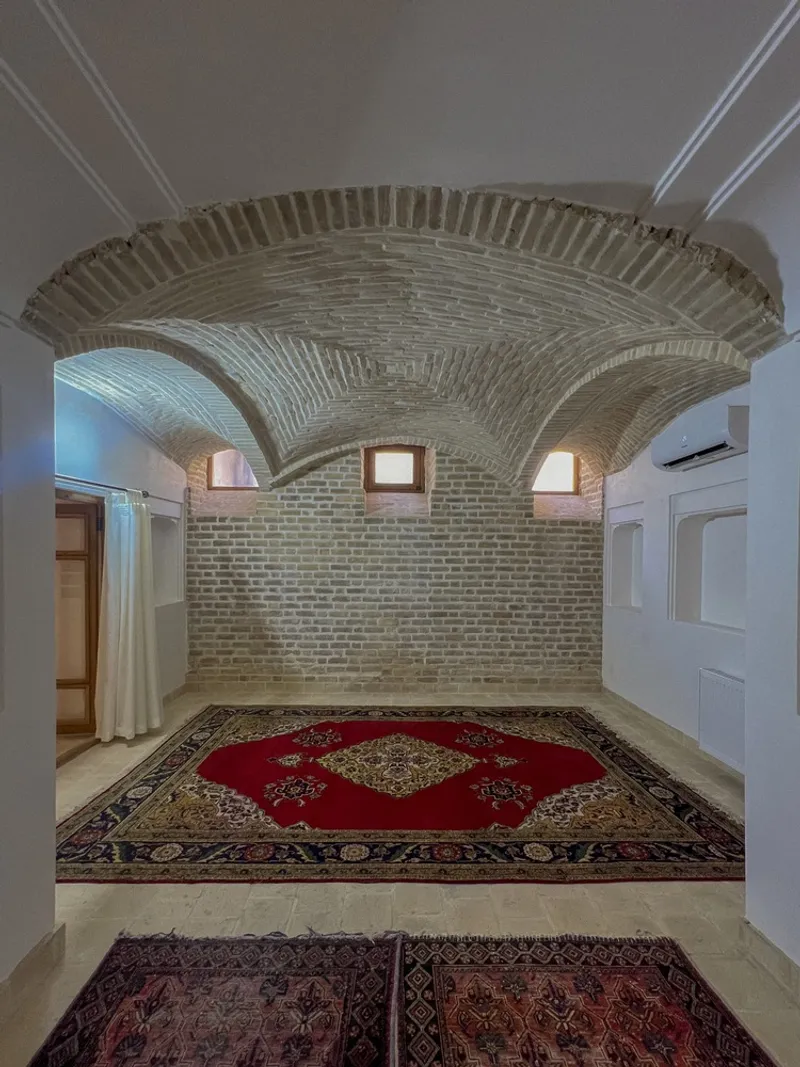
The interiors of Gazorgah House demonstrate why Qajar domestic architecture deserves serious attention beyond the courtyard. A hall with a radial brick vault ceiling terminates in three small square windows, a composition that transforms a structural necessity into a sculptural event. The brickwork here is extraordinary: each course fans outward from the center in a pattern that is simultaneously ornamental and load-bearing. Light enters obliquely and glances across the vault's curvature.
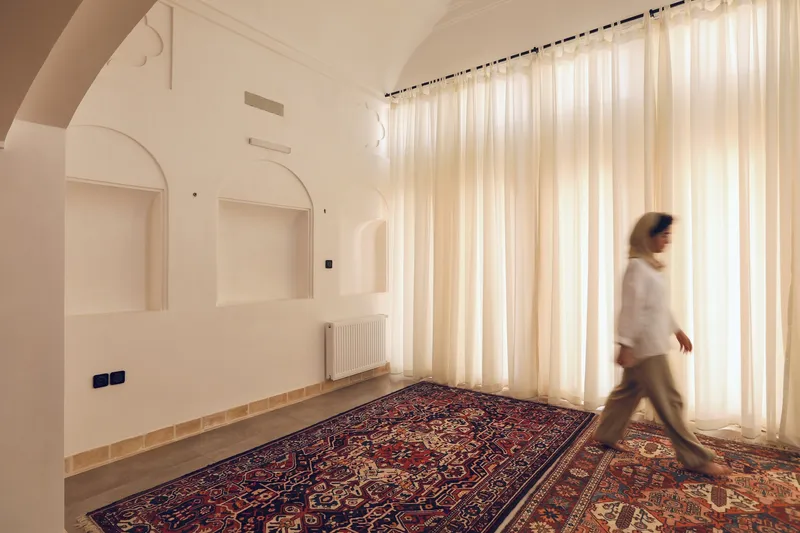
In other rooms, arched recesses and raised paneling create niches for sitting, storage, and display. The furnishing is deliberately sparse: wire chairs, patterned rugs, a few pieces with presence. One room features a figure moving past sheer curtains, the afternoon light diffusing through fabric into an all-white volume defined entirely by its arched wall niches. These spaces feel inhabited rather than curated, which is precisely the point. The house has been restored for living, not for exhibition.
Modern Insertions: Kitchen and Stair
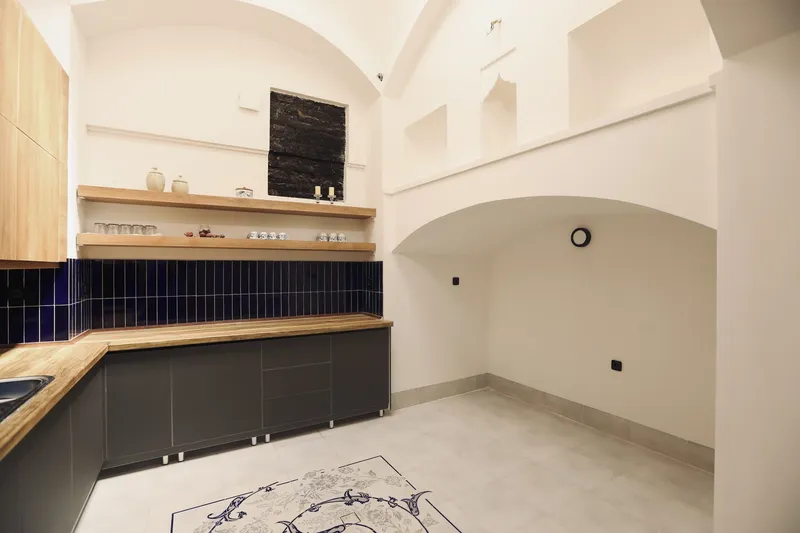
Where contemporary elements enter the project, they do so with clarity. The kitchen pairs timber countertops with a dark tile backsplash, inserted beneath an existing vaulted archway that leads to the adjacent room. The palette is warm but unmistakably modern, and the junction between old and new is left visible. There is no attempt to disguise the insertion.
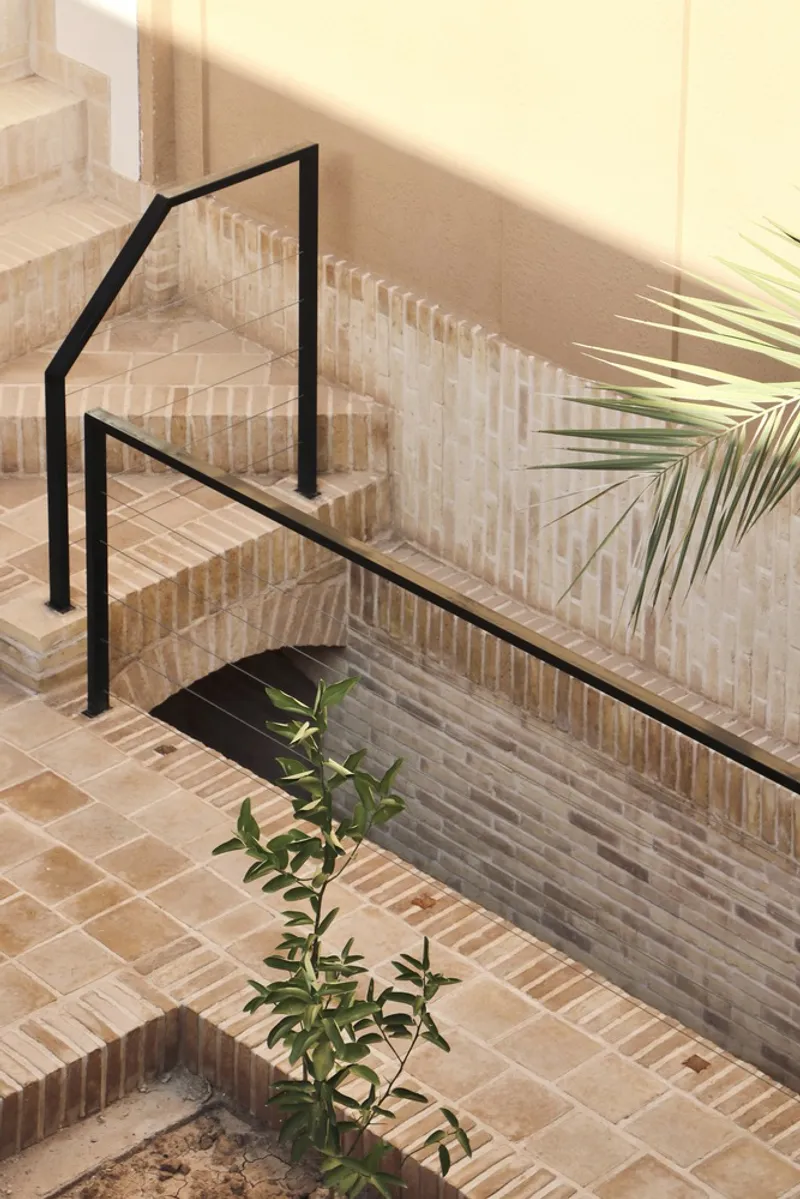
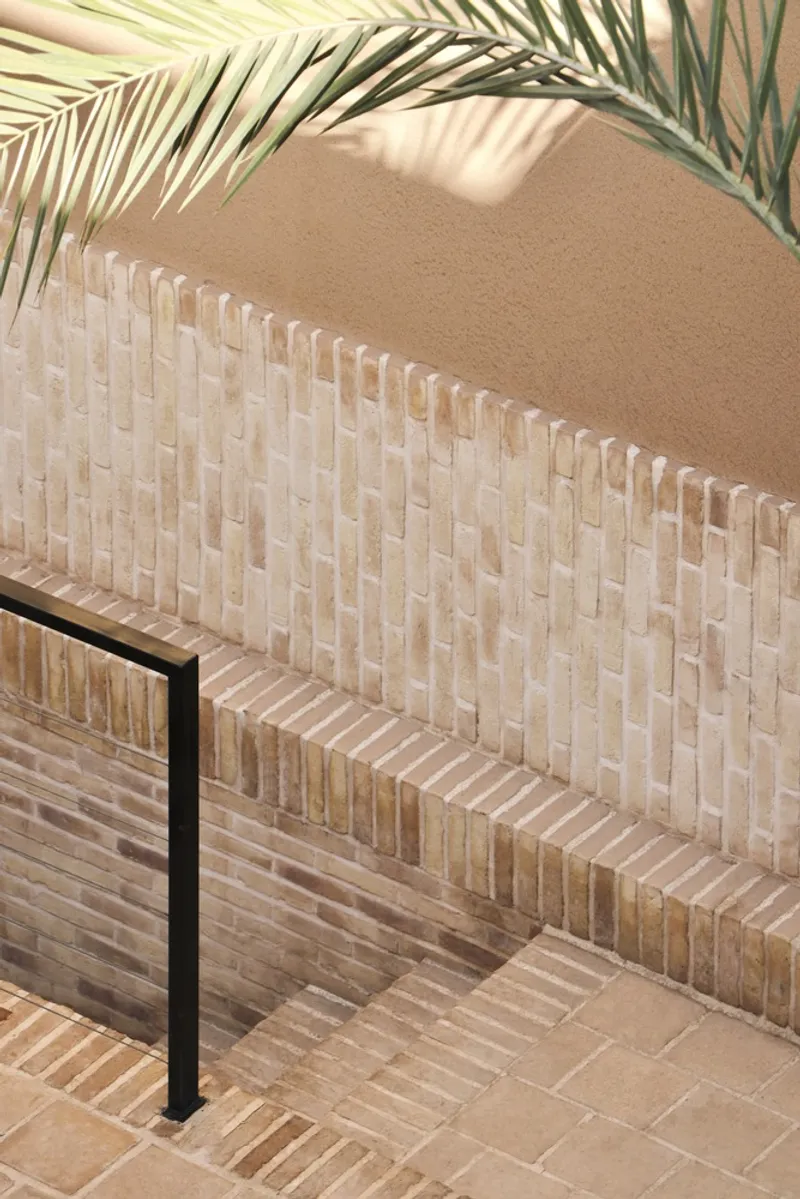
The brick staircase with its black steel handrail is the most overtly contemporary gesture in the project, and it works precisely because of its restraint. The steel is thin, almost linear, against the textural mass of the brickwork. A woven brick balustrade at the upper level creates a screen that filters light and palm shadows onto the plastered wall above. It is a detail that could only exist in this building: the new metalwork acknowledges the old masonry's capacity for pattern without competing with it.
Rooftop Reading
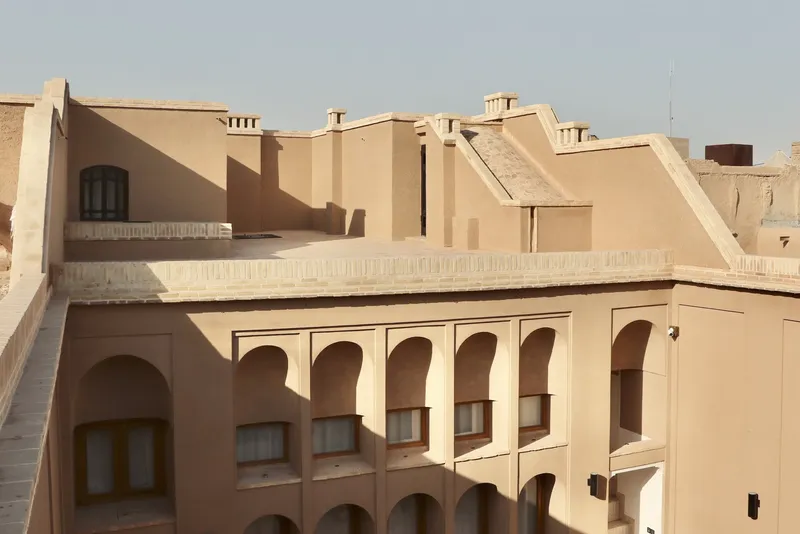
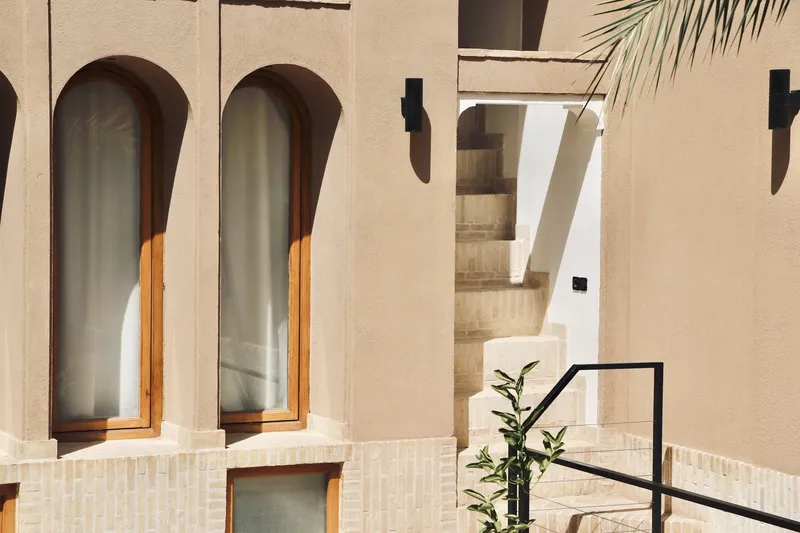
From the roof, the organizational logic of the house becomes legible in a single glance. The two-story courtyard reveals its depth, the arched openings read as a continuous register wrapping the space, and the rendered walls catch light differently at each angle. The rooftop view also makes clear how tightly the house sits within its urban context. Yazd's historic core is a dense weave of courtyard houses sharing party walls, and Gazorgah House participates in that collective fabric rather than standing apart from it.
Plans and Drawings
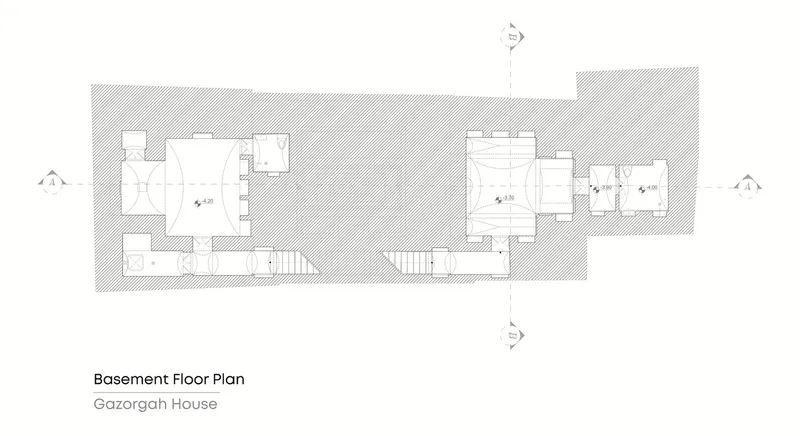
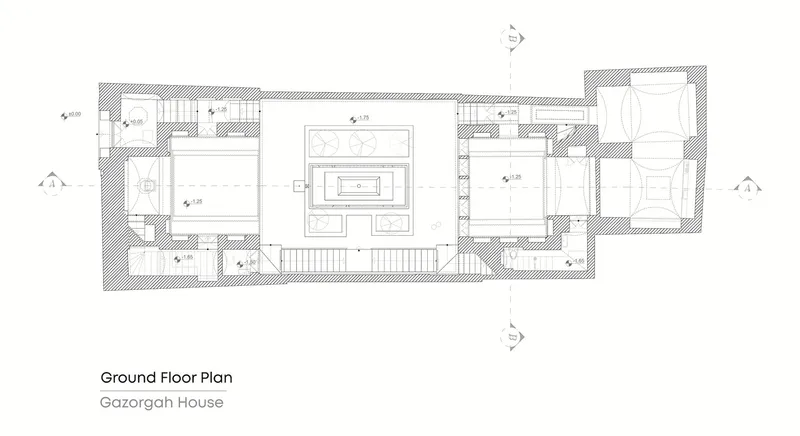
The basement and ground floor plans confirm what the photographs suggest: every room addresses the courtyard. At grade, the central open space with its pool organizes a ring of rooms, each with its own proportional logic, connected by thick-walled passages. The basement plan reveals a network of interconnected spaces served by two staircases, likely used for summer living when subterranean coolness offered relief from the desert heat. The plans are compact, efficient, and deeply rational, a reminder that environmental design is not a 21st-century invention.
Why This Project Matters
Restoration work in historic cities often falls into one of two traps: sentimental preservation that freezes a building in amber, or aggressive modernization that treats the old fabric as scenery for new insertions. Gazorgah House avoids both. Torab Home has produced a project where the Qajar architecture is treated as a living system with its own intelligence, one that simply needed careful repair and selective augmentation to function again. The result is a house that works as well today as it did a century and a half ago, which is the strongest possible argument for the typology.
In a global context where courtyard housing is being rediscovered by sustainability consultants and passive design advocates, Gazorgah House is a useful corrective. The strategies at work here, thermal mass, evaporative cooling, shaded transition zones, subterranean summer rooms, were not invented by computational analysis. They were developed by builders in one of the hottest inhabited places on earth, tested across generations, and refined into a typology of remarkable elegance. What Torab Home has done is not innovation. It is recognition, and that is exactly what this building needed.
Gazorgah House by Torab Home. Yazd, Iran. Photography by Mina Abouei.
About the Studio
Share Your Own Work on uni.xyz
If projects like this are the kind of work you want to make, uni.xyz is a place to publish your own, find collaborators, and enter design competitions.


Popular Articles
Popular articles from the community


LT2A and OPEN Architectes Thread a Brick and Glass High School Through a Wooded Belgian Campus
In Braine-l'Alleud, a 3,000 m² wing for Collège Cardinal Mercier pairs pale brick with a glazed colonnade, deferring to a small chapel and a dense wood.

David Macias Steps a Doorless Stone and Plaster House Down a Tropical Colombian Hillside
In the humid hills of Colombia, Threshold House replaces the front door with an open void and terraces its 850 m² down the slope instead of fighting it.

Architekt Andreas Gruber Scatters 23 Dark Timber Chalets Across a South Tyrolean Forest Edge
In Molini di Tures, Amonti Chalets breaks a resort into a hamlet of gabled timber houses, with parking, storage and services pushed into the slope.

David Ortega Stacks a Two-Story Mexico City Penthouse Around a Steel Stair and a Pergola-Shaded Roof Terrace
In Colonia Roma, a 300 m² penthouse uses oak joinery, a planted steel stair and a slatted roof pergola to make a new-build apartment feel like a house.

Similar Reads
You might also enjoy these articles


Hodi-Mandai Geram
Project Function: Preservation and revitalization of the Intangible heritage and socio-spatial identity of the Hodi by Housing, Cultural Memory Center, Sacred Grove, landscape, local tourism economy


Olio Towers: A Mid-Rise for Performers That Fuses Housing, Rehearsal, and Stage
Located blocks from Houston's Theater District, this modular tower stacks living units around a central performance atrium.

Oasis: Modular Green Housing Carved into Dhaka's Urban Fabric
A shortlisted Plugin Housing entry reclaims unauthorized settlements in Dhaka with stepped concrete volumes, green roofs, and ventilation-driven design.

Black Hole: A Floating Megastructure for the Post-Physical Era
Emiliano Mazzarotto envisions a spherical, self-scaling arena where e-sports, digital hotels, and holographic stadiums replace traditional public space.

Explore Persian Architecture Competitions
Discover active competitions in this discipline

Challenge to reimagine the Iron Throne

Photograph architecture without architects

Illustrate the lost glory of Angkor Wat - Render Challenge

Design challenge to reuse E-waste
Comments (0)
Please login or sign up to add comments
No comments yet. Be the first to comment!