

genarchitects Converts a Prairie-Style Villa into a Lakeside Bookstore in Beijing's Forest
Two bookstores share a renovated villa in Shunyi, Beijing, one extroverted toward nature and the other wrapped inward for children.


A Prairie-style villa tucked into a dense forest by a lake in Shunyi, Beijing, is not the obvious starting point for a bookstore. But genarchitects, led by Beilei Fan, Zhe Xue, and Rui Kong, saw in the low-slung brick-concrete structure exactly the right container for a dual program: an architecture bookstore called Juanzong Books and a children's bookstore called Yishan Books. The villa's inner corridor, its rooms of two distinct ceiling heights, and its proximity to willows and water gave the team a legible framework. Rather than fight the building, they left every load-bearing wall in place and worked surgically within it.
What makes the project worth studying is how a single residential plan yields two radically different spatial temperaments. The architecture bookstore is continuous and extroverted, opening itself to the garden through folding doors and picture windows. The children's bookstore is introverted and wrapped, lined in soft birch-colored plywood to create a warm, familiar cocoon. The two programs never compete. They share a roof but occupy different psychological registers, and the design decisions that produce this split are specific and replicable: ceiling height, material palette, aperture strategy, and the careful introduction of courtyards on three sides of the building.
A Villa Reframed by Courtyards
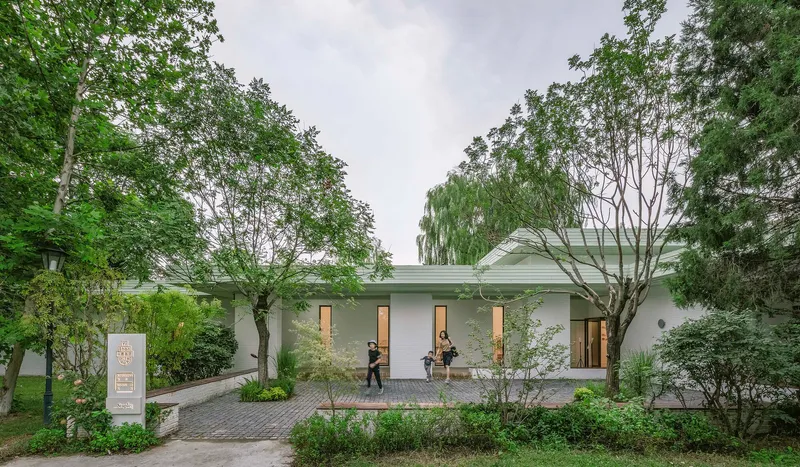
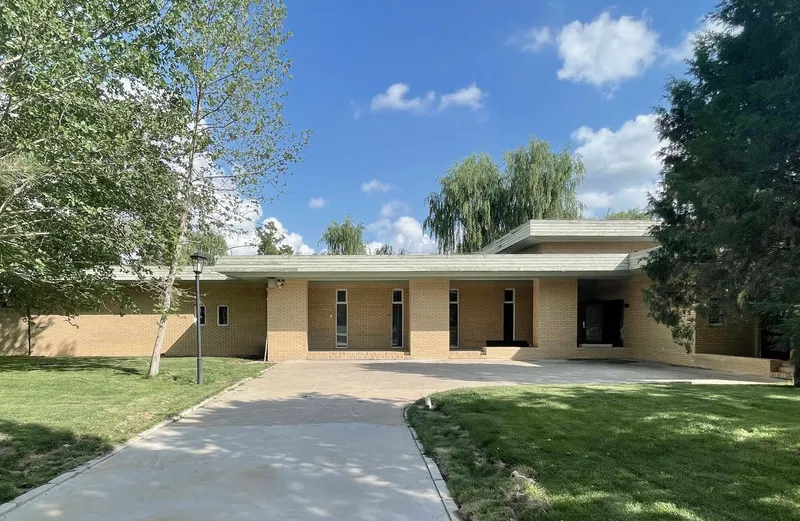
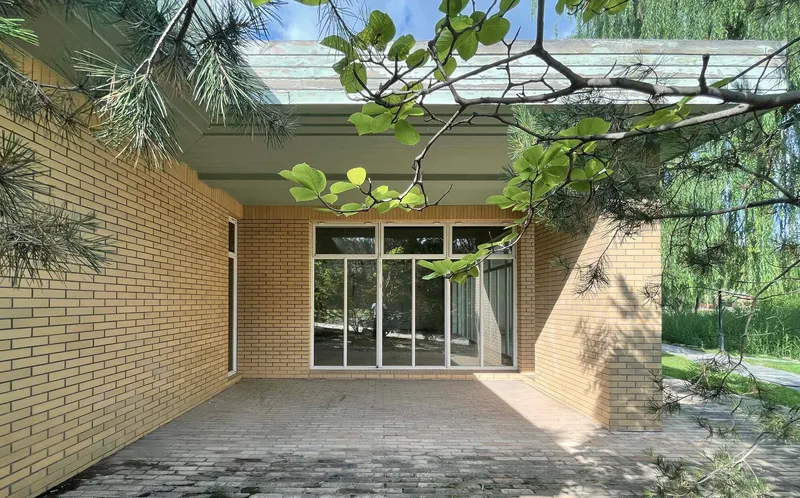
The original site lacked a strong sense of place. The north entrance opens directly onto a driving road, the east side faces neighboring villas, and the west side abuts a noisy walkway. genarchitects responded by adding courtyards on the east, north, and west sides, essentially building a landscape buffer that transforms the perimeter. Two trees planted in the northern forecourt provide summer shade; low hedges enclose the east and west courts without blocking light. Where the original courtyard wall exceeded property management height restrictions, it was simply converted into a bench, a pragmatic detail that doubles as seating.
The buff brick facade reads as calm and understated against the heavy canopy of willows. There is no signage war here, no flashy retail gesture. The entry courtyard, glimpsed through a timber pergola with glazed doors, signals a threshold between public road and semi-private interior. The building recedes, and the landscape advances.
The Architecture Bookstore Opens Outward
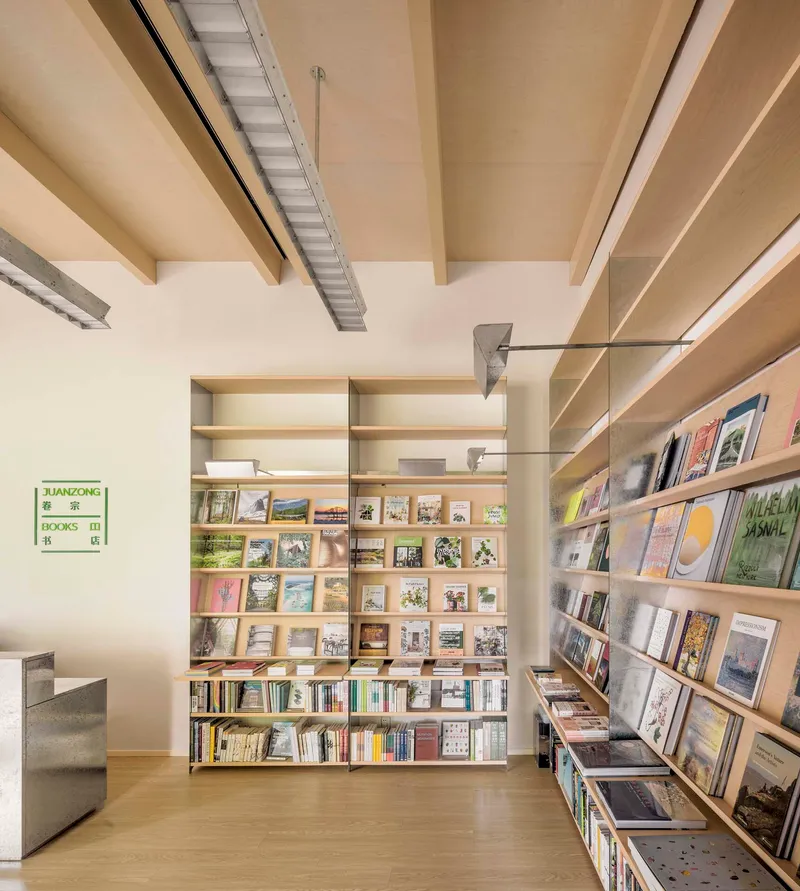
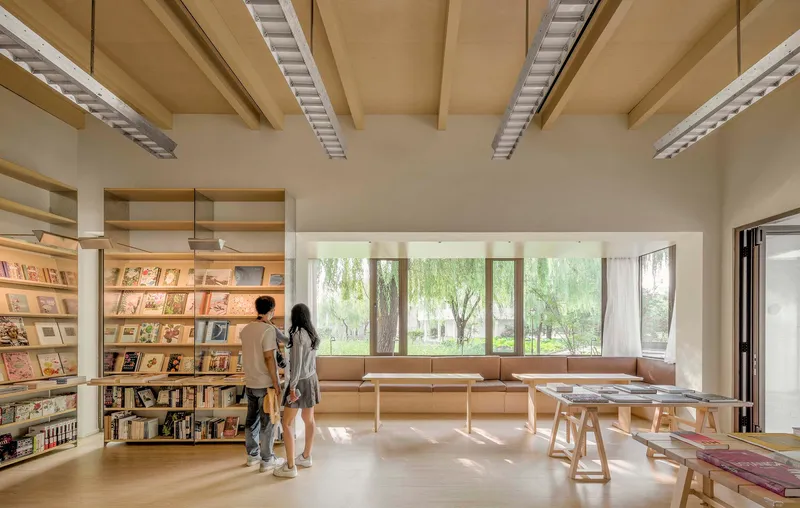
The higher-ceilinged rooms, the former foyer, living room, and dining room, at 4.8 meters, host the architecture bookstore. These spaces are continuous: you drift from the entrance lobby through a reading area into a coffee zone without encountering hard partitions. Three picture windows in the southwest corner were removed; two on the west wall were replaced with folding doors that open directly onto the courtyard. The effect is an interior that breathes outward, pulling the forest and the lake into the reading experience.
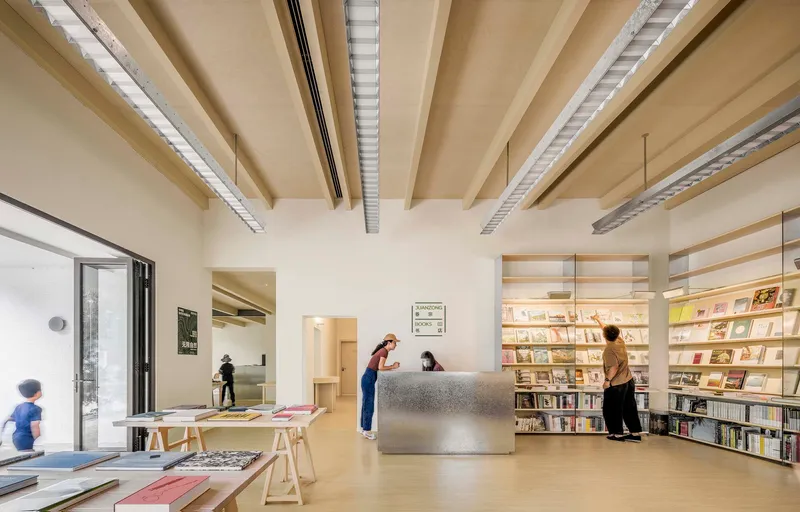
Exposed wooden ceiling beams run across the reading rooms, their rhythm reinforced by galvanized steel pendant lamps that drop into the volume without cluttering it. The bookshelves have their own integrated illumination, which keeps the ceiling clean and free of spotlights. It is a small detail with outsized impact: the eye reads the ceiling as continuous timber rather than a grid of fixtures, and the books themselves become the light sources in the room.
Where Reading Meets the Garden
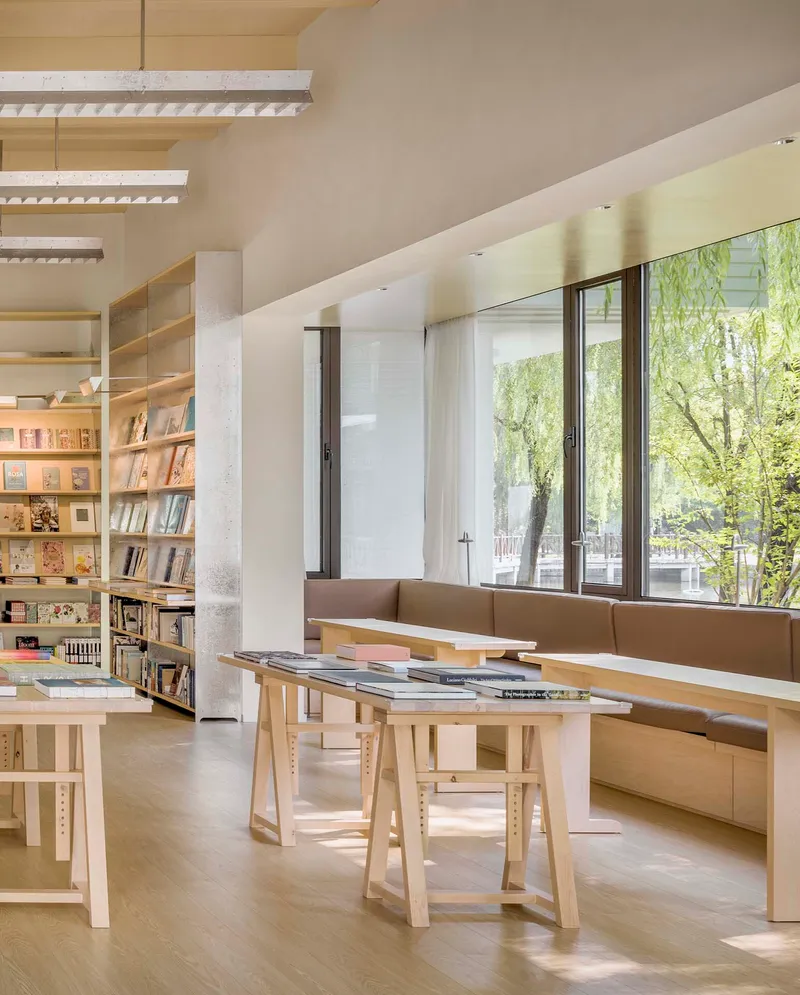
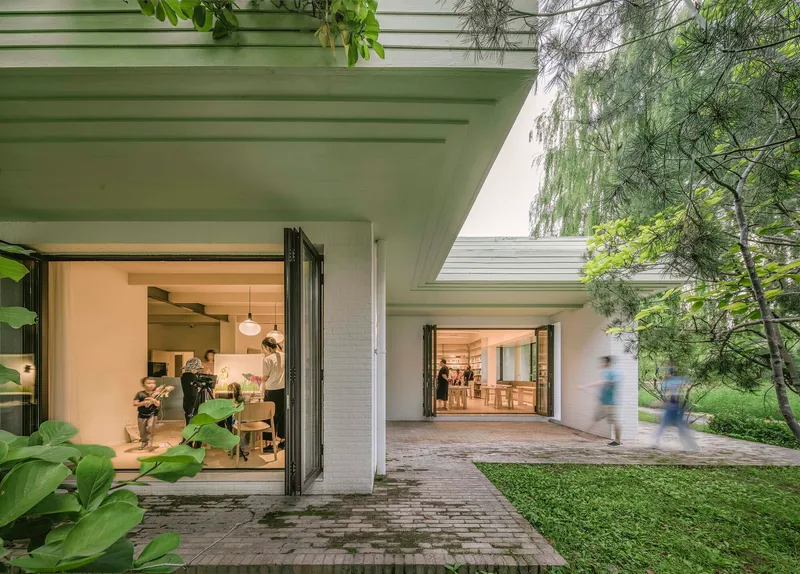
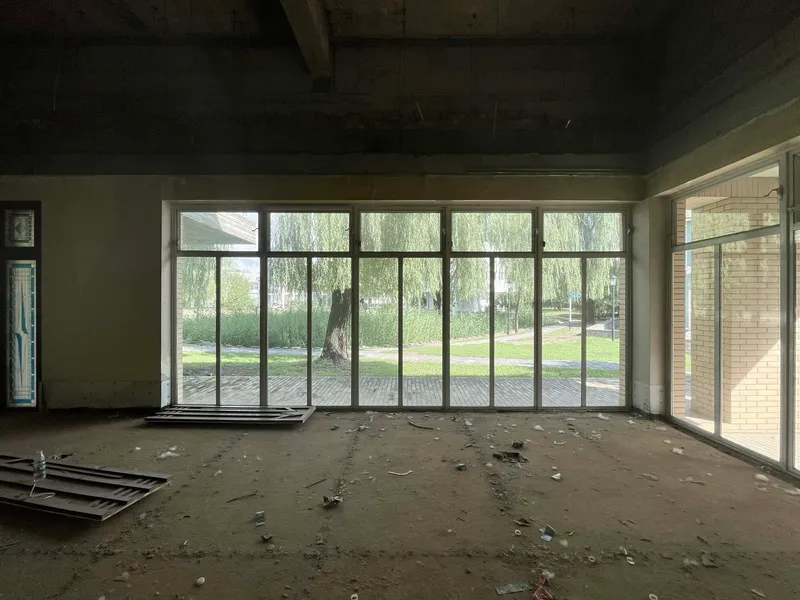
The bay window on the south wall, originally a standard residential feature, becomes a reading nook with a built-in bench seat facing full-height windows. A timber display table sits in front, and the greenery outside acts as wallpaper you cannot buy. The covered walkway on the courtyard side, with its exposed concrete ceiling beams and folding doors left open, blurs the line between corridor and garden path. You can move from shelf to courtyard in a single step.
This fluidity is not decorative. It solves a real problem: the villa's rooms, designed for domestic privacy, needed to be made legible as retail and communal space. By opening apertures and erasing thresholds, genarchitects allowed the building to accommodate browsing, gathering, and lingering without any room feeling cramped.
The Children's Bookstore Turns Inward
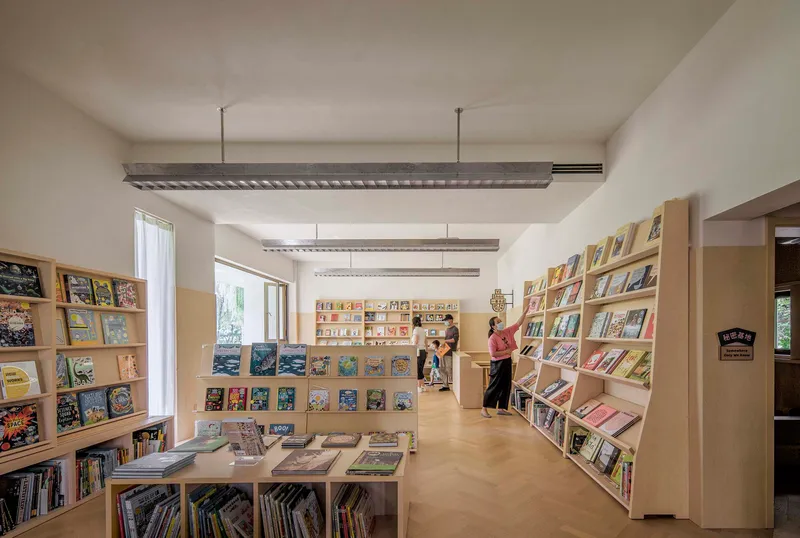
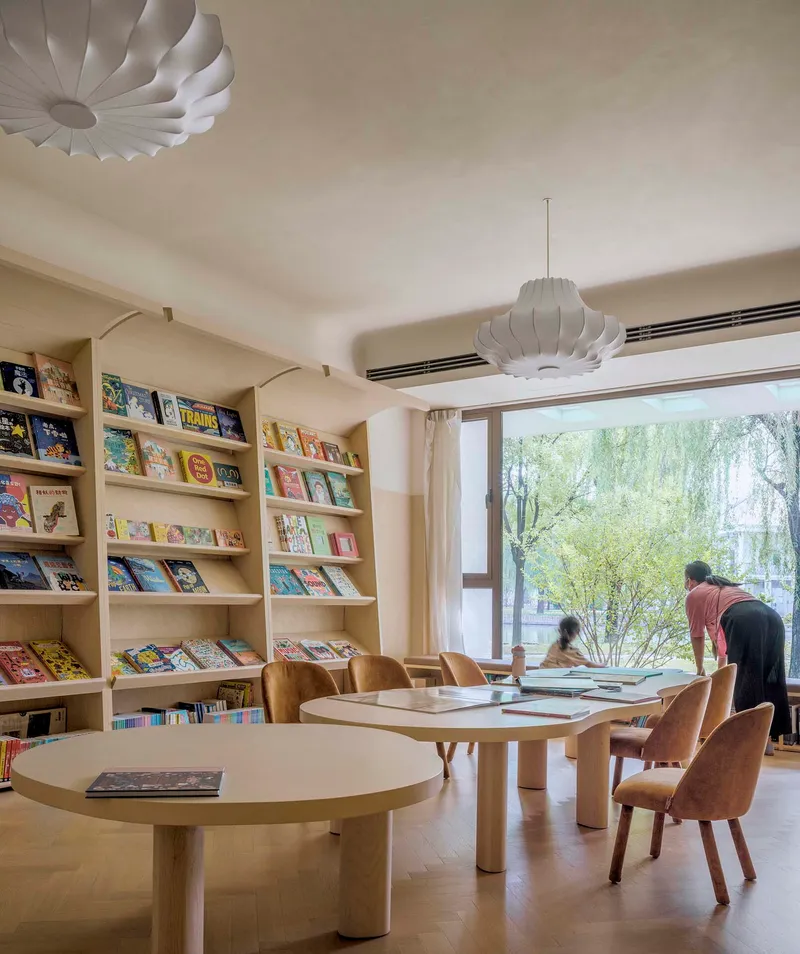
The three lower rooms at the end of the corridor, with ceilings at 3.5 meters, house Yishan Books, the children's bookstore. The spatial strategy here is the opposite of the architecture store: introverted, wrapped, and warm. Plywood bookshelves line the walls, and a soft birch color dominates. The intent is to return children to a "familiar and daily environment," a deliberate rejection of the overstimulating primary-color playgrounds that characterize most children's retail.
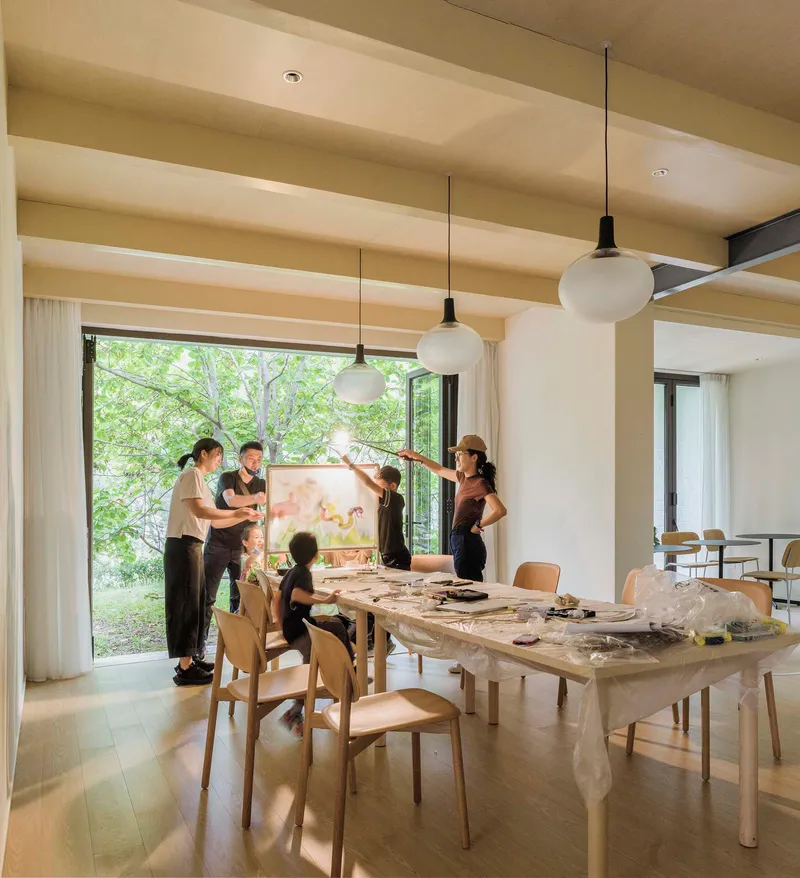
One particularly thoughtful detail: the penultimate shelf on every bookcase is designed as a "skimming-reading dock" calibrated to children's height. Kids can pull a book out and flip through it without sitting down or asking an adult for help. The shelves are not just storage; they are an interface scaled to the user. Air-conditioning and mechanical equipment are embedded between ceiling plates, keeping the rooms visually quiet. Pendant lights drop into the space for focused reading and workshop activities, as seen in the art workshop setup with timber tables and round stools.
Material Restraint and Furniture Logic
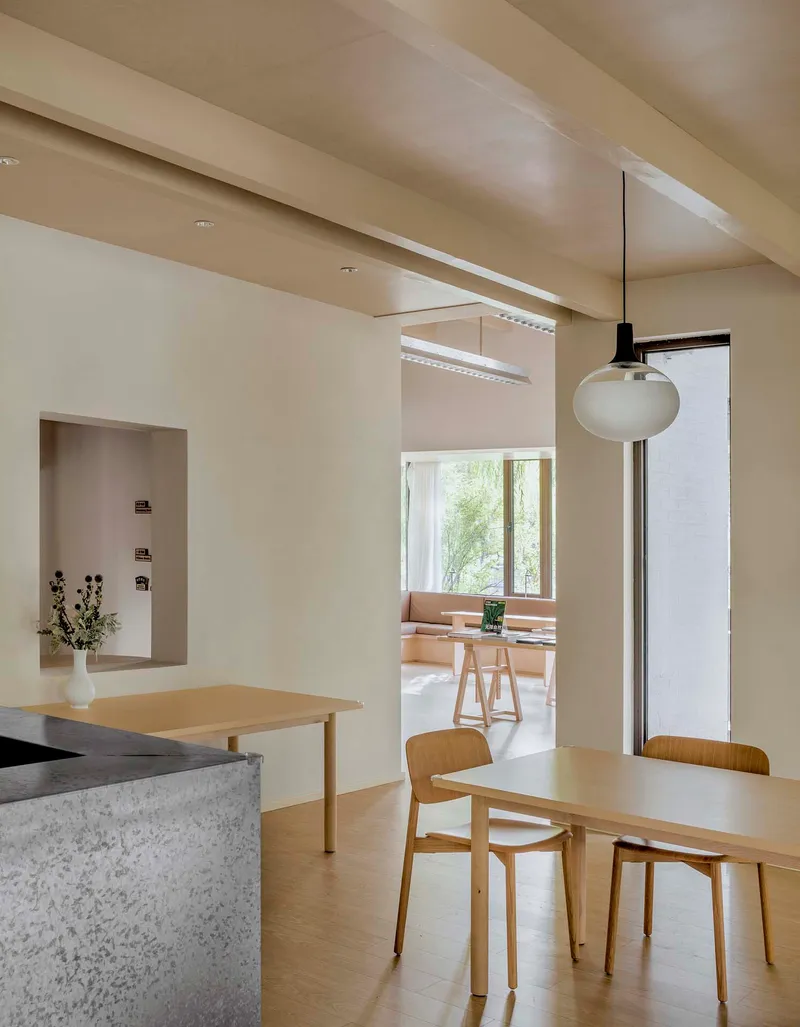
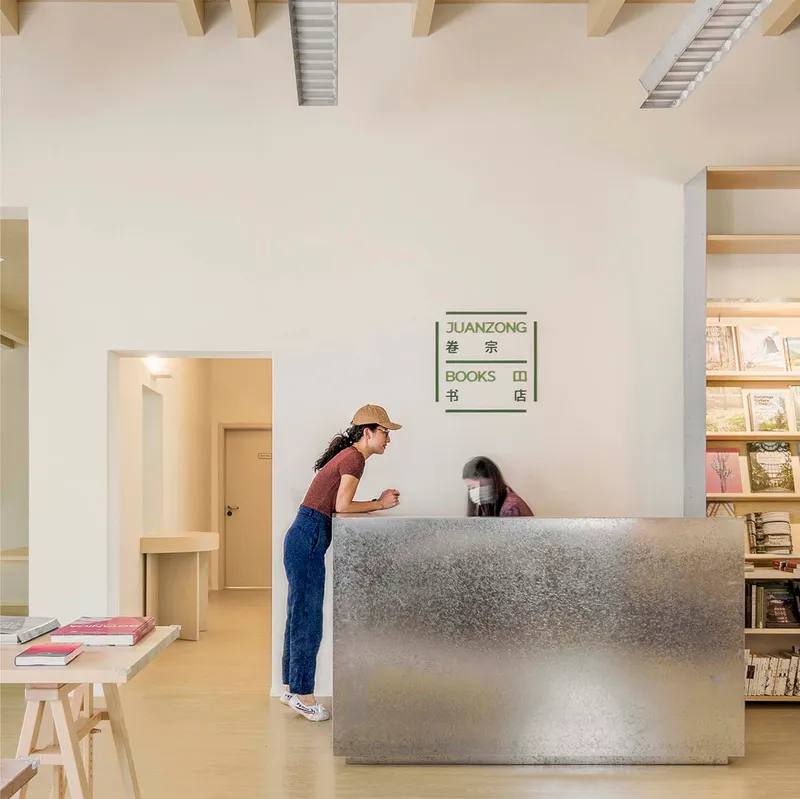
The material palette across the entire project is deliberately narrow: brick, concrete, plywood, galvanized steel, and timber. The terrazzo counter in the dining and coffee area, paired with a pendant lamp, introduces a texture that is denser and cooler, marking a programmatic shift from reading to eating. The textured concrete reception desk at the entrance serves as both a wayfinding element and a material anchor. A visitor in a straw hat standing at the counter gives a sense of scale: the desk is low enough to feel welcoming, solid enough to feel permanent.
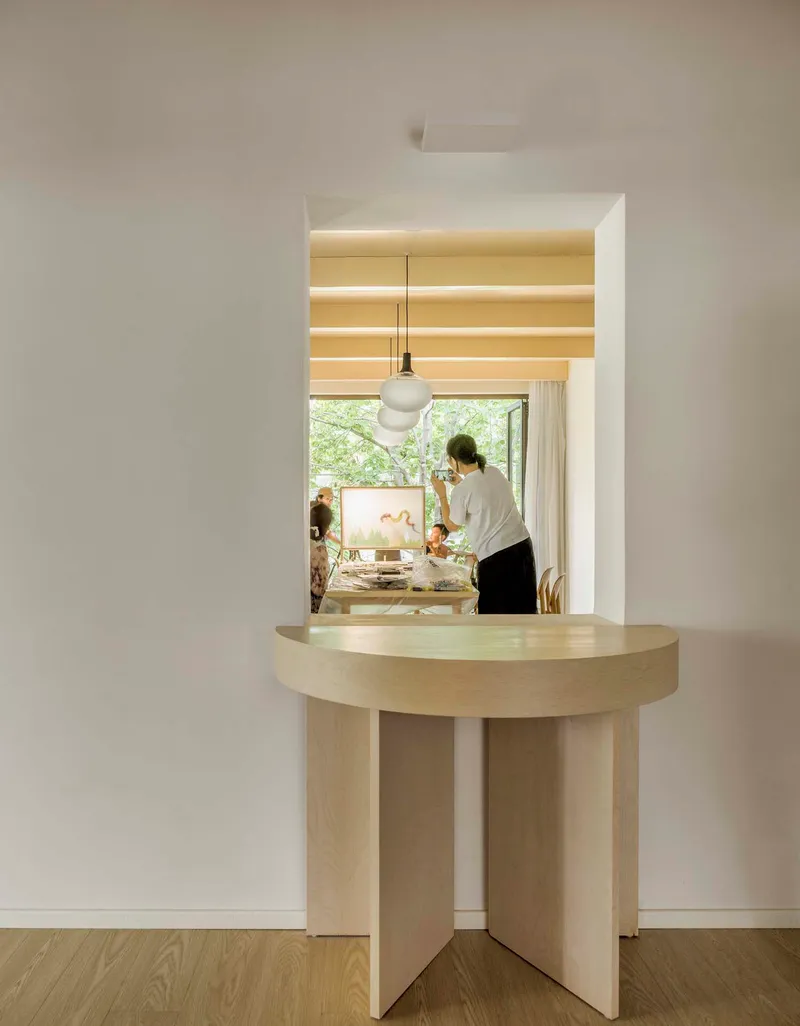
Framed doorways and threshold moments are used throughout to provide visual depth without physical barriers. A pale wood table in the foreground, a pendant-lit workspace beyond: these layered compositions reward slow looking and make 485 square meters feel considerably larger than the number suggests.
Plans and Drawings
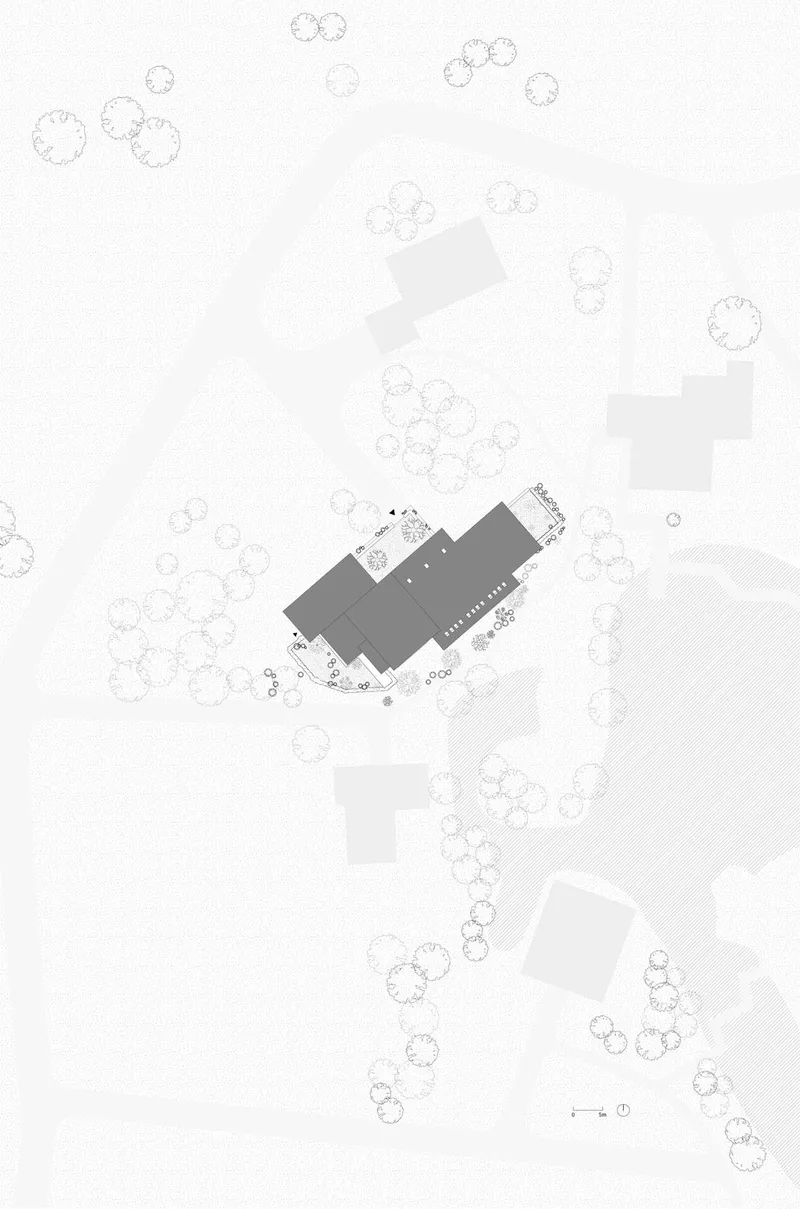
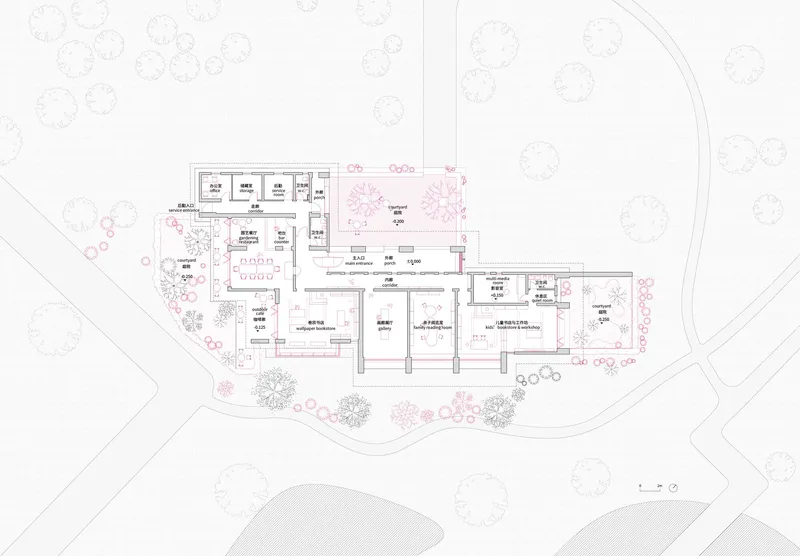
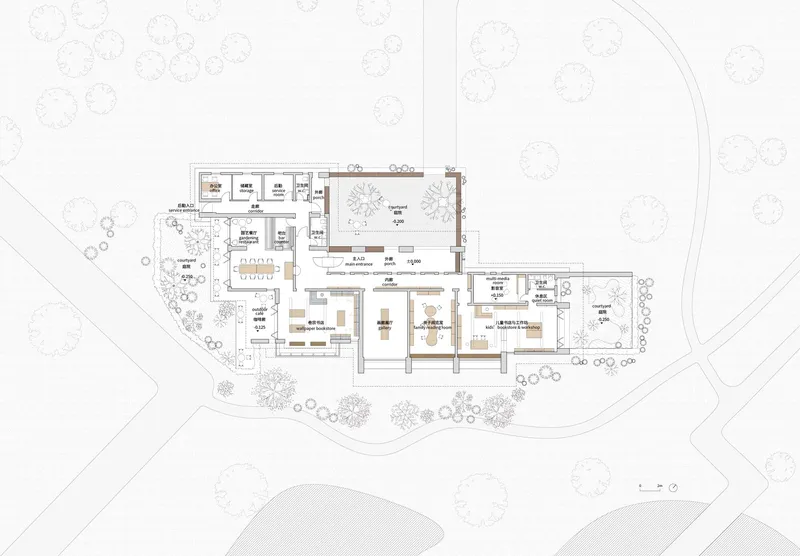
The site plan reveals the building's relationship to its surrounding tree canopy, a nearly continuous circle of mature specimens that insulate the villa from its neighbors. The floor plans show the inner-corridor logic clearly: a linear spine runs through the villa, linking the higher entrance and reading volumes at one end with the lower children's rooms at the other. Courtyards on three sides push the usable landscape outward, and the labeled room layouts make the programmatic split between Juanzong and Yishan legible at a glance.
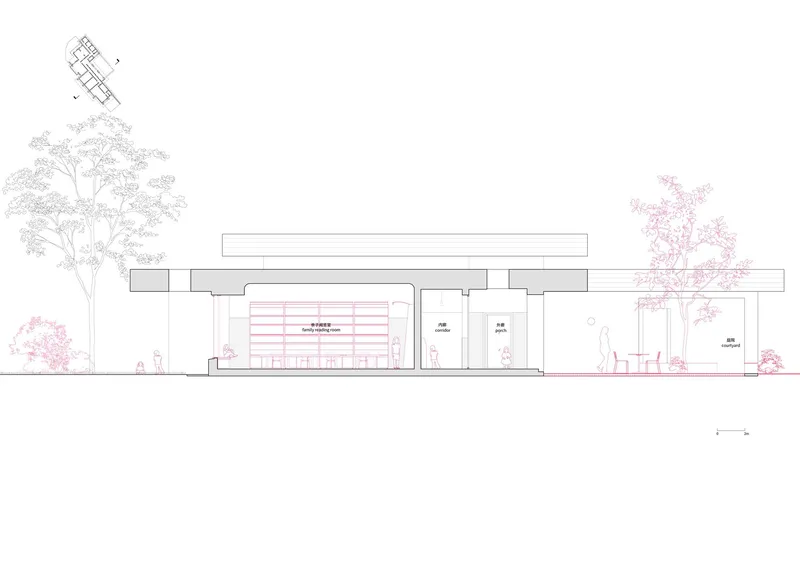
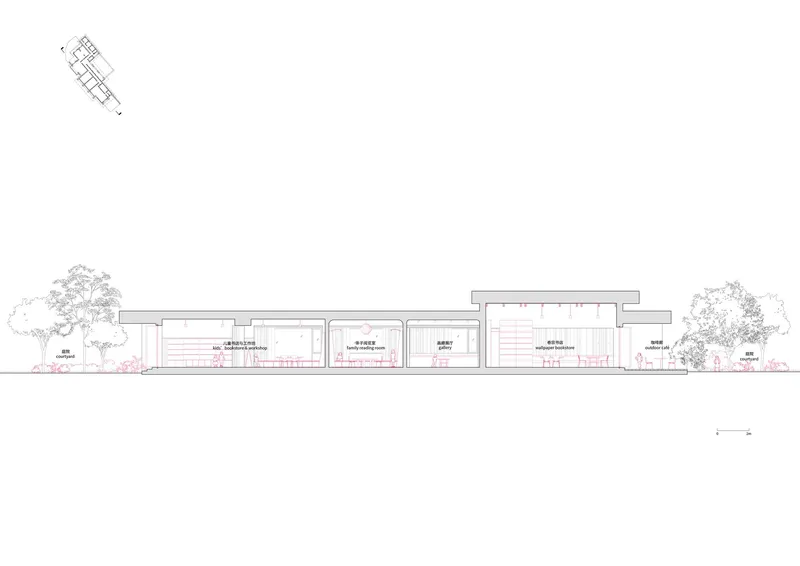
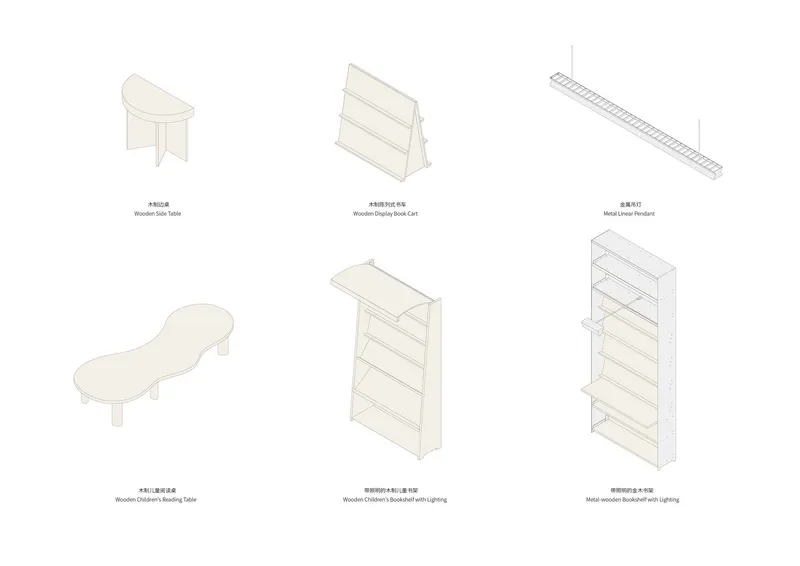
The sectional elevations confirm the two ceiling heights and show how flat roof volumes step down toward the children's store. Trees flanking the building appear as tall as the structure itself, reinforcing how embedded the villa is in its landscape. The axonometric drawing of custom furniture pieces, side tables, shelving units, and a reading table, documents the bespoke elements that make the interiors cohere. These are not off-the-shelf selections; they are designed objects calibrated to the spatial and programmatic needs of each room.
Why This Project Matters
Adaptive reuse projects often fall into two traps: either they gut the existing structure so thoroughly that the renovation claim feels hollow, or they preserve the shell so faithfully that the new program never breathes. genarchitects avoids both. By keeping every load-bearing wall intact and concentrating their interventions on apertures, surfaces, courtyards, and furniture, they achieve a transformation that is visible but not violent. The villa still reads as a villa. It simply works differently now.
The real lesson here is about programmatic temperament. Two bookstores in the same building, one open and outward-looking, the other enclosed and child-scaled, demonstrate that spatial character is not a fixed property of a floor plan. It is a product of ceiling height, material warmth, threshold design, and the relationship between interior and landscape. At 485 square meters, this is not a large project. But it is a precise one, and precision, in the context of Beijing's commercial architecture, counts for more than spectacle.
Juanzong Bookstore and Yi Shan Children's Books by genarchitects (lead architects: Beilei Fan, Zhe Xue, Rui Kong). Located in Shunyi, Beijing, China. 485 m². Completed in 2022. Photography by Yumeng Zhu.
About the Studio
Share Your Own Work on uni.xyz
If projects like this are the kind of work you want to make, uni.xyz is a place to publish your own, find collaborators, and enter design competitions.


Popular Articles
Popular articles from the community


David Ortega Stacks a Two-Story Mexico City Penthouse Around a Steel Stair and a Pergola-Shaded Roof Terrace
In Colonia Roma, a 300 m² penthouse uses oak joinery, a planted steel stair and a slatted roof pergola to make a new-build apartment feel like a house.

David Macias Steps a Doorless Stone and Plaster House Down a Tropical Colombian Hillside
In the humid hills of Colombia, Threshold House replaces the front door with an open void and terraces its 850 m² down the slope instead of fighting it.

Cube Design Draws an Ecological Corridor Between Two Shenzhen Hills with the Nankai Building
Beside Shenzhen's container docks, the Nankai Building pairs stacked balconies with a climbing green screen to connect two hillsides across its height.

Architekt Andreas Gruber Scatters 23 Dark Timber Chalets Across a South Tyrolean Forest Edge
In Molini di Tures, Amonti Chalets breaks a resort into a hamlet of gabled timber houses, with parking, storage and services pushed into the slope.

Similar Reads
You might also enjoy these articles


LAVA Architecten Gives Vocational Education a Sawtooth-Roofed Face on a Mechelen School Campus
In Mechelen, Belgium, a 2,053 m² STEM school on a 6×6 m grid turns workshops and classrooms into rooms that can be rearranged as teaching changes.

KEMA Studio Turns a Derelict Marvila Attic into a 60 m² Lighthouse Apartment Above Lisbon
In Lisbon's Marvila district, a rebuilt roof, four skylights and two plywood volumes turn an unlivable attic into a bright home facing the Tagus.

Pixel Gardens: One Repeated Module Stacked Into a Terraced Social Housing Tower for Famagusta
Salem Bader's shortlisted housing tower builds a vertical neighbourhood from one repeated module, offsetting units to carve terraces, light and air.

Bao Huynh Watercolor Atelier: A Serene Art Retreat in Hội An
Bao Huynh Watercolor Atelier in Hội An blends multifunctional art spaces, sustainable design, local materials, and family-friendly living in a serene environment.

Explore Landscape Design Competitions
Discover active competitions in this discipline

Challenge to reimagine the Iron Throne

Photograph architecture without architects

Illustrate the lost glory of Angkor Wat - Render Challenge

Design challenge to reuse E-waste
Comments (0)
Please login or sign up to add comments
No comments yet. Be the first to comment!