
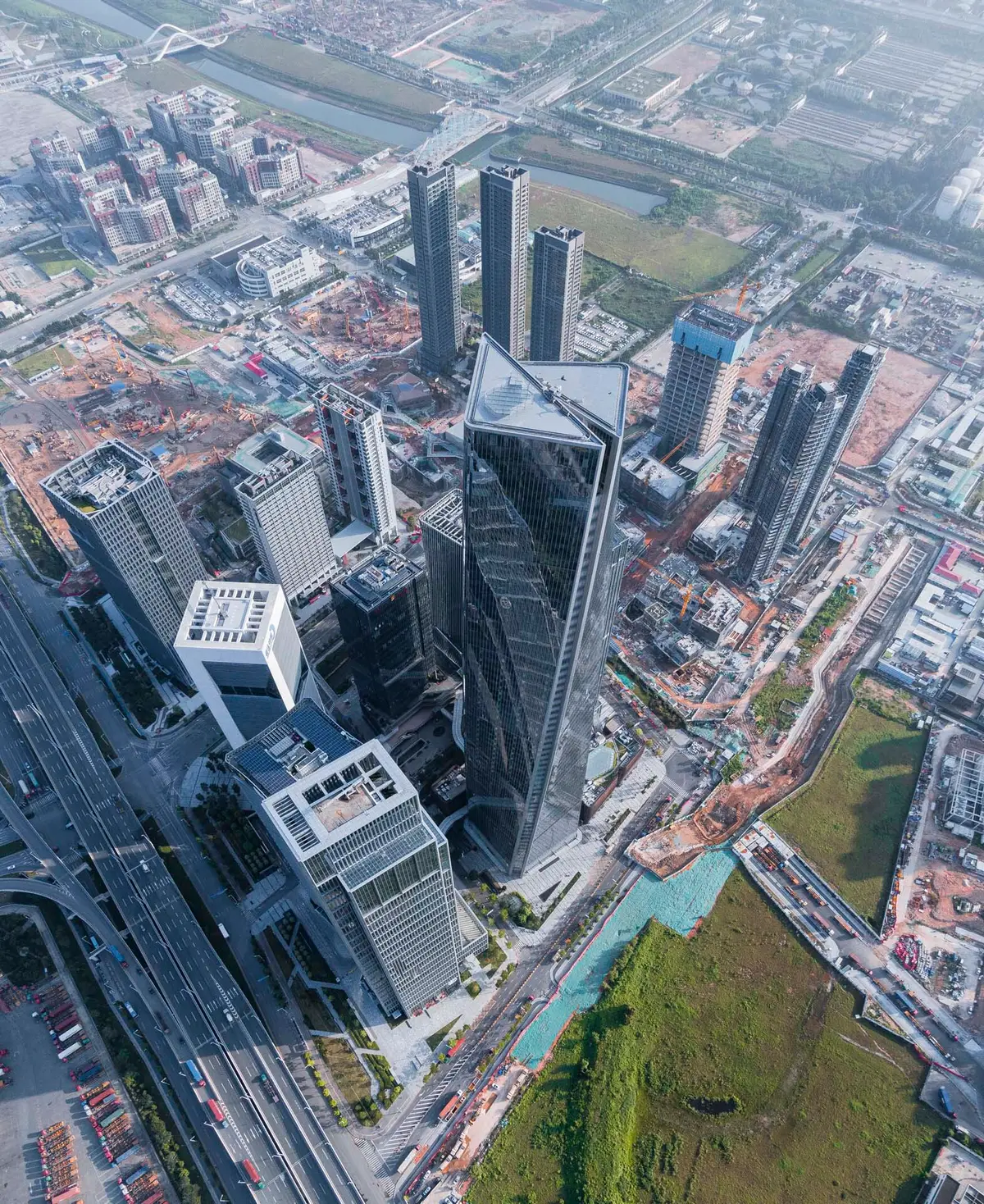
Gensler Twists a 300-Meter Tower in Shenzhen to Unite Two Cities in Glass
Shimao Qianhai Center spirals 63 stories above a new economic zone, its rotating form a structural response to typhoon winds and urban density.


A skyscraper that literally twists as it rises is easy to dismiss as a formal gesture, a developer's vanity move dressed up in parametric software. But Shimao Qianhai Center, the 294-meter tower designed by Gensler for Shenzhen's Qianhai special economic zone, earns its rotation. The 45-degree twist is not ornamental: it disperses typhoon-strength wind loads across the facade, tapers floor plates to reduce structural demand at height, and peels apart sightlines in a high-density block surrounded by six other towers. The result is a building whose geometry does real aerodynamic and urban work.
Completed in 2022, the 160,000-square-meter complex is more than a single tower. Six independent commercial podiums thread into pedestrian networks at multiple levels, connecting down to the Metro station below grade and up to rooftop gardens and an observation deck at the crown. The tower is the tallest structure in its block and one of the tallest in Qianhai, a zone positioned between mountains and the South China Sea. Gensler collaborated with AECOM, Woods Bagot, ARUP, and Foster on the broader development, but the tower itself is Gensler's statement: a frame-core cylinder system with two-way diagonal steel-concrete columns that express themselves as a visible lattice behind the curtain wall.
The Twist as Structural Logic
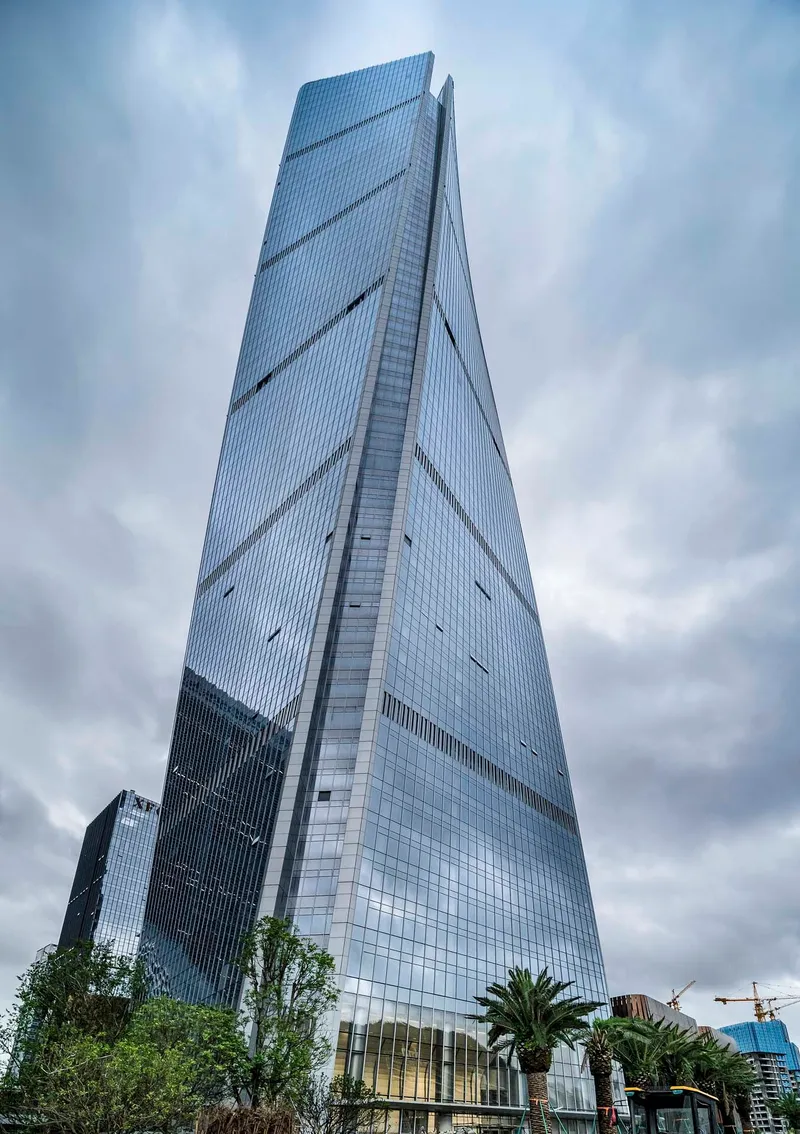
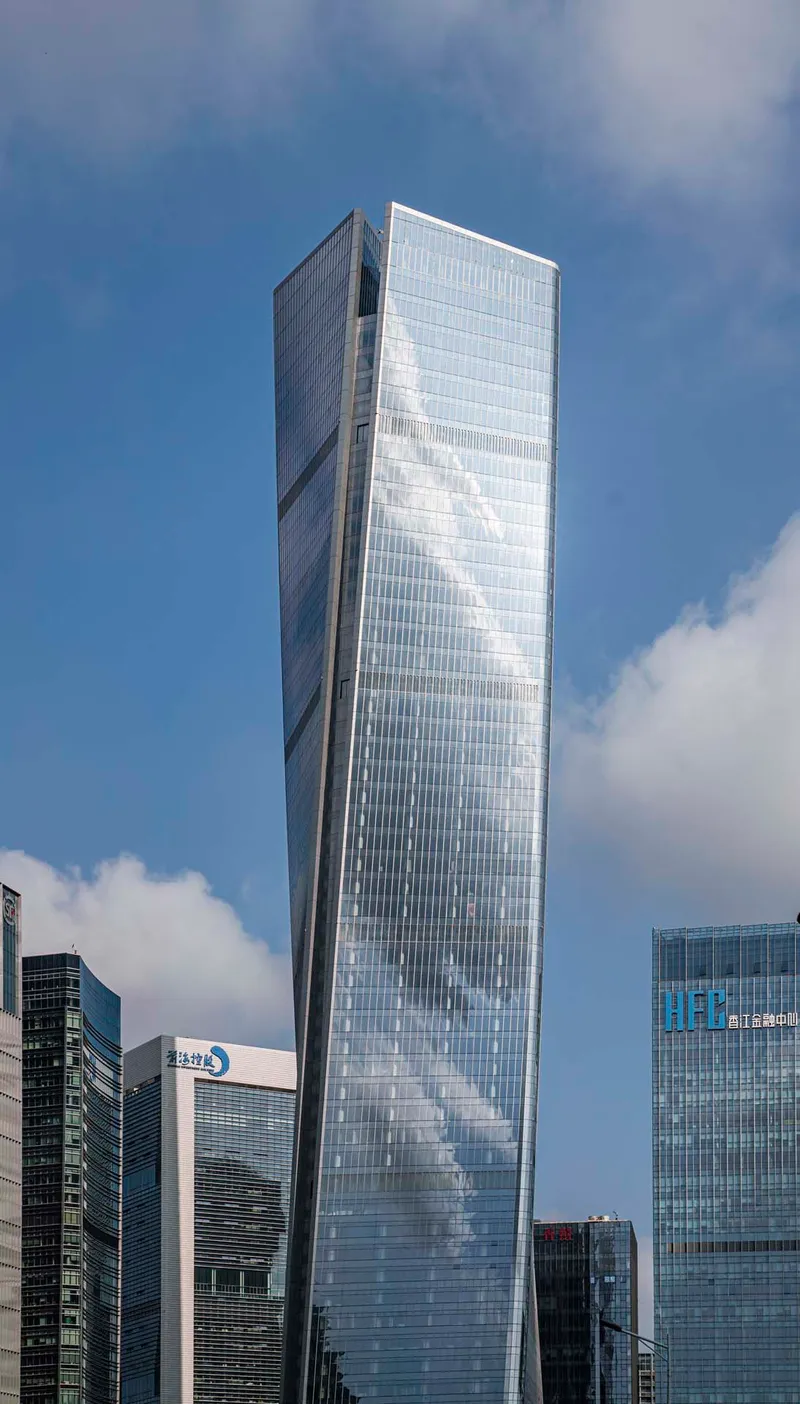
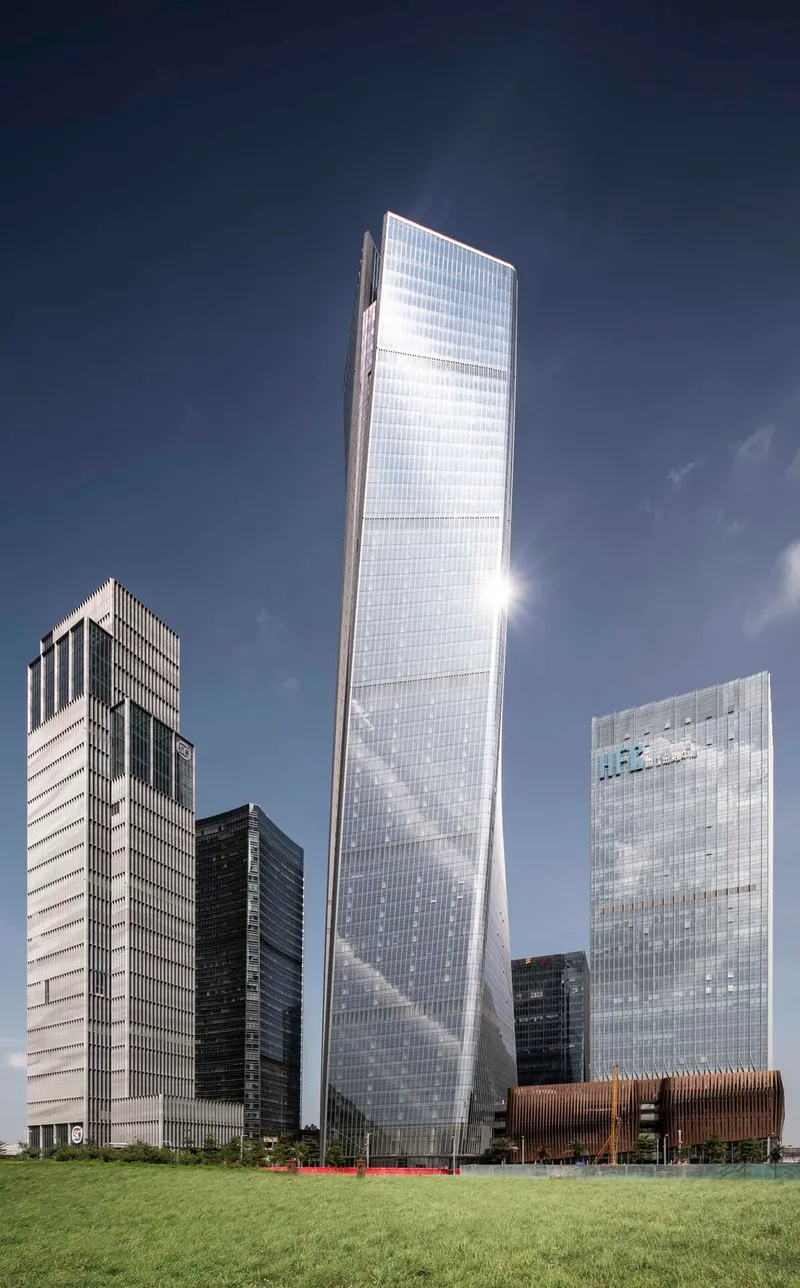
From street level, the diagonal bracing reads clearly through the glass skin, a lattice of steel pipe concrete columns that travels the full height of the building. These are not decorative mullions. The segmented two-way diagonal columns, fabricated from Q345BZ15 grade steel at plate thicknesses over 40 millimeters, carry gravity and lateral loads simultaneously. The tower has no truss layer, an unusual omission for a supertall that simplifies interior floor plates and eliminates the mechanical floors that typically interrupt leasable space.
The tapering silhouette narrows the building's profile toward its top, reducing the sail area exposed to wind. Combined with the gradual rotation, each floor is offset slightly from the one below, breaking up vortex shedding that can cause resonance in tall, prismatic forms. The engineering is invisible from the interior, but it defines the exterior completely.
Urban Context and Skyline Presence
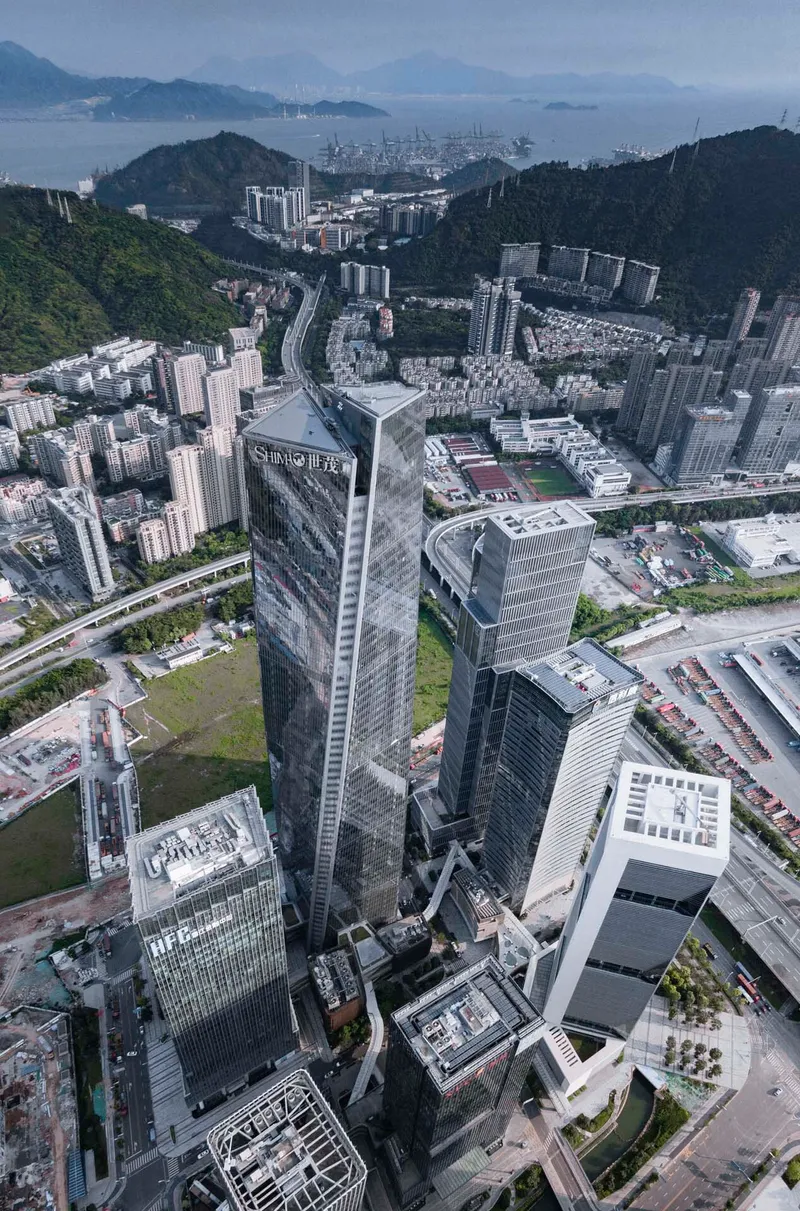
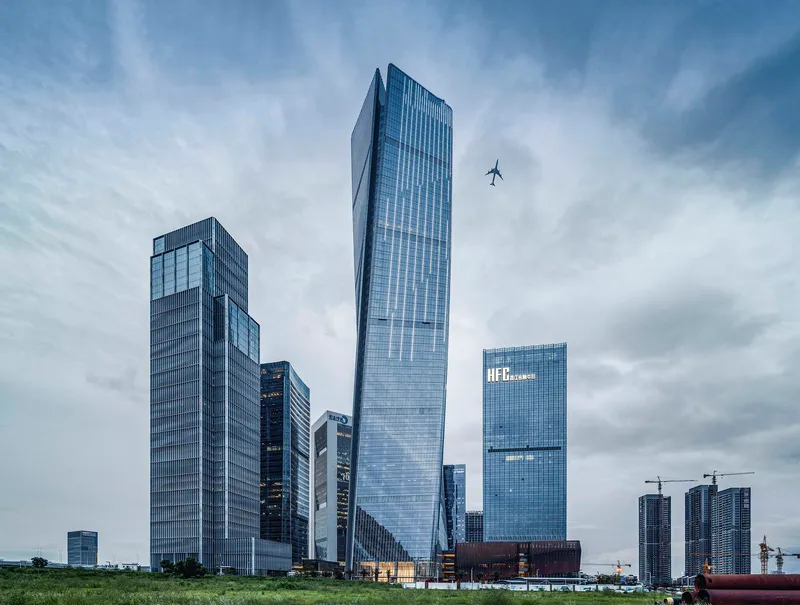
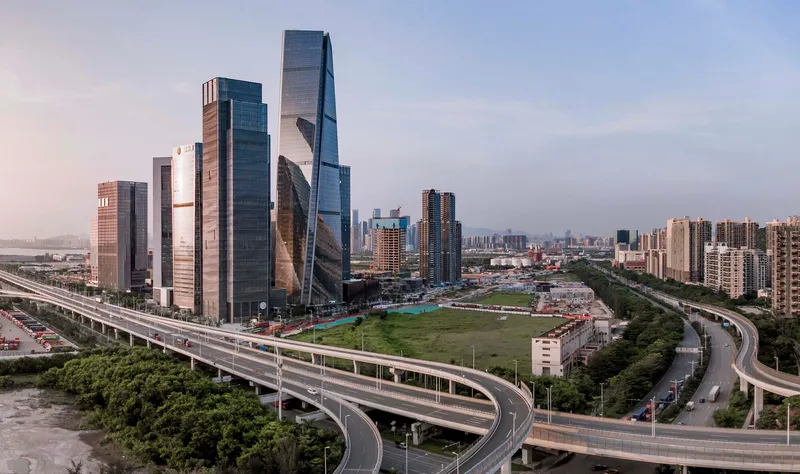
Qianhai is a district still under construction, and the aerial views make that plain. Cranes crowd the periphery, hillside housing cascades toward the harbor, and elevated highway ramps carve through green parkland at the tower's base. Shimao Qianhai Center is meant to symbolize the integration of Shenzhen and Hong Kong, two cities visible from either side of the site. Each volume of the twist is conceived as representing one city's identity, intertwined but distinct.
Whether that metaphor registers to passersby is debatable. What does register is scale. The tower's rotation makes it identifiable from every angle in a skyline that will only grow denser. Unlike a flat-sided slab that can vanish when viewed edge-on, a twisted form is always presenting a face, always catching light differently. It is a branding strategy and a wayfinding device wrapped in one.
The Copper-Clad Podium
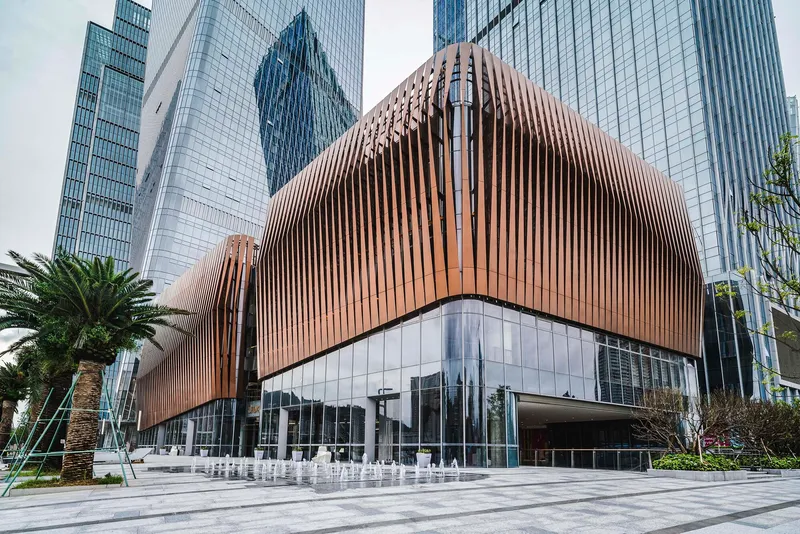
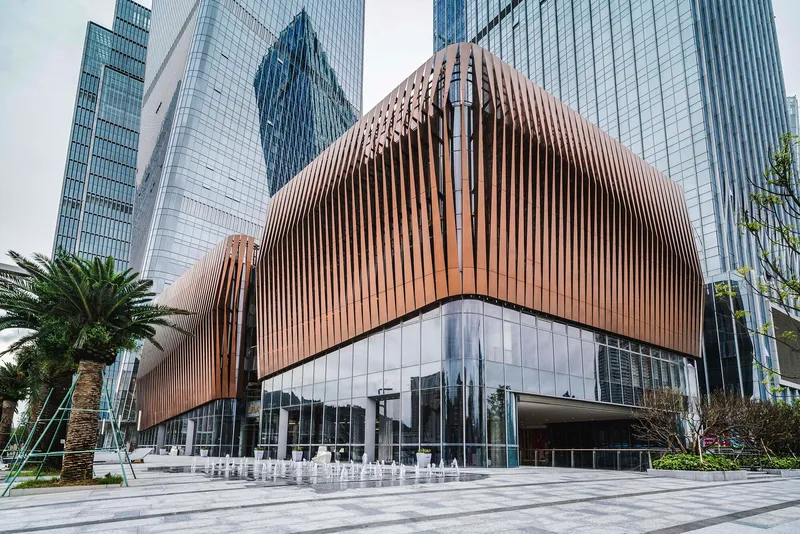
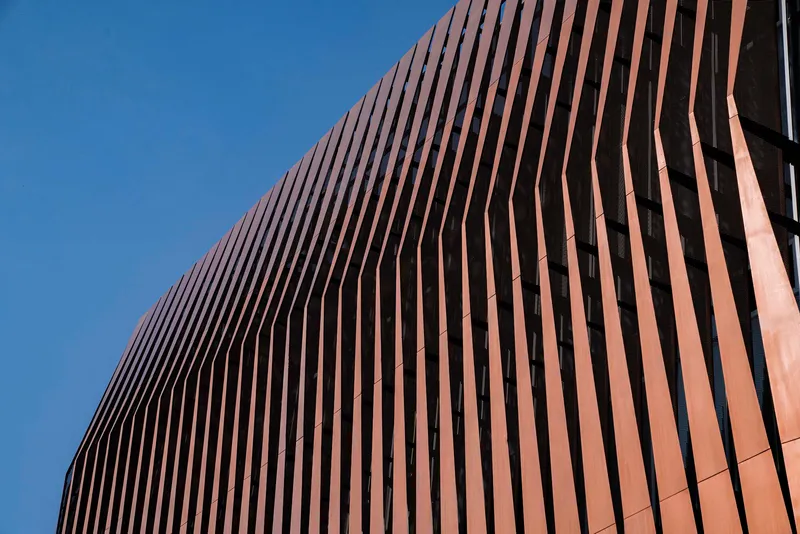
The podium volumes deserve attention separate from the tower. Wrapped in vertical copper-toned fins, they introduce a material warmth that the glass curtain wall above cannot provide. The fins create depth and shadow, modulating the scale of what would otherwise be anonymous retail bases. Fountain plazas, palm trees, and planted evergreens soften the ground plane, turning the space between podium and tower into something closer to a garden than a corporate forecourt.
These six independent commercial buildings house retail, restaurants, and gardens. Their curved forms contrast with the angular tower, establishing a dialogue between the organic and the geometric that is more convincing at ground level than any rendering could promise.
Material Contrasts at the Base
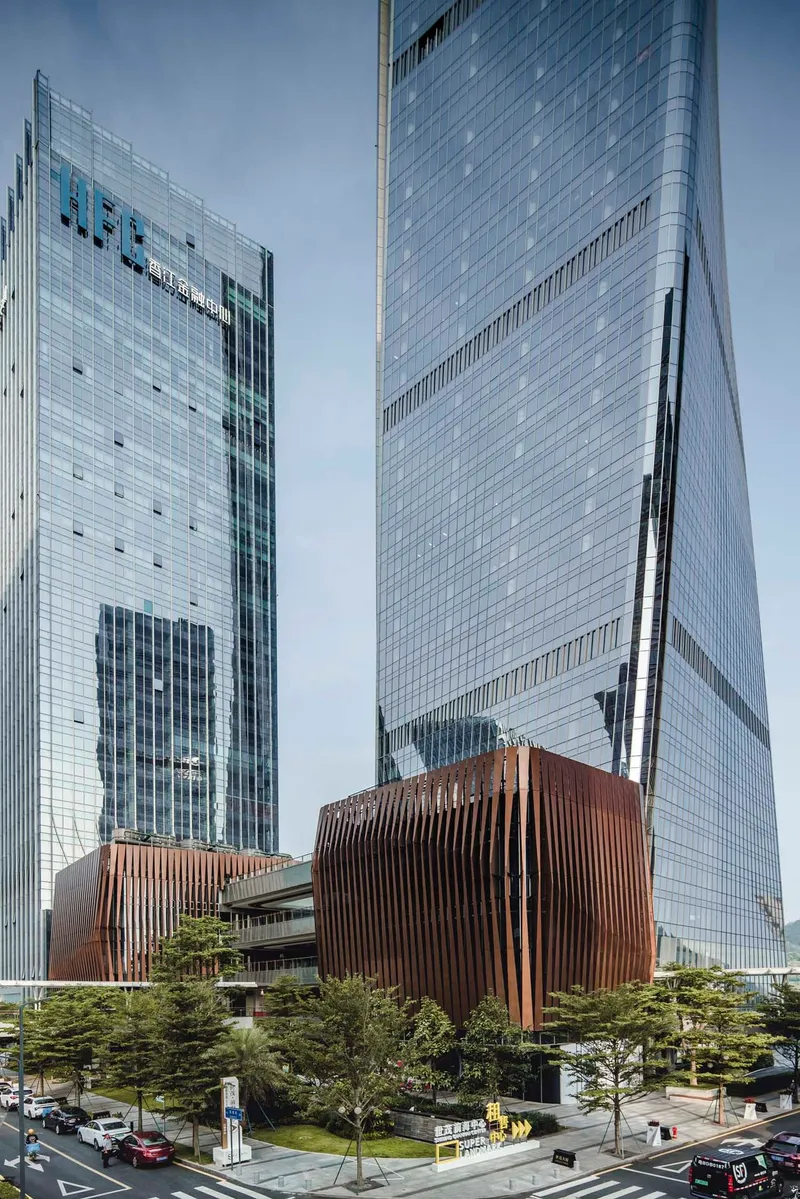
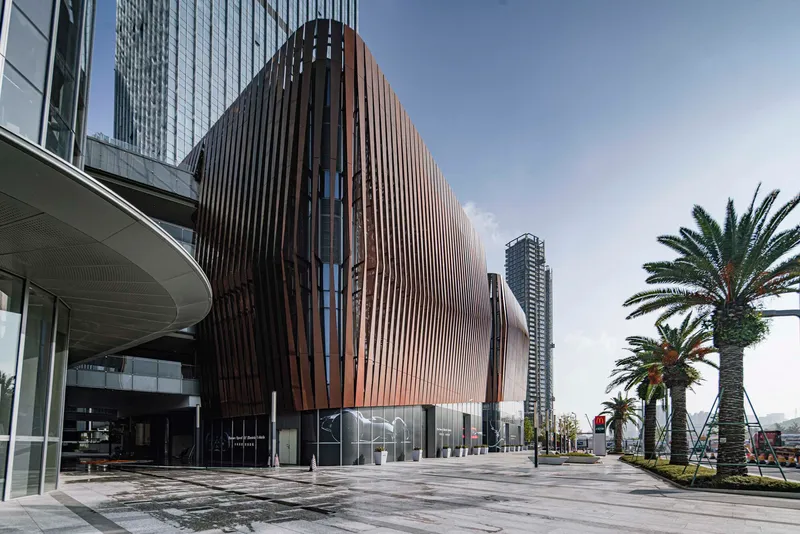
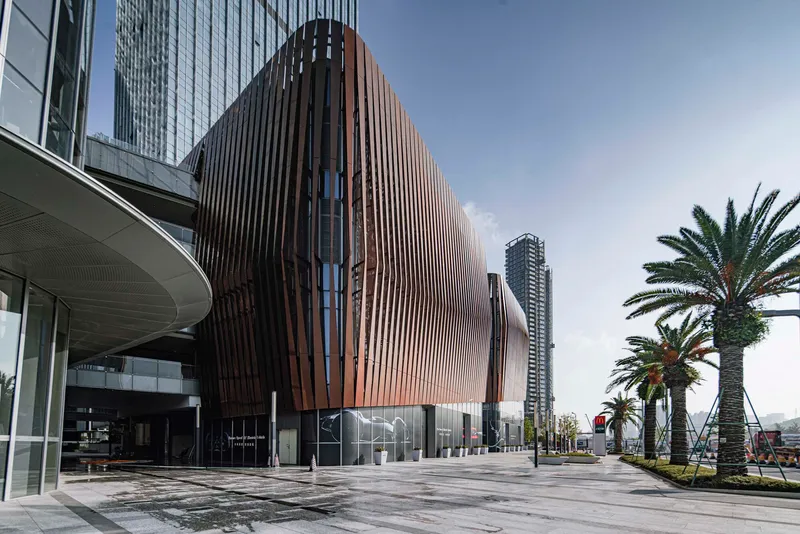
Up close, the podium architecture reveals a careful layering: bronze louvers over glass, timber-clad soffits above covered walkways, recessed entries flanked by planting. The louvered pavilions read almost as furniture in comparison to the tower's scale. They invite touch and proximity in a way that a 294-meter curtain wall never can.
The material palette is restrained but effective. Copper tones, clear glass, concrete, and planted greenery. There is no attempt to unify tower and podium into a single material system, and the project is better for it. The base feels human-scaled precisely because it refuses to mimic the tower above.
Between the Towers
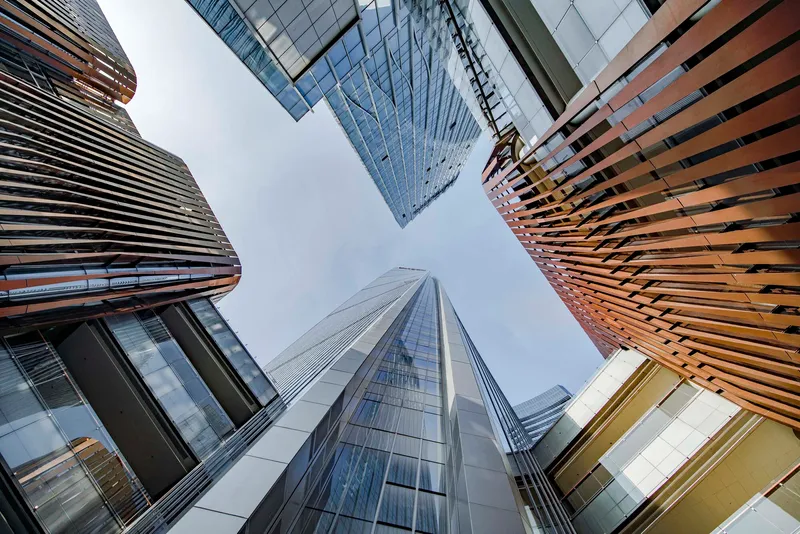
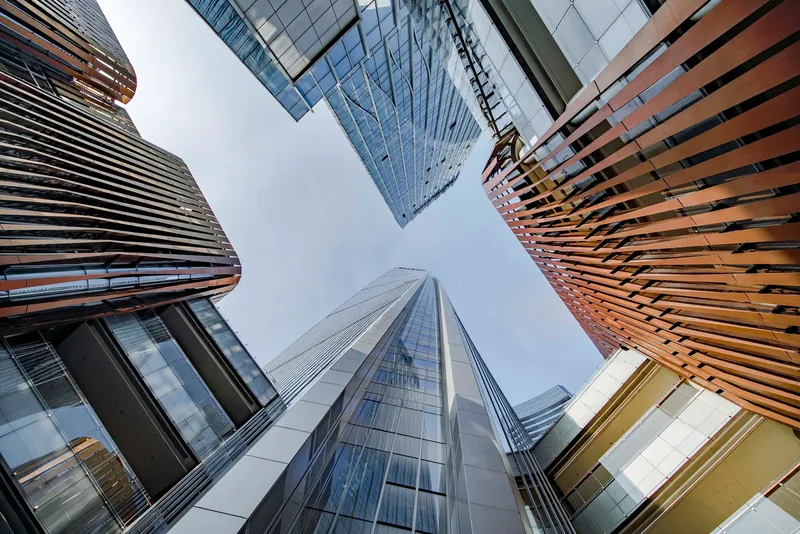
The interstitial spaces, the courtyards and plazas carved out between the tower cluster and its podiums, are where the urban design ambition shows itself. Worm's-eye views reveal four glass volumes converging on a central void, a courtyard that funnels light and air down to the ground plane. Ribbed facades and glass walls create rhythm and enclosure without claustrophobia.
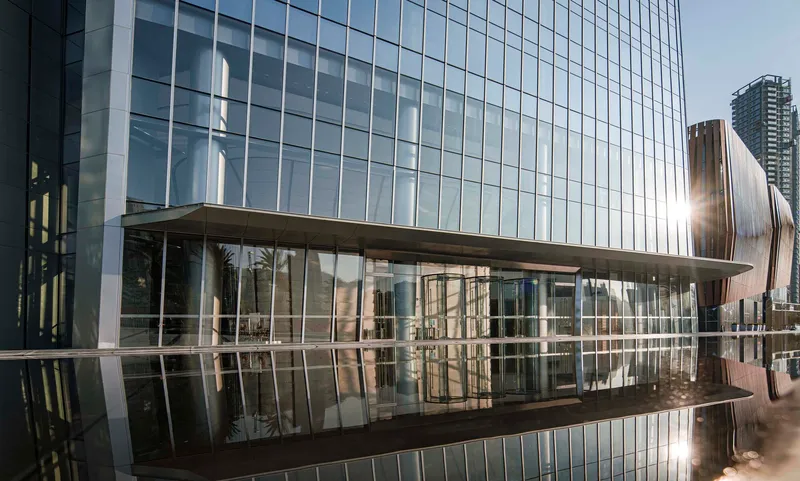
A reflecting pool at the tower base mirrors the curtain wall and an elevated pedestrian bridge, doubling the perceived openness of the plaza. These moments of reflection and framing suggest that someone thought carefully about the experience of arriving on foot, not just the experience of looking up.
Arrival and Threshold
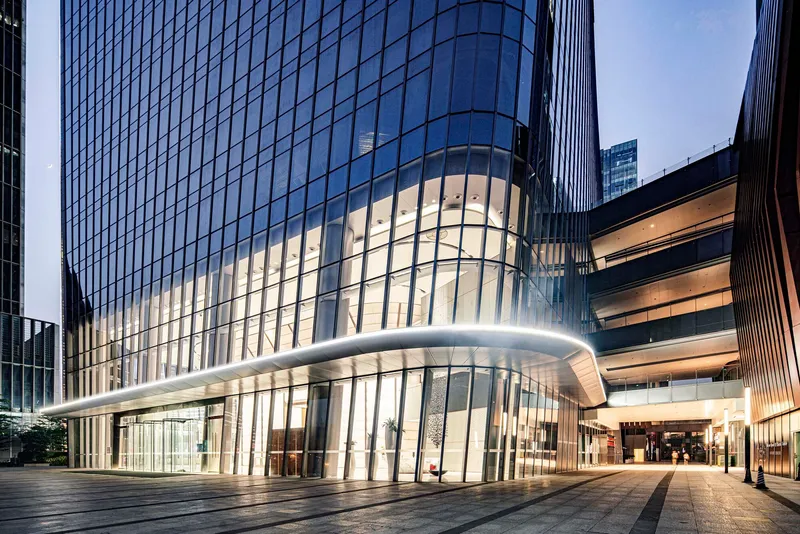
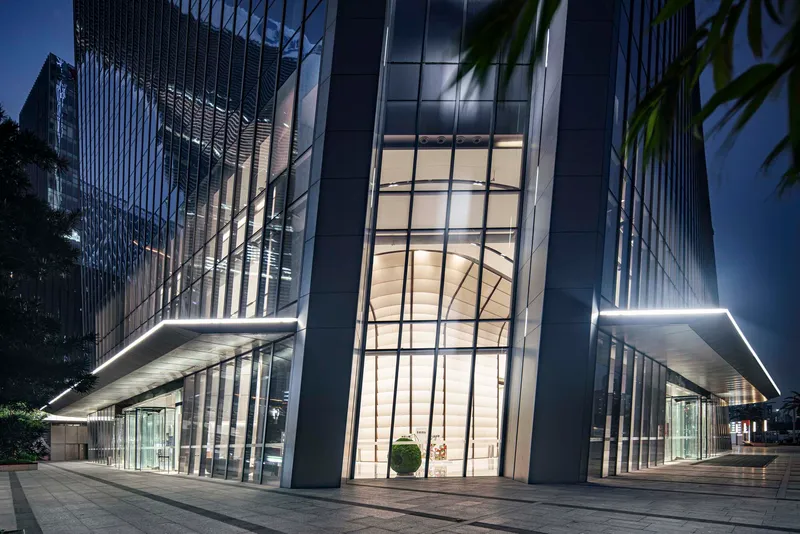
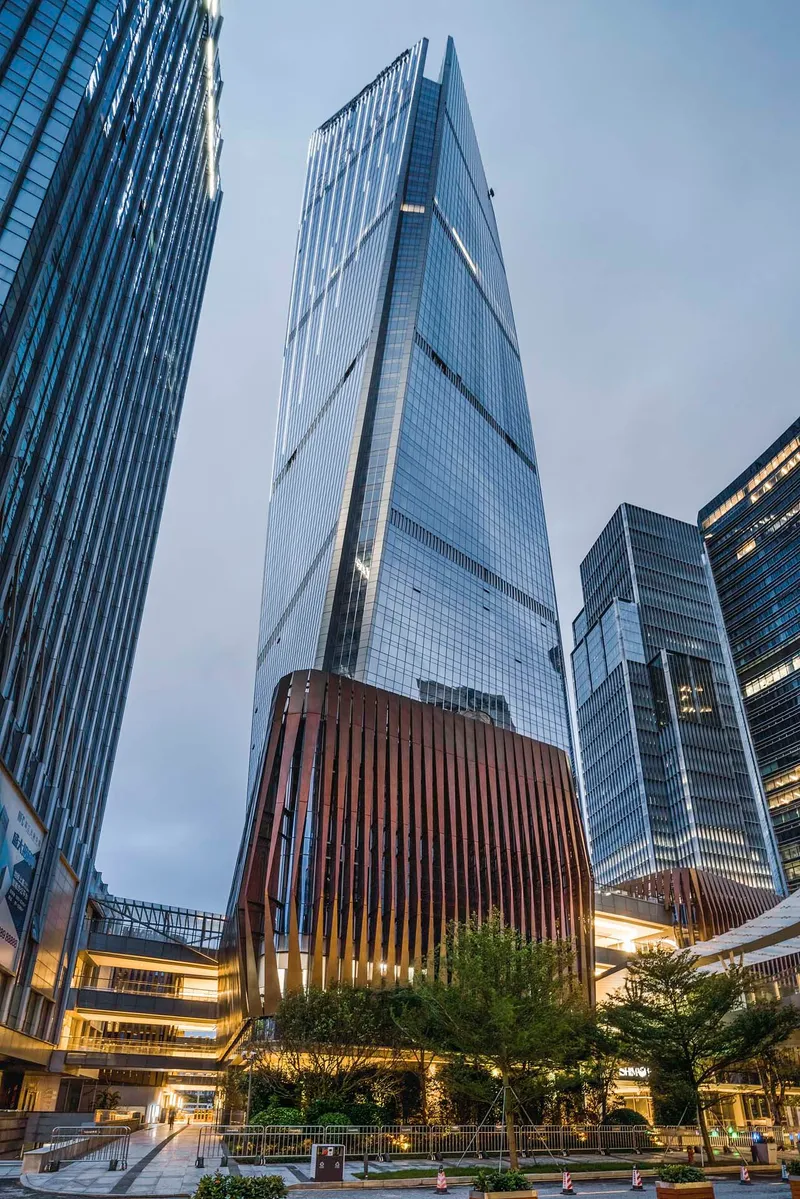
The tower lobby is a glass volume cantilevered beneath a floating canopy, illuminated at dusk to glow against the dark mass of the building above. The entrance sequence is deliberately compressed: low canopy, bright interior, then the vertiginous reveal of the tower shaft overhead. It is a classic supertall strategy executed with clarity.
At twilight, the timber-clad base volume warms the composition, anchoring the crystalline tower to something tactile. The contrast between the illuminated ground plane and the dark glass above gives the building a double identity: approachable retail destination at grade, corporate monument in the sky.
Plans and Drawings
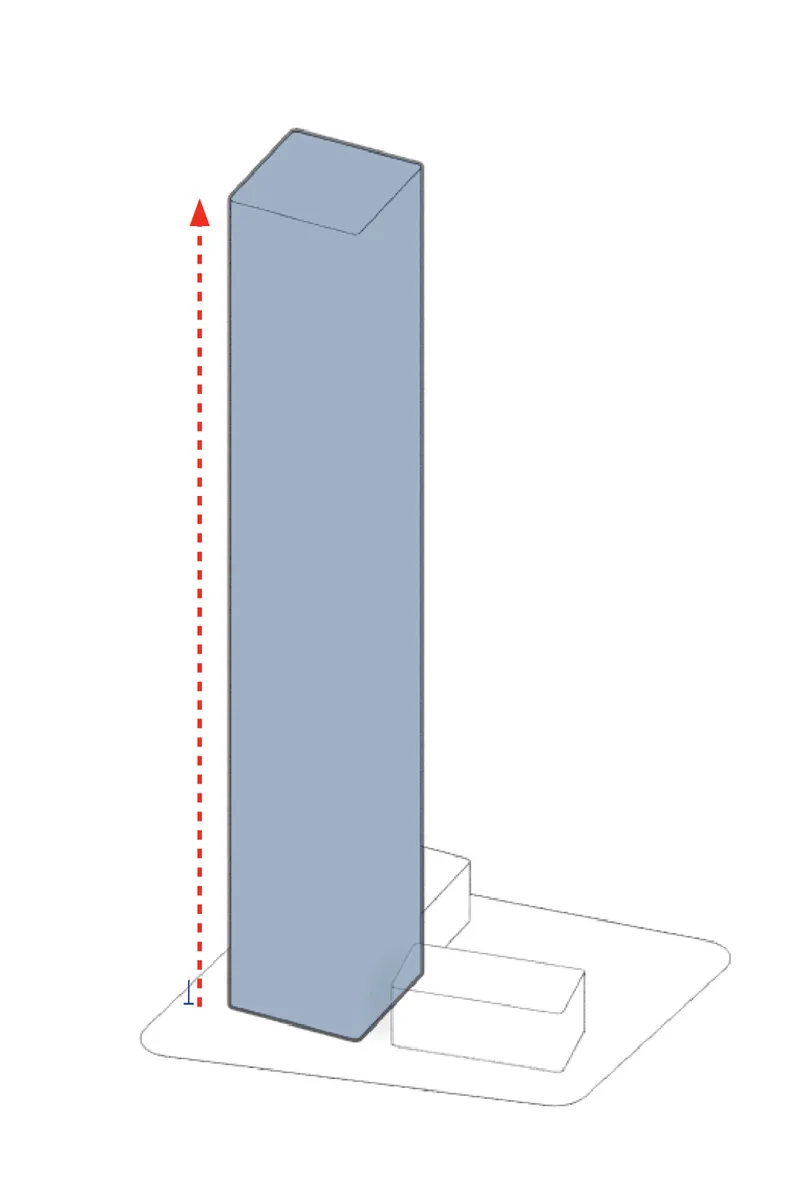
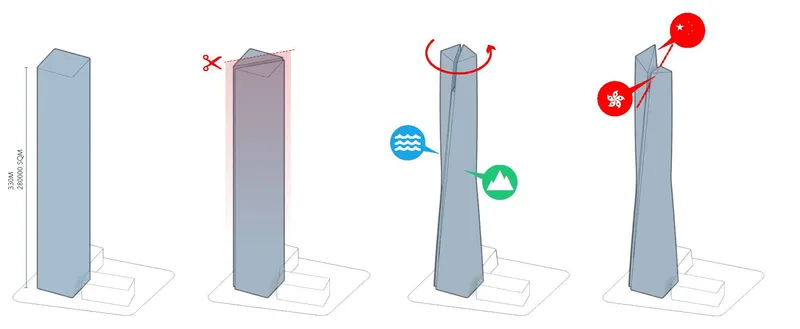
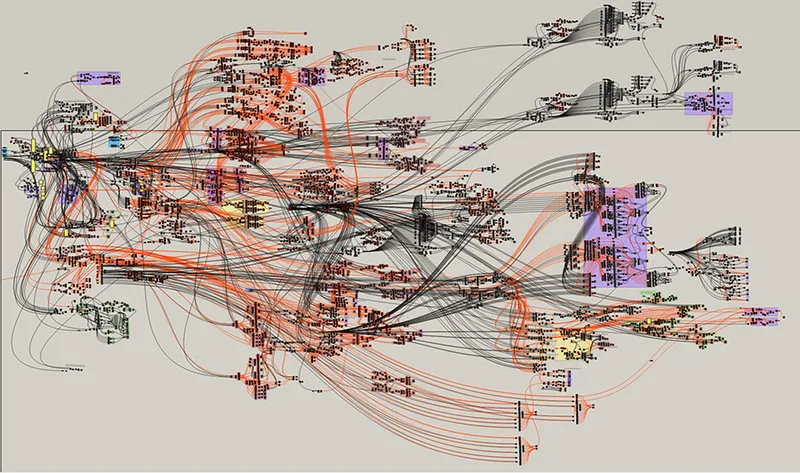
The isometric drawing confirms the tower's formal strategy: a slender volume rising from a stepped base, tapering and rotating as it climbs. The diagram sequence illustrates how angular cuts and programmatic zoning generate the final form, each variation tested against structural and spatial criteria. The computational design diagram reveals the parametric network underlying the curtain wall geometry, a mesh of interconnected nodes and curved pathways that govern the placement of every panel.
These drawings make clear that the twist is not a post-rationalized ornament but a design parameter present from the earliest generative studies. The building's form was always inseparable from its performance.
Why This Project Matters
Twisted towers have become a minor genre in supertall design, from Turning Torso in Malmö to Shanghai Tower. Shimao Qianhai Center enters the conversation with a credible structural rationale and an unusually well-resolved ground plane. The tower does not exist in isolation: it sits within a multi-level pedestrian network, connects to transit infrastructure below grade, and is flanked by podium architecture that holds its own materially and spatially. That integration is rarer and harder than the twist itself.
The project also marks a moment for Qianhai, a special economic zone still defining its identity between Shenzhen's established tech corridors and Hong Kong's financial district across the bay. Whether a single tower can truly symbolize the merger of two urban cultures is a question better left to the sociologists. What Gensler has delivered is a building that performs structurally in typhoon conditions, reads distinctly in a crowded skyline, and meets the ground with generosity. In a genre prone to spectacle over substance, that combination is worth noting.
Shimao Qianhai Center by Gensler, with contributions from AECOM, Woods Bagot, ARUP, and Foster. Located in Shenzhen, China. 160,000 m². Completed 2022.
About the Studio
Share Your Own Work on uni.xyz
If projects like this are the kind of work you want to make, uni.xyz is a place to publish your own, find collaborators, and enter design competitions.


Popular Articles
Popular articles from the community


David Macias Steps a Doorless Stone and Plaster House Down a Tropical Colombian Hillside
In the humid hills of Colombia, Threshold House replaces the front door with an open void and terraces its 850 m² down the slope instead of fighting it.

David Ortega Stacks a Two-Story Mexico City Penthouse Around a Steel Stair and a Pergola-Shaded Roof Terrace
In Colonia Roma, a 300 m² penthouse uses oak joinery, a planted steel stair and a slatted roof pergola to make a new-build apartment feel like a house.

Cube Design Draws an Ecological Corridor Between Two Shenzhen Hills with the Nankai Building
Beside Shenzhen's container docks, the Nankai Building pairs stacked balconies with a climbing green screen to connect two hillsides across its height.

GROUP A Strips a 1969 Rotterdam Harbor Headquarters to Its Frame and Wraps It in Timber Louvers
In Rotterdam's M4H harbor district, Ferro Offices reuses a 1969 frame, adds one timber storey and reaches BREEAM-NL Outstanding.

Similar Reads
You might also enjoy these articles


LAVA Architecten Gives Vocational Education a Sawtooth-Roofed Face on a Mechelen School Campus
In Mechelen, Belgium, a 2,053 m² STEM school on a 6×6 m grid turns workshops and classrooms into rooms that can be rearranged as teaching changes.

KEMA Studio Turns a Derelict Marvila Attic into a 60 m² Lighthouse Apartment Above Lisbon
In Lisbon's Marvila district, a rebuilt roof, four skylights and two plywood volumes turn an unlivable attic into a bright home facing the Tagus.

Pixel Gardens: One Repeated Module Stacked Into a Terraced Social Housing Tower for Famagusta
Salem Bader's shortlisted housing tower builds a vertical neighbourhood from one repeated module, offsetting units to carve terraces, light and air.

Bao Huynh Watercolor Atelier: A Serene Art Retreat in Hội An
Bao Huynh Watercolor Atelier in Hội An blends multifunctional art spaces, sustainable design, local materials, and family-friendly living in a serene environment.

Explore Tall Building Competitions
Discover active competitions in this discipline

Challenge to reimagine the Iron Throne

Photograph architecture without architects

Illustrate the lost glory of Angkor Wat - Render Challenge

Design challenge to reuse E-waste
Comments (0)
Please login or sign up to add comments
No comments yet. Be the first to comment!