

Plugin Housing: Dodecahedron Modules Tackle Hong Kong's Density Crisis
A geometry-driven prefabricated housing system stacks twelve-faced modules on vertical cores to rethink dense urban living in Hong Kong.


What if the shape of your apartment was dictated not by a developer's spreadsheet but by the same geometry that governs honeycombs, crystals, and galaxies? That is the provocation at the core of this modular housing proposal, which takes the twelve-faced dodecahedron, a form Plato associated with the cosmos itself, and turns it into a stackable, prefabricated living unit for one of the world's most land-starved cities. The result is a housing system that treats geometry as both structure and philosophy, delivering density without the claustrophobia that defines so much of Hong Kong's existing micro-housing stock.
Designed by Saeid Alitajer, Maryam Hoseini, and Maryam Ghaseminasab, this shortlisted entry for the Plugin Housing Challenge 2020 confronts Hong Kong's notorious coffin homes with a vertically stacked modular framework. Individual units are lifted and plugged into a skeletal structural core, keeping the urban ground plane open while maximizing light, air, and vertical expansion. The design draws on the Fibonacci sequence and Platonic solids to establish a universal geometric language that, the designers argue, scales across cultural and climatic contexts.
Vertical Stacking on Skeletal Cores

The presentation board reveals the full ambition of the system: polygonal modules cluster around vertical circulation and structural cores, creating a tower that reads less like a conventional apartment block and more like a three-dimensional tessellation. Trees and pedestrians occupy the ground level, illustrating how the lifted modules preserve public space beneath. Each unit plugs into the frame using a vertical mobility system, which means the tower can grow incrementally as demand increases. The approach minimizes disruption to the existing urban fabric and avoids the monolithic footprint of typical high-rise housing.
Set against Hong Kong's dense urban core, the scheme directly targets the demographics most affected by the housing shortage: single and double occupants aged 18 to 40. By keeping modules compact and standardized, the designers aim to reduce construction waste, accelerate installation, and lower costs, all critical factors in a city where affordability has become a crisis measured in square inches.
Anatomy of a Prefabricated Module
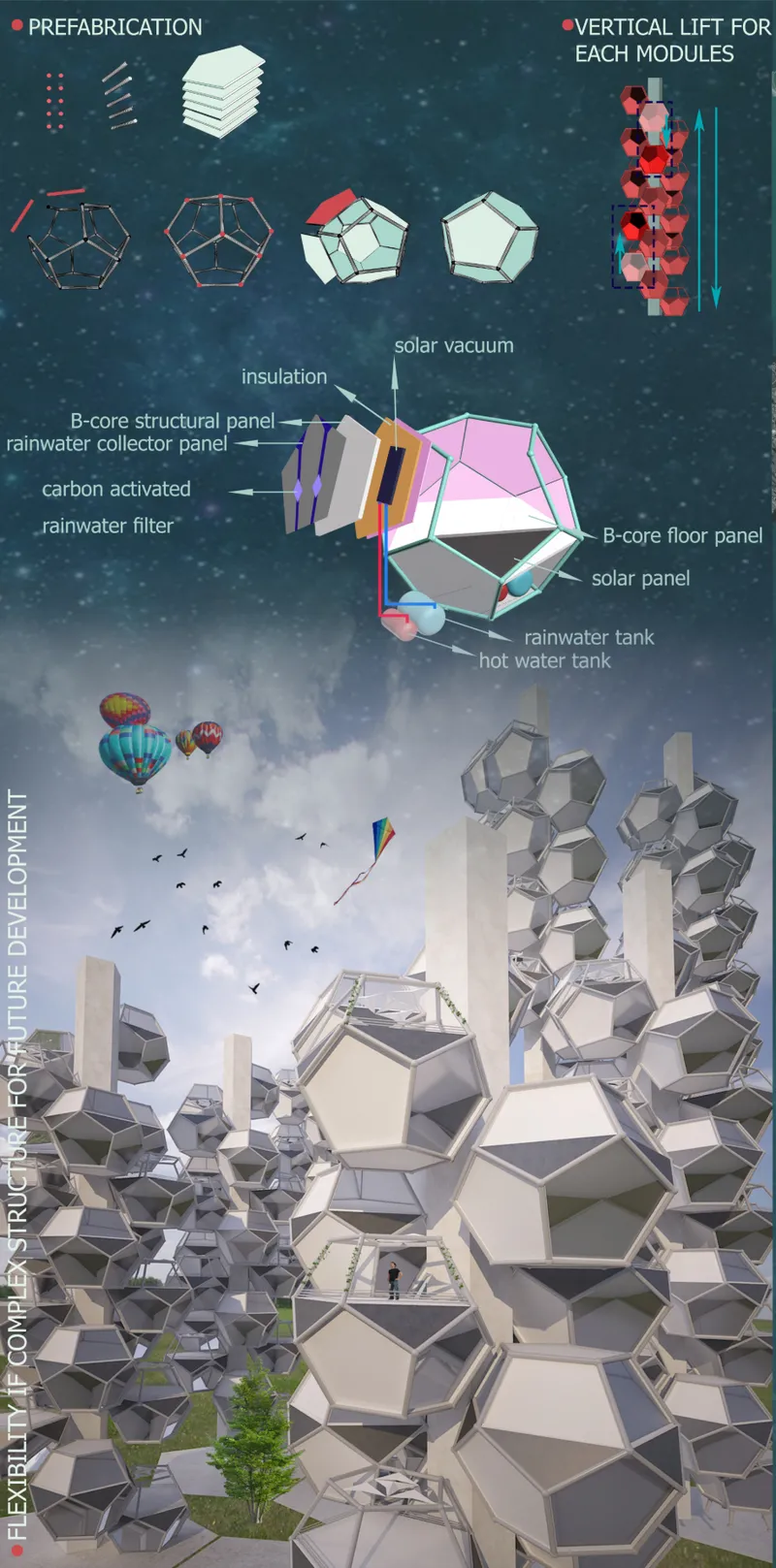
The exploded axonometric pulls the module apart layer by layer, revealing its material intelligence. B-core structural panels form the primary enclosure, layered with insulation for passive thermal comfort. Solar panels cap the upper surfaces, and carbon-activated rainwater filters handle water harvesting, making each unit functionally self-reliant. These are not afterthought sustainability features bolted onto a standard box; they are integrated into the panel assembly itself, so every module arrives on site ready to perform.
The dodecahedral geometry is central here. Its twelve faces distribute structural loads more evenly than a rectangular prism, and the angled surfaces create opportunities for clerestory-style light entry that a flat wall simply cannot offer. The choice of this form is deliberate: the designers cite its historical symbolism of ether and cosmic balance, but the functional payoff is equally significant in how it manages light penetration and structural redundancy within a compact envelope.
Faceted Interiors and Transformable Furniture
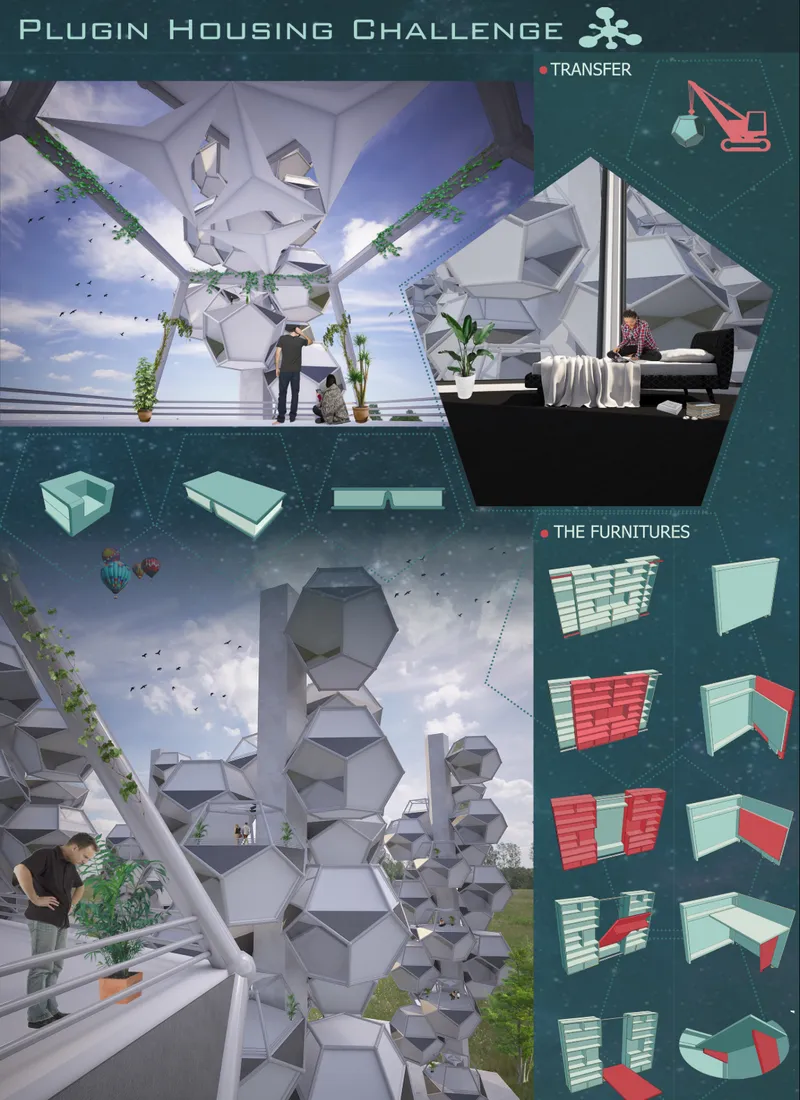
Inside, the angular walls become an asset rather than a constraint. The interior views show faceted surfaces that define distinct spatial zones within a single open module: sleeping, working, and socializing areas are separated by geometry rather than partition walls. Furniture pieces fold, shift, and merge to reconfigure the space throughout the day. A bed folds away, a shelf rotates into a desk, corner seating doubles as storage. The diagrams on the board map out these configurations with precision, showing how a unit designed for a single occupant can accommodate a guest or adapt to changing daily routines.
Large polygonal windows bring daylight deep into the module while their angled orientation limits direct sightlines from neighboring units, offering privacy without blinds. Planters integrated into the façade introduce biophilic elements at every level of the tower, softening the hard geometry and providing occupants with a pocket of greenery that, in a city as dense as Hong Kong, carries genuine psychological weight.
Geometry as Both Symbol and System
The philosophical ambition of the project is worth taking seriously. The designers frame their geometric choices as a reconnection between ancient mathematical principles and contemporary housing needs, arguing that the same proportional systems found in natural growth patterns can govern built environments. The dodecahedron is not picked for novelty; it is positioned as a module whose symmetry enables omnidirectional stacking, whose faces accept standardized panel systems, and whose form carries cultural resonance across geographies. Whether one buys the cosmic narrative or not, the structural and spatial logic holds up on its own terms.
Why This Project Matters
Modular housing proposals often fall into one of two traps: they are either relentlessly pragmatic boxes that solve logistics but ignore livability, or they are sculptural provocations that photograph well but never confront the realities of fabrication and cost. This entry navigates between those poles with unusual confidence. The dodecahedral module is genuinely prefabricable, its material layers are specified and purposeful, and its interior planning demonstrates a real understanding of how people live in very small spaces.
What makes the work compelling is the insistence that density does not have to mean deprivation. By grounding the design in a geometric system that produces both structural efficiency and spatial richness, Saeid Alitajer, Maryam Hoseini, and Maryam Ghaseminasab offer a model where affordability, sustainability, and architectural ambition coexist. In a global housing landscape increasingly dominated by repetitive slabs, that coexistence is exactly what the conversation needs.
View the Full Project
About the Designers
Designers: Saeid Alitajer, Maryam Hoseini, Maryam Ghaseminasab
Enter a Design Competition on uni.xyz
uni.xyz runs architecture and design competitions year-round that reward proposals with spatial conviction and real site intelligence.
Project credits: Plugin Housing Challenge by Saeid Alitajer, Maryam Hoseini, Maryam Ghaseminasab Plugin Housing Challenge 2020 (uni.xyz).


Popular Articles
Popular articles from the community


Tsunami Convergenics: Turning Catastrophic Ocean Forces into Underwater Housing Infrastructure
A speculative underwater settlement off the coast of Onagawa, Japan, treats tsunamis and typhoons as energy sources rather than threats.

Temporary Home for Dogs: A Reversed Zoo Rethinks Animal Shelter Architecture
In Bucharest, a sinuous corridor and freed landscape flip the logic of containment, designing a shelter that works to make itself unnecessary.

Opera by the Sea Estonia: Three Shells Dissolving Architecture into Tallinn's Coastline
A winning opera house proposal replaces monumental form with interconnected shells that blur the boundary between building, park and Baltic Sea.

Singing Woman: An Opera House That Performs Before the Curtain Rises
Ovidiu Cristian Pavel's conceptual opera house translates Estonia's choral identity into a sculpted waterfront landmark facing the Baltic Sea.

Similar Reads
You might also enjoy these articles

Shakur's House: Exposed Brick as an Interior Organiser in a 168 m² Mashhad Residence
Brick moves indoors in this Mashhad residence, where masonry walls, glass partitions and teal planes sequence a compact home without closing it off.

Day and Night Park: A Time-Based Urban Newsstand in Beijing
A temporary urban newsstand in Beijing blending travel, light, and reading through poetic colors, compact form, and community-focused design.

Modernist Patio Renovation in El Masnou, Barcelona by Oliver Segura Arquitectura + Cebrià Arquitectura
Modernist patio renovation blending tradition and innovation with a movable pool, leveled floors, and Catalan materials in El Masnou.

Alto Residencial Coop: Cooperative Housing Development in Santiago de Compostela by Carbajo Barrios Arquitectos
A linear cooperative housing complex blending white volumes and perforated metal façades, enhancing community living, natural light, privacy, and urban integration.


Comments (0)
Please login or sign up to add comments
No comments yet. Be the first to comment!