
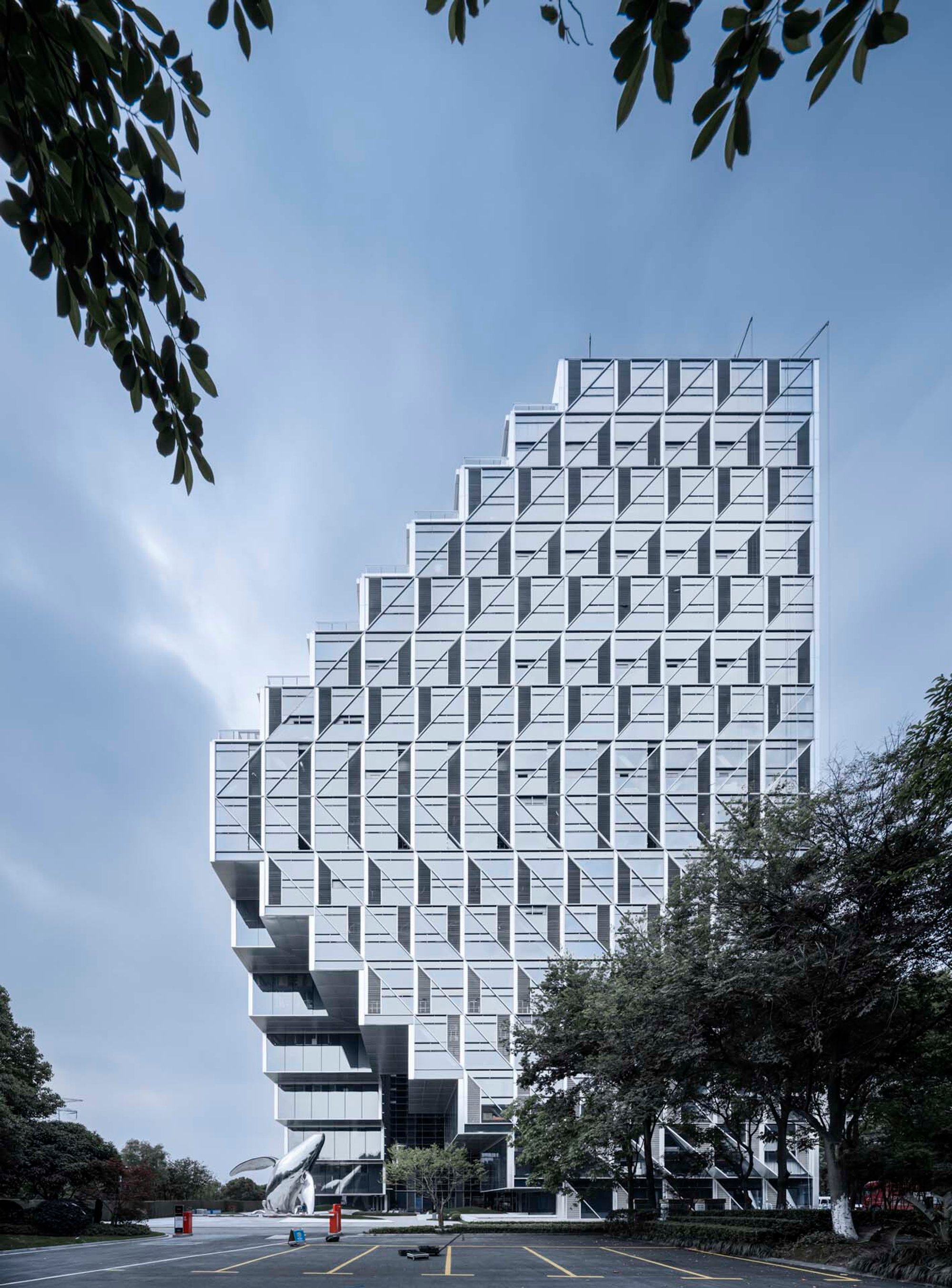
GLA Design Carves Diagonal Cuts into a 29-Meter Cantilever Office Tower in Hangzhou
Three bold slashes through a square volume create an X-shaped facade and channel monsoon winds through a tech corridor incubator.

Office buildings in Chinese tech corridors tend to default to glass curtain walls and generic floor plates, designed more by spreadsheet than by compass. GLA Design's Deep Blue building in Hangzhou's Zijingang Science and Technology City does something genuinely unexpected: it takes an almost square footprint, slices it three times along the northeast-southwest diagonal, and lets those cuts generate everything, from the structural logic to the ventilation strategy to the building's striking X-shaped silhouette.
What makes Deep Blue worth studying is how tightly its formal ambition is woven into practical constraint. The project is a secondary commission, meaning GLA inherited an existing pile foundation and basement structure from a demolished predecessor. The building density could not exceed the original scheme. Working within those limits, the architects managed to produce a 36,416 square meter incubator office with a 29.4-meter cantilever, a climate-responsive envelope, and a spatial variety that most tech parks never attempt.
The Diagonal Logic
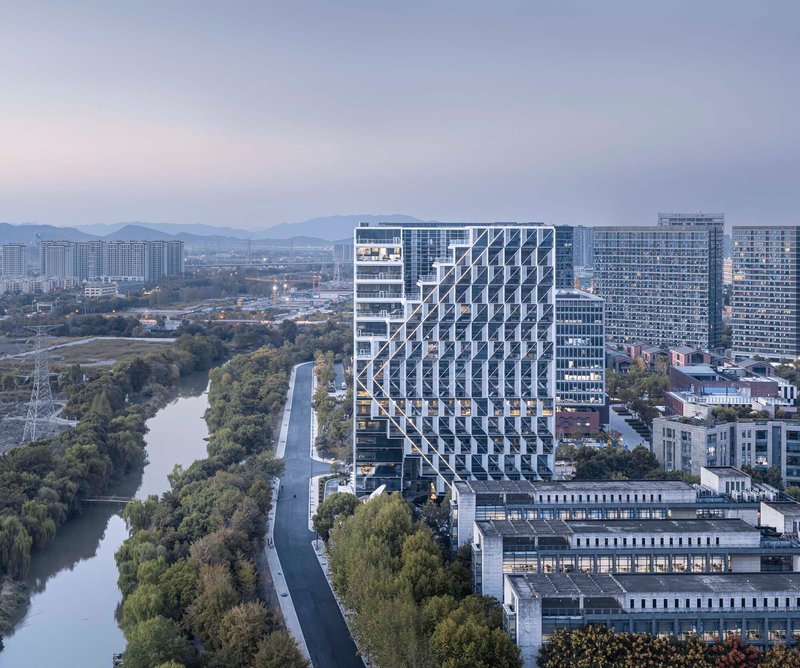
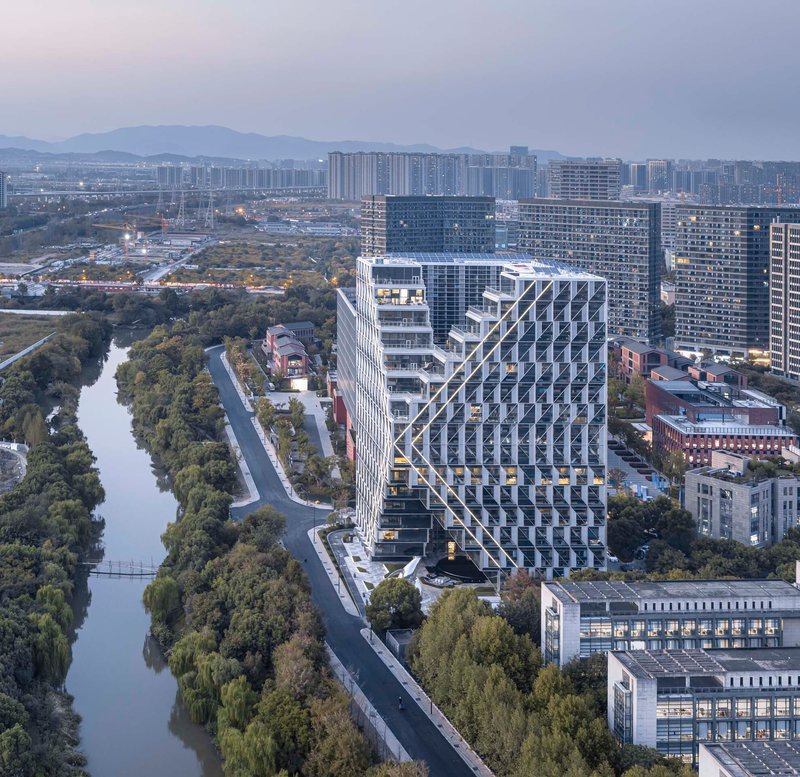
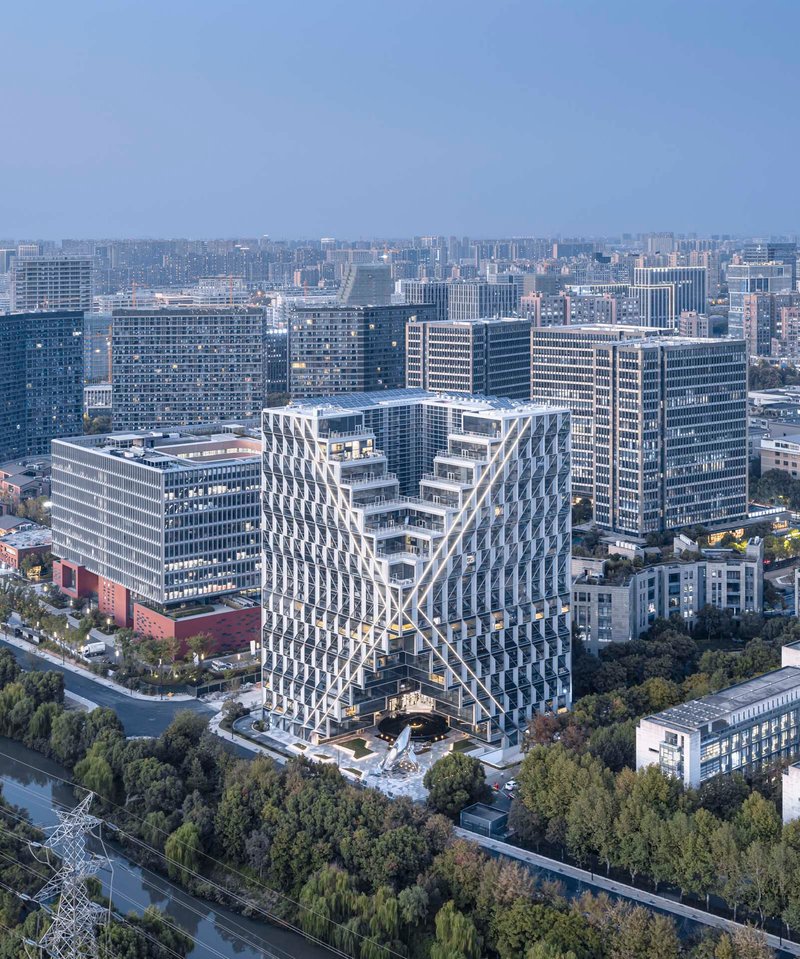
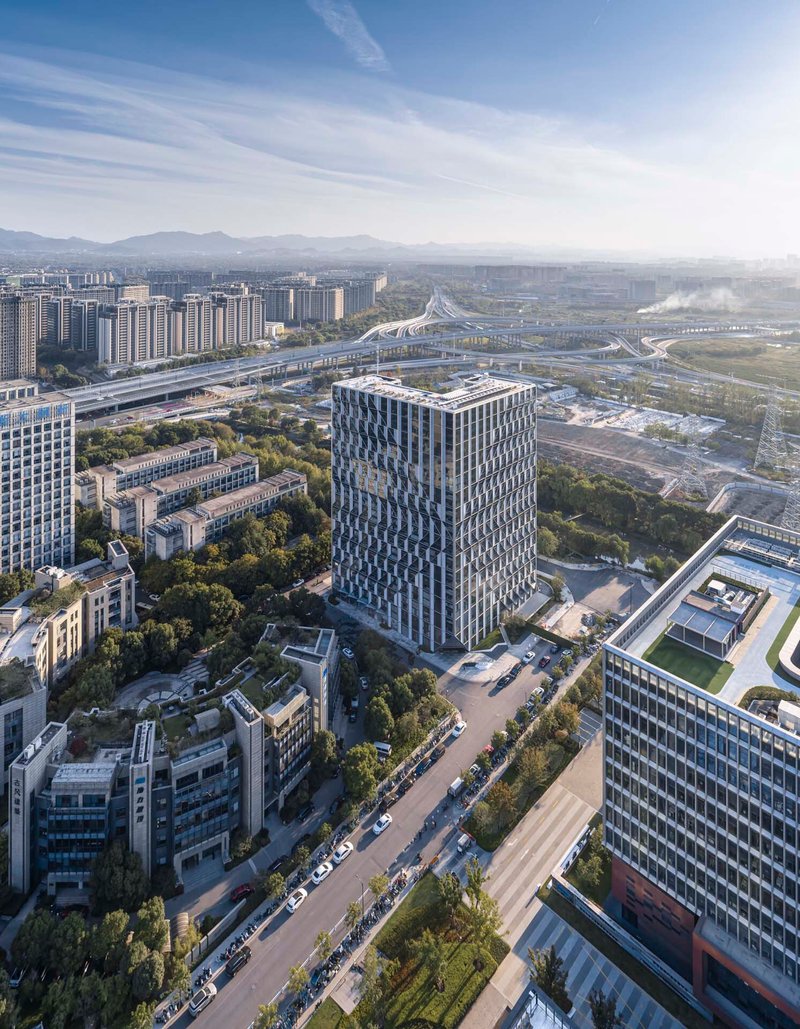
The three diagonal cuts are not decorative gestures. Oriented northeast to southwest, they align with Hangzhou's dominant monsoon directions in both summer and winter, channeling natural ventilation through the building's mass. The cuts also open sightlines and sunlight paths that a solid square volume would block, a critical move given that the site is flanked on three sides by office buildings of varying heights. From the air, the result reads as two interlocking volumes converging into an X. From the street, it looks like a ziggurat that has been sheared by wind.
The facade reinforces this reading with two distinct curtain wall unit types: diagonal panels that follow the cut lines and orthogonal panels that hold the building's rectilinear edges. Anodized aluminum plate and three-layer hollow Low-E ultra-white glass wrap the form, producing a surface that shifts between opacity and transparency depending on the angle. The glass does real thermal work, providing insulation and energy savings rather than simply framing views.
Reusing What Was Already There
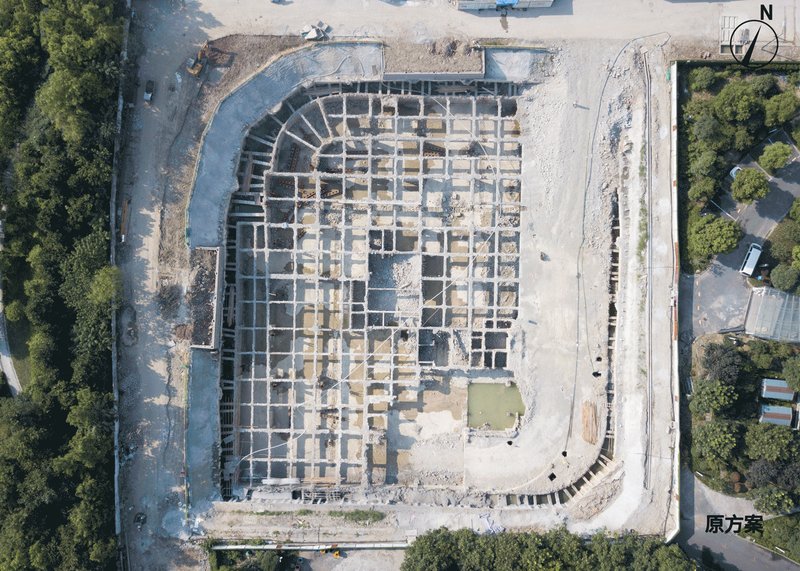
The construction image of the exposed gridded pile foundation tells a story that most renderings never show. GLA did not start from scratch. The original piles and basement floor structure were retained and reused, a decision driven partly by the tight land use constraints and partly by practical economy. Building on top of someone else's foundation is a significant engineering challenge, particularly when the new structure includes a 29.4-meter cantilever and qualifies as a special irregular structure with seismic overruns. The fact that the architects treated this inheritance as a design opportunity rather than a burden speaks to a pragmatic intelligence that the finished facade might not immediately suggest.
Facade and Materiality Up Close
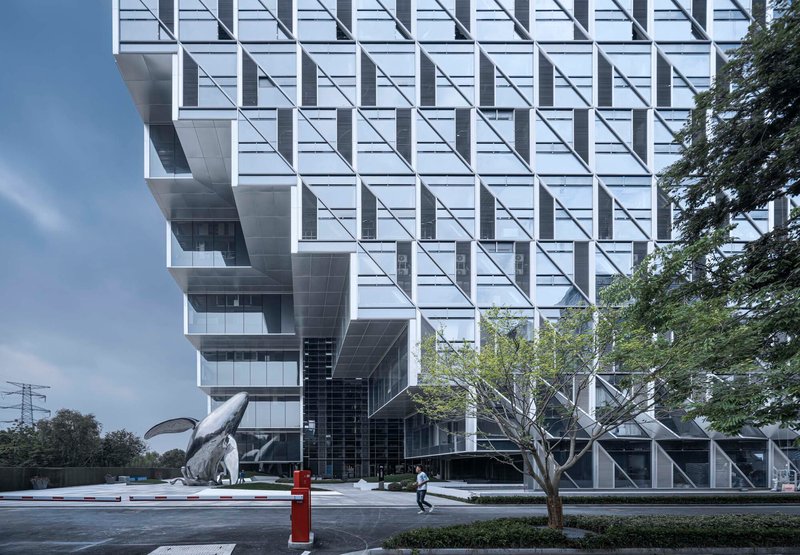
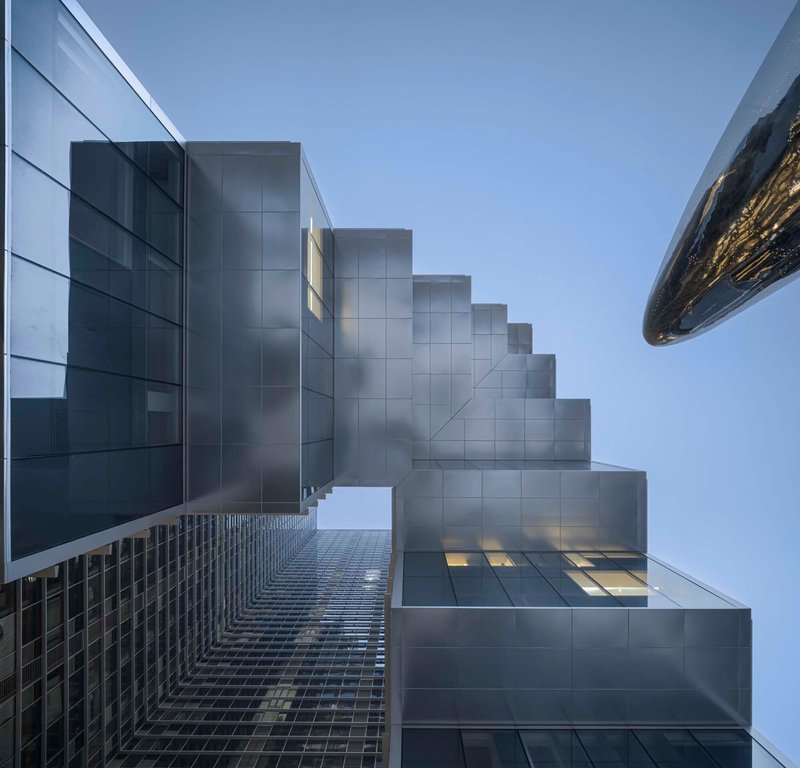
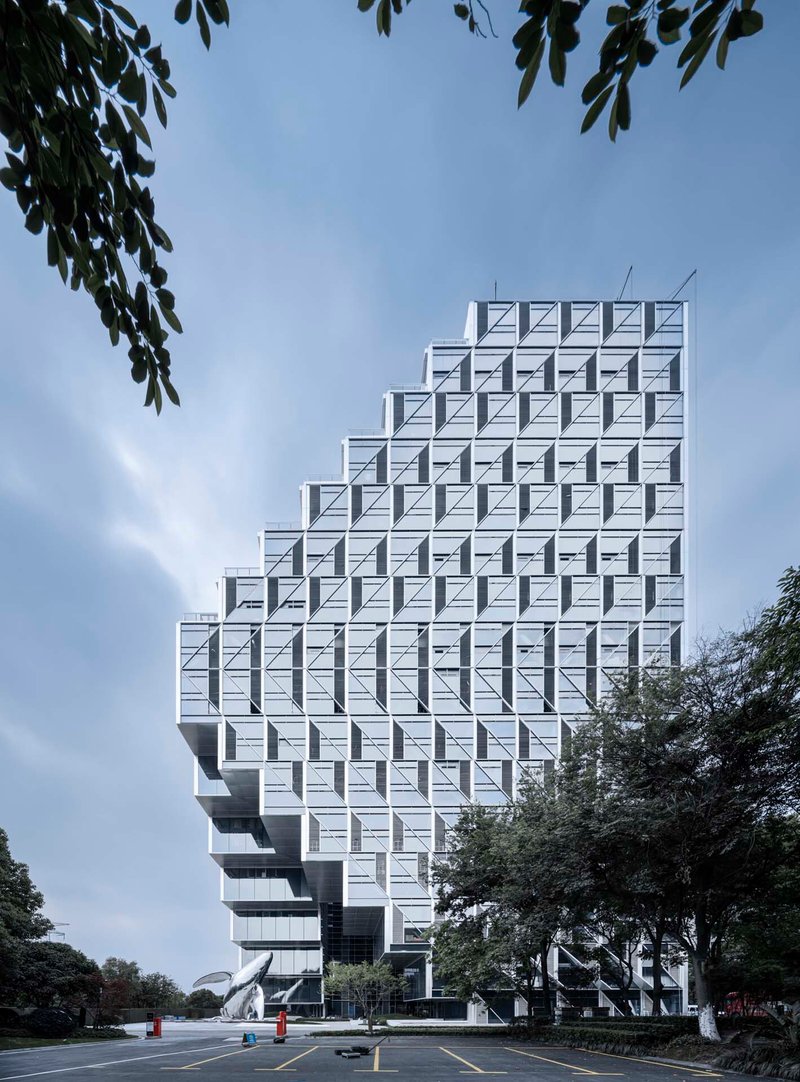
At street level, the anodized aluminum panels and diagonal bracing create a rhythm that is geometric without being monotonous. The panels catch light differently across the day, moving from cool white in overcast conditions to a warmer glow at dusk. The glass gridded base provides a visual counterpoint, grounding the building and giving pedestrians a sense of the interior life behind the skin. The stepped massing is legible from every approach: from the canal side, the building rises as a layered form above tree canopy; from the street, it presents a coherent, almost crystalline presence.
The choice of anodizing over paint or powder coating is worth noting. Anodized aluminum develops a hard oxide layer that resists corrosion and maintains its finish without the degradation that plagues lesser cladding materials in Hangzhou's humid subtropical climate. It is a material decision that will pay off in decades, not months.
The River Edge and Landscape Connection
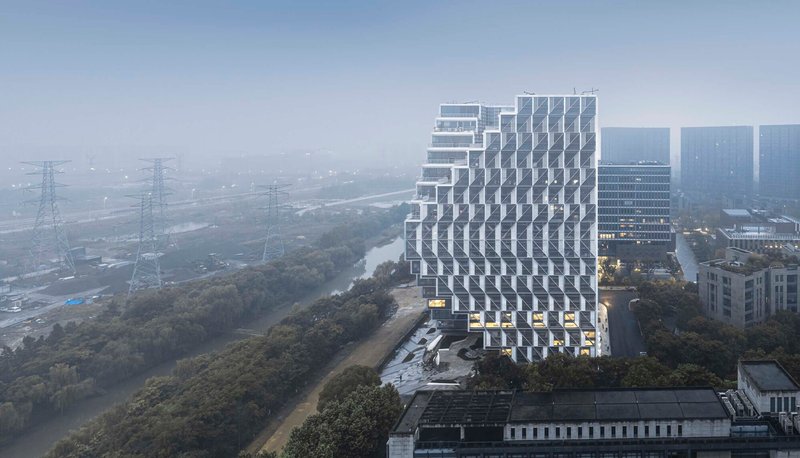
A river runs along the west side of the site, and GLA leveraged this asset with a gray space at the lower level that connects the internal atrium directly to the waterfront landscape. Stepped terraces at the southwest provide an upper set-back that reduces the building's visual bulk from the canal side while creating usable outdoor space. The morning mist photograph captures something that plans cannot: the building's relationship to its atmospheric context, the way it emerges from the low-lying haze that settles along Hangzhou's waterways. The landscape strategy is not just about views; it is about making the river a functional extension of the building's ground floor.
Office Modules and Spatial Variety
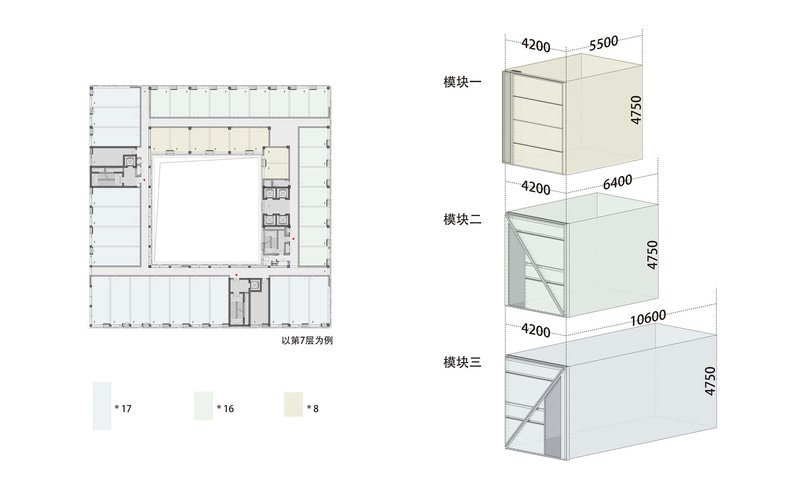
Deep Blue offers three types of office modules, all sharing a uniform 4.2-meter face width and 4.75-meter floor height but varying in depth. These modules are combined via unilateral walkways or inner walkways that conform to the X-shaped plan, creating a mix of independent offices and shared open areas. The 4.75-meter floor height is generous for a speculative office building, suggesting that GLA was designing for the kind of creative and tech tenants that populate Hangzhou's innovation corridor rather than for maximum floor count.
The exploded axonometric reveals how the three stacked volumes with diagonal bracing create distinct zones within the tower. A central atrium runs through the lower layers, connecting interior spaces visually and thermally. The visible atrium water system adds a biophilic element that softens the otherwise rigorous geometry. The intent is clear: Deep Blue is meant to function as an open, inclusive workspace and cultural place, not merely as leasable square meters.
Plans and Drawings
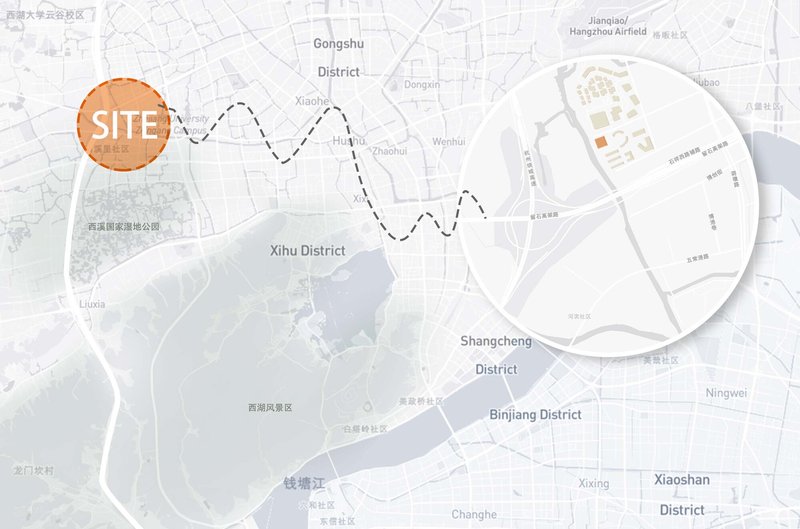
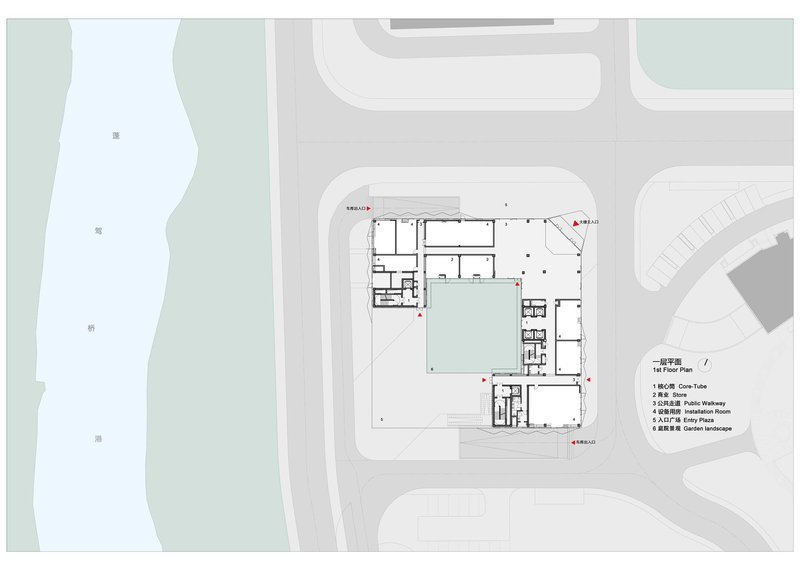
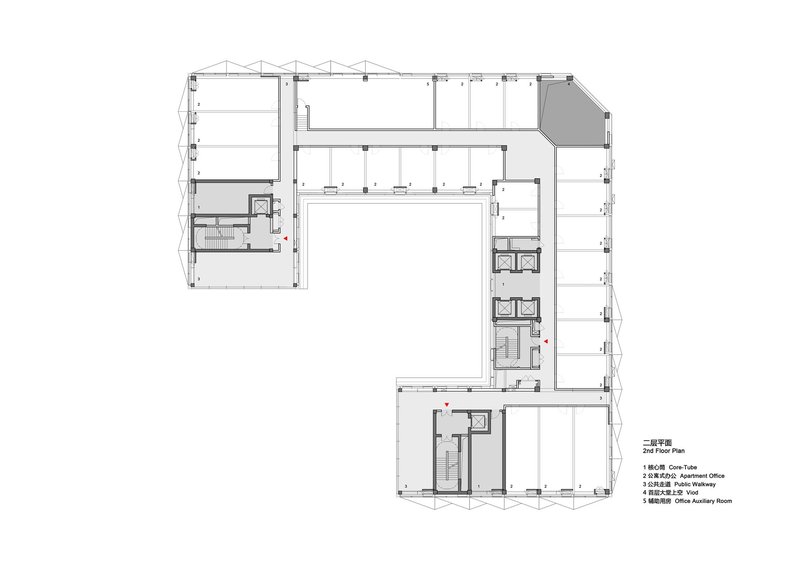
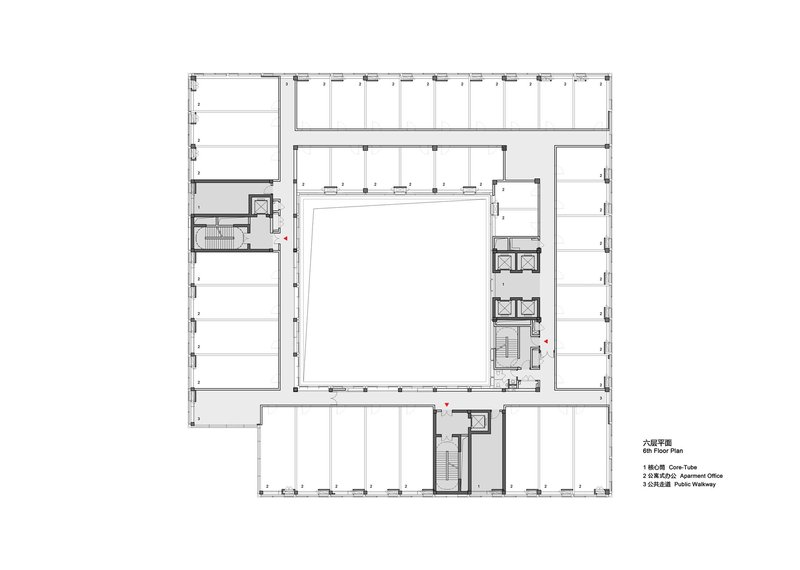
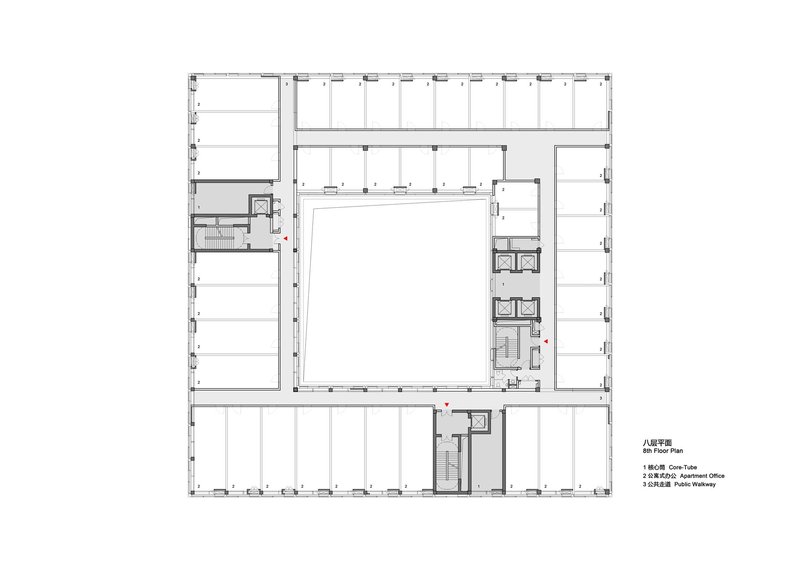
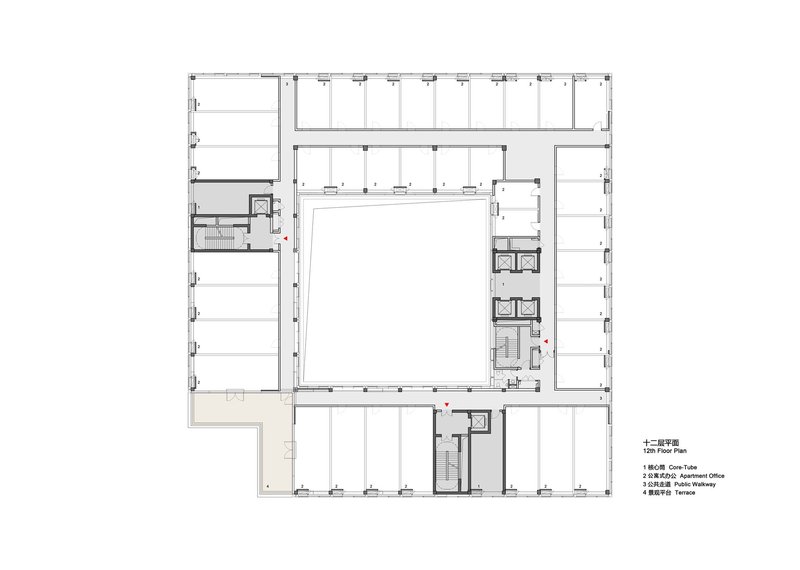
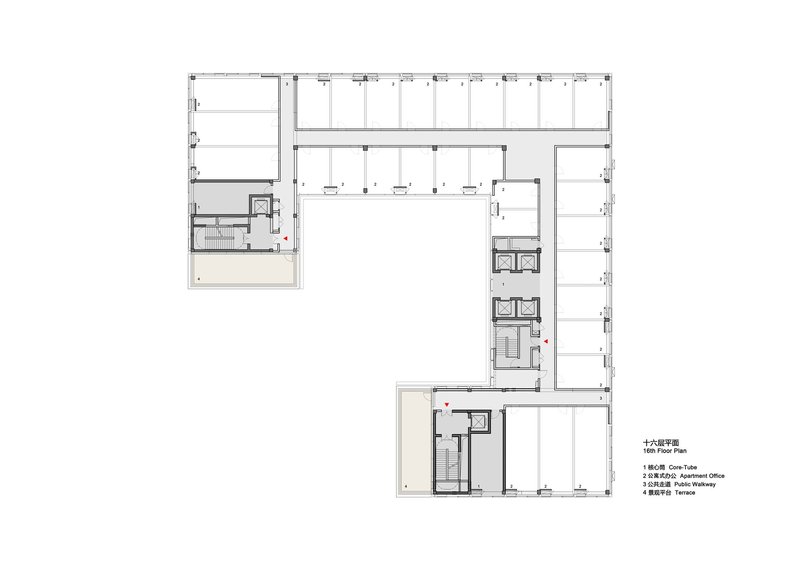
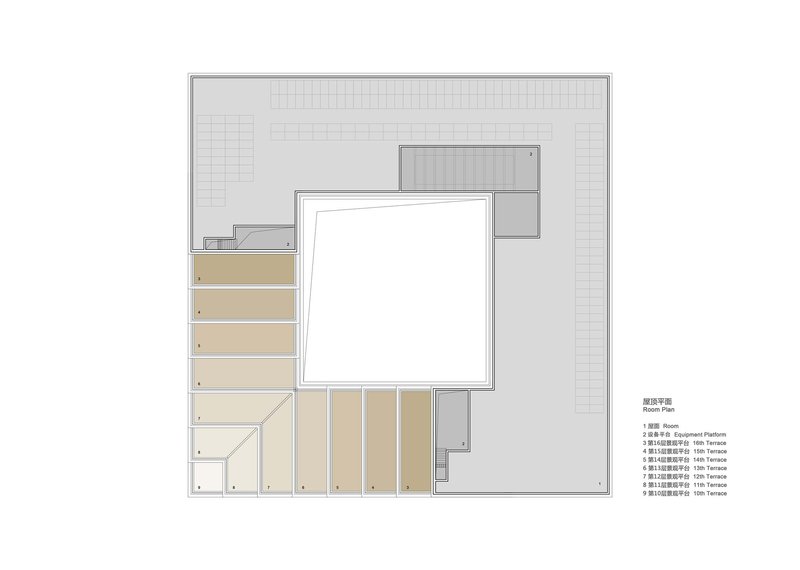
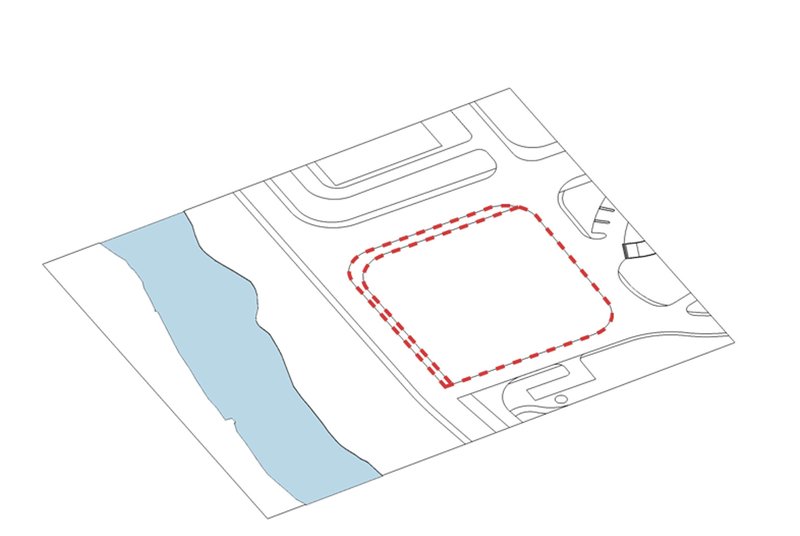
The floor plan sequence from ground level to the sixteenth floor tells the real story of the diagonal cuts. At the lower levels, the building occupies a large, roughly square footprint with a central courtyard and perimeter offices. As the tower rises, the floor plate progressively reduces, splitting into two separated wings by the sixteenth floor. The corner stair cores anchor each plan variation, maintaining structural continuity even as the livable area shifts and contracts. The site plan drawing confirms the building's adjacency to the river and surrounding streets, while the site-scale diagram shows its strategic position linking two areas across district boundaries.
What the drawings make explicit is how deliberately the diagonal bracing on the facade corresponds to the changing floor plates beneath. Each cut is not just a sculptural move but a structural and programmatic transition, redistributing loads while opening terraces and reducing solar gain on specific orientations. The terrace floor plan, showing a square courtyard surrounded by linear volumes, represents the moment where the building's massing negotiates between its full footprint and its tapering upper form.
Why This Project Matters
Deep Blue demonstrates that constraint can be generative. Inheriting someone else's foundation, working within an existing density cap, and responding to a humid monsoon climate are not glamorous starting points. But GLA turned each limitation into a design driver, producing a building whose form is legible as a direct translation of environmental and structural forces rather than as arbitrary geometry. The 29.4-meter cantilever is impressive, but more impressive is the fact that it sits on reused piles.
In the broader context of China's tech corridor architecture, where speed and repetition dominate, Deep Blue stands out because it was designed with a specificity that most speculative offices never achieve. Its orientation is calibrated to Hangzhou's wind patterns. Its cladding is chosen for Hangzhou's humidity. Its massing steps back toward Hangzhou's river. This is not a building that could be dropped anywhere. It belongs to its site, and that is increasingly rare.
Hangzhou DEEP BLUE Office Building by GLA Design. Located in Hangzhou, China. 36,416 m². Completed in 2022. Photography by Li Yao.
About the Studio
Share Your Own Work on uni.xyz
If projects like this are the kind of work you want to make, uni.xyz is a place to publish your own, find collaborators, and enter design competitions.



Popular Articles
Popular articles from the community

Constanti Architects Builds a Fortress of Privacy in Nicosia with House 345
A concrete and timber residence in Cyprus reinterprets the traditional introverted courtyard house for a new urban landscape.
Indiesalon Carves a Plywood Cave into a Seoul Bistro's Second Floor
Munhwa Bistro's second Seongsu branch wraps diners in a laminated timber vault laced with colored light and mirror illusions.
gru.a Builds a 70 m² Timber Shelter That Opens Like a Farm Door in Brazil's Valley of the Vines
In the mountainous region near Rio de Janeiro, a compact retreat uses plywood panels and deep eaves to blur the line between inside and out.
OMCM arquitectos Builds a Summer House in Paraguay from Quarry Waste Blocks and Three Sacred Trees
In the young hillside neighborhood of Altos, a 696-square-meter concrete volume hovers on six pillars around three preserved native Yvyraju trees.


Similar Reads
You might also enjoy these articles

127af Flips a Tiny Bagnolet Rowhouse Upside Down with a Handcrafted Roof Extension
A 55-square-meter terraced house on the edge of Paris gains a luminous upper living floor through lightweight timber and steel.
1.61 Design Workshop Wraps a 600-Square-Meter Café in Vietnam in Sculptural Burgundy Drama
Reden Café & Bistro pairs a helical staircase, mosaic floors, and deep red interiors to rethink Vietnamese hospitality space.

The Unbound Brain: A School Shaped by Cognitive Architecture
Cylindrical learning pods radiate like neurons from a central cortex, turning the floor plan into a spatial model of human thought.
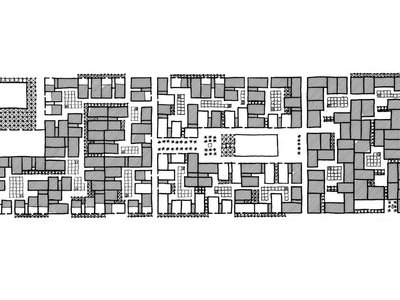
Revival Vernacular Architecture: Rammed Earth Settlements for the Sahara
A modular desert community in Mauritania that fuses passive cooling techniques with earthen construction and local craftsmanship.

Explore Office Building Competitions
Discover active competitions in this discipline




The International Standard for Design Portfolios


The Global Benchmark for Architecture Dissertation Awards


The Global Benchmark for Graduation Excellence


Challenge to reimagine the Iron Throne
Comments (0)
Please login or sign up to add comments
No comments yet. Be the first to comment!