

Glen Iris House by Pandolfini Architects: A Sculptural Residence Rooted in Form and Materiality
Sculptural residence in Melbourne featuring brick and concrete pavilions, passive design, and refined interiors seamlessly integrated with landscaped gardens.


Located in Melbourne’s Glen Iris suburb, the Glen Iris House by Pandolfini Architects is a bold reinterpretation of suburban living—one that balances expressive architecture with refined materiality and contextual sensitivity. Situated on the unceded lands of the Boonwurrung and Woiwurrung people of the Kulin Nations, the 600-square-meter residence redefines the modern Australian home through its volumetric composition and robust, timeless palette.

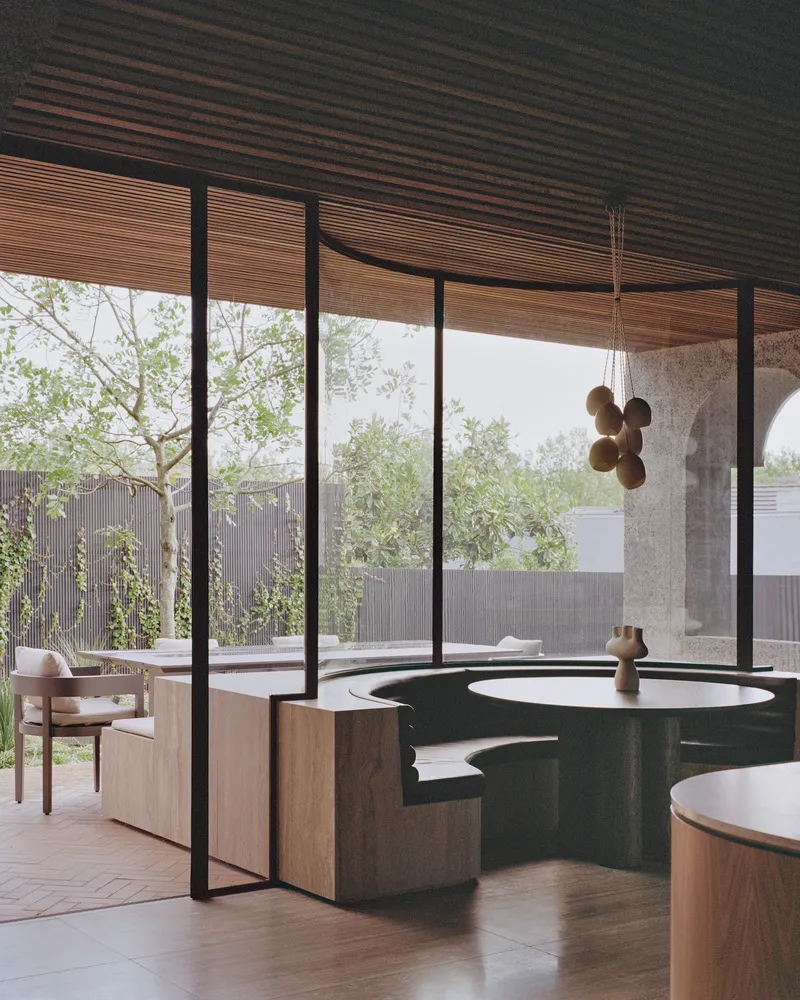
A Pavilion-Based Layout Across Terraced Topography
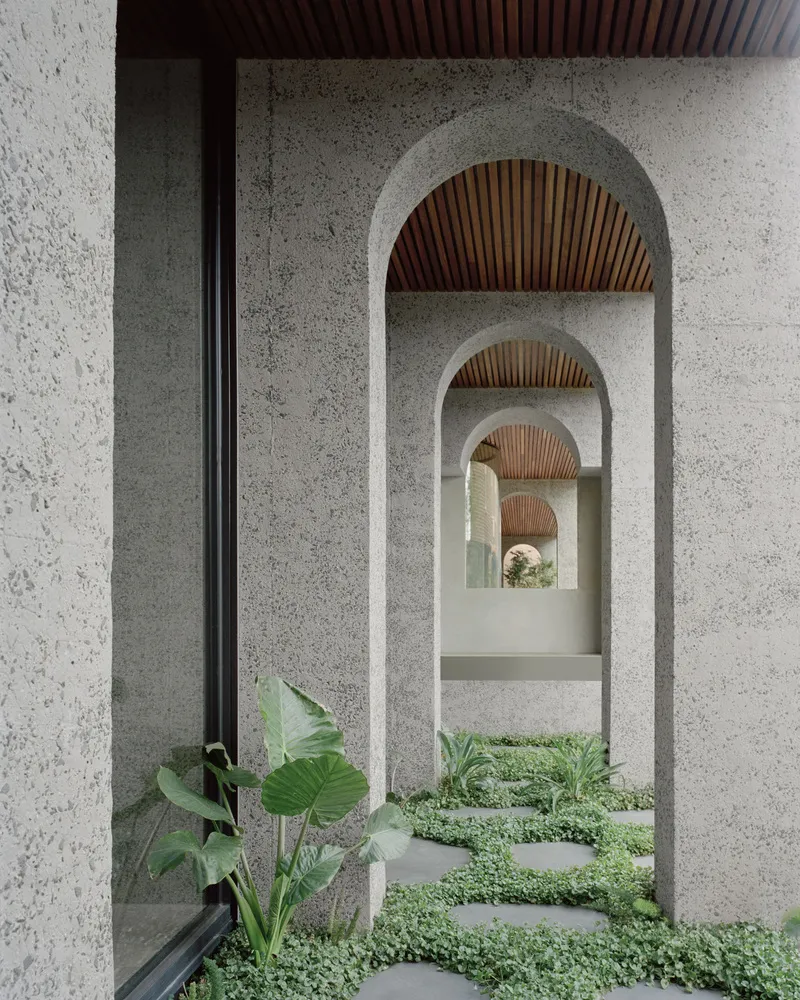
The house unfolds across a long, rectangular site, following the natural slope of the land through a series of three staggered pavilions. Each pavilion serves a distinct function: the central barn-like volume forms the open-plan living area, flanked by two brick-clad structures housing the private bedrooms in the front and a car workshop at the rear. These volumes are connected by glazed walkways, reinforcing the sense of separation and allowing the experience of transition between inside and outside to become a choreographed journey.

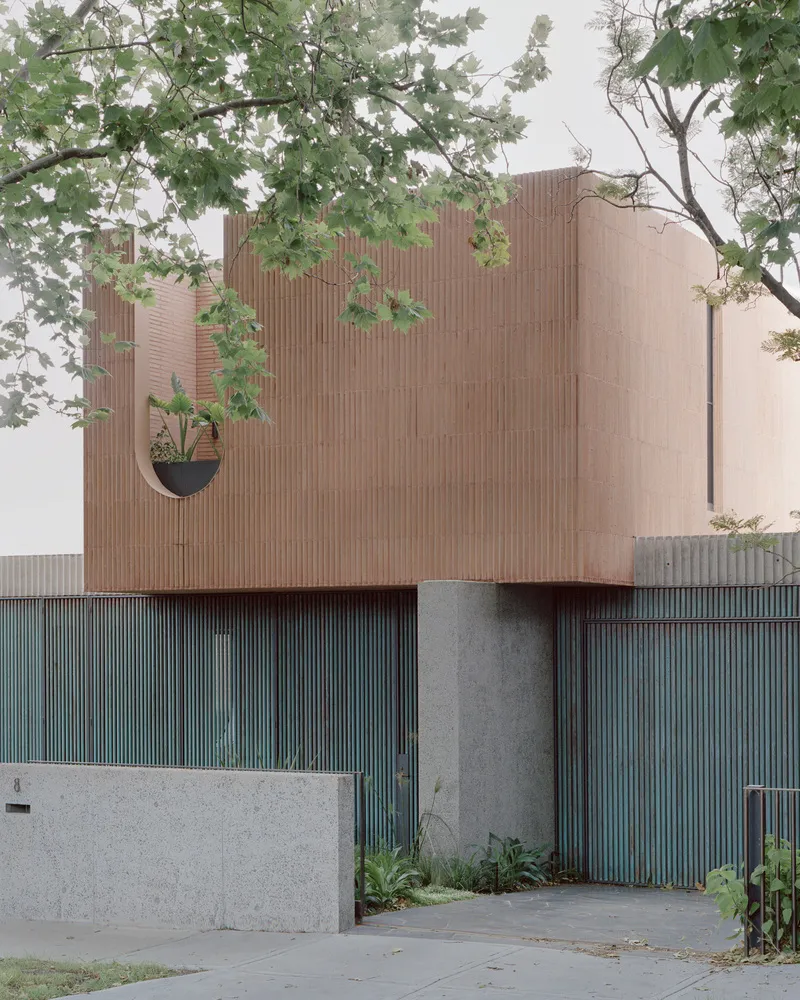
Interplay of Mass and Light on the Street Front
At the street interface, a patinaed copper screen stretches across the front façade, softening the boundary between private and public realms. Pushed back from the property line, this screen references local overgrown front fences while offering a welcoming gesture to the street. Above it, a cantilevered brick volume hovers, resting on a bush-hammered concrete blade, subtly marking the entrance. The terracotta brickwork, laid vertically and on a 45-degree angle, pays homage to the pitched tiled roofs common in the neighborhood while catching and playing with dappled sunlight filtered through mature trees.

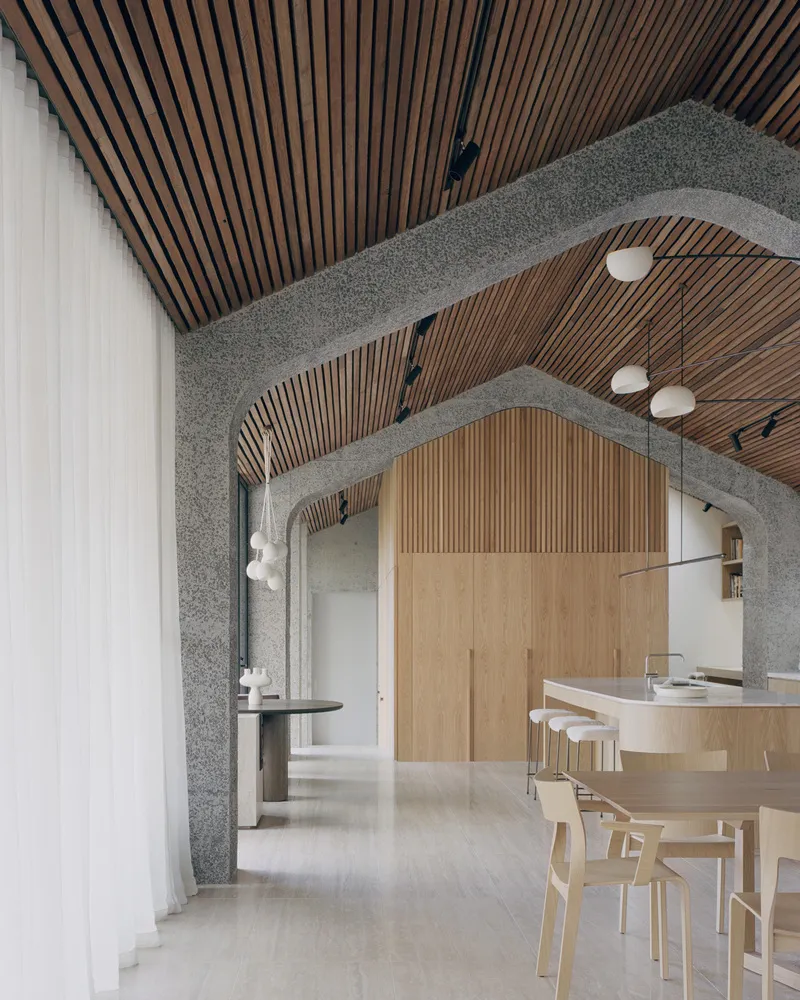
Monumentality and Warmth in the Living Pavilion
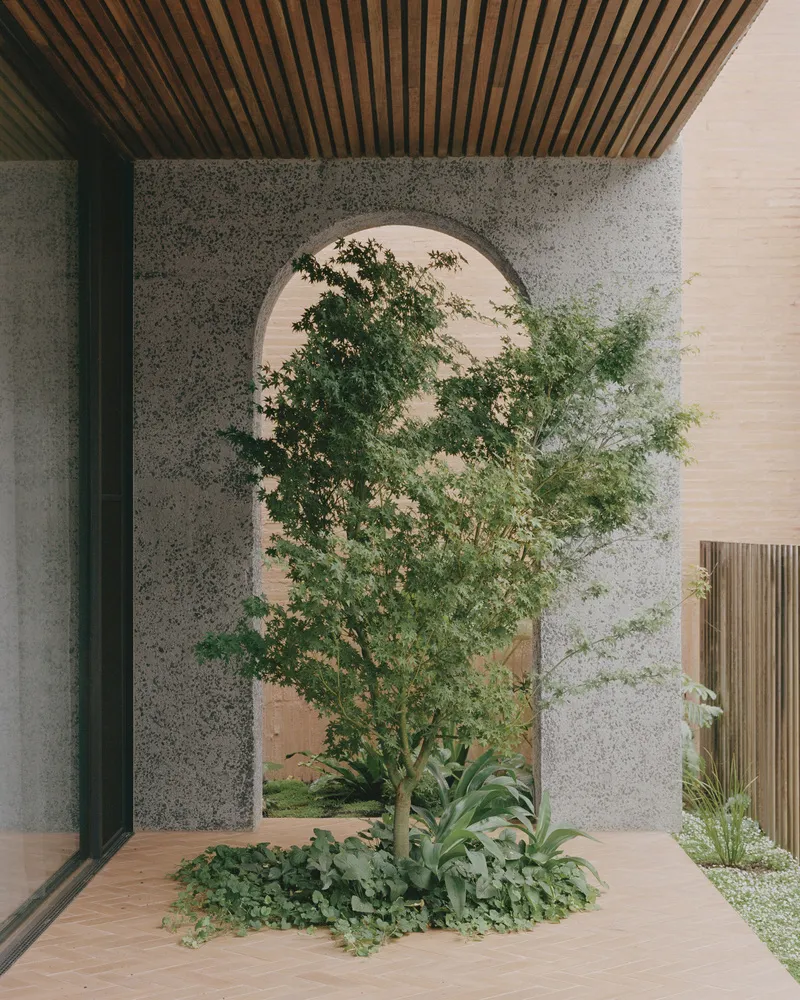
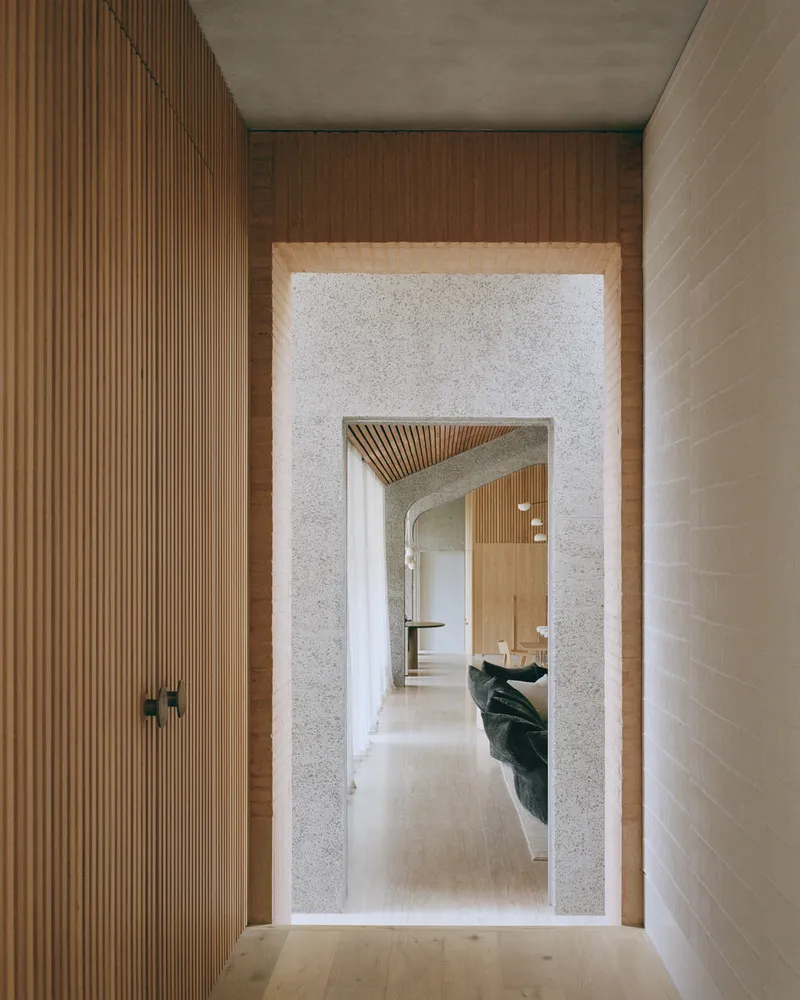
The main living pavilion stands in deliberate contrast to the monolithic bedroom wing. Here, an exposed concrete skeleton—composed of massive, bush-hammered ribs—shelters an interior of layered softness. Materials like travertine flooring, American oak cabinetry, and polished plaster walls create a dialogue of contrast and relief against the rugged shell. The architecture here is both structural and spatial, with walls that not only support but also frame and delineate zones within.


Environmental Sensitivity and Low-Maintenance Design
Sustainability is deeply embedded in the home’s architecture. The living areas are oriented to the north, with deeply set glazing that creates eaves for passive solar shading. Cross-ventilation is achieved through operable windows on opposing sides, ensuring natural airflow throughout the home. The architects employed durable, low-maintenance materials to allow the house to weather gracefully over time, further enhancing its sustainable lifespan.
The landscape design by Mud Office is intricately tied to the architectural composition. Integrated planter boxes, strategic voids, and visual connections between indoors and out allow the garden to permeate every zone of the house, forging a continual link with nature.
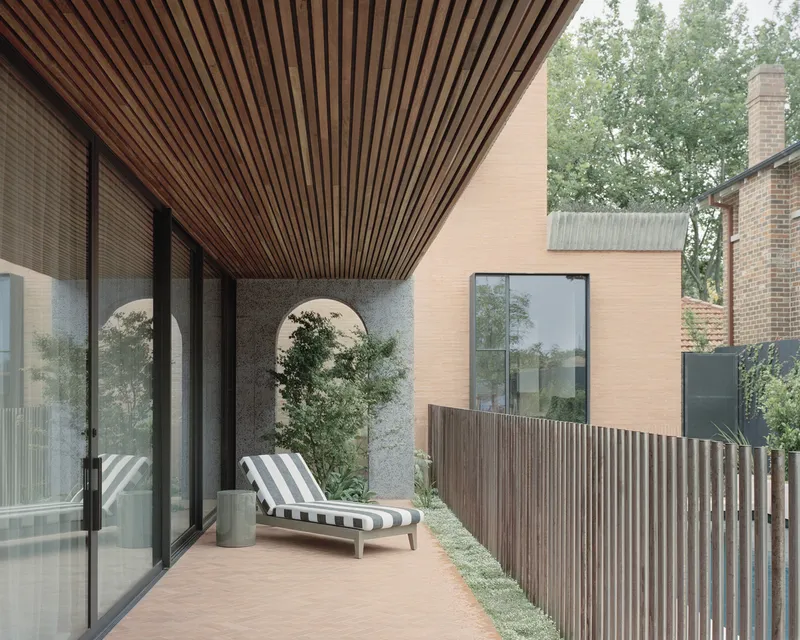
A Bold Urban Insertion with Sculptural Restraint
Despite its assertive material presence, the Glen Iris House exhibits a compositional simplicity that avoids ostentation. Its abstract façade, sculpted volumes, and nuanced material palette contribute to a home that is deeply personal yet contextually respectful. Inside, communal and private spaces are celebrated equally, unified through consistent attention to detail, form, and texture.
Glen Iris House is not just a residence—it is a spatial narrative that responds to site, climate, and culture, expressing itself through a dialogue of raw tactility and refined craftsmanship. Pandolfini Architects have delivered a project that feels both monumental and intimate, a house that lives as a sculptural form immersed in the suburban landscape.
All Photographs are works of Rory Gardiner


Popular Articles
Popular articles from the community


LT2A and OPEN Architectes Thread a Brick and Glass High School Through a Wooded Belgian Campus
In Braine-l'Alleud, a 3,000 m² wing for Collège Cardinal Mercier pairs pale brick with a glazed colonnade, deferring to a small chapel and a dense wood.

Architekt Andreas Gruber Scatters 23 Dark Timber Chalets Across a South Tyrolean Forest Edge
In Molini di Tures, Amonti Chalets breaks a resort into a hamlet of gabled timber houses, with parking, storage and services pushed into the slope.

Jaramillo Van Sluys Arquitectura and Urbanismo Turn a Demolished Registry Lot in Quito into an Orchard Plaza
In Quito's Centro Histórico, a 2,800 m² plaza exposes the San Agustín convent wall and redraws its lost Augustinian orchard in volcanic stone.

Cube Design Draws an Ecological Corridor Between Two Shenzhen Hills with the Nankai Building
Beside Shenzhen's container docks, the Nankai Building pairs stacked balconies with a climbing green screen to connect two hillsides across its height.

Similar Reads
You might also enjoy these articles


Hodi-Mandai Geram
Project Function: Preservation and revitalization of the Intangible heritage and socio-spatial identity of the Hodi by Housing, Cultural Memory Center, Sacred Grove, landscape, local tourism economy


Olio Towers: A Mid-Rise for Performers That Fuses Housing, Rehearsal, and Stage
Located blocks from Houston's Theater District, this modular tower stacks living units around a central performance atrium.

Oasis: Modular Green Housing Carved into Dhaka's Urban Fabric
A shortlisted Plugin Housing entry reclaims unauthorized settlements in Dhaka with stepped concrete volumes, green roofs, and ventilation-driven design.

Black Hole: A Floating Megastructure for the Post-Physical Era
Emiliano Mazzarotto envisions a spherical, self-scaling arena where e-sports, digital hotels, and holographic stadiums replace traditional public space.

Explore Architecture Competitions
Discover active competitions in this discipline

Challenge to reimagine the Iron Throne

Photograph architecture without architects

Illustrate the lost glory of Angkor Wat - Render Challenge

Design challenge to reuse E-waste
Comments (0)
Please login or sign up to add comments
No comments yet. Be the first to comment!