

gmp Architects Plants a Metal-Clad Science Museum on the Edge of Jiaozhou Bay
A 40,000 square meter cultural cube on Hong Island channels Qingdao's marine identity through architecture oriented entirely toward the sea.


Qingdao has been migrating around Jiaozhou Bay since the 1980s, stretching from its compact colonial-era old town on the southeastern shore toward newly engineered waterfront districts to the north and west. The Qingdao Science & Technology Museum, designed by gmp Architects (von Gerkan, Marg and Partners) and completed in 2026, is planted at the northeastern edge of the bay on Hong Island, not as a capstone to an already thriving cultural district but as a deliberate catalyst for one that does not yet exist. It is the first phase of a larger masterplan that will eventually include a marine aquarium and a planetarium, meaning the building has to function simultaneously as a self-contained destination and as a piece of urban infrastructure that gives shape to a stretch of coast still finding its identity.
What makes the project worth examining is less its program, which is familiar enough for a civic science museum, and more the precision of its relationship with water. Designed by Meinhard von Gerkan and Stephan Schütz with Nicolas Pomränke, the building sits on a podium at the water's edge and organizes every circulation route and visual axis toward the sea. The compact cube form is split by a public pathway that cuts through the ground floor, opening onto an observation terrace overlooking the bay. In a city built around marine research institutions, the architecture does not merely house exhibitions about water; it stages the encounter with it.
A Cube Split Open at the Waterfront
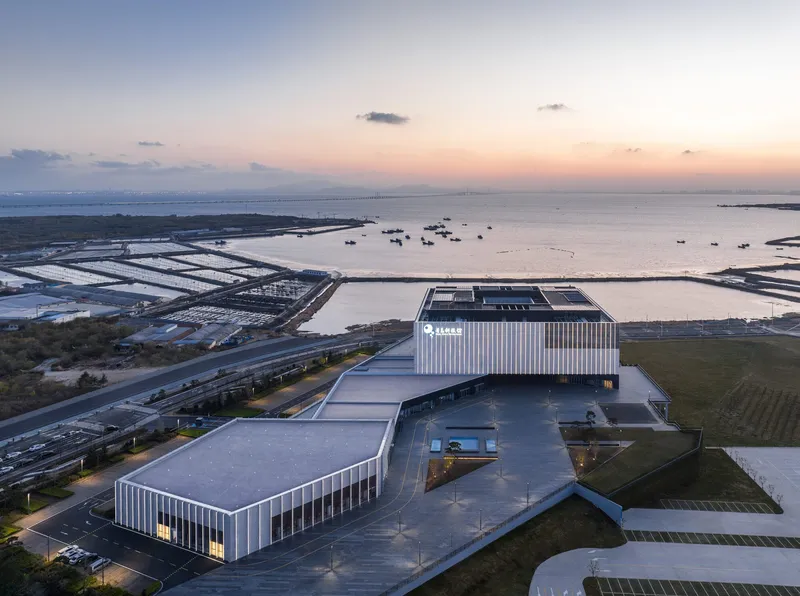
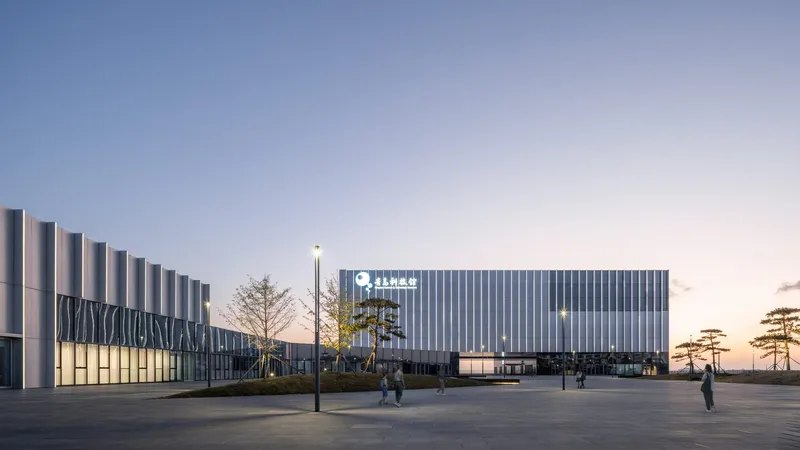
From the air, the museum reads as a pair of compact volumes flanking a generous central plaza, the whole composition set against coastal wetlands and a horizon line of open water. The building's footprint is angular rather than orthogonal, a diagonal disposition that lets the facades respond to multiple orientations at once: the approach from the city, the edge of the bay, and the future buildings that will eventually fill in the masterplan to either side.
At ground level, the plaza between the two volumes becomes the real public room of the project. Young trees punctuate a hardscape that draws pedestrians through the building rather than simply to it. The museum does not present a single monumental entrance; instead, two distinct entry points divide the program. One leads to exhibition halls, a café, and retail areas. The second channels visitors toward conference and event facilities. The split is functional, but it also keeps the ground plane porous, avoiding the hermetic quality that large institutional buildings so often fall into.
Vertical Fins and a Breathing Skin

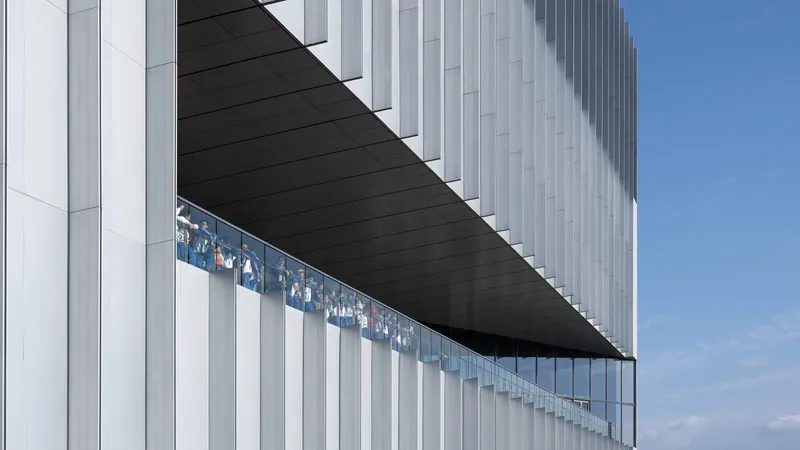
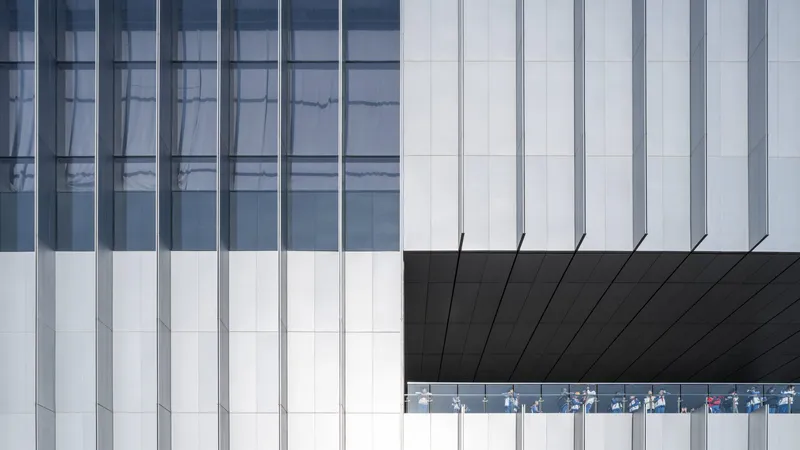
The facade is the element that will age well or age badly, and gmp has bet heavily on it. White metal cladding plates are layered over an auxiliary structure, creating a secondary skin that is not purely decorative. Mechanical valves, controlled by temperature gradient monitoring, open and close passages in the cladding to allow natural ventilation, turning the entire envelope into a responsive climate device. In a coastal city where humidity and salt air are constant adversaries, this is a pragmatic move dressed in elegant geometry.
Vertical fins give the facade its visual cadence, breaking up the metal surface with a rhythm that shifts as light conditions change throughout the day. Where the fins meet the black soffit of cantilevered volumes, a horizontal glazed band reveals the interior life of the galleries. The effect is of a building that is simultaneously opaque and transparent, solid when seen head-on but perforated and luminous at oblique angles. Integrated LED elements take over at night, illuminating the ribbed surfaces and turning the museum into a lantern visible across the bay.
The Space Between: Plaza and Passage
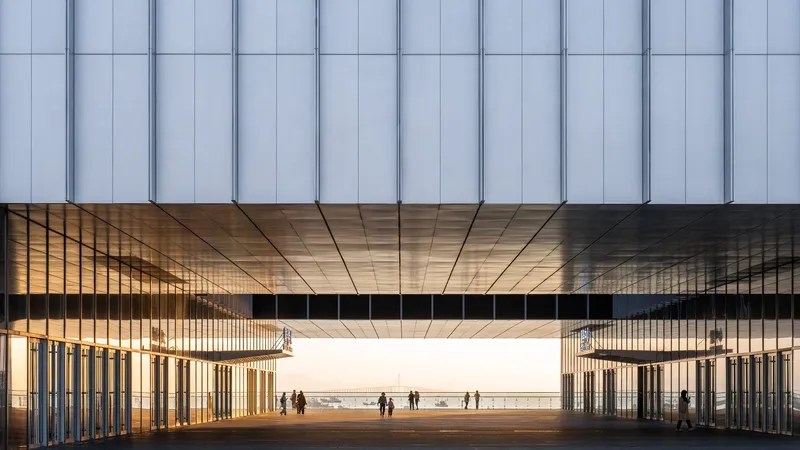
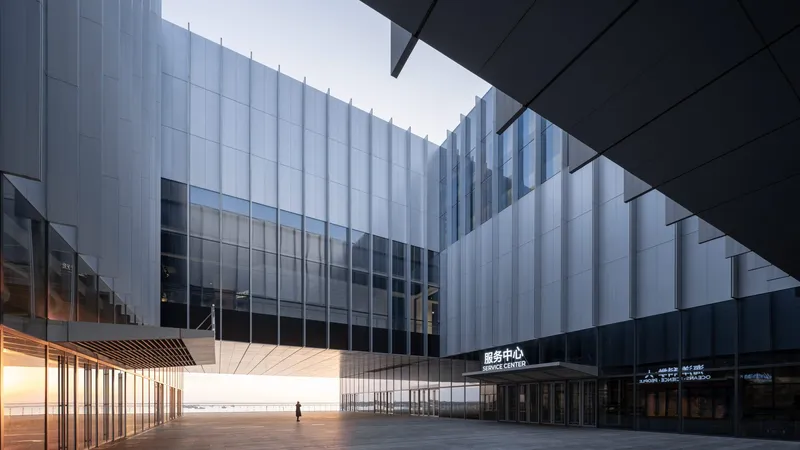
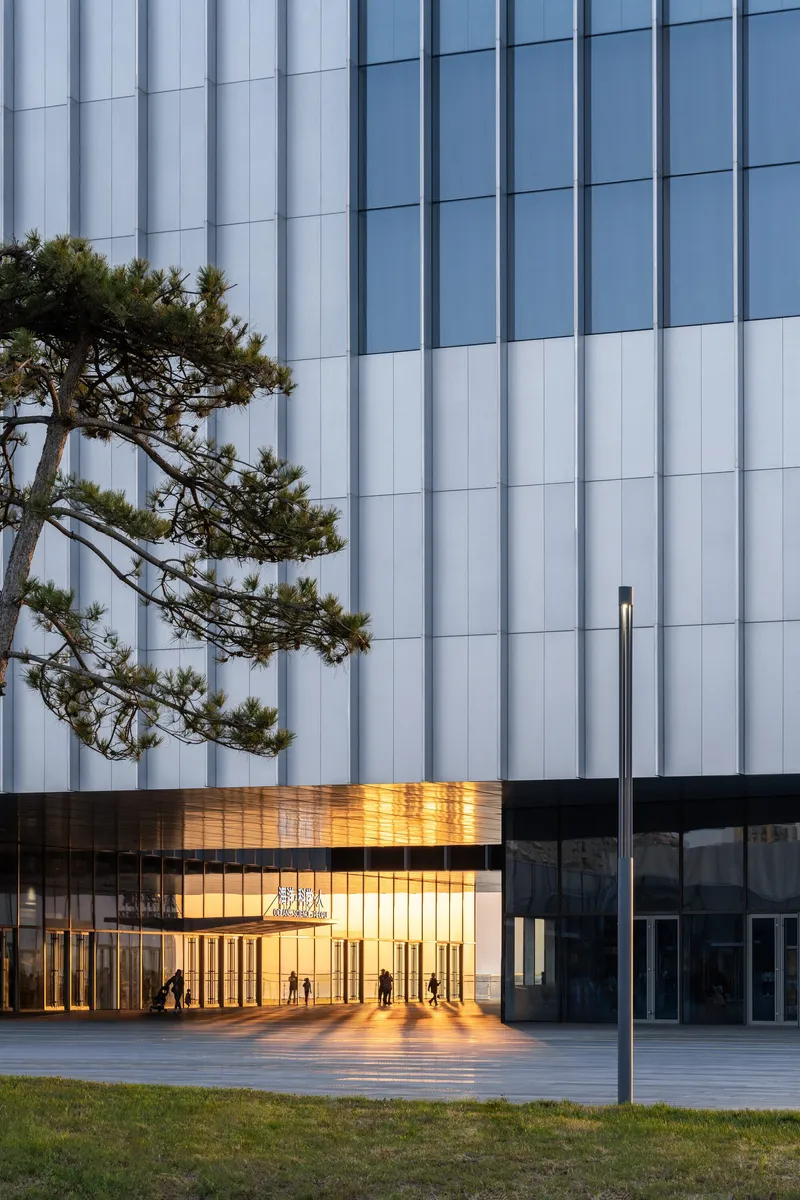
The covered plaza between the two main volumes is where the project's spatial ambition concentrates. Translucent ribbed facades rise on either side, while a timber-clad soffit runs overhead, warm against the cool metal of the exterior. At twilight, the space glows from within, the contrast between the bronze fins of the entrance pavilion and the white tower facade producing a layered depth that rewards slow looking.
Passing through the ground floor is designed as a civic act rather than an architectural afterthought. The public pathway is not a corridor; it is wide enough, open enough, and visually connected enough to the water beyond that it functions as a sheltered extension of the waterfront promenade. You do not need a museum ticket to walk through. That permeability is the strongest statement the building makes about its role in Qingdao's urban expansion: it belongs to the city before it belongs to any institution.
Interior Worlds: Atrium and Gallery
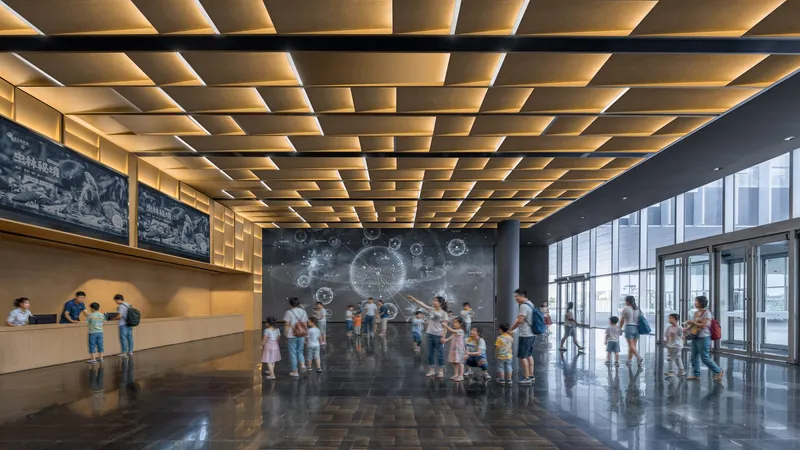
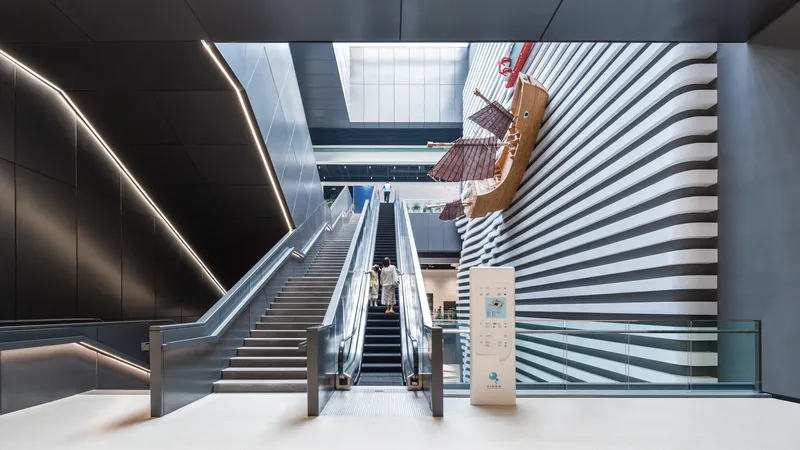
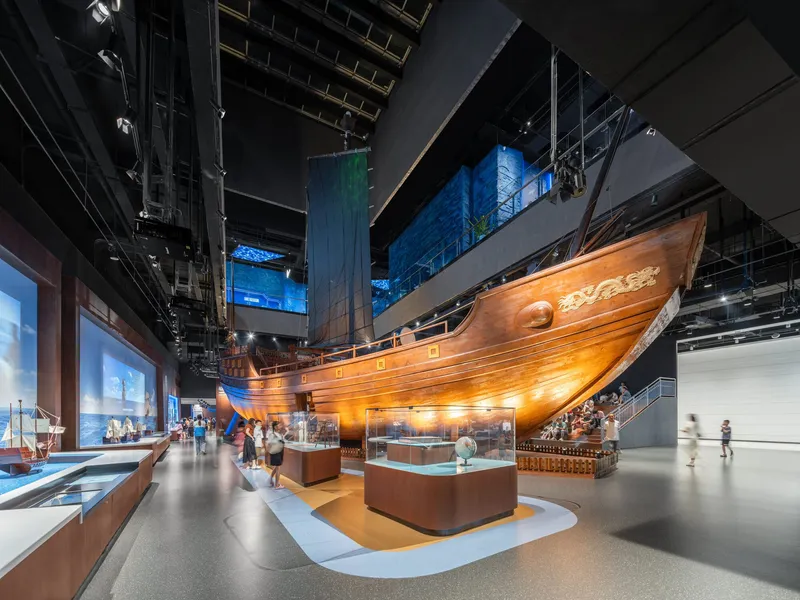
Inside, the entry lobby sets an immediate tone with a coffered timber ceiling that domesticates a space that could easily have felt cavernous. A projection wall at the far end draws visitors forward, and the material palette, warm timber overhead, dark paneling at the walls, polished floors below, avoids the generic white-box syndrome that plagues so many science museums. The atrium that follows is vertically ambitious: escalators and an open staircase ascend past a wall of horizontal striping that catches light from skylights above, creating a visual rhythm that echoes the facade's vertical fins in a different register.
The gallery spaces themselves are generous enough to accommodate large-scale installations. A suspended wooden ship hull, displayed above vitrines and interactive stations, makes the marine theme tangible rather than abstract. gmp has given the exhibition designers room to work without surrendering architectural control. The proportions of these rooms, the quality of light, and the carefully calibrated sightlines toward the sea all reinforce the building's overarching thesis: that a science museum on this coast should never let you forget where you are.
Plans and Drawings
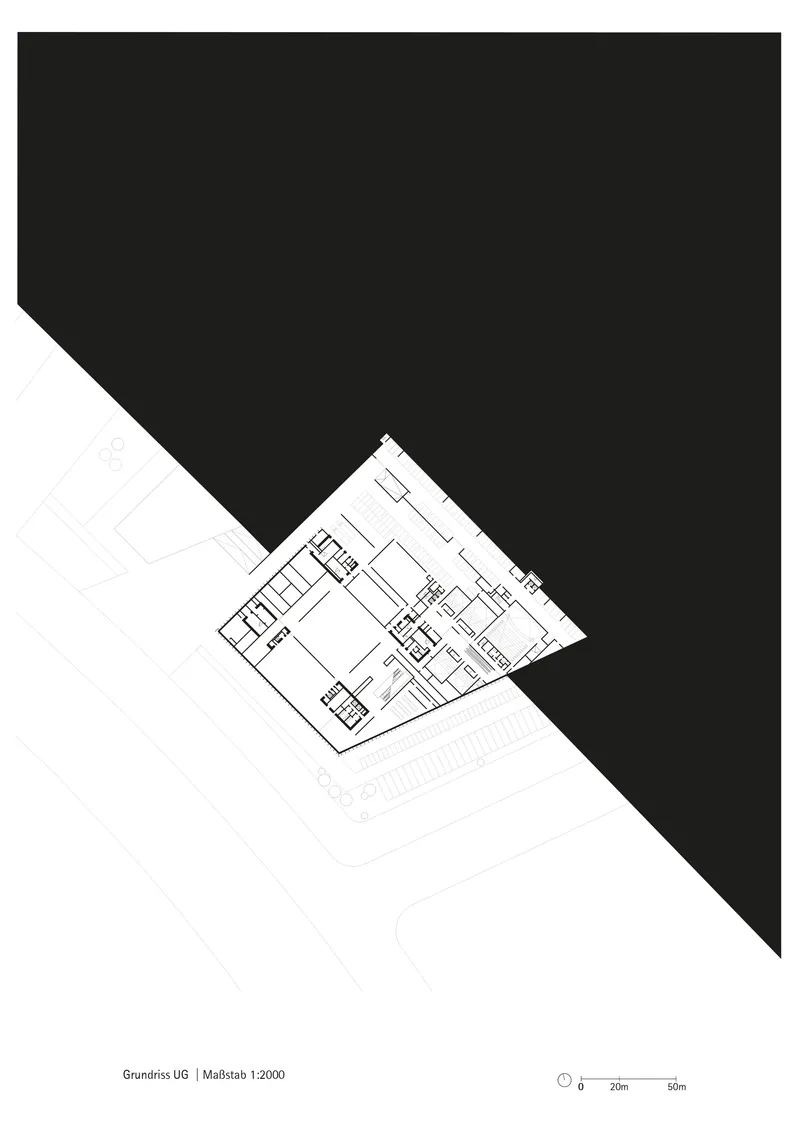
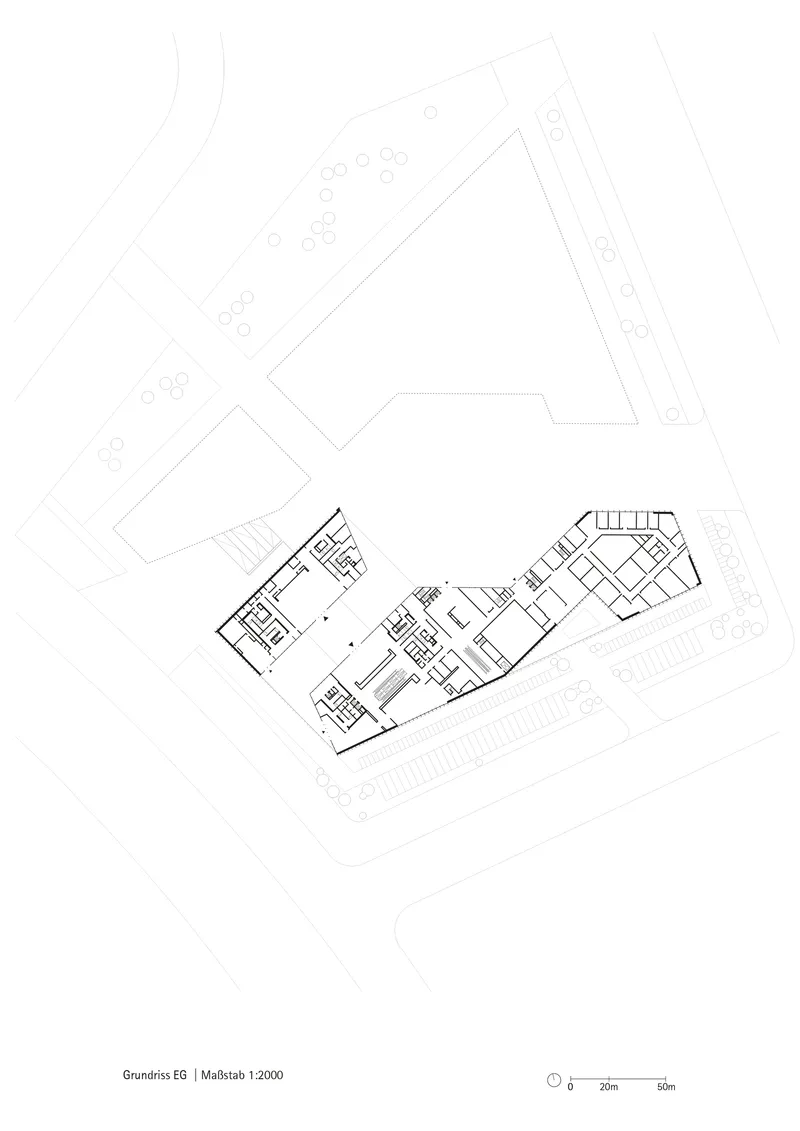
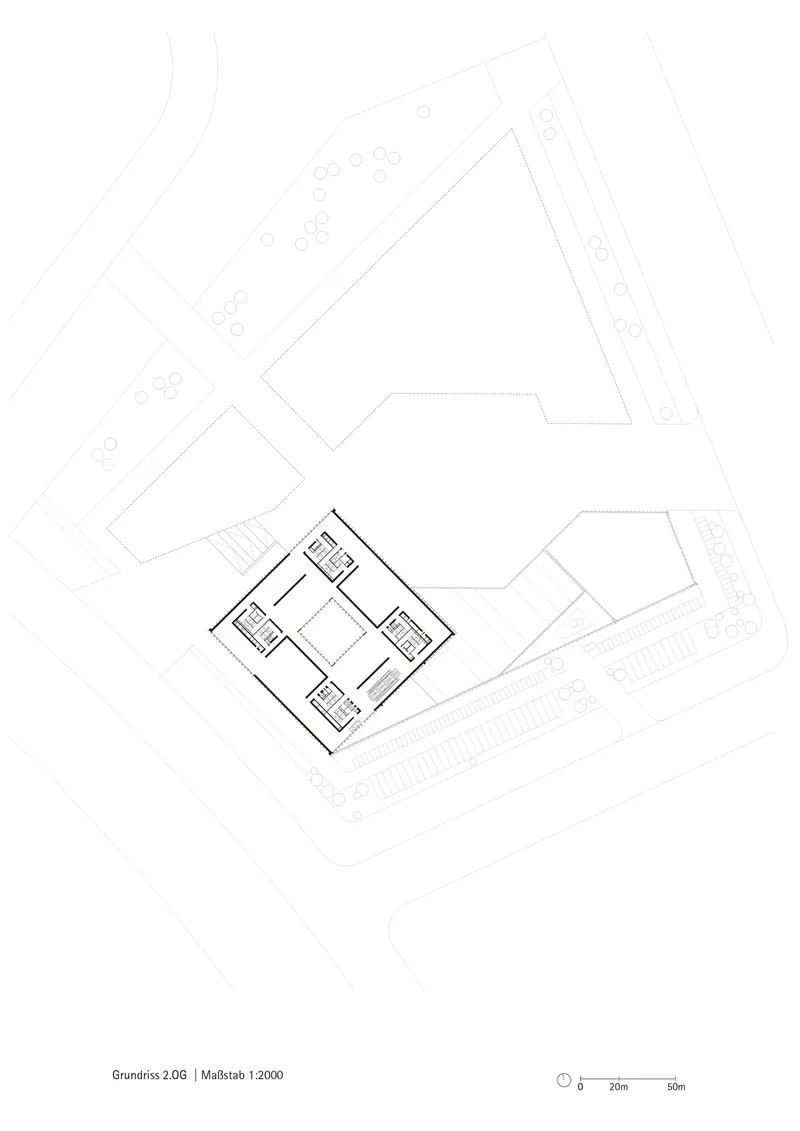
The floor plans reveal the diagonal geometry that is less apparent from photographs. The building's angular footprint creates a series of shifted axes that avoid long, monotonous corridors and instead produce moments of compression and release as visitors move between functional zones. Room divisions follow the diagonal composition, which means that few interior walls run parallel to the facades, giving each gallery and conference space a subtly distinct proportion.
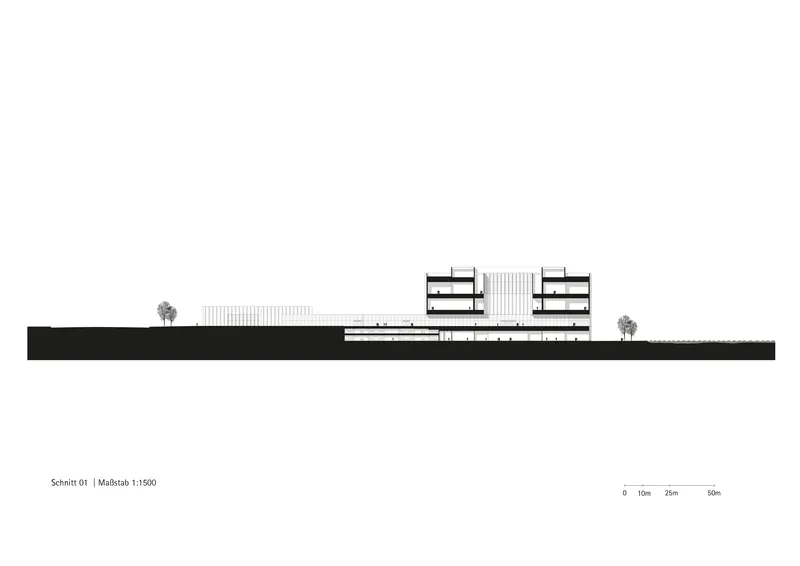
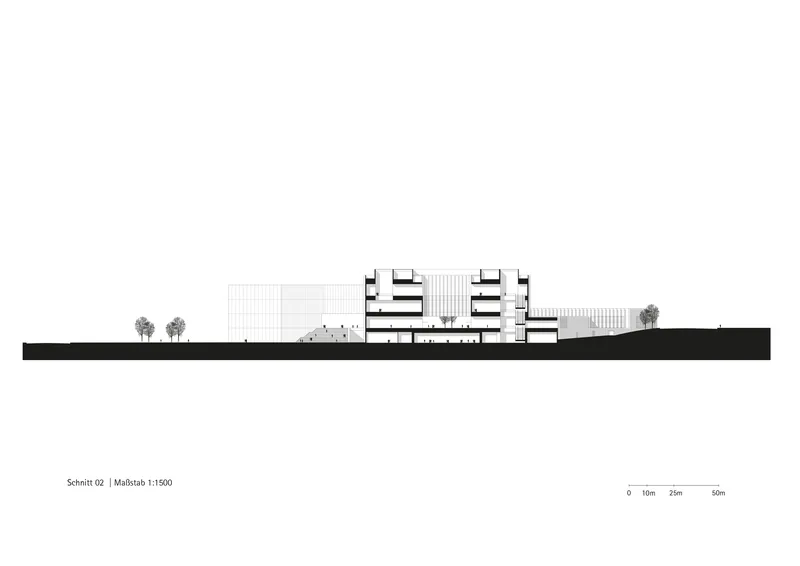
The sections are the most revealing drawings. Two elevated building volumes are connected by a transparent central element, confirming that the covered plaza is not simply a gap between buildings but a structurally articulated space in its own right. The terraced massing visible in the longitudinal section shows how the building steps down toward the water, maintaining a consistent orientation toward the bay while keeping the roofline varied enough to avoid the bluntness that a simple cube would impose.
Why This Project Matters
Waterfront museums are a well-worn genre, and many of them succeed as icons while failing as buildings. gmp's Qingdao Science & Technology Museum is interesting precisely because it reverses that formula. The exterior is restrained, even austere, relying on a single material system and a limited formal vocabulary. The real design energy goes into the relationships the building establishes: between its two volumes, between interior and bay, between the institution and the pedestrian who simply wants to walk to the water. That restraint is a bet that the masterplan will eventually provide the urban context the building currently lacks, and that when it does, the museum will read as the anchor rather than the anomaly.
As the first phase of a larger cultural complex that will include an aquarium and a planetarium, the building also has to hold space for buildings that do not yet exist. The diagonal footprint and the porous ground floor suggest that gmp has thought carefully about adjacencies and future connections, even if those remain speculative for now. In a Chinese city that has expanded by accretion for four decades, this kind of patient, infrastructure-first thinking is rare and valuable. The museum does not shout. It positions itself and waits for the city to arrive.
Qingdao Science & Technology Museum, designed by gmp Architects (Meinhard von Gerkan, Stephan Schütz with Nicolas Pomränke), with partner firms Shanghai United Design Group Co., Ltd. and Qingdao Tengyuan Design Institute Co., Ltd. Located on Hong Island, Qingdao, China. 40,000 m². Completed 2026. Photography by CreatAR Images.
About the Studio
Share Your Own Work on uni.xyz
If projects like this are the kind of work you want to make, uni.xyz is a place to publish your own, find collaborators, and enter design competitions.


Popular Articles
Popular articles from the community

Extended Shell: Retrofitting Kolkata's Balconies as Living Urban Thresholds
A modular retrofit system recovers the social and environmental intelligence of Kolkata's historic verandas for contemporary Park Street residents.

Manzana Morphosis: Stretching Barcelona's Grid into a Living Landscape for 2050
A radical reworking of the Eixample manzana turns density into a tool for generous public space, vertical ecology, and environmental performance.

The Amber Palace Opera: A Geological Fiction Surfaces on Tallinn's Baltic Waterfront
Pierre Brillard reimagines a Baltic legend as a public landscape, opera house, and waterfront promenade rooted in Tallinn's coastal identity.
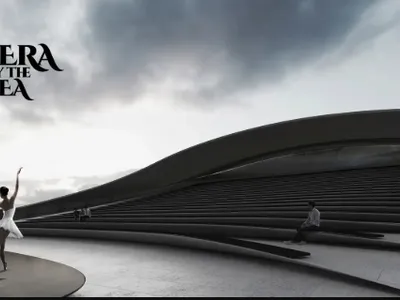
Opera by the Sea Estonia: Three Shells Dissolving Architecture into Tallinn's Coastline
A winning opera house proposal replaces monumental form with interconnected shells that blur the boundary between building, park and Baltic Sea.

Similar Reads
You might also enjoy these articles

Bao Huynh Watercolor Atelier: A Serene Art Retreat in Hội An
Bao Huynh Watercolor Atelier in Hội An blends multifunctional art spaces, sustainable design, local materials, and family-friendly living in a serene environment.

Atelier Macri Concept Store Interior Design by CASE-REAL
Atelier Macri store features a "ko" counter, walnut wood details, cork displays, blending retail, gallery, and seamless customer experiences.

Manuel Vargas Izquierdo Stadium and High-Performance Sports Center: Architectural Excellence in Jalpa de Méndez
The Manuel Vargas Izquierdo Stadium blends sustainable design, inclusive sports facilities, and cultural-inspired architecture, revitalizing Jalpa de Méndez’s public spaces.

KAKR Buluh Awar Hall: Revitalizing Community and Ecology Through Bamboo Architecture
Community built bamboo hall revitalizes Buluh Awar village, empowering youth, restoring ecology, celebrating vernacular craftsmanship through sustainable architecture and culture.


Comments (0)
Please login or sign up to add comments
No comments yet. Be the first to comment!