

Grace Dance center
when architecture becomes part of scenography
The proposal is based on a detailed analysis of the cultural context - the atmosphere of the original Latin American streets, where
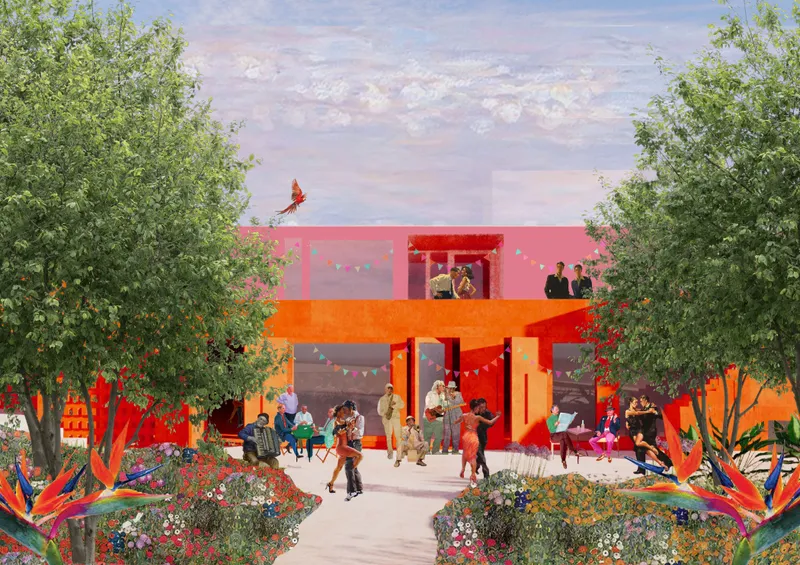
life takes place mainly outdoors. It is interesting to connect the real life of the dance halls on the ground floor with
dance school upstairs. The distribution of building volumes and distinctive colors follow on from traditional local ones
conditions but in modern terms.
Grace dance center Buenos Aires, in the historic district of San Thelmo, which is modeled after European cities based on a regular structure
urban grid. The land is situated on the corner of one of the blocks, in close proximity to the city park Lezama, relatively
busy traffic.
The intention is to design an object inspired by dance itself, which should meet various functional uses and be
open and accessible to all, so that it unites individual social classes of the population without distinction thanks to dance.
The building plot has a variable topography, in its longitudinal profile it has an elevation of eight meters. This situation was
an incentive to work with the topography of the terrain and the division of the object into five individual units that gradually rise
and thus copy the adjacent street.
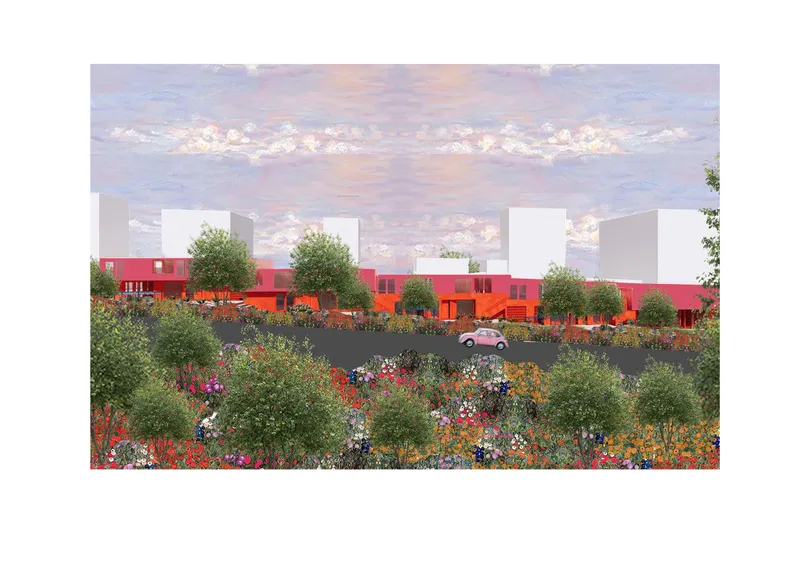
The overall rendering of the building, which due to its relatively large building volume
it gives the impression of two-story terraced houses, it does not create a strong gesture with its mass, but on the contrary it humbly adapts
your surroundings.
The main chosen building material is solid burnt brick, as a traditional local building material.
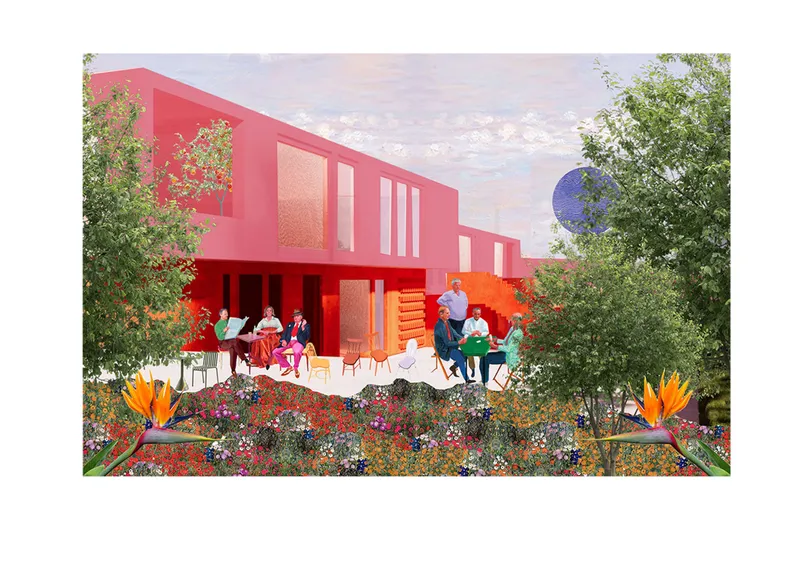
The building in front of it creates a wide vestibule of squares, which, thanks to the slope of the terrain and the shape of the building, have a function on the ground floor
each time a different character. The building has an appropriately chosen color that is inspired by regional architecture.
It thus creates a basis for the cultural diversity of visitors.
The goal is to create a space that will represent and reflect local forms of art, or Dance. In our case, we are talking about Buenos Aires - the "cradle of dance". Temperamental, colorful and unmistakable, this is precisely the culture of South America for me. Dance as an integral part of cultural heritage has been a very strong motive and part of the identity of civilizations for millennia. The movements that have evolved over time into the form we know today inspired me in the design itself. How has the union of two bodies, which turn into one during the dance, changed, developed and perhaps improved over the decades?
The addressed territory is located in the city of Buenos Aires, Argentina. This city is the cradle of the most famous dance - Tango.
"Tango is a direct expression of something that poets have often tried to put into words: the belief that struggle can be a celebration." Jorge Luis Borges
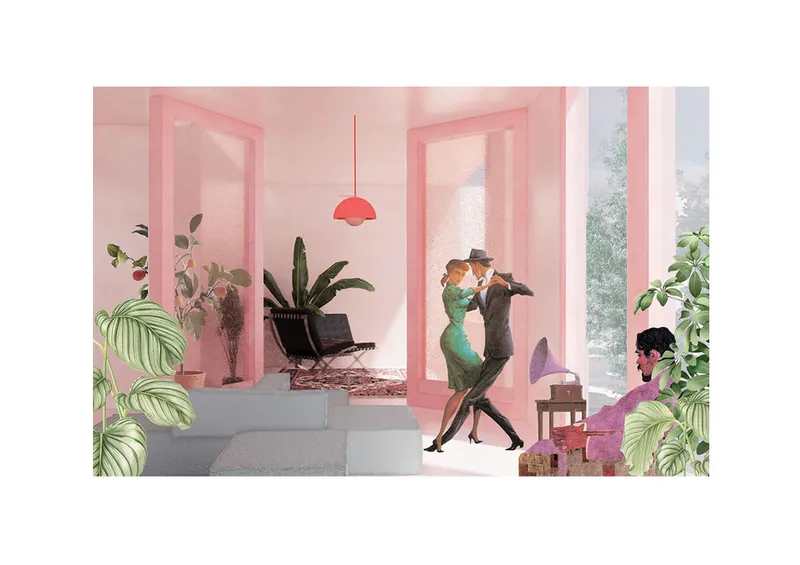
A strong motive is fast rhythmic movements that always perfectly match the music. The closeness of two bodies, passion and elegance. Tango itself is a fusion of European music, South American milonga and African rhythms. The main motive is to tell a love story. Tango is a lifestyle, it develops every day, it has no form, it has emotions and the result is an unmistakable experience.
Tango was born in the big cities of the Rio de la Plata region in the 1980s. The dance itself was originally considered a dance of the scum, the proletariat and too sinful for social halls. Initially, the tango was a dance of two men, who thus shortened the waiting time in brothels. In the 19th century, we are talking about a period when a huge influx of immigrants came to Argentina from the European continent. Only over the years did men invite women to dance. The perception of tango changed after this dance became popular on the European continent, it was Paris that gave it gloss and elegance, and that's how tango as we know it today was created. Tango is a combination of passion and story.
Every day in Buenos Aires tango is born anew in its new variations, in its variety it forms today the basis of the local identity of this otherwise incredible city. Just as Europe received tango from Argentina, it gifted Argentina by giving tango back and allowing it to evolve into new and new incredible forms.
The goal of the assignment is therefore precisely in the San Telmo area, which with its bohemian atmosphere attracts both visitors and local dancers without distinction. Respectfully but still with a street character and an emphasis on the fact that tango is not just a dance. Tango is a lifestyle. Today, tango is danced in countless places, in bars, restaurants on the streets, and that is why my proposal should unite people and not divide them. Proudly representing the culture and lifestyle of the local residents.
Dance is one of the oldest forms of human expression. We know that already in prehistoric times dance was considered a natural part of life, people used dance to release energy and emotions during ceremonies, various rituals, hunting, battles and burials. Dance is a part of the whole life, we could compare it to some stages of human life. Its rhythm, intensity, emotion and sometimes the main characters change with time and circumstances. In the period of ancient Greece, new forms of dance were created, and during the Middle Ages, when there was a split between science and religion, it was declared sinful under the influence of Christianity. Over the centuries, the dance continued to develop and change, it acquired an ornamental form, became romanticized and changed under the influence of fantasy. Thanks to population migration, the penetration and influence of cultural differences, various forms of dance have spread throughout the world and are still being refined. It is a fluid process that takes time.
The dance center is located in the cradle of tango - in the city of Buenos Aires, in the San Telmo area. The district of San Telmo is known precisely because it is one of the locations where tango was born. It consists of commercial establishments, art galleries and art not only indoors but also outdoors in the form of street murals. Nowadays, the San Telmo part is a good example of its transformation into a modern art scene and is still a sought-after refuge for all those who want to experience an inimitable / authentic atmosphere. The Parque Lezama park is located in direct contact with our area. A green oasis in the middle of a concrete jungle. Tourist attraction Plaza Dorrego with street performers attracts tourists every weekend. Upscale dining venues include live dance performances to promote culture, making the area suitable for this typology.
Thanks to the colonizing influences from Europe, especially Spain, we can observe that the city is strikingly similar to the metropolises of Madrid, Barcelona and Paris. The grid system, which was first created by the Spanish colonial authorities at the end of the 16th century, gives the city a more European character. Argentina is also referred to as "Europe on the American continent". European influences are reflected in the initially chaotic image of the city. Eclectic architecture is the result of migration and reflects the cultural and historical context. Here we can find examples of neoclassical, art nouveau, colonial or even baroque architecture. The urban image of the city is complemented by a network of public spaces, be it squares or parks.
The grid is centered around the two main streets, Avenida 9 de Julio and Avenida Rivadavia. Avenida 9 de Julio is also the widest street in the world, measuring approximately 140m.
The land is close to the main traffic arteries that connect the city. Near our territory is the Parque Lezama, which is attractive to the locals and is also one of the venues for street art events.
Currently, Buenos Aires is undergoing a process of modern urban planning and restoration of historic districts. The San Telmo part is just one of them.
Could it be said that we live in a daily choreography where our daily life is in constant movement with the surrounding world?
At first glance, architecture and dance are two different artistic directions, one dynamic and moving, the other rather fixed, static, but is it really so? For a closer analysis, I decided to find an intersection between these two disciplines, which became a solid basis for the concept of my entire proposal. Dance has like 7 elements. The relationship between architecture and dance can be explored in different ways. Both architecture and dance involve the creation of spaces and movement within those spaces and can be used to express ideas, emotions and cultural values. In order for dancers to be able to perform their art, they need space, and what's the use of space if it's empty? That is why creating space is very important for them, architecture becomes a scene and thanks to a correct and well-thought-out design, whether from an aesthetic or operational point of view, we can manage to create different feelings, moods and better communicate specific ideas. Quality space can bring quality content.
Another way in which architecture and dance are related is through the use of form. In architecture, the form of a building can convey meaning and express cultural values, while in dance the movements and positions of dancers can also communicate specific thoughts and emotions. Another sign is time, time passes, dance is an emotion in time, time affects the intensity of light and darkness, the nature of the materials used, which will add a patina over time, but also the architecture, which should be here even after us. Modern approaches increasingly emphasize the importance of an ecological and rational approach to design. Strength. In my case, I see strength precisely in material execution, massively repeating objects act as a kind of sculpture, with a strong reference to local culture. Body. Outer shell. Thanks to the form I chose, I managed to create pleasant, spacious spaces that have a diverse character. The austere form is complemented by various exterior terraces, staircases, details in the form of brick walls. Completed with greenery and textile elements serving as shading elements if necessary. The rhythm, as in dance, is easy to read when jumping as a reaction to the existing terrain
Overall, the relationship between architecture and dance is complex and multifaceted, but both can be used to create powerful and meaningful experiences that engage the senses and imagination.
The result is an object made up of 10 imaginary materials, which combines a dance school and life in the streets. The solution combines the elemental, sensual and spirited that we can see in the streets of Buenos Aires every day together with the beautiful and sublime. The goal of the proposal is to react and connect the already existing park and my dance school, so that one has the feeling that one is on a small beach and that the imaginary border between greenery and public space is blurred.
The building consists of 10 or 9 segments. The architecture reacts to the morphological conditions and thus it is embedded in the terrain, which overcomes up to 8 meters on the total length of 138 meters. The solution to cope with this difference in height for me was the leaping insertion of masses into the terrain, thanks to which we obtained 5 different public spaces, which have a diverse character related to the functional content inside. A park, small reptiles complete the character of a lively street. The building has 3 floors, where we are talking about 2 above-ground and one underground floor.
1.pp – contains underground parking, with a total of XX parking spaces. The building has underground parking under 3 masses. In the basement, there are also facilities for the auditorium and wellness, which runs through 2 floors. Next, the background of TZB. The visitor can get to the underground garage via a ramp with the exterior and to the building via vertical communication cores.
1.np - floor - "Live Street" the character of the first above-ground floor is the creation of the true Argentinian atmosphere on the 1.np there are cafes, bars that transform into dance floors during the day, open into squares and thus give visitors the opportunity to enjoy the right atmosphere here. small squares are connected to each other by residential staircases and are accessible from the street through perforations in the green park belt.
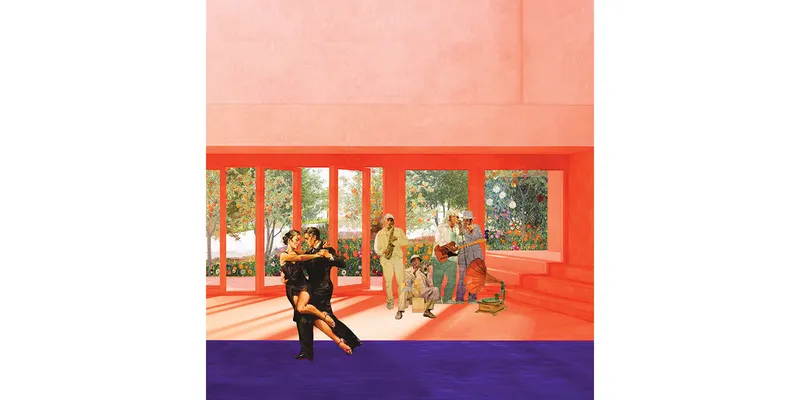
The main entrance is located in the central part of the entire building. It conceptually divides the entire object into two parts, on the left there are gastro establishments, fitness and wellness, which can function independently from the rest of the object. In the central part, we have the main entrance to the dance center with a lobby, a specialized costume shop, a cafe, which is connected to a multifunctional space that can function as a lecture room as well as a dance club. In the middle part there is a vertical communication that connects the entire object in a vertical plane. On the right side of the building, there are other bars and cafes, which open onto the square, as well as a secondary entrance for performers, which is located on the north side of the building. The front facade as well as the entire public space is oriented to the south. In the last extreme mass, there is a multifunctional space of the auditorium, which passes through the height of 2 floors. A lobby and a rest area are attached to the auditorium.
2.np we enter on the second above-ground floor. In the central part there are changing rooms divided for men and women, together with hygiene, showers with an emphasis on barrier-free accessibility, I decided on the floor in mass /3. and 4. level the floors to the same height so that they are also accessible to physically challenged dance enthusiasts. In the central part there are 3 dance halls and an exterior respirium, in the neighboring building there are other dance halls, storage areas, dressing rooms and hygiene facilities, as well as the band's rehearsal room, which is separated from the rest by a fixed partition for sound insulation. To the left of the central part of the school, there is a small dance studio that can be used as a performance hall, but also for various events, workshops, etc. In connection with the dance school, here we find the administrative block, where the director of the dance center, the financial department and administrative staff reside.
If necessary, it is possible to use the services of a masseur and physiotherapist, who are located on this floor. Loft apartment living is located in the last mass. In total, we can find 3 housing units here, which are used for short-term accommodation, but have facilities and character that meet the standards of long-term residence as well. The apartments are designed as airy open spaces separated into their functional zones, divided mainly by built-in niches that have replaced partitions, creating a semi-private character. The apartments have terraces available, as well as a common community terrace with plants intended for spending time together.
Thanks to the receding play of masses, I managed to achieve the character of the various spaces. The entire object has an authentic character, thanks to which we have obtained interesting atmospheres. The staircases that connect the masses at different height levels add another dimension to the whole design. Inspired by Robert Boffil and his apartment complex La muralla Roja, it arouses my curiosity and the feeling that I want to know what is behind it...
The supporting structural system of the entire building is designed as a combination of columns and walls. In 1 pp. There are columns at an axial distance of 7,500 mm x 7,500 mm. However, since the object is segmented into several parts, the module changes depending on the layout and design solution. Underground parking for 1 pp. It passes through 3 different height levels, so we were looking for a way to design an underground parking lot as comfortably as possible. The whole 1 pp. It is designed in a 3% slope. This slope still allows us to "park directly on the ramp". The structure gives a uniform impression, since the placement of the columns inside the layout is not visible on the facade.
When choosing the material, I decided on burnt brick. Classic burnt brick is one of the oldest natural building materials, it has good thermal insulation properties, thanks to which it creates pleasant living conditions and prevents the formation of mold. It is resistant to fire, has strong acoustic properties. Unsurpassed life cycle, exceptional energy efficiency, protection from unexpected elements, minimal waste and countless recycling options. They significantly reduce heating and cooling requirements. Accumulates and reflows heat.
Bricks have properties that make it possible to build more ecologically and in such a way that the architecture remains here after us. The perimeter brickwork is 400 mm thick. Internal partition masonry 200 mm. I decided to use the bricks as a facade element. Thanks to which the whole object has a sculptural character.
The color version of my design is the result of analyzing the materials and inspirations. I decided on a combination of pink and orange. I chose pink precisely because there is a pink palace on Plaza 25 de Mayo in Buenos Aires, which is also the presidential palace. It is interesting, however, that the reason why it is pink is that ex-president Domingo Faustino Sarmiento mixed the color red with white, which symbolized two conflicting opposition parties, thus the pink color was created.
This is exactly what I wanted to point out that my proposal is for everyone without any difference.
In my opinion, it is very important to take care of the preservation of cultural traditions, which form a unique part of our lives, projects like these have high potential not only as representative architecture, but are important precisely in the creation of a community. I believe that it is this dance house that could bring people back to this nowadays bypassed neighborhood in Buenos Aires and thus return dance to where it originated, to the street, among people, among professionals, but also those who do it for pleasure. When even one person dances, I consider the task accomplished.


Popular Articles
Popular articles from the community


Aquadapt: An Underwater Habitat That Rewrites Its Rooms by the Hour
Curved modules ring the seabed while one shell shifts from breakfast room to cinema, farm and football pitch as residents' needs change.


graciastudio Turns a Viewless Tijuana Lot Inward Around a Courtyard of Concrete, Timber and Trees
In Tijuana, Jorge Gracia's GA2 House stacks a timber-clad private floor over exposed concrete and replaces a missing view with a planted interior patio.

David Ortega Stacks a Two-Story Mexico City Penthouse Around a Steel Stair and a Pergola-Shaded Roof Terrace
In Colonia Roma, a 300 m² penthouse uses oak joinery, a planted steel stair and a slatted roof pergola to make a new-build apartment feel like a house.

Cube Design Draws an Ecological Corridor Between Two Shenzhen Hills with the Nankai Building
Beside Shenzhen's container docks, the Nankai Building pairs stacked balconies with a climbing green screen to connect two hillsides across its height.

Similar Reads
You might also enjoy these articles

Vereda Arquitetos Renovates a 40-Square-Meter Apartment Inside Niemeyer's Copan Building
A compact unit in São Paulo's most iconic residential tower gets a material overhaul that pairs exposed concrete with bold blue Formica.

Shakur's House: Exposed Brick as an Interior Organiser in a 168 m² Mashhad Residence
Brick moves indoors in this Mashhad residence, where masonry walls, glass partitions and teal planes sequence a compact home without closing it off.

Day and Night Park: A Time-Based Urban Newsstand in Beijing
A temporary urban newsstand in Beijing blending travel, light, and reading through poetic colors, compact form, and community-focused design.

Modernist Patio Renovation in El Masnou, Barcelona by Oliver Segura Arquitectura + Cebrià Arquitectura
Modernist patio renovation blending tradition and innovation with a movable pool, leveled floors, and Catalan materials in El Masnou.

Explore Architecture Competitions
Discover active competitions in this discipline


Challenge to reimagine the Iron Throne

Photograph architecture without architects

Illustrate the lost glory of Angkor Wat - Render Challenge

Design challenge to reuse E-waste
Comments (0)
Please login or sign up to add comments
No comments yet. Be the first to comment!